
Just another WordPress.com site

Archive for May, 2001

Monday 21 May 2001 – Antofagasta to Taltal

For reasons that are not clear to me now (2003) I took no digital images at S045 and S046 that were made past Antofagasta, on the way to El Cobre. I can only assume that there were just no cacti to be found.

Things seemed to look up as we spotted large clumps of cacti growing high up against the hill sides (S047). In the heat, we eagerly walked across the gently sloping base of the hill (with sand as fine as talcum powder) to start our climb to where the plants had been spotted through Leo’s binoculars. These had to be Copiapoa solaris. They were, but dead ones! But we did not discover this until we had climbed up the crumbling hillside. The rows of Eulychnia had not faired much better – all dead. It would be interesting to hear from other travellers through this area how the climate and flora has changed in recent years.

As the road descended from 1,000 m to 750 m. we made another stop (S048) and now found clumps of Copiapoa solaris with some 50% of the heads still alive – but barely. There was another, bluish stemmed, Copiapoa – C. atacamensis but again, it did not look happy.

The disused equipment yard of what used to be the mine at El Cobre (literally ‘the Copper’ – guess what they mined here!) was our next stop (S049). I had read so much about this location that it was great to actually see it, even though there was little to see, other than a collection of discarded trucks and, near by, some Copiapoa solaris.

Pleased that we were able a couple more ticks behind our list of Copiapoa species seen in habitat, we agreed that we should make for Taltal, still a fair distance away on a road (or track) of uncertain quality. But the need to stretch legs is such that a call from Marlon: ‘Stop! Cacti!’ was enough for us to do just that (S050). Because we knew we would return to this stretch with Attila and Rudolf later during our trip, we had not done our usual homework, checking what we were likely to pass and see. So we just took a GPS reading and pictures. My brief scribbled notes about the cacti says: ‘Copiapoa sp. – two different forms, clumping, different spination, tending to C. cinerea. Later (26 May and 27 May 2001) we would return to this exact GPS reading, knowing that we had come to the entrance to the Quebrada Botija and that the plants that we had photographed were those called Copiapoa varispinata by Attila and Rudolf in their 1996 book ‘Copiapoa in their Environment’. Later, we questioned the accuracy of this ID and Rudolf and I were able to see the type herbarium specimen at the Utrecht Herbarium and agreed with others that the name Copiapoa varispinata belonged to plants growing at the mouth of the Quebrada Izcuña, the ‘next valley south’. The plants we found here were later described by Graham Charles and Nigel Taylor as Copiapoa ahremephiana a name derived from the field reference of material that had been already been in circulation from seed collected by Roger Ferryman (RMF 53). But at the time of this, our first visit, we were unaware of the taxonomic significance of the plants we were busy taking pictures of. The plants seemed similarly unaffected. But, take a close look at the plants: why did I write down that there were two distinct forms?

The plants at our next stop (S051) was easier: one Copiapoa species only – small bodied C. haseltoniana plus Eriosyce taltalensis ssp paucicostata.

Rather late (after sunset, which happens around 18:30), we arrived at Taltal and found our lodgings for the next few days: the cabañas at Caleta Hueso Paraiso Atacama, just north of Taltal.

Today was a bank holiday – Navy Day – and a fancy dress party, with all guests dressed as pirates, was in progress.  While Leo and John went straight to bed, Marlon and I joined in with the celebrations and it only took a few glasses of Pisco Sour before I had been dressed up by the guests so that I too could call myself a pirate. Marlon had picked up the Nikon Coolpix to take more pictures of me making a fool of myself.  Alright Marlon, the cheque is in the post!

The arrival of a police car, lights flashing, had a very sobering influence, particularly as the two formidable looking officers, after some talking with the Chilean guests, came over to me and put on some handcuffs. What had I done? Then loud laughter – one of my drinking buddies turned out to be the Chief of Police for Taltal and, in respect of the strict no drinking & driving laws, had asked his officers to give him a lift home.
Sunday 20 May 2001 – San Pedro de Atacama to Antofagasta

With the car fixed, we could contemplate returning back to Antofagasta and continue our search for Copiapoa, but not before taking an early morning look for cacti on the way to El Tatio, where we found

  • (S042) Echinopsis formosa (syn. Soehrensia uebelmanniana)

  • (S043) Echinopsis (Trichocereus) atacamensis and

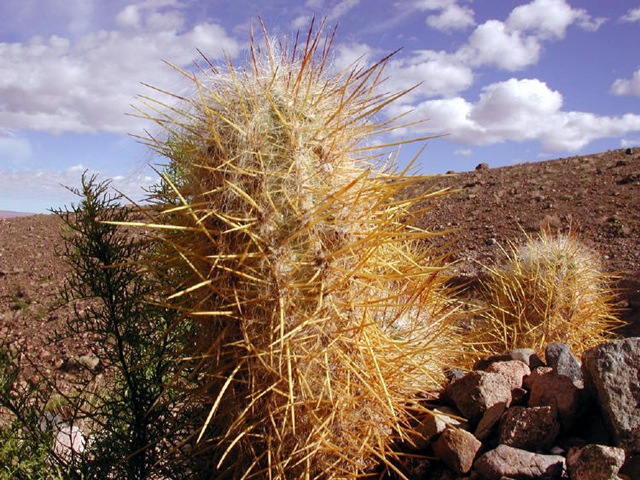
  • (S044) Oreocereus leucotrichus.

It was all a bit rushed, we had allowed ourselves until 11:00 am to take a look at these high altitude habitats before returning to Antofagasta at sea level, where we arrived in good time and found accommodation opposite, but not at one of the best hotels in town. In fact our accommodation could best be described as rather basic.

S044_01

S044: Oreocereus leucotrichus along the track to El Tatio

Saturday 19 May 2001 – San Pedro de Atacama

Once again, full credit to Leo for his persistence and ability to motivate various Chileans to go far beyond the call of duty.  The clutch was fixed (again a long story) while John, Marlon and I did ‘the tourist thing’ and went shopping for souvenirs.

It was interesting to see how many cactus souvenirs were on offer – that’s to say, souvenirs made out of cactus wood. I can appreciate that people use local natural materials to build their houses etc, but felt uneasy about buying these souvenirs when the conservation of cacti & succulents is such a hot discussion topic in the hobby.

The cactus supplying the material is Echinopsis (Trichocereus) atacamensis, or perhaps Echinopsis pasacana, as the wood is usually imported from Bolivia these days as local supplies are running low.

The main event of the day was John Ede being embraced by a hairy hippy smelling of alcohol, right in the middle of a crowded street. John was wearing the red strip of his favourite football (soccer) team: Liverpool FC as today was FA (Football Association) Cup day and Liverpool were playing in the final. His new friend turned out to be a scouser (native of Liverpool) who had settled (or had got stuck in?) San Pedro and had been following the game on the radio. Liverpool had just won the cup, which at least explained why John joined in with the strange dance in the middle of the road and then treated Marlon and I to a drink.

So, no cactus habitat stops today, but what a lot to look forward too!

Friday 18 May 2001 – Tocopilla to San Pedro de Atacama

We all felt a bit down after the lack of cacti on the previous two days and a night in a no-star hotel.

Progress  had been faster than anticipated, as we had not needed the ‘reserve’ days that we had built into our plans.  We could travel further north (through even drier areas) and look for Eriosyce laui, but instead decided on a ‘tourist’ excursion to San Pedro de Atacama, high up in the Andes and close to the Argentinean and Bolivian borders

We had a beautiful day travelling through some breath taking scenery with a small number of scenery stops, but only one cactus stop (S040) for large cushions of Cumulopuntia sp. S040a  at Valle de la Luna, just before San Pedro de Atacama presented a fascinating scenery of salt sculptures with snow-capped volcanoes as a back drop, but no cacti.

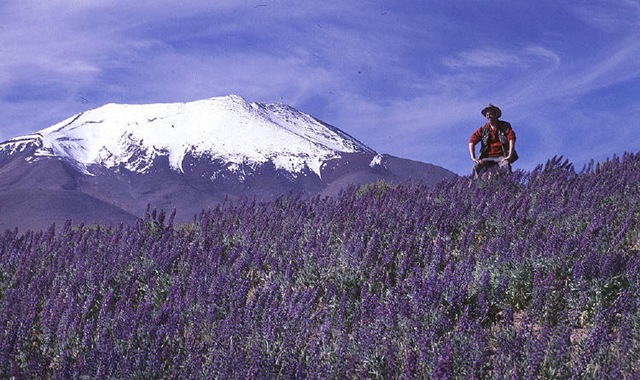
It did not take long to find and book into accommodation on the outskirts of San Pedro de Atacama and with plenty of daylight hours left, headed in the direction of the Bolivian / Argentinean border, climbing higher and higher. Marlon spotted some llama crossing the road ahead of us and Leo found a place to pull up to see if we could capture on film. As we crossed the low ridge over which they had disappeared, we were confronted by a completely unexpected view – a field of blue lupines with the 5,916m high Volcán Licancábur dominating the landscape against a clear blue sky. The llamas had disappeared, but who cares with a photographic subject like that? (S041)

We were still out breath (even walking across the road is a very tiring experience at 4,113 m altitude) as we drove off to find a suitable place to turn around and head back for San Pedro. As Leo completed the turn at 4,152 m altitude there was a bang from underneath the car and Marlon and I recognized the familiar smell of a burnt out clutch (the same thing had occurred during our 1999 trip through Brazil).

How we got off the hill (with snow forecast that night) and had the car fixed would take too long to tell.  Catch me at the bar at a cactus convention and I’ll tell you the story!

All’s well that ends well, although I can’t help but think what might have happened if the clutch had burned out a day earlier, on the way down from the Mantos de la Luna.

s041_042s

S041 Not cacti, but a field of wild Lupines in flower, close to heaven (well, 4,500 m)

Thursday 17 May 2001 – Mejillones to Tocopilla

We left the cabanas at  Mejillones and headed north for Tocopilla along Ruta 1, the coast road.  Dead plants continued to dominate the scenery (S038).  Of course, in this climate, it may be several years before dead plant material is recycled by nature so that the large number of dead plants may have occurred over many years, no doubt caused by droughts which have not permitted the population’s regeneration, as seedlings are unable to build up sufficient biomass following germination during the rare rain events, to survive the next drought.

At Michilla, we stopped at a refreshment stand  – a bright red metal structure with the words ‘Coca Cola’ emblazoned on it – along Route 1 for a cup of coffee.  ‘When did it last rain?’ we enquired from the lady running the stall. ‘That’s easy’ she explained, ‘it rained for 1 hour on 1 June 2000, my 45th birthday.’ Brilliant! Nearly a year without rain – that’s dry! ‘When was the last time before that?’ asked Leo. The lady looked puzzled and said: ‘That was the only rainfall that I have seen in my life.’  No wonder that there is no visible flora to speak of!

A tip from others suggested that we might find cacti (Copiapoa tocopillana) growing at a mine, high on the coastal hills, south of Tocopilla, the Mantos de la Luna.  We followed a massive truck up the single track unpaved road from sea level to the many small mines at the top of the hill (S039), but dead Eulychnia were the only sign of vegetation we found. The track was just wide enough for the huge lorries that snaked their way up the mountain. Occasionally, it seemed a lorry had lost its way, or that the road had just slipped away from the mountain side, indicated by a straight line down, with a lorry wreck at the bottom.

The sensible thing seemed to be to follow one of these truck monsters up the hill – after all, if it met another coming down, the experienced drivers would know a solution that we could equally apply with our much smaller pick-up. We need not have worried. It seems that there was an informal variable one way system with trucks travelling up hill in the morning, only to make the down hill journey in the afternoon. If we had known, we need not have driven for an hour in the dust of our ‘guide’. We drove through the cloud layer that hung at between 600 and 800 m and finally arrived at the top – an altitude of 1,142 m. The gaps between the clouds revealed some spectacular views of the Pacific Ocean coast line.

So, where was Copiapoa tocopillana? This is the most northern Copiapoa, as well as one of the least attractive and most difficult to find. We stared over the huge flat area inland – it seemed that the hill had been much higher once and was being systematically grinded down and presumably used for road building. What chance would a small cactus have here? And where should we start our search for the needle in the haystack? Time approached 2 p.m. – the time that the lorries would start their downward convoy. ‘Do you want to go first?’ came the question? ‘Yes please!’ was our reply – we had seen enough dead plants and lifeless scenery.

Our mood did not improve greatly when we arrived at Tocopilla, a poor and dirty town. We made for Hotel Casablanca that was recommended in the previous year’s Lonely Planet guide. What a difference a year makes! There was a pile of lorry tyres in what used to be the restaurant area. The locks on the doors of our rooms did not work and we felt that we did not want to risk our camera equipment being stolen, so lugged it with us as we found a Chinese restaurant for our evening meal. As we returned to the hotel at sunset, hundreds of vultures had taken up residence in the radio masts behind the hotel. Did they know something that we didn’t?

Wednesday 16 May 2001 – Caldera to Mejillones

We left Caldera for a drive of some 500 km to Antofagasta. We would pass many interesting cactus locations (Pan de Azucar, Esmeralda, Cifuncho, Taltal, Paposo) but forced ourselves to keep Leo’s foot on the accelerator pedal to ‘eat the miles’ on the Pan Americana – we would come back this way again on our way back to Santiago in a few weeks time, this time in the company of Attila Kapitany and Rudolf Schulz whose previous field work in the area would help us to drive up to the best locations without the hit and miss need for hour long searches.

North of Barquito, we stopped on a shale outcrop to look for Copiapoa barquitensis (S037) – our inexperience still showing: expecting to find the plant just because we were near the town after which it was named.  It actually grows in the hills behind the village and not right alongside Ruta 5! 

After Chañaral, Ruta 5 turns east before turning north again, some 30 km inland and now protected from sea fogs by the coastal hills that are the Pan de Azucar National Park.  We are now in the true Atacama Desert and can only be amazed at the landscape – no plants to be seen anywhere as we speed though the landscape at 100 k.p.h. – and can only guess how dry the climate here must be. So the signs along the road, urging drivers to switch on their main headlights in case of fog, look strangely out of place. It seemed impossible that fog could penetrate this far inland and there was no visible flora to suggest that it ever had in living memory.

We took the Antofagasta exit off Ruta 5 and, as there were still a few hours of daylight left, decided to find the coast road (Ruta 1) north. We took the exit to Juan Lopez on the Peninsula de Mejillones to find the Morro Moreno, the type locality of Copiapoa atacamensis. Sometimes, luck is on your side and you simply wind down the car window to take pictures of the plants you are looking for, as for example on Morro Copiapó where we found Copiapoa marginata. Not so in this case. The Morro was much bigger than the map suggested and much less accessible than M. Copiapó. Day light was now failing fast so we made for the town of Mejillones, north of the peninsula and found a holiday bungalow camp, deserted for winter. We had our pick of the cabañas and enjoyed a good night’s rest.

Tuesday 15 May 2001 – Copiapó to Caldera

Our first stop of the day was at Paipote, where we hoped to find Copiapoa megarhiza. The information we had was to look for ‘the granite hill in front of the mine’.  No one told us there were some 18 mines in and around Paipote and that at least half the hills are granite in origin! We searched one such location (S033) before realising that this was ‘one of many’ and found nothing.

We tried again a bit further along (S034) but again do not find any Copiapoa, unless we misidentified the few Eriosyce (Neoporteria) sp. plants (balls of spines are hard to ID) and the omnipresent Cumulopuntia sphaerica. We had planned to explore the area in detail, but soon concluded that a day would not be enough with the information that we had and that the area just did not look promising for any cactus discoveries and so returned to Copiapó before midday to collect our luggage from the hotel and travel on. This showed up our inexperience in the field – later during this trip and again in 2003 we found cacti in the most unlikely places. Yes, it is certainly possible to recognise likely locations from a distance, but never write off an area that looks less likely to accommodate cacti unless time pushes you on.

We travelled on to Bahia Inglesa (S035), the home of Copiapoa marginata with plants growing on the cliffs right at the sea’s edge. This is an important location in ‘Copiapoalogy’ as it is the neotype locality of the type species of the genus. Despite its significance, we were still deflated by our failure to find C. megarhiza so were happy to just take a few pictures as soon as we found the first C. marginata, and of the pelicans fishing from some off shore rocks, before moving on again to Caldera.. Some 20 km north of Caldera, (S036), we stopped to watch and photograph the sunset over the Pacific Ocean.  We all have the hope to take the ultimate ‘end-of-talk’ slide: a sunset over the Pacific with a Copiapoa, or at least a cactus, silhouetted against the sun.

Unfortunately, the clouds disappeared from the sky before the sun reached the horizon and the cacti failed to cooperate by staying just a little too far from the sea to allow us to compose the classic cactus shot.

We spent the night in Caldera, but, as I finally write up my notes two years later, my memory has let me down badly – I have no recollection of where we stayed and when we returned to the town in 2003 I had no recollection of having been here before. Had it not been for my brief notes taken on 15 May 2001, I would have said that I had never been here before. Why do I labour the point? Because some very important literature (Ritter’s Kakteen in Südamerika) was written many years after the author had made his original observations.  I’m not trying to distract from Ritter’s excellent mammoth work, but merely point to the fact that human memory often benefits from being supported by quite detailed notes and pictures – I hope that Ritter had both.

Monday 14 May 2001 – Vallenar to Copiapó

The previous day we had missed the Huasco Valley west of Vallenar, so the town of Huasco was the first goal today.  We stopped  at Punta Huasco (S024), where the railway, which is used to transport coal and ore from the mines, stops and their cargo is transferred onto ships.  The whole area, including the hill immediate inland from the loading dock, is pitch black, covered by a thick layer of coal dust.  Still we were there, so we might as well search for cacti in this unlikely place.

We were very pleasantly surprised to find Copiapoa fiedleriana, Eriosyce (Horridocactus) crispa and napina looking very healthy and Eulychnia iquiquensis looking as though life was perhaps more of a struggle, despite their black appearance. Their colour was purely due to the coal dust, as a wash revealed a greener epidermis. We would still refer to the small button-like Eriosyce by their ‘old name’ of Thelocephala. Within our small party, we all knew what we meant and we also realised that they were now members of the much larger and variable in size genus Eriosyce but for us the old name served as a useful handle. I can always refer to a brief summary of the current concept of the genus when I’m writing. They were incredibly difficult to find, if you were looking for them (none were in flower), but were easier if you accidentally stumbled across one, while taking a picture of another plant low down, or when I dropped my lighter and found  

A little further inland, between Bellavista and Huasco Bajo (S025) we found similar plants, but this time without their black covering. The Thelocephala also looked ‘different’ – something to check out later, when we had seen more plants. I now believe these to be either Eriosyce (Horridocactus) odieri or E. napina var duripulpa.

At Huasco Bajo we spent some time looking for the bridge over the Rio Huasco to the coastal track that leads to Carrizal Bajo. Yes, we got lost, most cactus tourists do as the local population seemed quite used to explaining how to get back on to ‘the cactus route’. We were keen to see more plants, but were disappointed at our next stop (S026) where we found nothing of any (cactoid) interest. I only took two digital images to record some of the scenery.

And so we drove on to the area marked on our 1:100,000 map as Llano los Hornicos, still south of  Agua de Luna for S027. Here we had more luck, finding Eulychnia iquiquensis, Eriosyce sp. and, according to my notes, Copiapoa fiedleriana. I say ‘according to my notes’ because as, two years later, I peruse my slides, there are none of Copiapoa for this stop. In the field in 2001, we were often so excited and busy taking pictures, quickly scribbling notes as the car pulled off, that matching slides to pictures back in the UK, only a month (but many more cactus stops) later was quite a challenge. I resolved at the time not to make the same mistake again and now rely on a digital camera to ensure that the first digital image at a stop is of a small card showing the stop number or of the GPS receiver, showing the latitude and longitude which is written in my note book before other pictures are taken. When my SLR camera comes out to take some shots on slide film, the same shot is also taken on my digital camera, so that sorting the slides should be a simple matter of comparing slides against digital images that are electronically sorted in time/date order. It also saves the time consuming task of scanning in all the slides later, as I find searching through scanned slides on my monitor more convenient than holding individual slides up against the light or on a light box when preparing talks.

We passed the sign for Agua de Luna (which is not actually shown on our maps) and stopped (S028) to find Copiapoa echinoides, C. fiedleriana, Eriosyce (Horridocactus) odieri.  Names on maps (that were printed in 1967 using aerial photographs taken in 1954!) do not always tie in to names on road signs found today. Also, roads may have ‘moved’ from the original track to a better asphalt road that takes a more direct line between villages.

Our next stop (S029) was near Caleta Angusta (according to the sign posts) or inland from Punta Agua de Patillo (according to the map – the road has moved closer to the coast since the map was drawn). What beautiful plants (Copiapoa dealbata our first ‘white’ Copiapoas) but what an awful location: the local rubbish tip, where the plants grew between disposable nappies, empty bottles and other non-degradable waste. Still, we took some great pictures, carefully angling the shots to capture the plants and not too much background, although some shots to illustrate the setting were also essential.  

A little further (S030) was much better – a small gully providing the perfect setting for large clumps of C. dealbata ideal for a group picture (and again in 2003 –  S200 and 2004 – S307) with many crested plants as well as much smaller, often single headed densely spined Copiapoa (echinata?) and C. echinoides. It was difficult to know which way to point the camera first and how many rolls of film / flash cards to fill.

We forced ourselves to drive on and arrived at the small village of Carrizal Bajo. From here we had a choice – drive north, as the coastal track passed through a (then) dried up river bed (but see 3 June 2001) or turn east (according to our more up to date Turistel high level map, a better road), and head for Ruta 5 for a reasonably quick return to Vallenar. We chose the latter, following the Quebrada Carrizal stopping (S031) to take some more shots of C. dealbata to the right of the road and again (S032) as a ‘different’ Copiapoa had joined C. dealbata, but what name should we give it? It had features of C. echinoides but more elongated stems than the plants that we had identified as such earlier. There was some resemblance with C. marginata as well. Perhaps there was some sense behind my statement that Copiapoa are just one highly variable species. (This statement was made to prompt some reaction from those more experienced than I, but does not seem to go away.).

Sunday 13 May 2001 – Vallenar and the Rio Huasco Valley

Today we planned to see how far inland we could find Copiapoa in the Huasco Valley, to see what other cacti we would find and to enjoy the scenery as once again we would drive to the foothills of the Andes.

We made our first stop of the day (S017) near the Embalse Santa Juana, another dam in the river that had created a large artificial lake inland from which the valley could be irrigated and developed for agriculture, a scenario that we had previously seen in the Rio Elqui Valley. No doubt many cacti that had grown here were now at the bottom of the lake. On the steep hillsides alongside the river we found Copiapoa coquimbana (C. vallenarensis?), Cumulopuntia sphaerica, Eulychnia sp. Echinopsis (Trichocereus) sp. and at least two taxa of Eriosyce (Neoporteria) – or was it just one highly variable species?

Further along (S018), now at an altitude (measured by GPS) of 667 m, we could not find any Copiapoa but instead found Eriosyce aurata, unmistakably as it showed of its woolly fruits, plus all the other cacti reported from the previous stop. The hillsides were especially crumbly and dangerous to climb, probably due to the recent road building work.

And so, on to El Maiten (S019), where Leo, (un)suitably dressed in shorts and T shirt once again became the mountaineer, risking life and limb to take a picture of  another Copiapoa coquimbana growing high on the cliff face. We didn’t really mind, except that he had the car keys in his pocket! We busied ourselves in the mean time with taking some pictures of the few Copiapoa coquimbana and Eriosyce (Neoporteria) sp. plants that grew right along the side of the road, with rocks tumbling down the hillside, dislodged by Leo’s climbing efforts, posing the only real danger. These were perhaps the highest altitude (880 m) and furthest inland occurring Copiapoa in this valley.

We christened the next stop (S020) the ‘Cow Stop’ as a small herd of eight Friesians came up the track, lead by a gaucho on horseback, with the tail enders being round up by another horse-mounted shepherd: a young girl who could not have been more than 7 years of age.

The road continued to climb until at 1,146 m (S021) Leo spotted an Eriosyce aurata growing fairly high on the cliff face above the road. This too was a bit worrying, because we had hoped that, as the driver, his eyes would be more focussed on the road – never mind. We all had a go at scrambling up the loose shale, often it was a case of ‘two steps forward, three steps back’ so again we had to be content of taking pictures of Leo taking pictures of the Eriosyce.

We made two more stops (S022 and S023), eventually reaching 1,620 m above sea level, but there were no cacti to be found within view of where we parked the car. The scenery offered plenty of picture material, before we turned the car round and headed back to Vallenar.

Saturday 12 May 2001 – Guanaqueros to Vallenar

We started the day by filling up the fuel tank – petrol stations are a lot more difficult to find than we are used to in Europe and become less frequent as we drive into the less densely populated northern part of the country. Petrol prices increase as stations become less frequent as the distribution costs so far north are argued to be greater. Most modern Chilean roadmaps have petrol stations clearly marked on them and it is wise to fill the tank when the fuel gauge still reads half full.

First cactus stop of the day (S010) was along Ruta 5 near Los Hornos, where most of the Copiapoa, Echinopsis (Trichocereus) and Eulychnia had seen better days, with many of the plants dead.

The ‘different’ cactus that we spotted from the car and persuaded us to stop (S011) proved to be Miqueliopuntia miquelii, as we had our first experience of the camanchaca, the coastal fog phenomenon for which the Atacama Desert is renowned. It was a strange experience at 9:30 in the morning to see a wall of fog come quickly towards us, envelop us, before disappearing as quickly as it had come, leaving our clothes slightly damp to the touch and water droplets hang from the spines of the Eulychnia – a strange experience in a place where the scenery told you that moisture was a precious commodity.

After another stretch of Ruta 5, we turned east, south of El Trapiche, onto a track leading east (S012). Here we found a much more varied selection of cacti: Copiapoa coquimbana (Ritter’s var. domeykoensis?), Cumulopuntia sphaerica, Eulychnia sp. and Eriosyce (Neoporteria) sp. as well as Oxalis gigantea. Doing his usual mountain goat impersonation, Leo reported some crested plants growing on top of the hill. Beyond this stop, the road climbed until some 10 km further the ceroids disappeared from the scenery. The road climbed to 1,250 m altitude, providing spectacular views of the snow capped Andes in the distance.

Our next stop (S013), with the GPS indicating an altitude of 1,150 m was disappointing with just some Cumulopuntia sphaerica growing beneath shrubs. Back onto Ruta 5 and heading north we pulled into the village of Domeyko to top up our coffee and bananas supplies and on again until we turned west at the turning to Caleta Carrizal. The scenery at S014 again indicated how dry it was and had been for a very long time, with Eulychnia, Cumulopuntia and Miqueliopuntia as well as Copiapoa sp. looking better than the landscape might suggest.. Again, our mountain goat – this time with Marlon in his slip stream – reported some Eriosyce (Neoporteria) growing at the top of the hill. Given ourlocation, we concluded that we were still looking at forms of Copiapoa coquimbana but some of the flowers showed more than just a hint of red. Was this Copiapoa rubriflora? No, because this was reported by Ritter from just south of Taltal and is now regarded as belonging to Copiapoa rupestris. So, is the epithet rubriflora perhaps appropriate for more than one Copiapoa taxon?

From here the road descended to about 400 m altitude, where, at S015 we found more Copiapoa, presumably still C. coquimbana although looking back at the pictures now (2003, after my second trip to Copiapoa Country), I wonder if there is more than a hint of C. megarhiza in these plants. Two crested stems were dully photographed by all and we observed that the parasitic Tristerix aphyllus here was also ‘feasting’ on the Copiapoa and Miqueliopuntia.

I still find cacti growing with an ocean as back ground a fascinating sight – such a contradiction between the dry and the wet! So our next stop (S016) near Carrizalillo seemed to promise a real treat. But was it Copiapoa coquimbana, C. echinoides, C. megarhiza or C. carrizalensis that we were looking at? The geography would suggest C. coquimbana, but once again towards the edge of a taxon’s supposed distribution area, its features can blend into those of its neighbours. The plants were growing at the base of a low – some 30 m. high – ridge to the east (inland) from the road. The sun was getting low to the west, so it was almost impossible to take any cactus & ocean pictures, especially as the east facing sides of the clumps were also the most marked and least attractive. Never mind, there would be other opportunities and we had to move on to get to Vallenar for the night.