Just another WordPress.com site

Archive for May, 2001

Friday 11 May 2001 – Guanaqueros: Into the Elqui Valley

The Elqui Valley, along with the Huasco and Copiapó valleys, are important agricultural islands in an otherwise barren landscape. We were treated to an ever changing flora as we drove from the coast up into the foothills of the Andes where snow topped hills form part of the scenery.

Irrigation has created oases where vineyards make an important contribution to Chilean wine production.

From La Serena, we followed Route 41 along the south side of the Rio Elqui, persuading a restaurant at Las Rojas to open for breakfast before making our first cactus stop (S005) at a viewpoint car park past the Embalse Puclaro, a dam to control the flow of water in the river, creating an upstream lake.  It was the view of the dam that prompted the stop, but any stop presents a photo opportunity for the resident cacti, and we’re not disappointed. We spotted our first Copiapoa! One of the many forms of C. coquimbana. This is a very complicated taxon to classify. On the one hand we saw many local forms that were quite different from each other and yet seemed to us to share a great number of common features. As a result, many species have been described only to be submerged into the earliest named taxon: C. coquimbana. The current thinking seems to support the classification of these green bodied Copiapoa from south of the Huasco river as belonging to one large complex, for now conveniently at species rank

A ‘No Entry’ sign on the entrance to an unpaved track leading to a mine seemed to present an invitation to take a closer look at the cactus flora (S006).   A fortunate opportunity, as in 2003 we found this entrance fenced off, leaving us pessimistic about the well being of the plants that we were able to see this time round.

As the road climbed higher and higher, we drove through the village of Monte Grande, with a charming church and a monument for the poet Gabriela Mistral – the perfect location for a lunch time coffee stop before we drove on to Pisco Elqui, a small village which lends its name to the famous Chilean alcoholic cocktail.  This was the highest place on today’s trip – having started at sea level in the morning we were now at 1,320 m. with mountains of 3,000 m. plus around us.

On the way back, we made another stop once the Trichocerei reappeared on the scene (S007) at 970 m. and were surprised to find a ‘cactus nursery’ in Vicuña, indicating that the cactus hobby is alive and well in Chile, with scope for a National Cactus & Succulent Society to discuss and provide guidance on the issue of conservation of the endemic cactus flora.  Metal food tins and plastic coffee cups were used as containers for the local cacti offered for sale.

We made another stop near the Puclaro Dam (S008) before returning to our accommodation for the night at Guanaqueros.  Travelling out of the main tourist season has the benefit that lodgings, such as those at Cabañas Bahia Club, are very reasonably priced and are open to some negotiation – full marks to Leo, our chief negotiator.

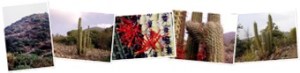
Thursday 10 May 2001 – Caleu to Guanaqueros

Today we started our journey to ‘Copiapoa Country’, aiming to get to the Parque Nacional Fray Jorge, traditionally regarded as the southern limit of genus Copiapoa, although the furthest southern occurrence reported is probably Ritter’s FR 504 (C. pendulina) from Puente Teniente, some 40 km further south.   

Ruta 5, the Pan Americana (Pan American Highway) provides a fast and smooth alternative for our journey north (and later back south again) to Ruta 1, the coast road which in places is little more than a badly maintained dirt track.

North of La Ligua, the road turns to to North West until it meets the Pacific Ocean at Caleta Pichicuy.  We passed Los Molles, Pichidangui (visited on the way home, S107) and decided to stretch our legs at an emerging summer residence village at Punta Totoralillo – S002, where local fishermen have changed their occupation to offering boat trips along the coast.

After a petrol stop at Los Vilos, we made another leg-stretch break at Caleta Chigualoco, but other than hillsides full of Trichocereus, found nothing of interest to the cactus tourist.

North of Caleta Teniente, the Pan Americana turns back inland and crosses the Rio Limari, which, nearer the coast, forms the southern border of the Fray Jorge National Park.

Finally we saw the signpost west and followed the 18 km of good unpaved road to the entrance of the Park, making an unscheduled stop, S003 just before the entrance. There is no reason why all nice cacti should grow inside the boundary of the Fray Jorge National Park!  So when Marlon spotted a bright red fruit on a Eulychnia acida, the time was right for a stroll along the road.to examine these plants and the much smaller Cumulopuntia sphaerica with its bright flowers. There are two species of Echinopsis (Trichocereus) species: E. chiloensis and E. skottsbergii, but to this date I have difficulty in deciding which is which.

Cumulopuntia sphaerica (that we carried on calling Tephrocactus berterii) was probably the most widely distributed cactus that we encountered although there were only few occasions when it seemed worthy of having its picture taken – usually it was dehydrated and covered in dust. As a result, we often omitted to report it in our stop list, so it is mentioned only if it can be spotted in pictures taken at that stop.

The surprise of this stop was Eriosyce aurata fa. sandillon – a  rather rare and difficult plant in UK cultivation. Because of this reputation, we somehow had expected that it would also be difficult to find and rare, but this was not the case. Groups of five to ten plants, growing a meter (c. 3 ft) apart could easily be found.

Unfortunately, National Parks in Chile only open at the weekend out of the main holiday season, so when we arrived at the gate on Friday afternoon, we found the gate locked.  Not deterred, we went back towards Ruta 5 for another look along the road side, S004, near our previous stop. Here we found other groups of Eriosyce aurata, with large woolly fruits.

We admired the large stands of Eulychnia that looked in remarkable good health compared to the stands that we were to see later during the trip.

Only a few minutes before the stop, we asked ourselves if we should be careful about snakes in this area. Somehow we concluded that there were no snakes in Chile.  Ironically, I stumbled across a snake soon afterwards, sunning itself in the afternoon sun.  It only waited long enough for me to take its picture before racing off into the bushes.  Was it poisonous? I’ll never know.

We found another Eriosyce but a different taxon with glabrous fruit, as well as another species (below: Copiapoa or Eriosyce s.l.?) 

Our reason for visiting Fray Jorge was to see the most southern Copiapoa that grow in the park.  Unfortunately we believe that we did not find these plants.  Plans to return on the Sunday before our flight back home did not come to fruition – there is only so much that can be fitted into a four week trip.

We continued north on Ruta 5 until it seemed sensible to look for accommodation, which happened to be in the seaside village of Guanaqueros, where for 20,000 pesos (about £25) we found room at Cabaña Bahia Club for four of us. All in all it had been a great way for me to spend my birthday, finished off with an excellent sea food meal at the local restaurant, washed down with Chilean red wine.

S003_03

S003: Cumulopuntia sphaerica (syn. Tephrocactus berteri)

Wednesday 9 May 2001 – Santiago to Caleu

John Ede and I enjoyed an uneventful Lufthansa flight from London, via Frankfurt, to Buenos Aires, where Leo van der Hoeven joined us.

The last leg, Buenos Aires, Argentina – Santiago, Chile took us over the Andes, with some spectacular views over the snow capped peaks, arriving safely at Santiago Airport where we were met by the representative of our car rental firm. Fortunately, Leo is fluent in Spanish, down to the arm and leg movements that to us northern Europeans are a little unusual.

We had rented a Nissan double cabin pick-up truck and this rather squashed vehicle was to be our home for the journey. With my long legs, I found the back seat particularly tight – still, a good excuse for frequent stops to stretch our legs, look for plants and take pictures.  I exposed 30 rolls of 36 exposure slide film – 1080 slides in all – and took another 2,000 plus digital images using a Nikon Coolpix 990 that I was privileged to have on loan from Nikon.

Again, without incident, we drove north along Ruta 5 to Rungue and then followed a track to Calue. We found the El Parador cabañas, run by a Chilean who was born in Belgium and who had lived in Birmingham, England for some 3 years before returning home. Here we met up with the 4th member of our ‘car party’, Marlon Machado from Salvador, Brazil, who had flown in the previous day and had been picked up at the airport by the owner of the cabañas.

Our first stop, (S001) covers an area of c. 5 km radius around the hotel where we found Neoporteria curvispina, Echinopsis (Trichocereus) chiloensis and Cumulopuntia sphaerica. The lush green hillsides around the cabañas at Hotel El Parador, some 60 km north of Santiago Airport, west of the Pan America Highway (Route 5), presents the perfect opportunity to stretch our legs and see our first cacti in their Chilean habitat.

Before long, Marlon was taking pictures of a globular cactus:  Eriosyce (Neoporteria) curvispina var. curvispina (Bertero ex Colla) Kattermann

The low shrubs provide ideal nursery bushes for a ceroid: Echinopsis (Trichocereus) chiloensis (Colla) Friedrich & Rowley. First described as Cactus chiloensis by Colla in 1826.  The name ‘chiloensis’, meaning from the Isla Chiloe, is incorrect and has been corrected by some authors to ‘chilensis’ (from Chile), but according to the rules of botanic nomenclature, the original spelling must stand. Friedrich Ritter lists 5 varieties of this variable species. The form common in this area is short spined and was given the name varietal name conjungens by Ritter.

Although lichens are common features growing on other vegetation, the bright coloured growth found growing on the stems are actually the flowers and fruits of a parasite: Tristerix (Phnygilanthus) aphyllus.  These parasites have a sweet taste and are the favourite food of guanaco – the ‘sheep’ of the Andes.


Tuesday 8 May 2001 – England to Santiago de Chile

INTRODUCTION

In August 2000, Rudolf Schulz spent a week with me, visiting UK cactus nurseries and collections.  As his departure for Australia drew nearer, he suggested that we’d meet up again, in May 2001 – in Taltal, Chile!

We agreed that I would make up a car full of fellow enthusiasts and would play ‘tag-along’ with Rudolf, Attila Kapitany and his wife Michelle and other ‘car parties’ that would make up Copiapoathon 2001. It did not take much effort to fill the three remaining seats in my car – John Ede (England), Marlon Machado (Salvador, Brazil) and Leo van der Hoeven (Netherlands), jumped at the chance.

00team

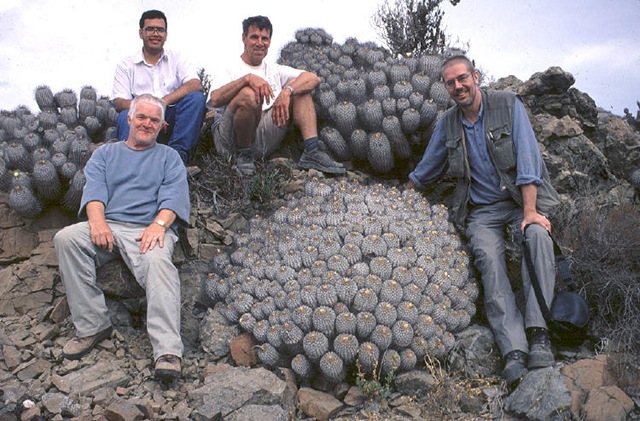
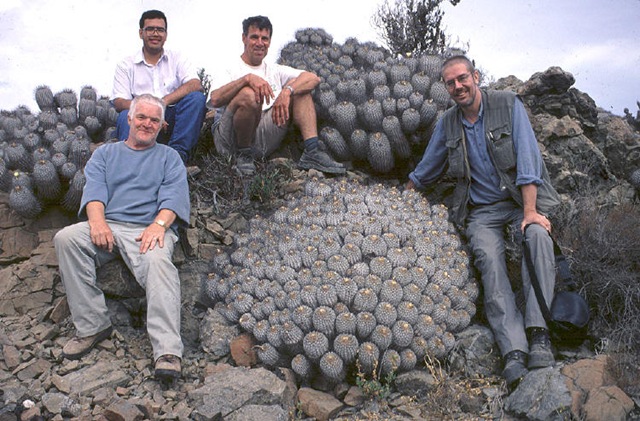
The 2001 Copiapoathon Party:
Top: Marlon Machado and Leo van der Hoeven
Bottom: John Ede and Paul Klaassen

The Copiapoathon ‘proper’ took place in Taltal, where we met up with other groups for a number of joint excursions during the day and interesting discussions over bottles of wine and fine food in the evening.

00party

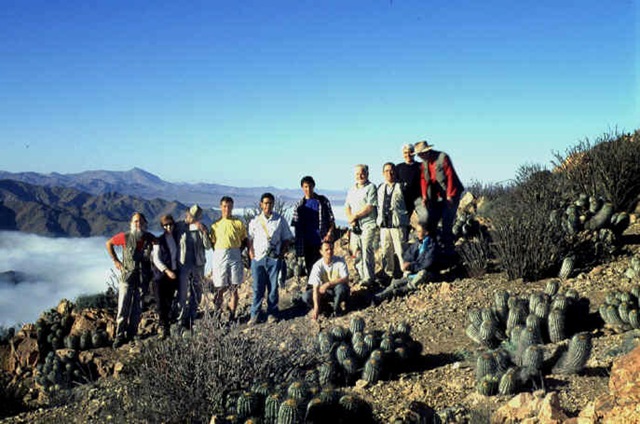
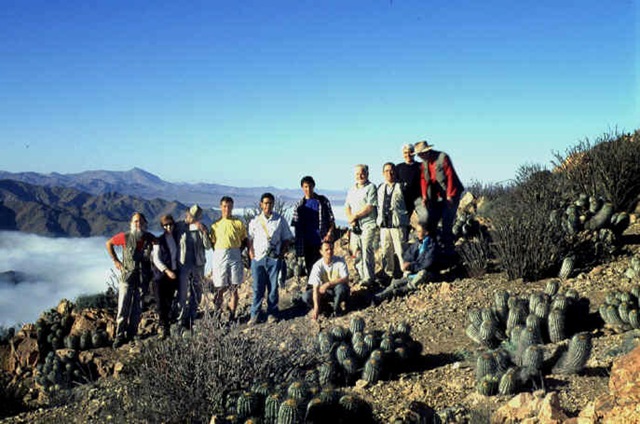
The Copiapoathoners:
left to right: Rudolf Schulz, Michele and Attila Kapitany, Leo van der Hoeven, Marlon Machado, Benjy Oliver,
Mark Aston, John Ede, Gustavo Valdes, Arturo Kirberg, Raquel Pinto (seated) and Paul Klaassen
posing on top of Cerro Perales among Copiapoa cinerea (fa tenebrosa)

Another Copiapoathon is already being planned and may become the first Convention of the Chilean Cactus Society which, at the time of writing, is also in its early planning stages.

This presentation consists of pages dedicated to each day of our trip (8 May to 5 June).  Each day, we made a number of ‘formal stops’ where most of the images were taken.  In time, there will be a page for each of these stops to display more images.

Tuesday 8 May 2001 – Copiapoathon 2001 Introduction

On August 2000, Rudolf Schulz spent a week with me, visiting UK cactus nurseries and collections.  As his departure for Australia drew nearer, he suggested that we’d meet up again, in May 2001 – in Taltal, Chile!

We agreed that I would make up a car full of fellow enthusiasts and would play ‘tag-along’ with Rudolf, Attila Kapitany and his wife Michelle and other ‘car parties’ that would make up Copiapoathon 2001. It did not take much effort to fill the three remaining seats in my car – John Ede (England), Marlon Machado (Salvador, Brazil) and Leo van der Hoeven (Netherlands), jumped at the chance.

00team

The 2001 Copiapoathon Party:
Top: Marlon Machado and Leo van der Hoeven
Bottom: John Ede and Paul Klaassen

The Copiapoathon ‘proper’ took place in Taltal, where we met up with other groups for a number of joint excursions during the day and interesting discussions over bottles of wine and fine food in the evening.

00party

The Copiapoathoners: left to right: Rudolf Schulz, Michele and Attila Kapitany, Leo van der Hoeven,
Marlon Machado, Benjy Oliver, Mark Aston, John Ede, Gustavo Valdes, Arturo Kirberg, Raquel Pinto (seated)
and Paul Klaassen posing on top of Cerro Perales among Copiapoa cinerea (fa tenebrosa)

Another Copiapoathon is already being planned and may become the first Convention of the Chilean Cactus Society which, at the time of writing, is also in its early planning stages.

This presentation consists of pages dedicated to each day of our trip (8 May to 5 June).  Each day, we made a number of ‘formal stops’ where most of the images were taken.  In time, there will be a page for each of these stops to display more images.