
Just another WordPress.com site

Archive for October, 2009

Wednesday, 21 October 2009 – Caçapava do Sul to Dom Predito

At the moment, I write up my notes in the morning following the Diary Date, simply because after a quick freshen up after our arrival, it is down to dinner and when we get back, I’m in deep sleep as soon as my head hits the pillow.

We had another great day cactussing, making six stops (according to Angie’s notes – mine are in the car). Again, there were a good number of first time encounters with taxa that so far I only knew ‘from captivity’ in my collection back home. 

We were due to have spent the night in Bage and arrived in good time to allow a much needed rest and start on downloading and note writing, but all hotels and motels in town turned out to be full or out of our budget. Once again (as in Chile) it turned out that a mining corporation had block booked all available rooms for a six month period. We turned down the opportunity to stay in a hotel clearly designed for an additional purpose, with cabanas providing only a double bed, rather than the two singles preferred by most blokes sharing rooms on a cactus trip. 

So it was that we decided again to drive on to the next town, Dom Predito, another 65 km along the road where our third attempt to find rooms was successful. Apart from a minor set back when Woody’s bed collapsed underneath him as he was downloading his pictures.

The complementary glasses of rum, the cocktails (similar to Pisco Sour in Chile) and ample quantities of cold beer helped to raise the spirits (excuse pun) again and to wash down the excellent food.

Oh yes, we had seen cacti as well today:

S1427: We drove along RS 357 from Caçapava do Sul towards Lavras do Sul before turning right (west) on an  unpaved road towards Santa Bárbara. After some 15 km we stopped at rock outcrops to the left of the road and found Frailea pygmaea, Gymnocalycium denudatum, Parodia (Notocactus) crassigibba, Parodia (Wigginsia) langsdorfii and P. sellowii

S1428: was farther along RS 357 and had G. denudatum and a form of F. gracillima called gigantea growing in the grass. Good job that no one cuts the grass here, or the plants would be gone.

S1429: still on RS 357 heading from Caçapava do Sul towards Lavras do Sul we stopped to see Parodia crassigibba, Parodia ottonis, Frailea pygmaea, and Parodia langsdorfii. I also managed a few shots of the ovenbird nests. These birds get their name because the nests that they build from mud look very similar to clay ovens. We had seen them before in 2005 in Argentina.

S1430 was a short, but difficult climb through low shrubs. I kept seeing Angie’s hat bopping up above the shrubbery while I had already reached a higher vantage point. We found Parodia ottonis, P. neobuenekeri, Gymnocalycium denudatum, P. sellowii, Cereus hildmannianus and Opuntia rubrogemmia

S1431 was a real treasure throve in terms of cactus taxa found in one location: Frailea gracillima,  F. pygmaea, F. horstii, Parodia langsdorfii, P. mammulosa, P. werneri (Notocactus uebelmannianus var. pleiocephalus), P. ottonis, Opuntia brunneogemmia, O. rubrogemmia,  Gymnocalycium denudatum, Echinopsis oxygona, and Cereus hildmannianus! Not bad for a single stop. Let’s hope that I can put the names to the pictures in time to come.
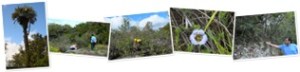
Tuesday, 20 October 2009 – around Caçapava do Sul

Our Cactus Adventures continue at a relentless pace, another ten stops today! Excellent! But with the day cramped solid from the 6 a.m. alarm on Angie’s mobile phone until I fall into bed exhausted at around 10 p.m. we’re on the go. Something has to give and that something is writing up the Diaries. Even just a list of today’s stops and a list of what we had seen would take too long. I have my images ad paper notes for that later so will keep to a few overview impressions.

I somehow managed to forget my traditional expedition hat, on the packing table at Angie’s. As I still had my pre-expedition no. 3 hair cut, the result was a red scalp and a new hat bought in the shop next door to the hotel after the damage was done.

As was the case yesterday, today’s stops were revisits of the exploration that Marlon had done before in 2005 and 2006 and again he was amazed at the changes, all due to the much more intense use of the land for forestry, agriculture and the highly efficient land clearing activities of bovine tractors (cows), sheep and goat. Many thriving habitat locations from 2005 and 2006 had their plant numbers decimated or destroyed. At the TL of Parodia (Notocactus) scopa only a few young seedlings were found.

Yesterday, those of us that managed to cram into Woody’s car (all except Cliff & I) finished the day at a P. scopa location where they found only three or four plants. On both occasions it would have been better to visit these first thing in the morning as, unlike other cacti we had found, these have a strong preference to grow on east facing slopes, i.e. in full shade by the time we got their at the end of the day.

And we continue to be surprised at what we find in some unlikely looking places. I dare say that without Marlon’s guidance we would not have stopped at many of them. The sound of water logged meadows squelching under foot is not usually associated with cactus explorations. Once we had reached the rocky outcrops the cacti appeared.

So, what did we see today? In no particular order and without checking books for the correct spelling: Frailea phaeodisca, F. gracillima ssp. horstii, Echinopsis oxygona, including one plant with its flower fully opened (an orderly queue was formed to take its picture), Parodia in the Parodia (Notocactus) crassigibba complex, including the red flowered P. uebelmannianus and its yellow flowered cousin, P. archnites, suggesting that flower colour alone is not enough to uphold different species names and Gymnocalycium denudatum.

Breakfast calls, so I’ll fill in with more detailed text and pictures at a later date.

Monday, 19 October 2009 – Canguçu to Caçapava do Sul

Still trying to get used to the hectic pace that can be part of field trips, my notes for today are abysmal. That is the great thing of being part of a group, others can help you out. So with the help of Angie via MSN chat and Marlon’s stop numbers and relevant data and with plotting these on Google Earth, I can tell you that we took road BR-392 from Santana da Boa Vista towards Canguçu, and that after some 32 km from the entrance of Santana da Boa Vista, we turned left (north) onto an unpaved road to Paredão, after 8.1 km granitic rock outcrops to the right of the road. was our first stop, S1408, providing us with pictures of Gymnocalycium horstii, Parodia ottonis nothominusculus and Frailea gracillima.

For S1409 we left the car at the same place as for S1408 but walked to a different hillside aspect where Frailea gracillima, Parodia (Wigginsia) langsdorfii (with strong central spine) and P. ottonis nothominusculus provided the cactus interest with a blueish Iris sp and small Petunia (endemic here) provided the colour.

Marlon was shocked to see what had happened here since his last visit in 2006. At the time it was obvious that the area would be cleared and planted up with trees – Eucalyptus and pine, mainly for the paper industry. It seems unlikely that the cacti can survive this change of habitat use. A great shame, but usually commercial interests outweigh plant conservation issues.

We moved some 2 km towards Santana da Boa Vista for S1410 and found two species of Eryngium, belonging to the family Apiaceae, although their appearance suggests that they are Bromeliads. Once the flower spikes are produced, things become clearer. The flowers are clustered in tight umbels, with a whorl of spiny basal bracts. Although these plants occur in Europe, their centre of diversity is in South America. I have no pictures of the P. ottonis that Marlon reports from here.

Things were a lot easier at S1411 where the raised side of the track, was covered in P. ottonis in advanced bud. In theory we only needed to wind the windows down to get the pictures, but with seven people jockeying for position, out of the car was easier.

S1412 was not for plants, but to take pictures of Cliff & Wiebe’s valiant efforts to get our Fiat Doblo up a steep part of the track. Woody had already managed this feat in the lead car, but our almost bald front tyres (on a front wheel drive car) had no chance and just spun round aimlessly. There was no other solution than to go back. Combined with a gutless engine (it became a bit better when we changed from an alcohol/petrol mix to pure petrol mix at the next fuel station). As consolation we still managed a few images of P. ottonis growing at the top of the hill where the car would not go.

Angie and I had been looking forward especially to S1413 where we again found P.ottonis, but growing alongside a new, yet to be described Frailea sp. Marlon had first come across this plant during previous trips and a picture of it appears on the back cover of one of the Cactus World journal (details to follow when I get home). Marlon had sent Angie some 20 seeds from the only fruit with ripe seed found and although there had been reasonable germination, Angie’s green fingers had failed this plant. Others who were given seedlings to graft were similarly disappointed. By Spring 2009 there was one plant left and it flowered. Angie stirred the flowers in the hope that self pollination would produce some seed and at least this was successful.

So you can imagine our excitement at seeing this plant in quite some numbers before us in habitat. It is nice to see that there are still things to be discovered and that mere mortals like ourselves can play a role in this. Quite a few plants were in flower. We should have some viable seed next year.

At S1414 we took more Frailea pictures, F. pygmaea, together with Parodia ottonis, Gymnocalycium denudatum, and Cereus hildmannianus and a variety of animal droppings for use in a future Zone Quiz. Animal grazing had taken the tops out of the Gymnocalycium and it was amazing to see how these plants had managed to generate new heads from the centre of the damaged stem. They must have a very deep meristem.

S1415 was for a tree that had a large Lepismium lumbricoides hanging from its branches.

The last stop (for Cliff & I) was S1416 for Frailea gracillima, Parodia ottonis. We again failed to negotiate a steep part of the track so Cliff & I waited by our car while Angie joined the other car to take a look at P. scopa, before returning and driving exhausted to our hotel.

Great day – again!

Sunday, 18 October 2009: Encruzijhada do Sul to Canguçu

During the night, the clocks had switched from Winter Time to Summer Time, which meant that we had to carefully set alarm clocks to be up at 6 a.m. for breakfast at 7 and on the road by 8. Our body clocks were already so confused that it really did not matter. It was light when we got up, and we were itching to and see our first cacti in habitat. We all managed except for Marlon, Woody & John, all sharing a room, firmly blaming Marlon, all in good humour.

Today we spent most of the time on good dirt roads, running parallel to BR471 making seven stops in all. I’ll stick with my S (stop) numbers, but will include Marlon’s MM numbers to enable cross referencing to his field list for names and other information.

S1400 (MM177) – Marlon pointed at the rocky out crops with the instruction:’ Go get them boys!’. Well, not really, but that’s how we felt.  In the end Marlon and Angie sat this one out as a formidable fence including barbed wire needed to be conquered. As I walked up hill through dense low forest I was reminded of a similar walk south of Mazatlan, Mexico over six months ago. Lots of lichens on the trees and rocks, mosses and the lush vegetation indicating that this place was usually quite wet. There they were: my first sight of a Frailea in habitat: Frailea gracillima. The plants were hardly the size of the top of my little finger. Why is it that small plants are often so fascinating? Other cacti included Parodia (Notocactus) ottonis and Cereus hildmannianus

Stop S1401 was a total of three clearings that Marlon had given separate numbers to on an earlier visit MM178, MM179 and MM180. The cacti were the same taxa as at the previous stop, except that the Frailea here was a nomen nudum: F. gigantea, regarded to be no more that a large form of F. gracillima. The plants were in bud and if we had waited, we would have seen one of the Frailea’s flowers open. Nice stop in very pleasant ‘not too hot, not too cold’ conditions.

Stop S1402 was very brief, caused by me exercising the right of any member of the expedition to shout ‘Stop!’ because they had seen something of interest: A reasonably sized P. ottonis with three nearly open flowers.

S1403 was Marlon’s MM181. Again, it was just a quick stop for a couple of dozen P. ottonis in full flower., near a farm house, as though they had been planted there.

S1404 (MM182) was for a Dyckia, some Tillandsias and one or two more Frailea gigantea.

S1405 (MM185) was for Parodia (Wigginsia) langsdorfii, something different again! We were seeing a good amount of cactus diversity on day 1!

S1406 (MM186) was a Marlon special, as he introduced us to Parodia gaucha, a new species that he and João F. Larocca described in 2008 (in Novon: A Journal for Botanical Nomenclature 18(2):214-219. 2008). It is an interesting plant that we could see growing / hanging on the steep rock face along the side of the road. We also found it growing alongside P. ottonis and along a plant that we referred to as a ‘dense-spined form’ of P. ottonis, that gave the impression of possibly being an intermediate form between the two. To add to the excitement, we also found anther Frailea, F. pygmaea, tiny plants, some already in bud.

We finished the day at S1407 (MM104) which had Parodia concinnus, P linkii and P. ottonis growing together.

A great day, full of promise for the rest of the trip!

Saturday 17 October 2009: London Heathrow to Encruzijhada do Sul

We landed on time at Sao Paulo Airport and should have had plenty of time to get through immigration, collect our hold luggage, clear customs and check in for our internal flight to Porto Alegre. Should have had…..! Due to the usual problems of too many passengers trying to be checked through too few desks at a leisurely pace, we missed our connecting flight. They put us on the next one out, which meant a 4 hour wait during which time we managed a Brazilian Burger King equivalent. Not cheap! But then Airport food never is.

As we waited at the Departure Gate, Cliff spotted Woody Minnich and John Senior, our travel companions from the US. At least we could be sure that Marlon and Wiebe Bosma (from the Netherlands) would be there to meet the Americans – we had been unable to contact Marlon on his mobile phone to advise our delay.

Again, flight & arrival were uneventful, Marlon and Wiebe Bosma were there to meet us and even the car pick up (we had both rented Fiat Doblos, but from two different agents) was tedious but turned out OK after we had asked our rep to free the toolkit from an back seat that had got stuck.

First impressions: Porto Alegre is a large modern city, with a significant number of tall skyscrapers on the horizon. As expected, the Airport was on the outside of town and Marlon was able to guide us out on a good dual carriage toll road (BR290) to Pantano Grande, where we turned south onto the BR 471. It was like driving on the A303 through Wiltshire in Spring! Very green and lush, with the occasional palm tree reminding us of where we were.

We arrived at Encruzijhada do Sul in the dark and soon found a good Hotel (no wifi). Excellent meal washed down with litres of Brazilian beer (Polar Export).