The last time I stayed in Guanaqueros on 27 November 2013 and before, in 2 January 2009, we visited the seaside resort of Totoralillo, the one south of Coquimbo, rather than the one north of Pichidangui, is was surprised to see the unusual hypanthium on the local Eulychnia. Was this a ‘sport’? But I also found similar plants at Playa Blanca and Tarambola.
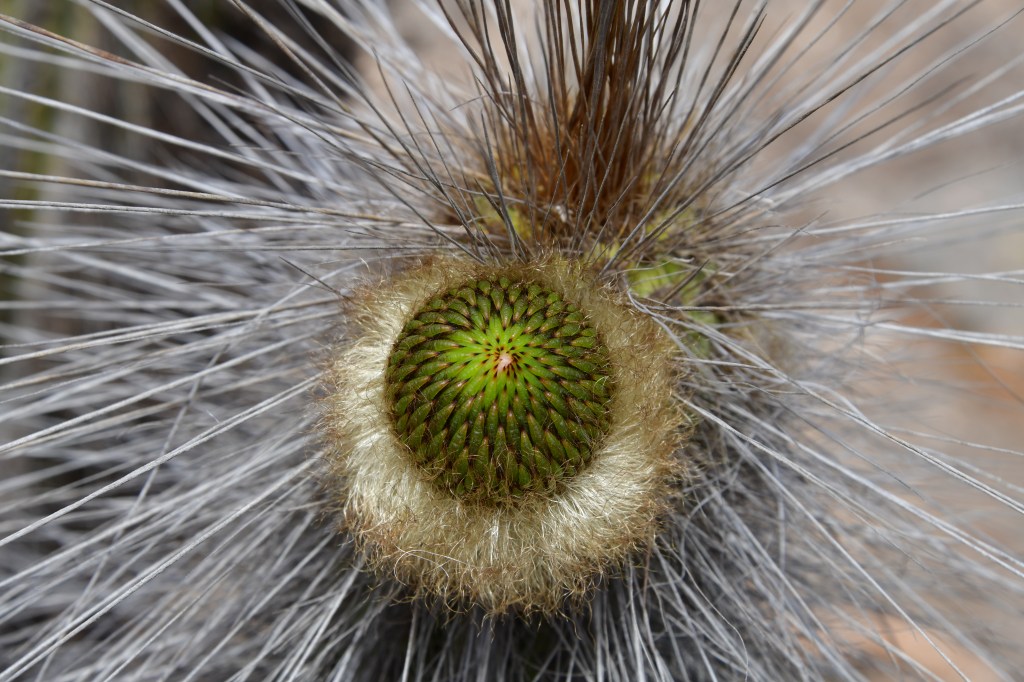
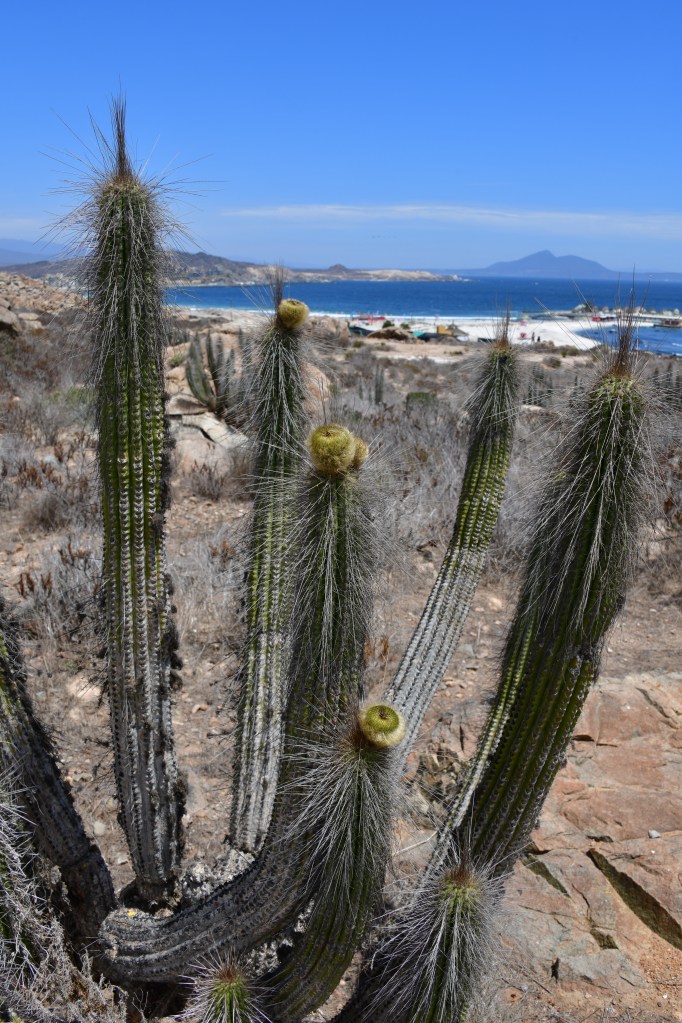
So what is so different? An important means of differentiating between different species of Eulychnia lies in their hypanthium. E. acida has a naked hypanthium, covered in scales with just small insignificant bristles emerging from between the scales . E. breviflora on the other hand is covered in long, honey coloured wool. As you can see in the images to the right, the hypanthium of the plants that grow here is a mixture of the two, with the lower part covered in long wool but the upper half of the hypanthium clearly displaying the acida-like scales.
During the 2009 visit, this phenomenon occurred on ripe fruits and the long hairs readily rubbed off. I had not seen E. breviflora fruits in such an advanced stage of ripeness. Is this what happens in all Eulychnia fruits?
But this time, the hypanthium was that of a bud, not a ripe fruit. Flowers appear at the shoulder of the stems (cf. lateral for E. acida and apical on E. breviflora).
Eulychnia hybrid acida x breviflora?Eulychnia cv April Fool’s Joke.
‘Should we start thinking of a new taxon?’ Ian and Al asked. I smiled. ‘Not until I have looked up the Latin for ‘1st April”
We went back to the cabanas so that I could roughly plan what we were going to do during the next few days. Suddenly there was a rumbling noise and the cabana began to shake. The fridge started to walk across the room. Then everything was quiet again. We had just experienced a 6.8 strength earthquake! But that is quite a regular occurrence in Chile! We saw no obvious damage – everything that was going to break, fall over or get knocked down already has!
As Angie and I had not made it to the rocky shoreline at Pichidangui, it was time to catch up after breakfast.
S3798 was the usual place to see three species of Eriosyce growing side by side: Eriosyce chilensis (in flower), E. subgibbosa (not in flower as it tends to flower around May time) and E. curvispina (in bud, with some buds bursting open) as well as Eulychnia castanea (in flower). Not bad for a first cactus stop!
We moved to the southern end of the rocky shore (S3799) where BCSS funding had contributed to publicity signs alerting visitors about the treasures that nature had liberally spread along the coast here. We met a Chilean couple on their way to church whom I recognised as local conservation fans from the pictures published when the signs were first unveiled. They were Adriana Razeto and her husband Nelson, who kindly showed us around their garden and invited us round anytime that we are in town! They had produced similar posters to inform visitors about the birds and other wildlife at the coast.
S3800 was a side trip into the Fray Jorge National Park where we saw Eriosyce aurata, Eulychnia acida, Echinopsis (Trichocereus) chiloensis and subsp. skottsbergii, Cumulopuntia sphaerica before spotting our first Copiapoa, C. coquimbana (Ritter’s C. pendulina) near the beach at El Sauces at S3801, As a bonus, many plants were in flower!
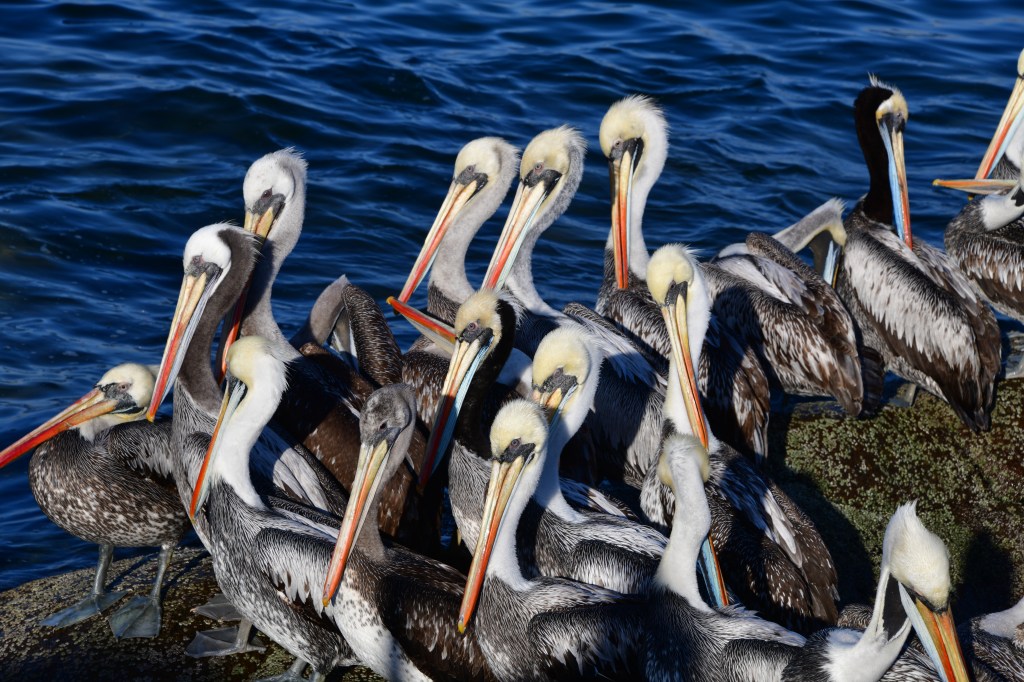
S3802 was at Guanaqueros where we enjoyed a visit to the harbour where the local airforce of pelicans were sunning themselves in the setting sun.
Peruvian Pelicans at Guanaqueros, Chile.
Our usual accommodation at Cabanas Club Bahia had no space, as this was a long Chilean Bank Holiday weekend for Halloween, with the added confusion caused by the civil protests taking place throughout Chile. No Problem – there are many cabanas etc along this stretch and at the second point of asking we found comfortable accommodation for two nights at Cabanas Mar Azul with Carlos, from Venezuela, going the extra mile to get our cabana fit for habitation. Thanks Carlos!
It was great to be in Santiago Airport again! We worked our way through the snake of people queuing for immigration, picking up our luggage and seeing Andres Gabor waiting to greet us at the exit gate. I (and many of the other European Cactus travelers) have used Andres’ company LYS Rent-a-car since 2003 (credit to Brendan Burke for recommending him after we had less success with the rental car from a different provider in 2001.)
Andres greets us and treats us to breakfast at the airport – a lot more civilized than picking up your rent-a-car at other international airports.
And so, around noon, we set off, this time without my SatNav! I had picked up the wrong one at home – the one with USA and Mexico data, rather than the South American on. So I missed the turning on Vespuchi to R5 – El Norte, but soon found a retorno to correct the matter.
From the airport, Ruta 5 – the PanAmerican Highway – runs inland heading north. Around Longotoma, some 200 km after leaving the airport, the road turns west and comes down a couple of hundred meters to the Pacific Ocean. Since 2001 it has been a tradition to burst into song as soon as we see the Ocean. First with that popular tune ‘Oh I do love to be beside the seaside’. As the waves appeared, Ian Thwaites, Al Laius, Angie and I burst into song, followed by the chorus of Cliff Richard’s hit from the 1960s ‘We’re all going on a Summer Holiday! I would have mimicked, the Hank B. Marvin guitar solo, had it not been for the fact that I was driving. *
One stop, S3797 at Los Molles, the type locality of Eulychnia castanea. Lots of new tourist development here, at the expense of the plants!
Eulychnia castanea flowering on the rocks at Los Molles.
I was not feeling too well, so we went to Hotel Rosa Nautica where after five years away I was still recognised by the elderly owners. I presume that it was her daughter who was supporting them and spoke good English. While I had a cup of chicken noodle soup and a rest, Ian and Al found the rocks on the beach and the three taxa of Eriosyce that grow there: E. curvispina, E. chilensis and E. subgibbosa. The light was past its best, but we could always go back the next day!
As a bit of padding today, I thought I’d add the complete lyrics to ‘Oh I do like to be beside the seaside’ so that Ian Woolnough’s party can follow the tradition. Ian and Al must have misunderstood as several days later they still burst out into song every time they see the sea!
Ian is considering to make this the BCSS Theme song, to be song before every UK branch meeting, or did I get that wrong!? 🙂
‘Everyone delights to spend their summer’s holiday down beside the side of the silvery sea. I’m no exception to the rule, in fact, if I’d my way, I’d reside by the side of the silvery sea.
But when you’re just a common or garden-working lad like me, a chance to see the sea is quite a novelty. I save up all the money I can while winter’s grim and grey Then off I run to have some fun where the balmy breezes play
Oh! I do like to be beside the seaside! I do like to be beside the sea! Oh I do like to stroll along the Prom, Prom, Prom! Where the brass bands play, “Tiddely-om-pom-pom!”
So just let me be beside the seaside! I’ll be beside myself with glee and there’s lots of girls beside, I should like to be beside, beside the seaside, beside the sea!
Timothy went to Blackpool for the day last Eastertide To see what he could see by the side of the sea. As soon as he reached the station there the first thing he espied Was the wine lodge door stood open invitingly Grinning to himself, he toddled inside and called out for a wine Which grew to eight or nine, till his nose began to shine. Said he ‘What people see in the sea, I’m sure I fail to see’ Then he caught the train back home again and to his wife said he
Oh! I do like to be beside the seaside! I do like to be beside the sea! Oh I do like to stroll along the Prom, Prom, Prom! Where the brass bands play, “Tiddely-om-pom-pom!”
So just let me be beside the seaside! I’ll be beside myself with glee and there’s lots of girls beside, I should like to be beside, beside the seaside, beside the sea!
William Sykes the burglar he’d been out to work one night filled his bags with jewels, cash and plate. Constable Brown felt quite surprised when William hove in sight. Said he, “The hours you’re keeping are far too late.” So he grabbed him by the collar and lodged him safe and sound in jail. Next morning looking pale, Bill told a tearful tale. The judge said, “For a couple of months I’m sending you away!” Said Bill, “How kind! Well if you don’t mind, Where I spend my holiday!”
Oh! I do like to be beside the seaside! I do like to be beside the sea! For the sun’s always shining as I make my way, And the brass bands play, “Ta-ra-ra-boom-de-ay”
So just let me be beside the seaside! I’ll be beside myself with glee and there’s lots of girls beside, I should like to be beside, beside the seaside, beside the sea! ‘
The song was written in 1907 by John A. Glover-Kind and made famous by music hall singer Mark Sheridan who first recorded it in 1909.
It was, for a long time, used as a signature tune by Reginald Dixon MBE, who was the resident organist at the Tower Ballroom, Blackpool between 1930-70. For more detailed information, not related to cacti, check out the Wikipedia entry for the song title and you’ll be amazed!


 The Cactus Trip Diaries