Just another WordPress.com site

Archive for the ‘Brazil’ Category

Sunday, 3 January – north of Umburanas

Despite last night’s spectacular thunderstorms – in the distance – we woke up to clear blue skies. Marlon had thought up three possible excursions for us, all fairly hard work, in terms of bumping along rough roads, varying in degree of difficulty by the distance to be covered on ‘very poor dirt’. Because the weather was good, we decided to go for the hardest of them all, to the location of Discocactus zehntneri var horstiorum. (S1655). These days this taxon is regarded as a synonym of D. zehntneri ssp boomianus from which it differs superficially by being much smaller with finer spination. I recommend ‘The Cacti of Eastern Brazil’ (2004) by Nigel Taylor & Daniela Zappi and the New Cactus Lexicon (2006) for the current thinking about the classification of the zehntneri group. Marlon has explained it to me twice, but without paper handy to write it all down, my memory being unreliable, I will make sure that by the time I do my 2010 presentations, I have his views right.

What ever the taxonomy and classification, this is an interesting location – extremely remote, with Leo last year failing to get Marlon and Gerardus to this site by becoming stuck in a 1 km stretch of soft sand and deciding to turn back without reaching the site. Should be good for a wind up or two during a few bottles of wine in months to come, Leo!

It was indeed not an easy journey, taking us 3 hours to cover 57 km, i.e. an average speed of 19 km.p.hr (12 m.p.h). If you consider that the first 25 km were probably covered at an average of 35-40 km p. hr. then you can imagine that during the last half, we were often at a crawl, but grateful, in the heat, not to be walking.

Why such efforts? You will already have seen our pictures of D. zehntneri (s.n. D. albispinus)  and its ssp. boomianus from previous days in these Diary pages. As a result, we know that this species is not endangered, especially as Marlon tells us that its distribution is much wider than was first imagined. But this form grows on a hill that seems to be composed of extremely high quality iron ore – haematite. The government has invited tenders for mining companies to remove the iron, the mountain and as a result, the habitat of this plant from the planet, so that we felt privileged to have the opportunity to photograph it. Who knows if it will still be there when any of us get the chance to visit again.

S1656 was for the type locality for the recently described Pilosocereus bohlei. Again, this is is an extremely remote location, but as it was only 6 km from the track that we were on to see S1655, it would have been silly to miss out. Marlon tells us that this plant was found by a party lead by Kurt Ingo Horst that included amongst others, Bernhard Bohle (Germany)  and Graham Charles (UK), but that Kurt Ingo  considered the track too rough for his 4×4, so that they made the journey from a near by village on the back of a truck. Compliments again to Cliff who calmly took us two both these locations in our city slicker’s 1.4 cc Chevvy Meriva Joy and got us back safely, all in good time.

The Pilosocereus is interesting because it seems to be made up of ‘spare parts’ from other taxa: the stems of mature plants have a flowering zone that most resembles that of P. gounellei, that it has a swollen base to its trunk that reminded me of the ‘bottle shape’ of Stephanocereus leutzelburgii. The fruits do not dehisce, unlike other Pilosocereus fruit, the stems remain short, to c. 150 cm (4.5 ft) in length, branching from the base and below the soil is a tuberous root! Certainly intriguing, but difficult to photograph as recent rainfall had created an unusual lush landscape with tall grass and shrubs in leaf making it difficult to get a clean shot of the plant.

Also at this location we found numerous Micranthocereus flaviflorus ssp. flaviflorus.

S1657 is for the images of all the other cacti (more or less the same as yesterday’s list) that we saw growing along the road, plus Rhipsalis lindbergiana that was growing in a palm tree, together with Pilosocereus pachycladus also growing epiphytically.

Saturday, 2 January – Petrolina to Umburanas

Today was planned to be just a driving day. We needed to get  to the village of Umburanas, which on most maps has one asphalt road going in before you fall off the edge into nowhere by following one of the three dirt roads going out of town. But it seems that we have internet connectivity and so might be able to keep you posted of our activities during the next few days (we’re provisionally booked in to the night of 5 January).

S1651 was a much needed P break and leg stretch at a rocky outcrop that Marlon spotted near Jacobina. We could see the Pilosocereus p and Cereus jamacaru from the road, but had to stomp along the rocks to find Melocactus ernestii.

We arrived in Umburanas around three – early enough to secure rooms in the only hotel in town, although Marlon has since spotted a Pousada as well, just in case. Plenty of time for a bit of exploring, so we went back out to the crossroads, where the asphalt road came in and selected the dirt road to the west. There is much agriculture going on with Agave sisalana planted in many fields along the road. Just as we decided that this did not look very promising for cacti, the track headed off into the hills, until eventually becoming too rough to continue on in our city slicker’s car, some 30 km along from Umburanas. S1652 is a record of cacti seen and photographed along the track, at the next two stops and on the way back, while S1653 was specifically for Micranthocereus flaviflorus ssp. falviflorus with yellow flower buds confirming its ID.

Similarly, S1654 was specifically for a Facheiroa sp. that requires a bit investigation before it can be given a positive ID. These plants are rarely seen in UK collections, accept of those who specialise in Brazilian ceroids. For five years I was the proud owner of a F. squamosa seedling that was about 15 cm (6") tall when it moved in and about 30 cm (12") when it succumbed to a cold winter while I was enjoying the South American warmth. The plant had been so unremarkable during its stay, that I had trouble remembering what it was when I saw its remains. In habitat we have now seen it several times, when it makes attractive stands of tall thin stems of 3m (9ft) length. F. ulei and F. cephaliomelana form a long, thin pseudocephalium that on mature plants seems to take up the upper third of the stem. This had a pseudocephalium, so we just need to check which of the two it is.

Friday, 1 January 2010 – South west of Petrolina

Happy 2010 everybody!

Marlon is a hard taskmaster, has us up for breakfast one hour earlier than we had grown used to and today got us back after sunset. As a result I’m slipping up on the Diaries. So today is just a short summary that I might fill out in years to come.

But he does manage to squeeze some exciting stops into each day’s itinerary, so we more than forgive him.

We woke up to a wet and dreary looking day.

S1647: Type locality of Discocactus subviridigriseus, (now a synonym of D. bahiensis ssp bahiensis) near Juazeiro’s (official?) municipal rubbish tip.  The gloomy light, threatening skies some how matched the rubbish tip setting well.

After a long drive over very poor roads (they had taken most of the hard top off the road, turning it back into a dirt road, which (surprisingly) was of a better quality than the short bits of tarmac that they had left behind, with pot holes big enough to lose your complete front axel in.) for some 3 hours to arrive at the type (and only reported) locality for Discocactus zehntneri ssp. albispinus. (S1648) Magnificent plants in a magnificent setting with wonderful clouds to heighten the dramatic settings.

S1649 and S1650: Marlon had looked at Google Earth and decided that there were some nearby rock outcrops that looked similar to the D. albispinus location, so we went to explore and found the plants growing here as well. Well done Marlon, two previously unreported locations added to the distribution information! Lots of other cacti photographed as well but full list will have to wait.

In the mean time, I’ll let the pictures tell the story.

Thursday, 31 December – South east of Petrolina

Today we headed off to the south-west of Petrolina / Juazeiro (this is a twin city of half a million inhabitants in total, Petrolina is north of the Rio Sao Francisco, in the State of Pernambuco, while Juazeiro on the south shore is in Bahia). Marlon wanted to do some exploring along the BR 235, a dirt road, despite its grand route number.

Along this road were a number of localities for Discocactus bahiensis ssp. bahiensis, but recently, a Czech / German party had described a new taxon here, D. petrhalfari, named in honour of one of the members in the party. We tend to be rather sceptical about such new discoveries, because all too often they turn out to be nothing more than a minor variant or form of a previously described cactus. We made a number of stops in unlikely looking places only to be pleasantly surprised that the Discos were here, despite the heavy agricultural development.

Lack of time does not allow me to report the full stop list (S1639 to S1646) but in the main, they were short stops to confirm what did grow here and what did not. Most of the usual northern Bahia cacti were also spotted. I’ll single out S1643, where D. bahiensis ssp bahiensis (s.n. D. subviridigriseus) was found growing under cleared shrubbery and in grass as well as below the barbed wire fencing. These were huge plants and many were in bud promising a flush of flowers tonight. One plant with advanced buds was taken to become a herbarium specimen and thanked us for its impending doom by producing six flowers that were photographed back in the hotel.

The second stop I’ll single out is S1645, where we did indeed find a Discocactus, D. petrhalfari, that appears to be intermediate in most respects between D. zehntneri and D. bahiensis. Marlon will do some more studies on these plants and when time permits will hopefully treat us to an article with his findings. In the mean time, enjoy some of today’s pictures to see out 2009.

Wednesday, 30 December – South west of Petrolina

Today’s outing was aimed at confirming the widespread distribution in this area of Discocactus bahiensis ssp bahiensis (D.b. for short). I recorded 9 separate stops, but they were all brief, just to confirm that D.b. was there, and in many locations they had different companion cacti, but on the whole, if we had spent more time at some of the stops, we would have found the companions there as well – may be.

D. bahiensis can be quite variable here and reminded me of seeing Gymnocalycium spegazzini in Argentina, that again can vary in strength of spination and colour of the epidermis. One such variants was given the name D. subviridigriseus, which is now a synonym under D. bahiensis.

We started at S1630 and S1631, which were quite bare, vegetation wise. D. bahiensis was there in quite some numbers, hiding among the dry grass. They tended to grow in clusters, so that if you took a photograph of one, you’d see another dozen without having to change your position, just the zoom range on the camera. As in most of the other locations, they seemed to happily share their habitats with goats and the odd cow.

As we drove a few km between stops, we’d see Cereus jamacaru. Yesterday we noticed that we were approaching a full moon phase and with sort sharp showers again building up, the night flowering cacti were getting ready to do their thing again tonight. 

S1632 gave us Melocactus zehntneri, Pilosocereus gounellei, P. pachycladus and Tacinga inamoena (in flower)

S1633, at 13:30 by now, and the storm clouds started gathering. The buds on the Discos were well advanced here and it looked like a flowering feast was due after 6 p.m. – when it would be dark.

S1634 and Tacinga palmadora, T. funalis, Pereskia bahiensis and Arrojadoa rhodantha had joined the list of cacti found here. T. funalis was a Marlon find and this was a mature plant with fruits. John Gander had invited me to speak at the Tephrocactus Study Group in May (Covering Opuntia s.l.) and I now have pictures of all the Tacinga species. Saw some being pollinated by hummingbirds as well, but in shady spots under the shrubs where cameras don’t reach.

S1635 was more Discos while at S1636 we found a lone Stephanocereus leucostele – peculiar how these occur in singles rather than in stands like so many of the other ceroids, and for Cereus albicaulis,  one of the less interesting cacti, at least visually.

S1637 was a special stop for Melocactus pachyacanthus, supposed have white seed pods – according to John – who thought that these plants with a very pale pink fruit, were more like M. zehntneri. Marlon explains that this is just variability within the species and that the spines, blue epidermis and fruit say ‘M. pachyacanthus’. We’re due to see ‘the true’ M. pachyacanthus in days to come and I promise to include pictures that may help the ID.

S1638 was the last stop of the day before trying (and failing) to outrun the storms that had been building up. We got back safely. Our hotel has a restaurant on the top (7th) floor, from where we observed the spectacle of different thunderstorms fighting it out along the Rio Sao Francisco. Cliff stayed up after the rest of us had gone to sleep and reports that some lightening bolts were practically overhead, making the hotel rock! Me? Fast asleep as usual.

Tuesday, 29 December – Senhor do Bomfim to Petrofina, Pernambuco

Today was an earlier than usual start for Cliff and myself. We had been happy to get up at 7, breakfast at 8 and on the road my 9, after all, this had been a 7 days per week routine for us since November – the rather more hectic pace required for the larger group to see as much as possible in Rio Grande do Sul is just not sustainable on a longer term, if it has to remain fun.

We have a policy of ‘no driving in the dark’ so with sunset at just after 6 p.m. – always (?) I tend to be asleep between nine and ten, so getting up ‘early’ is not that much of an issue for me.

Today we were out on the road by 7:45 a.m. and Marlon had suggested a ‘no guarantee of success exploration’ to see if we could find the recently described Melocactus braunii, described by …….. guess who. To this end we drove to the village of Campo Formoso and (by car) climbed two mountains with radio masts and microwave towers to investigate what grew on top. Nothing, cactus wise, on the first (S1625) but on the second (S1626) we found a cluster of Melocactus zehntneri on one large rock outcrop near the radio mast.

The remaining stops (S1627, S1628, S1629) were stops between Jaguarari and Flamingo for plants in the northern population of Espostoopsis dybowskii, showing the different settings where this can be found. You should recognise all the accompanying cacti in the pictures by now, so I won’t bore you here with that detail.

We made it to the town of Petrolina, just across the Rio Sao Francisco, in the State of Pernambuco (better hotels) where we plan to stay 3 nights, (with internet) as a base to do a mixture of exploration and checking out Discocactus sites from Marlon’s Masters studies.

The night ended on a high for me as we managed to find a very drinkable Brazilian Cabernet Sauvignon (2006) at a reasonable price, with grapes grown in the Sao Francisco Valley. It was my first wine since October!

Monday, 28 December – Feira de Santana to Senhor do Bomfin

Not much to report really. 506 km of driving (well done Cliff) and a bit of a crisis at the Airport where we arrived late (heavy traffic) but John had been waiting only some 20 minutes, so no panic there. BUT the Fiat Doblo that we had booked to swap for our little Chevy was not available – the booking could not be found and they had none spare, flowing the after Christmas rush. In the end, we settled on extending the contracts for the Chevy, it’s a bit tight, but only for two weeks and most of us stored unnecessary luggage at Marlon’s, so everything fits.

Marlon had planned one stop, just a leg stretch on this driving day, where we could expect the same plants that we saw yesterday, just in a different setting. Thunderstorms were gathering and just as we were at the spot, the heavens were in full flow. As we left our diving gear at home, we decided to give this stop a miss and hope for better weather tomorrow which is scheduled to be a cactus day.

As a result, no pictures of cacti in habitat – just a couple of Marlon’s collection.

2009-12-28 14-21-46 2009-12-28 14-22-47

Sunday, 27 December – Morro do Chapéu to Feira de Santana

Today was much of a driving day, 276 km (c 4 hours) to arrive at Marlon’s home in Feira de Santana. From here, we’ll make a 7 o’clock start to Salvador Airport to pick up John Senior from New Jersey for his second stint on the Brazil circuit (just check back to the Rio Grande do Sul notes for October and early November). We’ll also change our little Chevrolet Minerva for a larger Fiat Doblo.

Just one cactus stop today, (S1624) which was our third stop in 1999 and then our first opportunity to see lots of Melocacti in habitat. So Melocactus ernestii, Tacinga inamoena ssp subcylindrica and Cereus jamacaru were all photographed for comparisons with ten years ago.

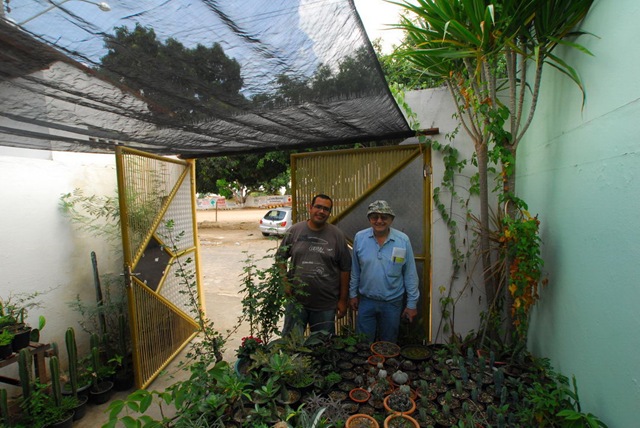
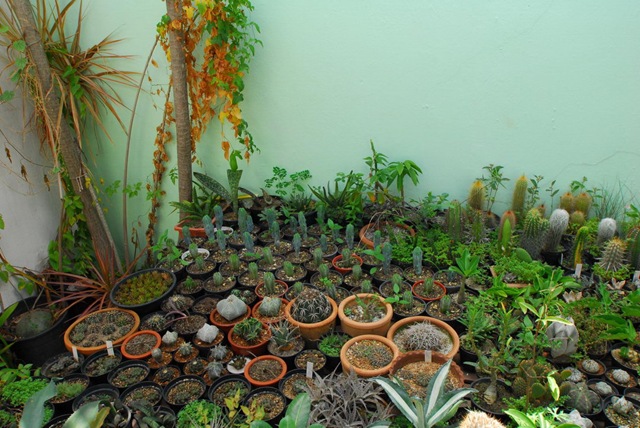
Soon after arriving at Marlon’s the heavens opened and his cactus collection, outside under shade cloth, got a good watering. We went out for a meal + beers, just around the corner, where they had a special promotion, buy one beer, get one free – so we bought seven bottles after which Marlon managed to negotiate another beer ‘on the house’ which of course deserved a free one as well. We have to get up at 6 tomorrow morning ……!

Saturday, 26 December – around Morro do Chapéu

I’ll start with a link to the Pousada Ecologica das Bromelias, where we have enjoyed our Christmas stay. No snow and ice, but then we did not come here for the winter sports and ski slopes!

http://www.brasiladentro.com.br/112261/br/hoteis-pousadas

It had rained during the night and a steady drizzle fell as we set out this morning. Delmar was going to take us to locations: Tabuleiro das Duas Irmãs and the turning, off BA-052 to Cafernaum where on the east side of the road is the western limit (?) of the habitat range of Discocactus zehntneri ssp boomianus.

By the time that we arrived at Tabuleiro das Duas Irmãs (S1622) it was still drizzling, but our worries that the dirt track from the BA-052 (little more than a dirt track itself in places) would be impassable once wet were unfounded. I’m sure that Cliff can give a better geological explanation, but it appeared to me that this Tabuleiro was a white sand in-fill between a pushed up layer of conglomerate rock. In real terms it was like walking through soft sand with just a thin top layer wetted by the rain. There was quite a caatinga vegetation here, so we were soon soaked from both the bottom up, as we brushed against wet vegetation and from the head down, from the rain. As it was still hot, any bits not affected by rain or wet leaves was soon soaked in our sweat! It was an easy place to get lost in, as large rock outcrops needed to be negotiated round the correct way, or else long detours were necessary to get to where you wanted to be. Even Delmar missed a turn in the track occasionally, so that we had to retrieve our steps.

Cactus wise, I think that we have now just about seen all the cactus taxa that the area has to offer. The sandy Tabuleiro was once again the home for Micranthocereus polyanthus ssp alvinii with Melocactus concinnus, M. paucispinus, Stephanocereus leutzelburgii, Micranthocereus purpureus, Pilosocereus pachycladus and as well as lots of different Orchids (not in flower), bromeliads and a charming little Eriocaulaceae sp. The rain had also brought out a large number of apparently solitary giant ants, about one inch long. It was easy to see their pincer mouth parts with the naked eye. Cliff found one carrying a large berry! But bad light made it very difficult to get a good depth-of-field picture of it close up.

As skies darkened we got back in the car and once back on BA-052, the heavens really did open for a while. Stretches of the road had been patched up with sand and on previous days had caused a huge dust cloud for every vehicle that met up from the opposite direction or overtook us. Today, the road surface floated slowly down the slopes and off to the side of the road. As we approached the roundabout for the turn south to Cafernaum, the rain stopped and the sun came out!

We had soon found the tell tale rocky hillsides and found a place to park. Again, as soon as we had fought our way through a small forest that separates the hillside from the road, we were amidst thousands of D. z. boomianus! (S1623). Unlike the visits to the previous boomianus locations, many plants here were in fruit, with fruits half full with what looks like viable seeds and the other half full of small ants. Fortunately they were not the 1" version that would have had your finger off.

Reviewing the pictures there are some truly impressive skies on display. Strangely, it stayed dry here.

Tomorrow we leave Morro do Chapéu and travel to Feira de Santana to meet Marlon at his flat. Then on 28 December we race to Salvador to pick up John Senior, who is already fed up with cold winters in New Jersey. The four of us will then go on a two week Marlon guided tour of northern Bahia – all new territory for me.

Friday, 25 December – East of Morro do Chapéu

Today was the first time for a long time (ever?) that I was in a church on Christmas Day. This time it was not for a religious service, but as part of a visit to the near ghost town of Ventura. Many years ago, I worked on a small project to put out of print texts of cactus books on-line, making sure that we retained the original pagination (for reference purposes) but modifying the text format to suit on-line reading. The only book that was ever produced was ‘Brazil and its Columnar cacti’ by Erich Werdermann, published in German in 1933. In it is a picture of the house that he used in 1932 as a base for his stay in Ventura.

Delmar Alvin was again with us as a useful guide, despite mutual language problems. Werdermann’s house has since been demolished. All my pictures for the visit to the village and the track to it are filed as S1619. It includes Marlon’s BR055 from where he reports Pseudoacanthocereus brasiliensis. We found the spot without problems. It was where a cattle gate had to be opened and cacti could be seen in the shrubbery. We found six cacti taxa here. Arrojadoa penicilata was easy to identify once we had discovered the one and only ring cephalium. If it does not get enough light, such as here in the shrubs, it just keeps growing without flowering. This plant had stems over 3 m long! The second cactus were young seedlings of Tacinga funalis, not a  plant often seen in cultivation in Europe and when you see the plant, it’s easy to understand why. Just thin sticks. Cliff ran his fingers up one of the stems and confirmed its ID as glochids stuck in his fingers. Next may be the reported Pseudoacanthocereus brasiliensis but as we have no good pictures to assist in the ID, Marlon will have to confirm this in a few days time. Another Tacinga was seen in the forest, spiny, but with thinner pads than I had seen on T. palmadora. Possibly T. brauniiCereus jamacaru and Pilosocereus glaucochrus completed the picture.

The Cachoeira Ferro Doido (waterfall) is a very nice place located 18 km to the east of Morro do Chapéu on the main road to Feira de Santana. Plants seen and photographed (S1620) were Micranthocereus purpureus, Melocactus oreas subsp. cremnophilus, Stephanocereus luetzelburgii, Pilosocereus glaucochrous, Pilosocereus pachycladus, and also the small Euphorbia appariciana. The place is very scenic, the river bed makes two canyons before the drop of the waterfall. As in 1999, there was no water falling, but the thunderstorms raging around us could change that in days to come. Remembering how a pose on a rock overhang a few weeks ago caused Marylan to gain the nickname ‘Crazy Woman’ I felt that I had to go one better, mainly in terms of potential distance to fall before going splat. There was a perfect rock overhang and Cliff was in charge of pointing the camera while I posed on the rock. Breath taking scenery!.  

With time to spare, Delmar suggested one more stop at a location he called ‘Tabuleiro Pachala Sergio’. The Tabuleiros seem to be the flat areas with fine white sand with variable density of vegetation. The common factor seems to be that M. polyanthus ssp. alvinii grows there. In this case we also found Stephanocereus luetzelburgii, Melocactus paucispinus and Pilosocereus glaucochorus. Delmar was busy gathering a wide range of fruits  from the low scrub, enough to supply a small grocery store.

We went back to the hotel and then got dressed up in our ‘finest’ to take Delmar out for our Christmas meal – to an Italian restaurant, just as in Famatina in 2008, but this time we had steak chips and salad instead of hamburger and pizza.

Another great day and a Christmas to remember in years to come. As far as the last picture in today’s album is concerned. No, Cliff has not bought the Italian restaurant in Morro do Chapéu! He is just waiting behind the bar to have his credit card payment cleared.