Just another WordPress.com site

Archive for the ‘Chile 2001’ Category

Wednesday 16 May 2001 – Caldera to Mejillones

We left Caldera for a drive of some 500 km to Antofagasta. We would pass many interesting cactus locations (Pan de Azucar, Esmeralda, Cifuncho, Taltal, Paposo) but forced ourselves to keep Leo’s foot on the accelerator pedal to ‘eat the miles’ on the Pan Americana – we would come back this way again on our way back to Santiago in a few weeks time, this time in the company of Attila Kapitany and Rudolf Schulz whose previous field work in the area would help us to drive up to the best locations without the hit and miss need for hour long searches.

North of Barquito, we stopped on a shale outcrop to look for Copiapoa barquitensis (S037) – our inexperience still showing: expecting to find the plant just because we were near the town after which it was named.  It actually grows in the hills behind the village and not right alongside Ruta 5! 

After Chañaral, Ruta 5 turns east before turning north again, some 30 km inland and now protected from sea fogs by the coastal hills that are the Pan de Azucar National Park.  We are now in the true Atacama Desert and can only be amazed at the landscape – no plants to be seen anywhere as we speed though the landscape at 100 k.p.h. – and can only guess how dry the climate here must be. So the signs along the road, urging drivers to switch on their main headlights in case of fog, look strangely out of place. It seemed impossible that fog could penetrate this far inland and there was no visible flora to suggest that it ever had in living memory.

We took the Antofagasta exit off Ruta 5 and, as there were still a few hours of daylight left, decided to find the coast road (Ruta 1) north. We took the exit to Juan Lopez on the Peninsula de Mejillones to find the Morro Moreno, the type locality of Copiapoa atacamensis. Sometimes, luck is on your side and you simply wind down the car window to take pictures of the plants you are looking for, as for example on Morro Copiapó where we found Copiapoa marginata. Not so in this case. The Morro was much bigger than the map suggested and much less accessible than M. Copiapó. Day light was now failing fast so we made for the town of Mejillones, north of the peninsula and found a holiday bungalow camp, deserted for winter. We had our pick of the cabañas and enjoyed a good night’s rest.


Tuesday 15 May 2001 – Copiapó to Caldera

Our first stop of the day was at Paipote, where we hoped to find Copiapoa megarhiza. The information we had was to look for ‘the granite hill in front of the mine’.  No one told us there were some 18 mines in and around Paipote and that at least half the hills are granite in origin! We searched one such location (S033) before realising that this was ‘one of many’ and found nothing.

We tried again a bit further along (S034) but again do not find any Copiapoa, unless we misidentified the few Eriosyce (Neoporteria) sp. plants (balls of spines are hard to ID) and the omnipresent Cumulopuntia sphaerica. We had planned to explore the area in detail, but soon concluded that a day would not be enough with the information that we had and that the area just did not look promising for any cactus discoveries and so returned to Copiapó before midday to collect our luggage from the hotel and travel on. This showed up our inexperience in the field – later during this trip and again in 2003 we found cacti in the most unlikely places. Yes, it is certainly possible to recognise likely locations from a distance, but never write off an area that looks less likely to accommodate cacti unless time pushes you on.

We travelled on to Bahia Inglesa (S035), the home of Copiapoa marginata with plants growing on the cliffs right at the sea’s edge. This is an important location in ‘Copiapoalogy’ as it is the neotype locality of the type species of the genus. Despite its significance, we were still deflated by our failure to find C. megarhiza so were happy to just take a few pictures as soon as we found the first C. marginata, and of the pelicans fishing from some off shore rocks, before moving on again to Caldera.. Some 20 km north of Caldera, (S036), we stopped to watch and photograph the sunset over the Pacific Ocean.  We all have the hope to take the ultimate ‘end-of-talk’ slide: a sunset over the Pacific with a Copiapoa, or at least a cactus, silhouetted against the sun.

Unfortunately, the clouds disappeared from the sky before the sun reached the horizon and the cacti failed to cooperate by staying just a little too far from the sea to allow us to compose the classic cactus shot.

We spent the night in Caldera, but, as I finally write up my notes two years later, my memory has let me down badly – I have no recollection of where we stayed and when we returned to the town in 2003 I had no recollection of having been here before. Had it not been for my brief notes taken on 15 May 2001, I would have said that I had never been here before. Why do I labour the point? Because some very important literature (Ritter’s Kakteen in Südamerika) was written many years after the author had made his original observations.  I’m not trying to distract from Ritter’s excellent mammoth work, but merely point to the fact that human memory often benefits from being supported by quite detailed notes and pictures – I hope that Ritter had both.

Monday 14 May 2001 – Vallenar to Copiapó

The previous day we had missed the Huasco Valley west of Vallenar, so the town of Huasco was the first goal today.  We stopped  at Punta Huasco (S024), where the railway, which is used to transport coal and ore from the mines, stops and their cargo is transferred onto ships.  The whole area, including the hill immediate inland from the loading dock, is pitch black, covered by a thick layer of coal dust.  Still we were there, so we might as well search for cacti in this unlikely place.

We were very pleasantly surprised to find Copiapoa fiedleriana, Eriosyce (Horridocactus) crispa and napina looking very healthy and Eulychnia iquiquensis looking as though life was perhaps more of a struggle, despite their black appearance. Their colour was purely due to the coal dust, as a wash revealed a greener epidermis. We would still refer to the small button-like Eriosyce by their ‘old name’ of Thelocephala. Within our small party, we all knew what we meant and we also realised that they were now members of the much larger and variable in size genus Eriosyce but for us the old name served as a useful handle. I can always refer to a brief summary of the current concept of the genus when I’m writing. They were incredibly difficult to find, if you were looking for them (none were in flower), but were easier if you accidentally stumbled across one, while taking a picture of another plant low down, or when I dropped my lighter and found  

A little further inland, between Bellavista and Huasco Bajo (S025) we found similar plants, but this time without their black covering. The Thelocephala also looked ‘different’ – something to check out later, when we had seen more plants. I now believe these to be either Eriosyce (Horridocactus) odieri or E. napina var duripulpa.

At Huasco Bajo we spent some time looking for the bridge over the Rio Huasco to the coastal track that leads to Carrizal Bajo. Yes, we got lost, most cactus tourists do as the local population seemed quite used to explaining how to get back on to ‘the cactus route’. We were keen to see more plants, but were disappointed at our next stop (S026) where we found nothing of any (cactoid) interest. I only took two digital images to record some of the scenery.

And so we drove on to the area marked on our 1:100,000 map as Llano los Hornicos, still south of  Agua de Luna for S027. Here we had more luck, finding Eulychnia iquiquensis, Eriosyce sp. and, according to my notes, Copiapoa fiedleriana. I say ‘according to my notes’ because as, two years later, I peruse my slides, there are none of Copiapoa for this stop. In the field in 2001, we were often so excited and busy taking pictures, quickly scribbling notes as the car pulled off, that matching slides to pictures back in the UK, only a month (but many more cactus stops) later was quite a challenge. I resolved at the time not to make the same mistake again and now rely on a digital camera to ensure that the first digital image at a stop is of a small card showing the stop number or of the GPS receiver, showing the latitude and longitude which is written in my note book before other pictures are taken. When my SLR camera comes out to take some shots on slide film, the same shot is also taken on my digital camera, so that sorting the slides should be a simple matter of comparing slides against digital images that are electronically sorted in time/date order. It also saves the time consuming task of scanning in all the slides later, as I find searching through scanned slides on my monitor more convenient than holding individual slides up against the light or on a light box when preparing talks.

We passed the sign for Agua de Luna (which is not actually shown on our maps) and stopped (S028) to find Copiapoa echinoides, C. fiedleriana, Eriosyce (Horridocactus) odieri.  Names on maps (that were printed in 1967 using aerial photographs taken in 1954!) do not always tie in to names on road signs found today. Also, roads may have ‘moved’ from the original track to a better asphalt road that takes a more direct line between villages.

Our next stop (S029) was near Caleta Angusta (according to the sign posts) or inland from Punta Agua de Patillo (according to the map – the road has moved closer to the coast since the map was drawn). What beautiful plants (Copiapoa dealbata our first ‘white’ Copiapoas) but what an awful location: the local rubbish tip, where the plants grew between disposable nappies, empty bottles and other non-degradable waste. Still, we took some great pictures, carefully angling the shots to capture the plants and not too much background, although some shots to illustrate the setting were also essential.  

A little further (S030) was much better – a small gully providing the perfect setting for large clumps of C. dealbata ideal for a group picture (and again in 2003 –  S200 and 2004 – S307) with many crested plants as well as much smaller, often single headed densely spined Copiapoa (echinata?) and C. echinoides. It was difficult to know which way to point the camera first and how many rolls of film / flash cards to fill.

We forced ourselves to drive on and arrived at the small village of Carrizal Bajo. From here we had a choice – drive north, as the coastal track passed through a (then) dried up river bed (but see 3 June 2001) or turn east (according to our more up to date Turistel high level map, a better road), and head for Ruta 5 for a reasonably quick return to Vallenar. We chose the latter, following the Quebrada Carrizal stopping (S031) to take some more shots of C. dealbata to the right of the road and again (S032) as a ‘different’ Copiapoa had joined C. dealbata, but what name should we give it? It had features of C. echinoides but more elongated stems than the plants that we had identified as such earlier. There was some resemblance with C. marginata as well. Perhaps there was some sense behind my statement that Copiapoa are just one highly variable species. (This statement was made to prompt some reaction from those more experienced than I, but does not seem to go away.).

Sunday 13 May 2001 – Vallenar and the Rio Huasco Valley

Today we planned to see how far inland we could find Copiapoa in the Huasco Valley, to see what other cacti we would find and to enjoy the scenery as once again we would drive to the foothills of the Andes.

We made our first stop of the day (S017) near the Embalse Santa Juana, another dam in the river that had created a large artificial lake inland from which the valley could be irrigated and developed for agriculture, a scenario that we had previously seen in the Rio Elqui Valley. No doubt many cacti that had grown here were now at the bottom of the lake. On the steep hillsides alongside the river we found Copiapoa coquimbana (C. vallenarensis?), Cumulopuntia sphaerica, Eulychnia sp. Echinopsis (Trichocereus) sp. and at least two taxa of Eriosyce (Neoporteria) – or was it just one highly variable species?

Further along (S018), now at an altitude (measured by GPS) of 667 m, we could not find any Copiapoa but instead found Eriosyce aurata, unmistakably as it showed of its woolly fruits, plus all the other cacti reported from the previous stop. The hillsides were especially crumbly and dangerous to climb, probably due to the recent road building work.

And so, on to El Maiten (S019), where Leo, (un)suitably dressed in shorts and T shirt once again became the mountaineer, risking life and limb to take a picture of  another Copiapoa coquimbana growing high on the cliff face. We didn’t really mind, except that he had the car keys in his pocket! We busied ourselves in the mean time with taking some pictures of the few Copiapoa coquimbana and Eriosyce (Neoporteria) sp. plants that grew right along the side of the road, with rocks tumbling down the hillside, dislodged by Leo’s climbing efforts, posing the only real danger. These were perhaps the highest altitude (880 m) and furthest inland occurring Copiapoa in this valley.

We christened the next stop (S020) the ‘Cow Stop’ as a small herd of eight Friesians came up the track, lead by a gaucho on horseback, with the tail enders being round up by another horse-mounted shepherd: a young girl who could not have been more than 7 years of age.

The road continued to climb until at 1,146 m (S021) Leo spotted an Eriosyce aurata growing fairly high on the cliff face above the road. This too was a bit worrying, because we had hoped that, as the driver, his eyes would be more focussed on the road – never mind. We all had a go at scrambling up the loose shale, often it was a case of ‘two steps forward, three steps back’ so again we had to be content of taking pictures of Leo taking pictures of the Eriosyce.

We made two more stops (S022 and S023), eventually reaching 1,620 m above sea level, but there were no cacti to be found within view of where we parked the car. The scenery offered plenty of picture material, before we turned the car round and headed back to Vallenar.

Saturday 12 May 2001 – Guanaqueros to Vallenar

We started the day by filling up the fuel tank – petrol stations are a lot more difficult to find than we are used to in Europe and become less frequent as we drive into the less densely populated northern part of the country. Petrol prices increase as stations become less frequent as the distribution costs so far north are argued to be greater. Most modern Chilean roadmaps have petrol stations clearly marked on them and it is wise to fill the tank when the fuel gauge still reads half full.

First cactus stop of the day (S010) was along Ruta 5 near Los Hornos, where most of the Copiapoa, Echinopsis (Trichocereus) and Eulychnia had seen better days, with many of the plants dead.

The ‘different’ cactus that we spotted from the car and persuaded us to stop (S011) proved to be Miqueliopuntia miquelii, as we had our first experience of the camanchaca, the coastal fog phenomenon for which the Atacama Desert is renowned. It was a strange experience at 9:30 in the morning to see a wall of fog come quickly towards us, envelop us, before disappearing as quickly as it had come, leaving our clothes slightly damp to the touch and water droplets hang from the spines of the Eulychnia – a strange experience in a place where the scenery told you that moisture was a precious commodity.

After another stretch of Ruta 5, we turned east, south of El Trapiche, onto a track leading east (S012). Here we found a much more varied selection of cacti: Copiapoa coquimbana (Ritter’s var. domeykoensis?), Cumulopuntia sphaerica, Eulychnia sp. and Eriosyce (Neoporteria) sp. as well as Oxalis gigantea. Doing his usual mountain goat impersonation, Leo reported some crested plants growing on top of the hill. Beyond this stop, the road climbed until some 10 km further the ceroids disappeared from the scenery. The road climbed to 1,250 m altitude, providing spectacular views of the snow capped Andes in the distance.

Our next stop (S013), with the GPS indicating an altitude of 1,150 m was disappointing with just some Cumulopuntia sphaerica growing beneath shrubs. Back onto Ruta 5 and heading north we pulled into the village of Domeyko to top up our coffee and bananas supplies and on again until we turned west at the turning to Caleta Carrizal. The scenery at S014 again indicated how dry it was and had been for a very long time, with Eulychnia, Cumulopuntia and Miqueliopuntia as well as Copiapoa sp. looking better than the landscape might suggest.. Again, our mountain goat – this time with Marlon in his slip stream – reported some Eriosyce (Neoporteria) growing at the top of the hill. Given ourlocation, we concluded that we were still looking at forms of Copiapoa coquimbana but some of the flowers showed more than just a hint of red. Was this Copiapoa rubriflora? No, because this was reported by Ritter from just south of Taltal and is now regarded as belonging to Copiapoa rupestris. So, is the epithet rubriflora perhaps appropriate for more than one Copiapoa taxon?

From here the road descended to about 400 m altitude, where, at S015 we found more Copiapoa, presumably still C. coquimbana although looking back at the pictures now (2003, after my second trip to Copiapoa Country), I wonder if there is more than a hint of C. megarhiza in these plants. Two crested stems were dully photographed by all and we observed that the parasitic Tristerix aphyllus here was also ‘feasting’ on the Copiapoa and Miqueliopuntia.

I still find cacti growing with an ocean as back ground a fascinating sight – such a contradiction between the dry and the wet! So our next stop (S016) near Carrizalillo seemed to promise a real treat. But was it Copiapoa coquimbana, C. echinoides, C. megarhiza or C. carrizalensis that we were looking at? The geography would suggest C. coquimbana, but once again towards the edge of a taxon’s supposed distribution area, its features can blend into those of its neighbours. The plants were growing at the base of a low – some 30 m. high – ridge to the east (inland) from the road. The sun was getting low to the west, so it was almost impossible to take any cactus & ocean pictures, especially as the east facing sides of the clumps were also the most marked and least attractive. Never mind, there would be other opportunities and we had to move on to get to Vallenar for the night.

Friday 11 May 2001 – Guanaqueros: Into the Elqui Valley

The Elqui Valley, along with the Huasco and Copiapó valleys, are important agricultural islands in an otherwise barren landscape. We were treated to an ever changing flora as we drove from the coast up into the foothills of the Andes where snow topped hills form part of the scenery.

Irrigation has created oases where vineyards make an important contribution to Chilean wine production.

From La Serena, we followed Route 41 along the south side of the Rio Elqui, persuading a restaurant at Las Rojas to open for breakfast before making our first cactus stop (S005) at a viewpoint car park past the Embalse Puclaro, a dam to control the flow of water in the river, creating an upstream lake.  It was the view of the dam that prompted the stop, but any stop presents a photo opportunity for the resident cacti, and we’re not disappointed. We spotted our first Copiapoa! One of the many forms of C. coquimbana. This is a very complicated taxon to classify. On the one hand we saw many local forms that were quite different from each other and yet seemed to us to share a great number of common features. As a result, many species have been described only to be submerged into the earliest named taxon: C. coquimbana. The current thinking seems to support the classification of these green bodied Copiapoa from south of the Huasco river as belonging to one large complex, for now conveniently at species rank

A ‘No Entry’ sign on the entrance to an unpaved track leading to a mine seemed to present an invitation to take a closer look at the cactus flora (S006).   A fortunate opportunity, as in 2003 we found this entrance fenced off, leaving us pessimistic about the well being of the plants that we were able to see this time round.

As the road climbed higher and higher, we drove through the village of Monte Grande, with a charming church and a monument for the poet Gabriela Mistral – the perfect location for a lunch time coffee stop before we drove on to Pisco Elqui, a small village which lends its name to the famous Chilean alcoholic cocktail.  This was the highest place on today’s trip – having started at sea level in the morning we were now at 1,320 m. with mountains of 3,000 m. plus around us.

On the way back, we made another stop once the Trichocerei reappeared on the scene (S007) at 970 m. and were surprised to find a ‘cactus nursery’ in Vicuña, indicating that the cactus hobby is alive and well in Chile, with scope for a National Cactus & Succulent Society to discuss and provide guidance on the issue of conservation of the endemic cactus flora.  Metal food tins and plastic coffee cups were used as containers for the local cacti offered for sale.

We made another stop near the Puclaro Dam (S008) before returning to our accommodation for the night at Guanaqueros.  Travelling out of the main tourist season has the benefit that lodgings, such as those at Cabañas Bahia Club, are very reasonably priced and are open to some negotiation – full marks to Leo, our chief negotiator.

Thursday 10 May 2001 – Caleu to Guanaqueros

Today we started our journey to ‘Copiapoa Country’, aiming to get to the Parque Nacional Fray Jorge, traditionally regarded as the southern limit of genus Copiapoa, although the furthest southern occurrence reported is probably Ritter’s FR 504 (C. pendulina) from Puente Teniente, some 40 km further south.   

Ruta 5, the Pan Americana (Pan American Highway) provides a fast and smooth alternative for our journey north (and later back south again) to Ruta 1, the coast road which in places is little more than a badly maintained dirt track.

North of La Ligua, the road turns to to North West until it meets the Pacific Ocean at Caleta Pichicuy.  We passed Los Molles, Pichidangui (visited on the way home, S107) and decided to stretch our legs at an emerging summer residence village at Punta Totoralillo – S002, where local fishermen have changed their occupation to offering boat trips along the coast.

After a petrol stop at Los Vilos, we made another leg-stretch break at Caleta Chigualoco, but other than hillsides full of Trichocereus, found nothing of interest to the cactus tourist.

North of Caleta Teniente, the Pan Americana turns back inland and crosses the Rio Limari, which, nearer the coast, forms the southern border of the Fray Jorge National Park.

Finally we saw the signpost west and followed the 18 km of good unpaved road to the entrance of the Park, making an unscheduled stop, S003 just before the entrance. There is no reason why all nice cacti should grow inside the boundary of the Fray Jorge National Park!  So when Marlon spotted a bright red fruit on a Eulychnia acida, the time was right for a stroll along the road.to examine these plants and the much smaller Cumulopuntia sphaerica with its bright flowers. There are two species of Echinopsis (Trichocereus) species: E. chiloensis and E. skottsbergii, but to this date I have difficulty in deciding which is which.

Cumulopuntia sphaerica (that we carried on calling Tephrocactus berterii) was probably the most widely distributed cactus that we encountered although there were only few occasions when it seemed worthy of having its picture taken – usually it was dehydrated and covered in dust. As a result, we often omitted to report it in our stop list, so it is mentioned only if it can be spotted in pictures taken at that stop.

The surprise of this stop was Eriosyce aurata fa. sandillon – a  rather rare and difficult plant in UK cultivation. Because of this reputation, we somehow had expected that it would also be difficult to find and rare, but this was not the case. Groups of five to ten plants, growing a meter (c. 3 ft) apart could easily be found.

Unfortunately, National Parks in Chile only open at the weekend out of the main holiday season, so when we arrived at the gate on Friday afternoon, we found the gate locked.  Not deterred, we went back towards Ruta 5 for another look along the road side, S004, near our previous stop. Here we found other groups of Eriosyce aurata, with large woolly fruits.

We admired the large stands of Eulychnia that looked in remarkable good health compared to the stands that we were to see later during the trip.

Only a few minutes before the stop, we asked ourselves if we should be careful about snakes in this area. Somehow we concluded that there were no snakes in Chile.  Ironically, I stumbled across a snake soon afterwards, sunning itself in the afternoon sun.  It only waited long enough for me to take its picture before racing off into the bushes.  Was it poisonous? I’ll never know.

We found another Eriosyce but a different taxon with glabrous fruit, as well as another species (below: Copiapoa or Eriosyce s.l.?) 

Our reason for visiting Fray Jorge was to see the most southern Copiapoa that grow in the park.  Unfortunately we believe that we did not find these plants.  Plans to return on the Sunday before our flight back home did not come to fruition – there is only so much that can be fitted into a four week trip.

We continued north on Ruta 5 until it seemed sensible to look for accommodation, which happened to be in the seaside village of Guanaqueros, where for 20,000 pesos (about £25) we found room at Cabaña Bahia Club for four of us. All in all it had been a great way for me to spend my birthday, finished off with an excellent sea food meal at the local restaurant, washed down with Chilean red wine.

S003_03

S003: Cumulopuntia sphaerica (syn. Tephrocactus berteri)

Wednesday 9 May 2001 – Santiago to Caleu

John Ede and I enjoyed an uneventful Lufthansa flight from London, via Frankfurt, to Buenos Aires, where Leo van der Hoeven joined us.

The last leg, Buenos Aires, Argentina – Santiago, Chile took us over the Andes, with some spectacular views over the snow capped peaks, arriving safely at Santiago Airport where we were met by the representative of our car rental firm. Fortunately, Leo is fluent in Spanish, down to the arm and leg movements that to us northern Europeans are a little unusual.

We had rented a Nissan double cabin pick-up truck and this rather squashed vehicle was to be our home for the journey. With my long legs, I found the back seat particularly tight – still, a good excuse for frequent stops to stretch our legs, look for plants and take pictures.  I exposed 30 rolls of 36 exposure slide film – 1080 slides in all – and took another 2,000 plus digital images using a Nikon Coolpix 990 that I was privileged to have on loan from Nikon.

Again, without incident, we drove north along Ruta 5 to Rungue and then followed a track to Calue. We found the El Parador cabañas, run by a Chilean who was born in Belgium and who had lived in Birmingham, England for some 3 years before returning home. Here we met up with the 4th member of our ‘car party’, Marlon Machado from Salvador, Brazil, who had flown in the previous day and had been picked up at the airport by the owner of the cabañas.

Our first stop, (S001) covers an area of c. 5 km radius around the hotel where we found Neoporteria curvispina, Echinopsis (Trichocereus) chiloensis and Cumulopuntia sphaerica. The lush green hillsides around the cabañas at Hotel El Parador, some 60 km north of Santiago Airport, west of the Pan America Highway (Route 5), presents the perfect opportunity to stretch our legs and see our first cacti in their Chilean habitat.

Before long, Marlon was taking pictures of a globular cactus:  Eriosyce (Neoporteria) curvispina var. curvispina (Bertero ex Colla) Kattermann

The low shrubs provide ideal nursery bushes for a ceroid: Echinopsis (Trichocereus) chiloensis (Colla) Friedrich & Rowley. First described as Cactus chiloensis by Colla in 1826.  The name ‘chiloensis’, meaning from the Isla Chiloe, is incorrect and has been corrected by some authors to ‘chilensis’ (from Chile), but according to the rules of botanic nomenclature, the original spelling must stand. Friedrich Ritter lists 5 varieties of this variable species. The form common in this area is short spined and was given the name varietal name conjungens by Ritter.

Although lichens are common features growing on other vegetation, the bright coloured growth found growing on the stems are actually the flowers and fruits of a parasite: Tristerix (Phnygilanthus) aphyllus.  These parasites have a sweet taste and are the favourite food of guanaco – the ‘sheep’ of the Andes.


Tuesday 8 May 2001 – England to Santiago de Chile

INTRODUCTION

In August 2000, Rudolf Schulz spent a week with me, visiting UK cactus nurseries and collections.  As his departure for Australia drew nearer, he suggested that we’d meet up again, in May 2001 – in Taltal, Chile!

We agreed that I would make up a car full of fellow enthusiasts and would play ‘tag-along’ with Rudolf, Attila Kapitany and his wife Michelle and other ‘car parties’ that would make up Copiapoathon 2001. It did not take much effort to fill the three remaining seats in my car – John Ede (England), Marlon Machado (Salvador, Brazil) and Leo van der Hoeven (Netherlands), jumped at the chance.

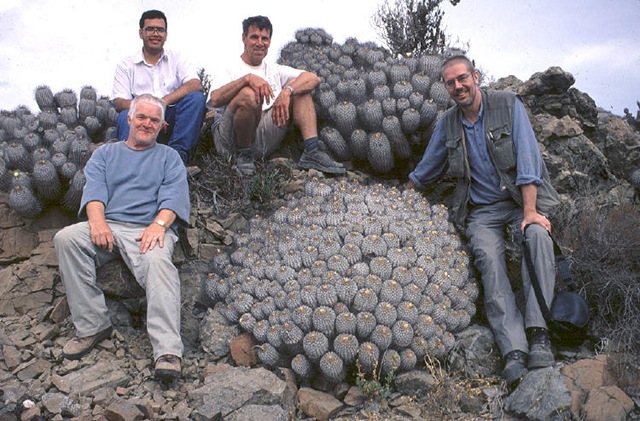
00team

The 2001 Copiapoathon Party:
Top: Marlon Machado and Leo van der Hoeven
Bottom: John Ede and Paul Klaassen

The Copiapoathon ‘proper’ took place in Taltal, where we met up with other groups for a number of joint excursions during the day and interesting discussions over bottles of wine and fine food in the evening.

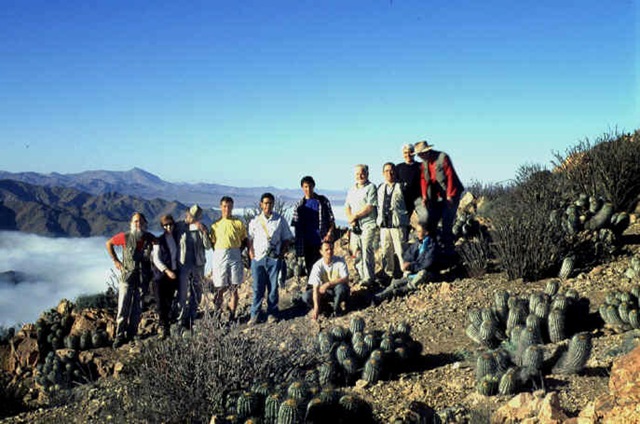
00party

The Copiapoathoners:
left to right: Rudolf Schulz, Michele and Attila Kapitany, Leo van der Hoeven, Marlon Machado, Benjy Oliver,
Mark Aston, John Ede, Gustavo Valdes, Arturo Kirberg, Raquel Pinto (seated) and Paul Klaassen
posing on top of Cerro Perales among Copiapoa cinerea (fa tenebrosa)

Another Copiapoathon is already being planned and may become the first Convention of the Chilean Cactus Society which, at the time of writing, is also in its early planning stages.

This presentation consists of pages dedicated to each day of our trip (8 May to 5 June).  Each day, we made a number of ‘formal stops’ where most of the images were taken.  In time, there will be a page for each of these stops to display more images.

Tuesday 8 May 2001 – Copiapoathon 2001 Introduction

On August 2000, Rudolf Schulz spent a week with me, visiting UK cactus nurseries and collections.  As his departure for Australia drew nearer, he suggested that we’d meet up again, in May 2001 – in Taltal, Chile!

We agreed that I would make up a car full of fellow enthusiasts and would play ‘tag-along’ with Rudolf, Attila Kapitany and his wife Michelle and other ‘car parties’ that would make up Copiapoathon 2001. It did not take much effort to fill the three remaining seats in my car – John Ede (England), Marlon Machado (Salvador, Brazil) and Leo van der Hoeven (Netherlands), jumped at the chance.

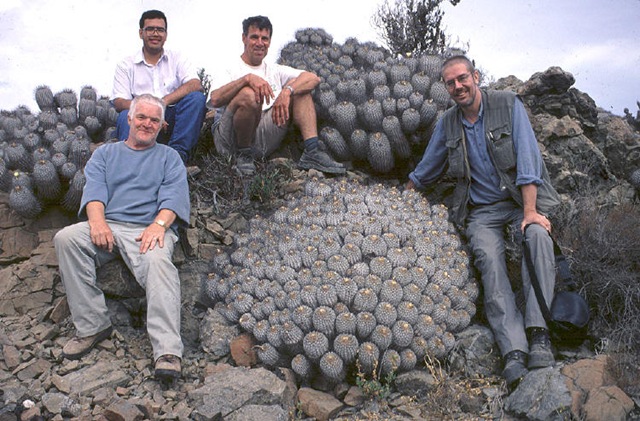
00team

The 2001 Copiapoathon Party:
Top: Marlon Machado and Leo van der Hoeven
Bottom: John Ede and Paul Klaassen

The Copiapoathon ‘proper’ took place in Taltal, where we met up with other groups for a number of joint excursions during the day and interesting discussions over bottles of wine and fine food in the evening.

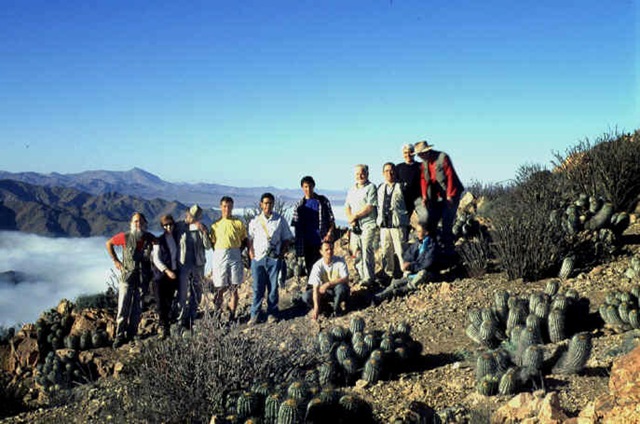
00party

The Copiapoathoners: left to right: Rudolf Schulz, Michele and Attila Kapitany, Leo van der Hoeven,
Marlon Machado, Benjy Oliver, Mark Aston, John Ede, Gustavo Valdes, Arturo Kirberg, Raquel Pinto (seated)
and Paul Klaassen posing on top of Cerro Perales among Copiapoa cinerea (fa tenebrosa)

Another Copiapoathon is already being planned and may become the first Convention of the Chilean Cactus Society which, at the time of writing, is also in its early planning stages.

This presentation consists of pages dedicated to each day of our trip (8 May to 5 June).  Each day, we made a number of ‘formal stops’ where most of the images were taken.  In time, there will be a page for each of these stops to display more images.