Just another WordPress.com site

Archive for the ‘Chile 2010’ Category

Monday, 4 November 2013 – around Huasco

After another good night’s sleep all round, my auto alarm woke me up at 7 so that we could be at breakfast by 8 and on the road at nine(ish). We did not have far to go, just a quick drive to the Eriosyce (Thelocephala) napina location at Huasco, where we would meet Brendan & Lucy Burke (S2891).

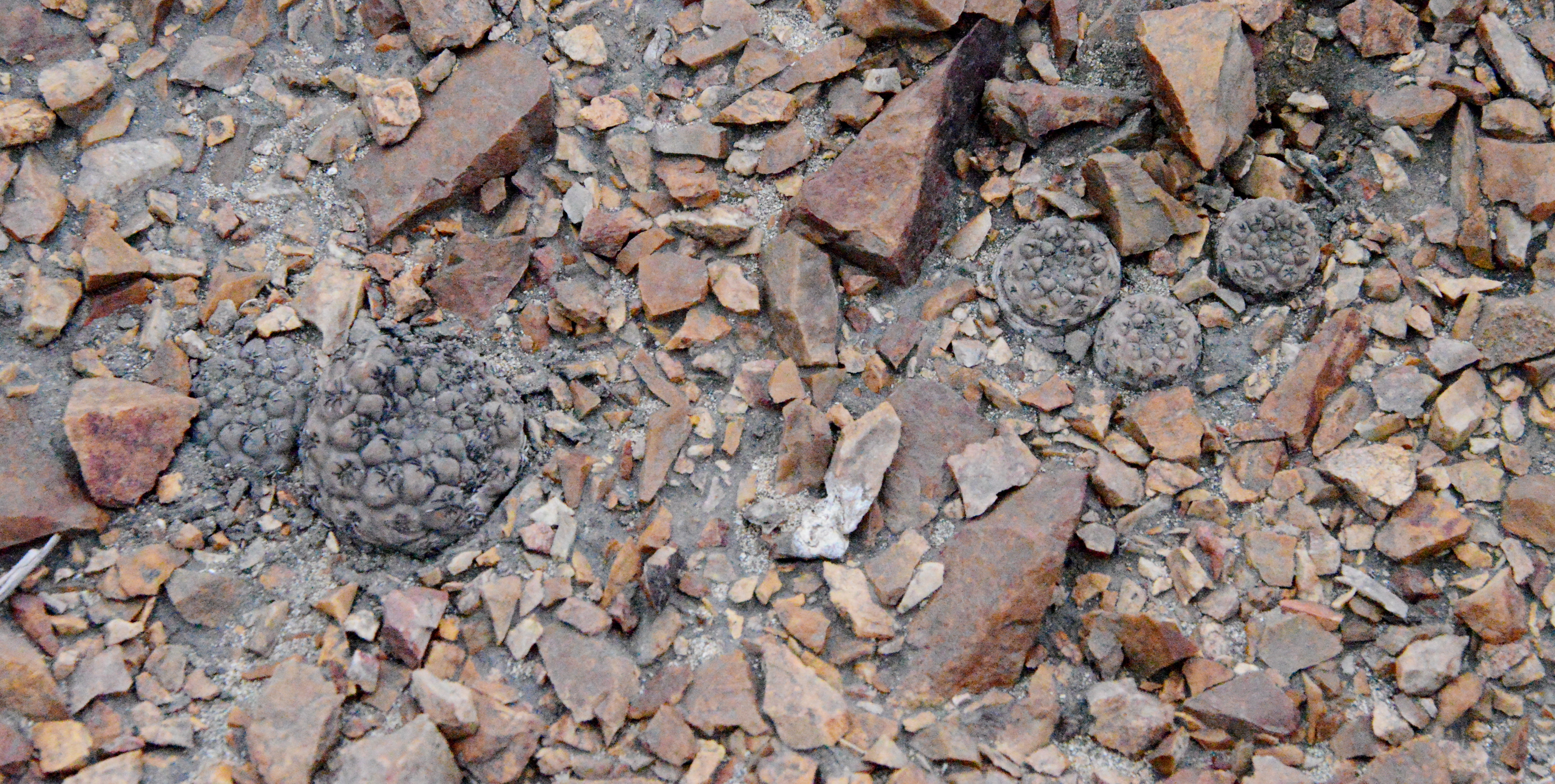
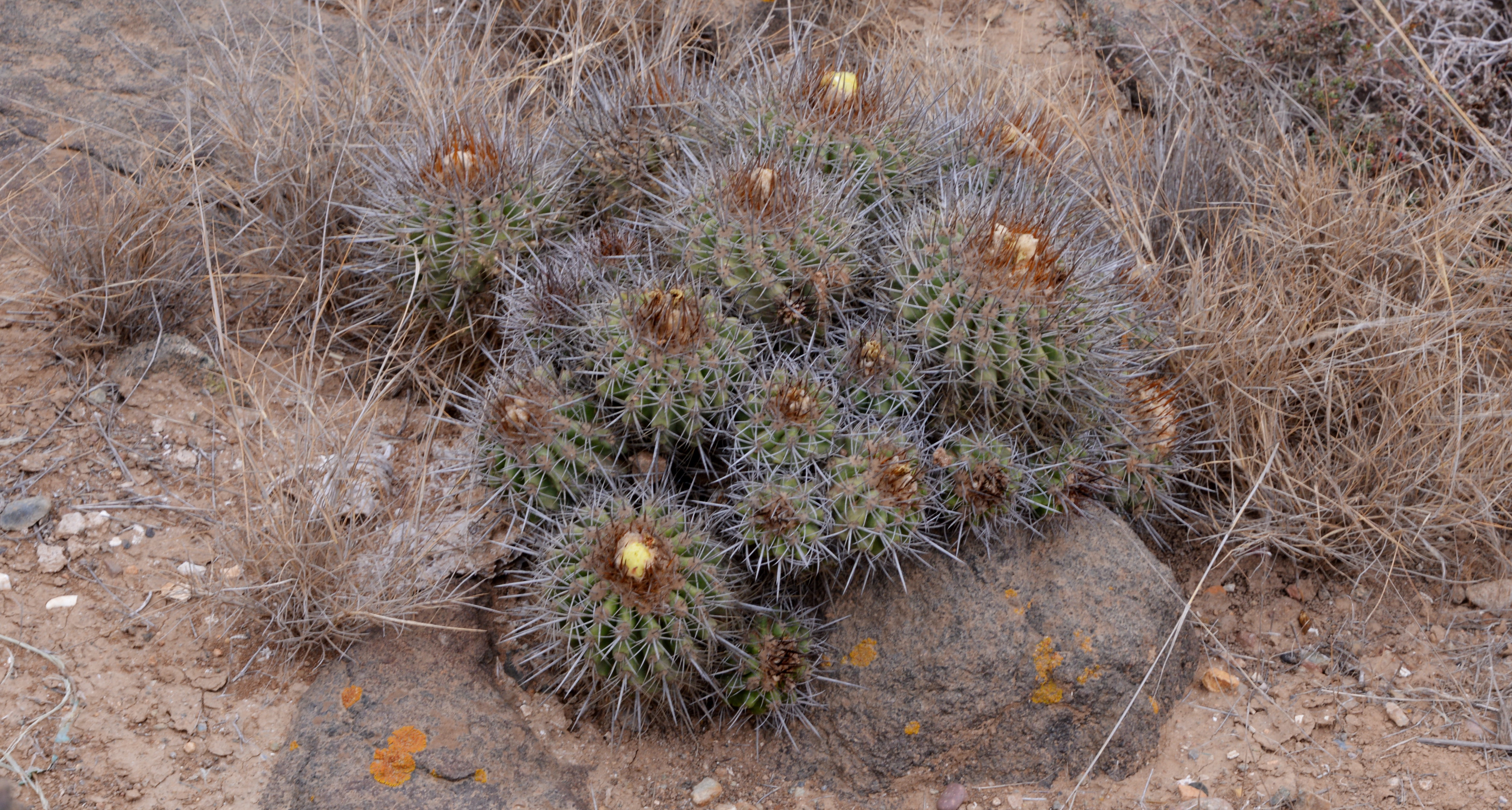
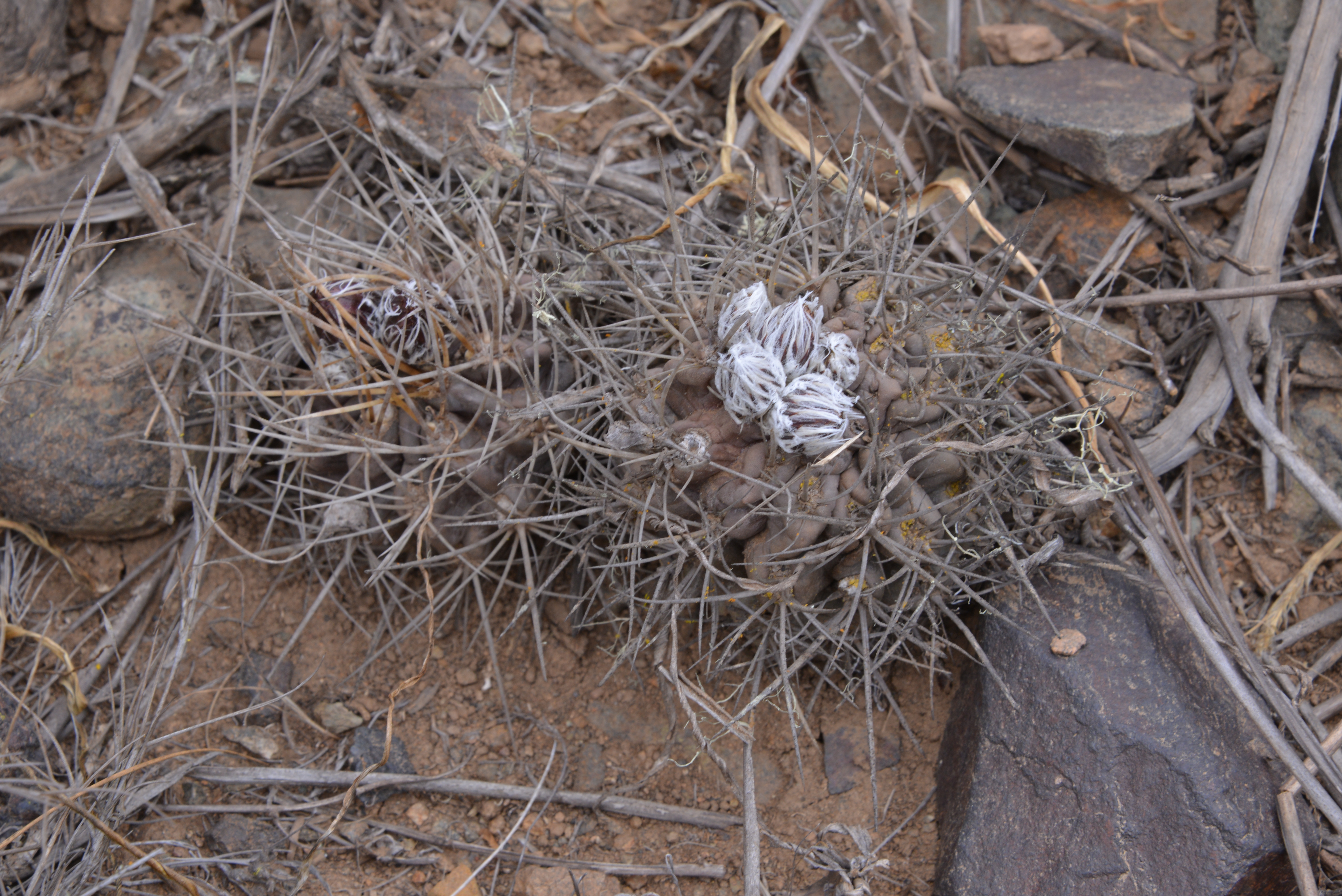
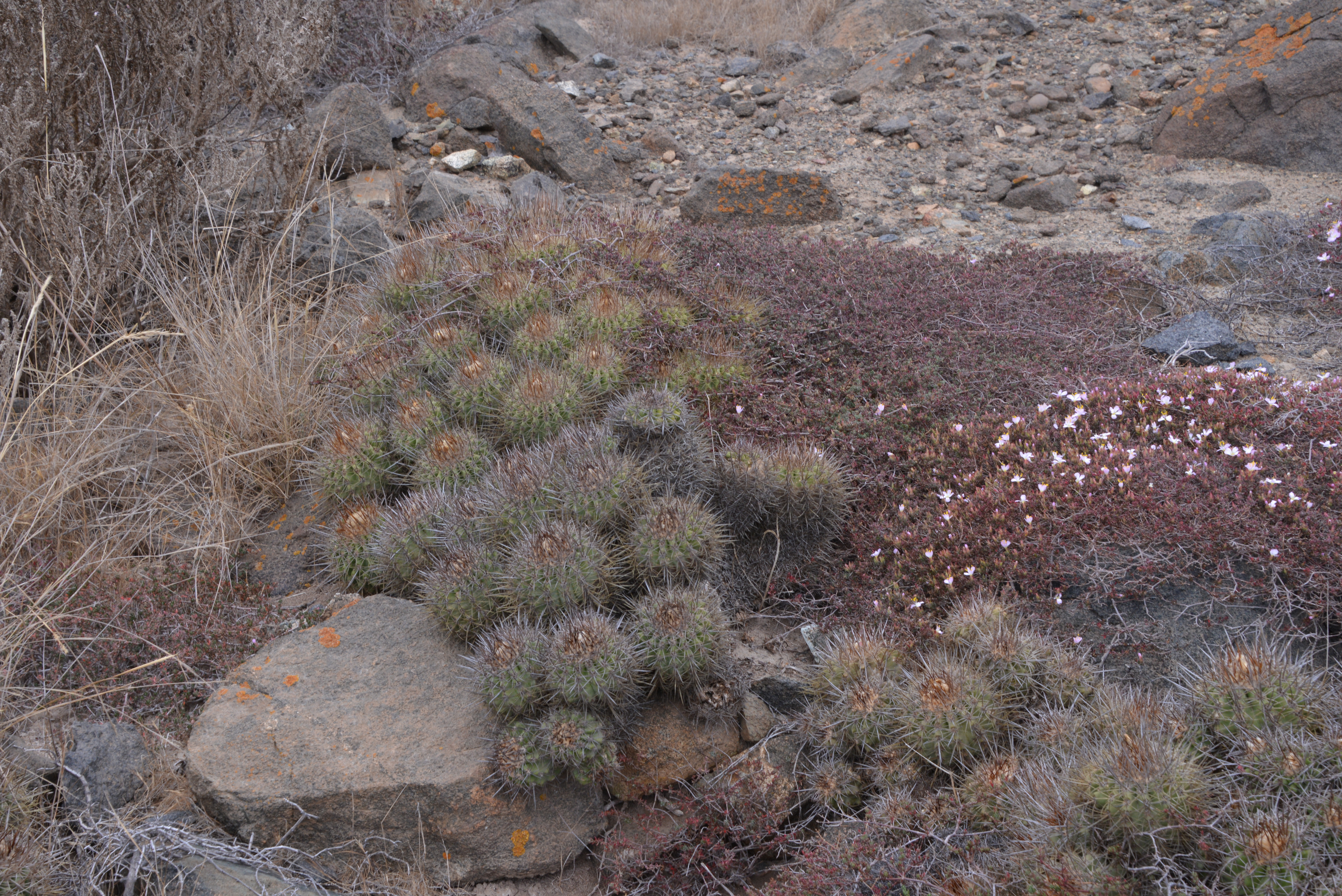
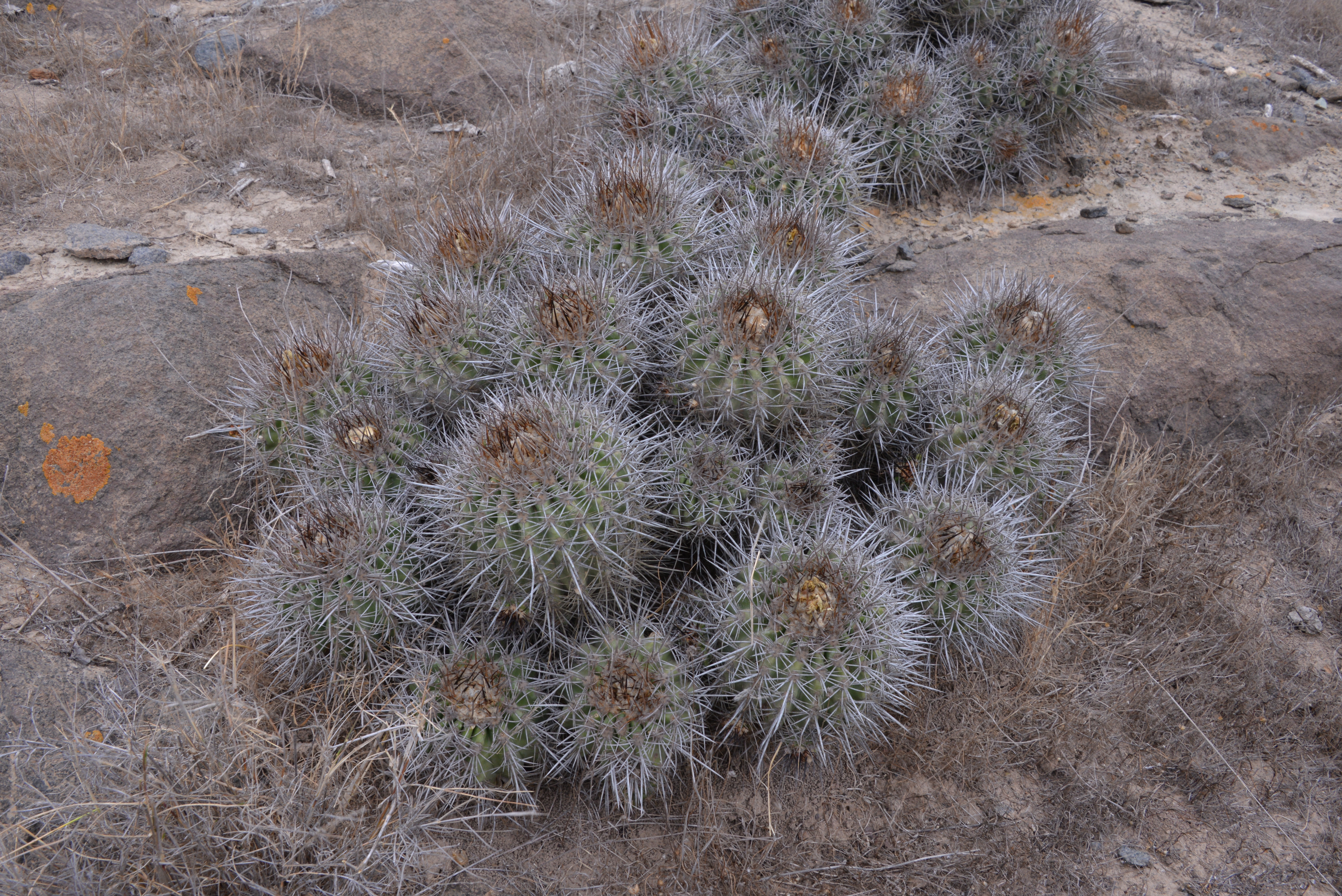
Just as I was explaining what cacti we would see to JYC, Brendan & Lucy arrived. They had a nice big 4×4 Nissan, one size up from ours, a bit like our Dodge Durango from the first three weeks.  They had never been to this spot before, even though Brendan had been visiting Chile longer than I had, his emphasis had always been on Copiapoa and because they tended to visit in January, when the Thelocephala were mostly asleep, they had never bothered with this stop. JYC was hugely excited by the clumps of C. fiedleriana, the Eriosyce (Thelocephala) napina and the E. (Neoporteria) villosa, Eulychnia breviflora and Oxalis gigantea, in flower.
S2891 - Copiapoa fiedleriana

S2891 – Copiapoa fiedleriana

S2891 - Eriosyce (Thelocephala) napina

S2891 – Eriosyce (Thelocephala) napina

S2891 - Eriosyce (Neoporteria) villosa

S2891 – Eriosyce (Neoporteria) villosa
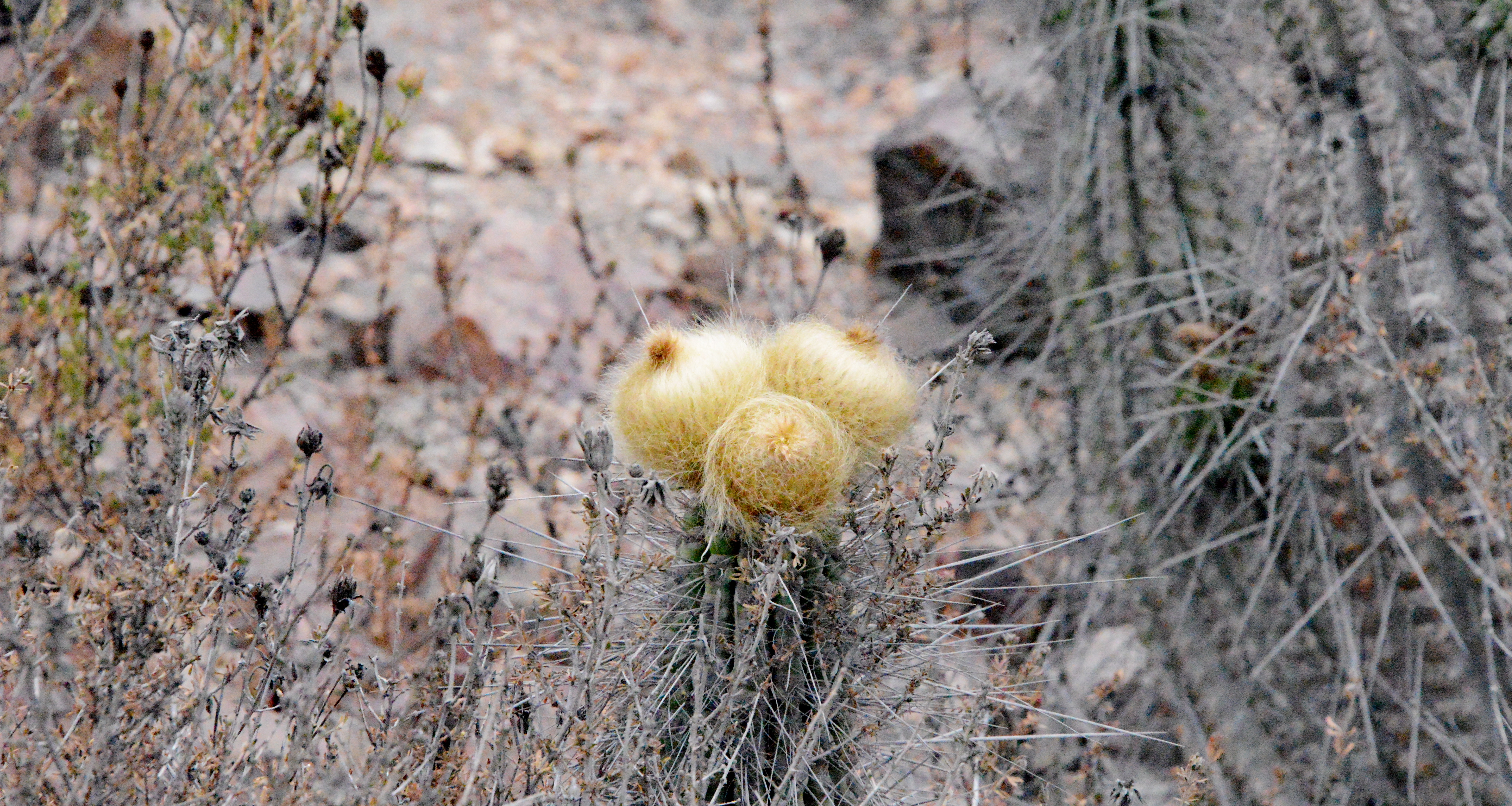
 S2891 - Eulychnia breviflora

S2891 – Eulychnia breviflora

Brendan & I spent much too much time chatting, catching up on various points but eventually had enough images so we headed for Quebrada Mala, now a convoy of 3 cars – 6 people. After a km or so Brendan flashed me and warned that my rear tyre was low. We had our first puncture – the huge nail was clearly visible. Fortunately a ‘Vulca’ (tyre repair place) was just around the corner and the guy had us quickly back on the road for the princely sum of 3,000 Chilean pesos – about £3. Before making him the man of the moment in resolving this incident, I have to acknowledge contributions by JYC and Brendan in liberating the spare tyre from the luggage compartment and removing the punctured tyre and replacing it with the spare before I drove the car to the Vulca.

Back on the road we took the turning in Huasco Bajo for the beach (Playa). We’re all going on a summer holiday….(Cliff Richard song). At Quebrada Mala (S2892), JYC was keen to key out the next Copiapoa into his App but came up empty – no wonder, C. echinata was not recognised as a good species in the NCL, so had not been included in the App. While looking at C. echinata we were distracted by another cactus, although not a Copiapoa: Eriosyce (Thelocephala) odieri. Several small plants were found, together with a few rabbit and guanaco droppings for good measure. I then pointed JYC to the bottom of an arroyo which had its sides covered with more Copiapoa that easily keyed out to C. dealbata on the App.
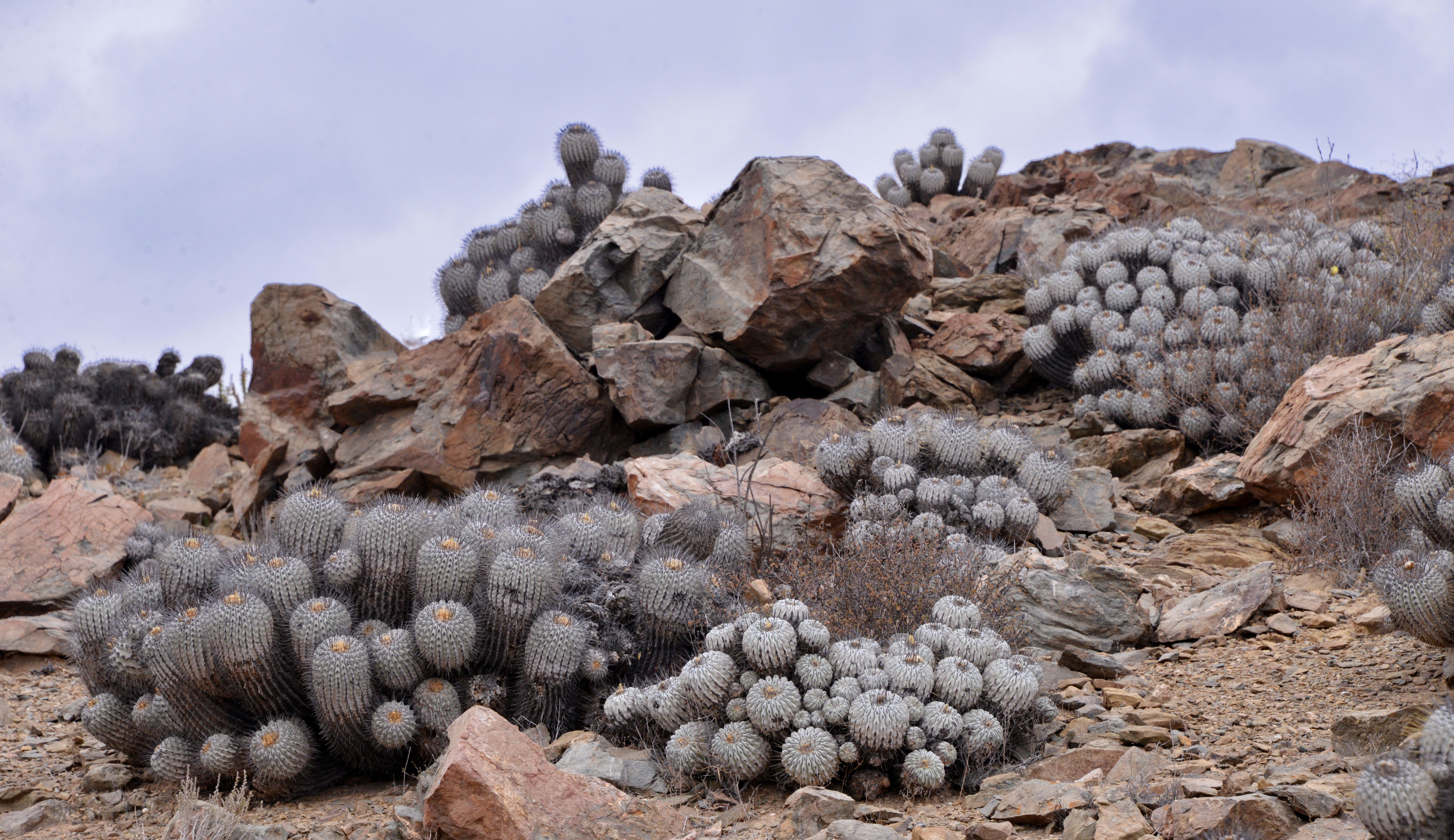
S2892 - Copiapoa dealbata at Quebrada Mala

S2892 – Copiapoa dealbata at Quebrada Mala

Small clumps of Copiapoa megarhiza ssp borealis (syn. C. echinata)

Small clumps of Copiapoa megarhiza ssp borealis (syn. C. echinata)

S2892 Eriosyce (Thelocephala) odieri

S2892 Eriosyce (Thelocephala) odieri

And so we drove on to Carrizal Bajo (S2893 – no cacti photographed) where I recounted some more cactus folklore about our crossing of the sandbank back to town when the tide was in, in 2001.

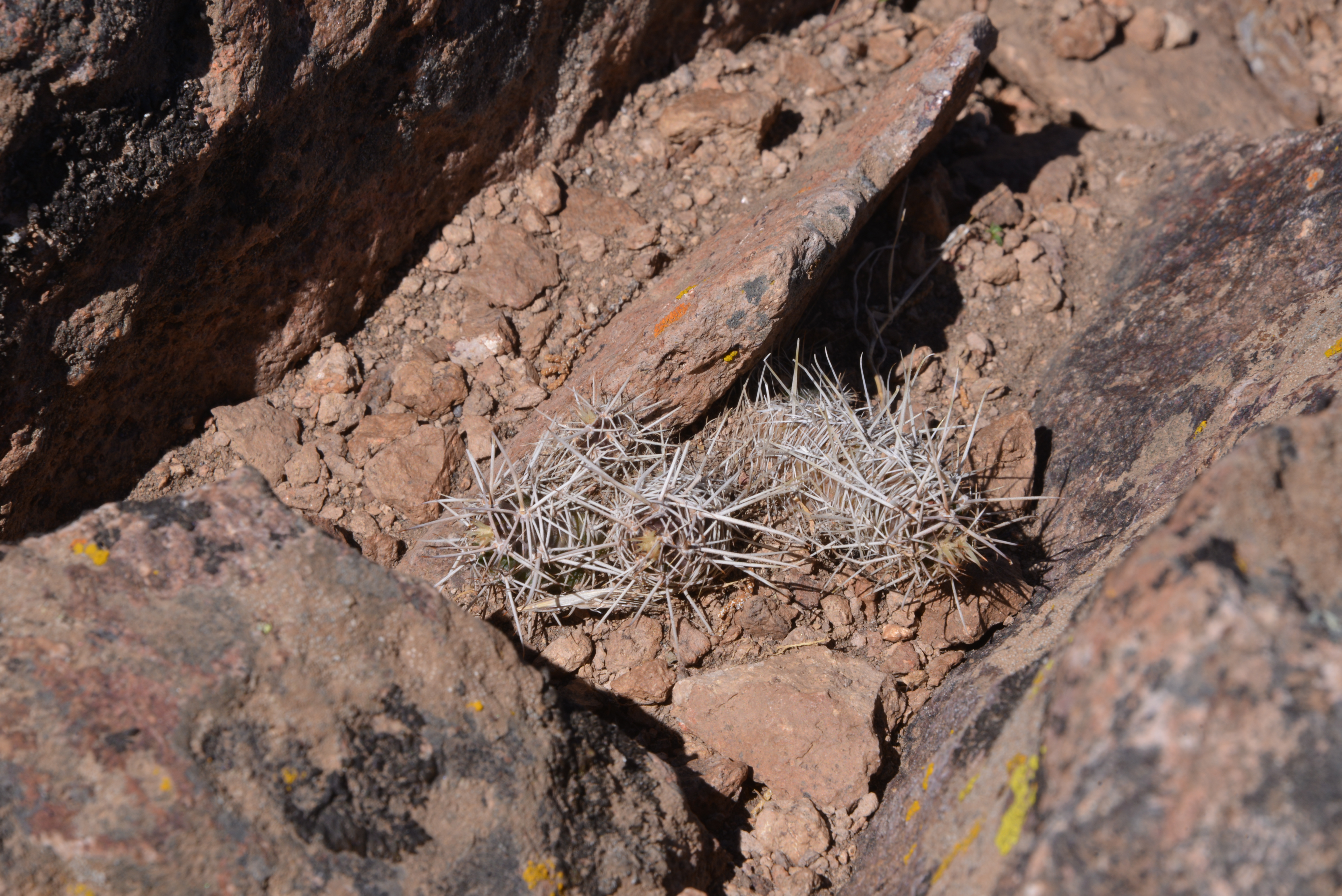
This time we elected to take the new main road and cross the stream over the new bridge and drove another 12 km for another population of C. dealbata (S2894) that included some very nice crests spotted here earlier with Angie.

S2894 - Copiapoa dealbata

S2894 – Copiapoa dealbata

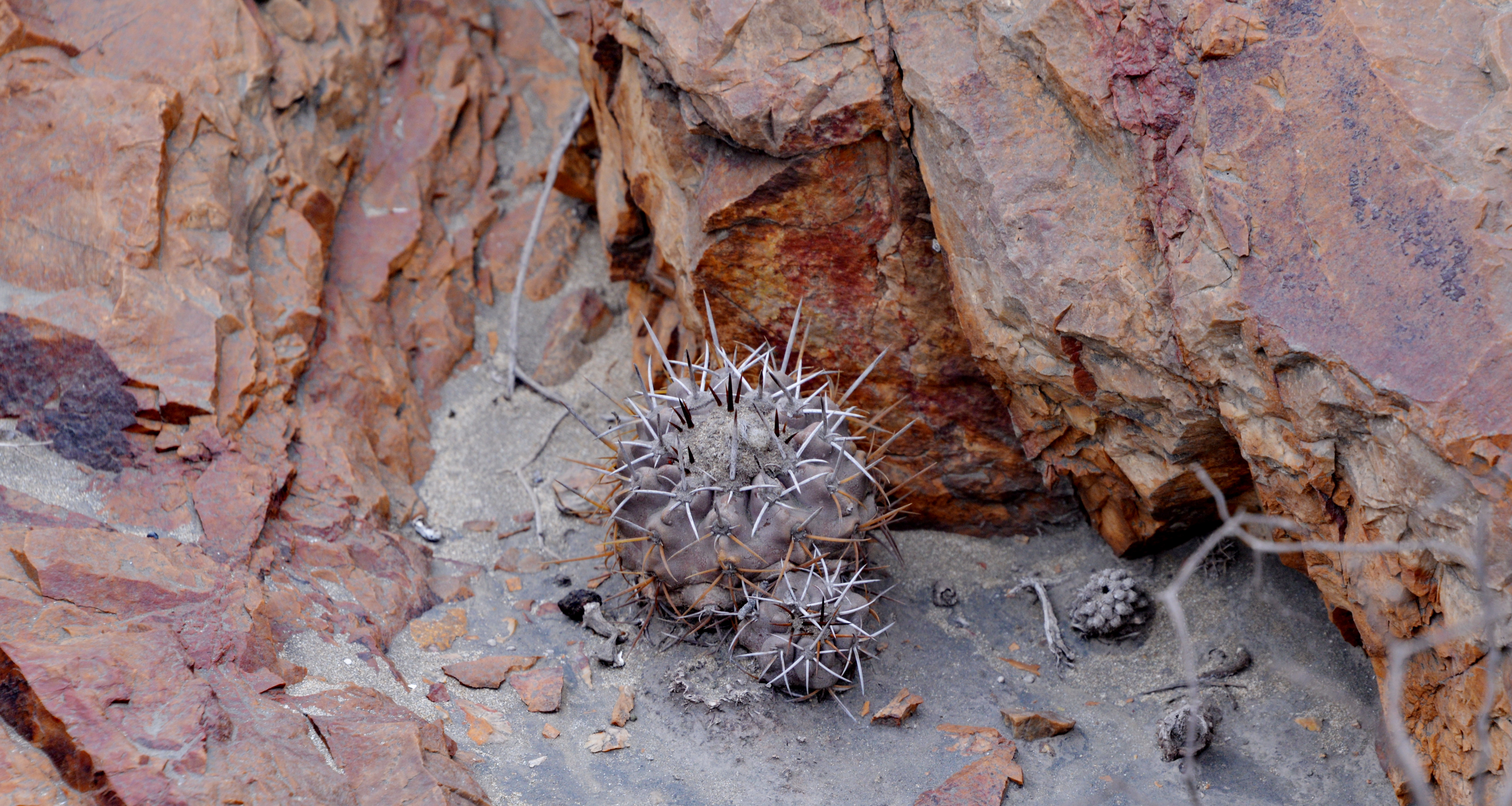
Before moving on we surprised Brendan & Lucy with the the remains of the peach cake that we had bought yesterday – surely that is how all cactus parties enjoy a snack on their trips? Then it was on to the Llanos de Challe National Park S2895) where we wanted to see Eriosyce napina spp. challensis. At the foot of the hill was another Copiapoa that was new to JYC: C. echinoides – another triumph, as it keyed out OK in his App.
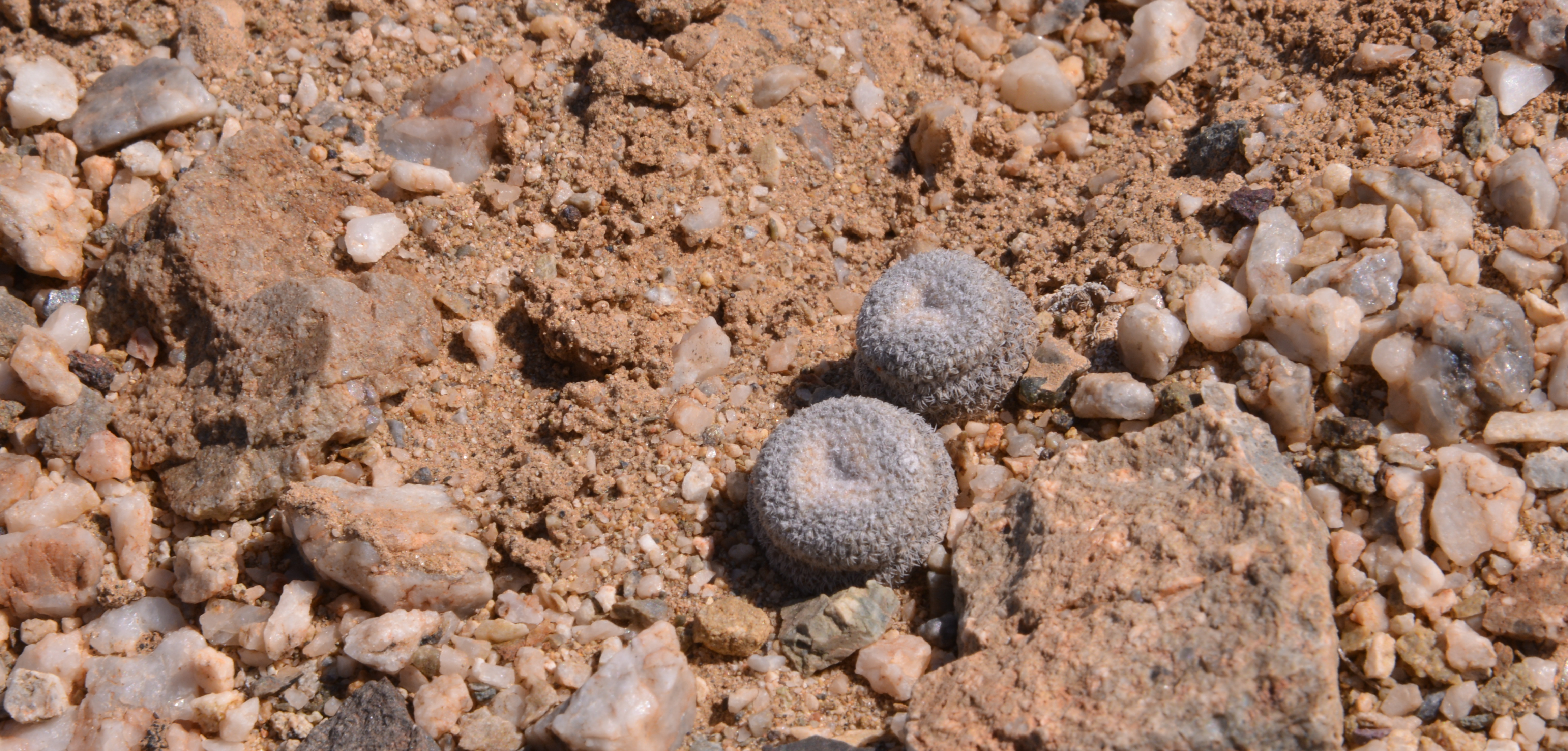
 S2895 - Eriosyce (Thelocephala) napina ssp challensis

S2895 – Eriosyce (Thelocephala) napina ssp challensis

Hot-crossed Thelo:  S2895 Eriosyce (Thelocephala) napina ssp challensis

Hot-crossed Thelo: S2895 Eriosyce (Thelocephala) napina ssp challensis

Time was ticking on and Lucy & Brendan still had to find beds for the night, so Bart & Marijke decided to spend some time on the beach while Brendan & Lucy chose to follow our car as we went looking for a new road to Maitencillo. First SatNav took us right up to Minas Collorados, as new mine to us, but one that seems to be very busy. It turned out to be a dead end at the mine. We followed the track through to R5 where after about a km. we found another track, signposted to Maitencillo, 12 km away. The area was very barren and we did not see any Copiapoa, so nothing too excited.

I was remarkably tired when we got back to the hotel. Unfortunately there were no rooms for Brendan & Lucy here tonight but they found another hotel nearer the centre of town.
Sunday, 3 November 2013 – Guanaqueros to Huasco

I should have mentioned that a shortness of accommodation in Guanaqueros had been solved by Bart & Marijke checking into a large cabana – up to 6 beds, so that after the wine and beers we could have a sound sleep.

The morning plan was shopping at Jumbo – which I thought was in Coquimbo but actually turned out to be in the Coquimbo end of La Serena. We caused a huge queue in the restaurant as we tried to work out what was what and which of these we wanted for breakfast – everybody was very patient and the Chileans behind us gave us a round of applause for persisting with our Spenglish – and for clearing off to our tables.

Past Los Hornos there is a turning to a track to Chungungo that we had taken (in the opposite direction) in 2001. It’s alongside a stretch of R5 where we’ve often admired the camanchaca clouds pouring over the hills and with our regular Los Hornos stop taken out by the road widening scheme, we needed a new spot to take a look at the local Copiapoa coquimbana etc. Bart & Marijke had been up this track in 2012, while I had been in South Africa so could report that the quality of track was much improved. We stopped soon after the coquimbana appeared (S2888) – the first for Jonathan, together with an Eriosyce ‘ball of spines’,and Echinopsis (Trichocereus) some with one side covered in bright red fungi or lichen.

S2888 - Copiapoa coquimbana

S2888 – Copiapoa coquimbana

S2888 - Copiapoa coquimbana

S2888 – Copiapoa coquimbana

S2888 - Copiapoa coquimbana

S2888 – Copiapoa coquimbana

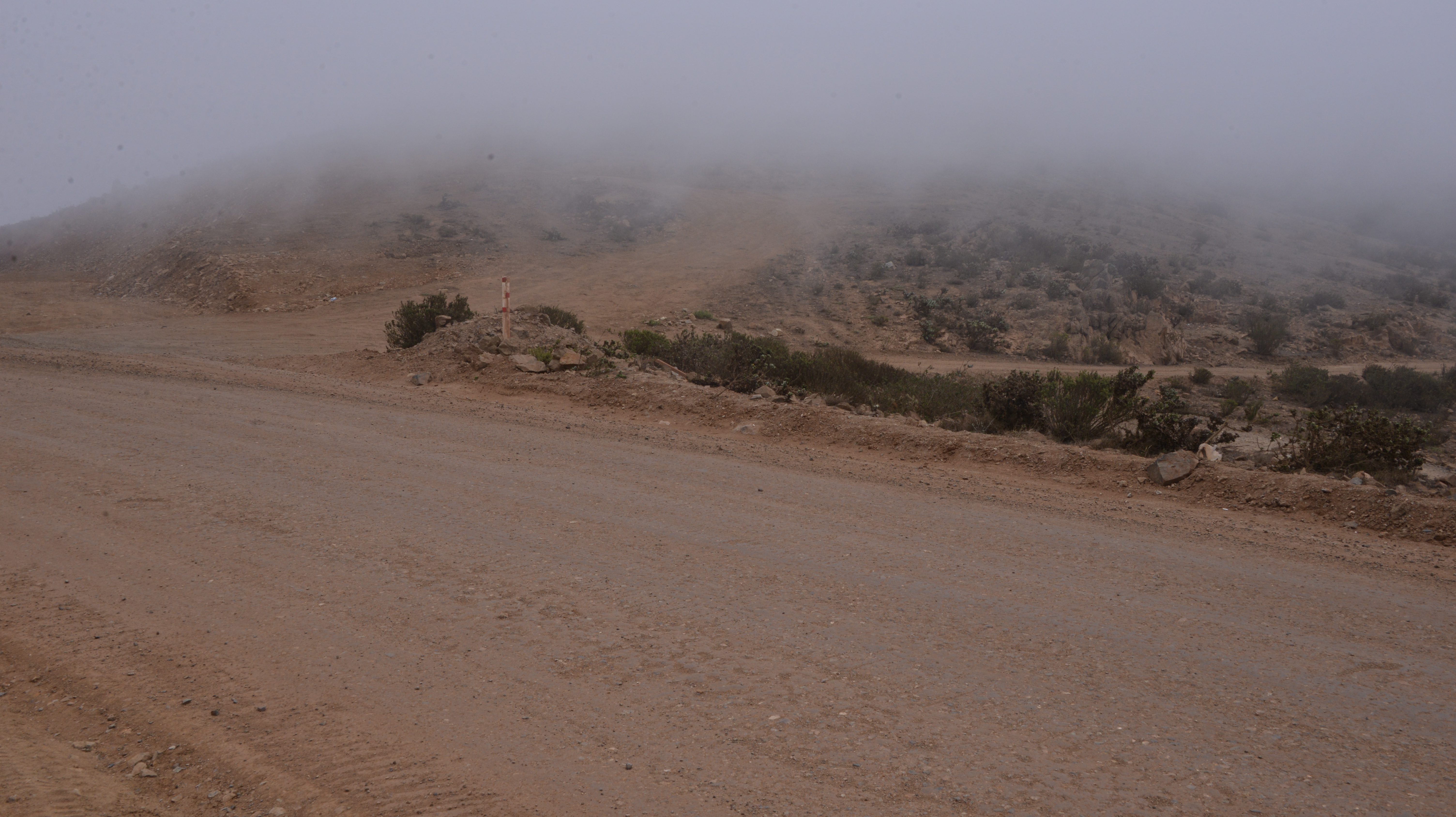
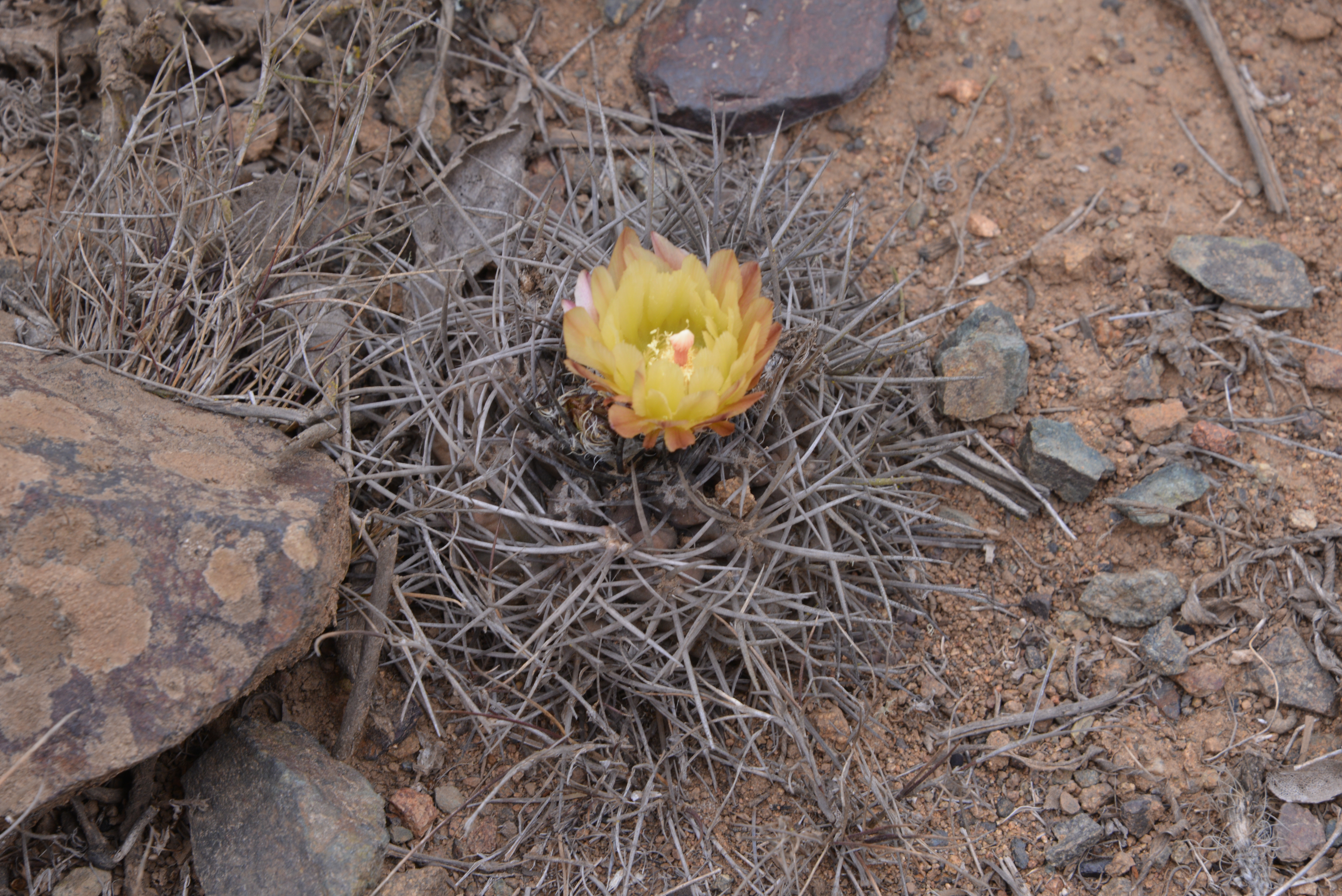
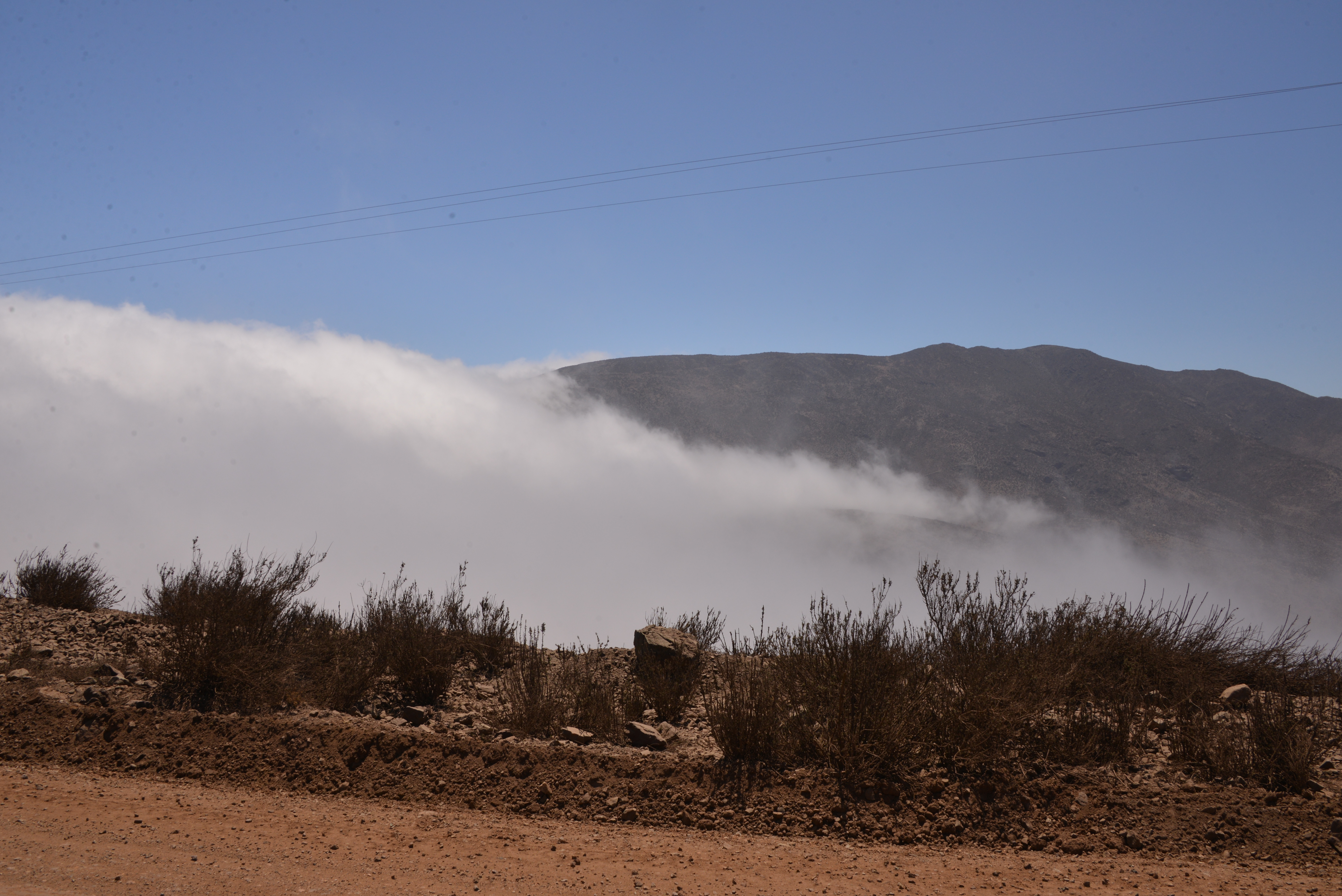
We stopped again a little farther along the road (S2889) as we had now reached the point where the road was about to disappear into the clouds. I’m still collecting images and movie clips for a talk on Fog, so the scenes here were magnificent. There was also an Eriosyce (Horridocactus) sp here, in flower, and different from ‘ball of spines’ encountered earlier. We made several more stops (all still filed under S2889)  to film the fog and arrived safely back on Ruta 5.

S2889 - fog

S2889 – fog

S2889 - Eriosyce sp

S2889 – Eriosyce sp

S2889 - Eriosyce sp

S2889 – Eriosyce sp

S2889 - more camanchaca rolling in

S2889 – more camanchaca rolling in

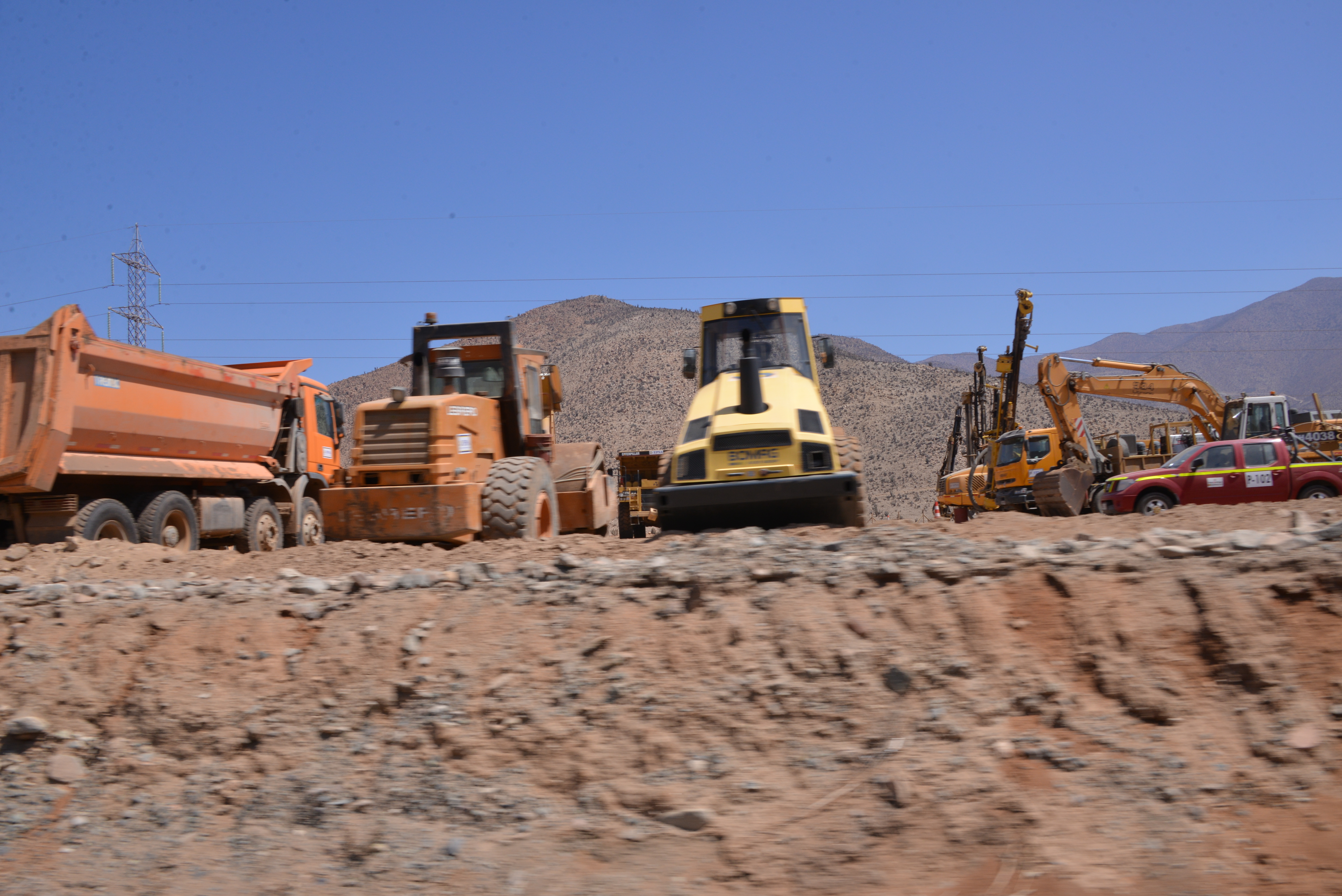
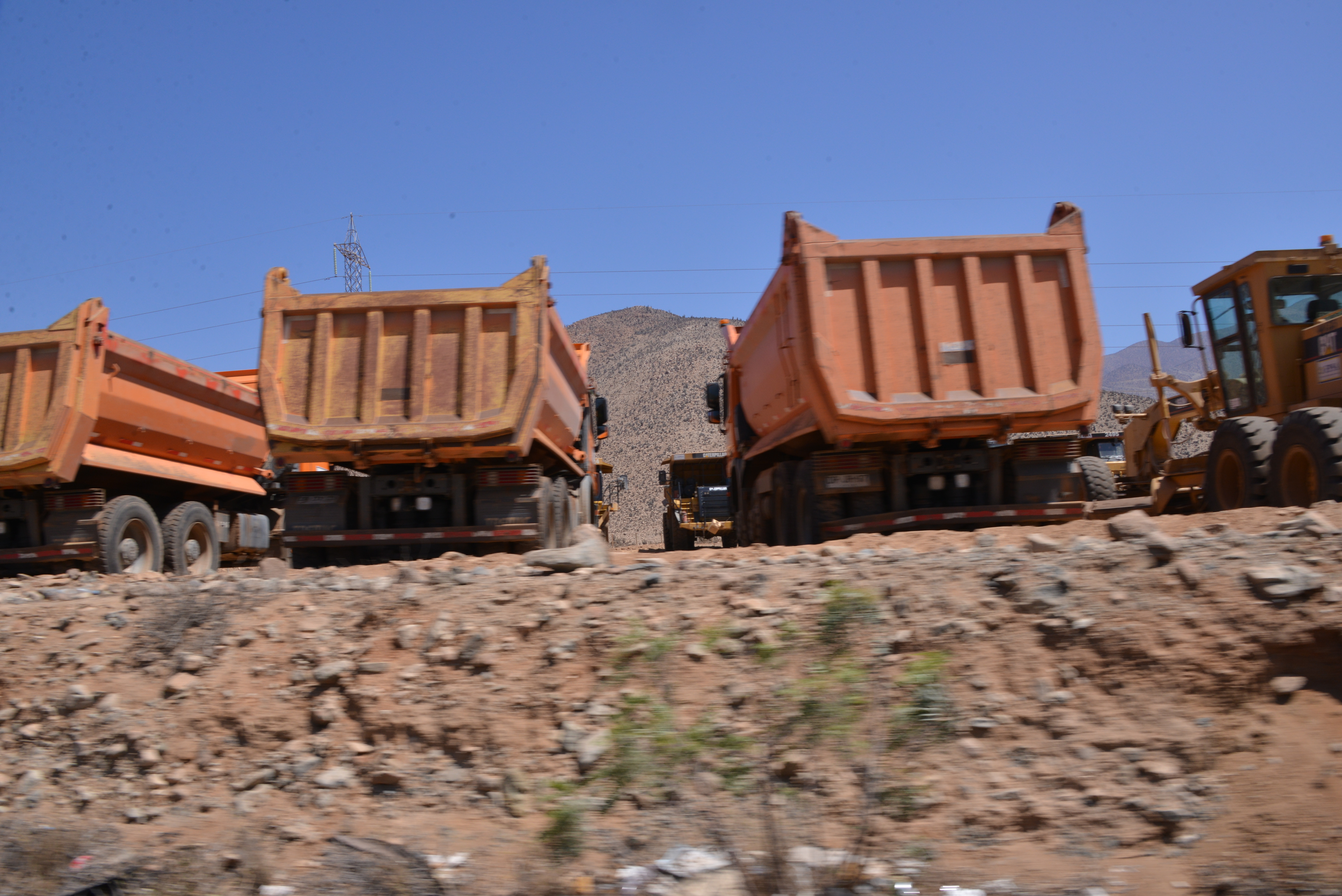
This time I was determined, with Jonathan’s help, to get shots of the lorry park that now sits on the Eriosyce riparia site (S2890) and between us we did a great job, I slowed down sufficiently to give JYC a better shot at things and he clicked the shutter at furious speed so I know have some images of doom. I wonder if the various organisations concerned with the road building scheme were aware of the plants and had arranged for them to have been moved to a safe place. That’s the danger of our phobia to keep plant locations secret so that they do not disappear through collecting – nobody else is aware where they grow and then we cry when a new road is laid right over the top of them!

S2890 - this used to be the habitat of Eriosyce riparia

S2890 – this used to be the habitat of Eriosyce riparia

S2890 - this used to be the habitat of Eriosyce riparia

now it is a car park for trucks and bulldozers, widening R5 – S2890

We got stuck for a while behind a big lorry that was going too fast to manage an overtaking manoeuvre and too slow to not be a nuisance, but made the Vallenar crossroads around 4 p.m. Opposite (south of) the familiar Copec station is a very nice restaurant / snack bar that according to Bart & Marijke had been here for quite a while – perhaps the restaurant that the taxi drivers had meant to take some of to in 2003? They were probably too embarrassed to find it closed and had just dumped the passengers off. We had a very nice large Expresso and not knowing how to order 4 slices of a cake covered in slices of peaches, I had ordered the whole thing – with half of it neatly packed in a cake box for a mid morning snack tomorrow.

While preparing to go out for dinner, I had an email from Brendan & Lucy, announcing that they were in Vallenar, ready to go out for a Pizza. We managed to get hold of them on Jonathan’s phone and have planned to meet up with them at the famous Huasco napina stop around 9:30. And so, what had started as me on my own for 5 weeks in cactus land was growing into a small party of 3 cars with 6 people. Roger & Pam, if you are reading this, there’s room for more!!

Saturday, 2 November 2013 – Santiago International Airport to Guanaqueros.

The alarm went off at 5, and we had an early breakfast as Angie needed to cross the road to the departure’s launch at 6 for her 8 a.m. flight. I joined her for breakfast, saw her off through security and went back for a coffee and to wait for Jonathan to wake up and then collect Dodgy from Alamo.

It all went a bit too smoothly. The car was driven up and presented at the driver’s side and although the tyres were not new, they were certainly good enough to last until the end of the rental period. Until we checked the passenger side. This still had the same tyres that had caused part of the problem during the previous 3 weeks.

Back to the desk for another chat. There were no other tyres available. I had spotted a Nissan Xtrail and asked if that was available. It could be. I checked the tyres, which looked fine. We’ll have it. We had lost the 4×4 functionality but had gained a car with legal and reasonable tyres that would last the remaining 4 weeks.

Eventually, by 12:30 we drove off, 2:30 hrs later than hoped and so there was insufficient time for a look at the cacti at Pichidangui about Jonathan had heard so much. We did stop at the Pronto for a bite to eat and was surprised to see how much fuel was still left. Dodgy had been thirsty!

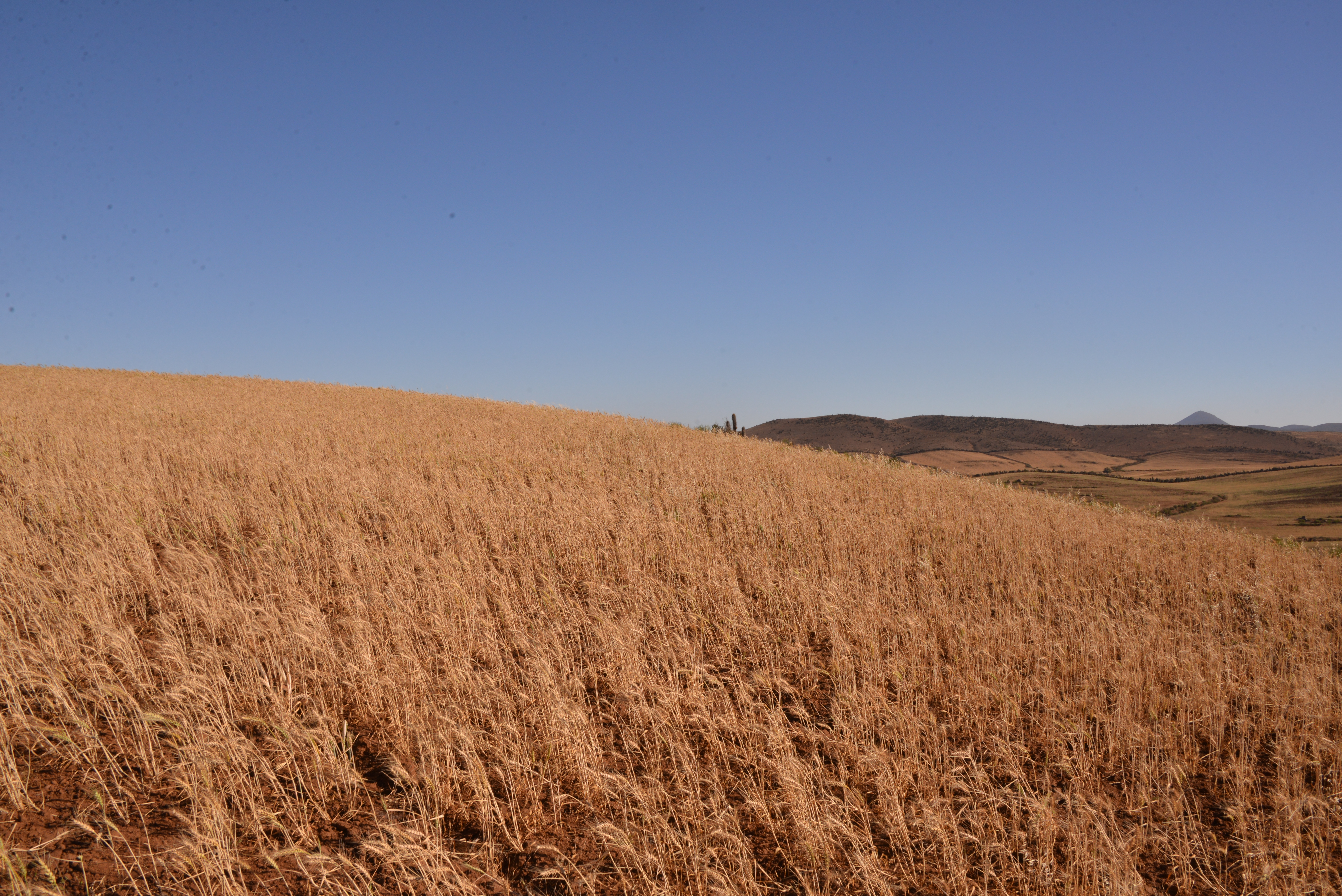
We made Fray Jorge around 17:30 so decided there was enough time for a quick drive along the track to the entrance and stopped (S2887) as soon as I spotted Eriosyce aurata, Trichocereus skottsbergii, and Eulychnia acida in the fields along the road. A quick leg stretch and photostop in a very windy hillside and Jonathan had also been introduced to Cumulopuntia sphaerica and Eriosyce subgibbosa ssp nigrihorrida (= ssp subgibbosa in the NCL – not a bad crop for Jonathan’s first Chilean cactus stop. He needs to be complimented for his understanding for such a brief stop on his first day. We’ll see much more in days to come!

S2887 - track to NP Fray Jorge - grain is now grown on the hillsides where up to 2006 many cacti could be found

S2887 – track to NP Fray Jorge – grain is now grown on the hillsides where up to 2006 many cacti could be found.

We arrived at Cabañas Club Bahia at c 18:55 but were told that he had just rented out the last accommodation. Disappointed, I turned the car round and asked where I might have more luck. That’s when he told me that may be my Dutch friends had arrived and had rented a cabaña that would sleep 4 …..

We raced on to Restaurant Pequeñia and indeed, there were Bart & Marijke, patiently waiting for us – we were 5 minutes late by now.

Tomorrow we would decide on a whether to stay in Huasco or Vallenar.

Friday, 1 November 2013 – Pichidangui to Santiago International Airport

Well, we had not been washed away overnight by any Tsunami, so all’s well that ends well. Officially we could check into the Holiday Inn Express at Santiago Airport at 16:00 but I was happy to try at 15:00 hrs, which meant time for a relaxed breakfast – Angie watched as the Marisco Empanada from yesterday afternoon did not agree with her. We drove very calmly at around 80 km.p.hr. along R5, which was full of holiday traffic with lots of police speed traps monitoring things alongside the road. We went wrong again at the airport, putting more faith in SatNav that insisted that we’d take Exit 16, rather than instinct and signs suggesting Exit 18 was for the Airport. In any event, we passed the Hilton Hotel again so knew we were on a familiar circuit to where we wanted to be.

I went to have a chat at the Alamo desk while Angie was going to have a try at ringing Florencia to announce that we were in town.

After a bit of gentle persuasion, Alamo would change the tyres on the car and I could pick up the car at 10:00 a.m. the next morning. Excellent.

Back in the hotel, Angie was making sense of local codes that may or may not required to ring Florencia. Let’s try it without. Bingo, the housekeeper answered the phone and seemed to be expecting our call as she ran off calling for Flo.

We had also enquired at reception if Jonathan Clark had arrived safely in the hotel and he joined us in reception where after chats about his flight experiences we agreed to all meet up and have dinner as soon after 7 as Flo arrived.

We enjoyed excellent chat over excellent food and wine. Then back to our room where Flo gave a preview of the draft PDF that Flo had brought along of the book that she and Juan had written, a field guide to the cacti of Chile. The book would be ready next week for an official presentation to an invited audience. We agreed to meet up at Flo’s parents place at Lonquen on Jonathan’s last day in Chile when hopefully we might receive a printed copy of the book of which 3,000 copies will be printed.

Angie was dropping off while we finished up, getting ready for her flight early tomorrow morning. Although it was still early, she had set the alarm for 5.

Thursday, 31 October 2013 – around Pichidangui

This was going to be a calm rest day, to use up the spare day in Angie’s itinerary. What better way to spend the morning than to take more pictures of the flowering cacti on the rocks of the Pacific coast at Pichidangui? It would have been better if there had been a bit more sun. We also tried to find the lenscap to Angie’s Nikon Coolpix 8800, that had fallen through the hole in the pocket of her fleece during our previous visit. By late morning even we die-hard cactophiles needed a change of scenery and went on a drive through the Quilimari Valley. We had been through here before and increasingly had found signs of agricultural development with vineyards appearing on the hill. But things here were very dry – no water in the dried riverbed and apparently failed vines on the hill. At one point, the road used to ford the river and herons would stand guard as we drove through, ensuring that we did not steal their fish and frogs. That was in the past. Now the ford was dry and no waterbirds to be seen.

We reached the Embalse Culimo. I did not recall seeing the dam before. Clearly the intention had been to build up a reserve of water to provide a constant supply for irrigation. But the reservoir too was bone dry.

The plentyful Echinopsis (Trichocereus) chiloensis were in flower, but quite a few looked less happy, showing signs of heavy infection of the parasite Tristerix aphyllus. Time will tell if nature can recover here. Today, it all looked rather sad!

The loop returned to R5, at Los Vilos and we decided to have afternoon tea at the beach. In fact, I settled on coffee and some shellfish empanadas – all very civilised. No doubt the weeks to come would involve more cactus explorations.

Back in Pichidangui the streets were as crowded as they had been for New Years Eve; what was going on? It turned out that today was a public holiday – Reformation Day and that tomorrow, there was another: All Saints Day. And so the Chileans had come out to play – crowding into their holiday homes, as Pichidangui’s recent growth is mainly due to holiday homes for the better-off inhabitants of Santiago. Better go to dinner a bit earlier, as yesterday the restaurant had been full up by 8 p.m.

As we sat and enjoyed our last meal together in the newly discovered Restaurant Nautilus, news came on the always-on TV that there had been an earthquake of 6.4 on the Richter Scale near Coquimbo with the epicentre in Guanaqueros, where Angie and I had stayed earlier for our first night in Chile and where Jonathan Clark and I are planning to stay next Saturday, meeting up with Bart & Marijke Hensel. A quick look on the internet reveals that Coquimbo had experienced another similar earth quake during the last 7 days and a total of 14 in the past year, all around magnitude 6.

This one was at a depth of 29 km but the earlier ones had been at 55 km depth. Check out http://www.earthquaketrack.com for details.

According to the waiter, there were no fatalities or major damage. Traffic on R5 was busy according TV images.

As the sun went down, the fishingboats in the bay put their lights on. Are earthquakes not commonly followed by Tsunamis? We are staying in a prime potential tsunami area. The earlier quakes had no tsunamis reported, so we’ll assume the same this time, unless we hear otherwise. No tsunamis are expected according to the news, but coastal areas are keeping an eye out for any unusual signs.

Just now, the internet reports that earlier today buildings swayed in Santiago, but no details at this time. Earthquakes are very common in Chile and we’ve been in some before, notably the 2007 Tocopilla earthquake, when bouncing along the road in our 4x4s we had been unaware of what had happened until we drove into town. That time we drove on to Calama where we witnessed two more quite severe aftershocks – well, my fellow travellers did – I slept through it all.

We are watching CNN Chile, but apart from a regular mention reporting that it had happened, there’s nothing on, with the news focus on the national elections on 17 November,and the news that Barrick Gold has suspended its mining operation at Pascua Lama, but I’m not clear if there is any relationship between the two items or indeed the earthquake.

Tomorrow we drive to Santiago where we meet up with Jonathan Clark and where early Saturday morning, Angie flies back home to the UK.

Wednesday, 30 October 2013 – Uspallata to Pichidangui (Chile)

Today our paperwork for taking the car into Argentina ran out, so we’d better get back. We had finished in Argentina for this trip anyway and have learned that for Andean Alpines we need to come in December / January.

Border crossings where you’re not familiar with the language are always stressful. And we had seen the Christo Redentor Pass, possibly at its most stressful on 31 December 2008 when we had joined what seemed to be the whole population of western Argentina in wanting to cross the border into Chile to celebrate New Year’s Eve on the seashores at Pichidangui. We got stuck in a 12 km queue that did not move for hours. In the end, we just got into the fast lane, overtook all the waiting cars, whose drivers hurled abuse and stones at us to arrive at the front of the queue where we received a severe telling off that went mostly over our heads. We had to turn around and get back to the end of the queue. Yes Sir! Can we just turn round in the space some 100 m ahead of us? Sure! There, another official directed us straight into the ‘crossing borders circus’ where hundreds of people were pushing to take their turns at the five different windows at which we had to present our papers.

So today we arrived back to cross back to Chile at the tunnel through Aconcagua, the highest mountain in the world outside of the Himalayas. We reached 3,400 m and only left the car to participate in the circus called immigration & customs. Slight hiccup as the dear lady at the ‘import the car from Argentina back into Chile’ window could not find Paso Icalma, where we had entered Argentina, on her list of border passes. ‘Update your list’ came to mind as a reply, as she did not speak or understand English. Her colleague had a much better idea: just accept the formal customs stamp on the paper work at Paso Icalma, I’m sure that if they can do this, they must be on the list. Well done!

The drive up & down the hill and the passage through the tunnel is always impressive, scenery wise. Angie was using my camera to take pictures. There were car wrecks that I’d be worried to even take to the shop on the corner who were attempting the climb & descend. Some were left steaming at the side of the road.

Back in Chile, it took ages to drive out of the clouds. In fact, by the time that we booked into Hotel Rosa Natica in Pichidangui, we were still under a thick layer of low cloud and in a light drizzle. So much for Chile in spring time. We hope for a sunny day tomorrow.

Tuesday, 29 October 2013 – around Uspallata

Yes, last night’s dinner at El Rancho’s in Uspallata was as good as I remember it from previous occasions. A rib-eye steak, twice the size, including thickness, as any steak that I have enjoyed this trip, with a nice Malbec, La Chamiza 2012 Reserva, to wash it all down with. Angie’s stomach had been a bit of colour, so she had a Cola, leaving me to drink the whole bottle on my own! It’s a hard live! Fortunately, the restaurant was only just round the corner from the Los Condores Hotel, so I did not have to stagger too far!

Today, I had promised to show Angie Maihueniopsis clavarioides in nature, at a spot were I had been before in 2008 and 2010. Although it is a very small population – we’ve never seen more than a dozen or so of the plants – it’s quite easy to find off the road north out of Uspallata, following the Andean foothills north, until the barely visible remains of an Inca settlement at Tambillos was seen on the west side of the road. The M. clavarioides grow across the track, less than 10 m. from the road. Easy. So I had left GPS details etc back at the hotel as we set off on a lovely sunny morning, still chatting about the devastation caused by storms in Europe during the night. Peter reports that everything at home is fine – just lots of rain, what’s new?

As soon as we had left town, there were changes. The road that I thought that we should take had a devisio – diversion, umleitung, omleiding, it doesn’t matter what language, such signs often spell trouble! Once we rejoined the road, it was wonderful, fairly new hard top. But there were many more trees around than I remembered. We drove a dozen km. and everything felt ‘wrong’ so we headed back to town and ignored the divisio sign, heading straight north instead of doing so after the turn west. We now drove through scenery reminiscent of a Dutch country road with poplar trees, in fresh green young leaves, along either side of the road. Once we had left the stream that had provided the water for such lush flora, the road turned east, rather than west. we were now heading for the next string of mountains. Never mind, these would have Denmoza rhodacantha growing on them that Angie compares to lovely red teddy bears. We soon had found a hillside full of them, parked the car and got the cameras fired up. Plenty of plants, quite photo genic, with the snow capped Andes in the background and some lovely white fluffy Andean clouds in the sky. 

Amazing how variable these plants were – Angie found one youngish (10 years old ?) plant, that she first thought might have been a Gymnocalycium, but the red bud soon confirmed it as yet another Denmoza.

Also at the stop, and more at the next stop, were very dehydrated clumps of Maihueniopsis hypogea. Well, at least it prevented the second stop from being a ‘no cactus’ stop.

With the Denmoza having satisfied our immediate need of exercising our shutter fingers on the cameras, we headed back to town where, after consulting Google Earth on the internet, I found the exact location of M. clavarioides – just a few km. farther along than where I was having doubts about the exact location. We set off again, this time with my other hand held GPS unit and after a brief stop at the Uspallata tourist information stop to obtain a local map. Had the ladies ever heard of the Inca ruins at  Tambillos and did the new track still go past there? Blank faces, while they took it in turns to answer mobile phone calls from friends. There is no such place – they told me – until I found it on the map, pointed it out and left them embarrassed, probably only until their next mobile call. Everywhere else in Argentina these Tourism kiosks have been manned by extremely friendly, helpful and knowledgeable people. I guess that in Uspallata, people only pass through, from the near by border with Chile. They also rapidly lost interest once they realised I was not about to purchase an adventure day out for some white water rafting.

Now, with renewed confidence we headed back into the desert, after passing through the tree lined track. There was a new concern though. In 2008 and 2010 the plants grew close to the track. Now, that track had been replaced by wonderful asphalt. Would the plants have survived this? About 2 km before Tambillos the usual disastrous sign marking the end of the paved road appeared. In our case I cheered – they had been saved from roadwork destruction! Or had they? The ripio had clearly been widened and opposite the fenced off area that is Tambillos, there is know a nice car park and a new aquaduct taking water safely underneath the road at the rare times of rainfall. By my reckoning and that of the GPS, these works had destroyed the population that we had so admired before. In a state of denial we searched for nearly two hours. We did find all the other plants found here on previous occasions: four Eriosyce (Pyrrhocactus) strausianus, more Maihueniopsis hypogea, looking extremely dry, and even a small Pterocactus reticulates.

In the end we gave up, with a note of optimism that perhaps it was just too dry and that all the plants were there but had shrunk into the ground.

Nothing left but to go back to the hotel and to prepare for our last night in Argentina in 2013, back at El Rancho, for another rib-eye and another excellent bottle of wine – somebody has to do this!

But not before reporting another success story. As you will have read on previous pages, although we had been very pleased with our rented car, a Dodge Durango, that was extremely comfortable on asphalt, we had been more than a little critical of the tyres that had little or no grip and made the car bounce around dangerously on the ripio tracks.

This morning I thought I’d drop a line to the .rentalcars rep who had arranged an excellent deal for me for cars on this trip and later in LA, Baja California and Mexico City. I explained the issue, the fact that the number I had called in Chile only had a Spanish speaking person answering. We had both been fluent, but unfortunately in different languages. Our rep, Dylan, had an automatic reply email to say that he would be back in the office at noon, UK time. Before setting out for our afternoon session, he had replied to say that the rental company would take the car on arrival at Santiago Airport, where we are staying on Friday night and after Angie flies back to the UK on Saturday morning, they would deliver the car with some legal and proper ‘wellies’ for the remaining 4 weeks of the holiday. What a relief and an experience that fills me with confidence for the remaining trips. No one can guarantee that nothing goes wrong on these trips, but when things do go wrong, it is how they are resolved that sets the standard of the quality of service which here was far exceeded. Many thanks, Dylan!

Monday, 28 October 2013 – Malargüe to Uspalata

Continuing the theme from previous days’ reports, I must start with a brief account of dinner, that more then made up for the disaster of the previous night: we enjoyed a rib-eye steak – rare, with all sorts of Argentinean side thingies – spiced tomatoes, squashed potatoes etc according to their Google translate menu, washed down with a bottle of Trapiche Malbec Reserva 2011, from Mendoza of course, that just hit the spot. Excellent!!

Today was due to be a driving day with the choice between 469 km on asphalt (according to the map) or 398 km of which at least 100 km would be on ripios. The most significant consideration were the tyres – already in a poor condition, I did not want to expose them to more slipping & sliding. So I decided on the longer way round, saving lots of time – in theory. I had failed to include a drive through the town of San Raphael, where the main highway went straight through town, with traffic lights every hundred meter, that all seemed to conspire in being red, except for the one where a white van man had broken down right on the crossroads.

The road went away from the Andes so that we were driving through some very uninspiring flat terrain. For those who have seen my Namibia & South Africa presentations, think of the most boring 500 km of road from Windhoek to Keetmanshoop. This had some saving graces: during the ‘I don’t believe there are no cacti’ leg stretch, Angie found one (1) Maihueniopsis darwinii (?) and just before San Raphael (we seem to have missed the San Raphael by-pass) the road went through some hills with nice twists and cacti visible, even at 80 km.p.hr. We stopped to photograph Echinopsis (Lobivia) huascha (?), Opuntia sulphur, a Pterocactus and Denmoza rhadacantha, showing off its peculiar flowers. Then it was back to flat agricultural land with a few tractors and local trucks, in such poor condition that they held all the through traffic up.

Things speeded up once we were back on RN40 and became interesting once we climbed along RN7 towards Uspallata at 1,900m and with just 85 km to the Chilean border. But we’ve stopped off at Uspallata for tonight and tomorrow night with a look around the local cacti on Tuesday.

We’re just off to visit a few of the restaurants where we enjoyed great steaks & Malbec in previous years – yes, there is genius behind my madness!

Sunday, 27 October 2013 – Chos Malal to Malargüe

You may remember that I left you yesterday facing the task of appeasing Angie after a ‘no(t enough) cacti’ day. But a larger challenge awaited us. Just round the corner of the Hotel was Restaurant Petite that on Friday night had served up an excellent meal (fillet steak & mushrooms for me). And that, after I had read on the Lonely Planet website:’For a good meal in pleasant surrounds Chos Malal doesn’t have a whole lot of options’, so we were pleasantly surprised by our discovery and I had every intention, after another great meal tonight, to give the tiny restaurant a great write up on Lonely Planet. We had checked to see if she’d be open on Saturday night and she replied in fluent Spanish: ‘yes of course, starting sometime between 20:30 and 21:00’. Excellent, sorted! So last night we rolled up at 20:50, but everything was shut, no lights on. Ah, well, we must be early. Let’s take a stroll around the block.

We arrived back at 21:05 to find the owner watering the pavement in front of the Restaurant and the surrounding plants. We greeted her all smiles, looking forward to another feast. Again, she was fluent in Spanish, most of which went over my head but by the tone and hand gestures we understood. ‘Sorry, I don’t feel like opening up tonight – we’re closed.’

So, where do two hungry tourists, not familiar with the local language, get a meal late in the evening. As some of you may know, I’m diabetic and do need my food at regular times – no food was not an option! Would the muesli bars that we had in the room be enough? Back in the room we consulted the internet again. There was just one Restaurant listed, but as we walked into town, we found many of the ‘streets’ being in the progress of refurbishment, with street furniture such as street names missing. We had reached the Plaza without having found the necessary road to the right. There was another long queue at the fuel station – favourite pastime is queueing for fuel, even when there seems to be no apparent reason for it? The Fuel Station had a snack bar that advertised empanadas. That was better than nothing – except: they had just run out. The girl serving was highly embarrassed and with as much English knowledge as we spoke Spanish, signalled us to follow her. We struggled to keep up as she took us a few houses up the road where, next to what we had assumed to be a clothes shop – shut – there was a door to a room where a man was folding cardboard boxes. She explained our need for empanadas. A head poked round the corner and with the help of the girl’s best English, we ordered a cheese and a meat one each – a real Saturday night feast! With a muesli bar as afters and a can of Quilmes beer, our feast was complete. I hope the owner of Restaurant Petite had a rotten evening!

After a good night’s rest and breakfast we were off. Angie was familiar with the 2010 group photo of the four of us posing behind a huge mound of Maihuenia and I had established that this would be on the 145, off RN-40 quite close to Malargüe – just some 70 km each way. So let’s go and take a look. I had also loaded some locations of the day in 2010 into SatNav, but without Argentine mapping, it could just tell us how many km. away it was, in a straight line – 110 km. We also had location data for a new discovery of Denmoza rhodacantha found for the first time (?) outside the Province of Mendoza. So I was quite confident that Angie’s hunger for cactus images could be satisfied.

Again, it was a wonderful sunny day. The lined trousers and jumpers packed for this trip were just spare luggage – bet it would have been freezing if I had left them at home!

After just over an hour I needed to stretch my legs (S2874). There was a low hill alongside the road and it reminded me strongly of a 2010 location (S2097), the one that we were looking for, 110 km away!

Soon I stumbled across small clumps of what we had called Maihueniopsis darwinii in 2010 but that taxon is limited to Santa Cruz Province, so this time I’ll use the suggestion from others that it is Maihueniopsis glomerata ssp hypogaea . I called Angie over and we happily snapped away as more clumps were found. Next success: a kicked out stem of Austrocactus! OK, it had been dead for quite a while, resembling plants in my collection back home in the UK – but where there is a dead plant, there may be live ones? But first, I stumbled over a small clump of Mauhuenia patagonica, then another and another, each larger than the previous one. Great! Two out of the three species that I might have hoped for, plus a dead example of the third! So the search was on for the Austrocactus, it just had to be here. Eventually the search was rewarded with a plant, some 15 cm (6”) tall. Not only was it alive but it had 4 small buds and signs of new growth at the apex. One thing was sure – they were not abundant! We managed to find two or three more plants and were about to return to the car, happy with our booty of cactus images when I stumbled across Pterocactus – probably P. fischeri, if that is an accepted name these days. Quite a few of them and some in bud. A really great stop for Patagonia after the long period lacking cacti.

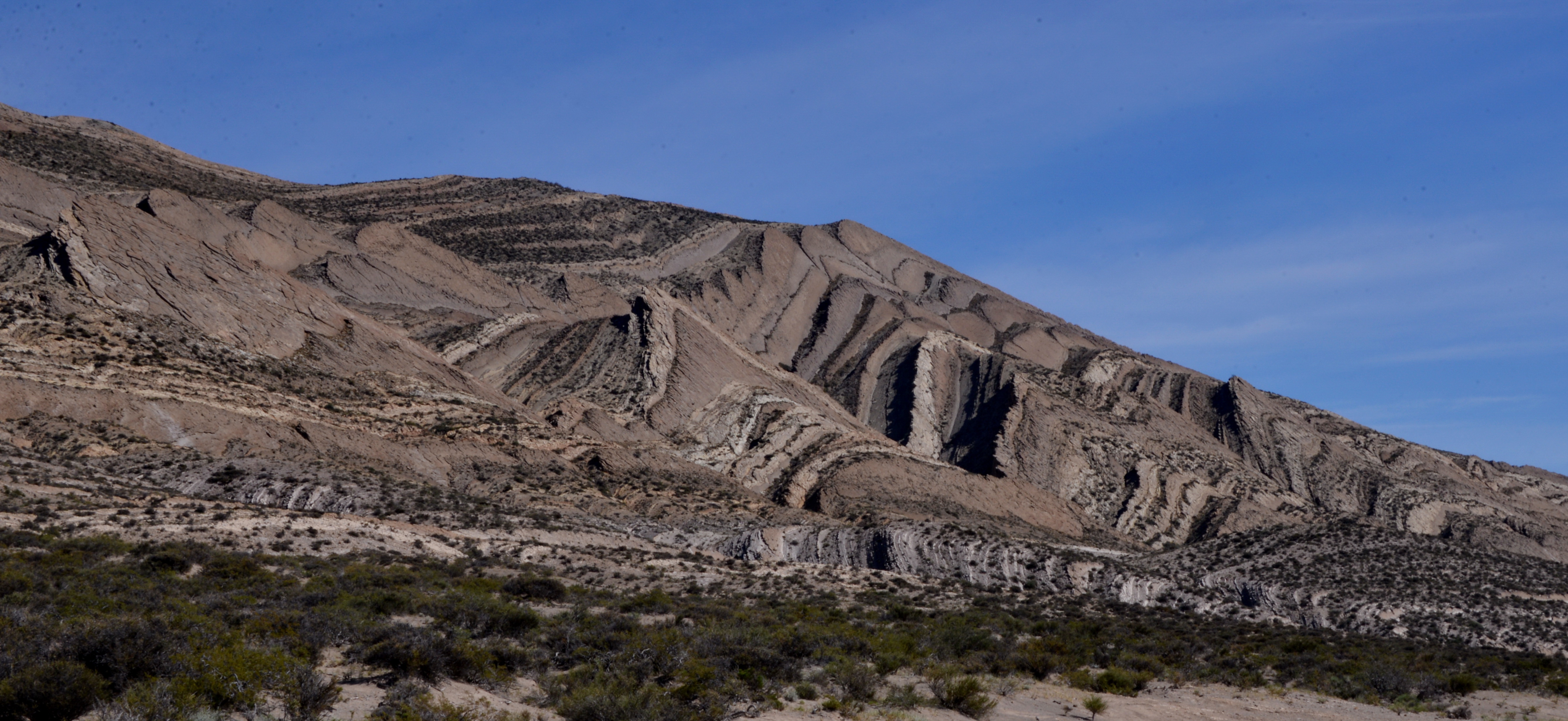
This attractive geology prompted S2874

This attractive geology prompted S2874

Pterocactus sp. showing off its underground tuber

Pterocactus sp. showing off its underground tuber

Pterocactus sp - two plants? more likely two stems from a single tuber

Pterocactus sp – two plants? more likely two stems from a single tuber

Pterocactus sp.

Pterocactus sp.

Austrocactus bertinii

Austrocactus bertinii

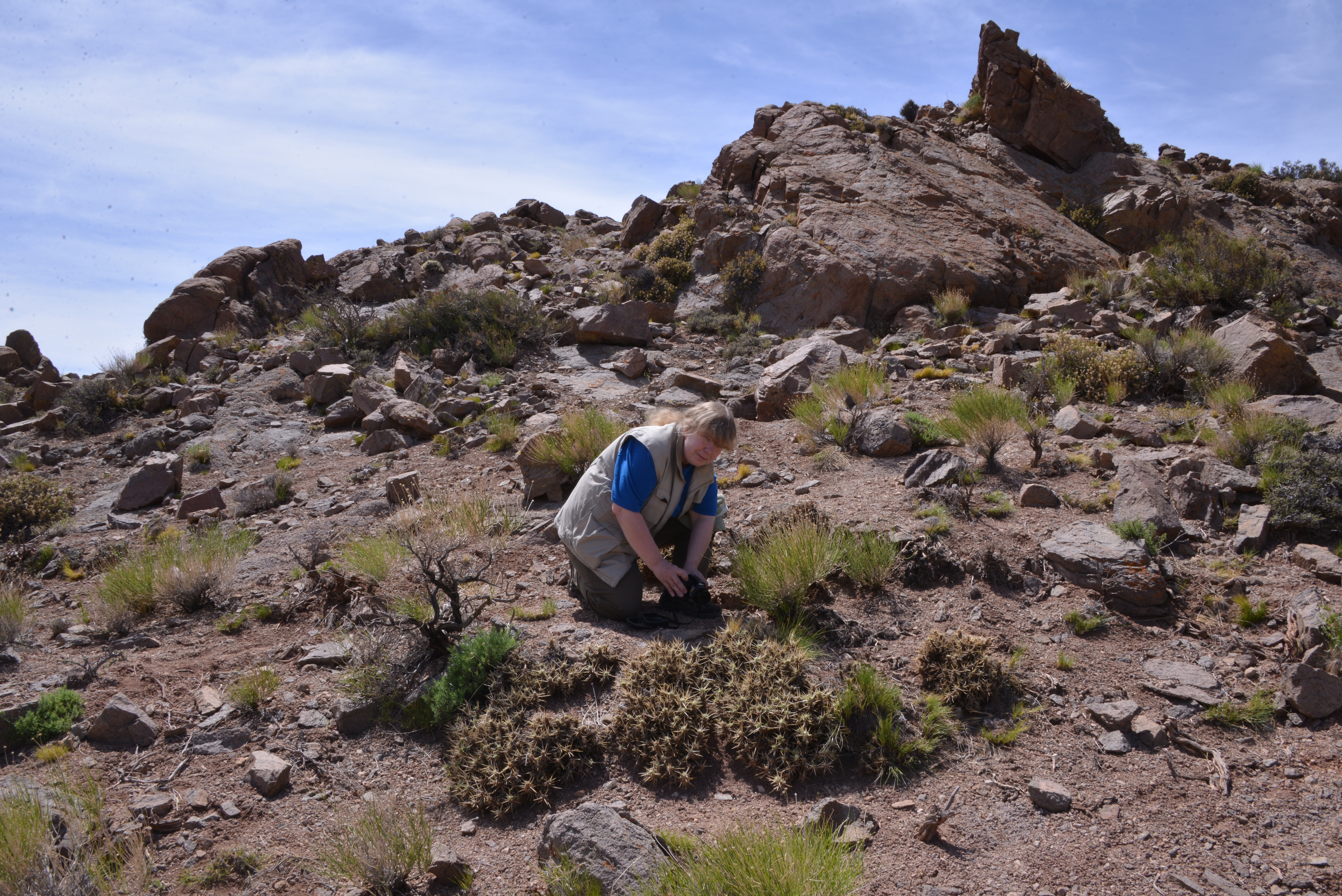
Angie and Mahuenia patagonica

Angie and Mahuenia patagonica

Maihueniopsis glomerata subs. hypogaea

Maihueniopsis glomerata subsp. hypogaea

We were still excitedly talking about our finds when we crossed a river. Was this the Rio Colorado that formed the northern border of Patagonia? The sign at the bridge said Rio Barrancas. According to our tourist map, we had already passed Buta Ranquil, where without noticing it, we must have crossed the Rio Colorado.

We crossed from Neuquen Province into Mendoza and now had time and fuel budget issues. There had not been a fuel station since we left Chos Malal, with 334 km to go, on a tank that showed nearly full when we left. That soon dropped and although we should have plenty to get to Malargüe, it made it less certain if we added the 2 x 75 km for the excursion to the Maihuenia mounds along ruta 145. Nature provided a helping hand by sprinkling the hillsides, right along RN40, with huge mounds: no need for the detour! (S2875)

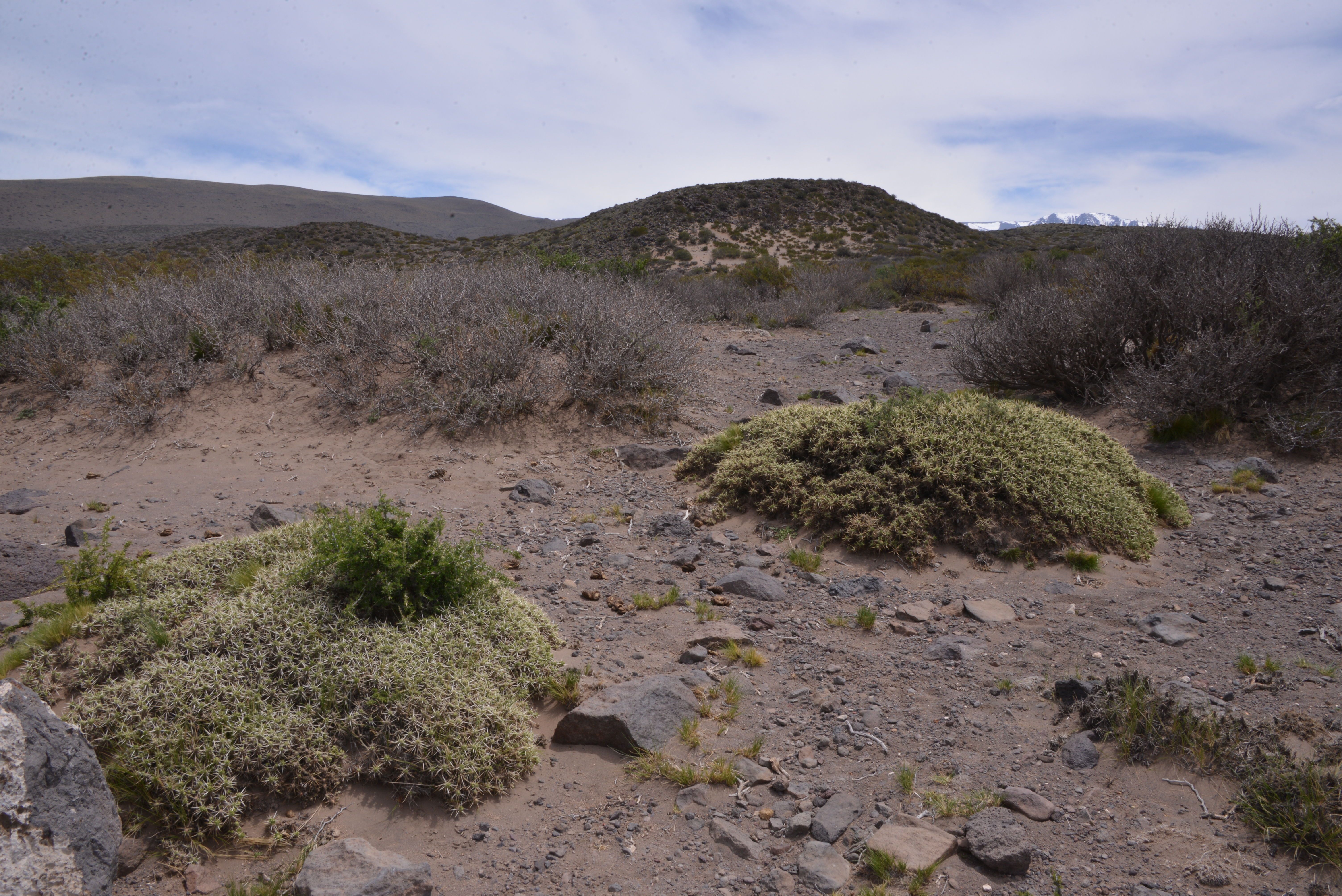
Maihuenia patagonica mounds (S2875)

Maihuenia patagonica mounds (S2875)

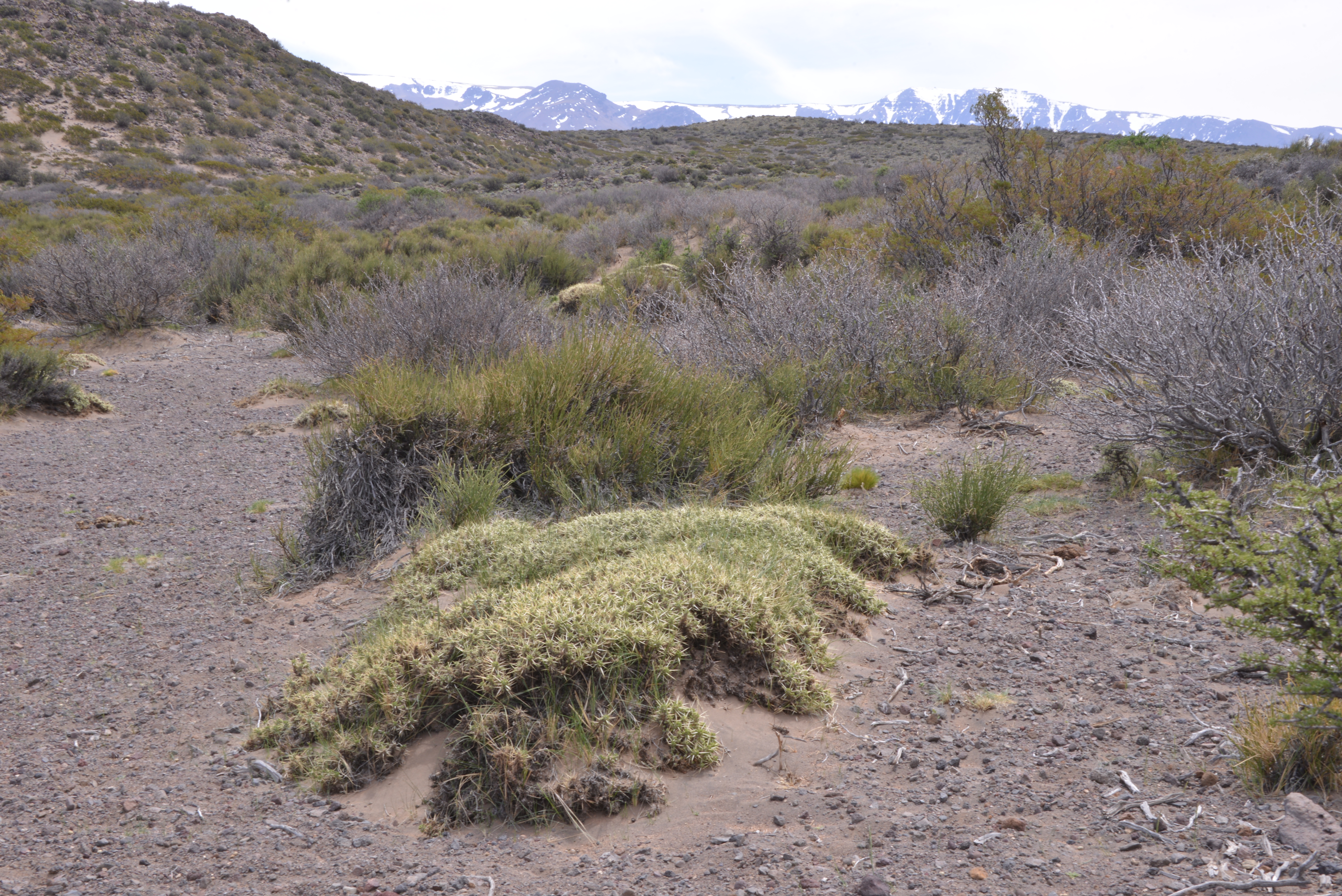
More Maihuenia patagonica mounds

More Maihuenia patagonica mounds

Maihueniopsis glomerata ssp hypogaea

Maihueniopsis glomerata ssp hypogaea

Maihuenia patagonica close up

Maihuenia patagonica close up

More Maihuenia patagonica mounds

More Maihuenia patagonica mounds

Just as well, as soon after entering Mendoza, RN40 turned into a ripio, with a maximum speed of 40 km.p.hr. recommended for our Kojak tyres. The signs of roadworks in progress seemed fairly permanent. Were these still the same road works as in 2010? The signs warned that these roadworks would be with us for 40 km. That’s one hour at 40 km.p.hr., longer, allowing for photo stops. After a short spell of new asphalt it was back to ripio and so on and on. We passed a village with a couple of fuel pumps. Great! But they had diesel only, not recommended for a petrol engine! Nafta would be available in 50 km. Well, that turned out to be 67 km and then we got stuck at the pumps where the driver in front of us left his car blocking the pumps, presumably for a call of nature, returning some 10 minutes later with a couple of milkshakes from the nearby restaurant!

Anyway, we arrived safely in Malargüe. Brand new asphalt started some 20 km before we entered town and the whole town seemed to have benefitted from a facelift since 2010. We headed for the Microtel at the north end of town. The alterations in progress in 2010 were still in the same state, but boarded off in a more formal (semi permanent?) way. Rooms were as comfortable as I remembered them and the bar area, where we enjoyed a bottle of the late Graham Hole’s excellent single malt whiskey (Auchentoshan), still echoed to the voices of Guillermo Rivera’s Patagonia touring party and my fellow travellers. Great memories. Cheers, Graham!

Saturday, 26 October 2013 – around Chos Malal

With yesterday’s cactus count embarrassingly low for a cactus trip, I thought that we’d play it save and repeat the day trip that we made from here in 2010 (6 December 2010), heading into the Andes, to a spot where we would at least see Austrocactus bertinii (?). There was a slight concern when we spotted long queues at the one and only petrol station in town (and for miles around!) but calculated that we had enough Nafta to make it there and back.

Again, the drive to the Andes ‘proper’ was spectacular but after a few hours Angie made the point that ‘spectacular scenery’ was beginning to wear a bit thin. You should try it for a month, like in 2010!

There were various places that I recognised as ‘2010 – no cacti found’ stops, so we drove past them. At Andacollo I spotted no cars queueing at the petrol station. Useful! or had they run out? In 2010, on a day called ‘Petrol Day’ in Argentina, when they celebrate their huge stock of this natural resource, most petrol stations were on strike! Was this a repetition?

We reached Las Ovejas, a charming little village, almost deserted on a Saturday morning. And with a fuel station and an empty forecourt. Let’s give it a try. We were greeted by a lady who gains the award of the most attractive service station attendant found on the trip. Corny chat up lines such as ‘What is a beautiful girl like you doing in a place like this.’went through my mind, but just in time I remembered my age (and that of the chat up line) and though better of it. I could have gotten away with it, as she did not speak a word of English, but Angie had returned from snack purchases in the shop. Anyway – the car’s tank was full to the top. And of course there were no queues when we came back to Chos Malal at the end of the day, but it pays to be alert to unforeseen events.

And so we drove on past Las Ovejas, looking for the sign of the Mirador (viewpoint) of La Puntilla. After too long, the road dropped down to a bridge across the Neuquen River and I knew we must have passed the spot. So this became our turn around spot. Back on the hill overlooking the river valley we decided to have a look around, but, although the area ‘looked right’ no cacti were found.

It remains a challenge on these roads, particularly with numerous road works in progress to patch up the ripio, so when I found a place to pull off, I recognised signs that this was the place. In 2010 there had been a formal car park and a wooden walkway led to the edge of the mountain side and offered a magnificent look onto the Rio Neuquen in the valley below. Except: now the foot path from the car park to the start of the walkway could hardly be seen and the walkway itself had been demolished. It had been a bit rickety in 2010 so perhaps health & safety had caught up with us, even in this remote place. I remembered the area where previously a dozen plants had grown. Gone – replaced by tracks of heavy equipment to demolish the wooden structure and the concrete base on which it had stood.

Concrete base are all that remains from the wooden structure over the Rio Neuquén Valley that we saw in 2010 at Mirador La Puntilla

Concrete base are all that remains from the wooden structure over the Rio Neuquén Valley that we saw in 2010 at Mirador La Puntilla

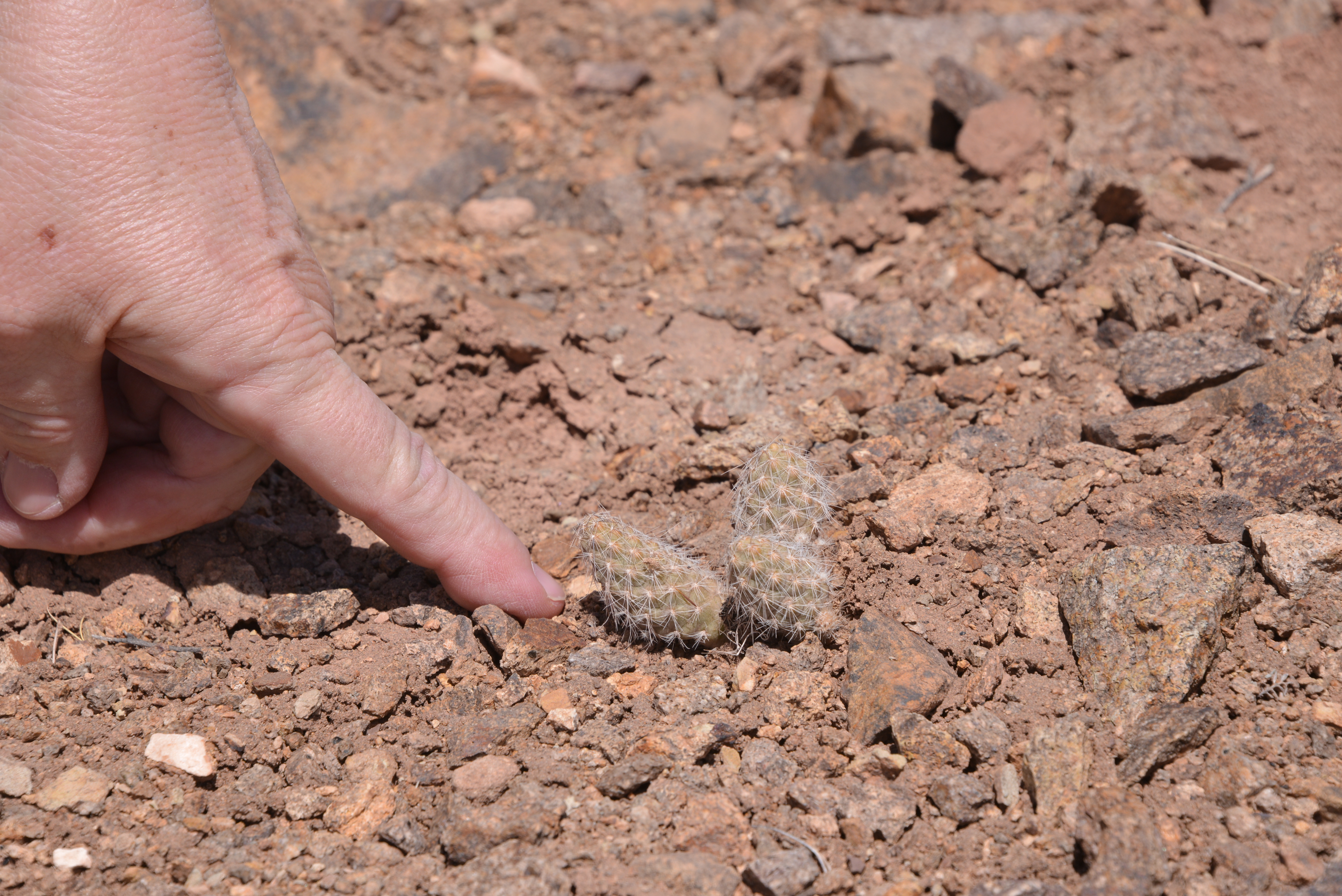
On this trip in Patagonia - if you see a cactus - photograph it!

On this trip in Patagonia – if you see a cactus – photograph it!

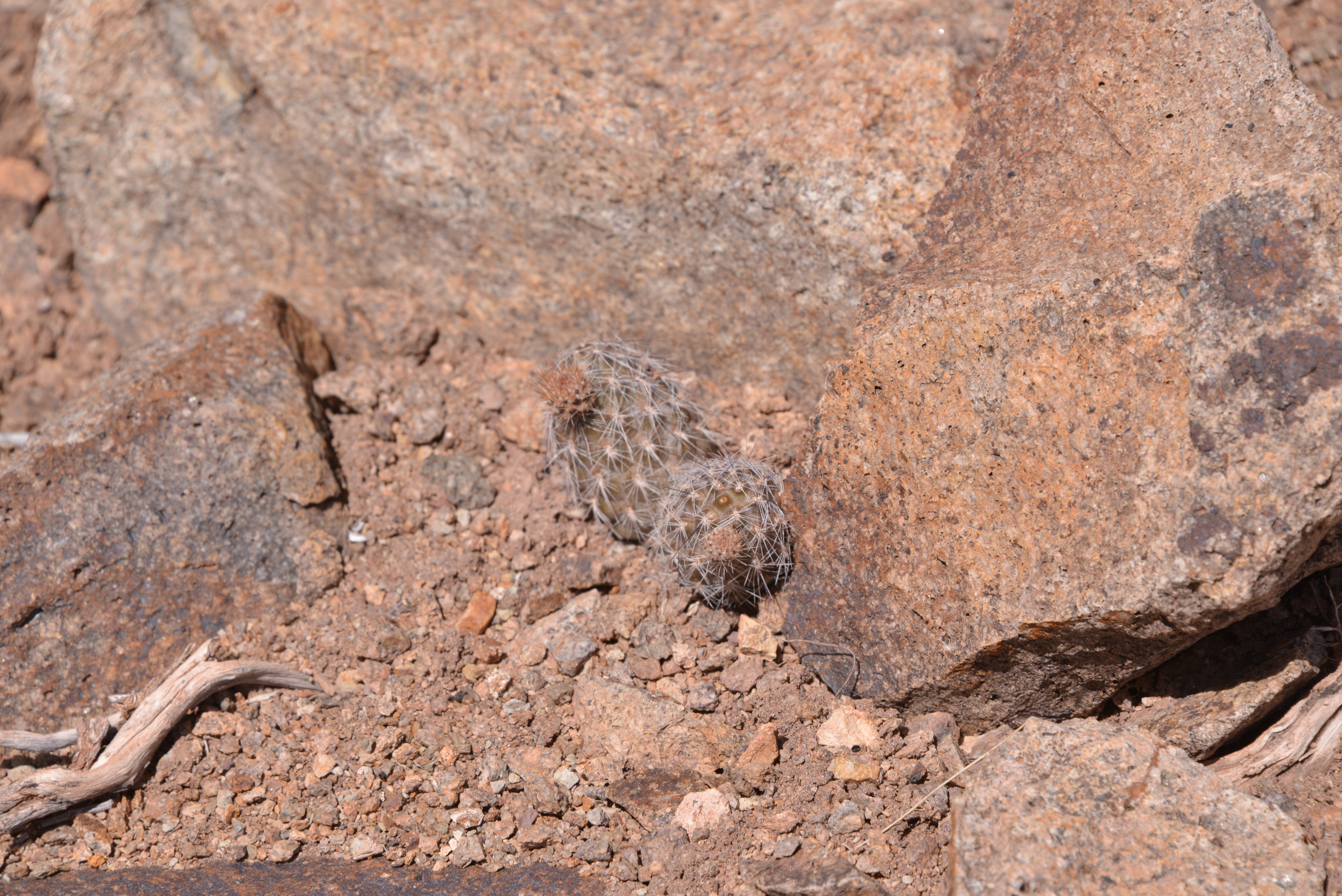
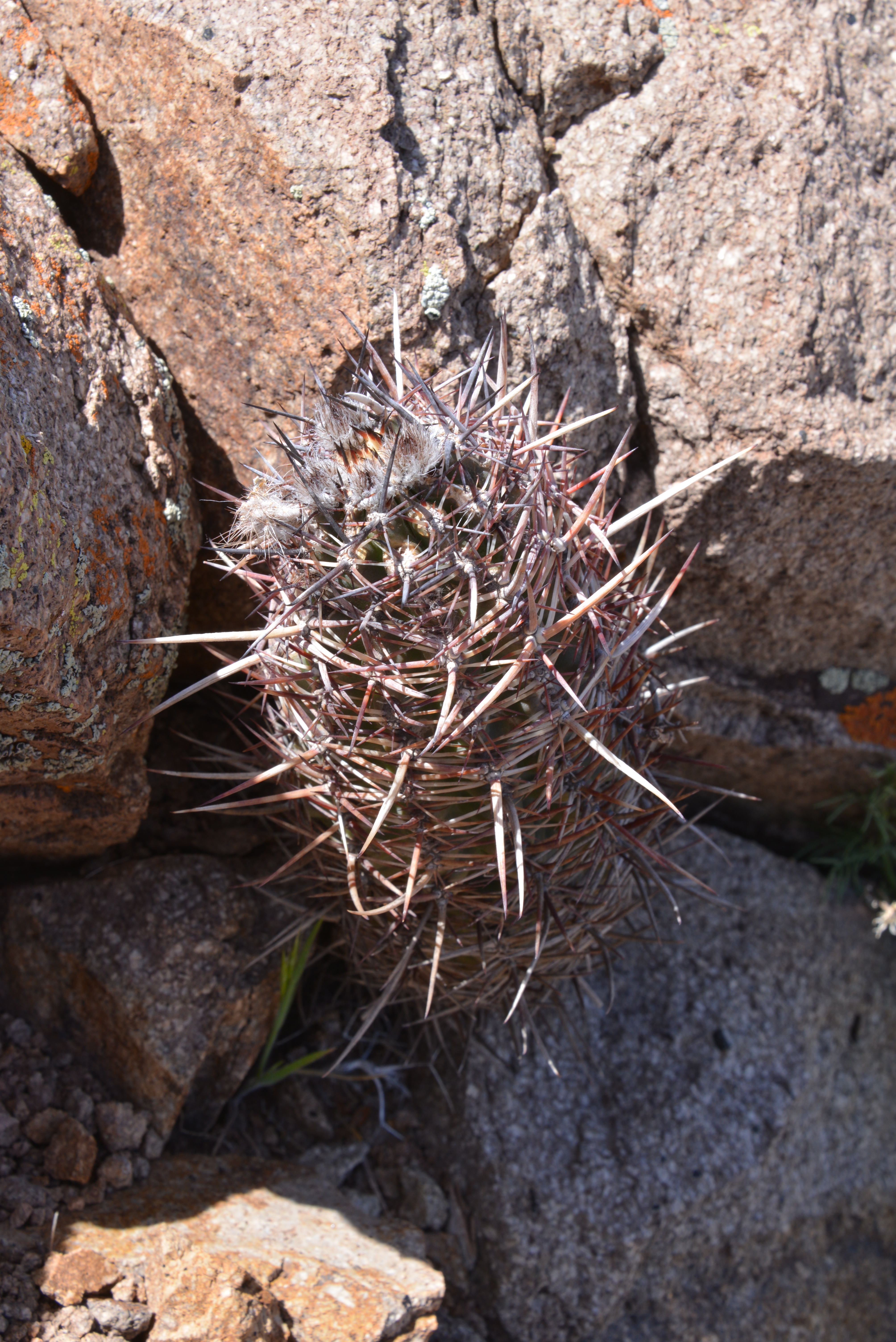
Austrocactus bertinii

Austrocactus bertinii


Which just goes to show that on each trip we should enjoy what we see and be prepared to be disappointed if we should ever return. (S2973 – Mirador La Puntilla S2103 in 2010)

The challenge for tomorrow is to find enough cacti to appease Angie – even despite the spectacular scenery.