Just another WordPress.com site

Archive for the ‘Chile 2010’ Category

Thursday 2 October 2014 – arriving at the Succulenticon

No images taken to jog the memory cells, so a brief report today. After a leisurely breakfast it took little time for me to pack and taking time to stroll around John & Ruth’s garden and chatting with Karen and Debra Zimmerman.

Then a shortish drive to Boondal,near Brisbane where the Brisbane International Virginia was the Convention Centre that we would call home for the next days. It reminded me of Friday, set up day, for ELK, with plant sales arriving and waiting before the sales area was laid out, while the first punters arrived to have a nose around. The official plant sales were not due to start until 17:00 hrs the next day.

Wednesday 1 October 2014 – Sightseeing Brisbane

First, meet my hosts, Ruth and John Higgins (left) and Karen and Debra Zimmerman. Karen is a fellow speaker from the Huntington Botanic Gardens in California, USA who will amaze us with her creations of Aloe hybrids. They are posing in front of a new bed that John is planting up this Spring – yes, it is Spring down under!

Left to right: ||Ruth and John Higgins, Karen and Debra Zimmerman

Left to right: ||Ruth and John Higgins, Karen and Debra Zimmerman

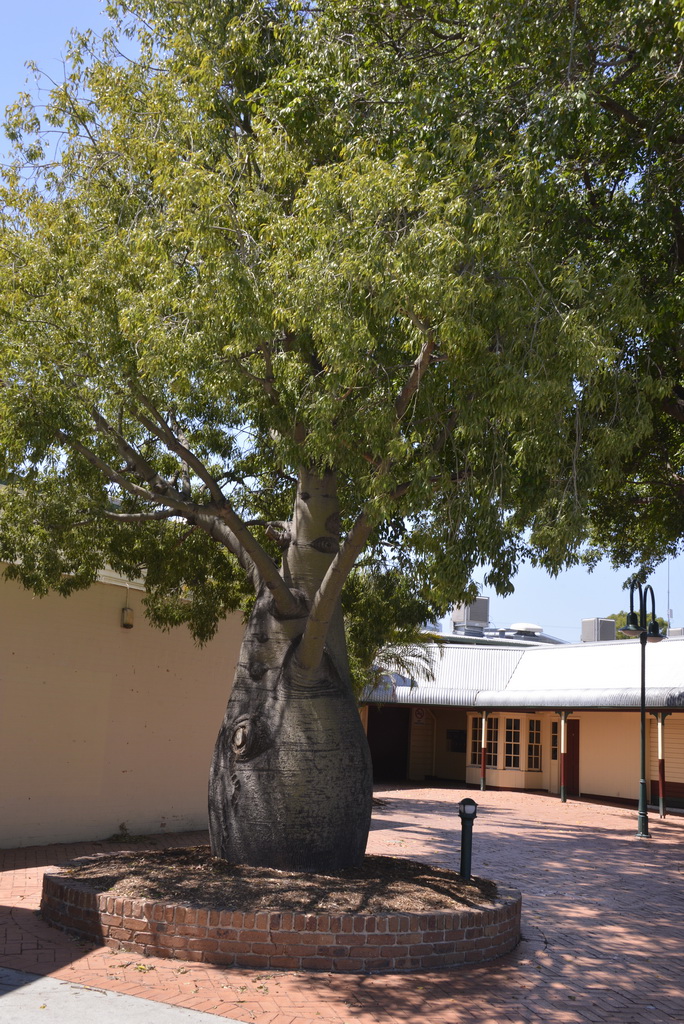
What would we like to do? I had bought Attila Kapitany’s excellent book on Australian Succulents and learned that Queensland boasted it’s own bottle tree – Brachychiton rupestris, the Queensland Bottle Tree. I had already seen and photographed caudiciforms in Brasil, Cuba, South Africa and Namibia so this would add nicely to my portfolio of fat trees. I can see that I’ll have to find time to take a look around Madagascar to add significantly to that portfolio!

Brachychiton rupestris

Brachychiton rupestris

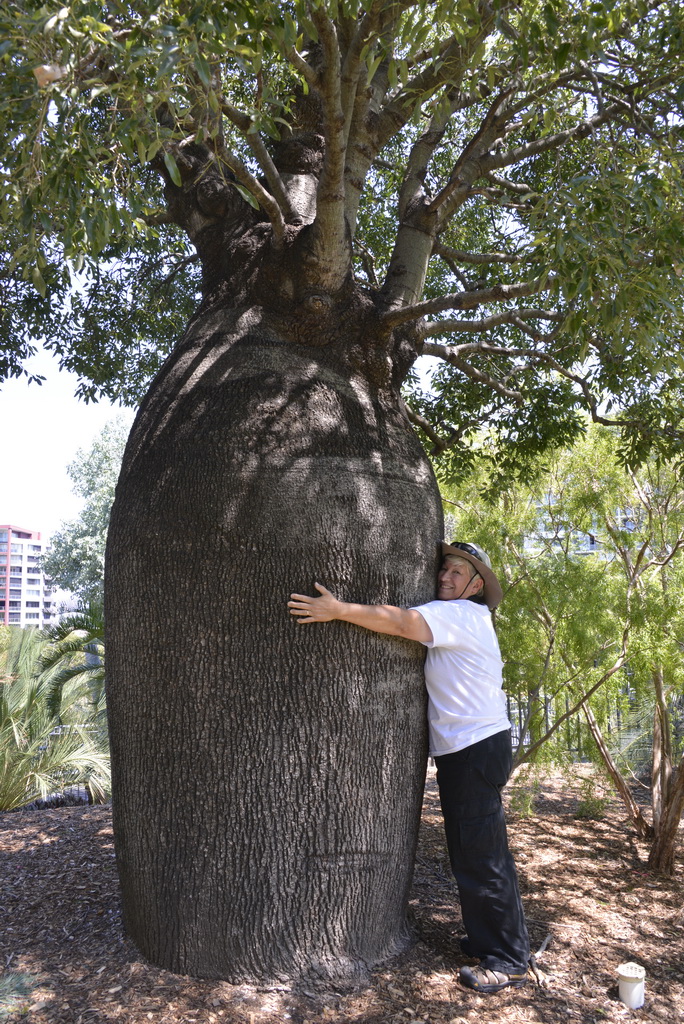
Karen Zimmerman

Karen showing that her arms are too short to hug the whole tree

John showed us a number of trees that he had known for many years as the town evolved around them, including ‘Bottle Tree Ridge’ in the Roma Street Parkland, a green oasis right in the middle of downtown Brisbane’s glass and concrete mountains towering over ancient churches. From memory, they were all B. rupestris. There were also numerous large cycads dotted around the park.

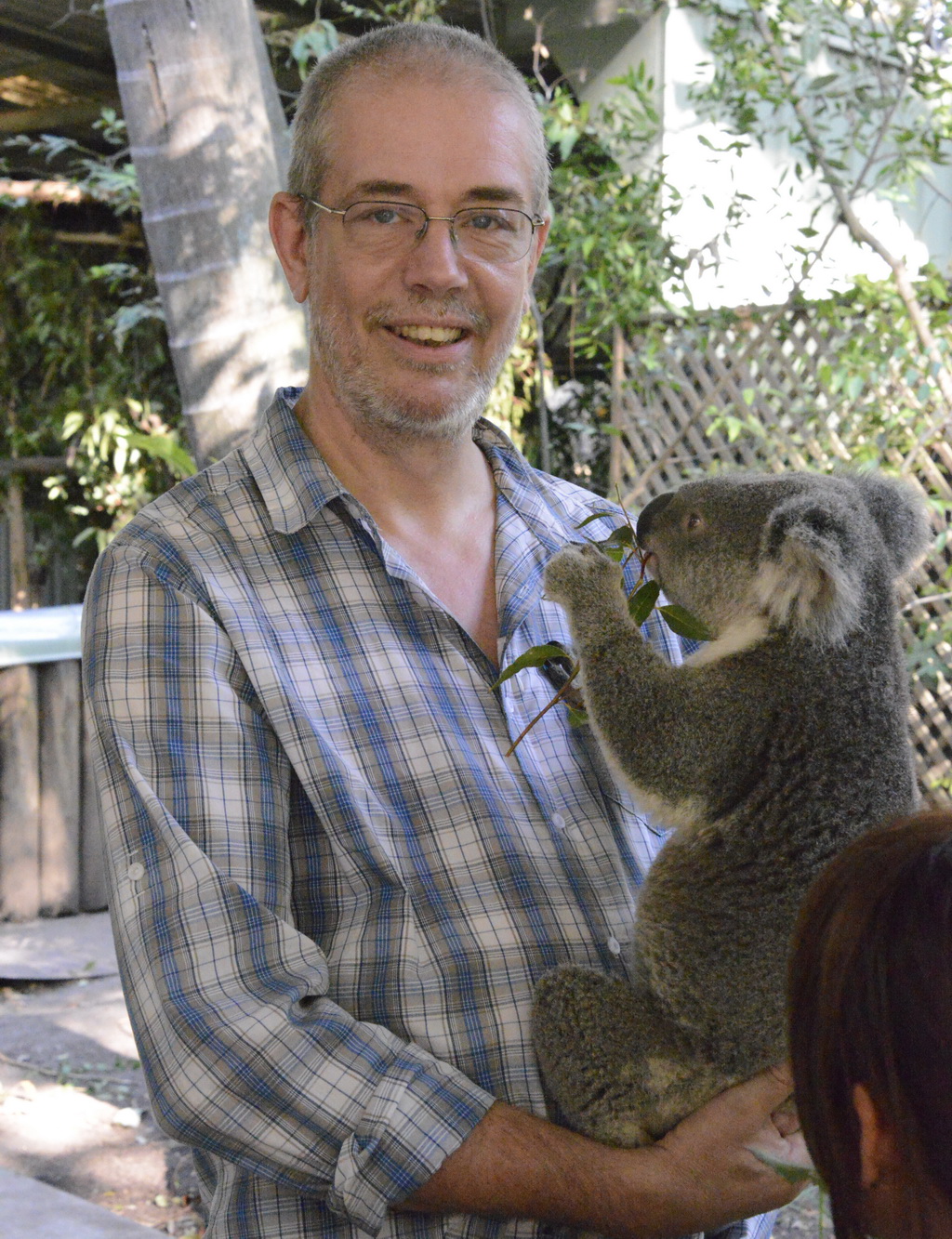
But Australia is probably better known for its unique fauna, and so we moved on to the Lone Pine Koala Sanctuary, to switch from hugging trees to hugging at least one of the 130 koalas that are safely living here

In case of confusion - I'm the cuddly one holding the koala!

In case of confusion – I’m the cuddly one holding the koala!

All the other stars were here too: duck-billed platypus, kangaroos, wallabies, wombats, Tasmanian devil and a range of flightless birds. Cameras snapped too often to include all pictures here.

A great day and only cacti in cultivation photographed.


Tuesday 30 September 2014 – arrival in Brisbane

I had heard a lot about Australia’s tight entry procedures and had made sure that I had carefully completed my entry card. Reason for visit? I ticked the ‘conference box’. The list of things I was bringing into the country included medicines, so another tick. I passed by people standing in line for the nothing to declare exit gate as I was courteously directed to the Arrivals gate. It might have been coincidence, but Brisbane is due to hold the G20 conference and it might have been assumed that this was the conference that I was attending, arriving early as a sort of ‘Agent 006 1/2’ security officer.

In any event, I sailed through and was met by Ruth Higgins holding up a sign with my surname, spelled correctly. Her husband John was on chauffeur’s duty in the car outside. It was still dark – or rather dark again. Tuesday 30 September became a ‘lost day’ and although I had not done anything but sit in an airplane seat, I was glad to be shown my bed and to keep up my reputation as the Martini Sleeper – Anytime, Anywhere, Any Place.


Monday, 29 September 2014 – off to Succulenticon 2014

As previous pages confirm, postings in The Cactus Trip Diaries are usually about adventures in the field. They serve as my notes to prepare the annual ‘What I Saw Last Winter’ presentations with which I tour the UK during the following summer. Readers might assume that like a latter day Indiana Jones my life is one big (cactus) adventure after another. Well, that would be fine by me, but the adventures extend further than ‘just’ driving around in the sun in some exotic country taking pictures of my prickly friends.

I’ve often thought about adding an entry for each talk, or at least for the talks that are strung together into a short tour, or at least to report from the annual Europese Landen Konferentie (ELK) event in Blankenberge in Belgium.

An invitation from the organisers of Succulenticon 2014, the twenty third Conference of the Australasian Cactus & Succulent Societies, this year hosted by the Cactus & Succulent Society of Queensland Inc to speak at the event provided the excuse for my first ever visit to Australia. Great, the perfect excuse for some brief reports of what we did with some images to illustrate the stories.

Today started around 8:00 at my sister Margot’s home in Whitton, a 15 minutes taxi ride through the London rush hour traffic to Heathrow’s Terminal 2 where the beautiful hostesses of Singapore Airways were to pamper me on the 13:30 hr flight to Singapore from where are a brief break to stretch my legs, I was off again for my 7:00 hr flight to Brisbane.

London Heathrow T2 Singapore Airways

London Heathrow T2
Singapore Airways

Nothing to do with Cacti and Other Succulent Plants

Finding a box of old photographs and slides brought home the fact that I have not always been a fan of Succulent Plants (including Cacti).

Although I started at the age of 6 and continued despite house moves with my parents from The Netherlands via Denmark to England I kept the interest going, including a small collection on the windowsill of my bedroom in Great Bookham, until roughly 1970, when an interest in Drugs (if you count pints of Guiness and Rothmans cigarettes in this category), Sex and Rock ‘n’ Roll took over.

It started with the PK Blues Club Sessions, when on a Saturday night in the late 1960’s my parents would allow me to invite a bunch of spotty teenagers to visit me and play records before, round about 22:00 hrs, we’d march off to The Plough for a few pints of libation convincing the landlord somehow that we were over the legal drinking age. How did we get away with it?

Records like Can’t Be So Bad by Moby Grape received their first airing to kids raised on British Pop, Rock and Blues and became part of the set of Lofty Flake Anagram, a band formed by three class mates and named after an album by Gary Burton, a jazz vibraphonist and influence on our drummer, Adrian Randall. The others in the band were Nick Ritchie (lead guitar) and Steve Williams (bass guitar). Me? I played the record player, tape recorder and later the MP3 player and provided enthusiasm and encouragement. One afternoon, Nick tried to teach me how to play the guitar. After hours of struggling to squeeze the chords of a basic 12 bar blues out of a non cooperative lump of wood with six strings, he burst into the opening notes of Country Boy by Head Hands & Feat / Albert Lee. Aaargh! I then borrowed Adrian’s drum kit as he wanted to move on into a more jazz orientated direction. I learned that I did not have the patience for long practice sessions and with a loud sigh of relief from my patient parents, the drum kit went back. I overheard my Mum saying to my Dad ‘You see, if you had put your foot down that there would not be a drum kit in the house, he would still be forcing the issue.’ Wise words Mum and well done Dad for listening.

As the number of people who wanted to come to the PK Blues Club Sessions and we were drummer-less,  our regular meetings went to the home of Helen and Alan Wright, both members of staff at our school, Therfield CS in Leatherhead, Surrey. They had a long time love for country blues and introduced us to records by Mississippi John Hurt, Leadbelly, Big Bill Broonzy etc. It also turned out that their son, Trevor, could pick a mean blues guitar as well as banjo. As musical trends were changing to country / folk / rock of the seventies, it did not seem to matter that we had no drummer. Bands like Crosby Stills & Nash (& Young), America, The Eagles and The Doobie Brothers proved that drums were not essential for an evening of live music. Nick brought a colleague from work, Bill Ferrier, along and Nick and Steve knew the cousin of my sister’s boyfriend (initially ‘Cousin Steve’ to me – Steve Hopkins) and Nick started going out with with ‘Cousin Steve’s sister.

The size of the people meeting at Ellen and Alan Wright continued to grow and started to take on the form of a band practice session. Time to look for larger premises, a problem that was solved by our ‘sort of local Pub’ – the Ranmore Arms, a charming country pub on lonely Ranmore Common, without neighbours requesting that the noise was turned down. The landlord was happy with the extra clientele that we brought along. As memory serves, I arranged for the players to be rewarded with free beer for the night and a good time was hed by all.

We built up quite a following and needed a name. ‘Canto’ was chosen as it reflected the close harmony singing along acoustic guitars that became our trade mark.

Trevor (guitar, banjo and vocals) writes: ‘My memory of how the name Canto came about is that our first paid gig was at the Hautboy Inn at Ockham, Surrey. The pub had some connection with Lord Byron, so I got out my copy of Childe Harold that I’d just done for A level. The book starts with “Canto the First” and everyone thought ‘That will do!’ ‘

Do come back from time to time as I will try to add images to this page or a link to a Canto Gallery elsewhere.

Canto Photo Gallery (1) – 1973 – the Ranmore Arms

Mexico March 2014 update

As some of you may have already noticed I have now completed my first (and likely only) tidy up of the Cactus Trip Diaries – correcting typos and adding extra text and images. It was a highly enjoyable but very time consuming process, completed after I had finished building my presentations for this trip and while I was already showing off what we saw this last winter to a number of BCSS branches in the UK.

The challenge as always remains to use relevant names for the plants. I aim to use names as used in the first edition of the New Cactus Lexicon, but am aware of a numbers of quite dramatic changes that have been the result of the publication of scientific research, particularly DNA studies. The many changes seem to be delaying the preparation and publishing of a second edition of the New Cactus Lexicon, as in addition to name changes, a steady stream of new names for newly discovered cacti have been presented.

I am not quite sure how useful my strategy of using New Cactus Lexicon taxonomy in talks really is when aiming for effective communication with the audience, as many still appear to hang on to Backeberg names from 1966. People just do seem to like change and look for stability in these matters.

I hope that you will enjoy these updates that start from 7 March 2014 and that you’ll join us again around mid October 2014 when we are planning to go back, this time to see Ariocarpus in flower, while the locations found on this last trip are still fresh in our mind.

Tuesday 1 April 2014 – Vizarron to CD Mexico

No images today. No, not an April Fool’s joke, just that with a driving day ahead of us to get to Mexico City, and a first re-packing exercise already completed, the sense of adventure had departed ahead of us. That is until I spotted a ‘Mexican Hat’ shop in Ezequiel Montes, finally a shop that sold sombreros – i.e. ‘Mexican Cowboy hats’ rather than the oversized larger than life hats that I have never seen anyone wear in the streets of Mexico. Why get such a hat on the last day of your trip? Well, to be honest, these plasticised straw hats are not that comfortable when first bought. I’m not quite sure if they need some gentle heat treatment to get them to fit the shape of individual heads – mine seems to be larger than the head of the average Mexican. ‘We know!’ I hear you shout.

This one, and those collected on previous trips will join a gallery of New World (+ South African) head gear on the wall of the Conservatory that was completed in the UK last year and will act as a reminder of the good times enjoyed. I might even wear them when the odd occasion demands that I stand out in a crowd.

With two SatNavs competing for the honour of who could get our destination the nearest (Ian claimed that I had told mine to go to the wrong place, but when I checked the most recent destination, it matched the coordinates that he had given me for the Hotel) we eventually arrived safe and in one piece. Of course, the Gods had to show their displeasure with our leaving by displaying a few thunderbolts, a distant rumble and a light rain just at the time that we had to unpack the car and walk the luggage three blocks to our hotel, through busy shopping streets. No way Jose! I could imagine another flight home with my back ceased up. Fortunately Cliff agreed to driving back to the Hotel, unloading all our luggage, leaving me on guard duty while Ian and he took the car back to the car park.

To distribute the weight of the luggage, I was wearing my bright orange winter sport jacket, leaving other guests no doubt wondering where the Dutchman had put his speed skates. The ensemble was topped off with the newly acquired sombrero. No one dared to take a photo, but I must have looked a picture – including beads of sweat on my forehead.

Tomorrow morning, a taxi collects me at 9:15 for the ride to the airport, from where I catch a flight to Newark (USA) and from there fly on to London Heathrow where Angie will meet me and whisk me straight off to Dover for a Channel Crossing and a drive to Cologne, to visit her Dad who is unwell. That means no Internet contact until I get back to home in the UK on Monday.

It has been a great trip – thanks to Cliff and Ian’s efforts – we must do it again sometime! (Plans exist for a trip to Peru in October 2014, after I get back from the Australian Convention in Brisbane.)

Who said life was dull!?

Monday 31 March 2014 – Vizarron to Bellavista and back

Today was the last full day’s cactus hunting, we went back towards Bellavista, where we went the first full day to see the southernmost Thelo – T. hastifer. They were in bud then. First I had some stops marked for Ariocarpus kotschoubeyanus ‘elephantidens‘ and at the first (S3133)  it turned out that we had stopped here on that first day to let Ian take some pictures of Yuccas that he liked the look off. Cliff and I didn’t even get out of the car. Today, we ignored Yuccas and put our noses to the ground, to find thousands of Arios!
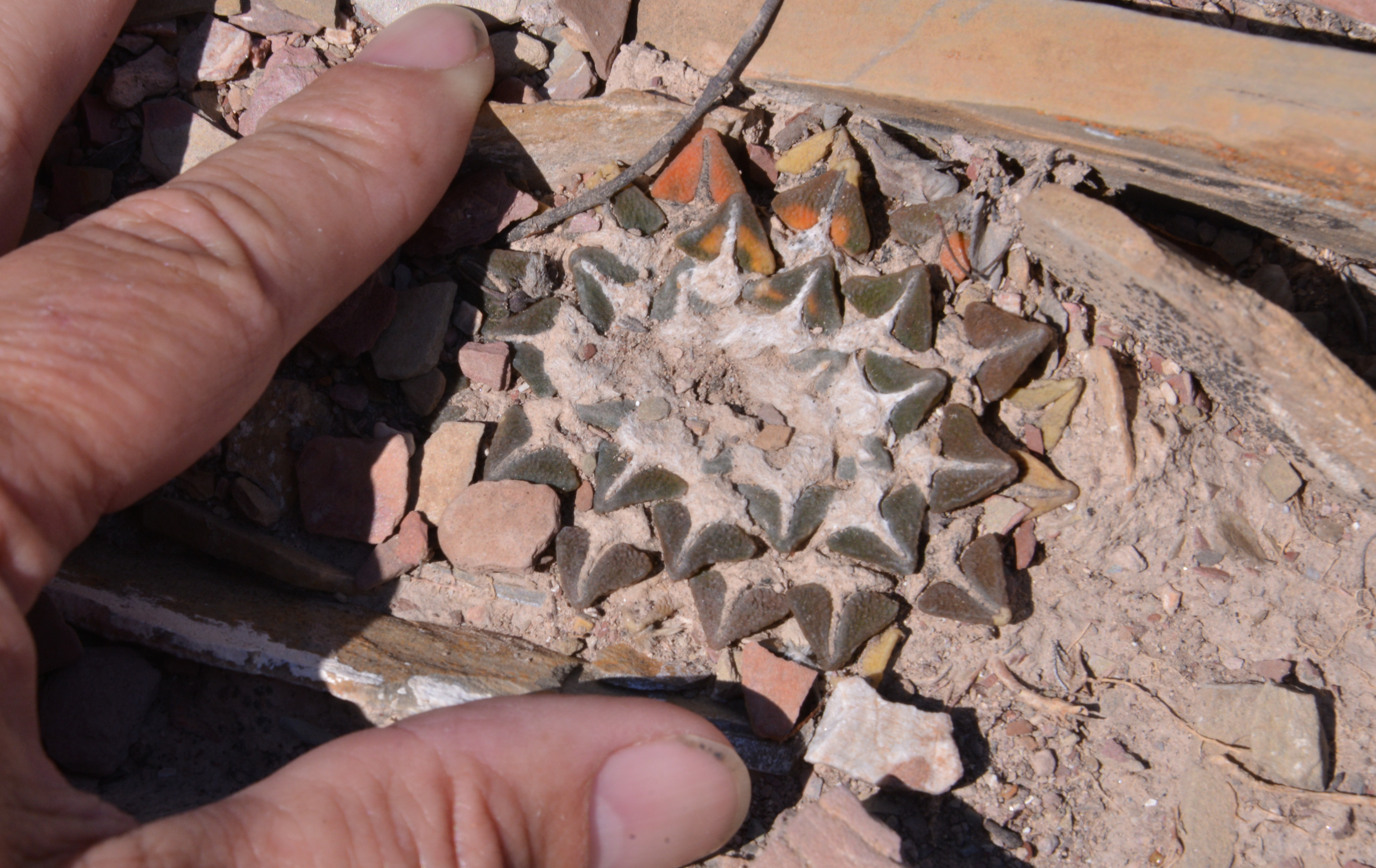
Ariocarpus kotschoubeyanus 'elephantidens'

Ariocarpus kotschoubeyanus ‘elephantidens’ – S3133

Our next stop, again for ‘Kots’, turned out to be just 1.3 km away, so we kept that for the way back.
On to a stop first reported 10+ years ago for Turbinicarpus  pseudomacrochele.(S3134) We’ve not had much luck for Turbs ‘proper’ and despite the three of us spread over a hill side for some 90 minutes in the blazing heat, we found none. Cliff was back first to the car – to find the only turb, in flower, right next to the car. We all photographed it from every different angle and moved stones around to make it look like a different plant, but we all know it was just the one. Typical.  Flower colour? You guessed it.
Turbinicarpus macrochele

Turbinicarpus macrochele

 Much to our surprise, T. hastifer was also here – I thought that it came from just one location, and here it was also in flower, so no need to go back to our original site – quite a long walk from car park to plants.
Thelocactus hastifer - S3134

Thelocactus hastifer – S3134

And back to the Ariostop that we had given a miss (S3135)  on the way up. We were distracted by hundreds of Thelocactus leucacanthus, with yellow flowers, as the main ssp should have.
Thelocactus leucacanthus ssp leucacanthus - S3135

Thelocactus leucacanthus ssp leucacanthus – S3135

We also found another thousand or more kots ssp elephants, I’ think my appetite has been satisfied for a while. MUST go back one year to see them all in flower! Late September, early October. 2015 is pencilled in. Coming? [Now in May 2014, as I tidy up the Diaries, we’re getting ready to book our flights for Mexico 2014 pt 2 in October 2014 – just could not wait. The original trip planned for that time slot, a Matucanathon in Peru, has been pushed back until we have got this out of our systems.]
Tomorrow is just a 240 km drive to the airport & hotel (just a bit more than Pichidangui – Santiago.
Next morning I catch my flight early (take a taxi) while Cliff & Ian have to hang around until early evening – they arrive Thursday around 16:00 hrs, when we should be doing battle with Brussels’ traffic.

Sunday 30 March 2014 – around Vizarron

Early this morning, the clocks in the UK changed to Summer Time, so in theory, it’s ‘safe’ for me to go back home. I fly out of Mexico City on Wednesday, so excellent timing before it gets too hot here. The following weekend, the clocks switch to Summer Time in Mexico.

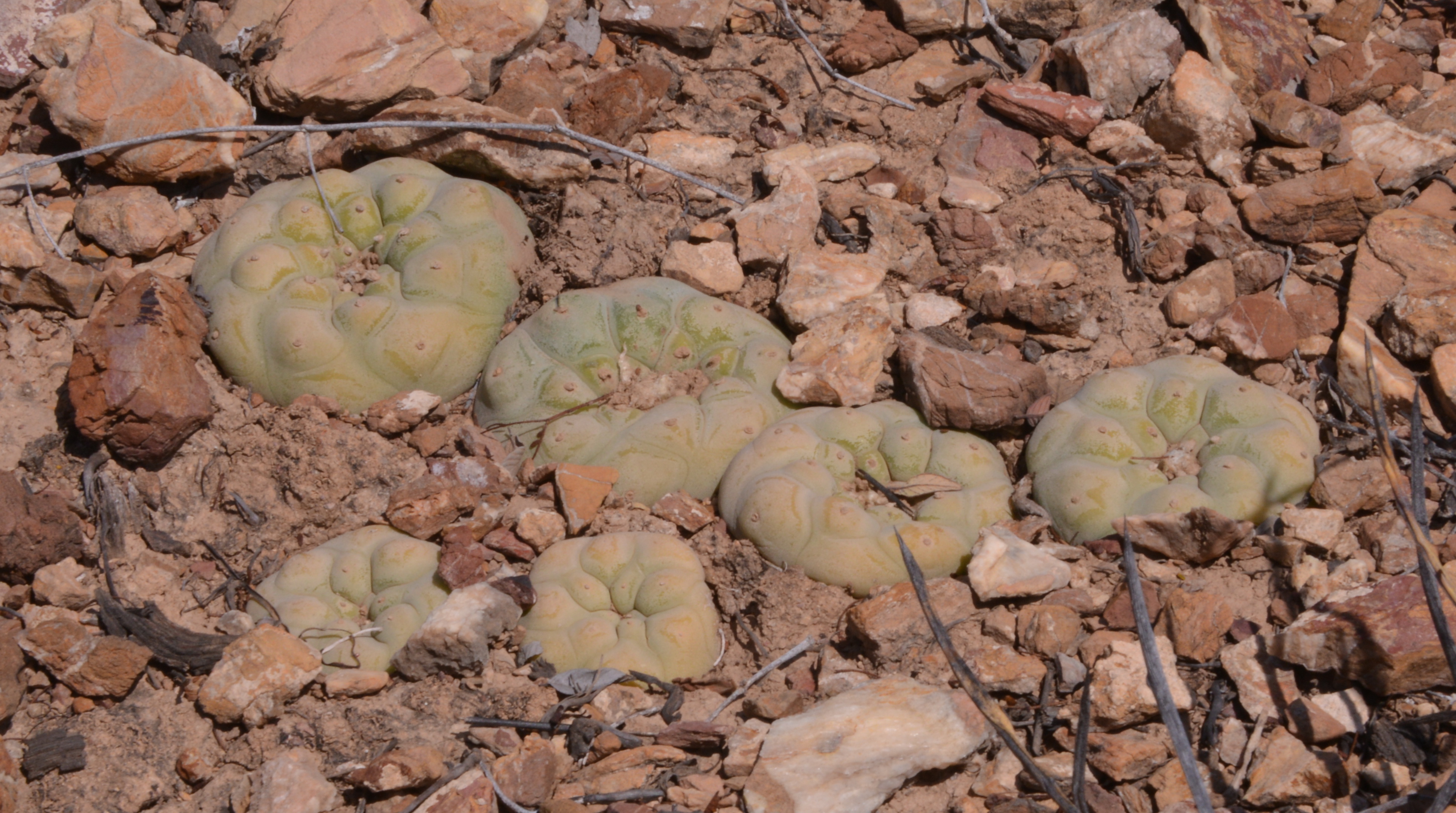
Manuel, our host in Hotel Boca Sierra (highly recommended if you are passing through, especially when all the building work in progress has been completed. Toilet seats would be nice!) is also keen on cacti – there is a small Rebutia muscula in a pot at the bar – the discussion focused on whether it is alive or not. Manuel insisted on showing us a habitat (S3130) for Lophophora diffusa, taking us along a poor track that was OK for his Nissan pick up, but tough going for the tyres of the Jeep Patriot.  We get the impression that these plants are quite common and given the right substrate and aspect, any stop will do to see these plants. Thanks for showing us these plants, Manuel! There was an interesting Agave too, sure to be in John Pilbeam’s latest book, with a name.

Agave sp - S3130

Agave sp – S3130

Next we returned to yesterday’s stop where Ian had found large numbers of L. diffusa and also some Strombocactus disciformis, but with the road cutting wall being in the shade at that time and in failing light, we had come back today to photograph the dozen plants in sunlight and look for some more. We did – at least a thousand of them! Ian (who else) managed to find the only plant in flower; well done again!

Strombocactus disciformis

Strombocactus disciformis

‘What?!’ , I hear you say: ‘Another white flowered plant?’ Yes, but as these plants often grow in the shade, they still seem to be able to interest pollinators (although none seen).

On the flat, we found many clumps of Thelocactus leucacanthus – many of them looking quite beaten up, but others in bud or in flower. In this area north of Vizarron it is ssp. schmollii that occurs abundantly over the hillside. It differs from ssp. leucacanthus by having magenta flowers and the plants kindly obliged by showing them, proving that not all cactus flowers here are white.

Thelocactus leucacanthus ssp schmollii, 16 km north of Vizarron.

Thelocactus leucacanthus ssp schmollii, 16 km north of Vizarron.

But for me, the Strombos remained the stars of the day. I also have to compliment the Mexicans on MEX120, a wonderful asphalt road, with bits recently updated, taking out a few bends where the old road can still be entered for an easy car-park and hassle free photography.

The other bonus, staying in Hotel Boca Sierra, is that they make and sell all sorts of the local marble and alabaster ornaments. Ian has been ogling the alabaster eggs for his Mum, who has a huge collection of these. I could also not resist a few items (I wonder how much my luggage will weigh in at….. )

Tomorrow we might take another look at Zimapan to see if Thelocactus hastifer – in bud soon after we arrived, has sprung into flower yet.

Saturday 29 March 2014 – Rio Verde to Vizarron

We started off with a search of Turbinicarpus rioverdensis and Thelocactus hexaedroforus. We met a very nice Mexican, Ramon, who had spent some time in Washington State and who spoke very good English. We asked permission to walk past his house and through the allotments of the small community to reach the GPS coordinates. Sure, do you want me to show you? I know where the cacti grow, he offered. So do we, thank you very much. And so we walked the supposed 300 m past his house, through the allotments and found: no cacti at all. Hmmmm. Should we go back and ask for Ramon’s help? Then Ian (again) came up trumps, thanks to a single plant in flower. Cliff and I had soon joined him. And as always, find one plant and soon you find a dozen, all in a small area.
Turbinicarpus rioverdense

Turbinicarpus schiedickeanus ssp rioverdense – S3126

Thelocactus hexaedroforus - S3126

Thelocactus hexaedroforus – S3126

When we got back to the car we thanked Ramon and showed him the pictures. Wow! he said. These small plants grow here?! I never knew. So we saved ourselves quite a bit of time by turning down his services as a guide. Anyway, half the fun is finding plants that play hide & seek with you, even if it seems unlikely that you will find anything in a particular spot. Another new taxon for me on my tick list!
We’re in Vizarron, in the State of Quaretaro, within a day’s drive of our first night in mainland Mexico, in fact we passed by here from that first night’s hotel. Were booked in for two nights with tomorrow planned as Strombocactus Day. We cheated and actually, unexpectedly, found some on the last stop (S3129) of the day, near the town. Although the light was poor, I still managed some OK images, but we’ll go back to do it properly. Another ‘first time tick!
Strombocactus disciformis - S3129

Strombocactus disciformis – S3129

And in between, another tick, this time for Lophophora diffusa, so another great day, but getting into that ‘going home soon’ frame of mind. I bought a pair of moccasins made out of goat skin, hand crafted by a local craftsman in the high street. Should last me a lifetime, once my toe has healed.
Lophophora diffusa - S 3128

Lophophora diffusa – S 3128