S3817 was at Quebrada Barracota, along the Huasco to Carrizal Bajo road. The Copiapoa could be seen from the car but we needed a stop for an ID – Copiapoa echinoides.
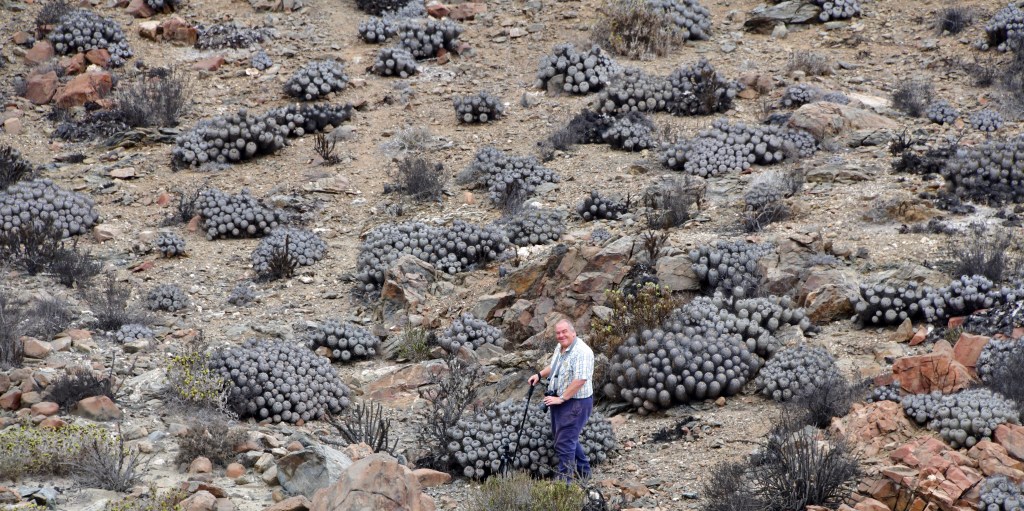
S3818 at Quebrada Mala was an old favourite, first our group photo in 2001 very close to the Pacific Ocean, but since then along new improved tracks farther inland. Ian just did not know which clump to photograph first!
As always, we asked ourselves and speculated how old these plants were!
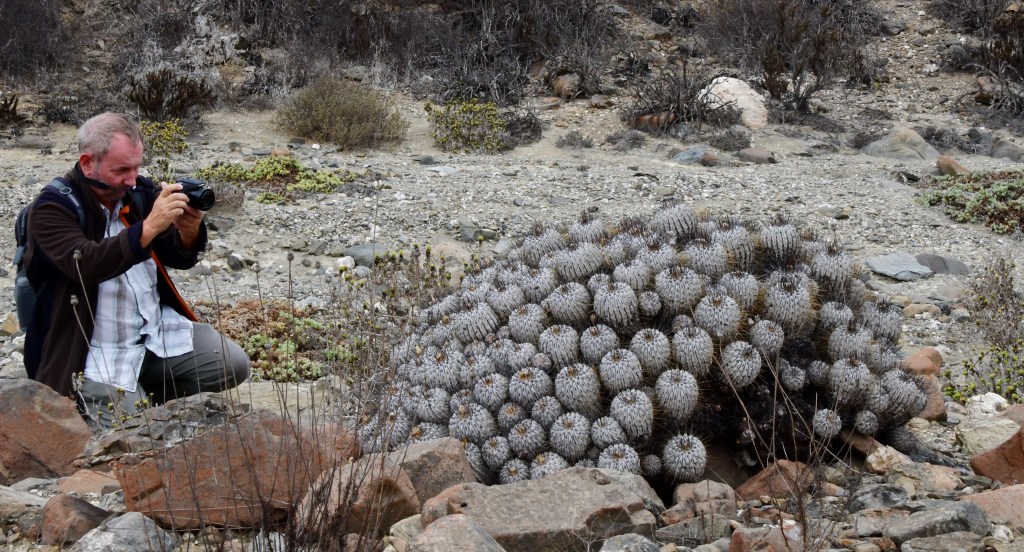
Al taking a close up – Copiapoa dealbata
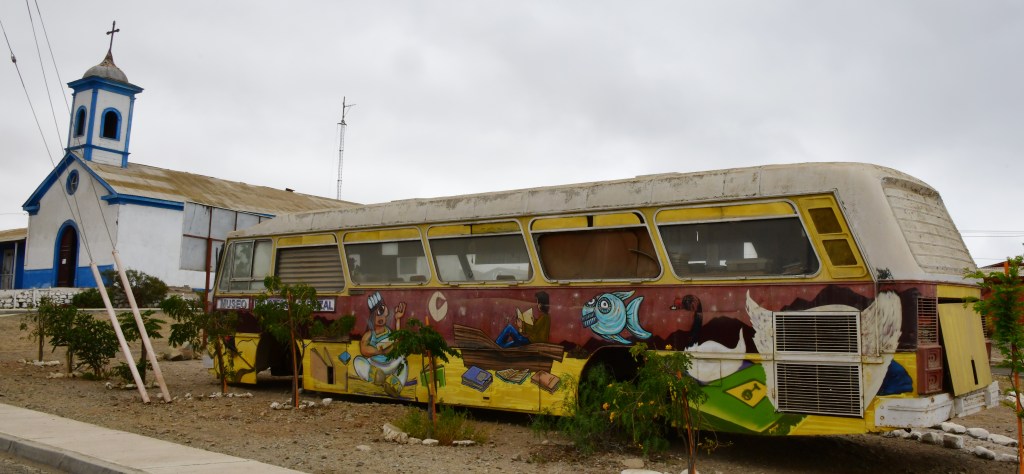
S3819 was time for a little culture: The Carrizal Bajo Library – it looks as though they replaced the old bus with a new(er) model!
We turned east and headed towards Vallenar. If we just made a short stop in the Llanos de Challe National Park, we should be in time for a treat at the Cake Shop at the Vallenar Crossroads, opposite the Copec station along R5.
In the Park, I was sure that we needed to climb the first low hill after entering the Park, driving past the ranger’s station at the northern entrance. Wrong! Back in the hotel it transpired that we should have climbed the second hill. Never mind, we would pass here again. Extremely dry!
Yes, I know, they are a little (a lot!) out of synch, but it will all fall into place in time.
The plan for today had been to climb in a panga and be taken to two of the islands (Isla Choros and Isla Damas) in the Penguin Biosphere Reserve, north of La Serena. Cabanas, shops and the boats taking paying guests were were all in resting mode after partying during the recent Halloween festivities and the excitement and tension of the recent civil unrest. Many Chileans seem to have stayed at home to protect their property (?). Ruta 5 was practically empty.
After a cold night we woke up to the sight of flags flapping in the wind – not what we wanted to see! When we arrived at the harbour it was confirmed: too windy to make the trip!
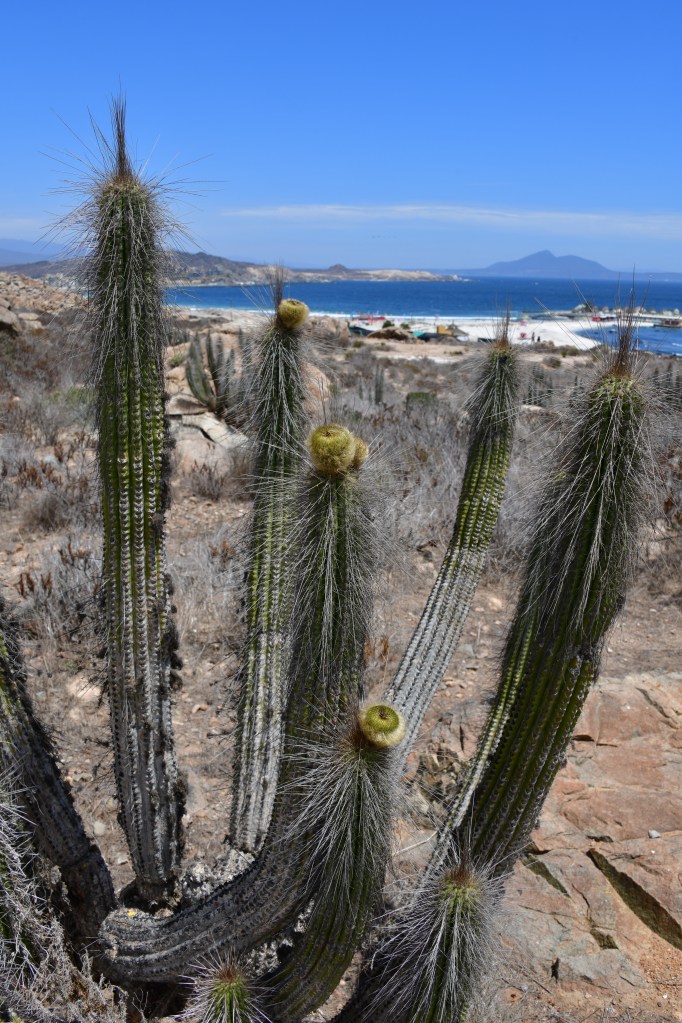
OK, so over to Plan B: show my compadres ‘my’ Eulychnia chorosensis. Even in the poor light and their dehydrated state, they still looked like interesting, attractive plants.
Some years ago, Angie & I risked driving from Punta Choros across a barely marked track on very soft sand, but in a Toyota Hilux built for such challenges, to Carrizalillo. Now this was very easy on a smooth newly tarmacked road that would put most UK roads to shame. We finally found a shop open where we could buy some chocolate to replace breakfast this time.
The top quality tarmac continued all the way to Domeyko. Our second stop today was 17 km before R5 at the site for Copiapoa domeykoensis, said to be a giant form of C. coquimbana, in the north of that plant’s distribution area.
We hit R5 at Domeyko and headed north for Vallenar, where we missed the turning to our favourite cake shop and ended up on the road to Huasco. Never mind – cake would have to wait until later!
At Maitencillo we turned left on the track to Ojo de Agua for the third stop today for Eriosyce thelocephala lembckei. It really was very dry and the Eulychnia, Copiapoa coquimbana and Miqueliopuntia looked like shadows of their former selves. No Thelocephala found, although I feel sure that they were there, buried in the sand, laughing at us. Perhaps a but farther along? We we passed a sign to El Mirrador, offering a magnificent view? but now over chicken farms! All the previous plants mentioned were found, but no T. lembckei. I could hear the cakes calling my name at the R5 cross roads, so we continued back. Ian requested a quick look at a very similar layby with all the usual suspects and after some searching he waved to the car and begged us over. He had found Thelocephala lembcki, as small and hidden as I have ever seen them. Well done, Ian! Once we had spotted one plant, some two dozen more were readily found, but it is that first plant that matters!
For the 6th stop of the day I wanted to take us to the traditional Eriosyce napina site in view of the monster power station that burns oil pellets and spreads cancer among the people of Huasco. This has always proved a popular spot but this time there were wooden poles wrapped in barbed wire that blocked the road and it seemed that office buildings at the power station were still smouldering having been burned down, presumably by rioters.
We decided not to hang around in case of trouble and returned to Vallenar where this time we successfully made Stop 7 of the day: the cake shop!
We’ll be here for two – three more days so you may get a few more Diary updates.
We managed to squeeze five people into the car as we had promised to give Carlos a lift to La Serena. The social unrest and public strikes had taken their toll on public services, with buses running while they could rather tan to a regular timetable. None of us were too certain where we were going, but just before I thought that we’d soon be out of town, Carlos asked to be dropped off and we continued our journey, at least until the Copec station for fuel and of course, a hot dog!
We didn’t see much of the Cuesta due to the Camanchaca that sounds a lot more interesting when you read about it than when you are driving around in it! We had made the exit to Los Choros before we knew it. (S3805) There seemed little point at looking for Eriosyce riperia in this drought, the plants would be well hidden, pulled down into the soil by their contractile taproot. Soon after the turn we stopped for a leg stretch. A lot had changed since our first stop here on 24 June 2003, when it gained my location reference L0202, although all the cacti reported then were still seen today: Copiapoa coquimbana, Cumulopuntia sphaerica, Eulychnia acida, with somewhat hairier buds than ‘normal’ E. acida, and Miqueliopuntia miquelii.
S3805 – Copiapoa coquimbana
By 2007, the then newly described Eriosyce (Thelocephala) napina subsp. riparia had been added to the list, but time constraints stopped us today to search for it.
Next stop S3806 will always be known to me as JA001, Juan Pablo Acosta’s first recorded cactus stop. The scenery, from the top of a low hill, down the dry Rio Choros is great and creates many angles where it forms the backdrop for the cacti that grow here. Again, it was striking how dry the plants were. The Eriosyce here is called E. (Horridocactus) simulans as it closely resembles the Copiapoa coquimbana (Ritter’s C. pseudocoquimbana) that is grows alongside with. Except that today there were no flowers or fruits to differentiate between the two taxa.
The Eulychnia has a low, upright growth, not procumbent like E. chorosensis, but the hypanthium is bristly, just like E. chorosensis. Another mystery Eulychnia! A transitional form or a different taxon? It’s all happening in this area!
S3807 was a stop for a herd of some dozen guanacoes and later joined by a family ? pack ? of foxes. We tend to carry some bread roll remnants, left over from breakfast and they were very happy with this sudden meal! Only when we drove on did we see the request not to feed the animals, in Spanish of course, as inappropriate food for animals under stress could kill them! We hope that they are all OK.
(S3807) Zorro chilla
We arrived at the port of Punta Choros that seemed deserted. Under the overcast skies the shacks looked impoverished. All the pangas seemed to be in. There was a bit of a breeze, too heavy to take passengers to Isla Choros and Isla Damas where Humboldt penguins build their nests under the stems of Eulychnia chorosensis. Perhaps tomorrow? Come at 8:00!
We found cabanas to sleep four and, after a walk through the village found a restaurant that was open (or did it open specially for us?)
Fingers crossed that tomorrow’s weather will allow us to make the boat trip!
The last time I stayed in Guanaqueros on 27 November 2013 and before, in 2 January 2009, we visited the seaside resort of Totoralillo, the one south of Coquimbo, rather than the one north of Pichidangui, is was surprised to see the unusual hypanthium on the local Eulychnia. Was this a ‘sport’? But I also found similar plants at Playa Blanca and Tarambola.
So what is so different? An important means of differentiating between different species of Eulychnia lies in their hypanthium. E. acida has a naked hypanthium, covered in scales with just small insignificant bristles emerging from between the scales . E. breviflora on the other hand is covered in long, honey coloured wool. As you can see in the images to the right, the hypanthium of the plants that grow here is a mixture of the two, with the lower part covered in long wool but the upper half of the hypanthium clearly displaying the acida-like scales.
During the 2009 visit, this phenomenon occurred on ripe fruits and the long hairs readily rubbed off. I had not seen E. breviflora fruits in such an advanced stage of ripeness. Is this what happens in all Eulychnia fruits?
But this time, the hypanthium was that of a bud, not a ripe fruit. Flowers appear at the shoulder of the stems (cf. lateral for E. acida and apical on E. breviflora).
Eulychnia hybrid acida x breviflora?Eulychnia cv April Fool’s Joke.
‘Should we start thinking of a new taxon?’ Ian and Al asked. I smiled. ‘Not until I have looked up the Latin for ‘1st April”
We went back to the cabanas so that I could roughly plan what we were going to do during the next few days. Suddenly there was a rumbling noise and the cabana began to shake. The fridge started to walk across the room. Then everything was quiet again. We had just experienced a 6.8 strength earthquake! But that is quite a regular occurrence in Chile! We saw no obvious damage – everything that was going to break, fall over or get knocked down already has!
As Angie and I had not made it to the rocky shoreline at Pichidangui, it was time to catch up after breakfast.
S3798 was the usual place to see three species of Eriosyce growing side by side: Eriosyce chilensis (in flower), E. subgibbosa (not in flower as it tends to flower around May time) and E. curvispina (in bud, with some buds bursting open) as well as Eulychnia castanea (in flower). Not bad for a first cactus stop!
We moved to the southern end of the rocky shore (S3799) where BCSS funding had contributed to publicity signs alerting visitors about the treasures that nature had liberally spread along the coast here. We met a Chilean couple on their way to church whom I recognised as local conservation fans from the pictures published when the signs were first unveiled. They were Adriana Razeto and her husband Nelson, who kindly showed us around their garden and invited us round anytime that we are in town! They had produced similar posters to inform visitors about the birds and other wildlife at the coast.
S3800 was a side trip into the Fray Jorge National Park where we saw Eriosyce aurata, Eulychnia acida, Echinopsis (Trichocereus) chiloensis and subsp. skottsbergii, Cumulopuntia sphaerica before spotting our first Copiapoa, C. coquimbana (Ritter’s C. pendulina) near the beach at El Sauces at S3801, As a bonus, many plants were in flower!
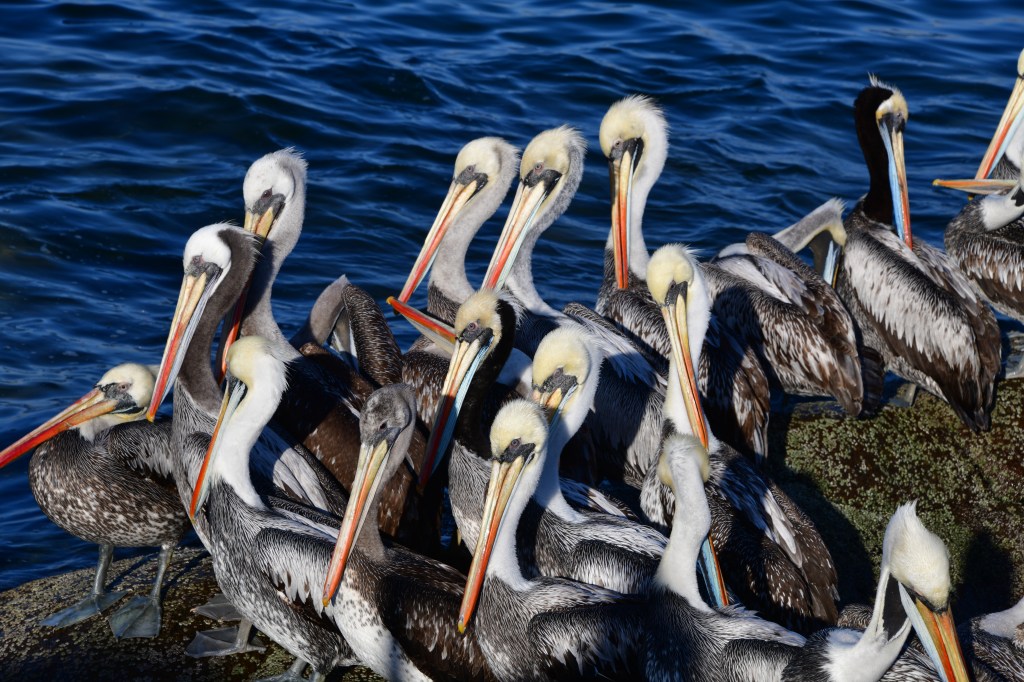
S3802 was at Guanaqueros where we enjoyed a visit to the harbour where the local airforce of pelicans were sunning themselves in the setting sun.
Peruvian Pelicans at Guanaqueros, Chile.
Our usual accommodation at Cabanas Club Bahia had no space, as this was a long Chilean Bank Holiday weekend for Halloween, with the added confusion caused by the civil protests taking place throughout Chile. No Problem – there are many cabanas etc along this stretch and at the second point of asking we found comfortable accommodation for two nights at Cabanas Mar Azul with Carlos, from Venezuela, going the extra mile to get our cabana fit for habitation. Thanks Carlos!
It was great to be in Santiago Airport again! We worked our way through the snake of people queuing for immigration, picking up our luggage and seeing Andres Gabor waiting to greet us at the exit gate. I (and many of the other European Cactus travelers) have used Andres’ company LYS Rent-a-car since 2003 (credit to Brendan Burke for recommending him after we had less success with the rental car from a different provider in 2001.)
Andres greets us and treats us to breakfast at the airport – a lot more civilized than picking up your rent-a-car at other international airports.
And so, around noon, we set off, this time without my SatNav! I had picked up the wrong one at home – the one with USA and Mexico data, rather than the South American on. So I missed the turning on Vespuchi to R5 – El Norte, but soon found a retorno to correct the matter.
From the airport, Ruta 5 – the PanAmerican Highway – runs inland heading north. Around Longotoma, some 200 km after leaving the airport, the road turns west and comes down a couple of hundred meters to the Pacific Ocean. Since 2001 it has been a tradition to burst into song as soon as we see the Ocean. First with that popular tune ‘Oh I do love to be beside the seaside’. As the waves appeared, Ian Thwaites, Al Laius, Angie and I burst into song, followed by the chorus of Cliff Richard’s hit from the 1960s ‘We’re all going on a Summer Holiday! I would have mimicked, the Hank B. Marvin guitar solo, had it not been for the fact that I was driving. *
One stop, S3797 at Los Molles, the type locality of Eulychnia castanea. Lots of new tourist development here, at the expense of the plants!
Eulychnia castanea flowering on the rocks at Los Molles.
I was not feeling too well, so we went to Hotel Rosa Nautica where after five years away I was still recognised by the elderly owners. I presume that it was her daughter who was supporting them and spoke good English. While I had a cup of chicken noodle soup and a rest, Ian and Al found the rocks on the beach and the three taxa of Eriosyce that grow there: E. curvispina, E. chilensis and E. subgibbosa. The light was past its best, but we could always go back the next day!
As a bit of padding today, I thought I’d add the complete lyrics to ‘Oh I do like to be beside the seaside’ so that Ian Woolnough’s party can follow the tradition. Ian and Al must have misunderstood as several days later they still burst out into song every time they see the sea!
Ian is considering to make this the BCSS Theme song, to be song before every UK branch meeting, or did I get that wrong!? 🙂
‘Everyone delights to spend their summer’s holiday down beside the side of the silvery sea. I’m no exception to the rule, in fact, if I’d my way, I’d reside by the side of the silvery sea.
But when you’re just a common or garden-working lad like me, a chance to see the sea is quite a novelty. I save up all the money I can while winter’s grim and grey Then off I run to have some fun where the balmy breezes play
Oh! I do like to be beside the seaside! I do like to be beside the sea! Oh I do like to stroll along the Prom, Prom, Prom! Where the brass bands play, “Tiddely-om-pom-pom!”
So just let me be beside the seaside! I’ll be beside myself with glee and there’s lots of girls beside, I should like to be beside, beside the seaside, beside the sea!
Timothy went to Blackpool for the day last Eastertide To see what he could see by the side of the sea. As soon as he reached the station there the first thing he espied Was the wine lodge door stood open invitingly Grinning to himself, he toddled inside and called out for a wine Which grew to eight or nine, till his nose began to shine. Said he ‘What people see in the sea, I’m sure I fail to see’ Then he caught the train back home again and to his wife said he
Oh! I do like to be beside the seaside! I do like to be beside the sea! Oh I do like to stroll along the Prom, Prom, Prom! Where the brass bands play, “Tiddely-om-pom-pom!”
So just let me be beside the seaside! I’ll be beside myself with glee and there’s lots of girls beside, I should like to be beside, beside the seaside, beside the sea!
William Sykes the burglar he’d been out to work one night filled his bags with jewels, cash and plate. Constable Brown felt quite surprised when William hove in sight. Said he, “The hours you’re keeping are far too late.” So he grabbed him by the collar and lodged him safe and sound in jail. Next morning looking pale, Bill told a tearful tale. The judge said, “For a couple of months I’m sending you away!” Said Bill, “How kind! Well if you don’t mind, Where I spend my holiday!”
Oh! I do like to be beside the seaside! I do like to be beside the sea! For the sun’s always shining as I make my way, And the brass bands play, “Ta-ra-ra-boom-de-ay”
So just let me be beside the seaside! I’ll be beside myself with glee and there’s lots of girls beside, I should like to be beside, beside the seaside, beside the sea! ‘
The song was written in 1907 by John A. Glover-Kind and made famous by music hall singer Mark Sheridan who first recorded it in 1909.
It was, for a long time, used as a signature tune by Reginald Dixon MBE, who was the resident organist at the Tower Ballroom, Blackpool between 1930-70. For more detailed information, not related to cacti, check out the Wikipedia entry for the song title and you’ll be amazed!
After a week of hard rain (80 mm in one day at Boscombe Down, about 1 km away!) the calendar has moved to October with just one month to go before Al Laius, Ian Twaites, Angie Money and I head off to Santiago de Chile for three weeks of cactus hunting in the Chilean Atacama Desert. This time we fly via Toronto, Canada, not the first place you think of when looking on how to get from London, England to Santiago, but as the earth is round(ish) I guess that it doesn’t really matter how you get round the globe.
Things left to do, in no particular order, include:
Pay the deposit to confirm the car rental agreement that is already in place.
Book our flu jab for Angie and I at the local surgery
Check that our travel insurance is up to date
Take the photographic equipment for a test drive, next time the sun here dares to show its face.
Check our passports are still valid.
Obtain our eTA (Electronic Travel Authorisation) to transit in Canada.
My intention is to produce daily reports of where we are, what we’ve seen and how the environment where our favourite plants live, survives in the harsh conditions. I travelled to Brazil around the same time last year and still struggle to complete the Diaries for that adventure. It seems that my laptop and software is so keen to protect me when I travel away from home, that it freezes my accounts when it spots when I move! Fingers crossed that it behaves this time.
Correspondence with friends in Chile suggest that they have had very little rain this year, so that the chances of seeing the Desert in Flower are low. But such events can be very localised and one afternoon of light rain can trigger a local flush of blooms, so we’ll have our cameras ready.
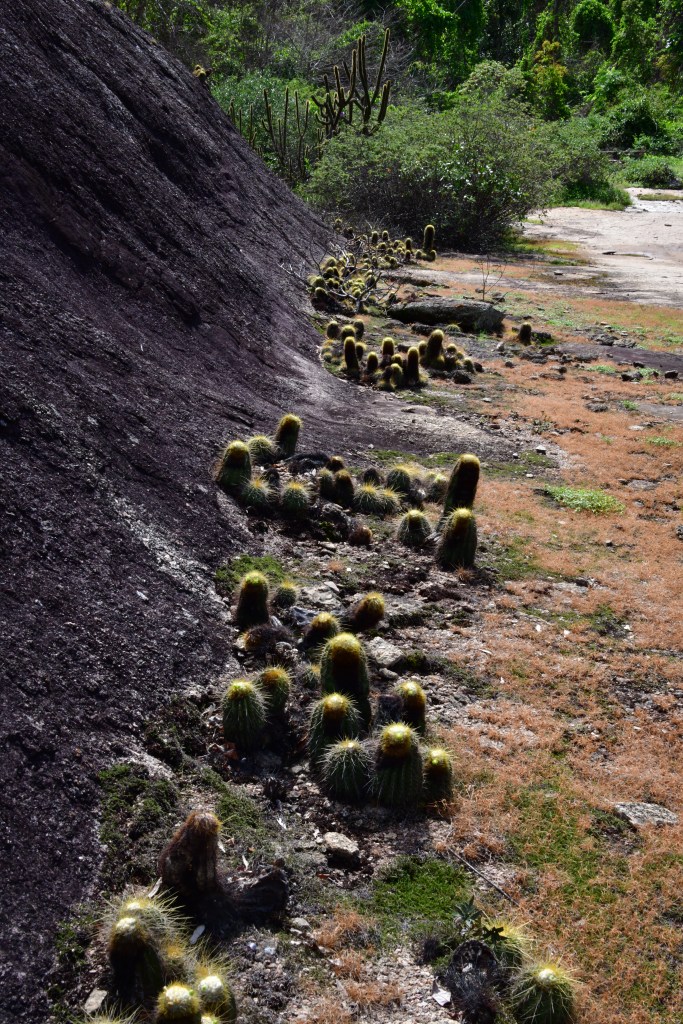
Inselbergs are granitic or gneissic rock outcrops that are considered terrestrial islands because of their strong spatial and ecological isolation, thus harbouring a set of differing distinct plant communities. In Brazil, inselbergs scattered in the Atlantic Forest contain unusually high levels of plant species richness and endemism. Inselbergs are thought to have differing microenvironments but in the rain are all very slippery especially on the steep parts. Our interest here is that they contain differing populations of the genus Coleocephalocereus (Cactaceae).
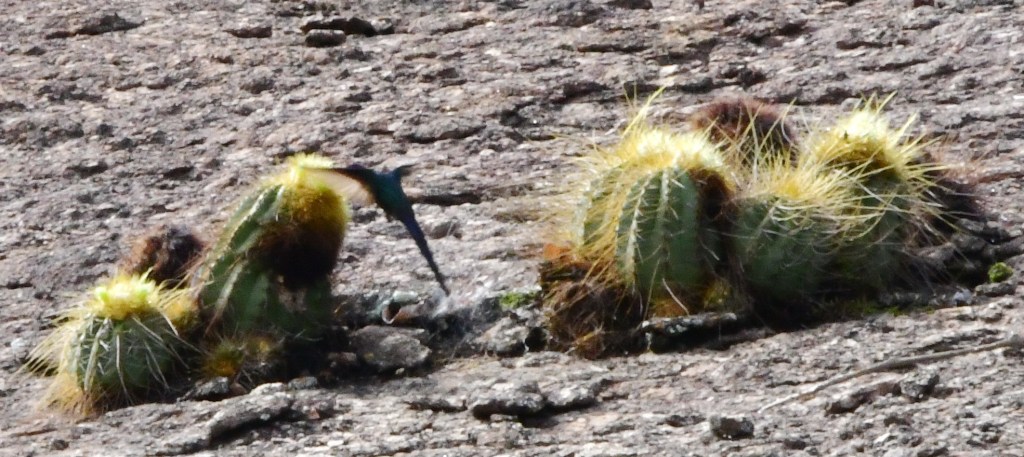
Our first stop, S3721, was for Coleocephalocereus (Buiningia) aureus subsp. brevicylindrica. We had already seen the giant Coleocephalocereus (Simplex) goebelianus which Backeberg had ‘blessed’ with the long name that has not endeared the plant to those who need to write labels for a living! They are therefore often still seen under the name Buiningia.
S3721 Coleocephalocereus aureus subsp. brevicylindricus with hummingbird pollinator.
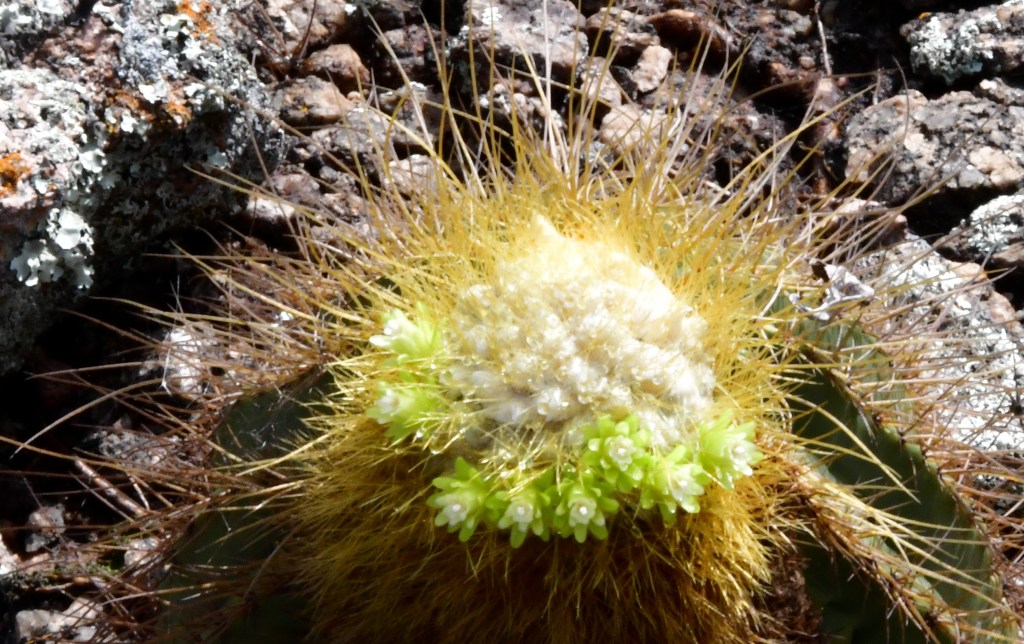
Young plants are hard to distinguish from similar sized Melocactus. Once the lateral cephalium forms it becomes much easier to distinguish the genera as Melocactus has a terminal apical cephalium while Coleocephalocereus has a lateral cephalium. Both genera are pollinated by hummingbirds.
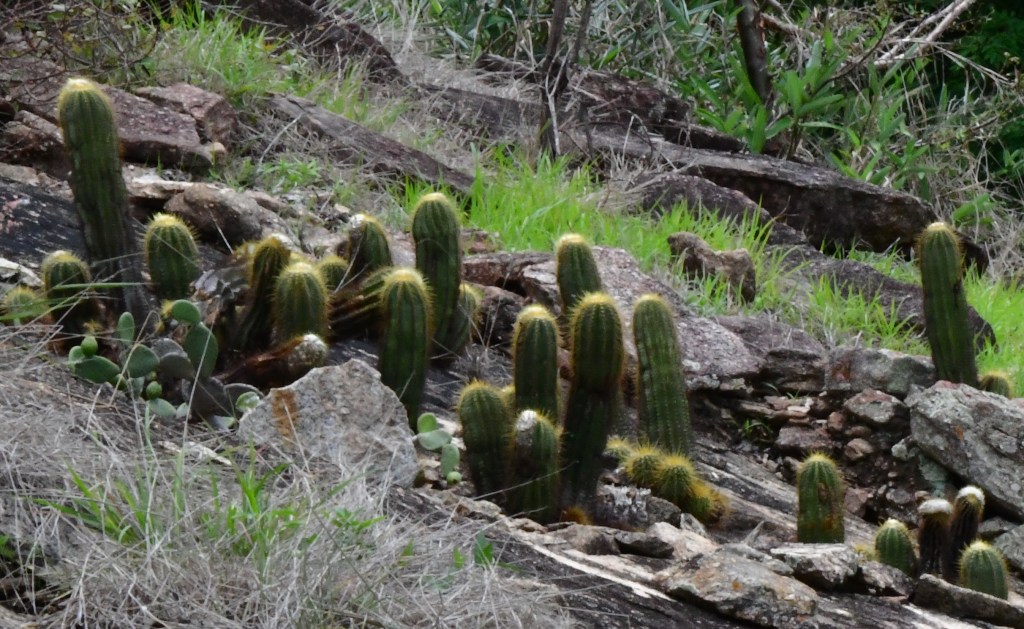
‘Buiningia‘ are said to contain just two species: the yellow flowered C. aureus and the purple flowered C. purpureus. But there are some subspecies that deserve recognition, if only in cultivation: C. aureus subsp. brevicylindricus and C. aureus subsp. elongatus that in nature are respectively shorter and taller than subspecies aureus. We were fortunate to see all of these taxa.
S3721: Yellow flowers: Coleocephalocereus aureus!
S3722 was another population of Buiningia aurea subsp. brevicylindrica, but the sides of the inselberg were much too steep for us to climb them to inspect the plants. It seems that the berries did not like the steep slopes either and rolled downhill to collect along the base of the rock.
S3712: seeds grew where the fruits rolled down the steep hill.S3723 was the farm where we were invited to stay and were treated to a free range roast chicken dinner in 1999 and where, the next morning we were shown our first plants of B.brevicylindraca – here with flower and berry.
S3724 was for the almost inevitable second puncture, this time for John & my car. The other car, with Alain, Chris and Marlon inside raced on, oblivious to our flashing lights and honking horn. Eventually, after John had changed the tyre, they returned rather sheepishly. Did you not hear us or see our flashing lights? Sorry, we were listening the the Electric Light Orchestra at full blast was their poor excuse! So much for team work!
There were more Buiningia at S3725. Here the stems were a little taller. B. aurea subsp. aurea?
S3725 – stems a little taller?
S3726 was a stop along the side of the track for a huge, 30 cm diameter flower, appearing in the shrubs growing along the track: Aristologia gigantica!
There were more Buiningia at S3727, as well as Tacinga inamoena and various Bromeliaceae; Pereskia at S3728 and Melocactus sp. at S3729.
In May 1999, Marlon brought us to a conservation project on the Serra do Piripiri near the third largest town in the State of Bahia, Vitória da Conquista. Here a small group of professionals had read Nigel Taylor’s report that Melocactus conoideus was threatened with extinction. They decided to do something about this, negotiated for half of the area on the Serra do Piripiri to be fenced off. When we visited for the first time in 1999, the fence has been completed, but there was a snag; during the frequent flash fires on the hill, the dry vegetation would burn, the wooden fence posts would catch fire and the fence would need repairs. The late Keith Grantham observed that as one reason for locals to visit was to collect the small grade substrate which was great for making concrete. Replace the wooden posts with concrete ones and the problem would be fixed. As the Conservation group and their families had already spent a good few years building the wooden fence, they feared their families’ reaction. At Keith’s suggestion a proposal was prepared for the BCSS Conservation Fund that had just benefitted from a bequest through the sale of the plant and book collection of Portsmouth Branch’s President Ken Ethridge. This donation covered the cost of labour so that the fence could be repaired with concrete posts.
By the time of our next visit in 2009, the fence was in place and the number of plants had increased dramatically. There was enough concrete left to build some office / class room space and the schools used it for their conservation classes!
This time Caio had warned us that in recent years, the Conservation Unit had been suffering a severe process of degradation caused by the criminal use of natural resources and irregular occupation of the area. Elimination of native vegetation, soil degradation and threat of loss of springs are just some of the issues which can seriously affect the geography of the city and the characteristics of our climate. Watch the video and help Vitória da Conquista take care of the natural heritage, which does not belong to government or individuals, but to all people and generations. Save the Piripiri Mountain!
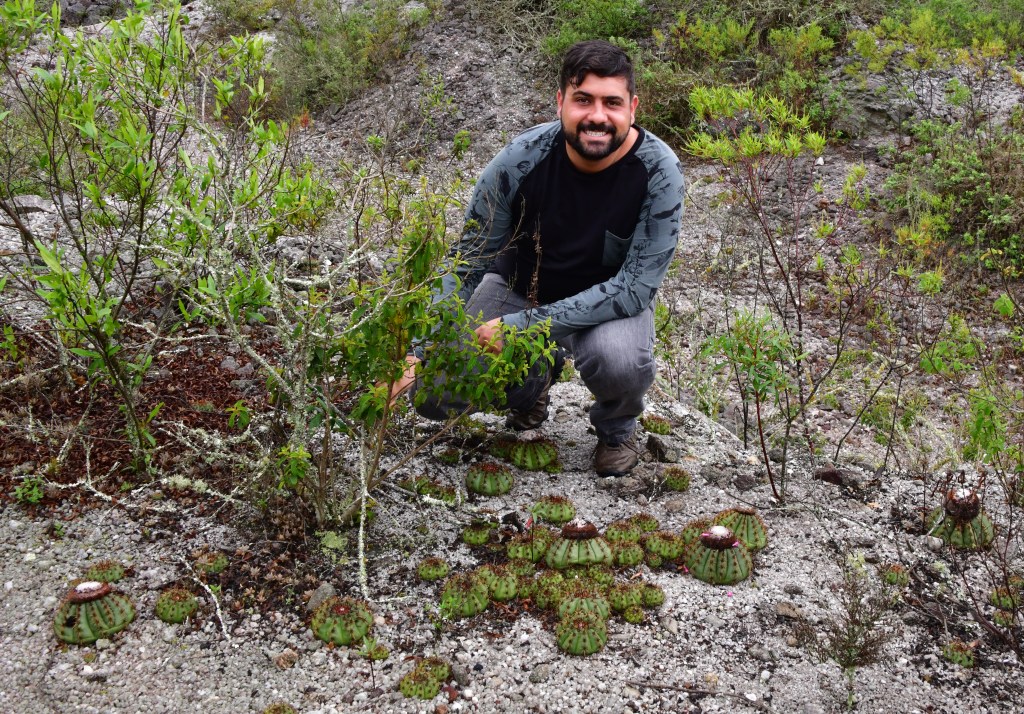
Caio Coelho and a random group of Melocactus conoideus – now a very healthy population. But the town of Vitoria da Conquista keeps growing as well, coming ever closer. … so that Caio had thought it safer for a couple of armed guards to join us.
We had a great lunch in the town of VdC – as this would also the point where Jarred would leave us, catching a bus towards Rio de Janeiro and a few days of rest to write up his notes. Good luck with your job hunt in the US!
The remainder of the group now headed south, back into Minas Gerais and on to the town of Pedra Azul, where here in the north east of the State, the landscape was dominated by Inselbergs.
We had arranged to meet Marylan Coelho and her son Caio, friends from my previous trips to Brazil, at the Floresta Nacional Contendas do Sincora. This National Forest was created in 1999 to promote the sustainable and multiple use management of renewable natural resources, the maintenance and protection of water resources and biodiversity, the recovery of degraded areas, environmental education, the maintenance of samples of the caatinga ecosystem fragment and the support to the sustainable development of the natural resources of the bordering areas. The Park has an approximate total area of 11,034 hectares. There are facilities to give courses that aim to make local people familiar with their environment.
We met managers and staff who explained their objectives and treated us to refreshments before taking us for a walk along the Trilha das Bromelias (The Bromeliad Trail) that took us past plants that occurred naturally in the park. This was augmented by great quality images, taken by local photographers Josafa Almeida and Josafa Filho that illustrate organisms such as birds, mammals and insects that can also be found in this environment but that unlike the plants move around or appear only at night or during specific seasons. It certainly made me think twice about going out at night to see cacti, knowing that I might meet puma, leopards, snakes and tarantula!
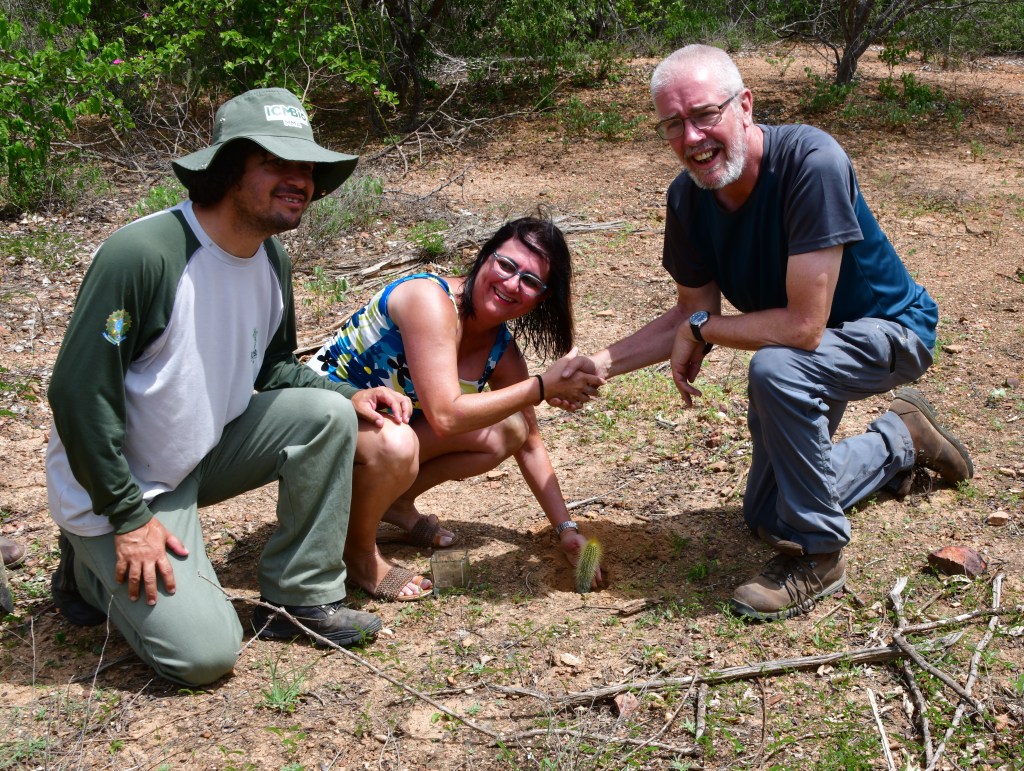
The cacti seen during the walk included Arrojadoa penicillata, Pereskia bahiensis, Pilosocereus pachycladus and Tacinga werneri and Marylan invited me to join her in planting a cultivated plant of Arrojadoa marylaniae to mark our friendship since 1999.
S3711: left to right: The manager of the Park, Marylan Coelho and PK planting a seedling of Arrojadoa marylaniae
The second and last stop of the day, S3712, was some two hours away where Marlon wanted to show us a new species of Arrojadoa that he and Alvado wanted to publish. We were slightly surprised when we reached the plant, growing at the bottom of a steep and quite high hill. that Marlon produced a knife and started to attack the plant, explaining that he needed to collect samples to include as herbarium specimen to support the description. Alain sacrificed some of his cachaça, at 38 – 48 % alcohol by volume, the strongest alcohol available, in which the flowering stem of the plant could be preserved. I believe that the plants were found as botanists and students searched for new locations of Arrojadoa marylaniae that is close to extinction at its only known location that we’ll visit tomorrow. It was interesting to note that Espostoopsis dybowskii and Arrojadoa penicillata also grows here, just like at the A. marylaniae site! This plant has a very fragmented range with populations that I have seen growing near Jequia and, in the north, between Jaguarari and Flamingo. The distance between these locations used to be part of the Atlantic Forest of which some 85% has disappeared, replaced by agriculture and by logging, exported to Europe and the USA.
Marlon taking pictures and herbarium specimen for a possible new species of Arrojadoa.








 The Cactus Trip Diaries