
Just another WordPress.com site

Archive for the ‘2010’ Category

Saturday, 27 March, 2010 – Monclova, Coahuila to Bustamante, Nuevo Leon

Another excellent day with seven stops that provided cacti in two genera that I had not seen in nature before: Epithelantha (I assume  it was E. micromeris) and Astrophytum, with A. capricorne as it’s representative. There were also a number of candidates for first time of photographing a species that I had not seen before in nature. Now don’t jump to the conclusion that I have become a mere  ‘list ticker’, but at the same time, there is little point in going back time after time to photograph things that I have thousands of pictures of already – unless we are in Chile of course.

The theme for today can be summed up by that song from the sixties by the Chicago Transit Authority: ‘Does anyone really know what time it is?’ with all the jumping from one time zone to another and different countries / states  changing from winter to summer time on different weekends. California had already made the change on the night of 17 / 18 March. In the UK (and Europe in general I believe) it happens on the last weekend of March so in fact around 2 a.m. on 28 March, while in Mexico, it seems to be next weekend – Easter Weekend – that the clocks change. Anyway, John & I got it wrong and knocked on Eunice’s door 55 minutes after we thought that we had agreed to meet for breakfast, only to be told that we were 5 minutes early. We had already had breakfast, so Eunice was on her own, while I used the extra time to have a chat with Angie. Sorry Eunice.

I guess it only matters what time it is when I need to catch my flight back to England in a couple of weeks+ time.

Today’s stops were S1790 to S1796 inclusive.

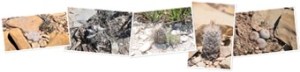
S1790 and S1791 were ‘leg stretchers’ but did not yield anything exciting, so I won’t bore you with the plant list. S1792 are pictures taken around the charming Mexican town of Bustamante. Our database suggests that there is also a town by that name in the State of Coahuila, but as the plants reported are the same that we found here, in Nuevo Leon, I wonder if that might be a typo. So S1793 to S1796 are from the Bustamante canyon area known as Ojo de Agua. Not a very original name, as I have come across several of these in Latin American countries. We found Epithelantha micromeris, Escobaria sp, a small growing Echinocereus pectinatus form – is this E. pailianus that I have grown and killed several times in the UK? E. fendleri (?), E. stramineus, Astrophytum capricorne, Ferocactus / Thelocactus hamataspinus (?), a Sclerocactus (Ancistrocactus sp) and a Mammillaria sp to be identified and various Opuntia sp. that the Tephrocactus Study Group meeting can have a chance to ID.

Back in Bustamante, work was in progress for a big fiesta, probably to celebrate Palm Sunday. I bought yet another hat to ‘blend in with the natives’, as you’ll see on tomorrow’s pictures.

Friday, 26 March, 2010 – Sanderson, TX to Monclova, Coahuila, Mexico

Although this is now my fifth visit to Mexico, there is always a tenseness among those in the car as we head for the border crossing. ‘What will go wrong this time?’ is at the back of our minds.

Absolutely nothing.

The cafe in Sanderson was closed for breakfast, so we had brunch near Los Rios, still in Texas. We had opted to cross at Eagle Pass into Piedras Negras, Coahuila, rather than use the big crossings at Laredo or El Paso. The crossing went in fact too smooth, just a traffic light changing from red to green – we did not even get a stamp in our passports! The Tourist Visas that Eunice and I had from our trip to Baja were valid for 180 days, but John needed to buy one, so we had to turn back to the alternative crossing, where there were more formal offices.

We learned that the import of the rental car would be at Allende, some 80 km south, at the first check point. It only took 45 minutes, and that included getting our passports stamped at immigration. We had anticipated the main snag experienced last year and had insisted on a letter of authority from Dollar, granting permission to take the car into Mexico.

Today’s stops were S1788, a scenic stop to photograph the bridge across the Pecos River, but a cactus stop as we spotted an Opuntia sp. S1789 was our first Mexican plant stop with Opuntia sp., Echinocereus sp. and Escobaria sp. formally identified at genus level anyway, plus three more different cactus sp. to keep me awake wondering what they are.

We arrived safely at the Best Western in Monclova around 7 and enjoyed a nice Mexican dinner (well, I had a Margarita, a Negra Modelo cerveza and a burger and chips) before retiring to the hotel for Diary writing.

I wonder how this weekend’s clock changings will work out in the end. We seem to be 7 hours adrift from the UK and probably still will be tomorrow.

Thursday, 25 March, 2010 – Alpine to Sanderson

Today provided a good example of how temperature ranges, rather than minimum temperatures affect our plants. We woke up to a white frosting on the ground and ice on the windscreen with the thermometer indicating 31F (just below 0C, i.e. freezing), at 7:30 a.m. By midday, the temperature had climbed up to 85F (29C). In the UK, it is not uncommon to start the day in March with scraping the ice of car windows first thing in the morning. By midday, the temperature may have crept up to 45F (7C).  While cacti bodies are reasonably well adapted to protect the core of the stem from the extreme high and lows experienced at the epidermis; they are less likely to endure low temperatures throughout a 24 hour period for days on end.

Back to today. We had a very ice breakfast at the Best Western in Alpine and I forgot to take pictures of the cacti planted out in their front garden. Just after 8 a.m. we were on the road, back to Terlingua, to look for IW#3, our name for a stop recommended by Ian from one of his visits, a.k.a The Starlight Theatre stop. Eunice had entered the coordinates into her SatNav system, a similar one to mine.

Except that mine shows the distance to the end destination in the bottom right corner of the screen, while hers shows the distance to the next turn. So when we had ‘arrived’ we were disappointed not to see the Starlight Theatre or any of the other features mentioned. But as the ‘town’ of Terlingua is a ghost town where most of the 2,000 original inhabitants have now died or left, all that remains are tourist outfits, including doom buggy operators, with some redevelopment in progress. Perhaps the Theatre had been pulled down? 

We had a good look around at the spot where the SatNav had taken us, including a ‘promising looking hill’ that Ian had mentioned (S1781) and were about to leave disappointed, when John reported an interesting cactus in flower on top of the hill. It’s amazing how fast I can still climb (short distances) when there is a cactus as reward. The plant in question was Echinocereus russanthus, and while I made my climb, John had found several more. An excellent find!

Back in the car I asked Eunice to set up the GPS for the next stop. Looking at the display, she exclaimed: but we still have 7 miles to go to Ian’s stop! Oooops. As I followed the new instructions we did find the Starlight Theatre etc, (S1782) as well as Ariocarpus fissuratus, Echinocactus horizonthalonius, Mammillaria lasiacantha, Echinomastus sp. (I bought the 2008 Cacti of Texas book, so should be able to get the name later).

S1783 was at the turning on TX 385 heading towards the visitor’s centre. We found Agave lechuguilla, Corynopuntia emoryi and/or C. schottii, Cylindropuntia leptocaulis, Echinocactus horizonthalonius, Echinocereus russanthus, E. stramineus, Fouquieria splendens and another tricky Sclerocactus sp.

S1784 was roughly half way between the road junction at S1783 and the visitor’s centre at S1785. We saw Agave lechuguilla, Echinocactus horizonthalonius, Echinocereus russanthus in flower, Echinocereus sp., looking like E. enneacanthus, but with stems much shorter than plants seen in Mexico later on this trip, E. stramineus, Mammillaria heyderi and Opuntia sp.

The next stop was at the Big Bend National Park visitor’s centre junction at Panther Junction (S1785) where in the small garden I photographed Agave sp., Fouquieria splendens, Mammillaria heyderi, Opuntia sp., Yucca elata, Yucca faxoniana (s.n. Y. carnerosana). They were numbered with the names printed in a small guide that of course I have since mislaid, hence the ‘sp.’ names again.

We continued driving along TX 385, through the Chisos Mountains and made a leg stretch stop (S1786) where we saw Agave lechuguilla, Echinocactus horizonthalonius, Echinocereus enneacanthus, E. stramineus, Lupinus sp., Opuntia sp. (like O. santa-rita) and Sclerocactus sp.

We headed to Daggerflat’s Road for the last stop of the day (S1787) where we saw lots of Ariocarpus fissuratus together with Echinocactus horizonthalonius, Echinocereus pectinatus, Euphorbia antisyphalitica, Opuntia engelmannii, O. rufida, Sclerocactus sp., Yucca torreyii, Yucca elata, said to be the tallest Yucca at Big Bend State Park, and Yucca faxoniana (s.n. Y. carnerosana), very impressive, with large, thick leaves.

Wednesday, 24 March, 2010 – Van Horn to Alpine

Van Horn turned out to be almost a ghost town of some 2,400 inhabitants and almost as many Motels, along I-10. Some 29% of the population has income below the national poverty line and driving around town late at night to find a place to buy a sandwich was quite eerie.

We still had an oil change to perform and rang Dollar to tell them of our failed attempts. We were now granted permission to get the oil changed anywhere that we could.

Just as last year’s journey – that time on the way back from Mexico, we passed through the town of Marfa. No, not one of my usual typos, not Martha, but Marfa with an f. We tried three different petrol stations before we found Brit Webb, now in his eighties and apparently, running a garage single handed. He must have worked in it since he left school and run it since he left the air-force. ‘Sure, I’ll do you an oil change’. Music to our ears. But then after he had drained all the oil and came to replace the filter, he found that he did not have the right one in stock. Never mind, he knew his business, got into his car and came back ten minutes later with the right one.

At last we could focus on some plant stops. We made five between Marfa and then along the Rio Grande through the Big Bend Ranch State Park:

S1776 was one suggested by Ian from his trips in this area; his ‘Nice big Hamatocactus uncinatus‘ stop. I’ll call it Sclerocactus uncinatus and we did not walk all the way to see Ian’s (alleged)  big one, as we were happy to walk only half the distance from the road to find one in full bloom. We also found Echinocereus engelmanii (or E. stramineus?), E. pectinatus and E. enneacanthus, all in bud, two Cylindropuntia sp, at least two Opuntia sp. and an Echinomastus sp. Did you not see these, Ian?

The next stops were along the Rio Grande and were as much for the scenery as for the plants, which were all from the S1776 list, plus Opuntia rufida popping in and out and at the last stop, some Ariocarpus fissuratus, but again half the distance from the road where Ian had reported them.(S1777, S1778, S1779, S1780).

At least the Diaries are once again up to date. Tomorrow we’ll cover the other half of the Big Bend area and select the safest crossing into Mexico and aim to spent our last night in the USA just before it, ready to cross first thing on Friday.

Tuesday, 23 March, 2010 – Tucson, AZ to Van Horn, TX

As we drove out of Tucson, we noticed a ‘Service Warning’ message lit up on the dashboard. After a bit of trial & error we managed to navigate down the menu structure to learn that an oil change was due. Disappointing, as we had only just taken out the car for a three week and had advised our intention to travel in Mexico, when I had made the booking in January.

Eunice phoned their roadside assistance number who apologised, confirmed that an oil change was due in about 500 km and suggested that we’d return to Dollar at Tucson Airport or drive on to El Paso, where they’d swap cars. Swapping cars was not our ideal solution, as we had all the Mexico papers for the car that we were currently driving. It would be quite a time consuming hassle for us to change all that. So we agreed to call Dollar at El Paso, about an hour before we were likely to arrive, and they would do the oil change.

Around 11 a.m. we needed to stretch our legs, so pulled off I8 at the exit for Dragoon and stopped at the first pull off after the exit (S1774). Not a bad random stop, with Cylindropuntia prolifera, Opuntia sp, Ferocactus wislizeni and Agave sp. The Coryphantha was keen to show off its variability on a clump where each head could have been described as a different species!

S1775 was on the corner of Titanic & Dyer in El Paso, Texas, where a particularly atracive crested Ferocactus wislozeni had been planted out next to a fire hydrant. I doubt that it will be there for many year.

Dollar had given us permission to get the necessary oil change at any Walmart or Express-Lube. The first one along our route was in El Paso, but told us that there was a 2 hour wait minimum as they only had two staff on duty. The second address was in error, we could not find any Walmart or their look a-likes. Fortunately, El Paso has three Walmarts (at least) and we were next in line. The lady in charge (and the only employee on duty in the garage section would page us when the car could be picked up.   We killed the time with some shopping and had a cheese burger at the McDonalds, before checking on progress. It appeared that we had missed the pager announcement, made soon after we had started our shopping, because they did not have the right filter in stock! Argghh!

32 miles from Van Horn there was another Border Patrol check point. All along the US / Mexico border area, well into the USA, these check points aim to control the movement of people, drugs and weapons. So far, we have always just been waved on. This time, the dog used to smell out criminals, reacted. That meant that that they were obliged to search us in detail. That meant all of us out of the car, then the dog let loose. One of Eunice’s bag seemed to justify more attention. It contained her supply of freshly ground coffee, a substance often used to put dogs off the smell of illegal drugs. The bulges in my jacket raised suspicion too, so we were marched into the office where I was hand searched. The officer could not believe how many cameras, batteries etc I carried with me. Ultimately we were given a clean bill and were allowed to leave. Never a dull moment.

We later learned that three US consular officials had been murdered just across the border in Mexico, so it was understandable that they were on high alert.

The Motel 6 at Van Horn had been booked by Eunice on her mobile phone. Free wifi was guaranteed. But on arrival it did not reach as far as the rooms that we had been allocated.