Just another WordPress.com site

Archive for the ‘Mexico’ Category

Sunday, 28 March, 2010 – Bustamante to Minas Viejas

It was only some 30 km from Bustamante to Minas Viejas but we took quite a while to cover the last 20 km from the gate along the asphalt road, up the mountain to the Great Hall which would be our lodgings for the night. At the princely sum of 33 pesos (less than US$3, or GBP2) for all three of us. We were the only people here and the hall served as our indoor campsite. Eunice had brought along air-mattresses for us and John had his own cot-bed. The hall had a kitchen and bathrooms and avoided the setting up of tents and the clearing of sharp rocks. There is quite a wind whistling around the place as I write these notes, so it is just as well that I do not need to put up a tent.

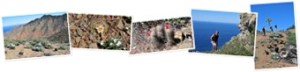
From the gate to the Great Hall, the reasonably maintained track wound its way up a canyon and I recorded four stops for pictures taken along the way.

S1797 was prompted by us spotting our first Opuntia in flower. We were still on the flat lands of the Valley floor at around 580 m.

Local reports from Los Angeles all along the route to here suggested that in general it had been a wet winter, so that everything looked relatively lush compared to June 2009 when Eunice had last been here. It meant that the Opuntias were full of advanced buds. But the warmth of Spring needed to persuade these buds to open had been late this year, as if the flowers had been waiting for our arrival. The coming weeks should be a real feast.

We saw Epithelantha micromeris, the omni-present Agave lechuiguilla, Agave scabra, recognised by the sandpaper-like texture of the underside of the leaf, Opuntia engelmannii (?), and a small globular cactus about which we can’t make up our mind as young plants look different from older plants and flower remains and fruits will probably require some reading and looking up things on the Internet once I’m back home in England. Coryphantha, Sclerocactus (Ancistrocactus) and Echinomastus are among the candidate genera.   Or are we seeing more than one species of similar looking plants? There was also an Echinocereus sp. that we had seen yesterday. It forms clumps and looks to be coming just out of its winter rest, looking dehydrated and in need of some moisture and warmth. At the Great Hall they had a picture book of the natural history of the area and there was our plant and the label clicked immediately: Echinocereus viereckii.

S1798 was at the beginning of our ascend up the hill at around 800 m. Plants spotted included that Coryphantha / Sclerocactus sp. again, small solitary green bodied plants assumed to be seedlings of Echinocereus viereckii and a slightly larger, clumping sp. too, were they the same species? The book suggests E. enneacanthus, but the accompanying pictures of plants in flower suggests E. vierecki to me. Agave scabra was also still abundant.

We had climbed to 1,020 m when we photographed Echeveria simulans in flower, for the start of S1799. This stop lasted until we reached the Grand Hall. We saw Sedum palmerii, (although the book calls it S. greggii, John is positive that it is E. palmerii) abundant and in flower, another Sedum sp., Echinocereus enneacanthus and E. viereckii. the same one that we had seen at the previous stop, and a form with long pendant stems up to a meter long, Hamatocactus setispinus, a thick leaved Tradescantia sp. – are there succulent Tradescantia ? Opuntia engelmannii.  Mammillaria heyderi (?), M. prolifera (? not reported from this area,  so probably something else), Tillandsia sp., Agave stricta and our first Agave ovatifolia, although the book called it A. gentryi.

Throughout our trip and also in Brazil, we would come across the resurrection plant, Selaginella, and here it was in all its stages between very dry and in full glory, depending on the aspect of the hillside and the availability of moisture. I suspect that there is more than one species that we have seen on our travels – must read more later. *

After inspection of our quarters for the night, we went farther up the track, until it deteriorated and climbing to the top of the hill tomorrow became a good alternative. John and I walked back along the track, while Eunice drove the car. All images are filed as  S1800 and included Agava stricta, A. ovatifolia, a few A. scabra, Mammillaria heyderi (?), Echinocereus viereckii , Oxalis sp. and Opuntia sp.

Tomorrow we’ll explore a bit more around the area before returning for a night in comfort at Bustamante.

*  From Wikipedia:

‘Selaginella is a genus of plants in the family Selaginellaceae, the spikemosses.

Selaginellas are creeping or ascendant plants with simple, scale-like leaves on branching stems from which roots also arise. The plants are heterosporous (megaspores and microspores), and have structures called ligules, scale-like outgrowths near the base of the upper surface of each microphyll and sporophyll. There are about 700 species of Selaginella, showing a wide range of characters; the genus is overdue for a revision which might include subdivision into several genera. Selaginella lepidophylla – the resurrection plant, dinosaur plant, and flower of stone (Chihuahuan Desert of North America)’

So what species is the one that we saw in Brazil?

Unusually for the lycopods, each microphyll contains a branching vascular trace.
Saturday, 27 March, 2010 – Monclova, Coahuila to Bustamante, Nuevo Leon

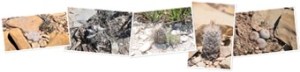
Another excellent day with seven stops that provided cacti in two genera that I had not seen in nature before: Epithelantha (I assume  it was E. micromeris) and Astrophytum, with A. capricorne as it’s representative. There were also a number of candidates for first time of photographing a species that I had not seen before in nature. Now don’t jump to the conclusion that I have become a mere  ‘list ticker’, but at the same time, there is little point in going back time after time to photograph things that I have thousands of pictures of already – unless we are in Chile of course.

The theme for today can be summed up by that song from the sixties by the Chicago Transit Authority: ‘Does anyone really know what time it is?’ with all the jumping from one time zone to another and different countries / states  changing from winter to summer time on different weekends. California had already made the change on the night of 17 / 18 March. In the UK (and Europe in general I believe) it happens on the last weekend of March so in fact around 2 a.m. on 28 March, while in Mexico, it seems to be next weekend – Easter Weekend – that the clocks change. Anyway, John & I got it wrong and knocked on Eunice’s door 55 minutes after we thought that we had agreed to meet for breakfast, only to be told that we were 5 minutes early. We had already had breakfast, so Eunice was on her own, while I used the extra time to have a chat with Angie. Sorry Eunice.

I guess it only matters what time it is when I need to catch my flight back to England in a couple of weeks+ time.

Today’s stops were S1790 to S1796 inclusive.

S1790 and S1791 were ‘leg stretchers’ but did not yield anything exciting, so I won’t bore you with the plant list. S1792 are pictures taken around the charming Mexican town of Bustamante. Our database suggests that there is also a town by that name in the State of Coahuila, but as the plants reported are the same that we found here, in Nuevo Leon, I wonder if that might be a typo. So S1793 to S1796 are from the Bustamante canyon area known as Ojo de Agua. Not a very original name, as I have come across several of these in Latin American countries. We found Epithelantha micromeris, Escobaria sp, a small growing Echinocereus pectinatus form – is this E. pailianus that I have grown and killed several times in the UK? E. fendleri (?), E. stramineus, Astrophytum capricorne, Ferocactus / Thelocactus hamataspinus (?), a Sclerocactus (Ancistrocactus sp) and a Mammillaria sp to be identified and various Opuntia sp. that the Tephrocactus Study Group meeting can have a chance to ID.

Back in Bustamante, work was in progress for a big fiesta, probably to celebrate Palm Sunday. I bought yet another hat to ‘blend in with the natives’, as you’ll see on tomorrow’s pictures.

Friday, 26 March, 2010 – Sanderson, TX to Monclova, Coahuila, Mexico

Although this is now my fifth visit to Mexico, there is always a tenseness among those in the car as we head for the border crossing. ‘What will go wrong this time?’ is at the back of our minds.

Absolutely nothing.

The cafe in Sanderson was closed for breakfast, so we had brunch near Los Rios, still in Texas. We had opted to cross at Eagle Pass into Piedras Negras, Coahuila, rather than use the big crossings at Laredo or El Paso. The crossing went in fact too smooth, just a traffic light changing from red to green – we did not even get a stamp in our passports! The Tourist Visas that Eunice and I had from our trip to Baja were valid for 180 days, but John needed to buy one, so we had to turn back to the alternative crossing, where there were more formal offices.

We learned that the import of the rental car would be at Allende, some 80 km south, at the first check point. It only took 45 minutes, and that included getting our passports stamped at immigration. We had anticipated the main snag experienced last year and had insisted on a letter of authority from Dollar, granting permission to take the car into Mexico.

Today’s stops were S1788, a scenic stop to photograph the bridge across the Pecos River, but a cactus stop as we spotted an Opuntia sp. S1789 was our first Mexican plant stop with Opuntia sp., Echinocereus sp. and Escobaria sp. formally identified at genus level anyway, plus three more different cactus sp. to keep me awake wondering what they are.

We arrived safely at the Best Western in Monclova around 7 and enjoyed a nice Mexican dinner (well, I had a Margarita, a Negra Modelo cerveza and a burger and chips) before retiring to the hotel for Diary writing.

I wonder how this weekend’s clock changings will work out in the end. We seem to be 7 hours adrift from the UK and probably still will be tomorrow.

Thursday, 25 March, 2010 – Alpine to Sanderson

Today provided a good example of how temperature ranges, rather than minimum temperatures affect our plants. We woke up to a white frosting on the ground and ice on the windscreen with the thermometer indicating 31F (just below 0C, i.e. freezing), at 7:30 a.m. By midday, the temperature had climbed up to 85F (29C). In the UK, it is not uncommon to start the day in March with scraping the ice of car windows first thing in the morning. By midday, the temperature may have crept up to 45F (7C).  While cacti bodies are reasonably well adapted to protect the core of the stem from the extreme high and lows experienced at the epidermis; they are less likely to endure low temperatures throughout a 24 hour period for days on end.

Back to today. We had a very ice breakfast at the Best Western in Alpine and I forgot to take pictures of the cacti planted out in their front garden. Just after 8 a.m. we were on the road, back to Terlingua, to look for IW#3, our name for a stop recommended by Ian from one of his visits, a.k.a The Starlight Theatre stop. Eunice had entered the coordinates into her SatNav system, a similar one to mine.

Except that mine shows the distance to the end destination in the bottom right corner of the screen, while hers shows the distance to the next turn. So when we had ‘arrived’ we were disappointed not to see the Starlight Theatre or any of the other features mentioned. But as the ‘town’ of Terlingua is a ghost town where most of the 2,000 original inhabitants have now died or left, all that remains are tourist outfits, including doom buggy operators, with some redevelopment in progress. Perhaps the Theatre had been pulled down? 

We had a good look around at the spot where the SatNav had taken us, including a ‘promising looking hill’ that Ian had mentioned (S1781) and were about to leave disappointed, when John reported an interesting cactus in flower on top of the hill. It’s amazing how fast I can still climb (short distances) when there is a cactus as reward. The plant in question was Echinocereus russanthus, and while I made my climb, John had found several more. An excellent find!

Back in the car I asked Eunice to set up the GPS for the next stop. Looking at the display, she exclaimed: but we still have 7 miles to go to Ian’s stop! Oooops. As I followed the new instructions we did find the Starlight Theatre etc, (S1782) as well as Ariocarpus fissuratus, Echinocactus horizonthalonius, Mammillaria lasiacantha, Echinomastus sp. (I bought the 2008 Cacti of Texas book, so should be able to get the name later).

S1783 was at the turning on TX 385 heading towards the visitor’s centre. We found Agave lechuguilla, Corynopuntia emoryi and/or C. schottii, Cylindropuntia leptocaulis, Echinocactus horizonthalonius, Echinocereus russanthus, E. stramineus, Fouquieria splendens and another tricky Sclerocactus sp.

S1784 was roughly half way between the road junction at S1783 and the visitor’s centre at S1785. We saw Agave lechuguilla, Echinocactus horizonthalonius, Echinocereus russanthus in flower, Echinocereus sp., looking like E. enneacanthus, but with stems much shorter than plants seen in Mexico later on this trip, E. stramineus, Mammillaria heyderi and Opuntia sp.

The next stop was at the Big Bend National Park visitor’s centre junction at Panther Junction (S1785) where in the small garden I photographed Agave sp., Fouquieria splendens, Mammillaria heyderi, Opuntia sp., Yucca elata, Yucca faxoniana (s.n. Y. carnerosana). They were numbered with the names printed in a small guide that of course I have since mislaid, hence the ‘sp.’ names again.

We continued driving along TX 385, through the Chisos Mountains and made a leg stretch stop (S1786) where we saw Agave lechuguilla, Echinocactus horizonthalonius, Echinocereus enneacanthus, E. stramineus, Lupinus sp., Opuntia sp. (like O. santa-rita) and Sclerocactus sp.

We headed to Daggerflat’s Road for the last stop of the day (S1787) where we saw lots of Ariocarpus fissuratus together with Echinocactus horizonthalonius, Echinocereus pectinatus, Euphorbia antisyphalitica, Opuntia engelmannii, O. rufida, Sclerocactus sp., Yucca torreyii, Yucca elata, said to be the tallest Yucca at Big Bend State Park, and Yucca faxoniana (s.n. Y. carnerosana), very impressive, with large, thick leaves.

Wednesday, 24 March, 2010 – Van Horn to Alpine

Van Horn turned out to be almost a ghost town of some 2,400 inhabitants and almost as many Motels, along I-10. Some 29% of the population has income below the national poverty line and driving around town late at night to find a place to buy a sandwich was quite eerie.

We still had an oil change to perform and rang Dollar to tell them of our failed attempts. We were now granted permission to get the oil changed anywhere that we could.

Just as last year’s journey – that time on the way back from Mexico, we passed through the town of Marfa. No, not one of my usual typos, not Martha, but Marfa with an f. We tried three different petrol stations before we found Brit Webb, now in his eighties and apparently, running a garage single handed. He must have worked in it since he left school and run it since he left the air-force. ‘Sure, I’ll do you an oil change’. Music to our ears. But then after he had drained all the oil and came to replace the filter, he found that he did not have the right one in stock. Never mind, he knew his business, got into his car and came back ten minutes later with the right one.

At last we could focus on some plant stops. We made five between Marfa and then along the Rio Grande through the Big Bend Ranch State Park:

S1776 was one suggested by Ian from his trips in this area; his ‘Nice big Hamatocactus uncinatus‘ stop. I’ll call it Sclerocactus uncinatus and we did not walk all the way to see Ian’s (alleged)  big one, as we were happy to walk only half the distance from the road to find one in full bloom. We also found Echinocereus engelmanii (or E. stramineus?), E. pectinatus and E. enneacanthus, all in bud, two Cylindropuntia sp, at least two Opuntia sp. and an Echinomastus sp. Did you not see these, Ian?

The next stops were along the Rio Grande and were as much for the scenery as for the plants, which were all from the S1776 list, plus Opuntia rufida popping in and out and at the last stop, some Ariocarpus fissuratus, but again half the distance from the road where Ian had reported them.(S1777, S1778, S1779, S1780).

At least the Diaries are once again up to date. Tomorrow we’ll cover the other half of the Big Bend area and select the safest crossing into Mexico and aim to spent our last night in the USA just before it, ready to cross first thing on Friday.

Tuesday, 23 March, 2010 – Tucson, AZ to Van Horn, TX

As we drove out of Tucson, we noticed a ‘Service Warning’ message lit up on the dashboard. After a bit of trial & error we managed to navigate down the menu structure to learn that an oil change was due. Disappointing, as we had only just taken out the car for a three week and had advised our intention to travel in Mexico, when I had made the booking in January.

Eunice phoned their roadside assistance number who apologised, confirmed that an oil change was due in about 500 km and suggested that we’d return to Dollar at Tucson Airport or drive on to El Paso, where they’d swap cars. Swapping cars was not our ideal solution, as we had all the Mexico papers for the car that we were currently driving. It would be quite a time consuming hassle for us to change all that. So we agreed to call Dollar at El Paso, about an hour before we were likely to arrive, and they would do the oil change.

Around 11 a.m. we needed to stretch our legs, so pulled off I8 at the exit for Dragoon and stopped at the first pull off after the exit (S1774). Not a bad random stop, with Cylindropuntia prolifera, Opuntia sp, Ferocactus wislizeni and Agave sp. The Coryphantha was keen to show off its variability on a clump where each head could have been described as a different species!

S1775 was on the corner of Titanic & Dyer in El Paso, Texas, where a particularly atracive crested Ferocactus wislozeni had been planted out next to a fire hydrant. I doubt that it will be there for many year.

Dollar had given us permission to get the necessary oil change at any Walmart or Express-Lube. The first one along our route was in El Paso, but told us that there was a 2 hour wait minimum as they only had two staff on duty. The second address was in error, we could not find any Walmart or their look a-likes. Fortunately, El Paso has three Walmarts (at least) and we were next in line. The lady in charge (and the only employee on duty in the garage section would page us when the car could be picked up.   We killed the time with some shopping and had a cheese burger at the McDonalds, before checking on progress. It appeared that we had missed the pager announcement, made soon after we had started our shopping, because they did not have the right filter in stock! Argghh!

32 miles from Van Horn there was another Border Patrol check point. All along the US / Mexico border area, well into the USA, these check points aim to control the movement of people, drugs and weapons. So far, we have always just been waved on. This time, the dog used to smell out criminals, reacted. That meant that that they were obliged to search us in detail. That meant all of us out of the car, then the dog let loose. One of Eunice’s bag seemed to justify more attention. It contained her supply of freshly ground coffee, a substance often used to put dogs off the smell of illegal drugs. The bulges in my jacket raised suspicion too, so we were marched into the office where I was hand searched. The officer could not believe how many cameras, batteries etc I carried with me. Ultimately we were given a clean bill and were allowed to leave. Never a dull moment.

We later learned that three US consular officials had been murdered just across the border in Mexico, so it was understandable that they were on high alert.

The Motel 6 at Van Horn had been booked by Eunice on her mobile phone. Free wifi was guaranteed. But on arrival it did not reach as far as the rooms that we had been allocated.

Thursday, 18 March, 2010 – Isla Cedros – trip to Isla Navidad

As I write these notes, it is already Monday 22 March. The tour to Baja – Isla Cedros and southern California is over and we have enjoyed very full days, making it difficult to find time to write up these Diary pages. To catch up, I’ll just post brief summaries and add to them once I get home. Pictures will depend on time and internet facilities availability.

Those of you who have been on cactus day trips to islands in Baja California and Chile will know the routine: early breakfast, then a walk to the harbour to wait for the fishermen, whose pangas (small open boats with outboard motor) would hopefully take us to the target for the day, weather permitting. Sometimes it is a question of balance – it may be the only chance to go the the island as time budgets are set for us to move on to other locations and on the other hand, health & safety demands that the captain only takes us out when he knows that he and his passengers will be safe. Sometimes conditions around the lee of the island can be different from what you see at the harbour. Weather can sometimes change very quickly and the bats are vulnerable to wind, so the captain has the last word without tempting him to take irresponsible actions.

Today, all systems were go, but with the warning that we’d get wet. Most of us had weather proof gear, more for the cameras than for ourselves. I have a wonderful picture of one of our party with a plastic shopping bag over his head. After some two hours bumping from one wave to the next we were soaked and glad to arrive on Isla Navidad. Just like all these islands, these are nature reserves, here to protect a rare bird, the Black Vented Sheerwater, that builds its nests, tunnels, in the soft ground. So we were asked to stay on the track at all times and were taken to two locations by pick up truck, with several stops on the way, but with some frustration as we were seeing the endemic Mammilaria hutchinsoniana in flower, some two meters from the path. Only long tele zoom lenses could capture the detail. Eventually a compromise was reached so that a few people at the time could visit some of the plants spotted in flower and take pictures from close up. The other target for our cameras was Ferocactus fordii. Unlike F. chrysacanthion on Isla Cedros, F. fordii was in flower.

We were shown three cardon, but these were not Pachycereus pringlei as suggested in the plant list for the island, but P. pecten-arboriginum, which is common in BCS where it takes over from P. pringlei. Technically, Isla Navidad is in the state of Baja California Sur, but it was the spination of the few stems that I was able to photograph at close quarters that persuaded me that it was P.p-a rather than P. pringlei.

I recorded two stops, S1762 and S1763 to file the images taken.

Wednesday, 17 March, 2010 – Isla Cedros – Punta Norte

Today was probably the hardest hike that I have made for plants and our goal was not even a cactus! Dudleya pachyphytum, first found by Alfred Lau and described by Moran & Benedict, is is a plant that is not often seen in cultivation in Europe, probably because plants in the genus Pachyphytum itself are just as attractive and easier to propagate, from leaf cuttings. 

I recorded a total of eleven stops today (S1751 to S1761 inclusive). On these long hikes (10:30 hours in total) plus two hours each way by boat – the return journey was in the dark! – it is always difficult to decide how to split pictures taken into stops. My failing GPS for the camera provided the solution. From time to time I would check the connection and hold it tight until I had taken a picture that had recorded the coordinates. I’ll next upgrade my cameras when Nikon models with similar specifications or better include a built in GPS.

In simple terms, S1751 was for images taken during the boat ride along the eastern shore of the island. S1752 – S1759 were for pictures taken on the way to our target, S1760 was the place where the plants grew and S1761 were pictures taken on the way back. There were not many in S1761 as I was dog tired, walking on robot power, very thirsty, despite the litre of water that I had taken and eventually needing a rest to let the tail-enders catch up, as I was getting cramps in both legs, from thighs to my toes – not nice. Jose eventually breezed by to say that he was on his way to base camp to collect fresh water. I realised why his second name is Angel! Never did pure water taste so good!

So what about the plants that we saw? Well, certainly Dudleya pachyphytum, a very nice plant in habitat but critically endangered, as it is very rare, just found in one relatively small location with nearby pine forests having suffered badly from forest fires. There was plenty of evidence burnt clumps of D. pachyphytum. Its remoteness will probably be the plants’ best protection and I feel confident that Jose understands the issues and will fight for these plants and their habitat. Please let me know if there is anyway in which I can help.

Other plants, in the order we came across them were:

  • Pachycormus discolor var veatchiana, easily spotted from the boat and a constant companion along the trail that brought us to our end point.

  • Opuntia sp. as I said yesterday, O. oricola and O. prolifera are reported from the island so it may just be a matter of finding a picture that matches what we saw.

  • Agave sebastiana – in large numbers, a very pretty member of the genus. Again, it was almost omni present.

  • Ferocactus chrysacanthion, with us from start to finish, most plants not large, and with spination colour ranging from yellow to red. No buds or flowers seen. As I am writing up this notes a day late, I can say that the flowering season differs from that of F. fordii that we would see on Isla Navidad.

  • Echinocereus maritimus forming some very large mounds with impressive spination. Usually they were smaller plants with small clumps looking pretty beat up by the environment. The yellow flower was the give away. E. engelmannii is also reported from the island but I can’t say that I saw any candidates for the species. It can be very variable in nature and may be at the height of the flowering season, the flowers will give away their identity.

  • Mammillaria (Cochemiea) pondii. While yesterday we found just one plant in flower and were told that October is the peak flowering season for these plants on the island, today we saw many more plants in flower. Because I am colour blind, their bright red flowers do not leap out for me, but my travel companions were very helpful to point out their presence. I’d guess that some 5% of the plants that we saw were in bud or flower. The flower colour is one that digital cameras seem to struggle with, showing flowers where the colour is over saturated.

  • Dudleya sp., probably D. cedrosensis, as the name suggests, an endemic from this island, but there are other species listed from the island, so more research needed to show which name matches the plants that we photographed.

  • Mammillaria goodridgei and its ssp. rectispinus although not photographed until later on our hike, they seem happy to crop up in small numbers all along the track. Usually small and solitary, pulled back into the gravel, they are not so easy to spot, with lots of more obvious plants distracting our attention.

  • Dwarf Lupine sp.

  • Pine trees – I’ll need to look up the plant list to tell which one. They seem to indicate the presence of water when seen at lower altitude and show the reliance on regular fogs in small clusters growing right at the top of hills in the north of the island. It was quite disheartening early on in the trip, when we spotted these trees high on hill tops above us, that we’d have to climb that high! Sometimes it is easier to be ignorant of such facts.

What is interesting to note as I review my pictures, is that all these plants are very abundant along the route that we took. At every point that I stopped to take a picture I could have taken pictures of dozens of that species, with the exception of D. pachyphytum.

Tuesday, 16 March, 2010 – Isla Cedros Day #1

It was another 5 a.m. breakfast day, to be at the harbour by six to discover the weather forecast for the day. Calm seas would see us take two pangas to Islas San Benito.

Sadly the winds were too strong to make the trip today, but I keep my fingers tightly crossed for the next few days as I’m keen to see and photograph Mammillaria neopalmeri there – it’s an island endemic.

Instead, we boarded three very capable 4×4 vehicles for a drive to La Colorado and six plant stops on the way there and back. For some people we now get to the interesting bit of the Diaries, the plant stop list! Other’s will now reach for the ‘next’ button before their eyes glaze over. Here we go:

Immediately west of Cedros we passed through an area that seems to be in regular use as the town’s rubbish dump. Rubbish is an issue in any small community where its size does not yet necessitate a strict disposal policy with related (costly) services. Here the rubbish was spread out over a very large area, as though it was being sorted and readied for collection at a future date. Time will tell. As tourism might increase the number of people sharing this island environment in the future, the rubbish disposal problem will only become worse, unless it is put in place to put people off from coming.

S1745 – Mammillaria goodridgei (endemic) was spotted almost straight away by our eagle eyed Japanese companions. It took a while before I spotted my one and only plant – it’s great to travel in a group! The plant was in flower, but at 9 a.m. it was still too early for the flower to be open. We found a few more of these very small, solitary plants before finding a similar but more robust plant. Here, at 9:10, the flowers were open and the plant had a number of ripe berries as well. But was it the same species or another member of the M. dioica complex? M. blossfeldiana and M. hutchinsoniana are also reported from here and are non endemics, also occurring in Baja California south of Ensenada. Pachycormus discolor variety veatchana (with smaller leaves and different flowers from the main species that we had seen on BC in 2008) was here as was a hairy caterpillar.

S1746 again had P. discolor var veatchiana, but as we were now almost right on the coast, the plants were windswept and looked like huge bonsais, if that is not too much of a contradiction in terms. But the attraction cactus-wise here was Ferocactus chrysacanthus, nice plants with very tight spination and only few plants in fruit – no buds or flowers seen.

S1747 – We almost stumbled across a large Mammillaria as soon as we stepped out of the cars – but which one? It took until a few stops later, when we saw it in flower, to realise that this was Mammillaria (Cochemiea) pondii. Agave sebastiana was here too, many plants beginning to flower. Also, we saw our first Dudleya on the island, but which one? They formed impressive clumps of many hundreds of heads. A Google search suggests that D. cedrosensis is an island endemic, but Paul Thomson’s monograph on the genus dismisses this as an invalid name. Instead, he lists D. acuminata and D. moranii as occurring on the island. In addition to D. pachyphytum of course. More on that distinctive taxon later. The distinctive flower stalks required to ID Dudleyas were unfortunately not seen or at least not photographed by me.

S1748 is where we finally saw our one and only M. pondii in flower. Later, I learned from the owner of the cabanas where we were staying that this plant usually flowers in October on the island. More reading necessary to discover the trigger; fogs? rain? shortening day time hours? Presence of a migratory pollinator? A combination of all these factors? It seems that just as on Isla Magdalena, where we found M. halei in 2008, fogs (rather than rain) occur regularly on the island. So just like the Chilean Atacama Desert coastal zone then.

Also here were Ferocactus chrysacanthus, Agave sebastiana, Dudleya sp. (or was there more than one?) Echinocereus maritimus with the yellow flower (only one found) providing the clue. Interesting to see that the outside petals are red, just as in Copiapoa in Chile. Jose was getting the taste for cactus hunting and found a tiny Mammillaria goodridgei.

S1749 was at Punta Colorada, where we stopped for lunch, while snapping more pictures of ocean scenes and the ever popular group photo with much hilarity as the self-timer on one of the cameras failed to co-operate.

S1750 was more of the same, but this time pictures of Euphorbia misera, to remind me that we had seen it at all the previous stops as well. The Pachycormus discolor were much taller here, real giants compared to the ‘bonsai’ forms seen earlier.

After a 90 minute rest back at the cabanas the group was off again, this time to excursions to the Salt Works and an Abalone farm. I had seen these elsewhere before, so stayed behind to catch up on the Diaries. I’ll try to add some pictures tomorrow if time permits.

On Isla Cedros

Sorry for the lack of postings, but we are kept busy from 5 a.m. through to late in the evening when brain & eyes cease to function. I’ll catch up as soon as I can. Having a whale of a time!