Just another WordPress.com site

Archive for the ‘Mexico’ Category

Tuesday 28 October 2014 – around Cuatro Cienegas

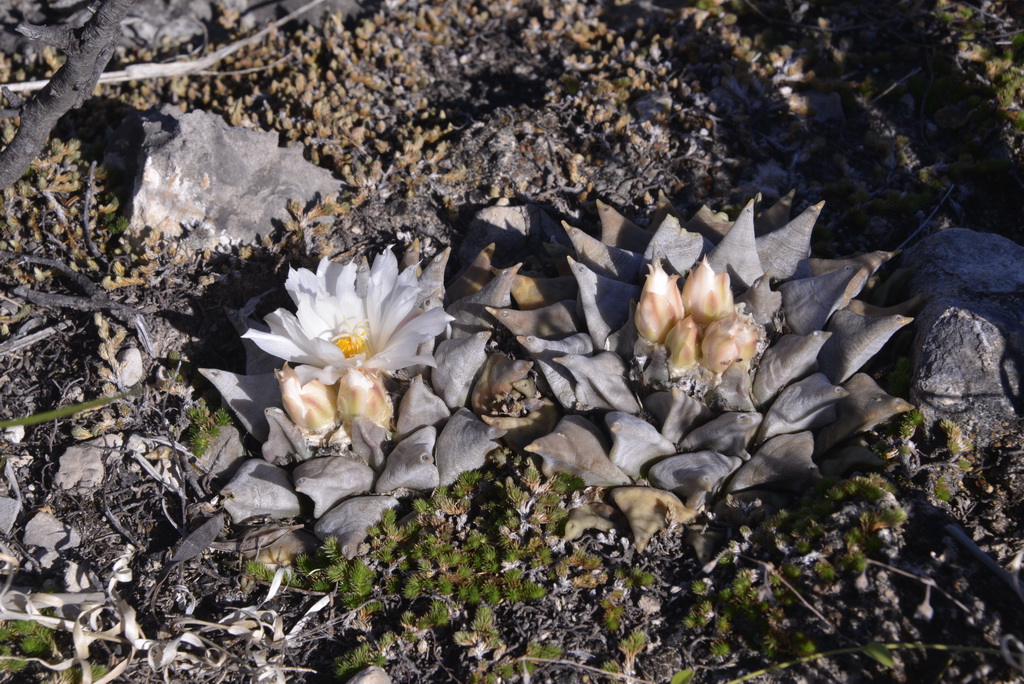
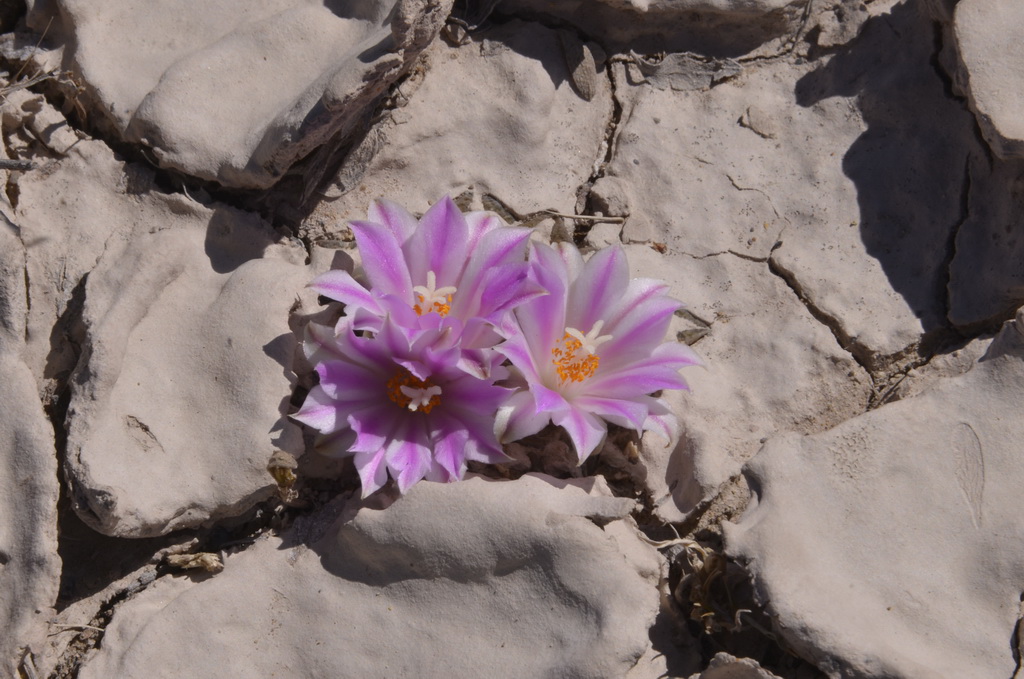
It was a short drive, just 4.7 km from the Hotel to the location where I had been at least twice before, usually at the end of the day, tired, with no great memory of previous visits. This visit (S3184) I will remember, as we were greeted within a couple of steps from the car by Ariocarpus fissuratus in full flower – when a few weeks earlier when Alain and Eunice visited here, there had not been any flowers.
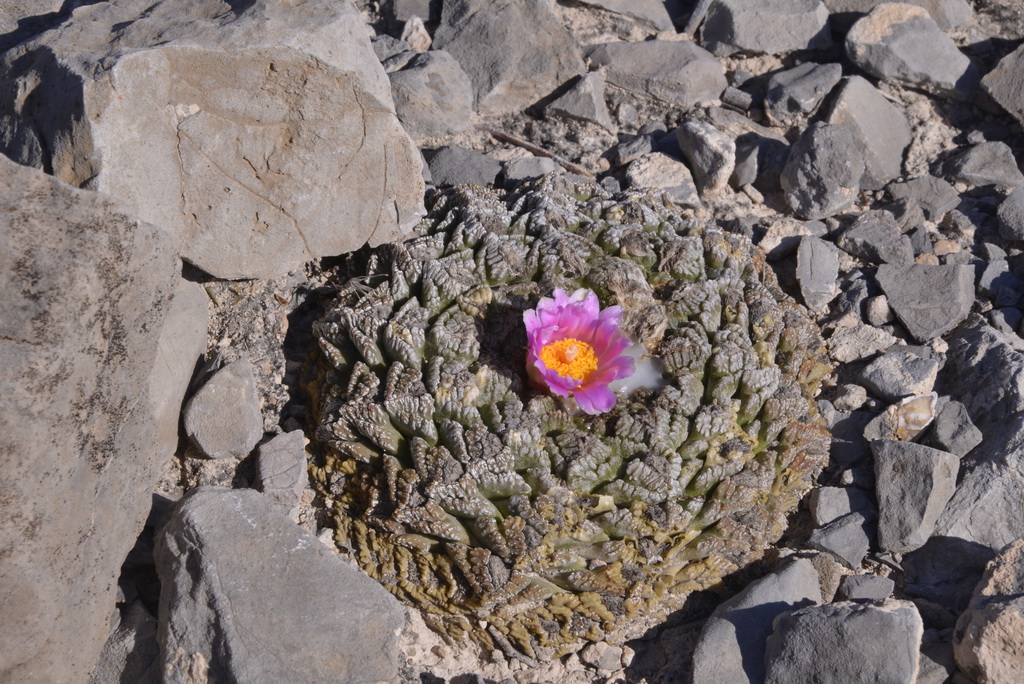
First plant to greet me at the Ariocarpus fissuratus stop (S3184)

First plant to greet me at the Ariocarpus fissuratus stop (S3184)

All the cacti spotted during previous visits were still here, including some large Astrophytum capricorne, that had been in flower during Alain’s previous visit but now had finished – you can’t have it all! 107 images later, mostly of Ariocarpus in flower, I was beginning to suffer from Ariocarpus indigestion! How many flowering Ario pictures do you need? Quite a few more it seems, as we moved on to our usual A. kotschoubeyanus location along MEX 30 (S3185). Of all the Kots locations that I have seen, this has the densest gathering of tiny cacti. Despite the mass flowering here, the flowers were still too small and the plants too far apart to create a true ‘purple haze’ affect, although I feel optimistic about what can be done with some time in PhotoShop – Christiaan, please take note!
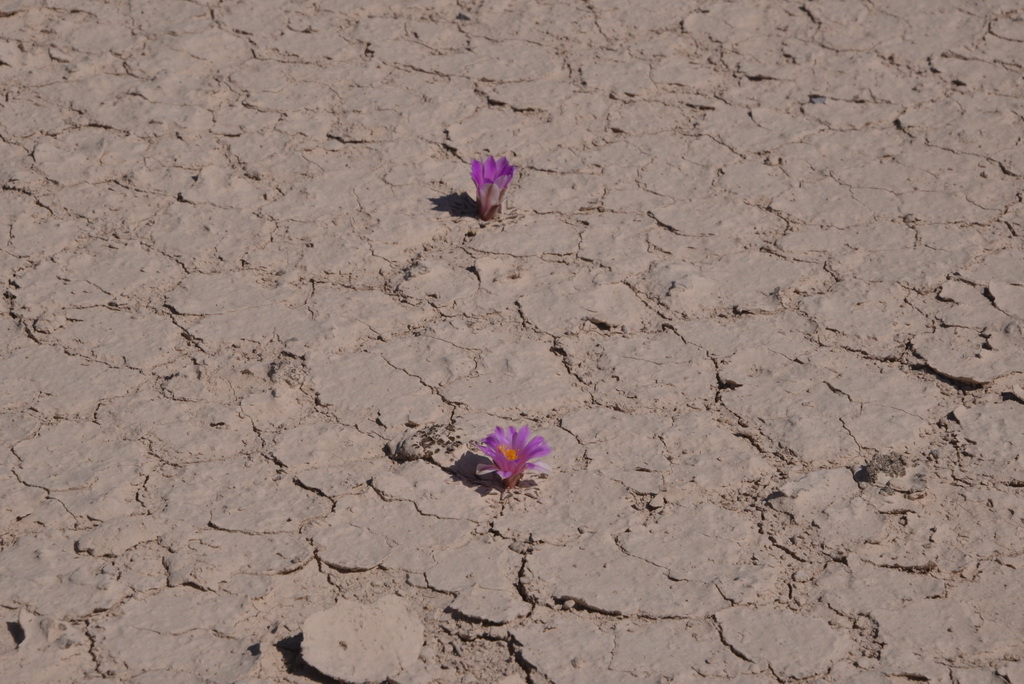
Mass flowering at S3185, but the flowers and plants were unable to create the stunning purple haze effect that I had seen in the Atacama Desert by Calindrinia in flower.

Mass flowering at S3185, but the flowers and plants were unable to create the stunning purple haze effect that I had seen in the Atacama Desert by Calandrinia longicarpa in flower.

It was very hot, 34 C according to the car’s thermometer, and another 82 images later, Ario indigestion was complete. So on for a few more km to the turning where in March we had emerged after a tortuous track through the desert from Parras. It can be done, but I would not recommend it! This time we stopped at the junction with MEX30 (S3186) and some very nice, tall, Thelocactus bicolor subsp bolaensis. Previous visitors have called the plants here ‘Thelocactus wagnerianus’, so a bit more reading is due. The remarkable thing here is that we found one Thelo still in flower. Many more had been in flower during our March visit. There is also a very nice Echinocereus here. Is it E. stramineus? E. longisetus? Answers on a postcard please (or by email).
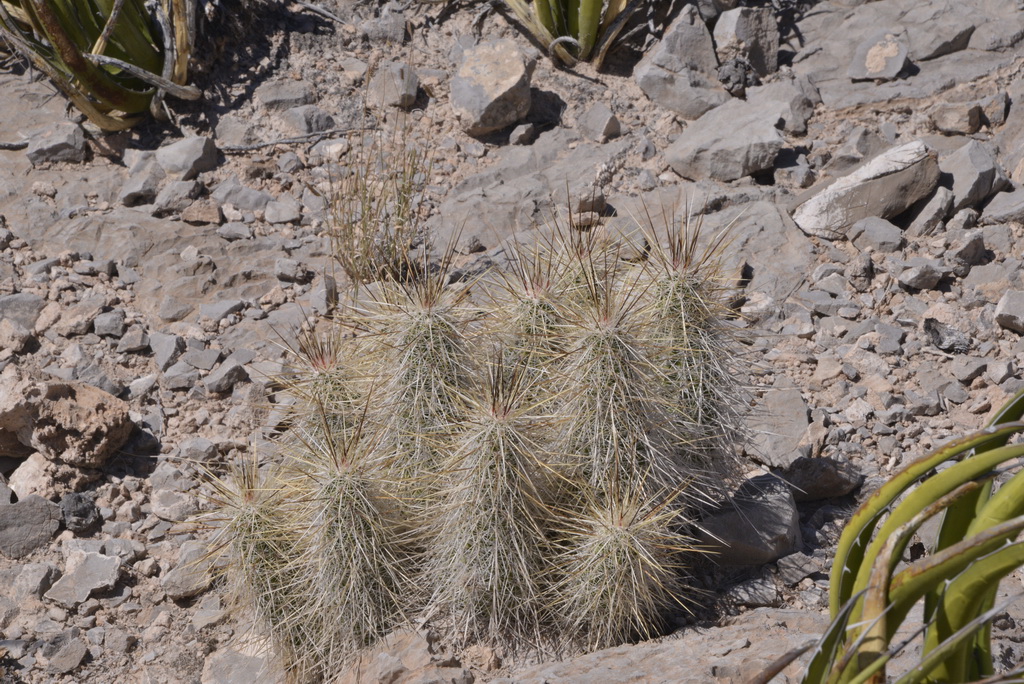
Echinocereus ID please!

Echinocereus ID please!

And so,  still very early in the afternoon, we decided on one more stop (S3187), along MEX 30, opposite the turning to S3185, before spending the afternoon at the poolside of the hotel with cool beers and a refreshing breeze.  The T. bicolor subsp. bolaensis were here too, and again there were some plants still in flower – great!
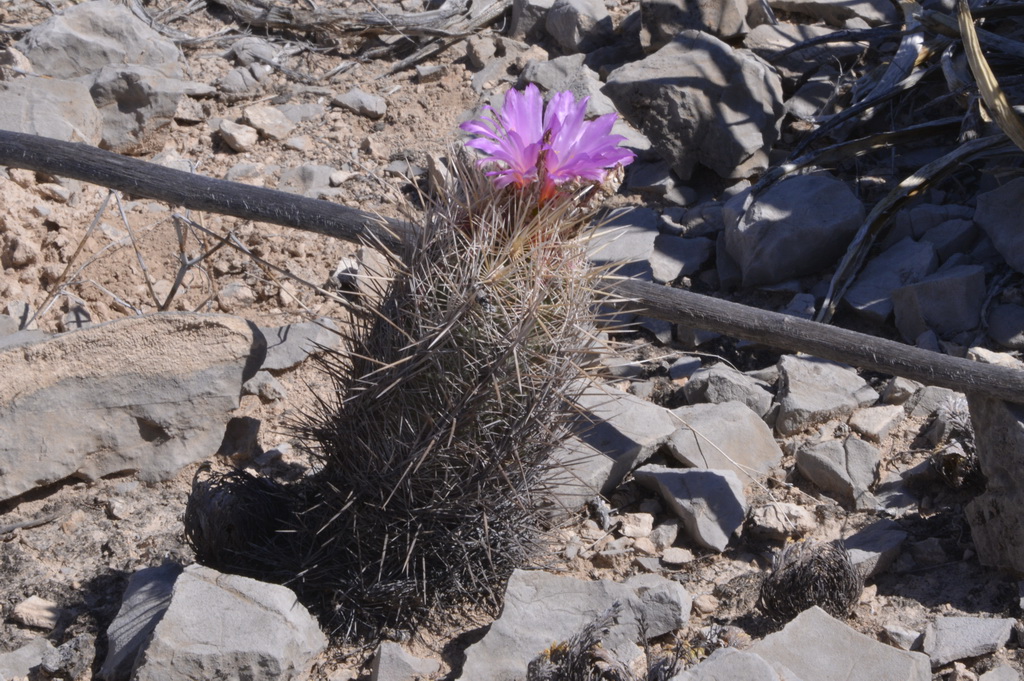
Thelocactus bicolor subsp. bolaensis (S3187)

Thelocactus bicolor subsp. bolaensis (S3187)

We have reached the northern most part of our trip, so tomorrow we start heading south again.
Monday 27 October 2014 – Ramos Arispe to Cuatro Cienegas

Lots of driving, mostly on excellent asphalt and four stops where the expectations regarding plants were met.

S3180 was an ad-hoc stop, because we needed to stretch our legs and provided most of the cacti that you might expect to find anywhere in Coahuila. SatNav tells me that we were near General Cepada. Plants photographed, in the order that the pictures were taken include Echinocactus horizonthalonius, Agave lechuguilla, Fouqueria splendens, Thelocactus bicolor and its subsp. bolaensis (so much for the rule that a species and its subspecies are not supposed to grow together), Lophophora williamsii, Opuntia rufida, Echinocereus stramineus, Corynopuntia sp., Mammillaria heyderi, Coryphantha sp (probably more than one – Ian has names) Astrophytum capricorne, and Epithelantha micromeris or one of its many names, real or imagined. Not a bad start for an unplanned Coahuila stop, but not  completely unexpected.

For S3181 we turned off Mex 40 at Estacion Marte, having pulled towards it by a table mountain called El Pillar. I had been here before in 2010 when some Mexicans were processing Agave leaves by turning them through a ‘mill’ to obtain pulp and fibre. This time the equipment was still there, but not in use. We crossed the railway before a long train with a variety of freight wagons passed through. Another 2 km past the village, the track offered access to a vast area of dried mud flats where in the past (Spring time) we had found Ariocarpus kotschoubeyanus and an assortment of other cacti struggling for survival. This was supposed to be their flowering time and we were not disappointed, but instead of the 100 % mass flowering that I had hoped for, this was a rather modest show by those plants, covered in dried up silt that had managed to push their flowers through the mud. Some of these had their flowers eaten by (we presume) a beetle that was seen marching around, leaving flower remains near the plants. I set myself the challenge of taking a picture of a plant in flower, with a wide angle setting that also included the expanse of desert and El Pillar in the background. I might need the help of my son, Christiaan, and his CGI wizardry, to convey both my expectations and reality for future presentations.

Ariocarpus kotschoubeyanus (S3181)

Ariocarpus kotschoubeyanus (S3181)

As we approached El Pillar, we drove along huge silt flats that were sure to contain huge numbers of A. kotschoubeyanus as well, but in true cactus tourist style we had driven straight passed these to our intended target. With our objective reached, we relaxed and made a random stop along the road that we had passed on Mex 40 to our turning to E. Marte and made a ‘quick’ ad-hoc stop, S3182. By the time that two cars have pulled over, released their passengers and equipment into the desert, get their bearings, take plenty of pictures before being shepherded back towards the car, at least an hour had passed – just to give you an impression of what a ‘quick stop’ means.

Next a stiff drive at speeds between 100 and 120 kph to La Paloma where we turned into the desert to a spot where in the past we had found crested Ariocarpus retusus. Would the whole crest be in flower? We will never know. Many of the plants were still in advanced bud, some had today opened their flowers. The crest that Ian had found in March was looking unwell, the crests that Alain had found three weeks earlier were not seen. I asked Alain for the information, which he said he had given to Ian, I asked Ian, who said it was stored away on his computer. In any event, the plants were not found, until I read Ian’s report of the day.

Ariocarpus retusus (S3183)

Ariocarpus retusus (S3183)

Fortunately I had found a number of crested retusus plants here before in 2010 when John Bleck showed me the plants that he had found. This time, and last March, we were distracted by a gate that had since been built to reach the exact spot where we had parked that time.

Ten minutes after continuing our journey to Cuatro Cienegas, Alain asked if we would see Ariocarpus agavoides. May be, but as I have seen it already  …..

We’ll probably pass that way, and it would be churlish to avoid sharing past experiences with friends.

Some 50 km south of Monclova, traffic suddenly came to a halt. Of course those in a hurry (most) just had to overtake, trucks, salloon cars and everything. The queue went as far as the eye could see. There was nothing coming the other way, just as well, as there was no way through for them. The usual characters, you get them all over the world, got out of their cars and marched purposefully towards the assumed couse of the hold up, but outside their air conditioned car soon found that the temperature rather soon ‘cooled’ their tempers. After some 45 minutes, traffic suddenly started moving our way – still nothing coming through from the north. It appeared that police had just closed the road and at a gravel track, sent us south east, towards MEX 53. We must have looked quite a convoy on Google Earth, if that had been life, a stream of cars several km. long throwing up lots of dust, moving through the desert at some 50 kph.

When we hit MEX 53 we were still 47 km south of Monclova, so arrived in Cuatro Cienegas in the dark, but fortunately Restaurant El Doc stays open until 23:00 hrs, so we didn’t go hungry. Alain and Eunice had eaten here a few weeks earlier and Alain was able to recommend the rib-eye but warned against the T-bone, so four rib-eyes were ordered, but, disappointingly, four T-bones were served. Never mind.

Sunday 26 October 2014 – Galeana to Ramon Arizpe

Not the best of days. Today the clocks changed, both in Mexico and in Europe. Ian had suggested an early start as we wanted to go to a location near China – still in Nuevo Leon, Mexico, but a good long drive away. Bart and I were the only ones up on time and there was no breakfast to be had, other than a hot chocolate and a piece of cake at the OXXO near the Hotel. My laptop played up again, I probably tried to shut it down while it was doing a mega software update, so this morning the system just hung.

We arrived at our destination and walked around a set of coordinates for almost two hours without any different outcome. Astrophytum (Digitostigma) caput-medusae was as impossible to find now as it had been last March. This time the herbacious ground cover was even thicker and only the more robust cacti pocked out from between them – Echinocereus viereckii and Mammillaria sp. to name but a few.

Disappointed but not entirely surprised we headed back to a main road and nother longish drive to Ramos Arispe where tomorrow we have some more nice target plants.

Saturday 25 October 2014 – around Galeana

I had assumed incorrectly that Ian and crew wanted to see Geohintonia today, having missed out yesterday, but Ian said that he and Cliff were happy with what I had shown them in March and wanted to head straight for the Ariocarpus scaphirostris site. Fine no problem. The track to Rayones was generally improved but still had 5% of places where recent rains made the going ‘adventurous’, so we fell a little behind Cliff & Ian’s car, providing the excuse for a stop where in March we had found some Ariocarpus retusus. They had not been there long, so had not found any plants yet, leaving Alain to be the first to find the local Ario. It did not take long to find a few more, but only one or two in flower. This was not the flowering feast that we might have anticipated given the time of year.

There was another tricky bit of road, so I suggested that our car would stop at the  Aztekium ritteri on the way to the ‘Scaph’ site to see the plants in the best light and give us the option of a better, but longer, road back to the hotel. Ian said they would see us at the ‘scaph’ site, but changed his mind and decided to join us, after overshooting the turn to the track that led to the village with the ritteri hill. His competitive nature got him first to the spot. Fortunately the plants had not moved since our March visit but this time were bathing in a short spell of sunlight. Those of us who give A. ritteri top of the greenhouse positions to receive the maximum of UK / northern European sunlight might like to know that these days, we have only found the plants in narrow canyons where they grow on vertical gypsum cliffs where they grow in mud – just like Turbinicarpus alonsoii, Aztekium hintonii and Geohintonii mexicana elsewhere in Mexico. These plants are not used to getting long periods of intense sun in nature. It may be that once upon a time they lived on the main hillsides, fully exposed to the Mexican sun, where previous visitors might have collected all these easy to find plants, rendering them close to extinction and from what we observed, seeming to justify a conservation status of ‘threatened’. These days, they live in small narrow canyons off the main cliff face in locations that only receive the intense sun for brief spells, a couple of hours at most. I managed to pick up a good crop of images to add to those from previous visits.

S3177 Aztekium ritteri growing on a sunny cliff face

S3177 Aztekium ritteri growing on a sunny cliff face

Expectations rose as we approached the Ariocarpus scaphirostris site. Would we find the plants pumped up by recent rain and bursting with buds and flowers? Looking at the Selaginella lepidophylla (resurrection fern, rose of Jericho) there had been recent humidity here, as the plants were wide open. It did not take long to find ‘Scaphs’ but they still looked like drought victims, although most were in bud. With six people spread out over the hillside, it did not take long to find four or five plants in flower and on these too the tubercles looked like drought victims with this one probably the nicest I saw:

S3178 Ariocarpus scaphirostris in flower

S3178 Ariocarpus scaphirostris in flower


Friday 24 October 2014 – Matehuela to Galeana

Just a minor blip in this morning’s departure, our tyre pressures were down on the rear left hand tyre, according to the on-board diagnostics, so off to a garage to check them out. Conclusion: tyres fine, diagnostics dodgy.

We headed east to Dr Arroyo, much quieter now than when we tried to get rooms here a few days ago – it seemed there was a Policia Federales convention in town and all rooms were taken.

We missed the turning to La Solidad, La Trinidad and Sandia – no wonder, apparently they were sign-posted to Monterrey! So while Ian realised what was going on and turned around to try some brief stops along that road, we blundered on towards La Ascencion – Ariocarpus Hill, where in March the idea had come to my mind to see this Ariocarpus covered hill in October, during the flowering season.

But first an ad-hoc stop along NL 61 with some large Ferocactus pilosus and some clumps of a Thelocactus multicephalus to entertain my camera shutter finger at S3173.

Thelocactus multicephalus (?)

Thelocactus multicephalus (?)

On to S3174, just north of La Ascencion. Although the Ariocarpus retusus were as densely packed on to the hillside as I has expected, the mass flowering I had expected to see did not come off. About 25% of the plants had already flowered,, some were in bud, some 25% were in full flower, but the hilly terrain and the plants’ tendencies to grow very flat to the ground, among grasses and annuals did not produce the anticipated mass flowering shots. Still plenty of individual plants in flower shots, plus a couple of crested plants (without flowers)

Ariocarpus retusus crest

Ariocarpus retusus crest

Alain, Bart and I had taken all the images we needed, and more, progressing on to the higher ‘Hill #3’ for the first time – same plants as hills #1 an 2.and it was still early, so we decided to head on to the Geohintonia mexicana site (this time S3175). Again did not know the tract that we were on that leads to the location, trying to send us down a a non existent track. I stuck to my guns and we arrived safely at the spot. The cacti that had previously caused us a head ache to ID looked very pumped up this time, but no easier to give them a reliable name. Are they Coryphantha sp? Neolloydia sp? or a Thelocactus?

Mystery cactus at S3175

Mystery cactus at S3175

The narrow canyon where in March we had seen the best Geohintonia was now flooded so rather than getting our feet wet, I risked broken limbs by climbing a low gypsum rock face to take pictures of the Geohintonia there:

S3175 - Geohintonia mexicana

S3175 – Geohintonia mexicana


Thursday, 23 October 2014 – around Matehuela

Ariocarpus bravoanus at El Herrero

Ariocarpus bravoanus suibsp. hintonii at El Herrero

Today’s breakfast in the wifi restaurant was a real shock: my laptop refused to start up despite having been charged all night. Had I lost all my Australia images and all Mexico images to date? Rather anxiously I got back to the Hotel, plugged my charger back into the mains and try again – Bingo!!! I quickly backed up all the files that I had worried about to my plug in HD drive.

Great! I was also worried that the data for future stops during the trip would be inaccessible, so quickly wrote down coordinates for a stop I had made with Eunice in 2011 and where after some searching we found Ariocarpus bravoanus, or was it subsp. hintonii? (PS. yes it was) Without Internet access I can’t get to the relevant data in Google Earth. A task for the days back in England. Not only did we find it again, but not at the exact spot, but in the same area and Ian found it some 500 m farther along as well all recorded as S3170.

From this site I saw and recognised the large white cross on the hill at El Herrero, where again in 2011, Eunice and I went to have a look for Ariocarpus and Turbinicarpus, but where on that occasion a group of Mexican young man started following her as she searched for the plants. This time (S3171) we were not bothered by any of the local people and therefore found the plants (Ariocarpus bravoanus subsp. hintonii and A. retusus ‘horachecki’, in flower and a Turbinicarpus reported as T. frailiana by previous visitors. A good stop with excellent spots by Ian and Cliff. Alain spotted the A. bravoanus subsp hintonii plants in flower – what did he have for breakfast?

For S3172 we drove 84 km south of Matehuila to El Huizache, the famous road junction often visited by Charlie Glass and Bob Foster. Again, Ariocarpus retusus were in flower – the best being a plant with eight flowers! All the other cacti were as in March, but not in flower.

Again, we had a great day!

Wednesday, 22 October 2014 – Jaumave to Matehuila

It had to happen, by going to a cheaper hotel in Matehuela, we missed out on wifi, making it more difficult to issue the daily missives. Never mind, the restaurant where we had dinner had wifi, but when we returned the following morning, so that I could post this record of our adventures, my laptop refused to switch on, despite having been on charge all night long. Never mind, here a bit later than planned is what we did on Wednesday.

We made five stops and missed out on a sixth because two pick up trucks with a number of fine burly men told us that we were not allowed to look at the Pelecyphora strobiliformis near El Refugio, because they were sure that we wanted to steal their peyote. We were not about to have a punch up, particularly as I had been there twice before already, once last March with Cliff and Ian and once in 2011 with Eunice Thompson.

But let’s focus on what we did see.

S3165 was near Miquihana where we took a turn off the very nice newly made asphalt road, to Villa Bustamante, just to look what grew on the low hill. Sarda was nominated as cactus spotter extraordinaire as she found two Ariocarpus retusus in flower. There were some huge Mammilloydia candida and some very fine Thelocactus conothelos. Not bad for an ad-hoc stop!

S3166 was another random stop rewarding us again with A. retusus in flower, Mammillaria formosa, Coryphantha sp.

S3167 was past Miquihana and still on lovely new asphalt, we saw some huge Ferocactus pilosa that were taller than Alain ‘Fero’ Buffel, so a ‘must see’ stop.

Near Doctor Arroyo we made stop S3168 and found lots of Thelocactus hexaedrophorus, T. conothelos and a Dasylirion sp.

Next we were turned away from the Pelechyphora site and so went on to S3169 where I spent three previous times to find a Turbinicarpus (I forget which) and of course failed again this time, but ironically, given the previous stops objections, we found lots of Lophophora – and did not eat or steal any!


Tuesday, 21 October 2014 – around Jaumave

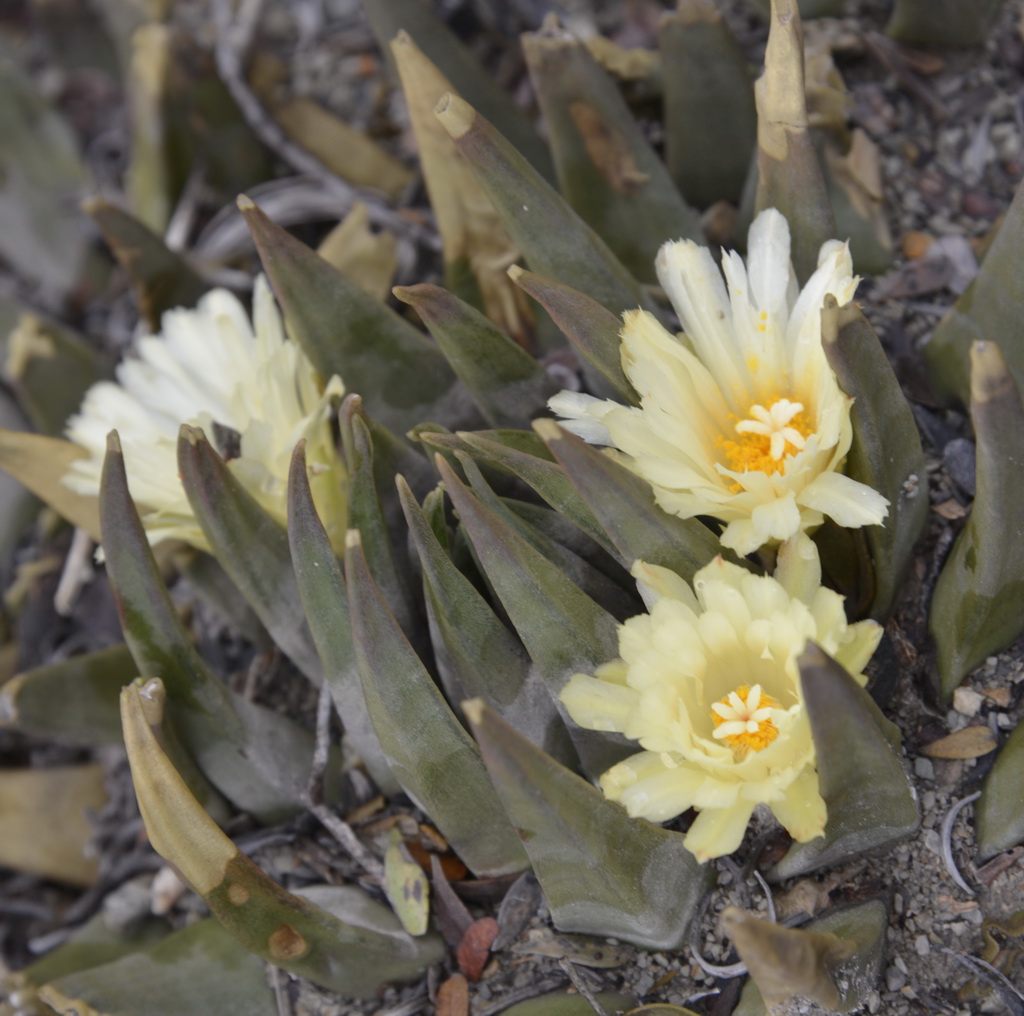
HOORAY – ARIOCARPUS FLOWERS AT LAST!!!

Ariocarpus trigonus in flower

Ariocarpus trigonus in flower

The rain had stopped during the night so our car party went for breakfast ‘next door’ while Ian and Cliff got over the previous night’s rum headache.

First stop (S3161) was at the second site where we had seen Obregonia denegrii in March, some distance past the village of San Antonio. As expected, the plants again looked pumped up after the recent rain, high humidity and high temperatures. The water had caused quite a bit of erosion here, with some plants growing isolated on small ‘islands’ during a hard rain. The Obregonia looked in great shape with many huge mature plants balanced by lots of young seedlings. Then there were the Arios, A. trigonus here, but still no flowers or buds on the first plants we saw. It was not until we climbed the low hill where we had seen plenty of them in March that Sarda (again) became to spotter of plants in flower.

Also here, some magnificent Astrophytyum myriostigma, with one or two still in flower. When added to our March pictures, we have of course much too many images than ‘needed’, but can you ever have too many pictures of nice cacti?

A quick visit at the Pemex in Jaumave to milk the ATM machine and I was solvent again. And on to the track to EL Cielo where we had been surprised by some really nice plants before. We headed straight for the farthest away stop from March, with a brief stop where the track crossed a river, so that I could take some pictures of huge groups of butterflies. The Monarch butterfly’s migration route is supposed to go by here (S3162). And so on to the farthest away spot, but 2km before we got there, the track, very muddy and wet in places, proved too much for our ‘townie cars’, so we parked and enjoyed a 2 km march (S3163). It was not too hot, but boy, was it humid! Cliff struggled as a result. Again the cycads looked magnificent and although the vegetation was much more dense, I still managed to find the huge clump of Mammillaria klissingiana that the audience at my presentations had enjoyed.

One more stop on the way back (S3164) where in March we had found Neolloydia ‘grandiflora’, then in full flower, now just looking pretty without flowers. Theleocactus conothelos was also here, but partially hidden in the tall grass, and a very nice small Coryphantha.

Got home safely and just about to get ready for dinner.

Monday, 20 October 2014 – CD del Maiz to Jaumave, the scenic route

The rain was still pouring down as we woke up. It was a quick swim to the restaurant and a full breakfast. So instead of the planned activity of driving to El Cielo National Park, a cloud forest, we decided to make it a driving day and head for Tamaulipas in the hope that things might be drier at lower altitudes. Soon after we crossed the border with TAM, the wipers could indeed be switched off.

Before that, we had driven down the long and winding road, passing by trees covered in Tillandsias, rocks covered in ferns and trees covered hillsides that included Beaucarnea recurvata with its large panicles waving above the tree canopy. Very difficult to get a descent picture. There are nine species, but B. recurvata is the only one listed for San Luis Potosi and Tamaulipas, so that will do. True giants.

It was dry when I eventually spotted Cliff’s car from MEX 85, parked along the track.  It took no time to find Thelocactus bicolor subsp schwarzii but they seemed at least twice as large as in March. Lots of Ariocarpus trigonus, and a few of Sclerocactus (Ancistrocactus) scheeri, all looking as if they were on steroids.

Whereas in March the village near where they live had seemed to have been deserted for some years, allowing plants to recover from the damage done by the goats and cattle that the villagers owned, this time the village was populated again and the cattle were back, but ‘parked’ in a field outside the area where the cacti grow. So where was Astrophytum asterias? By now, Ian, Sarda and Cliff had returned from their explorations and soon showed us the first few, so that we could get our eyes in. Wow, they had also grown, happy to grow in mud! But at 27C in October, the conditions are different enough to suggest that we should not try this in the UK. Tomorrow the temperature is forecast to be 30C with 100% humidity. Boil in a bag cultivation should work!

Astrophytum asterias

Astrophytum asterias


Sunday, 19 October 2014 – Rio Verde to Ciudad del Maiz

Today we repeated the trip from Rio Verde to Palomas and repeated the stops from previous occasions, starting with the Ariocarpus retusus ‘scapharostoides’ stop. Again, I searched in the ‘forest’ around Pylon #1, to no avail. The vegetation was too lush, hiding the thorns on the Acacia trees, while trying not to slip over as the cows had ensured that often I was almost ankle deep in manure. The others had walked straight on to Pylon #4 where the same plants seen in March were photographed again, this time surrounded by grass and Tagetes with their yellow flowers, but no flowers, or buds or evidence of spent flowers on the Arios – we’re still not sure if we have missed the flowering season or are too early (S3153).

S3154 was a quick stop for a mass (or mess?) of epiphytic cacti hanging from the tree branches – Disocactus? Hylocereus? Also lots of Tillandsia.

S3155 was for a location for which Ian had data for Lophophora viridiscens. He came back to the car disappointed, as the coordinates were now at the bottom of a reservoir, under meters of water. While he had been tracking the location down, we had wondered about the place and had found Ariocarpus kotschoubeyanus, Lophophora viridescens, Mammillaria sp, Coryphantha maiz-tablensis and Echinocereus enneacanthus and E. pentalopus.

S3156 was a random toilet stop, but while we were waiting for Cliff to catch up (their car had low ground clearance so could not keep up unless risking losing the exhaust), Alain had managed to find some Lophophora williamsii ‘koehressii’ – I remain unconvinced about these form names. Aian there were epiphytic cacti, E. enneacanthus, C. maiz-tablensis and large Sclerocactus uncinatus.

For S3157 we were back at ‘michelinman’, a massive Echinocactus platyacanthus, growing close to the largest Ferocactus histerix that I have ever seen.

One more stop, S3158 for Leuchtenbergia principis was nearly at the crossroads for the main road to Ciudad del Maiz. By now it had started to drizzle. Ian not only found the Leuchtenbergia but managed to find it in full flower – another candidate for my wall back home! (It’s picture that is).

Leuchtenbergia principis

Leuchtenbergia principis among the Agave lechuguilla and Mammillaria perbella

The drizzle became harder once we were back in the car and was quite persistent when we found a hotel with running water (through the yard) and a good restaurant almost next door. Let’s hope the weather clears a bit, I don’t really fancy ‘cactus in the rain’ as a theme for a future talk.