Just another WordPress.com site

Around 10 a.m. we arrived at S433 and were once again standing in the Spring sunshine, surrounded by cacti. Exactly a week earlier, the Brits and I were at London – Gatwick, boarding our plane to Madrid, the first leg of our flight to Cordoba, Argentina. It seems a year ago. Today, exactly a month after S33, both events seem a life time ago, such is the human mind.

Cacti at S433 included Cereus aethiops. This too has a tendency to germinate underneath a bush or shrub, eventually poking it’s head above its nursery. Here however, was a beautiful exposed specimen, multi-branched, some 150 cm (5 ft) tall and wide. If any cactus show had a special Cereus aethiops class, this plant would have won it. Shame there were no flowers.

The cry ‘What’s this Gymno?’ had become a familiar sound during our stops (sometimes provoking the response: ‘That’s not a Gymno, that’s an Acanthocalycium!). This time the consensus indicated G. hybopleurum (syn. G. catamarcense). It was easier to ID Trichocereus huascha and T. terscheckii and Opuntia sulphurea. And still the camera drifted skyward and recorded Tillandsia’s growing in the trees. The good news is that I have received offers of help to ID the Bromeliads. The only thing I have to do now is find the time to go through 3,562 images, select those of Bromeliads and get them to the volunteer. Patience please.

While the cameras were pointing skywards, the birders amongst us (Michael and Bryan) identified a spot in the sky as a condor, circling down. I find it difficult to share their enthusiasm. Why does the condor leave an image of ‘the King of the Andean skies’, when the somewhat smaller and much more frequently seen Turkey Vulture has a much less glamorous image. At the height that this bird was soaring, I could not possibly give an ID. Perhaps Gymnocalycium were not so difficult after all.

S434 had much the same plants, but the site was more exposed and as a result they looked different. Acanthocalycium glaucum was the new entry on our species list. The move of this taxon to Lobivia or Echinopsis seems an obvious one, as the plants were displaying woolly flower buds, rather than the spiny calyx that give the genus Acanthocalycium its name.

The scenery was increasingly becoming a distraction – as an increasing number of images of cactophiles, lined up to take the photo of the colourful mountainsides indicate.

S435 had the same cacti as S434, while at S436 (Los Naciementos) the Trichos changed from straight T. terscheckii to a more white densely spined top stems of T. pasacana. The word ‘hybrid’ was used, as was ‘intermediates’ and ‘over lapping distribution areas’, once again showing us all that nature is difficult to pigeon-hole. As usual, I took the pictures, noted GPS data and will find out more later by comparing the plants from others to in what respect these plants are converging.

Lobivia huascha (or Echinopsis if you prefer) were very robust and densely spined. Just look up the list of synonyms for this taxon and you’ll understand that it must be quite variable across its distribution area. It would take quite a bit of time and space, sowing and comparing seedlings from different locations to determine how much of this variation is genetic and how much of it is due to different growing conditions (soil, temperature, exposure, availability of water etc.). This is true for most of the Cactaceae (and I guess plants in general) that have a reasonable wide distribution area.

Some of you have asked me about more information about each habitat. I’m plotting our Stops in Google Earth and this certainly adds another dimension to the experience. I’ll check with Guillermo about his views on sharing some or all this data on-line. I’d leave some locations (e.g. the bonniae stop) off the list as numbers of this plant are very low and would not benefit from many visitors. There were other places where we respected Guillermo’s request not to take GPS readings.

And then we arrived for a night at the Ruines. Now I’ve seen a few ruines in my life, my own home is irreverently referred to as the ‘Klaassen No-Star Hotel’ by some (usually when the service (flow) of beers temporarily drops below expectation) , but the Hosteria Ruinas de Quilmes was a complete and very pleasant surprise. I took as many pictures of the Inca influenced architecture and ornaments as I usually take of cacti at one of our stops. Tremendous! Just enter Hosteria Ruinas de Quilmes into the Google search engine and select the Adventure Life link for a set of images that show better than words what I mean. In fact, the image top right in the set shows the location of that evenings wine tasting and the big pot in that picture is where Cliff and Mark took turns sticking their heads into the pot to make rude noises. Nobody said that these trips had to be serious, scholarly affairs! Doing searches on any of the geography names mentioned will show you a wealth of images that might fill your curiosity until I reach the end of the Diaries and create the website with (some) images. Of course, booking a space on one of Guillermo’s tours is a much better option – see it live!

Guillermo’s itinerary indicated 4 stops – we made 5. Great!

I have always found it very interesting to plan cactus trips and, in a way, missed doing the detailed planning for this trip. It helps me to become familiar with the area that we’ll be visiting. This was particularly useful when I duties included driving and navigating. The end product can be a frighteningly detailed plan that would require military discipline to achieve – no fun to explore, ruled by a stop watch! Flexibility is key and one should never go on trips like this with the expectation that you’ll manage every single stop that has been planned – trust the tour leader! Although we did not manage all the stops listed on Guillermo’s website, in case you are reading the Diaries alongside the itinerary, we saw all the key plants we hoped to see and I came back with a greater number of pictures of a greater number of cactus species than I had hoped for.

S428 offered Tephrocactus alexanderi and T. weberi. Recent fruits suggested that there ought to be seed around and I showed off my cactus expertise by telling fellow travellers that Tephrocactus seed is quite unlike seed from most of the Cactaceae and showed others how to collect it. I was right in knowing that the seed was ‘different’, but wrong in collecting bags full of Acaciaseed instead – Tephro seed is really much more different!

More seed was collected at S429, but on the whole, most cacti we saw on the trip were in advanced bud. The late Spring had delayed flowering and there was no fresh seed to be had, apart from that of the Tephros. As usual on these trips, I concentrate on collecting data, including images, rather than focus on searching for seed. As I share my information and images with fellow travellers, they share their seedlings with me – one benefit of a team approach. In 2003, Benjy Oliver was the seed collector and I was able to include his seed list on the website version of that trip’s Diaries. I’m not sure who focused on seed collecting this time – there was just none to be found, but if any of the trippers want to advertise their surplus seed, I’ll be happy to list it. To solve the problem, Guillermo had a seed list from one of his friends in Cordoba, complete with habitat details of the seed’s parents. Guillermo, if you get a chance to send me your friends’ contact details before the Diaries end, I’ll include it in my final message and on the website version. All I have to do now is to find time to sow the seed, together with that collected on previous trips. I must do better!

S430was a stop with a difference: the Thermal Baths at Fiambala. Warm (hot) water comes from a thermal spring in the hills and cascades through a series of man made pools that become cooler as you go down. Most of the group took a dip, to swim with the small baby frogs that seemed to enjoy the environment, but as I can take a warm bath anytime I like in England, I went to explore the hillside down the road for more cacti.

There were spectacular views from ‘our hill’ (c 1,850 m altitude) on to the plane through which we had travelled earlier. I enjoyed the peace and quiet of a gentle breeze whistling through the spines of Echinopsis leucantha and indulged myself by taking more pictures of T. alexanderi. Wonderful spine colours from almost white, through tan shades to almost black. If the seed that I collected reflects the variability of the parents, I’ll be very pleased. Can anyone advise from experience on any special tricks for germinating Tephros?

A quick fuel & supply stop in Tinogasta provided photo opportunities for a typical north west Argentine town during siesta time, with some colourful and interesting graffiti.

S431 was a cultural as well as cactological stop, at the Ruinas El Shincal, which from 1470 to1536 was the regional Inca capital. I can be a culture vulture, but on this occasion focused on photographing Cereus aethiops, Gymnocalycium hybopleurum (plants also known by the synonym G. catamarcense), with Echinopsis (Trichocereus) terscheckii and Opuntia sulphureaas props among the ruins, to set the scene. The scent of the flowers of a local herbaceous plant (Viburnum sp.) filled the air and was quite overpowering. The Gymnos included the only variegated Gymno I saw during the trip and one of a small number of crested specimens – always useful to include in presentations back home.

On our way to S432we passed through the township of Londres (Spanish for London) and we made a quick photo stop to prove that we had been there. A colourful mural told us that the town was founded in 1558 by Captain Don Juan Perez de Zurila to celebrate the marriage of Maria Tudor of England to King Felipe II of Spain.

At S432 to the north of Londres, we found Gymnocalycium hybopleurum, Opuntia sulphurea and Trichocereus pseudocandicans, quite unlike London, England. Some of the Gymnos here had impressive heavy spination and made me look forward to seeing G. spegazziniin the field in days to come. Other were quite weakly spined. Were these really all the same species?

Ian had been quite dismissive about Gymnos before the trip, so I enjoyed catching him out with a quick enthusiastic reply to my question: ‘Any interesting Gymnos here?’

As I have so far succeeded in being fairly brief today, I’ll tell you about our wine tastings. It seems to have become tradition at private gatherings of cactophiles in the UK (and in Belgium, Alain?) to enjoy some bottles of wine from the country whose plants are the focus of that particular gathering’s interest. So during our planning meetings in the UK, we also sampled a few Argentinean red wines, having already become fans of the Chilean reds from the other side of the hills. This filtered through to Guillermo, who had spent some time in the Argentine wine trade in Mendoza. Most in the party happily took up his offer of regular (it seems daily?) half hour wine tastings, where we would gather in the Hotel restaurant and sample small quantities of three different bottles of wine. Guillermo taught us the differences between the various grapes (Malbec – my favourite; Cabernet-Sauvignon – a close second; Shyraz etc) and of the differences between cheap, medium and quality examples of each.

I doubt that many of us will progress to true wine-snob status, but we certainly enjoyed experimenting with a new range of facial expressions and terminology to suit the occasion. As Clifftonnaires disease took hold and blocked our sinuses, our ability to distinguish Mark’s Peach Brandy from Dick & Phyllis’ Rum & Cokes and Argentina’s Quilmes Crystal beer, in a blind-fold test, would have made an interesting experiment! Perhaps an idea for struggling Cactus & Succulent plant societies?

Keen not to be the person to hold up our departure (or perhaps because we could not sleep due to our own coughing or that of the person with whom we shared rooms), it was not unusual in the hour leading up to breakfast to find cactophiles taking in the morning air and taking some pictures of the hotel where we had stayed that night. As a result, by 7:38 on a bright Spring morning, many of us (eventually most of the party) were exploring the small piece of wasteland opposite the Hosteria del ACA in Anillaco. I took so many digital images that I gave this ‘endangered habitat location’ as Stop number: S420, as it was home to a Gymnocalycium, tentatively identified as G. kieslingii, Opuntia sp. (presumably O. sulphurea) and, right next to the hotel, a meter (3 ft) tall Trichocereus sp., growing as any epiphytic cactus, in the branch axel of a large tree. Although the forecast was for a nice sunny warm day, we learned that only a week ago, there had still been snow covering Anillaco, a reminder that all we see on our trips are snapshots of conditions for around one hour, before moving off to the next location. It’s easy for such experiences to leave a lasting impression and the assumption that conditions we saw are typical and last 365 days per year. Not so!

By 8:45 we had had our breakfast, our luggage was safely on the bus and we had reached the Sierra Copacabana where, at S421, we found Gymnocalycium mucidum, that I still know better by one of its synonyms: G. glaucum. I can’t claim to be a huge fan of the genus. Years ago, I found myself at a table in the bar at ELK helping to breakdown language barriers between some English and German speaking drinkers. We had just seen a presentation by Dutchman Ludwig Bercht that included lots of names of Gymnos and South American location names. ‘Too many species names, most created by you Germans’ I joked with my new drinking partner. ‘But I am Austrian’ he protested. ‘A lot of fuss about a genus that at most contains 6 – 14 species, for which you need to see the seed and fruits before you can tell them apart!’ I continued my attempt of a friendly wind up, using the then newly described G. amerhauseri to make my case. ‘Yes, but easy to grow and some nice flowers.’ he replied. And so we continued to put the world to rights on many other issues, before exchanging names and email details at the end of the evening, when I learned that my new friend was Helmut Amerhauser. Each year at ELK, I know to expect a tap on my shoulder, from a smiling Helmut reminding me: ‘Just a few species, but nice flowers!’         

John Pilbeam’s Gymnocalycium book, now out of print, and not necessarily considered correct by some people (so why not put pen to paper and your neck on the block and publish a ‘more correct’ account?) but at least provides some help in narrowing the choice of names by means of huge series of close up pictures of areoles and spine clusters. But these are of healthy plants in cultivation, in good shape – nice globular plants. But in the field, at the start of Spring, many of the plants we saw were still dehydrated and as flat as pancakes, so plenty of scope for incorrect IDs.

One common feature seems to be that many enjoy growing in the company of a ‘nursery bush’, but are able to survive in the open if that protection should disappear. As a general observation I found that Gymnos growing with such protection (or the more permanent protection of a large boulder) were less dehydrated and more globular, and like plants in my collection, than the flat pancakes found in the more exposed situations.

Variability of plants, from what I assume to be the same species at the same location, is amazing and helped me to understand one reason for the large number of names in the genus.

Some distance on (2:15 hours drive away), at S422, we were looking again for G. glaucum, here accompanied by some very large Echinopsis leucantha, with similar nursery bush behaviour as the Gymnos, Tephrocactus weberi, T. articulatus and Opuntia sulphurea (in flower, and therefore worthy of a mention).

Back on the bus, a few hours later, we were reminded by sign posts that Copiapó and Chañaral were only 486 and 538 km away and I reflected on how much more varied the cactus flora was here on the eastern side of the Andes – perhaps a topic for a future talk, comparing plants from a narrow latitude band, separated by the Andes.

S423 and its worth noting that we had climbed to 2,141 m (7,029 ft) altitude (from 1,064 m or 3,493 ft at S422) and were now finding Cumulopuntia (Maihueniopsis sensu Kiesling) boliviana growing alongside Echinopsis leucantha and Tephrocactus geometricans and at around 2400 m (7,830 ft) at S424 (Denmoza rhodacantha and T. geometricans) and S425 (D. rhodacantha, Lobivia (Soehrensia) formosa and M. boliviana).  I have to warn here that altitude readings from handheld GPS equipment can not be considered to be reliable, particularly if there has been no opportunity to calibrate the receiver at the start of the trip. Once the GPS has reported its latitude and longitude readings (quite quickly) it can take several more minutes when the system averages signals received from more satellites that help to improve the accuracy of altitude readings. As I find the precise altitude readings less important then taking pictures, I tend to switch off the GPS before it has reached that degree of accuracy. So why do I report the altitudes here? Because, as we climb higher, the air becomes thinner and at around these altitudes walking around taking pictures becomes harder, especially as ‘Clifftonaire’s Disease’ affects the body’s ability to get sufficient oxygen into the body.

Although the temperatures became more comfortable, the danger of sunburn is another feature to be aware of. Last year, in Chile, Alain Buffel became quite uncomfortable around San Pedro de Atacama, at similar altitudes. In days to come we would be climbing to almost twice these altitudes, at La Quiaca, so this was good preparation.

As shadows were lengthening, we had one more objective, to find Lobivia bonniae. I had received GPS data for its location from a friend (thanks Brian! I owe you a beer at ELK 2006) but our first attempt (S0426) led up a narrow canyon where we met a dry but highish waterfall that was too difficult for some of the party. Those that conquered the obstacle reported that the canyon just got narrower and seemed to be a dead end. Back to the bus, Guillermo started up his laptop and we consulted Brian’s email to confirm GPS details. We were close, but not close enough. A second attempt, (S0427) a few hundred meters along, brought us in a much wider dry valley and there, on a ridge, alongside T. geometricans and the omni-present E. leucantha, we found a dozen plants of L. bonniae, as shadows lengthened (last picture at 18:50!). Despite the poor light for photography, I also managed to get 2 shots of a Pterocactus. The name P. megliolii was suggested, but this is reported from the province of San Juan, while we were some distance further north, in Catamarca, from where P. tuberosus has been reported. More reading to do. Any suggestions from readers with a passion for these plants are welcome.

472093

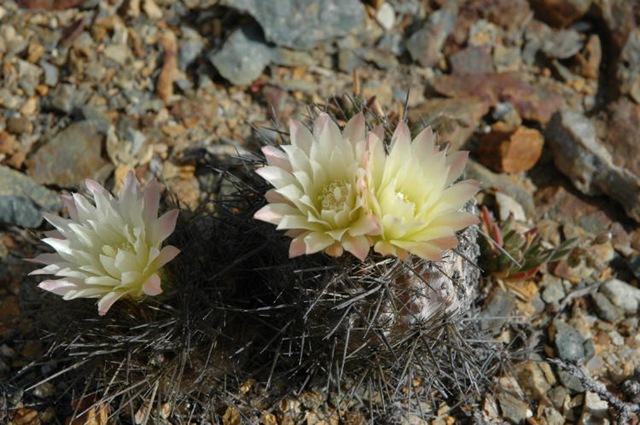
S0427 – Echinopsis (Lobivia) bonniea

These digests are becoming longer each day and I promise to try (but won’t guarantee) to be briefer in future.

We started the day with a walk to Chirau Mita, the name of a private cactus collection, a few blocks from the hotel, in Chilecito. The large sign at the front gate told us that we were about to enter a cactus and succulent plants botanical garden. The array of plants and the way that they were displayed were so photogenic that cameras were soon snapping and provided such a distraction (particularly when the chocolate point Siamese cat joined in the conversation and the pictures) when I was talking to the owner, that I forgot to ask his name. However, from their website (http://www.chiraumita.com.ar), if I can trust my very limited comprehension of Spanish, he was Sebastian Carod, who had created this masterpiece with his partner Patricia Granillo, the owner. Take a look at their website, as it tells you more than I can do justice to here. To help me to organize my images, this became S416on the trip. (address:

Cactus Chirau Mita
Ruta Provincial Nº 12
(5300) La Rioja – La Rioja
Tel: +54 (3825) 42-4531

S417took us back into the field, at an altitude of 686 m. Alan Hirsch asked me to include altitudes in my location information, as this might be useful to help determine if climatic conditions would help plants reported here, to survive in his collection in Washington DC. Alan, I’ll be happy to send you a copy of the complete stop list with altitudes when I finish the Diaries, but I doubt if it will help much. Why?

Many of the species were found at many locations covering huge areas and at a wide range of altitudes. There were several days that we travelled through a number of different climatic zones, but altitude seemed to be only one aspect contributing to these conditions. I remember various threads on various groups suggesting that hardiness for some species of Echinocactus in the USA is closely related to the particular conditions at their habitat, so that if you want a specimen that will survive in particular harsh conditions, you need to be sure that the plant, or the seed from which your plant has germinated is from a suitable cold hardy location. The jury is out when it comes to plants that have spent many generations in cultivation. No doubt they will require acclimatization before being exposed to challenging conditions. I’ll mention altitudes in the Diaries, when ever I think it is relevant either to the plants, but more so, to our ability to breath and will do the full list later.

Meanwhile, at S417, off the road from Plaza Vieja to Famatima, we were looking for (and found) Gymnocalycium saglionis, Trichocereus huascha and T. terscheckii, while avoiding the spines of Opuntia sulphurea. And yet I found this the most interesting plant here, as I found an individual with wonderful twisted spines – ‘forma tortuosa’? We would often come up with joke names, such as ‘carparkeriensis’ for a plant found at the car park etc, so please do not take this as the source of new descriptions and names.

472090

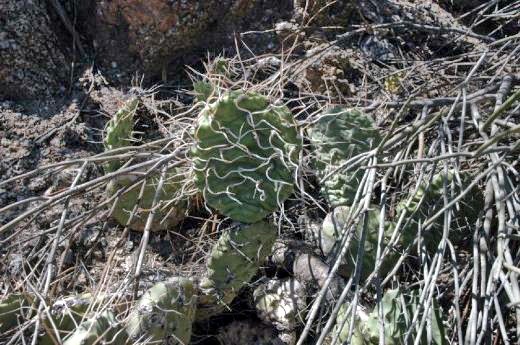
S417 – Opuntia sulpurea ‘fa tortuosa’

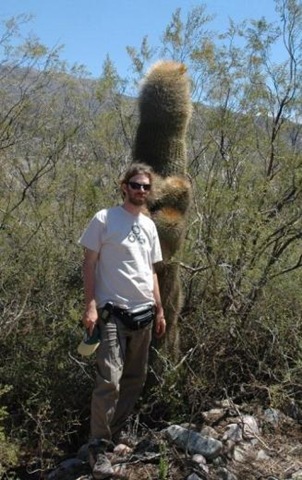
S418, in the Quebrada Famatima was forced on us as the undulations of the track proved too much of a challenge for the bus – the back bumper had already needed surgery after scraping along the road yesterday. Lobivia famatinensis is from this valley, but too far on for us to reach on foot while staying on schedule. No worries, as there were plenty of interesting plants to see. Just a bit up the road, we found Denmoza rhodacantha (in flower), Lobivia (Soehrensia) formosa, Tephrocactus weberi, Trichocereus candicans and T. terscheckii. The Lobivia were large plants, growing against and on top of a steep cliff face alongside the river valley, often peeking out of large clumps of a bromeliad, Deuterocohnia (Abromeitiella) brevifolia, made up of thousands of small individual heads. One or two of the Lobiviawere in flower. As we drove off, after lunch, we passed a specimen that must have been more than 2 m (6 ft 6) tall and asked Diego to pose next to it to illustrate the scale.

472091

S418 – Diego posing in front of Echinopsis (Soehrensia) formosa

Two hours later, we reached S419, on the outskirts of the village of San Blas, where Tephrocactus articulatus (O. papyracantha), T. alexanderi, T. aoracanthus and T. geometricans were growing side by side. So why do these not hybridise? Why are there no intermediates? (or did we not look close enough?) What are the barriers that keep them separate species etc. Time to do some reading when I get home, I think. Echinopsis leucantha and Gymnocalycium mucidum (syn. G. glaucum) completed the set here.

Another great day cactussing behind us and another in prospect tomorrow.

International airports and long distance flights are like global petri dishes; bacteria and viruses compete for dominance, only the strong survive …. and find hapless travellers on their way to holiday destinations.

And so it was that breakfast on day two of our cactus adventure was accompanied by various coughs, splutters and sniffs. Cliff Thompson actually admitted that he was afraid that he might have picked up a good old British Autumn (= Fall) cold, as we travelled to the airport a few days earlier. `Good job that we`re going to South American Spring to escape this autumn misery!` we agreed. Wrong! As the air-conditioning system on the bus made sure that we all received our fair share, one by one we fell victim of what was jokingly referred to as `Clifftonaires disease`: sore throat and wheezy lungs followed by an irritating tickle cough that still follows me round and has infected Angie and her son Peter since my return. Sorry!

Some were hit harder than others, ran high temperatures and fell victim to probable secondary infections, affecting the distance that they could comfortably move away from the nearest toilet. Various medications and treatments were recommended from different corners of the planet, all with little effect. Eventually we became so concerned about one member of the group, Chris, that we persuaded him to go and see a doctor. On his return he complained bitterly about the huge injection needle that had been used on his backside and the tablets that he had been prescribed, but the next day he had greatly recovered and appeared to have shaken off most of the symptoms, while others still spluttered and coughed and persevered, in fear of The Needle.

However, today we were still blissfully unaware of what was install health wise and by 9:50 were at our first stop of the day: S409, where we could add Cleistocactus baumannii, Echinopsis leucantha and Stetsonia coryne to our already impressive list of cactus genera and species seen on day 1, and become re-acquainted with Echinopsis (Trichocereus) candicans and Opuntia sulphurea. I also recorded seeing Jatropha excisa, not because I found it a beautiful plant, but because I had a deep respect for members of the genus since walking into shrubs of Jatropha urens in Brazil in 1999, while I was dressed in shorts and sandals. I could not see the hairs that in Brazil had caused me such intense pain, but still made sure that I kept a wide birth of this member of the Euphorbiaceae that was just coming into leaf.

The Tricho was in flower, the usual large white often nocturnal flower that is typical for the genus, but quite large for a smaller than average Tricho plant. The Cleistocactus was also in flower, but it was quite a small diminutive flower that had been got at by various nibbling animals. Stetsonia coryne is often seen for sale in European nurseries as small 15 cm (6 inch) tall, dark green stems with prominent white felted areoles and, for its size, impressive long black and brown spines. I have grown it in my collection, but it was usually passed on at bring & buy sales or branch raffles as it got bigger. And big it gets! Huge tree like plants to 8 m (25 ft) tall, with many branches, towering over the low Acacia scrub. Impressive? Yes! Pretty? No. The Cleistocactus also looked better in cultivation than here, in the wild, sprawling through other vegetation.

Echinopsis leucantha occasionally showed that it had the potential of being a nice plant when I managed to find one or two nice, unmarked stems, much larger than plants that I usually associate with the name Echinopsis in European cultivation. I`m sure that this is one reason why there has been such resistance to the lumping of genera of mainly tall or large plants like Soehrensia and Trichocereus into Echinopsis, which has the image of being small globular plants in cultivation. Kiesling lists an impressive 19 names as synonyms, so for those collecting `names`, an impressive addition to boost the numbers!

The other impressive find here and at many other locations were the stones, here very dark, but glistening with mica. Ian, Rob and Cliff with some considerable geological knowledge between them mumbled impressive names of the rock types and geological formations. Sorry guys, it went over my head as I was trying to keep up with photographing the plants and images that tell this story, but feel free to write in with your geological notes, I`m sure that there will be interested readers on these lists.

At S410 we were able to add Cereus forbesii and Gymnocalycium bodenbenderianum to our species list. Can I make an appeal to taxonomists to use short names that roll easily off the average tongue and have a fighting chance of fitting on to plant labels? Trichocereus candicans here made an impressive attempt to qualify for the name of `Creeping Devil`, crawling over the sandy soil and only lifting the stem apex to lift the flower buds skyward. Tillandsia look particularly great when they grow on ceroids!

S411 was our lunch stop at Aguas de Ramon. Guillermo, Diego and the drivers would quickly set out the picnic tables and seats and bring out the French bread sticks, cold meat cuts and cheese slices, bottles of cola, lemonade, water etc. all presented on the table cloths that Guillermo`s wife, Sylvia, had insisted should be used. In the mean time we`d disappear into the field and here found much the same plants as at S410, but with the addition of our first Tephrocactus – T. articulatus. I already had a soft spot for these plants, as they are often among the first plants in a hobby collection, as soon as individuals start going to cactus club meetings. Most hobbyists will have grown this plant into a large clump and, if lucky, might have flowered it, only to see it disintegrate into a pile of individual joints when it is moved a few inches to get another plant out. Here the plants had managed an impressive 8 spineless globular joints on top of each other, severely dehydrated, looking like a tower of old, wrinkled circus artists, about to collapse.

The Opuntia here included O. quimilo, with red flowers and very long (c 12 cm or 5 inches) spines. There were a few Trichos in flower, but the flowers were way past their best (at 12:30) and Gymnocalycium bodenbenderianum demonstrated how you can escape the occasional fire by keeping yourself very flat to the ground.

By 2 p.m. we found ourselves at my stop S412 – The Salt Flats. The main impressions from my images and notes is that we were confronted with a thick, almost impenetrable mesquite scrub and that Ian reported that the temperature had soared to an amazing 41C. We spread out in an attempt to find another form of G. bodenbenderianum (known amongst splitters as Gymnocalycium riojense ssp paucispinum var. platygonum) and another popular cactus in European collections: Setiechinopsis mirabilis. The Gymno was found, as was E. leucantha, Stetsonia coryne and T. articulatus. The Setiechinopsis will remain an unknown for me in habitat.

We reached S413 around 6 p.m. when Ian`s thermometer indicated a temperature of 31C in the shade! And yet, I did not feel desperately uncomfortable in the dry heat with a slight breeze. Gymnocalycium hossei and G. saglionis grew alongside G. bodenbenderianum (syn. G. riojense) and persuaded me to take a closer look at John Pilbeam`s Gymnocalycium book when I find time at home, to tell me which is which in the pictures I took. Some of the Gymnos obliged with flowers. There were some paper like spines on the Tephrocactus articulatus, justifying the synonym Opuntia papyracantha.

We made two more stops, S414 and S415 (Los Colorados) with much the same cacti in different settings, but with for me the highlight of the day at s415: Pyrrhocactus bulbocalyx. At 19:00 hours, the sun was low in the sky, throwing long shadows and giving the red hills an extra red touch. These Argentinean Eriosyce are quite a challenge to grow in Europe, at least in the UK.

It was dark when we reached our hotel in Chileceto and it we settled down to our routine of shower, down loading digital images, wine tasting and dinner. It`s a hard life, but someone has to do it!

Tomorrow we have a picnic in the Famatina Valley and travel on to Anillaco.

We had all experienced shifts in time zones, the Brits GMT – 4 hours and the Americans (at least those from California) Pacific Time + 4 hours, so it was somewhat of a miracle that we all managed to meet up at the appointed time from breakfast. Well done! This feat was in fact repeated throughout the trip, even if some of the hotels were not quite up to our eagerness to get on the road.

The routine was that we brought all our luggage down so that it could be loaded onto the 20 seater bus by our drivers. This proved quite a challenge, as the airlines used by the Americans allowed twice as much luggage per person as our flight from Europe. But Jorge was well up to the challenge and succeeded every day.

And so we arrived at our first cactus stop of the day at 8:26, according to the metadata that comes as part of digital images. Digital camera developers please note: it would be useful if this data in future could include GPS (global positioning system) data and weather information (temperature, humidity etc) – no need for the short range weather forecast as we are likely to move on to other locations.

I take at least a day to get back into a `field study routine` while trying to decide where I am, what time it is and what I`m supposed to point my camera at, so this first day`s information is very poor and will be augmented by info from others in the group over time. For now I can tell you that our first stop was alongside a main road near the village of El Manzano and that my first picture was of a nice Gymnocalycium mostii, growing amidst more vegetation than we`d seen on a whole trip in the Chilean Atacama Desert! Some of the plants were in bud, but there were no flowers – and this was to be the story in many locations during the trip, because:

  1. Because just like the UK in April / May 2005, Argentina was experiencing a late Spring and
  2. because in juggling the preferred dates of travel for the Brits, we had ignored advice from Guillermo to delay our departure by a few weeks to optimise seeing cacti in flower.

I use `S numbers` (i.e. Stop numbers) for my cactus trips and remembered that in 2004 I had reached number S three hundred something or other, but not the exact number. So I decided to start at S400 for this trip. My other routine is to make the first picture at a stop an image of the GPS showing the appropriate location data. Any image that follows must be taken at that Stop, or en-route to the next one (usually this can be concluded by the data stamp of each digital image). Great plan, but when I switched on my GPS it transpired that the batteries were flat and my spare batteries were in my main case, at the bottom of the busses luggage space. Never mind, there were enough fellow travellers with GPS equipment, so it was a case of copying this into my (paper) note book. But where was my note book? Still in the side pocket of the bag that I had intended to take, but that had to be left in England as the zipper broke as I carried it to my car. Aarrgghh! I felt frustrated and humiliated at such beginners` errors. Fortunately I had a miniature note pad that easily fits into a shirt pocket and that somehow managed to contain all my notes by the end of the trip. The replacement for my field note book that I bought a few days later was only used as an occasional supply of toilet paper, but more of that later.

So, S400 – El Manzano, along the main road: Gymnocalycium mostii, an Opuntia sp (probably O. cordobensis or O. sulphurea – on my day of disasters I forgot to take its picture) lots of Acacia scrub (the name Acacia caven was suggested), most with thorns more formidable than any cactus we could find the first of the many charming bromeliads that we would see: Tillandsia recurvata, here growing from the telephone lines.

Our next stop (S401) was north of El Manzano, at a small stream, where the attraction was a Puya spathacea in bud on the hill on the opposite side of the stream from where we were parked. By the time I arrived on the scene, there was an impressive array of tripods (favoured by some of the photographers from the USA), lined up along the stream pointing at the low (c. 10 m.) hill. Having taken the same picture as everyone else, I followed Mark who had found a way to cross the stream (using the bridge a bit further along was too obvious for us) and had managed to get to the top of the hill and take a picture of the plant, the flower spike and the activity among the photographers.

Next on to S402, christened the Car Rally Stop. This was because the road is frequently used for car rallies and the particular corner where we were looking for cacti would then be `populated` by a hundred or more spectators, waiting for cars to lose control and crash into ditch. In the process, the spectators would be standing on top of a small population of Gymnocalycium amerhauseri. Each September, at ELK, we see Helmut Amerhauser, one of the officers of the Austrian Gymnocalycium Study Group. Next September I must pull his leg about the trampled on appearance of the plants named in his honour. They grew alongside G. mostii and introduced us to our first cactus challenge, identifying different Gymnocalycium species that share the same habitat. I am no expert on this genus at all and will probably be laughed at for calling the large plants here G. mostii, with the smaller plants being G. amerhauseri.

We moved on to S403 at El Cuadrado, where G. mostii was joined by Echinopsis (Lobivia) aurea and Echinopsis (Trichocereus) lamprochlorus. E. aurea rewarded us with the first (bright yellow) cactus flower of the trip. These plants proved a lot more of a challenge to photograph than the Copiapoa on previous trips in Chile, as these were surrounded and partially covered by other vegetation, with spines and blades of grass intermingled. My final image of this stop is of a small hairy leafed Oxalis in flower. A pest in most cactus collections in the UK, I have to admit that they can be quite interesting plants in habitat.

El Cuadrado turned out to be a small hill and S404 was higher up, probably at its summit. Here the diversity of cactus flora was impressive. Going through my digital images I have found Echinopsis aurea, Gymnocalycium amerhauseri, G. bruchii, G. mostii, Parodia (Notocactus) submammulosus, Trichocereus candicans and T. lamprochlorus as well as images of a Euphorbia sp., and of bromeliads (with viscous toothed edges to their leaves – real ankle-rippers!). It was only 11:24 (according to my last digital image) and the array of cactus genera and species that we had seen was impressive! I`m sure that if I had remembered to look, I could have added a couple of Opuntia to the list as well.

They certainly appeared among the images at the next stop, S405, 30 minutes drive further on. If my notes are correct, the Gymnocalycium here include G. bruchii, G. capillaensis, G. monvillei and G. valnicekianum, and probably more if you are a serious student of the genus and take the splitters view. The Parodia, Opuntia and Trichocerei mentioned for previous stops were also present, in an attractive setting of low, green, rolling hills. Quite a few cacti were in flower – most were in bud, we were just a few days too early. The sun was out and quite strong compared to what we had experienced in the UK a few days earlier. A cool breeze made conditions very comfortable. Life is good! The sound of clicking cameras and shouts of “Here’s a bruchii in full flower” filled the air, until the sound of the bus horn called us back to reality.

S406 was near Capilla del Monte, and offered G. capillaense, G. valnicekianum and Trichocereus candicans, as well as the omni-present Opuntia sulphurea, which I`ll probably drop from my list of cacti seen at future stops, unless there is something unusual to report. As I ended up surrounded by Acacia on a dead-end path, I took the opportunity of photographing at least 4 species of Tillandsia on one tree. Could these turn into a new obsession for me? No repotting needed!

S407 was on the shore of a lake or water reservoir. Most of my fellow travellers were marking our progress on the road atlases that Guillermo had provided. I`ll mark my copy up at a future wine tasting session. The Gymno here is again G. valnicekianum, but much bigger plants than those seen at previous stops. Am I becoming a splitter? It was 5 p.m. when we boarded the bus and 5:40 when we arrived at S408. On the ridge alongside the road, some 3 m (12 ft) above us Guillermo had spotted Acanthocalycium spiniflorum (syn. violaceum) Basking in the late evening sunshine. By 6 p.m. we sat back on the bus, satisfied with a rewarding day of `cactussing`, arriving at Cruz del Eje before sunset, for a beer at the poolside and our first wine tasting in the hotel restaurant before dinner.
I have rambled on enough for today and will tell you all about the now infamous wine tastings in a future report.

It seems to have become a kind of tradition that I post my daily diary pages from a recent cactus trip, aiming to cover the events of exactly a month ago (see Copiapoathon Diaries for 2003 and 2004). Judging from a reasonable number of positive reactions (and no negatives), I assume that readers don`t mind putting up with my ramblings for the next 21 days, that cover a recent trip in north west Argentina.

I am a registered speaker for the BCSS, giving talks / lectures at various branch meetings (or `programmes` as my new American friends call them). Often people tell me how lucky I am to be able to make such trips and expressing the wish to be able to make such trips themselves. One of the purposes of these Diaries is to share with you how easy it is to do this. Some of those that asked the question, later came along on subsequent trips or used the diary reports as a means of mapping out their own route.

So why Argentina? My previous 3 trips to Cactus Country have been to Chile, with a particular focus on Copiapoa. During these trips we would drive up various river valleys until we hit border posts with Argentina. I am Dutch and like flat, open country views. Like most of my fellow countrymen, when we see a hill, we are curious to learn what is at the top and on the other side. The Andes have some of the highest `hills` in the world!

During chats with fellow `cactus trippers`, a question that would pop up regularly would be: `What is your favourite cactus country?` And the number one choice was Argentina.

One particular champion is Leo van der Hoeven from Holland, who has visited Argentina in pursuit of cacti on numerous occasions. During his frequent visits to my house while working in the UK, he convinced me by showing numerous brilliant slides of a wide range of cacti in some spectacular locations. `Where would you recommend?` I asked, and an avalanche of names of towns and villages in north west Argentina came forth, in no particular order. We poured over maps, leaving many red circular marks where we left our glasses of fine Argentinean wines a little too long. While surfing the net to get more information about these places, I remembered Guillermo Rivera`s Cactus Expeditions website and found that many of the locations that Leo had recommended appeared on his trip itineraries. In fact, the match was so good, that I wrote to Guillermo (with whom I had previous correspondence, as we both have a passion for seeing cacti in habitat) and asked about the possibility of a `customised trip`, a bit longer than his usual trips and one that could take in some of the locations on Leo`s list that were not on his, provided that I could get enough people together to fill a small coach. Guillermo agreed, but I failed in getting the required number of participants.

Fortunately Guillermo had the solution: inviting Woody Minnich from the USA to join with a group of American cactophiles on this `more cactus-intensive than usual` trip.

And so it came to be that exactly a month ago as I write this, I sat down with 6 Brits (Anne Adams, Bryan Thomas, Cliff Thompson and Ian Woolnough – all participants on some previous trips, and Mike Harvey and Paul Shipsides, both new to Cactus Country) and 8 Americans: (Woody Minnich, John Bleck, Phyllis and Dick McEuen, Mark Muradian, Chris Rogers, Rob Skillin and Charles Spotts) in a conference room at the Holiday Inn in Cordoba, for a welcome dinner and introductory talk by Guillermo and Diego. Each of us received a printed itinerary (a printed version of the outline published on Guillermo`s website) and a list of plant names for the Argentinean Cactaceae following the classification of Roberto Kiesling. I will follow his taxonomy in my Dairy Reports, in the certain knowledge that some of you will disagree with it, but sure that from the names used, you can arrive at the names used in your preferred systems.

In the past, Guillermo (and others) have been accused of advertising on forums / groups, such as these. I ask those that are sensitive on this point to accept these contributions for what they are – factual reports of some of the plants, places and adventures that a group of cactophiles experienced during October 2005. In keeping with my objective of previous diaries, to share information and enable readers to undertake similar trips themselves, I plan to include details of how to contact Guillermo, and the URL for his website, in my final report. I would ask the owners of the group to contact me privately if they feel that this is inappropriate for their particular group or forum.

Finally, the diaries meet a very important but selfish need – to force me to firm up my often scanty notes before the brain forgets, and to ask fellow travellers to correct me if this has already been the case.

I hope that you`ll enjoy reading about our trip as much as we enjoyed being there!

Having said our ‘au revoirs’ to Alain in Frankfurt, Anne and I arrived eventually, 10 minutes early, at London-Heathrow. As always, plans for the next trip are already in place – north western Argentina in October 2005. Eventually I tumbled into bed at 9 pm BST – 33 hours after getting up at Pichidangui. 

During our trip we had travelled  21,832 km (some 13,500 miles) to get from England via Frankfurt and Buenos Aires to Santiago and then drove as far north as Maria Elena and back again. In Chile we travelled 5,550 km (c. 3,400 miles) by road – some 2,000 km of which along the often excellent Pan Americana. We had only one puncture. I came back with 5.07 GBytes of extra data (mainly digital images) on my laptop in my Copiapoathon 2004 folder – now containing 3,670 files. In addition, Alain’s folder contains another 2.88 GBytes with 2,185 files. It was the first time that I relied entirely on digital cameras and without regrets. Each evening I downloaded that day’s images from Alain and my cameras to the laptop and, after some little time to flip the portrait format pictures over, we’d open a bottle of wine and enjoy the daily image show, all before dinner.

As always, the reports are my way of documenting and reliving some of our adventures before they fade from memory, or rather blend into one, and to fulfil a promise to Anne and Alain that I’d tell them in detail where we had been and what we had seen after the event, rather than in the field, where every one should concentrate on absorbing as many images and experiences as possible without having to know what, where and when. 

For now, books on north west Argentina are piling up around me and planning for 2005 begins in earnest.

2410-014

Views of London as we prepare to land at London: Along the Thames, left to right:
Houses of Parliament, Westminster Bridge, old Town Hall, Millennium Wheel, foreground: Waterloo Station.

Alarm clocks had been set for 6 a.m, but I woke up at 5, ready to go. The trip was over, except for the journey home. We had done most of the packing the night before, and had agreed to have breakfast at a truck stop on the way to the airport. I can’t recall stopping, other than to take on fuel for the last time, close to the airport. We were now all rather subdued – the trip was over.

We arrived at the airport without incident and having dropped Anne, Alain and all the luggage off at the Departures drop off point, I took the car to the agreed spot in the car park. It is amazing how emotionally involved you can get with a lump of metal. Each time, I quietly say thank you to the car – it is amazing how much we put these cars through and how little trouble they usually present us with. This Toyota had been particularly well behaved – thank you.

I found the others in the departure area and, after checking in our luggage, we went to the souvenir shop to reduce the rather large amount of Chilean pesos we had left over. I know that better and cheaper souvenirs can be bought en route – as I had found in Toconao, but these then have to be dragged around for the remainder of the trip, when fragile cups and clocks can easily get broken. The rep from the car rental firm managed to find us – a sign that we must have stood out in the crowd – and the formalities of returning the car were soon completed without problem.

Unlike 2003, the flights took off on time. As usual, I could not resist the temptation of taking yet more pictures of the flight over the Andes.

On previous trips, a feeling of depression crept in as soon as the km readings on Ruta 5 started to drop below 1000, north of Chañaral. The last week however had been so full of unexpected and new experiences that the feeling did not hit me until S318, yesterday.

We had made it to the Bahia cabañas at Guanaqueros, where we had also stayed on my birthday in 2001. We had breakfast at one of the many truck stops along Ruta 5. From here it was a relatively short drive to Fray Jorge, as I had promised Alain to show him some ‘big’ Eriosyce and in the hope of collecting some more seed. And so, at 9:15 a.m. we presented ourselves at the entrance gate  (closed) to the Parque Nacional Fray Jorge (S319), where the sign proclaimed a 9:00 opening time. The warden arrived at 10:15, just as we set off to our next stop (S320), on the track back to  Ruta 5, where on previous occasions, if we had brought a small vacuum cleaner, we could have collected kilos of E. aurata seed. This time I had brought my adopted seed sucker, with a larger bore tube, but like Ian’s last year, it too got blocked by the third seed, so that it was back to tweezers to top up supplies. Being foreigners, we felt we had a good excuse to ignore the ‘Private property – no admittance’ signs that had now appeared along the track. There were more fences going up, so in Bob Dylan’s words: ‘The Times, They Are A-Changing’.

There were two more stops to make before the trip was over – bar the journey home. S321 was last year’s stop in the Quillimari valley where this time Eriosyce curvispina was in full flower. Again, agricultural development was progressing at pace. Some of the neatly newly planted out vineyards on the hillside across the valley reminded me of the war graves of allied soldiers around Arnhem in the Netherlands and filled me with similar sadness in the knowledge that it would not be long before the cacti that we had pictured would be ploughed under.

S322 was a celebration – the coast at Pichidangui that had become an unplanned, almost accidental, last stop in 2001, only to provide the continuity for trips as it became the first and last stop of subsequent trips. In a way it offered the promise of being the first stop on the next Chile adventure, provisionally planned as ‘Angie’s Birthday Tour 2007’. We had the rest of the afternoon to feast our eyes and cameras on the numerous plants in flower before returning to our cabañas and doing the final packing. Where had all the extra luggage come from!?!?!?
(Same question each trip!).

s322-0057

S322: Eriosyce chilensis (albidiflora) can be ugly plants, with beautiful flowers.