Just another WordPress.com site

Today was the sort of day that is practically inevitable when you spend so much time on rough roads: car problems.

Throughout this Baja trip, Premium Gasoline, the kind preferred by Eunice’s Landcruiser, has been in short supply. This gave rise to the occasional cough and splutter but nothing worse. We had given the car fuel additives that seemed to slightly improve the condition. We had just filled up, ironically with Premium Gasoline, when, still in view of the monument that marks the border between Baja California Norte and Sur, the car coughed, spluttered and then died. We were still in phone reach of Guerrero Negro so Eunice called the hotel who promised to send someone out to collect us and look at the car.

Although my knowledge of cars that go wrong can be written on the back of a postage stamp we did take the cursory look under the hood. Yep, the engine was still there! I confirmed that leads attached to the distributor were still in place and suggested that we’d try staring one more time. LC (pronounced Elsie, short for Land Cruiser) immediately kicked back into action. We called the hotel and cancelled their rescue mission, but decided to head back to town, especially as coughing etc was still a feature of the ride back.

Our would be saviour  was there to meet us and suggested that he would take us to a near by garage, experts in fuel injection, for a quick diagnosis. Bad fuel was the general consensus, especially as we had to take some fuel from an unofficial seller at Catavina – Elsie guzzles fuel.

The filter was located, cleaned and re-fitted. We were on our way, but returned even before we had left the town – same problem. Again, Elsie was put on the diagnostics computer. Distributer cap? Rotor arm? Another test drive and back for more tests as none of these seemed to be the cause. In the end a caple connecting the battery to the on board computer had shaken loose and was sending confused messages to the ignition system. Bolt tightened – and all was fine. Phew!!!

Inconvenient, but this could have happened hundreds of km away from civilisation! A lucky escape.

With less time than planned, we decided to stick to MEX1 for now and drive north to near Miller’s Landing. We made three stops and found Dudleya acuminata.  Elsie behaved fine so that tomorrow we will be brave (foolish?) and attempt the drive via San Borja to Bahia de los Angeles. Wifi there might be iffy, so anticipate delayed Diaries!
Today was much more than a drive along MEX 1 between San Ignacio and Guerrero Negro. Not discouraged by yesterday’s drive into the Sierra San Francisco, today we took another road into the mountains but this time heading for the village of San Francisco de la Sierra. Our target plant was Dudleya rubens that is said to be not common and to grow in out of the way places.

Most of the tourist activity in this area is whale watching, with pre-historic cave paintings a close second. Obviously, the whale watching happens along the coast but the cave paintings are found in the mountains. The Cueva del Raton (Cave of the Rats) is one such cave and the CSSA Dudleya Special Edition journal makes mention of D. rubens growing on the rockwall next to the cave. 

As we turned off MEX1, sign posts told us that we had to drive 38 km to get to the village with the cave being near by. Eunice had been on this track for Christmas 2009, but on that occassion it had been very wet and some of the cars in the party just had city tyres and could not make the track that was covered in mud. That was then. This time we were faced with a newly tarmac-ed road! I had seen this before and expected the hard top to turn to dirt after the first bent. Not so. After some 12 km the inevitable happened and the nice smooth road surface turned to dust. Never mind – we had already covered a signifacant distance, so we had our bonus in advance and had already reached an altitude of 342 meters when we made our first stop (S2215). We found: Agave cerulata, Bursera microphylla, Cylindropuntia sp., Dudleya cultrata, Echinocereus brandegeei, Ferocactus sp., Mammillaria dioica, Mammillaria heyderi ssp meiacantha, Myrtillocactus cochal, Pachycereus pringlei, Stenocereus (Hertrichocereus) thurberi, Stenocereus (Machaerocereus) gummosus, Tillandsia sp. Not bad for a first stop!


The list for S2216, farther along the track, was very similar but the star of the show here was an Echinocereus that at first glance looked nothing like any Echinocereus that I had seen or grown. Reid Moran’s field notes suggested E. engelmannii grows here and on closer inspection, there was some resemblance to this species, especially when I found just a few plants with the more familiar (but variable) strong spination.  A quick email to friends at the Echinocereus Study Group confirmed that these were indeed E. engelmannii (Thanks Martina & Andreas). The plants were coming into bud and the flower remains from the previous season were still in evidence, but no fruits.  There were also large clumps of Mammillaria (Cochemia) pondii ssp setispina and another small globular white spined Mam. with black hooked tips to the spine. (M. fitkaui?).

For S2217 we arrived at the Ecotourism facility of San Francisco de la Sierra, or so the sign claimed. There was no one in – a lady from a neighbouring house confirmed that nothing was open. A farmer came by with a truck full of goats milk. Did we want to see the cave paintings? No thank you, we were here for the plants. We asked if he knew where we could find ‘Semperviva’ – this is the local name for Dudleya (and Echeveria and probably all of the Crassulaceae). Yes, they grew in the hills but it was very dry and they would be more easily found during the rainy season.They would lead us there in their car, after dropping off the milk. They drove off in the opposite direction that we had understood. Perhaps they were going back to take the milk home and would then come and find us? We went tto the nearby Cueva del Raton. This is where an article in the CSSJ Dudleya special had reported seeing the plants. We found the caves, with a most formidable barbed wire fence making sure that the ancient art treasures were safe.  

We took a look with zoom lenses along the edge of the rock face and thought that tere might be Dudleyas growing there. Our hopeful pictures confirmed that we were right once we were able to zoom in on the pictures at our computers (S2217)

We took a look in the hills above the village, but had to keep an eye on the clock as I did not want to be stuck on the mountain in the dark. S2218.

Time had come to turn back. We approached a steep rockface along the side of the trac., heavily in shadow. I bet if they grow any where it will be here. We allowed ourselves 10 minutes (S2219) to point our zoom lenses at the rockface and snapped away in the hope of obtaining some reasonable picks. It worked!

S2220 was for odd pictures taken on our way down to road. We had already reserved rooms in Guerrero Negro so arriving as the sun set was not too much of a worry.

Another great day. 


Alain posted a comment regarding pictures. You don’t have to be clever to find the pictures – they are not there, no matter what your IQ might be.

It’s difficult enough to keep up to date with the texts, sorting pictures just adds another dimension of complexity for which I do not have the time.

During my 3 week break in the UK I barely completed the sorting of the 3 months of pics from Chile & Argentina, I want to add four galleries: one of the Austrocacti that we saw in 19 Stops, another for the Pterocactus (similar number) one for the Gymnocalycium – alledgedly one species: G. subgibbosum and another for the Andean alpine plants that need to be identified.

The facility to do this does exist in WordPress, its just lack of time for now. Watch this space and I’ll post siome pics when I can.

Today’s explorations were along the track from MEX 1 to Santa Martha. I have written up a full text for today’s report, but it’s on the other laptop that has a battery that’s flat in seconds.

So for now – some pictures – with the relevant text below.

Today’s activities continue the theme of this short venture into Baja California, to seek out some Dudleya at locations reported in Reid Moran’s Field Books and to explore for Dudleya in the area around such finds in the hope that developments since Reid Moran’s explorations from the 1940s through to the 1980’s have not destroyed some of these locations. It is just as likely that new developments may have opened the area, so that places that were previously inaccessible can now be reached in the comfort of an air conditioned 4×4. In short, we’re on a Dudleyathon.

The Field Books suggest that he did not botanize in the area around Santa Martha in the Sierra San Francisco and so the track from Mex 1 to Santa Martha (a collections of half a dozen homes with a number of small farms along the track) was the subject of today’s outing. My eyes were playing up again, despite a pair of goggle-like sunglasses that fit over my prescription glasses, so we only made some brief stops for plants along the side of the track. Cactus and other succulent plant vegetation wise there was nothing that we did not see already in 2008 along the track farther north, to San Borja.

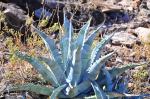
All pictures today are recorded as S2214 and the only note as an addition to the 2008 plant list is that the Agave with the banded pattern on its leaves is A. cerulata. As we got back at a reasonable time and I had only taken 56 pics I include a small selection of images taken today.   This rare treat is specially for Alain, to show him that it’s the author and not the software that is to blame for the relative lack of images. In Chile and Argentina, Juan would make up for this by posting his pictures on his Flickr site. Perhaps Eunice should be encouraged to do the same.

Today we decided to explore the Vizcaino peninsula, south of Guerrero Negro. We had been here in 2008 but experienced our first double puncture that tended to distract from cactus exploring a bit.

This time we decided to stick on the main road, hard top according to the map, but in reality there was a badly graded section that probably loosened most of the fillings in my teeth!

We made four stops (S2210 to S2213) but more for scenic than floral records.

The hope was to get to Punta Eugena, right at the end of the Peninsula, opposite Isla Natividad where we saw some interesting cacti last year. However, today was about time and fuel budgets. We had to turn around at 2 pm yto get to San Ignacio before dark. There was supposed to be fuel at Punta Tortugas, near the end of the peninsula, but ‘supposed to be’ and finding it, are two different things.

In the end we made it to the fuel stop but there was only ‘normal’ fuel, not the ‘premium’ that Eunice’s car runs on. But by now we had used up our time budget, so never reached Punta Eugena – never mind.

Based on advice from fellow travellers at the Desert Inn, we had booked ourselves in for two nights at the San Ignacio Springs Bed & Breakfast. (http://www.ignaciosprings.com/) this is an amazing place alongside the lagoon, amidst a forrest of palm trees. Accommodation is in ‘yurts’ – Mongolian tents, but these are furnished with solid beds, better than many of the beds that I have slept in these last few months! Gary and Terry made us feel very welcome and excellent food was presented in the communial sitting area with wifi, from where I type up today’s notes.

The surprise of the day was running into Ruth Bataista. Ruth was at the Larry & Raquel B&B in Bahia de Los Angeles in February 2008 and had helped us to arrange a trip to the islands in March that year. She was now helping out here – what a coincidence!

Tomorrow we go plant hunting in the Sierra San Francisco.

Prologue:

Regular Diary readers will have noticed a gap between my flight to the US on 3 February and today.

Just as I was about to take up my squat outside the admin office at the Desert Inn – the only place where you can pick up a wifi signal – the generator shut down for the day. Without electricity to power our laptops or the internet router we took breakfast and hit Mex 1 for a day in the Desert.

———————————-

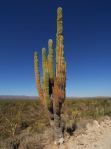
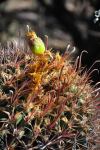
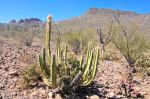
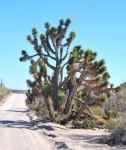
S2205 was at km 195 and was just an early morning legs stretch in an area that I had photographed extensively in 2008. Plants photographed this time: Senecio sp. Ferocactus sp. Mammillaria dioica fa. Echinocereus engelmannii, Fouquieria columnaris, F. diguetii, Pachycereus (Lophocereus) schottii, Cylindropuntia sp. and a Solinaceae sp. in flower and in fruit

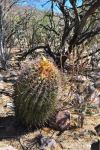
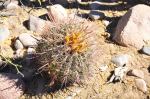
S2206 was a short comfort break where I spotted some nice Ferocactus sp.

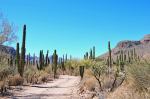
All the above plants were seen again at S2207. A lovely blue sky with windswept clouds enhance the mainly scenic pictures taken.

S2208 was a specific stop to see Dudleya gatesii. To me the plants looked very similar to D. cultrata that we had seen yesterday – more reading to do and no doubt seeing these plants in flower will help. There were lots of Agave shawii around but my eye was caught by two plants that had exceptionally fierce large teeth along the leaves and the single spine tip of the leave was twisted like a corkscrew. Very nice plants!

We arrived in Guerrero Negro in time for a drive to the lighthouse (S2209). In 2008 Alain and I did this in the morning and were entertained by huge flocks of migrating birds – geese, ducks and a range of waders. As we were here almost exactly at the same dates as in 2008, I was expecting a similar spectacle, but I was disappointed, particularly as the light was not good for photography of the few birds that were within camera reach. 

Three days after leaving the UK and I had yet to click a shutter with the camera pointing at a cactus or succulent in habitat. The shutter finger was becoming impatient! Eunice had promised to take me to see Dudleya anthonyi in habitat. 

From the hotel, we could see low hills along the coast to the north of San Quintín. The newly acquired Baja California Almanac told us that these were three volcanoes, long time inactive. They stood out clearly in the plain around San Quintín, so we were soon at the foot of one of them, the one with a microwave station on top.

S2196 was a quick stop to allow Eunice to get her bearings as a warren of tracks went off in all direction. During my short stroll I managed to spot just one Dudleya, D. cultrata, growing with Euphorbia misera and Mesembryanthemum chrystalinum. The first shots had been fired!

S2197 was called as soon as we saw large silver white Dudleya growing to the left of the track. The habitat was quite difficult to negotiate as it was an old lava flow with the gaps between the jagged clumps of lava hidden by shrubs. The lava itself was covered in lichens and algae. D. anthonyi is a beautiful plant in habitat. It is notoriously difficult to distinguish from D. brittonii and D. pulverulenta that also form large rosettes of leaves covered in white farina.

Dudleya anthonyi (s197)

Dudleya anthonyi (s197)

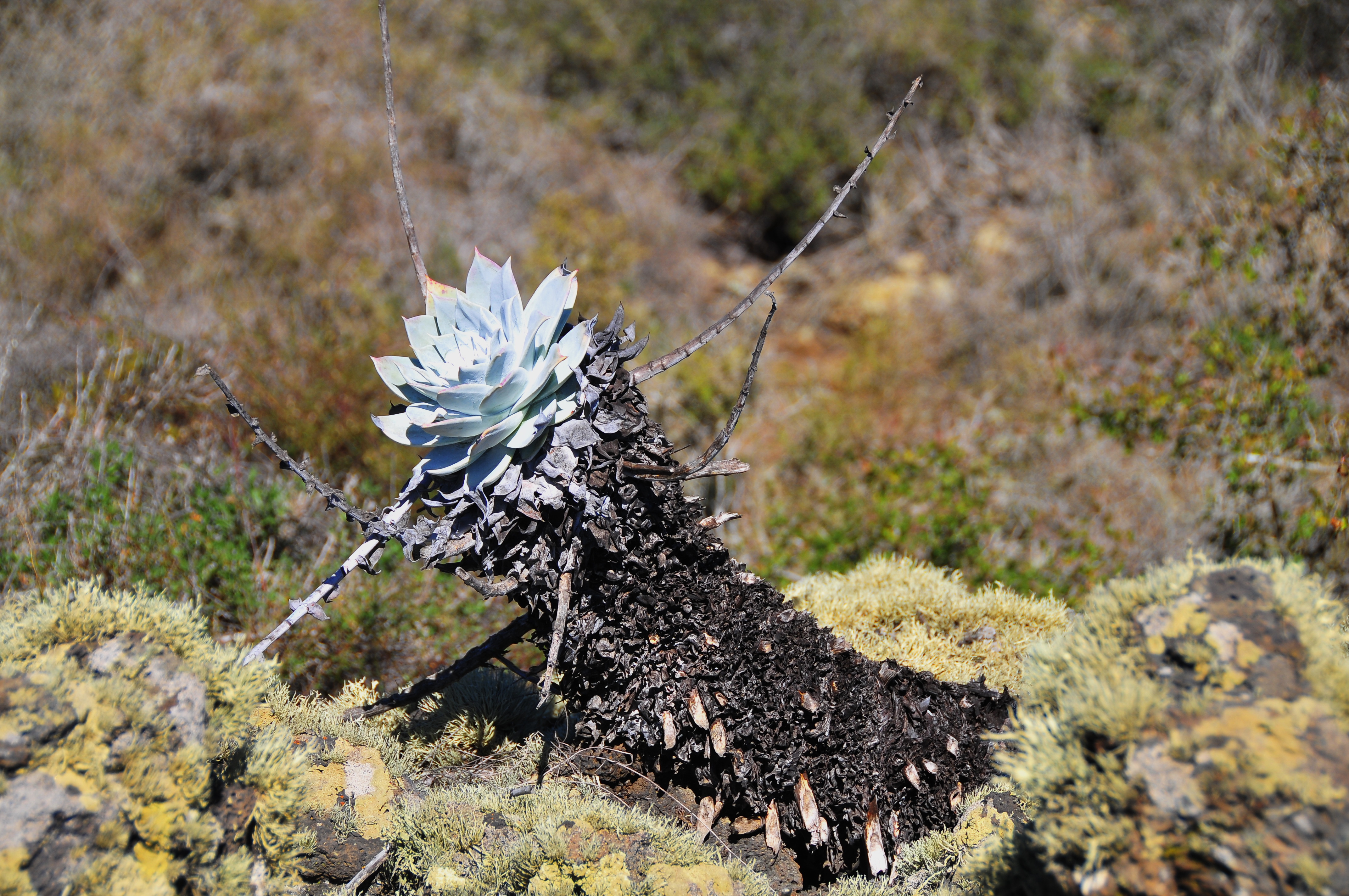
D. brittonii invariably has bright green forms growing side by side with the white farina covered forms. whenever I have seen them in habitat, they grow on vertical cliff faces. D. anthonyi is not reported to have a green form. The plants here all grew on volcanic rocks on the flat. All mature plants found were growing on a formidable stem that looked at least three times its true thickness, due to a thick layer of blackened dried up leaves covering the true stem. I have not seen these trunks on the other similar white leaved species. Comments in literature suggest that the only reliable way to distinguish the three species from each other is to compare flower structures. Flowering usually takes place from April to June, when I have not been able to visit Dudleya habitats.

Fortunately the three species do not seem to share habitats with each other as far as we have been able to make out.

There were two other Dudleya species here: D. cultrata and D. attenuata. 

During the two hours at this location there was a thick wall of cloud – fog that hang over the Pacific Ocean a few km. off shore. Isla San Martin, that lies more or less opposite this location and is the Type Locality for D. anthonyi was repeatedly partly or fully shrouded with mist. The scene was very similar to the camanchaca that we are so familiar with from Chilean cactus trips. The lichen and algae that cover the lava rocks and shrubs suggest that these fogs regularly cover this area.

We drove back to the hotel, making a detour through San Quintín to visit a street market where I picked up my 2011 Mexican Cowboy hat and a couple of souvenirs.

Today was a driving day. We crossed the border into Mexico at midday. Amazing how easy and relaxed this all seemed compared to February 2008 when Alain and I were a touch anxious about our first ever crossing into Mexico. Practice makes perfect I guess. The Mexican authorities responded well to our attempts at speaking Spanish and helped us in perfect English.

We had arranged to meet José, our guide on the Isla Cedros tour last year, for a snack outside Ensenada. It was great to meet him again and catch up on this and that.

In 2008, Alain and I had planned to spend the night at the Desert Inn at San Quintín. We had been surprised by the earlier than anticipated sunset and in the dark had managed to get the car stuck in wet sand. We had failed to find the Desert Inn but had succeeded in finding very acceptable accommodation at Hotel Marie Celeste. 

Due to chatting with José for longer than planned, we again arrived in San Quintín in the dark. This time we popped into every petrol station along Mex 1 and each time the instructions were to go on to the next station. We passed the ill faithed turning that we took in 2008, but stuck to the instructions to carry on to the the next petrol station.  Here we were told that we were very close and should turn off Mex 1. The track came to a cross roads and a sign to the Hotel Mision Santa Maria – yet another change from the Desert Hotel / Hotel Pinta that was in force in 2008. Finally we found our target – a very nice hotel but where internet connectivity was limited to the reception area and restaurant. This is where I discovered that an adapter for the small laptop is still in Amesbury (hopefully) or lost. The battery died while chatting with Angie, so ‘hunting for a Dell cable with US/Mex plug’ has been added to the itinerary.

No photo stops today.

As today’s subject suggests, while Eunice rushed around dealing with last minute panics I sat around and rested.

No pictures taken today.

It was a restful rest day – much needed!

It was 5:30 a.m. when Angie woke me up with a welcome cup of coffee. By 6:15 we were on the road to T5, Heathrow Airport. There was no rush hour traffic congestion so that I had to wait an hour at Heathrow before I was able to check in my luggage. No problem; I rather wait an hour than get stressed in a traffic jam when cutting it fine.

The BA crew had turned up for work, so no inconvenience from threatened strike action. Was this why only 30% of the economy seats were taken, so that I could stretch out over four seats? I landed at LAX exactly on time and Eunice walked into the arrivals hall just as I was starting up my mobile phone to enquire where she had got to.  It was 11:00 p.m.  in the UK by now, but only 16:00 hrs in LA, where we drove across town in the omni-present traffic jams to find a burger bar for a bite to eat, on our way to the LA Cactus & Succulent Society’s February where I was due to give a presentation of what I saw this winter since 8 October. A world premier, so close to Hollywood and in time for this year’s Oscars! I spotted some cosmetic changes to make before the next showing in 6 weeks time.

I eventually fell into bed after 11:00 pm (LA time that is), some 26 hours after getting up. I’m sure I was asleep before my head hit the pillow!!!