I quite like days where we did not see much – there is just less to write up in the Diaries.
Ian and Al were keen to see the area where on previous (much wetter) occasions I had seen Euphorbia copiapina in flower. Sure, so we took the turning from R5 to Barranquillas where in 2004 the world had suddenly turned purple, with billions of Portulaca grandiflora in flower; with beetles stuffing themselves with pollen and with the sky filled with birdsong from birds feeding on the beetles. As I was taking pictures of this scene, my hands soon started to itch due to my allergy to Euphorbia latex.
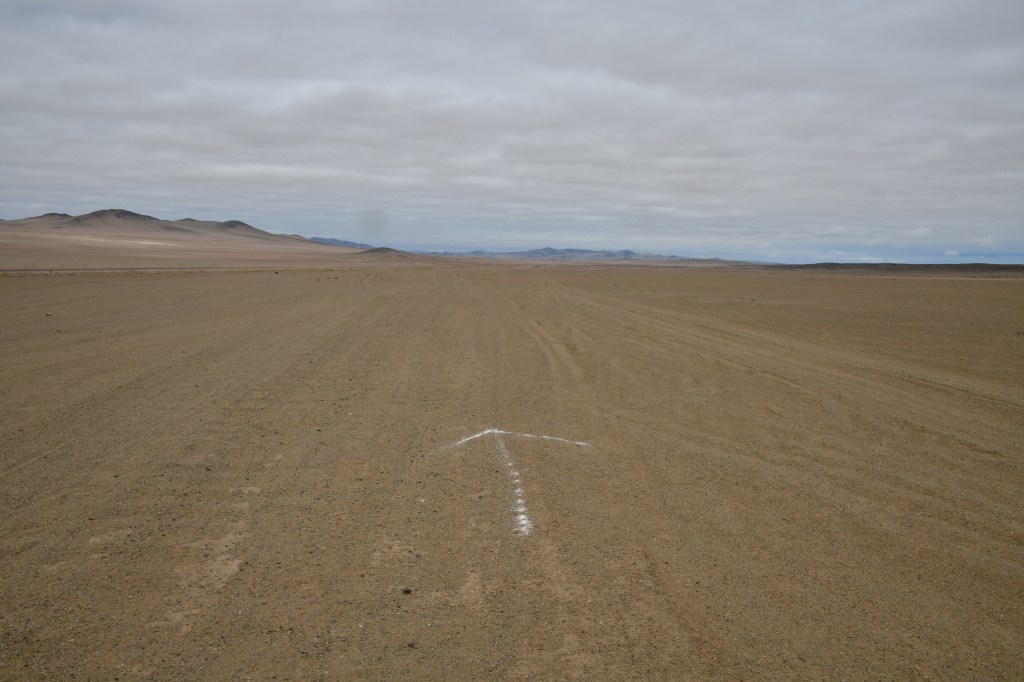
In 2019 things were very much drier, resulting in no images of plants:
S3826: along the road from R5 to Barranquilla No flora or fauna to observe. In 2004 this was a purple mass as far as the eye could see!
The second stop of the day was on Morro Copiapo where eventually we found our usual stop. It seems that a large are of rocks and hillside had been removed to be used for building materials to create new beach villages.
There were very few cacti to see. Many dead Eulychnia breviflora, a few still standing up and one with a flower and four buds! We eventually found a few clumps of Copiapoa marginata. This is the neo type of the Genus Copiapoa. Is this global warming at work?
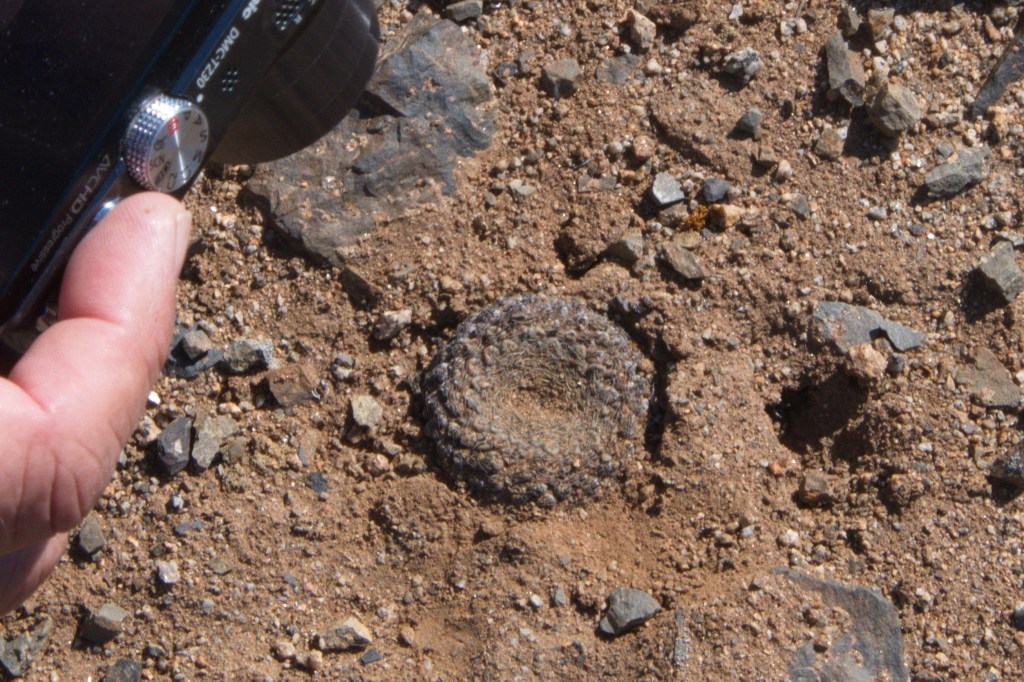
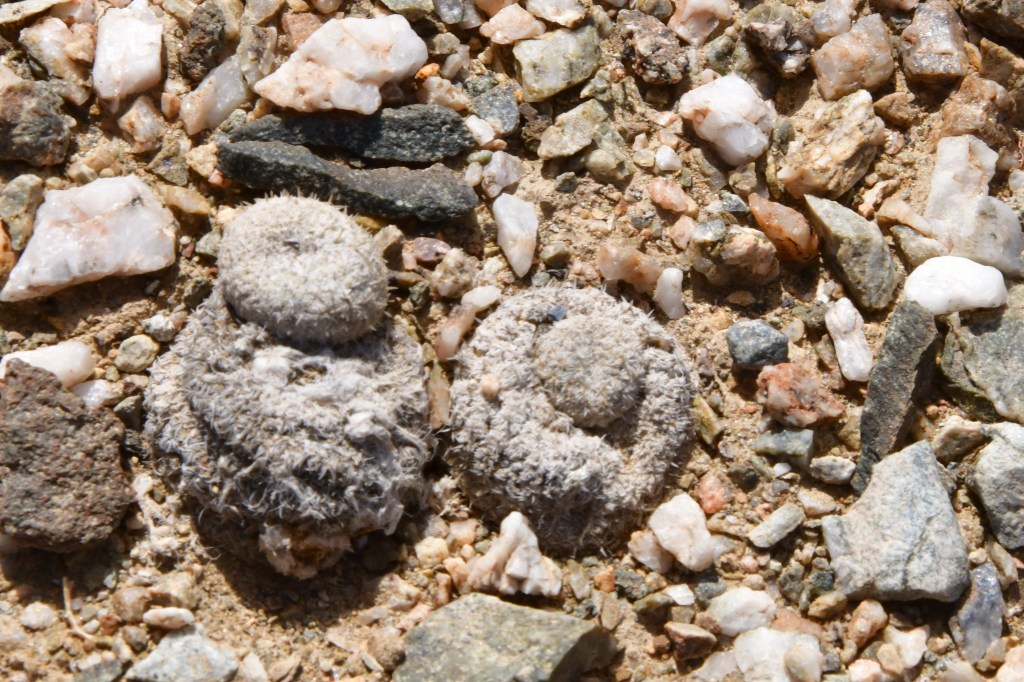
Finally the top challenge of the day: find Eriosyce (Thelocephala) odieri – again, this is its type locality: One plant found!
S3826 Eriosyce (Thelocephala) odieri
Tomorrow we move on to Chañaral. Ian Woolnough’s group, the Magnificent Seven, report landing safely in Chile and should catch up with us in Taltal in a few days time.
Technically we made four stops today with the last stop at the cake shop on the corner of the old R5 and the road to Vallenar, but as I took no photos here, I have not allocated a Stop number.
For the first stop of the day, (S3822) we headed north along R5 and turned east at the difficult to see sign to El Donkey. This is now a good salt track. We briefly hit the beginnings of a pea-souper fog as experienced in 2003, but it lifted quickly, producing a bright sunny day, again at the expense of the fauna and flora. The Eulychnia were simply too dry to give an accurate ID but so far from the Ocean it has to be E. acida. These plants practise stem-sacrifice at times of extreme drought. They also demonstrated spine sacrifice with bald stems surrounded by piles of long spines. Not sure that this is a good idea on their part as the spines are useful to catch fog droplets and direct them to the plants root. I was bluffing about my ability to find the location for Copiapoa coquimbana subsp. andina having only been there on three previous occasions, the last one five years ago! Of course, I had brought my Garmin Nuvii SatNav along, but the wrong one – this one had my US and Mexico data on while the one with my Chile data is still in England!
Never mind, the location where I had been shown them by Rudolf Schulz appeared in due course along the side of the road and sure enough,we were able to detect clumps of Copiapoa on the lower part of the hill. We walked over for closer inspection and I managed some nice pictures.
Copiapoa coquimbana subsp andina
On another occasion, with Bart & Marijke Hensel, we were taken to another location and another and another, but the track that we had been on could not be found this time.
We wasted a bit of time trying to find the turning but then decided to head back via the Parque Nacional de Challe to see if we could improve on yesterday’s hunt for Eriosyce (Thelocephala) challensis. Checking back in the hotel last night it transpired that we had been on the wrong hill, 790 meters from the coordinates where we had found them in the past. It took about an hour to get to the ‘next’ hill but once again, it was very dry, so the chance of finding them was slim.
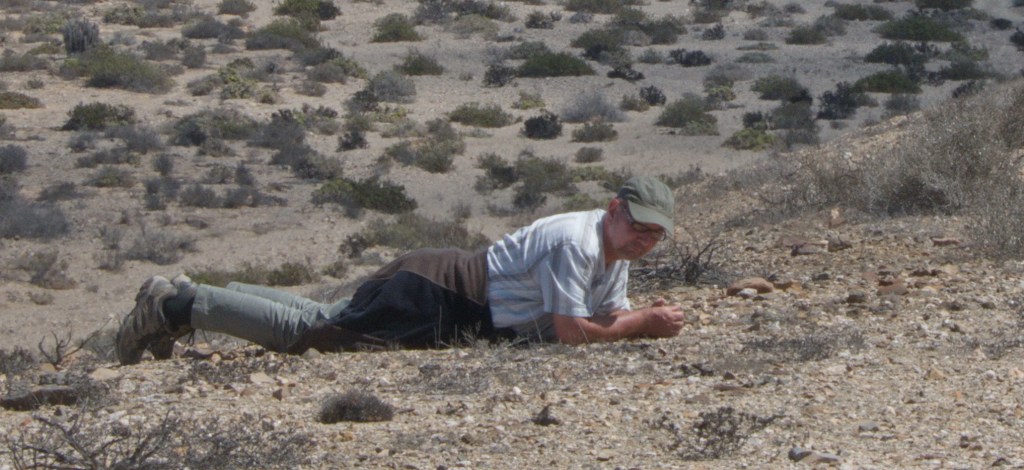
I saw Al lying flat on the ground and took a picture while composing the heading ‘BCSS Editor lies down on the job’ when he suddenly jumped up, did a little dance and called over: ‘Got them!’ And sure enough, he had found them, hence the stop at the cake shop where we had promised to pay for the cake of the first person to find the plant!
BCSS Editor lies down on the job and finds Thelocephala odieri subsp. challensis!Eriosycenapina subsp. challensis
As usual, finding one leads to finding more.
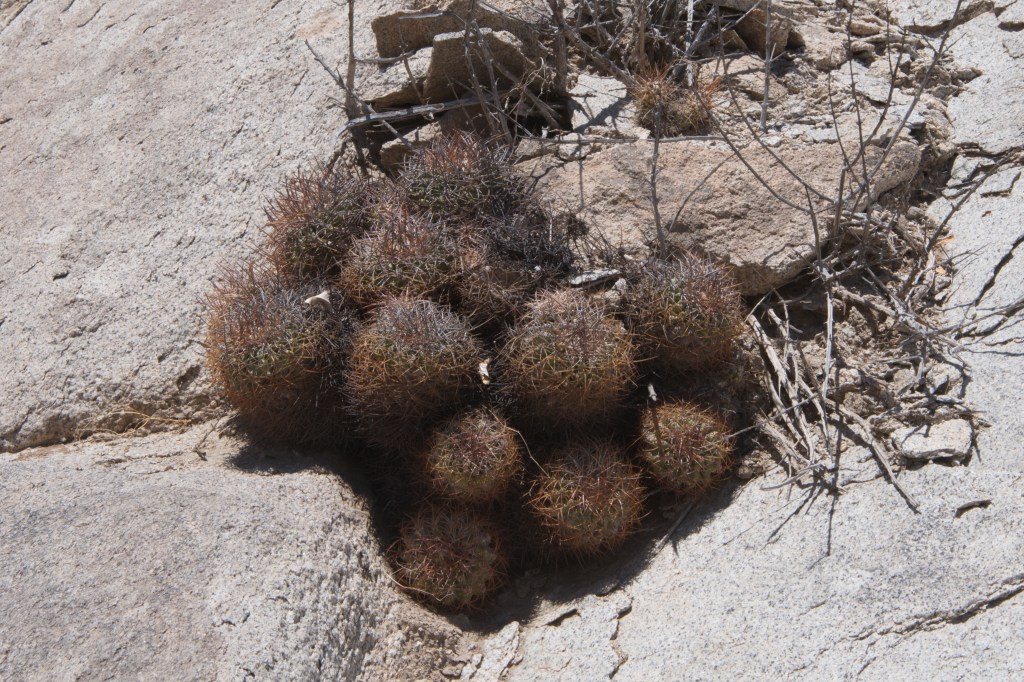
As our special bonus we drove on in the direction of Carrizal Bajo where I knew of a population of Copiapoa dealbata – again, fewer in number and soon to become smaller still, as there were signs of a tunnel being built, presumably to stop the road from flooding.
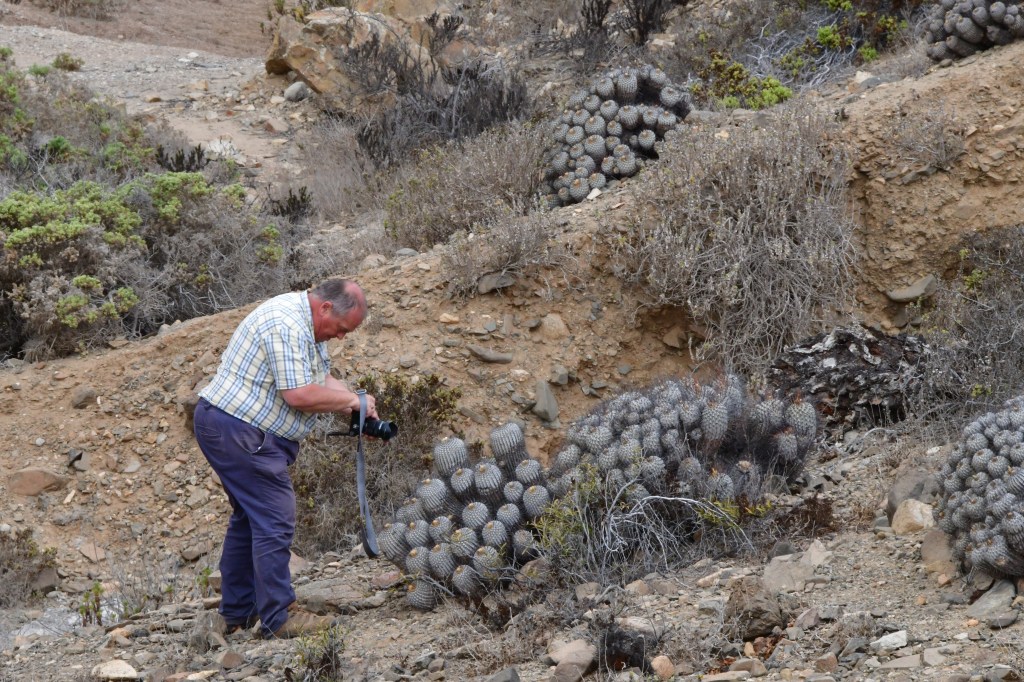
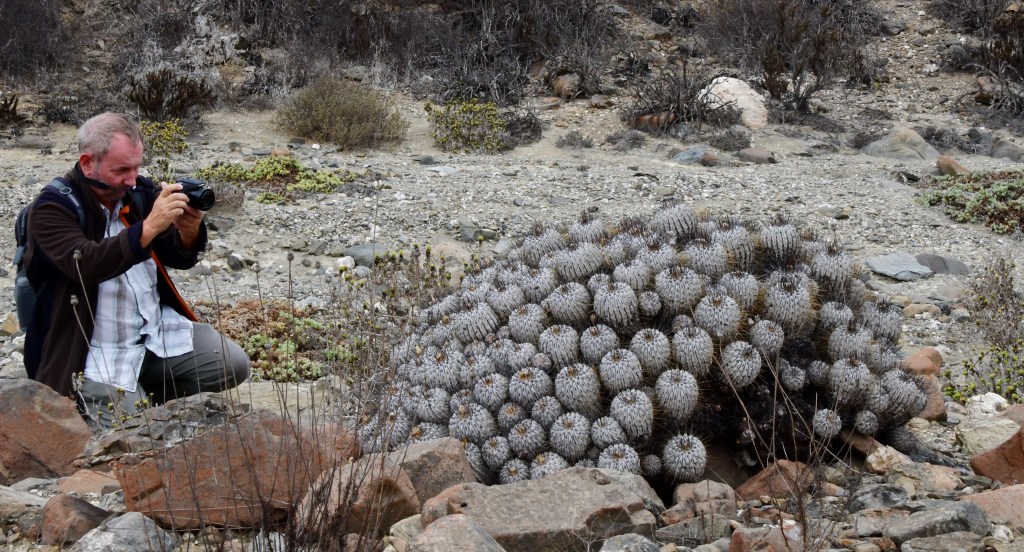
Left: Ian; right Copiapoa dealbata at km 60 on road from R5 to Carrizal Bajo.
We took a good number of images before I allerted the others about the possible closing time of the Vallenar Cake Shop. Great how quickly everyone was back in the car.
PS Decided to go back to the Pizza restaurant on the Plaza, which was full of a happy family orientated crowd with lots of flag and banner waving people, all smiling, chanting and lots of pogo jumping. Ian and I bought a flag each in order to blend in. Got back safely to Hotel Atacama on Sereno.
S3817 was at Quebrada Barracota, along the Huasco to Carrizal Bajo road. The Copiapoa could be seen from the car but we needed a stop for an ID – Copiapoa echinoides.
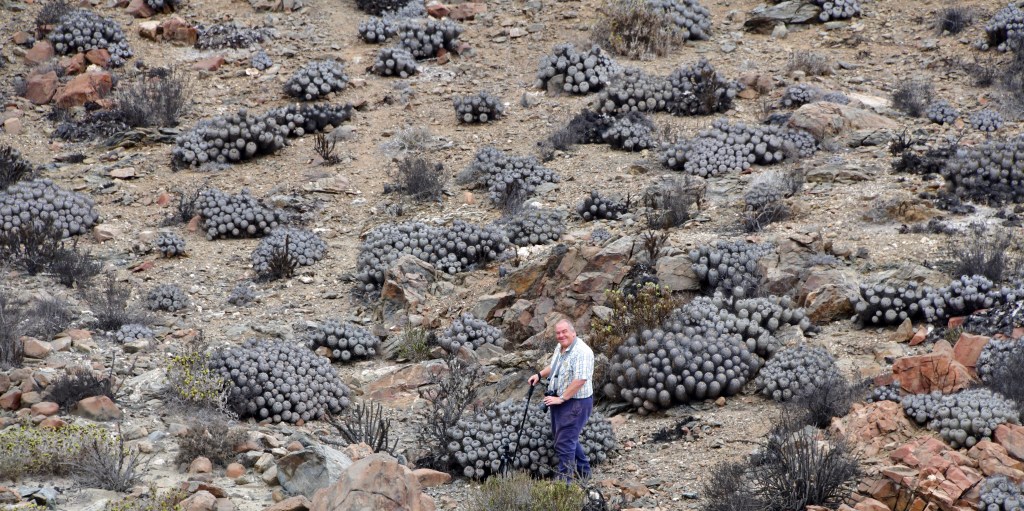
S3818 at Quebrada Mala was an old favourite, first our group photo in 2001 very close to the Pacific Ocean, but since then along new improved tracks farther inland. Ian just did not know which clump to photograph first!
As always, we asked ourselves and speculated how old these plants were!
Al taking a close up – Copiapoa dealbata
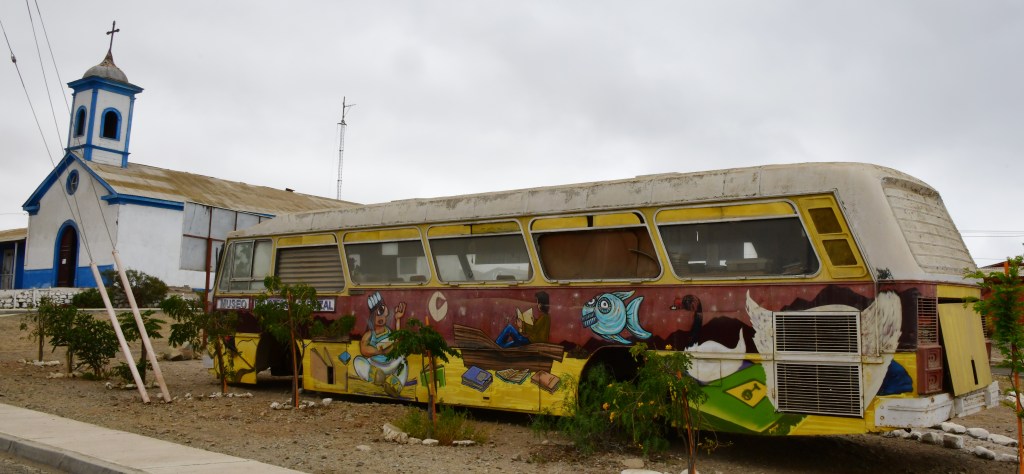
S3819 was time for a little culture: The Carrizal Bajo Library – it looks as though they replaced the old bus with a new(er) model!
We turned east and headed towards Vallenar. If we just made a short stop in the Llanos de Challe National Park, we should be in time for a treat at the Cake Shop at the Vallenar Crossroads, opposite the Copec station along R5.
In the Park, I was sure that we needed to climb the first low hill after entering the Park, driving past the ranger’s station at the northern entrance. Wrong! Back in the hotel it transpired that we should have climbed the second hill. Never mind, we would pass here again. Extremely dry!
Yes, I know, they are a little (a lot!) out of synch, but it will all fall into place in time.
The plan for today had been to climb in a panga and be taken to two of the islands (Isla Choros and Isla Damas) in the Penguin Biosphere Reserve, north of La Serena. Cabanas, shops and the boats taking paying guests were were all in resting mode after partying during the recent Halloween festivities and the excitement and tension of the recent civil unrest. Many Chileans seem to have stayed at home to protect their property (?). Ruta 5 was practically empty.
After a cold night we woke up to the sight of flags flapping in the wind – not what we wanted to see! When we arrived at the harbour it was confirmed: too windy to make the trip!
OK, so over to Plan B: show my compadres ‘my’ Eulychnia chorosensis. Even in the poor light and their dehydrated state, they still looked like interesting, attractive plants.
Some years ago, Angie & I risked driving from Punta Choros across a barely marked track on very soft sand, but in a Toyota Hilux built for such challenges, to Carrizalillo. Now this was very easy on a smooth newly tarmacked road that would put most UK roads to shame. We finally found a shop open where we could buy some chocolate to replace breakfast this time.
The top quality tarmac continued all the way to Domeyko. Our second stop today was 17 km before R5 at the site for Copiapoa domeykoensis, said to be a giant form of C. coquimbana, in the north of that plant’s distribution area.
We hit R5 at Domeyko and headed north for Vallenar, where we missed the turning to our favourite cake shop and ended up on the road to Huasco. Never mind – cake would have to wait until later!
At Maitencillo we turned left on the track to Ojo de Agua for the third stop today for Eriosyce thelocephala lembckei. It really was very dry and the Eulychnia, Copiapoa coquimbana and Miqueliopuntia looked like shadows of their former selves. No Thelocephala found, although I feel sure that they were there, buried in the sand, laughing at us. Perhaps a but farther along? We we passed a sign to El Mirrador, offering a magnificent view? but now over chicken farms! All the previous plants mentioned were found, but no T. lembckei. I could hear the cakes calling my name at the R5 cross roads, so we continued back. Ian requested a quick look at a very similar layby with all the usual suspects and after some searching he waved to the car and begged us over. He had found Thelocephala lembcki, as small and hidden as I have ever seen them. Well done, Ian! Once we had spotted one plant, some two dozen more were readily found, but it is that first plant that matters!
For the 6th stop of the day I wanted to take us to the traditional Eriosyce napina site in view of the monster power station that burns oil pellets and spreads cancer among the people of Huasco. This has always proved a popular spot but this time there were wooden poles wrapped in barbed wire that blocked the road and it seemed that office buildings at the power station were still smouldering having been burned down, presumably by rioters.
We decided not to hang around in case of trouble and returned to Vallenar where this time we successfully made Stop 7 of the day: the cake shop!
We’ll be here for two – three more days so you may get a few more Diary updates.
We managed to squeeze five people into the car as we had promised to give Carlos a lift to La Serena. The social unrest and public strikes had taken their toll on public services, with buses running while they could rather tan to a regular timetable. None of us were too certain where we were going, but just before I thought that we’d soon be out of town, Carlos asked to be dropped off and we continued our journey, at least until the Copec station for fuel and of course, a hot dog!
We didn’t see much of the Cuesta due to the Camanchaca that sounds a lot more interesting when you read about it than when you are driving around in it! We had made the exit to Los Choros before we knew it. (S3805) There seemed little point at looking for Eriosyce riperia in this drought, the plants would be well hidden, pulled down into the soil by their contractile taproot. Soon after the turn we stopped for a leg stretch. A lot had changed since our first stop here on 24 June 2003, when it gained my location reference L0202, although all the cacti reported then were still seen today: Copiapoa coquimbana, Cumulopuntia sphaerica, Eulychnia acida, with somewhat hairier buds than ‘normal’ E. acida, and Miqueliopuntia miquelii.
S3805 – Copiapoa coquimbana
By 2007, the then newly described Eriosyce (Thelocephala) napina subsp. riparia had been added to the list, but time constraints stopped us today to search for it.
Next stop S3806 will always be known to me as JA001, Juan Pablo Acosta’s first recorded cactus stop. The scenery, from the top of a low hill, down the dry Rio Choros is great and creates many angles where it forms the backdrop for the cacti that grow here. Again, it was striking how dry the plants were. The Eriosyce here is called E. (Horridocactus) simulans as it closely resembles the Copiapoa coquimbana (Ritter’s C. pseudocoquimbana) that is grows alongside with. Except that today there were no flowers or fruits to differentiate between the two taxa.
The Eulychnia has a low, upright growth, not procumbent like E. chorosensis, but the hypanthium is bristly, just like E. chorosensis. Another mystery Eulychnia! A transitional form or a different taxon? It’s all happening in this area!
S3807 was a stop for a herd of some dozen guanacoes and later joined by a family ? pack ? of foxes. We tend to carry some bread roll remnants, left over from breakfast and they were very happy with this sudden meal! Only when we drove on did we see the request not to feed the animals, in Spanish of course, as inappropriate food for animals under stress could kill them! We hope that they are all OK.
(S3807) Zorro chilla
We arrived at the port of Punta Choros that seemed deserted. Under the overcast skies the shacks looked impoverished. All the pangas seemed to be in. There was a bit of a breeze, too heavy to take passengers to Isla Choros and Isla Damas where Humboldt penguins build their nests under the stems of Eulychnia chorosensis. Perhaps tomorrow? Come at 8:00!
We found cabanas to sleep four and, after a walk through the village found a restaurant that was open (or did it open specially for us?)
Fingers crossed that tomorrow’s weather will allow us to make the boat trip!
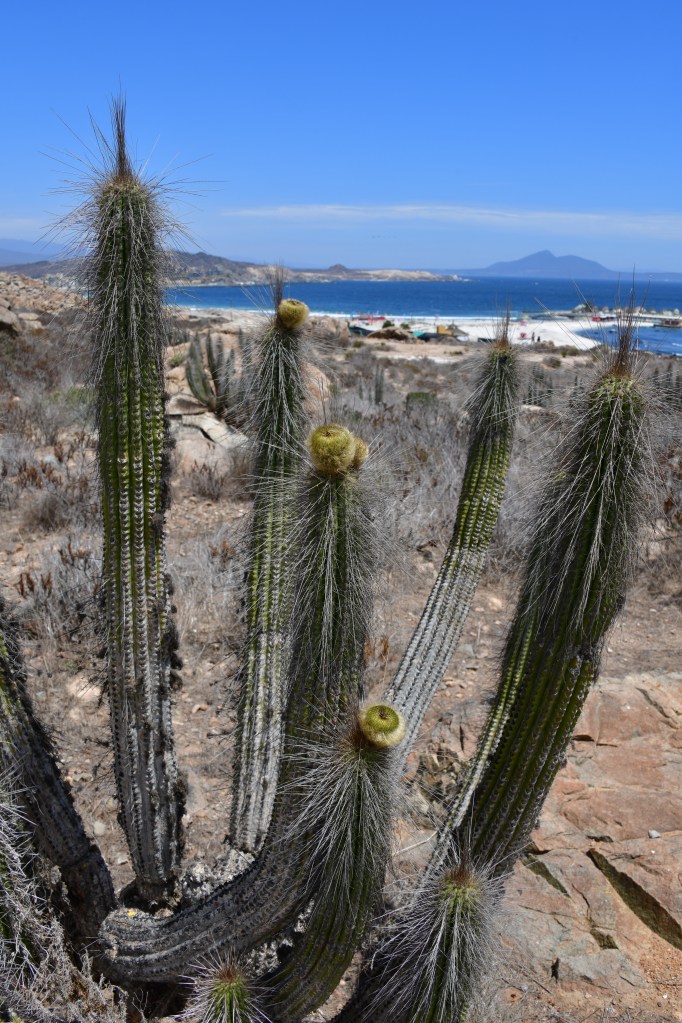
The last time I stayed in Guanaqueros on 27 November 2013 and before, in 2 January 2009, we visited the seaside resort of Totoralillo, the one south of Coquimbo, rather than the one north of Pichidangui, is was surprised to see the unusual hypanthium on the local Eulychnia. Was this a ‘sport’? But I also found similar plants at Playa Blanca and Tarambola.
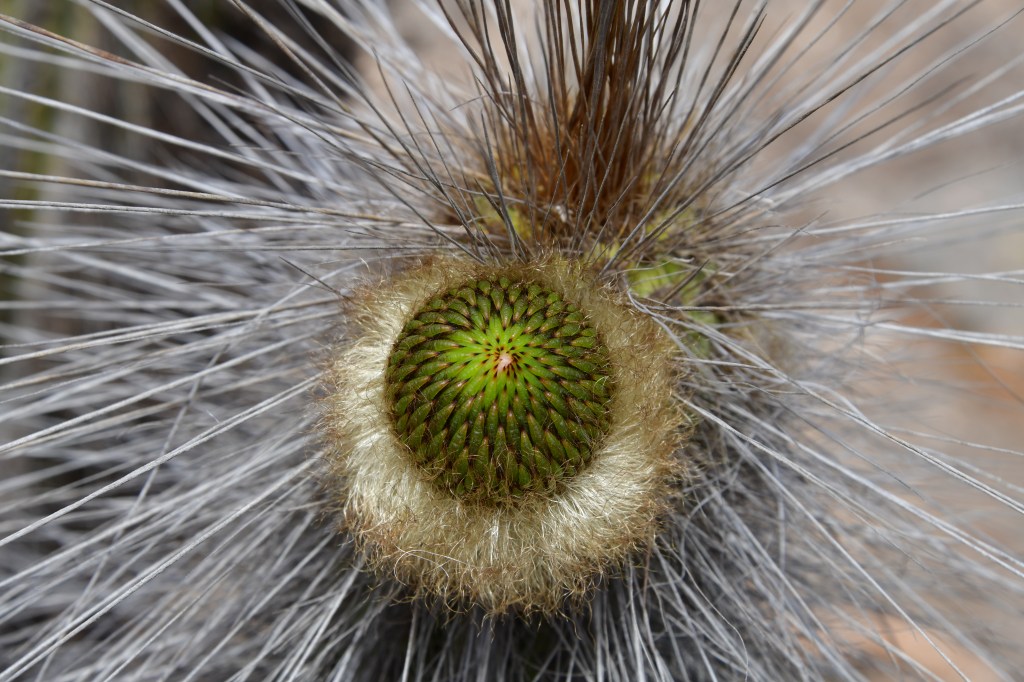
So what is so different? An important means of differentiating between different species of Eulychnia lies in their hypanthium. E. acida has a naked hypanthium, covered in scales with just small insignificant bristles emerging from between the scales . E. breviflora on the other hand is covered in long, honey coloured wool. As you can see in the images to the right, the hypanthium of the plants that grow here is a mixture of the two, with the lower part covered in long wool but the upper half of the hypanthium clearly displaying the acida-like scales.
During the 2009 visit, this phenomenon occurred on ripe fruits and the long hairs readily rubbed off. I had not seen E. breviflora fruits in such an advanced stage of ripeness. Is this what happens in all Eulychnia fruits?
But this time, the hypanthium was that of a bud, not a ripe fruit. Flowers appear at the shoulder of the stems (cf. lateral for E. acida and apical on E. breviflora).
Eulychnia hybrid acida x breviflora?Eulychnia cv April Fool’s Joke.
‘Should we start thinking of a new taxon?’ Ian and Al asked. I smiled. ‘Not until I have looked up the Latin for ‘1st April”
We went back to the cabanas so that I could roughly plan what we were going to do during the next few days. Suddenly there was a rumbling noise and the cabana began to shake. The fridge started to walk across the room. Then everything was quiet again. We had just experienced a 6.8 strength earthquake! But that is quite a regular occurrence in Chile! We saw no obvious damage – everything that was going to break, fall over or get knocked down already has!
As Angie and I had not made it to the rocky shoreline at Pichidangui, it was time to catch up after breakfast.
S3798 was the usual place to see three species of Eriosyce growing side by side: Eriosyce chilensis (in flower), E. subgibbosa (not in flower as it tends to flower around May time) and E. curvispina (in bud, with some buds bursting open) as well as Eulychnia castanea (in flower). Not bad for a first cactus stop!
We moved to the southern end of the rocky shore (S3799) where BCSS funding had contributed to publicity signs alerting visitors about the treasures that nature had liberally spread along the coast here. We met a Chilean couple on their way to church whom I recognised as local conservation fans from the pictures published when the signs were first unveiled. They were Adriana Razeto and her husband Nelson, who kindly showed us around their garden and invited us round anytime that we are in town! They had produced similar posters to inform visitors about the birds and other wildlife at the coast.
S3800 was a side trip into the Fray Jorge National Park where we saw Eriosyce aurata, Eulychnia acida, Echinopsis (Trichocereus) chiloensis and subsp. skottsbergii, Cumulopuntia sphaerica before spotting our first Copiapoa, C. coquimbana (Ritter’s C. pendulina) near the beach at El Sauces at S3801, As a bonus, many plants were in flower!
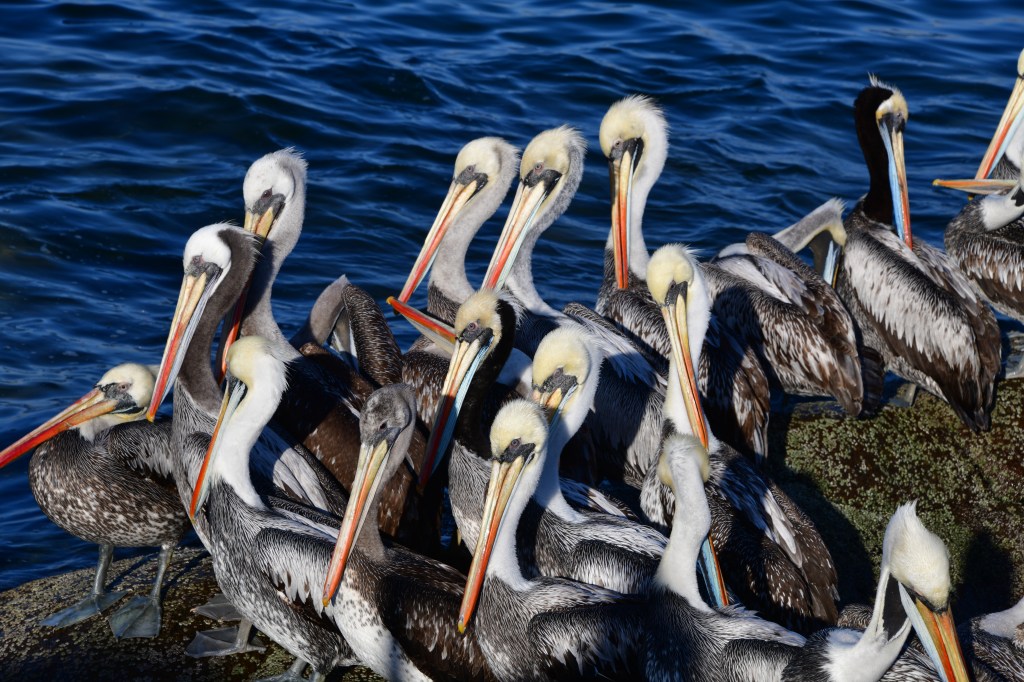
S3802 was at Guanaqueros where we enjoyed a visit to the harbour where the local airforce of pelicans were sunning themselves in the setting sun.
Peruvian Pelicans at Guanaqueros, Chile.
Our usual accommodation at Cabanas Club Bahia had no space, as this was a long Chilean Bank Holiday weekend for Halloween, with the added confusion caused by the civil protests taking place throughout Chile. No Problem – there are many cabanas etc along this stretch and at the second point of asking we found comfortable accommodation for two nights at Cabanas Mar Azul with Carlos, from Venezuela, going the extra mile to get our cabana fit for habitation. Thanks Carlos!
It was great to be in Santiago Airport again! We worked our way through the snake of people queuing for immigration, picking up our luggage and seeing Andres Gabor waiting to greet us at the exit gate. I (and many of the other European Cactus travelers) have used Andres’ company LYS Rent-a-car since 2003 (credit to Brendan Burke for recommending him after we had less success with the rental car from a different provider in 2001.)
Andres greets us and treats us to breakfast at the airport – a lot more civilized than picking up your rent-a-car at other international airports.
And so, around noon, we set off, this time without my SatNav! I had picked up the wrong one at home – the one with USA and Mexico data, rather than the South American on. So I missed the turning on Vespuchi to R5 – El Norte, but soon found a retorno to correct the matter.
From the airport, Ruta 5 – the PanAmerican Highway – runs inland heading north. Around Longotoma, some 200 km after leaving the airport, the road turns west and comes down a couple of hundred meters to the Pacific Ocean. Since 2001 it has been a tradition to burst into song as soon as we see the Ocean. First with that popular tune ‘Oh I do love to be beside the seaside’. As the waves appeared, Ian Thwaites, Al Laius, Angie and I burst into song, followed by the chorus of Cliff Richard’s hit from the 1960s ‘We’re all going on a Summer Holiday! I would have mimicked, the Hank B. Marvin guitar solo, had it not been for the fact that I was driving. *
One stop, S3797 at Los Molles, the type locality of Eulychnia castanea. Lots of new tourist development here, at the expense of the plants!
Eulychnia castanea flowering on the rocks at Los Molles.
I was not feeling too well, so we went to Hotel Rosa Nautica where after five years away I was still recognised by the elderly owners. I presume that it was her daughter who was supporting them and spoke good English. While I had a cup of chicken noodle soup and a rest, Ian and Al found the rocks on the beach and the three taxa of Eriosyce that grow there: E. curvispina, E. chilensis and E. subgibbosa. The light was past its best, but we could always go back the next day!
As a bit of padding today, I thought I’d add the complete lyrics to ‘Oh I do like to be beside the seaside’ so that Ian Woolnough’s party can follow the tradition. Ian and Al must have misunderstood as several days later they still burst out into song every time they see the sea!
Ian is considering to make this the BCSS Theme song, to be song before every UK branch meeting, or did I get that wrong!? 🙂
‘Everyone delights to spend their summer’s holiday down beside the side of the silvery sea. I’m no exception to the rule, in fact, if I’d my way, I’d reside by the side of the silvery sea.
But when you’re just a common or garden-working lad like me, a chance to see the sea is quite a novelty. I save up all the money I can while winter’s grim and grey Then off I run to have some fun where the balmy breezes play
Oh! I do like to be beside the seaside! I do like to be beside the sea! Oh I do like to stroll along the Prom, Prom, Prom! Where the brass bands play, “Tiddely-om-pom-pom!”
So just let me be beside the seaside! I’ll be beside myself with glee and there’s lots of girls beside, I should like to be beside, beside the seaside, beside the sea!
Timothy went to Blackpool for the day last Eastertide To see what he could see by the side of the sea. As soon as he reached the station there the first thing he espied Was the wine lodge door stood open invitingly Grinning to himself, he toddled inside and called out for a wine Which grew to eight or nine, till his nose began to shine. Said he ‘What people see in the sea, I’m sure I fail to see’ Then he caught the train back home again and to his wife said he
Oh! I do like to be beside the seaside! I do like to be beside the sea! Oh I do like to stroll along the Prom, Prom, Prom! Where the brass bands play, “Tiddely-om-pom-pom!”
So just let me be beside the seaside! I’ll be beside myself with glee and there’s lots of girls beside, I should like to be beside, beside the seaside, beside the sea!
William Sykes the burglar he’d been out to work one night filled his bags with jewels, cash and plate. Constable Brown felt quite surprised when William hove in sight. Said he, “The hours you’re keeping are far too late.” So he grabbed him by the collar and lodged him safe and sound in jail. Next morning looking pale, Bill told a tearful tale. The judge said, “For a couple of months I’m sending you away!” Said Bill, “How kind! Well if you don’t mind, Where I spend my holiday!”
Oh! I do like to be beside the seaside! I do like to be beside the sea! For the sun’s always shining as I make my way, And the brass bands play, “Ta-ra-ra-boom-de-ay”
So just let me be beside the seaside! I’ll be beside myself with glee and there’s lots of girls beside, I should like to be beside, beside the seaside, beside the sea! ‘
The song was written in 1907 by John A. Glover-Kind and made famous by music hall singer Mark Sheridan who first recorded it in 1909.
It was, for a long time, used as a signature tune by Reginald Dixon MBE, who was the resident organist at the Tower Ballroom, Blackpool between 1930-70. For more detailed information, not related to cacti, check out the Wikipedia entry for the song title and you’ll be amazed!
After a week of hard rain (80 mm in one day at Boscombe Down, about 1 km away!) the calendar has moved to October with just one month to go before Al Laius, Ian Twaites, Angie Money and I head off to Santiago de Chile for three weeks of cactus hunting in the Chilean Atacama Desert. This time we fly via Toronto, Canada, not the first place you think of when looking on how to get from London, England to Santiago, but as the earth is round(ish) I guess that it doesn’t really matter how you get round the globe.
Things left to do, in no particular order, include:
Pay the deposit to confirm the car rental agreement that is already in place.
Book our flu jab for Angie and I at the local surgery
Check that our travel insurance is up to date
Take the photographic equipment for a test drive, next time the sun here dares to show its face.
Check our passports are still valid.
Obtain our eTA (Electronic Travel Authorisation) to transit in Canada.
My intention is to produce daily reports of where we are, what we’ve seen and how the environment where our favourite plants live, survives in the harsh conditions. I travelled to Brazil around the same time last year and still struggle to complete the Diaries for that adventure. It seems that my laptop and software is so keen to protect me when I travel away from home, that it freezes my accounts when it spots when I move! Fingers crossed that it behaves this time.
Correspondence with friends in Chile suggest that they have had very little rain this year, so that the chances of seeing the Desert in Flower are low. But such events can be very localised and one afternoon of light rain can trigger a local flush of blooms, so we’ll have our cameras ready.
To all intents and purposes, the trip was over. We reached that stage that seems to happen at the end of all cactus & succulent plant trips: you’re cactussed out. Just can’t get excited by looking at yet another cactus and the mind is already moving ‘home’ where ever that is, or in Alain’s case, to his next trip, as his wife Greet was whisking him off for a week of visiting Christmas markets in London!
The date of the picture is 10 December 2018, flying from Rio de Janeiro to Schiphol, Amsterdam, in the Netherlands. Alain had a connecting train or flight to Belgium where he arrived safely we assume – we did not see him again until the traditional BBQ the night before ELK 2019 – it matters not, as the Cactus Trip was over.
Billy met John at the arrivals gate at Heathrow. Chris’ car was parked at my place in Amesbury, but as Angie and her son Peter were in Cologne to help her mum celebrate her 89th birthday, we now had to make the journey back to Wiltshire by National Express coach, after a couple of hours wait in the unheated waiting room at the Heathrow bus station. Considering the heat experienced in Brazil, warm winter clothes seemed inappropriate during packing, but essential now. I became chilled to the bone and administered some chocolate bars to get my blood sugar levels back up. I had become quite disorientated but got better during the 90 minute coach journey to Amesbury. Close to midnight, the town was deserted. We dragged our luggage to the local kebab shop and asked to ring for a taxi, just as one drove by empty. We managed to wave down the driver who dropped us off home. Next ‘crisis’: where were my door keys? I had expected Angie to let me in, but she was in Germany! So, in the rain and by the light of the lamppost in front of my house, shivering in my inappropriate summer clothes, I unpacked my luggage and finally found the keys right at the bottom of the suitcase! Alain and Marlon had promised me copies of their stop notes, but to date, nothing has been received. So the information in this trips Diaries is based on my memory which appeared to improve with time as I presented my images at BCSS branches in the UK and at the Convention of the Scandinavian Cactus Society in Odense, Denmark in August 2019. Apologies for errors and omissions, but I’d rather have an imperfect set of memories than go into the next trip, to the Chilean Atacama Desert without having written up the previous trip.
In Chile, I’ll be back to recording all stop details myself and not to rely on others. Angie will be along, so she can bring the beers at the end of each day while I write up each day’s notes and sort the images by stops. All I’ll need is a bit and a following wind and hope that the internet and my laptop cooperate in getting the messages out each day.
Ian Woolnough will be setting off from Santiago one week after us, with a group of eight Brits. We’ll meet up in Taltal and hope that they can find the labels that we’ll leave behind so that they don’t need to worry about plant IDs in the field.




 The Cactus Trip Diaries