Just another WordPress.com site

Yesterday’s early stops focussed on trying to find the Chicken Farm Stop at km 27 on the Mex  40 Saltillo to Monterey road. Unfortunately, this is now the location of a huge motorway intersection. Although there are plenty of chicken farms around the intersection, the one that was here in 1973 is likely to have been destroyed by the development, together with many thousands of plants, if today’s exploration of the surrounding hills provides an indication.

We made five stops between 8:45 and 15:49, all in a relatively small area around this intersection, with temperatures approaching 30 C, but with a stiff breeze cooling us down and threatening at times to take our hats off. The sixth and unnumbered stop was at the local Walmart where John and I sat down in the air conditioned cafeteria, drinking a ice cold Sprite while Eunice went shopping – incl. three pairs of sunglasses to replace the pair broken the previous day.

S1828 was a disused quarry reached after we turned off at km 25 on Mex 40. We climbed the hill and I took an amazing 165 images of what seemed initially a none too promising location. As we climbed the limestone hill, we photographed: the White Prickly Poppy (Argemone grandiflora), Thelocactus rinconensis (s.n. T. phymatothelos), Evening Primrose (Oenothera sp.), Echinocereus stramineus (?), Mammillaria pottsii, Echinocereus pectinatus, Echeveria cuspidata, Epithelanta micromeris, Mammillaria woodsii [PS No. occurs much farther south], including a dichotomously splitting plant.  

As we pulled away, I spotted an Opuntia in flower, bright yellow. All the Opuntias are heavy with buds after a wet winter (relatively) but they are late opening their buds (cold spring, although with temperatures around 30 C around midday, that too is relative. S1829, here at the bottom of the hill that was S1828, turned out to be more than just a quick picture. 30  minutes later we left having taken pictures of Mammillaria heyderi ssp meiacantha, Coryphantha sp., Echinocactus horizonthalonius, Echinocereus pectinatus, Mammillaria heyderi ssp meiacantha, Mammillaria pottsii, Opuntia sp.

We tried to find another location suggested by John, based on his notes (or were they from the Glass & Foster Logbook?), but this time found the track blocked by a locked gate. We parked near the gate (S1830), disappointed at not being able to reach our goal, but 75 minutes later left happy after finding an impressive selection of plants: Agave lechuguilla, Corynopuntia sp., Coryphantha sp1, C. sulcata, Cylindropuntia spinosior, C. tunicata, Echinocereus stramineus, Epithelantha micromeris, Euphorbia antisyphalitica, Hechtia sp., Lophophora williamsii, Mammillaria heyderi ssp meiacantha, Neolloydia conoidia, Opuntia sp., Sedum sp, Thelocactus bicolor ssp bolaensis and Tradescantia sp. Quite a catch!

We returned to yesterday’s S1818, now S1831, for a more detailed look around. An impressive list of plants found now included another one of the ‘painted Agave’: A. fernandi-regis. Also found: A. stricta, Ariocarpus retusus, Echeveria cuspidata, Echinocereus pectinatus, E. stramineus, Escobaria sp. Hechtia sp., Lophophora williamsii, Mammillaria formosa ssp chionocephala, M. heyderi ssp meiacantha, M. pottsii, Neolloydia conoidia, Opuntia rufida, Thelocactus bicolor ssp bolaensis, Thelocactus rinconensis, T. setispinus (?) I must check how to distinguish this last taxon from Ferocactus hamatacanthus, especially when there are no flowers and fruits to examine.

With a bit of time to spare John and I decided to take a look around a near by the flat area at yet another Chicken Farm (S1832) and found Ferocactus hamatacanthus, Agave lechuguilla, Agave scabra, Coryphantha sp, Cylindropuntia sp., Mammillaria heyderi ssp meiacantha, Thelocactus rinconensis, Echinocereus stramineus, Fouquieria splendens, Cylindropuntia leptocaulis, Lophophora williamsii, with evidence of digging, most likely for the peyote. Peyote omelettes anyone?

A great selection of plants here – I think that I’ll be back at some future date.
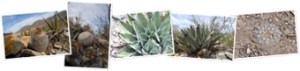
Today produced eleven stops, as we entered Huasteca Canyon this time from the Saltillo end. The intention was to go as far as yesterday’s turn around point and then turn  back. However, the track was so bad in places and the turn around point was somewhere in the middle, that we opted to form a convoy of three cars – we were the meat in the Mexican sandwich – and return to the Santa Catarina / Monterrey end from where we could pick up a fast freeway for the last 80 km home. As a result, the stops tended to be brief, with probably more time in the car than any of us had wanted, but the plants seen were worth it.

We left Saltillo around 8:30 a.m. and made straight for a stop near the place that John called the Chicken Farm Stop, when he visited the place with Charlie Glass and Bob Foster in 1973. Unfortunately, the chicken farm seems to have made space since the 1970s to become a junction of the Mex 40 and Mex 57, major highways that between them have gobbled up lots of cactus habitat

As a result, today’s first stop was not the original ’73 location, but it seemed likely that the hills around here would host most of the plants listed. S1817 celebrated the fact that we had managed to find a track off the Mex 40 and were at the foot of a mountain to be explored in detail later. During our ten minute stomp around, we found Thelocactus rinconensis (s.n. T. phymatothelos), large plants in advance bud but with the white flowers struggling to open fully through the heavy spination. I thought of Cliff, as the genus Thelocactus is (one of?) his favourite(s). The location is marked, Cliff, for a future Thelocactathon. Also found: Mammillaria pottsii, and Echinocereus stramineus (?)

S1818 was a Eunice stop, from a previous visit last June, just on the other side of a wired off project from the previous stop, but a bit higher up the hill: Plants seen in the order that we found them: M. pottsii, Ariocarpus retusus, E. stramineus, Coryphantha sp. (C. radians?), Thelocactus bicolor, Echinocereus pectinatus (?), Mammillaria heyderi ssp. meiacantha, Cylindropuntia spinosior, C. tunicata, and C. leptocaulis.

We now followed the dirt track into Huesteca Canyon, but still on a broad plain with the mountains slowly moving in on us. S1819 was prompted by a clump of Echinocereus viereckii (?) in full bloom. Also found: O. rufida, Mammillaria heyderi ssp. meiacantha, C. leptocaulis, C. spinosior, Echinocactus spinosior, Agave scabra and Yucca thompsonii (?)

The excuse for S1820 was a large twin of Ferocactus pilosus / stainsii – not sure which name got stuck to this plant. As we were taken its picture, we saw groups of much larger plants some 100 m away. It was as though the desert had been designed as a practice track for the 100 m hurdles, as we sped to these groups.   They were in full bud and some of the flowers were beginning to open. Also found, a different flat padded Opuntia sp., denser spined than what we’ve been calling O. engelmanii, A. scabra, Echinocereus sp., Tillandsia recurvata (often seen, not always photographed or mentioned). Soon after we carried on, a heavy duty iron gate with ‘we mean business’ padlocks, blocked the road. We went back to an earlier fork in the road and took that.

We had been admiring an orange-yellow flower, like the Californian Poppy (Escholtzia sp.) for a while. Now we were coming along massive groups along the roadside, worthy of pictures (S1821). Of course we continued to look our for cacti and found C. leptocaulis, a much more robust form than the pencil thin cladodes usually seen; could this be a hybrid with the other Cylindropuntia here, C. spinosior?  And if so, here, why not in the other places where we had seen both species together? Agave scabra was still here as was a small globular cactus with a huge magenta flower, a Gymnocactus perhaps? or an Echinomastus? In fact there were a few candidates for this genus, perhaps because I don’t know it well enough? There was also a flat padded Opuntia with a variegate-like marking on the pads. Interesting, but unlikely to warrant a taxonomic name.

S1822 was just five pictures taking of the Ferocactus stainsii growing on a steep cliff face.

At S1823 I’m suggesting Turbinicarpus (Gymnocactus) knuthianus  for a small globular cactus. Also near there we saw Agave gentryi.

S1824 was past the sign for Llanitos, a small hamlet, population 18 on one sign, 19 on another. Soon after we saw Agave parresonia (a close relative to A. parryi). There was even an Agave posing as an epiphyte high in the trees – one more for the ‘unusual epiphyte’ corner of a future talk. Also photographed, an Opuntia sp. hanging down the cliffs, pretending to be a promising hanging basket subject.

We reached the village of El Pajonal, rather concerned at the lack of progress and considering to turn round. No cacti, just scenery, but very nice. (S1825).

So what was the quickest way back to the hotel? Via Monterrey, or back the torturous route that we had come? We asked people in the village of El Pajonal: via Monterrey was their suggestion. As we turned the corner out of the village, there was the sight that Eunice had been wanting to show us (S1826): Agave victoria reginea growing ‘on the flat’, rather than zoom lens range on cliff faces. Due to the late hour, and the need to get back in day light, we allowed ourselves just eleven minutes here, until some of the locals invited us to form a three car convoy to town. It was long enough to take 44 images, many of the Agave, but also some from the local Echinocereus that is keeping me awake trying for an ID. I’d call it Echinocereus adustus, but that plant is not reported from this area, and none of the Echinocereae that are, fit this plant. Interesting! [Since coming home, a bit more searching suggests that Echinocereus reichenbachii ssp armatus is the closest fit and reminded me that some of the Echinocerei that I’ve been calling ‘E. pectinatus’, might be forms of E. reichenbachii or E. rigidissimus.]

S1827 is just for the scenery as we bounced for another 90 minutes through some of the most incredible scenery. The Andes are impressive, but here, the mountains press much closer in on you, sometimes making you doubt that there is room for a road to pass through.

Another great day! But long, and with 307 images to take home as souvenirs.

The other event worth reporting was that there was a power cut that took out all the electricity for our hotel and the one next door, plus the shared restaurant. We were enjoying a bottle of Casillero del Diablo – Cabernet Sauvignon and guacamole as starters. They let us have the guacamole for free, but we had to pay for the wine, before crossing the road to a Brazilian restaurant for the usual unlimited meat feast that we had experienced earlier on our travels in Brazil.

Today’s visit was dedicated to Huasteca Canyon, between Monterrey, Nuevo Leon and Saltillo, Coahuila. The key plant that we were looking for was the recently described Agave albopilosa, described as recently as 2007 by Mexicans I. Cabral, Villarreal & A.E. Estrada in Acta Botanica Mexicana. Although the location is kept vague, as the Sierra Madre Occidental, we knew that it comes from Huasteca Canyon from an article in the L.A. Times.

We made eight stops (S1809 to S1816) and were lucky to find A. albopilosa at one of them. It seems to be a very limited distribution, known only from one spot that we have been asked to keep confidential, to avoid plundering by the trade in cacti & other succulent plants. The market should have ample supplies following micro propagation by a Californian nursery, according to the LA Times article, but not until 2011. Europe may have to wait a bit longer I guess.

As today’s pictures show, it is a wonderful plant that will have great appeal for both specialist Agave collectors and the general public: a mix that could spell disaster for the plants’ survival in nature. The Canyon is a host to a large number of Agave: A. lechuiguilla, A. victoriae-reginae (described by T. Moore  in 1875). A. stricta , probably its closest relative, A. bracteosa  and A. scabra, the latter on the valley floor while the others clung on precariously to the perpendicular rock walls. Given its extremely limited distribution compared to the other taxa mention, I can’t help but feel that A. albopilosa is a natural hybrid with a mix of genes from some if not all of the other parents. For now, all I can say that I was fortunate to be one of a small number of people to have seen this plant in nature, where it’s remote location in a National Park is perhaps its best protection.

After last year’s visit to the State of Durango, where we saw  A. victoriae-reginae only through powerful zoom-lenses of our cameras, it was great, here, to be able to walk among the plants to take their pictures. It is in plentiful supply here, again protected by the boundaries of the National Park.

In case you think that I have turned from cactophile to Agave-nut, there was plenty to enjoy on the cactus front as well, with Echinocactus horizonthalonius (incl. two plants in flower) Echinocereus sp. (E. enneacanthus? E. fendleri? E. vierecki?), Opuntia sp. – there was a mule munching away on its pads –  Cylindropuntia leptocaulis and C. spinosior ? (x2), Mammillaria sp. (x2), with M. formosa as one candidate, Epithelantha micromeris ssp bokeri, according to John, as it does not show the strong apical depression that is characteristic of E. micromeris and Hamatocactus setispinus.

On the other succulent plant front, I have mentioned the Agave already. I was baffled to find Kalanchoe daigremontiana, a plant that is endemic to Madagascar, but looked very handsome growing here in Mexico.

But in the end it was the stunning scenery, among the best that I have seen, that made this a very memorable day.

Judge for yourself.

Breakfast at Hotel Ancira was at 8:00, so a chance of a bit of a lie in. By nine we were on the road and heading back to Saturday’s S1793, past Ojo de Agua (now S1807). Eunice wanted to look for a particular spot for which she now had the GPS. This time it produced nice pictures of Astrophytum and Epithelantha with the sun in a better position, so I was quite happy with the repeat stop. Eunice failed to find a stone that she found last June.

We stopped briefly in town, as we passed the guys from the breakdown service and minutes later were back on the main road to Monterrey. Perhaps we should have stopped longer at the tyre guy, as soon the low tyre pressure light started to flash again. All four tyres were still round, but we were uneasy about the situation and stopped at the first tyre man (here again called a Vulkan for short, just as in Chile), where Eunice’s I Phone’s translation software told the tyre man that we would like him to check the pressures. They seemed OK, but he put them up from 33 to 34 just to be on the safe side. The warning light stayed on …..

Soon we entered the outer city limits of Monterrey, Mexico’s third largest metropolitan area, with some four million inhabitants. Eunice had booked us into the Best Western, but this turned out to be a bit of a nightmare, with eight hotels of this chain in town. Eventually (three hours later) we arrived at the right one, and after settling in, we decided to find a Walmart for some purchases. Top of the list was a tyre pump that works from the cigarette lighter, breaking the reliance on finding petrol stations etc. It will stay in the US for use on future trips, so a good investment. I’ll do the same in Chile I think.

Today’s pictures include one of me with the painted lady at Walmart, one of the more unusual pictures taken on cactus trips. I’ll also include an image of me with new hat – should have gotten one in Cuba as well so that I can start a display of hats at the Stonehenge Cactarium, Winebar, Cinema and Haberdashery, with my unique Cuba shirt substituting for a Cuban hat.

It was a cold night. I finally found something that wakes me up, low temperatures! The coyotes howling at a full moon meant that it took a while before I dozed off again.

We had brought a supply of eggs sausages and bread rolls that Eunice transformed into breakfast, before setting off for an informal stroll up the lime stone hillside (S1802) in the general direction of the microwave tower at the top.  Plants spotted were the same as those seen yesterday: Agave scabra, A. stricta, A. ovatifolia and A. lechuiguilla, Opuntia engelmannii, a Sedum sp., small leaved, similar to one that I have seen growing in nature in Cornwall and Somerset in the UK, Sedum sp. #2, Hamatocactus setispinus, Echinocereus enneacanthus and E. viereckii, and Mammillaria heyderi, with buds bursting to open anytime soon. All these plants sat on a lime stone hillside with other hills providing a marvellous back drop.

We were back at the Great Hall in time to meet Nacho, a retired miner who now acted as caretaker at the hall and who was going to show us some other interesting things. First was a short drive along the track that we had followed yesterday, to a parking spot from where we walked to and inside Mina Buena Vista (S1803). This was the same name as the mine where we had looked for Copiapoa tocopilliana and Eriosyce laui in Chile in 2008. Needless to say we did not find them here either. The track, that had been in the shade yesterday, was now in full soon and showed up many more Mammillaria heyderi, this time with their flowers wide open. It may be that I’ll revise the species name when I get home amongst my books, but for now, I’ll use this name as it is a good indication of what it looks like. M. formosa could be a candidate. Echeveria simulans was here, in bud and in flower.

Next, Nacho took us up the hillside, on a track that was getting worse by the minute, driving through the lime stone. With memories of Brazil still fresh in mind, I was expecting to see Melocactus. We were taking pictures from the car window (S1804) as we made slow progress and just before we reached the point to turn around (S1805) and continue exploring on foot, the sound of a stone pinging from underneath a tire did not sound quite right. Almost immediately, the tire pressure warning light came on. As I walked around the car I could hear the hissing of air escaping from the near side front tire. Where is Cliff when you need him?  I posed for a number of pictures fixing the the tire, before letting Nacho do the job twice as fast. I think that Eunice managed to snap a picture of me reading the manual, while work was in progress.

The puncture dampened our enthusiasm somewhat as we remembered ‘Double Puncture Day’ in Baja California in 2008 and in Cuba, last month, and the track that had caused the damage was not going to improve on the way back. The pressure warning light had stayed on, not unusual following a puncture, but it did raise some concerns and the promise to ourselves to check pressures when we were getting the tire fixed.

We decided to return to the Great Hall, drop Nacho off and pick up our luggage and drive the 30 or so km back to Bustamante where we had pre-booked the hotel that we had stayed last time, and get the tire repaired. As we drove off, John noticed that the spare tire on the front looked a bit soft. Never mind, let’s go! Most of you will recognize ‘puncture-phobia’ when you are left without a spare, so I made a number of tire check stops, each time confirming that the tire was getting worse. 4 km from the gate to the main road, John hung his head out of the window to confirm that we were practically riding on the rims. Time to stop.

Eunice phoned the hotel where we were due to stay and put on her best impersonation of a Mexican blonde by telling the hotel owner that we were in trouble with two flat tires. With the use of the translation program on her mobile phone, the message was finally received. Help was on its way! We then remembered that the gate had a security lock with a 4 digit number to unlock it (1111 if you are ever there in an emergency) so offered to walk to the gate to open it. We took some pictures of a few Opuntia engelmannii now in flower, and of me posing some more as Mr. Tyre Repairman, while John took some 30 minutes to cover the distance to the gate at a brisk pace, arriving at the same time as the repair team. In 2008 we donated Ian to our rescuers. This time, the repair men left their trolley jack under the car and took Eunice as security as they went back to their garage to fix the two tires. Thirty minutes later they were back. The original front tire appeared to have been patched many times before and had an emergency patch that should be OK for use as a spare, but the puncture in the spare tire was fixed and would be fine.

As you can tell, there are some merits in having a two-car expedition team.

Tomorrow we head off in the direction of Monterrey, where Dollar have an office for a chat about a replacement spare tire.

It was only some 30 km from Bustamante to Minas Viejas but we took quite a while to cover the last 20 km from the gate along the asphalt road, up the mountain to the Great Hall which would be our lodgings for the night. At the princely sum of 33 pesos (less than US$3, or GBP2) for all three of us. We were the only people here and the hall served as our indoor campsite. Eunice had brought along air-mattresses for us and John had his own cot-bed. The hall had a kitchen and bathrooms and avoided the setting up of tents and the clearing of sharp rocks. There is quite a wind whistling around the place as I write these notes, so it is just as well that I do not need to put up a tent.

From the gate to the Great Hall, the reasonably maintained track wound its way up a canyon and I recorded four stops for pictures taken along the way.

S1797 was prompted by us spotting our first Opuntia in flower. We were still on the flat lands of the Valley floor at around 580 m.

Local reports from Los Angeles all along the route to here suggested that in general it had been a wet winter, so that everything looked relatively lush compared to June 2009 when Eunice had last been here. It meant that the Opuntias were full of advanced buds. But the warmth of Spring needed to persuade these buds to open had been late this year, as if the flowers had been waiting for our arrival. The coming weeks should be a real feast.

We saw Epithelantha micromeris, the omni-present Agave lechuiguilla, Agave scabra, recognised by the sandpaper-like texture of the underside of the leaf, Opuntia engelmannii (?), and a small globular cactus about which we can’t make up our mind as young plants look different from older plants and flower remains and fruits will probably require some reading and looking up things on the Internet once I’m back home in England. Coryphantha, Sclerocactus (Ancistrocactus) and Echinomastus are among the candidate genera.   Or are we seeing more than one species of similar looking plants? There was also an Echinocereus sp. that we had seen yesterday. It forms clumps and looks to be coming just out of its winter rest, looking dehydrated and in need of some moisture and warmth. At the Great Hall they had a picture book of the natural history of the area and there was our plant and the label clicked immediately: Echinocereus viereckii.

S1798 was at the beginning of our ascend up the hill at around 800 m. Plants spotted included that Coryphantha / Sclerocactus sp. again, small solitary green bodied plants assumed to be seedlings of Echinocereus viereckii and a slightly larger, clumping sp. too, were they the same species? The book suggests E. enneacanthus, but the accompanying pictures of plants in flower suggests E. vierecki to me. Agave scabra was also still abundant.

We had climbed to 1,020 m when we photographed Echeveria simulans in flower, for the start of S1799. This stop lasted until we reached the Grand Hall. We saw Sedum palmerii, (although the book calls it S. greggii, John is positive that it is E. palmerii) abundant and in flower, another Sedum sp., Echinocereus enneacanthus and E. viereckii. the same one that we had seen at the previous stop, and a form with long pendant stems up to a meter long, Hamatocactus setispinus, a thick leaved Tradescantia sp. – are there succulent Tradescantia ? Opuntia engelmannii.  Mammillaria heyderi (?), M. prolifera (? not reported from this area,  so probably something else), Tillandsia sp., Agave stricta and our first Agave ovatifolia, although the book called it A. gentryi.

Throughout our trip and also in Brazil, we would come across the resurrection plant, Selaginella, and here it was in all its stages between very dry and in full glory, depending on the aspect of the hillside and the availability of moisture. I suspect that there is more than one species that we have seen on our travels – must read more later. *

After inspection of our quarters for the night, we went farther up the track, until it deteriorated and climbing to the top of the hill tomorrow became a good alternative. John and I walked back along the track, while Eunice drove the car. All images are filed as  S1800 and included Agava stricta, A. ovatifolia, a few A. scabra, Mammillaria heyderi (?), Echinocereus viereckii , Oxalis sp. and Opuntia sp.

Tomorrow we’ll explore a bit more around the area before returning for a night in comfort at Bustamante.

*  From Wikipedia:

‘Selaginella is a genus of plants in the family Selaginellaceae, the spikemosses.

Selaginellas are creeping or ascendant plants with simple, scale-like leaves on branching stems from which roots also arise. The plants are heterosporous (megaspores and microspores), and have structures called ligules, scale-like outgrowths near the base of the upper surface of each microphyll and sporophyll. There are about 700 species of Selaginella, showing a wide range of characters; the genus is overdue for a revision which might include subdivision into several genera. Selaginella lepidophylla – the resurrection plant, dinosaur plant, and flower of stone (Chihuahuan Desert of North America)’

So what species is the one that we saw in Brazil?

Unusually for the lycopods, each microphyll contains a branching vascular trace.

Another excellent day with seven stops that provided cacti in two genera that I had not seen in nature before: Epithelantha (I assume  it was E. micromeris) and Astrophytum, with A. capricorne as it’s representative. There were also a number of candidates for first time of photographing a species that I had not seen before in nature. Now don’t jump to the conclusion that I have become a mere  ‘list ticker’, but at the same time, there is little point in going back time after time to photograph things that I have thousands of pictures of already – unless we are in Chile of course.

The theme for today can be summed up by that song from the sixties by the Chicago Transit Authority: ‘Does anyone really know what time it is?’ with all the jumping from one time zone to another and different countries / states  changing from winter to summer time on different weekends. California had already made the change on the night of 17 / 18 March. In the UK (and Europe in general I believe) it happens on the last weekend of March so in fact around 2 a.m. on 28 March, while in Mexico, it seems to be next weekend – Easter Weekend – that the clocks change. Anyway, John & I got it wrong and knocked on Eunice’s door 55 minutes after we thought that we had agreed to meet for breakfast, only to be told that we were 5 minutes early. We had already had breakfast, so Eunice was on her own, while I used the extra time to have a chat with Angie. Sorry Eunice.

I guess it only matters what time it is when I need to catch my flight back to England in a couple of weeks+ time.

Today’s stops were S1790 to S1796 inclusive.

S1790 and S1791 were ‘leg stretchers’ but did not yield anything exciting, so I won’t bore you with the plant list. S1792 are pictures taken around the charming Mexican town of Bustamante. Our database suggests that there is also a town by that name in the State of Coahuila, but as the plants reported are the same that we found here, in Nuevo Leon, I wonder if that might be a typo. So S1793 to S1796 are from the Bustamante canyon area known as Ojo de Agua. Not a very original name, as I have come across several of these in Latin American countries. We found Epithelantha micromeris, Escobaria sp, a small growing Echinocereus pectinatus form – is this E. pailianus that I have grown and killed several times in the UK? E. fendleri (?), E. stramineus, Astrophytum capricorne, Ferocactus / Thelocactus hamataspinus (?), a Sclerocactus (Ancistrocactus sp) and a Mammillaria sp to be identified and various Opuntia sp. that the Tephrocactus Study Group meeting can have a chance to ID.

Back in Bustamante, work was in progress for a big fiesta, probably to celebrate Palm Sunday. I bought yet another hat to ‘blend in with the natives’, as you’ll see on tomorrow’s pictures.

Although this is now my fifth visit to Mexico, there is always a tenseness among those in the car as we head for the border crossing. ‘What will go wrong this time?’ is at the back of our minds.

Absolutely nothing.

The cafe in Sanderson was closed for breakfast, so we had brunch near Los Rios, still in Texas. We had opted to cross at Eagle Pass into Piedras Negras, Coahuila, rather than use the big crossings at Laredo or El Paso. The crossing went in fact too smooth, just a traffic light changing from red to green – we did not even get a stamp in our passports! The Tourist Visas that Eunice and I had from our trip to Baja were valid for 180 days, but John needed to buy one, so we had to turn back to the alternative crossing, where there were more formal offices.

We learned that the import of the rental car would be at Allende, some 80 km south, at the first check point. It only took 45 minutes, and that included getting our passports stamped at immigration. We had anticipated the main snag experienced last year and had insisted on a letter of authority from Dollar, granting permission to take the car into Mexico.

Today’s stops were S1788, a scenic stop to photograph the bridge across the Pecos River, but a cactus stop as we spotted an Opuntia sp. S1789 was our first Mexican plant stop with Opuntia sp., Echinocereus sp. and Escobaria sp. formally identified at genus level anyway, plus three more different cactus sp. to keep me awake wondering what they are.

We arrived safely at the Best Western in Monclova around 7 and enjoyed a nice Mexican dinner (well, I had a Margarita, a Negra Modelo cerveza and a burger and chips) before retiring to the hotel for Diary writing.

I wonder how this weekend’s clock changings will work out in the end. We seem to be 7 hours adrift from the UK and probably still will be tomorrow.

Today provided a good example of how temperature ranges, rather than minimum temperatures affect our plants. We woke up to a white frosting on the ground and ice on the windscreen with the thermometer indicating 31F (just below 0C, i.e. freezing), at 7:30 a.m. By midday, the temperature had climbed up to 85F (29C). In the UK, it is not uncommon to start the day in March with scraping the ice of car windows first thing in the morning. By midday, the temperature may have crept up to 45F (7C).  While cacti bodies are reasonably well adapted to protect the core of the stem from the extreme high and lows experienced at the epidermis; they are less likely to endure low temperatures throughout a 24 hour period for days on end.

Back to today. We had a very ice breakfast at the Best Western in Alpine and I forgot to take pictures of the cacti planted out in their front garden. Just after 8 a.m. we were on the road, back to Terlingua, to look for IW#3, our name for a stop recommended by Ian from one of his visits, a.k.a The Starlight Theatre stop. Eunice had entered the coordinates into her SatNav system, a similar one to mine.

Except that mine shows the distance to the end destination in the bottom right corner of the screen, while hers shows the distance to the next turn. So when we had ‘arrived’ we were disappointed not to see the Starlight Theatre or any of the other features mentioned. But as the ‘town’ of Terlingua is a ghost town where most of the 2,000 original inhabitants have now died or left, all that remains are tourist outfits, including doom buggy operators, with some redevelopment in progress. Perhaps the Theatre had been pulled down? 

We had a good look around at the spot where the SatNav had taken us, including a ‘promising looking hill’ that Ian had mentioned (S1781) and were about to leave disappointed, when John reported an interesting cactus in flower on top of the hill. It’s amazing how fast I can still climb (short distances) when there is a cactus as reward. The plant in question was Echinocereus russanthus, and while I made my climb, John had found several more. An excellent find!

Back in the car I asked Eunice to set up the GPS for the next stop. Looking at the display, she exclaimed: but we still have 7 miles to go to Ian’s stop! Oooops. As I followed the new instructions we did find the Starlight Theatre etc, (S1782) as well as Ariocarpus fissuratus, Echinocactus horizonthalonius, Mammillaria lasiacantha, Echinomastus sp. (I bought the 2008 Cacti of Texas book, so should be able to get the name later).

S1783 was at the turning on TX 385 heading towards the visitor’s centre. We found Agave lechuguilla, Corynopuntia emoryi and/or C. schottii, Cylindropuntia leptocaulis, Echinocactus horizonthalonius, Echinocereus russanthus, E. stramineus, Fouquieria splendens and another tricky Sclerocactus sp.

S1784 was roughly half way between the road junction at S1783 and the visitor’s centre at S1785. We saw Agave lechuguilla, Echinocactus horizonthalonius, Echinocereus russanthus in flower, Echinocereus sp., looking like E. enneacanthus, but with stems much shorter than plants seen in Mexico later on this trip, E. stramineus, Mammillaria heyderi and Opuntia sp.

The next stop was at the Big Bend National Park visitor’s centre junction at Panther Junction (S1785) where in the small garden I photographed Agave sp., Fouquieria splendens, Mammillaria heyderi, Opuntia sp., Yucca elata, Yucca faxoniana (s.n. Y. carnerosana). They were numbered with the names printed in a small guide that of course I have since mislaid, hence the ‘sp.’ names again.

We continued driving along TX 385, through the Chisos Mountains and made a leg stretch stop (S1786) where we saw Agave lechuguilla, Echinocactus horizonthalonius, Echinocereus enneacanthus, E. stramineus, Lupinus sp., Opuntia sp. (like O. santa-rita) and Sclerocactus sp.

We headed to Daggerflat’s Road for the last stop of the day (S1787) where we saw lots of Ariocarpus fissuratus together with Echinocactus horizonthalonius, Echinocereus pectinatus, Euphorbia antisyphalitica, Opuntia engelmannii, O. rufida, Sclerocactus sp., Yucca torreyii, Yucca elata, said to be the tallest Yucca at Big Bend State Park, and Yucca faxoniana (s.n. Y. carnerosana), very impressive, with large, thick leaves.

Van Horn turned out to be almost a ghost town of some 2,400 inhabitants and almost as many Motels, along I-10. Some 29% of the population has income below the national poverty line and driving around town late at night to find a place to buy a sandwich was quite eerie.

We still had an oil change to perform and rang Dollar to tell them of our failed attempts. We were now granted permission to get the oil changed anywhere that we could.

Just as last year’s journey – that time on the way back from Mexico, we passed through the town of Marfa. No, not one of my usual typos, not Martha, but Marfa with an f. We tried three different petrol stations before we found Brit Webb, now in his eighties and apparently, running a garage single handed. He must have worked in it since he left school and run it since he left the air-force. ‘Sure, I’ll do you an oil change’. Music to our ears. But then after he had drained all the oil and came to replace the filter, he found that he did not have the right one in stock. Never mind, he knew his business, got into his car and came back ten minutes later with the right one.

At last we could focus on some plant stops. We made five between Marfa and then along the Rio Grande through the Big Bend Ranch State Park:

S1776 was one suggested by Ian from his trips in this area; his ‘Nice big Hamatocactus uncinatus‘ stop. I’ll call it Sclerocactus uncinatus and we did not walk all the way to see Ian’s (alleged)  big one, as we were happy to walk only half the distance from the road to find one in full bloom. We also found Echinocereus engelmanii (or E. stramineus?), E. pectinatus and E. enneacanthus, all in bud, two Cylindropuntia sp, at least two Opuntia sp. and an Echinomastus sp. Did you not see these, Ian?

The next stops were along the Rio Grande and were as much for the scenery as for the plants, which were all from the S1776 list, plus Opuntia rufida popping in and out and at the last stop, some Ariocarpus fissuratus, but again half the distance from the road where Ian had reported them.(S1777, S1778, S1779, S1780).

At least the Diaries are once again up to date. Tomorrow we’ll cover the other half of the Big Bend area and select the safest crossing into Mexico and aim to spent our last night in the USA just before it, ready to cross first thing on Friday.