Just another WordPress.com site

Archive for the ‘Chile 2010’ Category

Tuesday 27 November 2018 – Pedra Azul – Jequitinonha

Inselbergs are granitic or gneissic rock outcrops that are considered terrestrial islands because of their strong spatial and ecological isolation, thus harbouring a set of differing distinct plant communities. In Brazil, inselbergs scattered in the Atlantic Forest contain unusually high levels of plant species richness and endemism. Inselbergs are thought to have differing microenvironments but in the rain are all very slippery especially on the steep parts. Our interest here is that they contain differing populations of the genus Coleocephalocereus (Cactaceae).

Our first stop, S3721, was for Coleocephalocereus (Buiningia) aureus subsp. brevicylindrica. We had already seen the giant Coleocephalocereus (Simplex) goebelianus which Backeberg had ‘blessed’ with the long name that has not endeared the plant to those who need to write labels for a living! They are therefore often still seen under the name Buiningia.
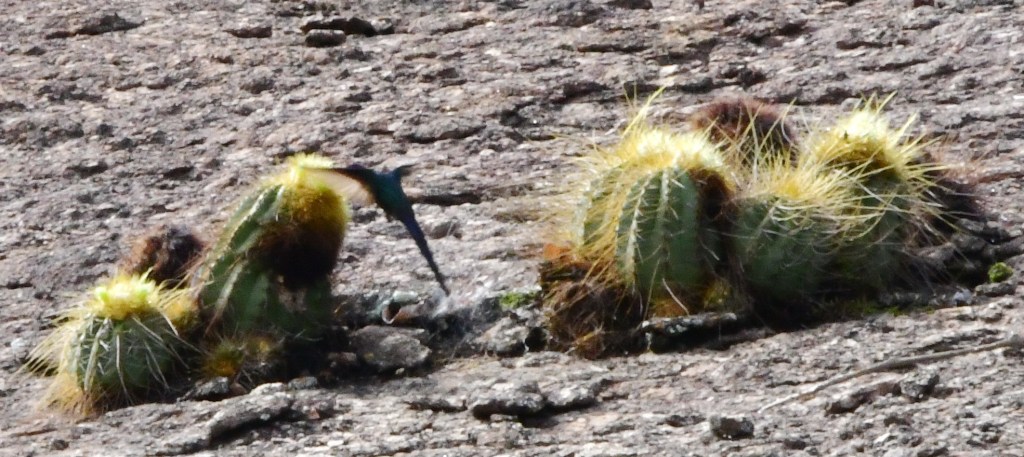
S3721 Coleocephalocereus aureus subsp. brevicylindricus with hummingbird pollinator.

Young plants are hard to distinguish from similar sized Melocactus. Once the lateral cephalium forms it becomes much easier to distinguish the genera as Melocactus has a terminal apical cephalium while Coleocephalocereus has a lateral cephalium. Both genera are pollinated by hummingbirds.

Buiningia‘ are said to contain just two species: the yellow flowered C. aureus and the purple flowered C. purpureus. But there are some subspecies that deserve recognition, if only in cultivation: C. aureus subsp. brevicylindricus and C. aureus subsp. elongatus that in nature are respectively shorter and taller than subspecies aureus. We were fortunate to see all of these taxa.
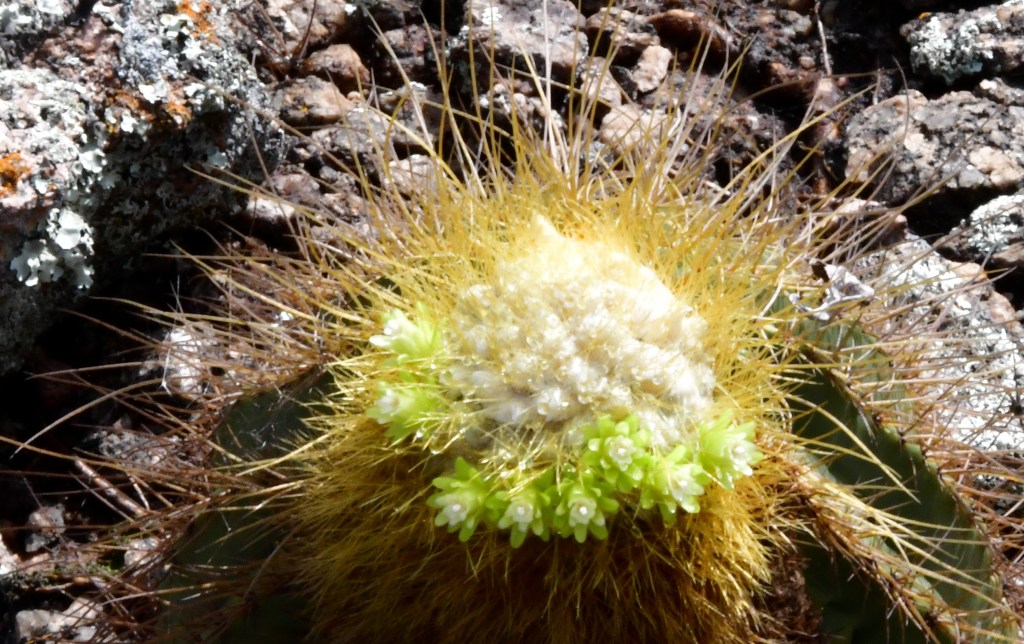
S3721: Yellow flowers: Coleocephalocereus aureus!

S3722 was another population of Buiningia aurea subsp. brevicylindrica, but the sides of the inselberg were much too steep for us to climb them to inspect the plants. It seems that the berries did not like the steep slopes either and rolled downhill to collect along the base of the rock.
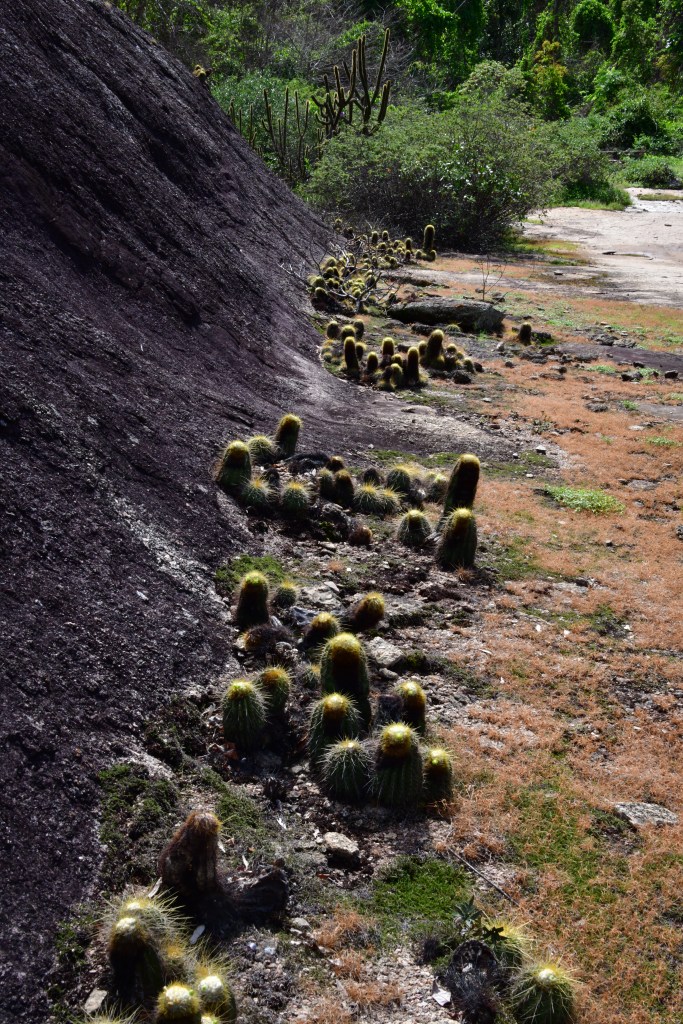
S3712: seeds grew where the fruits rolled down the steep hill.
S3723 was the farm where we were invited to stay and were treated to a free range roast chicken dinner in 1999 and where, the next morning we were shown our first plants of B. brevicylindraca – here with flower and berry.

S3724 was for the almost inevitable second puncture, this time for John & my car. The other car, with Alain, Chris and Marlon inside raced on, oblivious to our flashing lights and honking horn. Eventually, after John had changed the tyre, they returned rather sheepishly. Did you not hear us or see our flashing lights? Sorry, we were listening the the Electric Light Orchestra at full blast was their poor excuse! So much for team work!

There were more Buiningia at S3725. Here the stems were a little taller. B. aurea subsp. aurea?
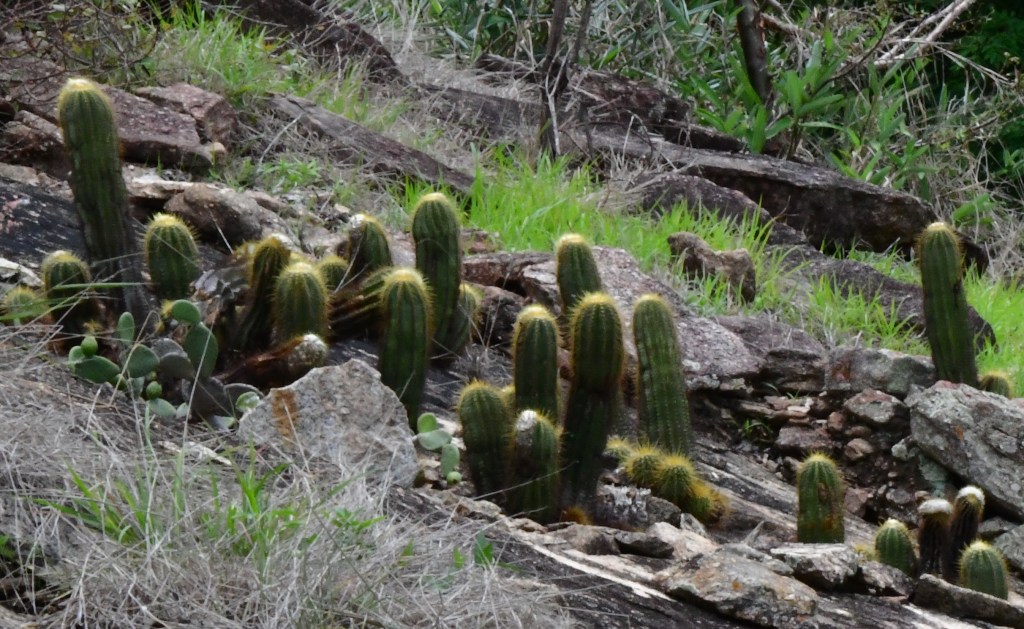
S3725 – stems a little taller?

S3726 was a stop along the side of the track for a huge, 30 cm diameter flower, appearing in the shrubs growing along the track: Aristologia gigantica!

There were more Buiningia at S3727, as well as Tacinga inamoena and various Bromeliaceae; Pereskia at S3728 and Melocactus sp. at S3729.
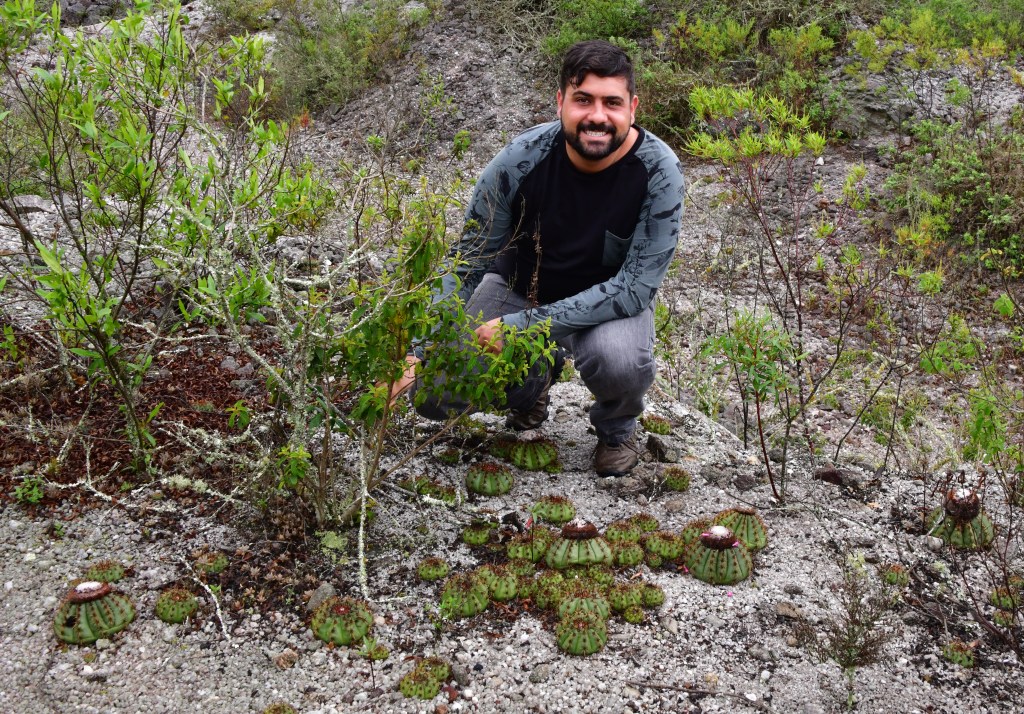
Monday, 26 November 2018 – Vitória da Conquista to Pedra Azul

In May 1999, Marlon brought us to a conservation project on the Serra do Piripiri near the third largest town in the State of Bahia, Vitória da Conquista. Here a small group of professionals had read Nigel Taylor’s report that Melocactus conoideus was threatened with extinction. They decided to do something about this, negotiated for half of the area on the Serra do Piripiri to be fenced off. When we visited for the first time in 1999, the fence has been completed, but there was a snag; during the frequent flash fires on the hill, the dry vegetation would burn, the wooden fence posts would catch fire and the fence would need repairs. The late Keith Grantham observed that as one reason for locals to visit was to collect the small grade substrate which was great for making concrete. Replace the wooden posts with concrete ones and the problem would be fixed. As the Conservation group and their families had already spent a good few years building the wooden fence, they feared their families’ reaction. At Keith’s suggestion a proposal was prepared for the BCSS Conservation Fund that had just benefitted from a bequest through the sale of the plant and book collection of Portsmouth Branch’s President Ken Ethridge. This donation covered the cost of labour so that the fence could be repaired with concrete posts.

By the time of our next visit in 2009, the fence was in place and the number of plants had increased dramatically. There was enough concrete left to build some office / class room space and the schools used it for their conservation classes!

This time Caio had warned us that in recent years, the Conservation Unit had been suffering a severe process of degradation caused by the criminal use of natural resources and irregular occupation of the area. Elimination of native vegetation, soil degradation and threat of loss of springs are just some of the issues which can seriously affect the geography of the city and the characteristics of our climate. Watch the video and help Vitória da Conquista take care of the natural heritage, which does not belong to government or individuals, but to all people and generations. Save the Piripiri Mountain!

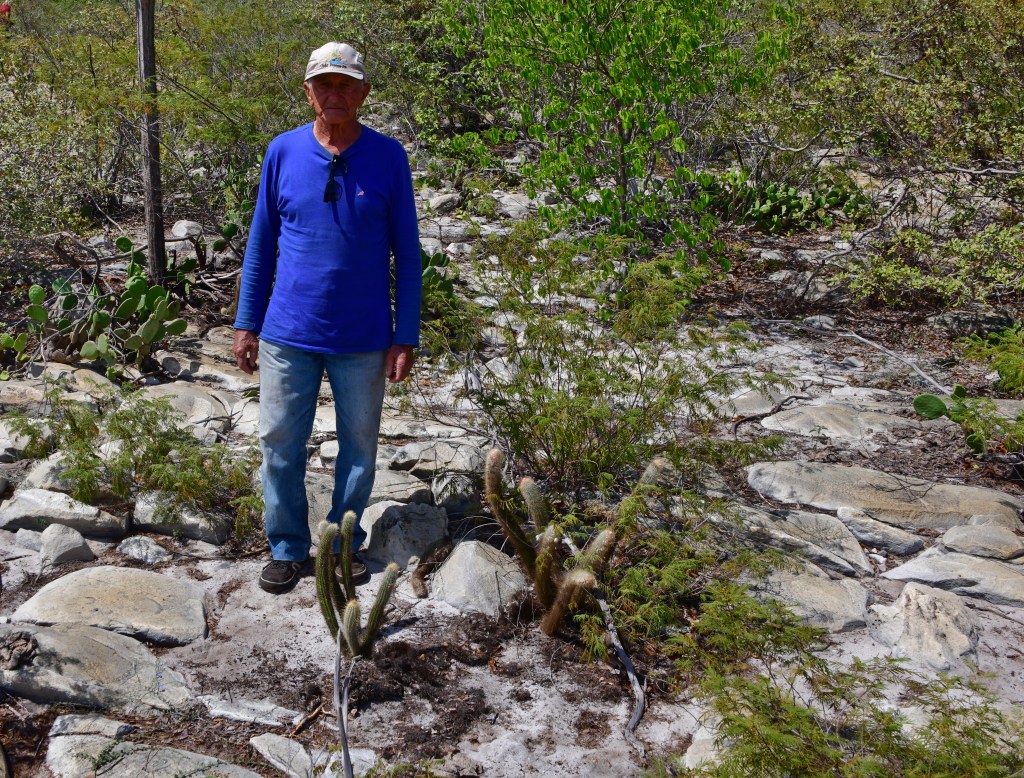
Caio Coelho and a random group of Melocactus conoideus – now a very healthy population.
But the town of Vitoria da Conquista keeps growing as well, coming ever closer.
… so that Caio had thought it safer for a couple of armed guards to join us.

We had a great lunch in the town of VdC – as this would also the point where Jarred would leave us, catching a bus towards Rio de Janeiro and a few days of rest to write up his notes. Good luck with your job hunt in the US!

The remainder of the group now headed south, back into Minas Gerais and on to the town of Pedra Azul, where here in the north east of the State, the landscape was dominated by Inselbergs.

Saturday, 24 November 2018 – Contendas do Sincora to Vitória da Conquista

We had arranged to meet Marylan Coelho and her son Caio, friends from my previous trips to Brazil, at the Floresta Nacional Contendas do Sincora. This National Forest was created in 1999 to promote the sustainable and multiple use management of renewable natural resources, the maintenance and protection of water resources and biodiversity, the recovery of degraded areas, environmental education, the maintenance of samples of the caatinga ecosystem fragment and the support to the sustainable development of the natural resources of the bordering areas. The Park has an approximate total area of ​​11,034 hectares. There are facilities to give courses that aim to make local people familiar with their environment.

We met managers and staff who explained their objectives and treated us to refreshments before taking us for a walk along the Trilha das Bromelias (The Bromeliad Trail) that took us past plants that occurred naturally in the park. This was augmented by great quality images, taken by local photographers Josafa Almeida and Josafa Filho that illustrate organisms such as birds, mammals and insects that can also be found in this environment but that unlike the plants move around or appear only at night or during specific seasons. It certainly made me think twice about going out at night to see cacti, knowing that I might meet puma, leopards, snakes and tarantula!

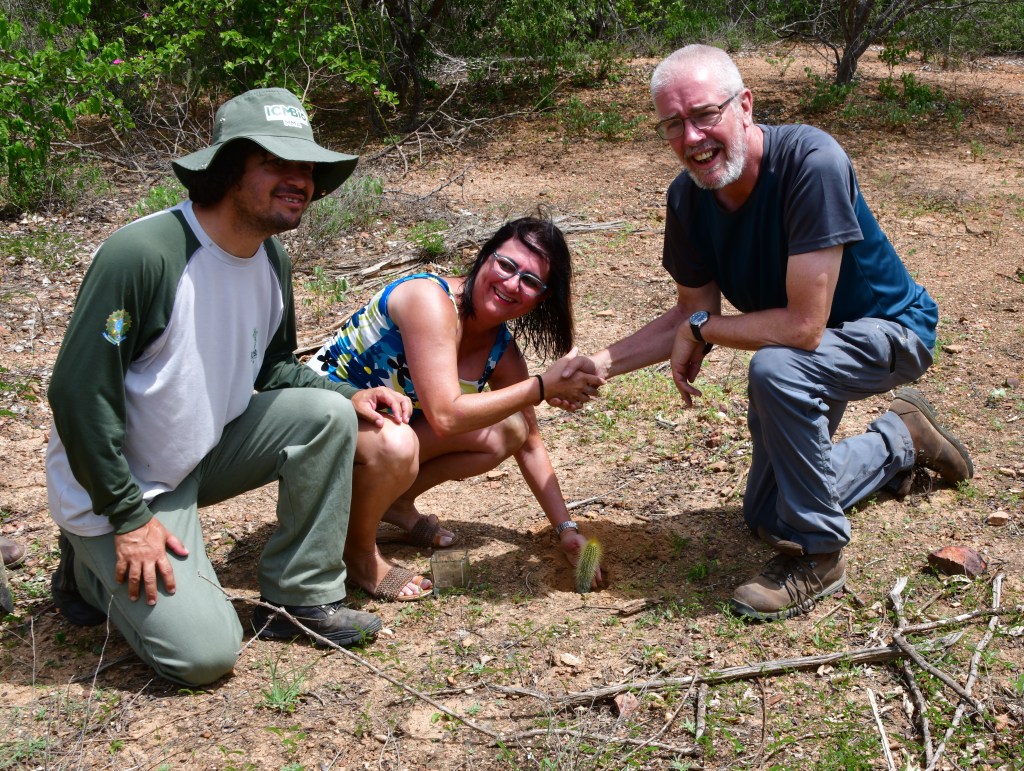
The cacti seen during the walk included Arrojadoa penicillata, Pereskia bahiensis, Pilosocereus pachycladus and Tacinga werneri and Marylan invited me to join her in planting a cultivated plant of Arrojadoa marylaniae to mark our friendship since 1999.

S3711: left to right: The manager of the Park, Marylan Coelho and PK
planting a seedling of Arrojadoa marylaniae

The second and last stop of the day, S3712, was some two hours away where Marlon wanted to show us a new species of Arrojadoa that he and Alvado wanted to publish. We were slightly surprised when we reached the plant, growing at the bottom of a steep and quite high hill. that Marlon produced a knife and started to attack the plant, explaining that he needed to collect samples to include as herbarium specimen to support the description. Alain sacrificed some of his cachaça, at 38 – 48 % alcohol by volume, the strongest alcohol available, in which the flowering stem of the plant could be preserved. I believe that the plants were found as botanists and students searched for new locations of Arrojadoa marylaniae that is close to extinction at its only known location that we’ll visit tomorrow. It was interesting to note that Espostoopsis dybowskii and Arrojadoa penicillata also grows here, just like at the A. marylaniae site! This plant has a very fragmented range with populations that I have seen growing near Jequia and, in the north, between Jaguarari and Flamingo. The distance between these locations used to be part of the Atlantic Forest of which some 85% has disappeared, replaced by agriculture and by logging, exported to Europe and the USA.

Marlon taking pictures and herbarium specimen for a possible new species of Arrojadoa.

Wednesday 21 November, around Morro do Chapeu

Breakfast was delayed a bit as the hotel manager in this one-man operation was trying to fix the internet. It seems that some bright spark had lit a bonfire below the cable that carries the signal into the hotel, explaining the acrid smell that woke us up.

As soon as breakfast was over, we left to pick up Father Delmar. In 2009 Marlon had excused himself to spend Christmas with his family. Could we have contact information to meet Father Delmar? Sure.

We were both fluent, in different languages, but, using Google Translate and a lot of waving of hands, arms and legs, we managed fine. For our days together, he acted as our guide and we took him to the best (Italian) restaurant in town for dinner on Christmas Day, where he knew everyone. or did he take us? This time he took us to ‘Marlon’s Reserve’ to see Micranthocereus polyacanthus subsp. alvinii.

Monday, 12 November, 2018

Around Diamantina: Mendanha to Inhai

Memories of today’s Diary pages – or for most of them – are a little bit hazy so I am relying on Marlon’s notes – in Portuguese and Google Translate – and Alain’s Stop list, received on 11 June 2020! Marlon took a month off from his regular business of providing garden plants and services to local customers. He was taking numerous mobile phone messages from client’s chasing orders, so he needs to catch up.

We’re based in Diamantina for few days, ideally situated in the middle of Uebelmannia country, specifically for members of the U. pectinifera complex. I was first here in 1999, with the late Keith Grantham, Brian Bates to meet up with Rudolf Schulz and join Rudolf and Marlon in explorations for their 2000 book ‘Uebelmannia and their Environment’, our first Uebelmanniathon.

Today’s program was similar to the one for Monday, 16 November 2009 when I travelled with Cliff Thompson from Waterlooville, UK. That time, Marlon was unable to join us for the Minas Gerais stretch of our trip, so  that we relied on Google Translate for our communications in Portuguese. Today’s stop list records eight stops:

  • S3653 near Mendanha where we saw and photographed Cipocereus minensis and Velloziaceae sp., This is the TL for U. pectinifera that I missed seeing, due to a fall.

    It had rained overnight. The rocks were covered in a cyanobacterium that gave the rocks a black appearance. This cover was in turn covered in Algae and Lichen making the surface rather slippery. Also, many of them were loose and so, within minutes I made my first tumble, grazing my head, unprotected following Angie’s dramatically short haircut, a #0, both arms and a cut over by kneecap. The bleeding was not too bad, although it did seem to attract a large number of mosquitoes. But worst of all, the tumble seemed to have damaged my self confidence, so that although I had already started the day as the slowest thing on two legs, I was now being overtaken by snails. Hummingbirds flew by my face, but I was too slow to get their picture.S3654 near Mendanha, provided Epiphyllum phyllanthus, Opuntia sp and Tillandsia sp
  • S3655 – Along the Rio Jequitinhonha, around the bridge at HU 850 we saw Cipocereus minensis, Dyckia sp. and Velloziaceae sp.
  • S3656 along the track to Inhai we saw wild pineapple (Ananas sp), Brasilicereus markgrafii, C. minensis, Discocactus placentiformis and a small mushroomS3657 refreshments at Inhai.


Wednesday 27 September 2017 – One month to go!

Yes, just one month and Angie and I will briefly visit London Heathrow Airport to fly to Madrid, where we change for our flight to Santiago de Chile. During a three week period we plan to re-visit our favourite spots from the last sixteen years and meet up with old friends:- cacti, people and hotels and restaurants, between Pichidangui, some 240 km from Santiago Airport and up to Tocopilla.

The internet has been awash with stories and images of one of the best flowering deserts for years – they seem to become more frequent in recent years! Coincidence or a by-product of global warming? Let’s hope that the flowering continues on for another month or two!

Fingers crossed that unlike the rain that caused the desert to be in flower in 2015, there is not as much damage as there was on that occasion. The Chilean coastal hills have little, often no vegetation or soil to support it. So any water that falls here immediately finds the fastest way down, carrying any dust and gravel down with it as a thick sludge. In 2015 there were reports of Copiapoa megarhiza floating down the Rio Copiapoa. In Chanaral we saw the damage done to houses where the mud filled the ground floor up to their ceilings.

I have ordered the new Nikon D850 DSLR camera, so, at least equipment wise, I should come back with the best images ever.  Its release was oversubscribed, so although I am next on the local camera’s shop waiting list, the next box that they receive is mine. Hopefully with some time to spare to get used to its new features.

As usual, I’ll aim to send daily blogs to keep the folks back home informed, up to date and entertained.

Saturday 29 October – around Ifaty update

Please take a look at

Saturday 29 October – around Ifaty

for an updated version, including images.

Wednesday 9 March – around La Ventana pt1

Throughout the night Angie kept me informed of the developing weather situation: Still thunder and lightning to the south, wind getting stronger, absolutely bucketing down etc. I slept on in the certain knowledge that the internet weather forecast said: clear sunny day – chance of rain 0%.

I guess that they keep that forecast as a permanent feature on their site and just change the date – why not, they’d usually be right! But this time, sadly, they were wrong. By 8:00 I received an email from our Capitain to say that the weather was wrong for the trip. I wrote back and asked if they had any submarines in their fleet. Sadly not.

So I’m writing part 1 of today’s missive from the palm leaf covered terrace of Kurt & Marina’s, overlooking the Sea of Cortez, with the clouds breaking and the sun making it difficult to read the monitor. We will check with the boat people to see if we can try again around noon.

Watch this space!

Thursday 3 March 2016 – Bahia de Los Angeles to Santa Rosalia

It was a long drive and not quite what was planned.

We should have looked for accommodation as we entered Baja California Sur, in Guerrero Negro, .but it was still early and I thought that we would gain an hour by crossing the State border.

In any event, after five previous trips I finally spotted four plant of Mammillaria dioica with very distinct flowers to say that they were not. My guess is M. blossfeldiana judging by images on page 90 of John Pilbeam’s 2015 ‘Cacti & succulents of Baja California’ book.

Mammillaria fraileana

Mammillaria fraileana?


Tuesday 1 March 2016 – San Quintin to Catavina

It is becoming clear that our main focus this trip seems to be the Ferocacti that we pass on the way south. Jonathan has learned that it is better to read Nigel Taylor’s paper published in Bradleya (1984) in the hotel rather than as we speed past a myriad of cacti. He’s happy that we have seen F. gracilis in its various forms but what happened to F. fordii? Angie and I concentrate on spotting the Feros and taking their pictures, happy to worry about their names when we get home.

Jonathan has developed a technique for his 3D videos of approaching the plant with the camera skimming the grass and low vegetation and slowly rising as he approaches the plant. Although we are all on the same trip, I’m sure that we’ll end up with three quite different presentations.

We are also finding numerous Mammillaria of the M. dioica complex. We’re a but later in the season than usual, so I might be lucky and spot some of the named flower colour variations on a theme – fingers crossed.

The Catavina boulder fields always provide a scenic settings for cacti and succulents, so we’re adding many hundreds of images to the already overflowing image database back home!

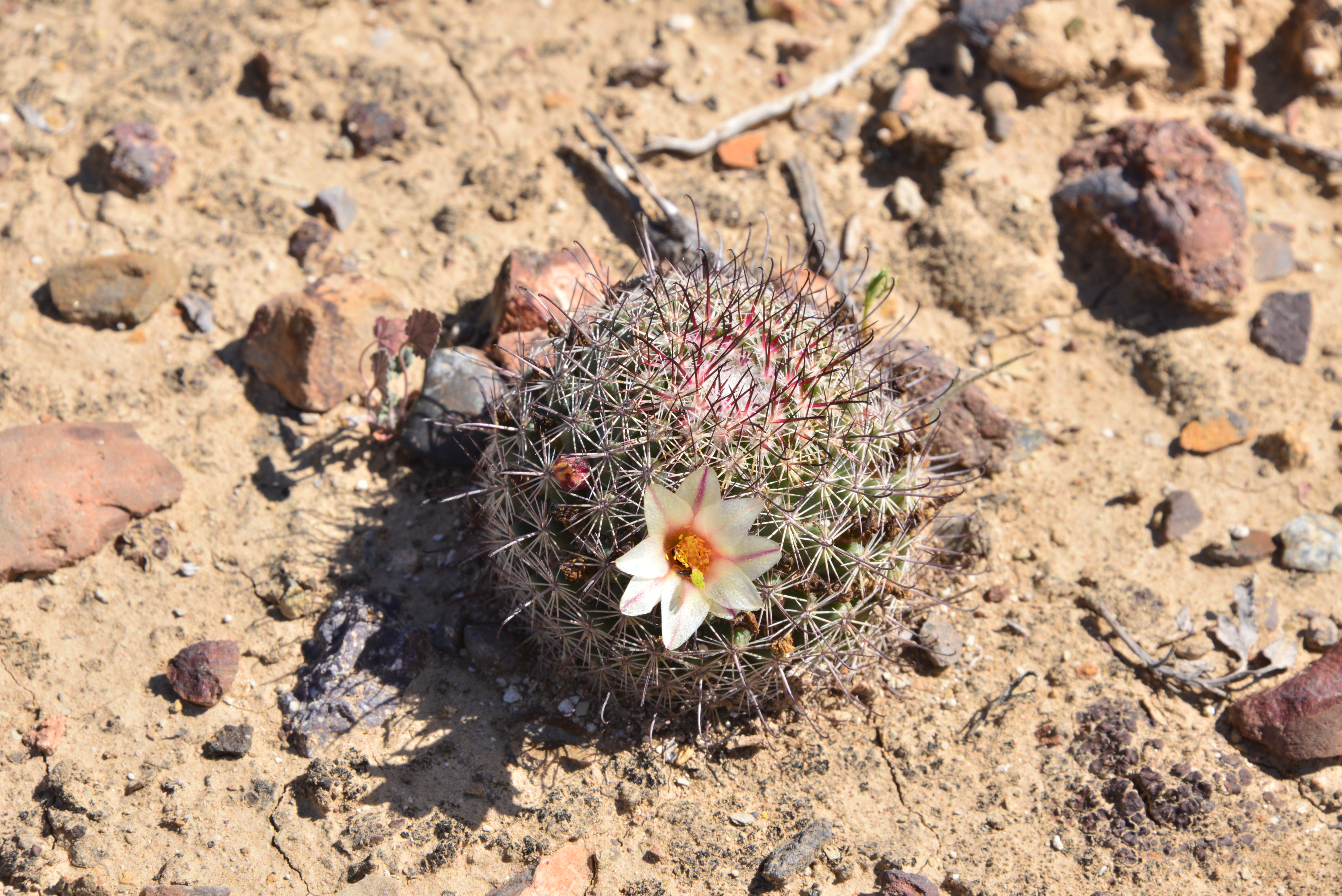
Mammillaria dioica

Mammillaria dioica I presume!