Just another WordPress.com site

Archive for the ‘Chile’ Category

Friday, 22 November 2013 – in Guanaqueros

I had a lazy day, realising that I had not had a ‘day off’ from the ‘up at 7, breakfast at 8, on the road by 9’ routine for the last 6 weeks or so, not counting the days stuck in Vallenar where the nervous energy involved in getting back on the road were enough to nullify these as rest days.

So I went back to sleep for a couple of hours after my inner auto-alarm got me up at 7 and worked on organising my 6,144 images (there are actually only half that number, but my camera takes high quality JPEGs AND NEF (Nikon’s RAW) images each time I press the shutter.

With my normal MS Access database not available for such matters (doesn’t run on a MAC) it was down to organising things in an OpenOffice spreadsheet.

By 13:00 hrs it was time for lunch, another luxury not afforded on the road, so a walk to El Pequenia in town and a ‘Sea Garden’ for lunch, fish, shrimps, clams and all sorts of other ‘fruits of the sea’.

When I had walked ‘home’ and continued with organising files, I promptly fell asleep and woke up around 16:00 hrs. Must have needed it!

In exactly one more week I’ll be at Santiago Airport for my flight home and by Tuesday 3 December I hope to be at the BCSS Southampton Branch’s AGM and American Supper to show off my sun tan before it all wears off – nothing lasts forever!

No cacti photographed and no stops recorded today.

Thursday 21 November 2013 – Pichidangui to Guanaqueros

Tuesday’s visit to Bahia Teniente, the location for the southernmost Copiapoa habitat, left me curious, as we did not find the plants in question – just insufficient time budget I’m sure. But still. It’s not possible to access the entrance heading north on R5, but the first official exit after the hole in the fence is for El Cebada, so it was there that I made today’s first stop.

One Sunday morning in 2006, Angie and I made our first attempt to get there in a Toyota Hilux. There is a gravel track that runs back south, parallel to R5 and then dips down to the bottom of a, mainly dry, riverbed. That day, a gate had been locked about three-quarters up the hill. There was not enough space to turn the car around so there was nothing for it but to reverse back up. Should have been easy, except the handbrake did not hold and the wheels spun on the gravel. I had to hold the car on the footbrake while Angie locked the 4×4 in place on the front wheel hubs.

So I was a little apprehensive at the top of the hill, but could see that the gate was open (and now derelict, so  that it was impossible for me to get locked in) and so I got down safely. I had managed this also in 2007 with Leo and Juan, so knew to expect a track that took me through bits of shallow water to the beach. Was my luck still in or would I get stuck here in the mud that hid below the water. The Xtrail had a switch to select ‘2x’ or ‘Automatic’ and we had wondered in Nessy 1 if this referred to some sort of 4×4 drive. Worth selecting it anyway, just in case. I got through fine but then failed to notice that the sand on the beach was of the fine talcon powder variety so got immediately stuck in that! With the possible 4×4 ‘Automatic’ still on, I managed to crawl back to terra firma and to park the car on firm land next to the ‘river’.(S2956)

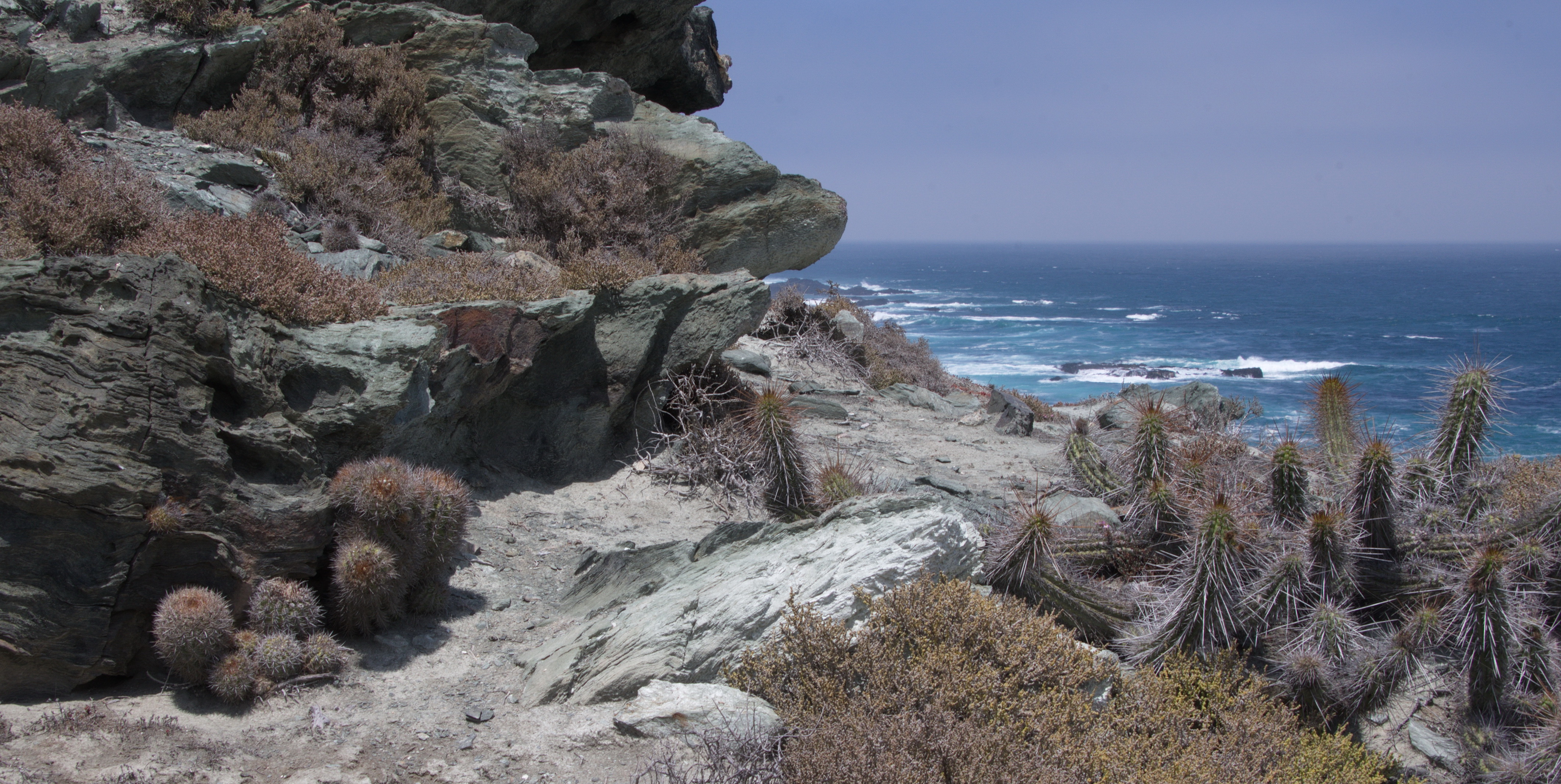
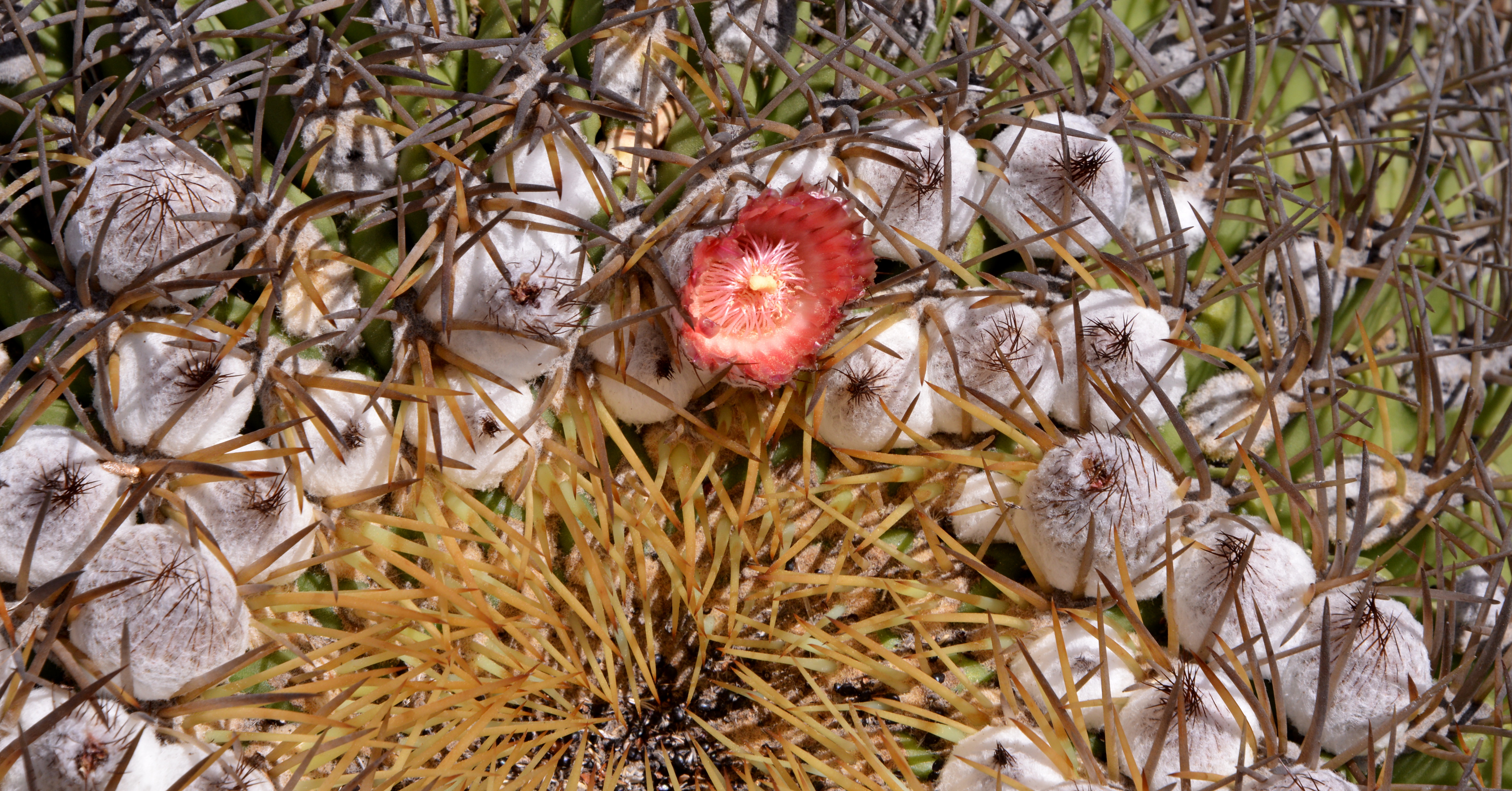
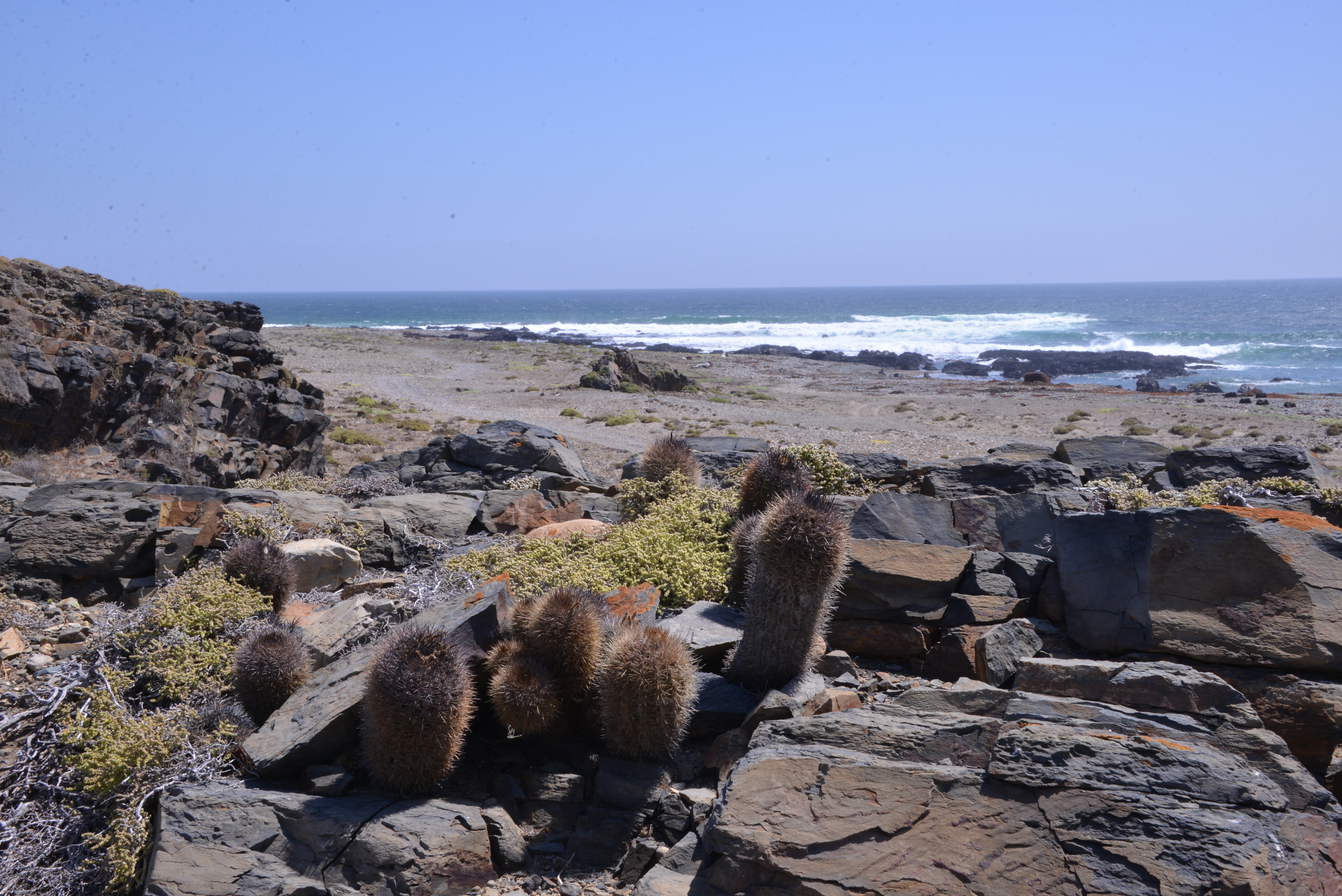
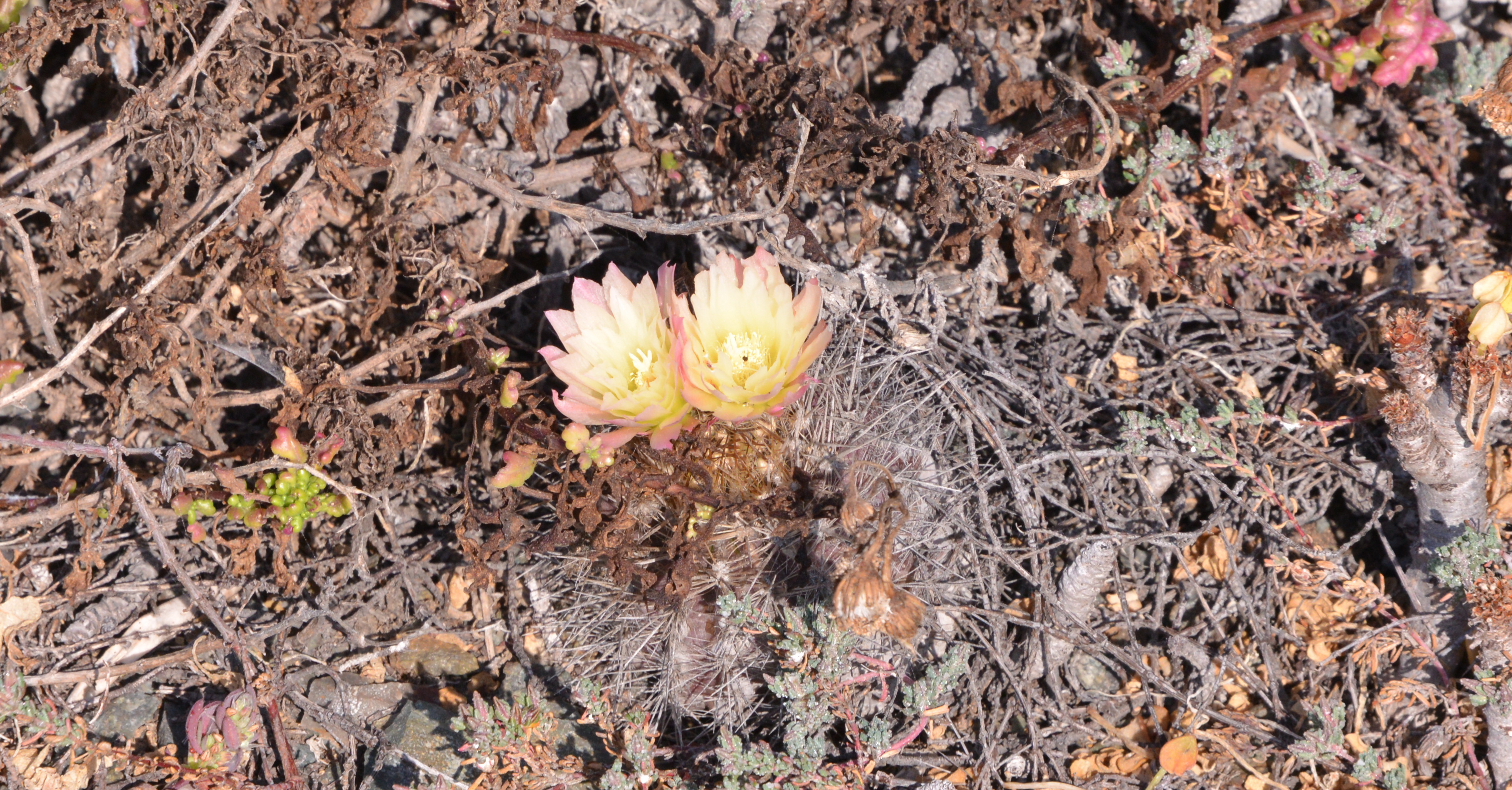
I could see some Eulychnia castanea on top of the low dunes, a mixture of black rock outcrops like we had seen at Bahia Teniente, just across the ‘river’, and ‘talcon powder sand dunes’. I decided to climb the rocks to a nice vantage point overlooking the beach, great for some scenic overview shots. As I adjusted my position, I nearly tripped over the first globular cactus – Eriosyce subgibbosa, the same species seen at Bahia Teniente yesterday. Switching the camera to ‘cactus mode’, I soon found a lot more, but there were some that looked ‘different’, with a more felted apex: Copiapoa coquimbana. Farther along there were more, some in flower, confirming the ID. They were very photogenic, growing on the dark rock with the off-white beach in the background and the Ocean waves rolling in. It seemed when I looked at the car that the water in the river had risen very slightly in the hour that I had been playing in the sand, so perhaps this was another tidal river, similar to the one that caught us out in 2001, at Carrizal Bajo. Best to move the car. I caused a minor landslide as I took the short way down a sand dune and got safely back on R5 a few minutes later.

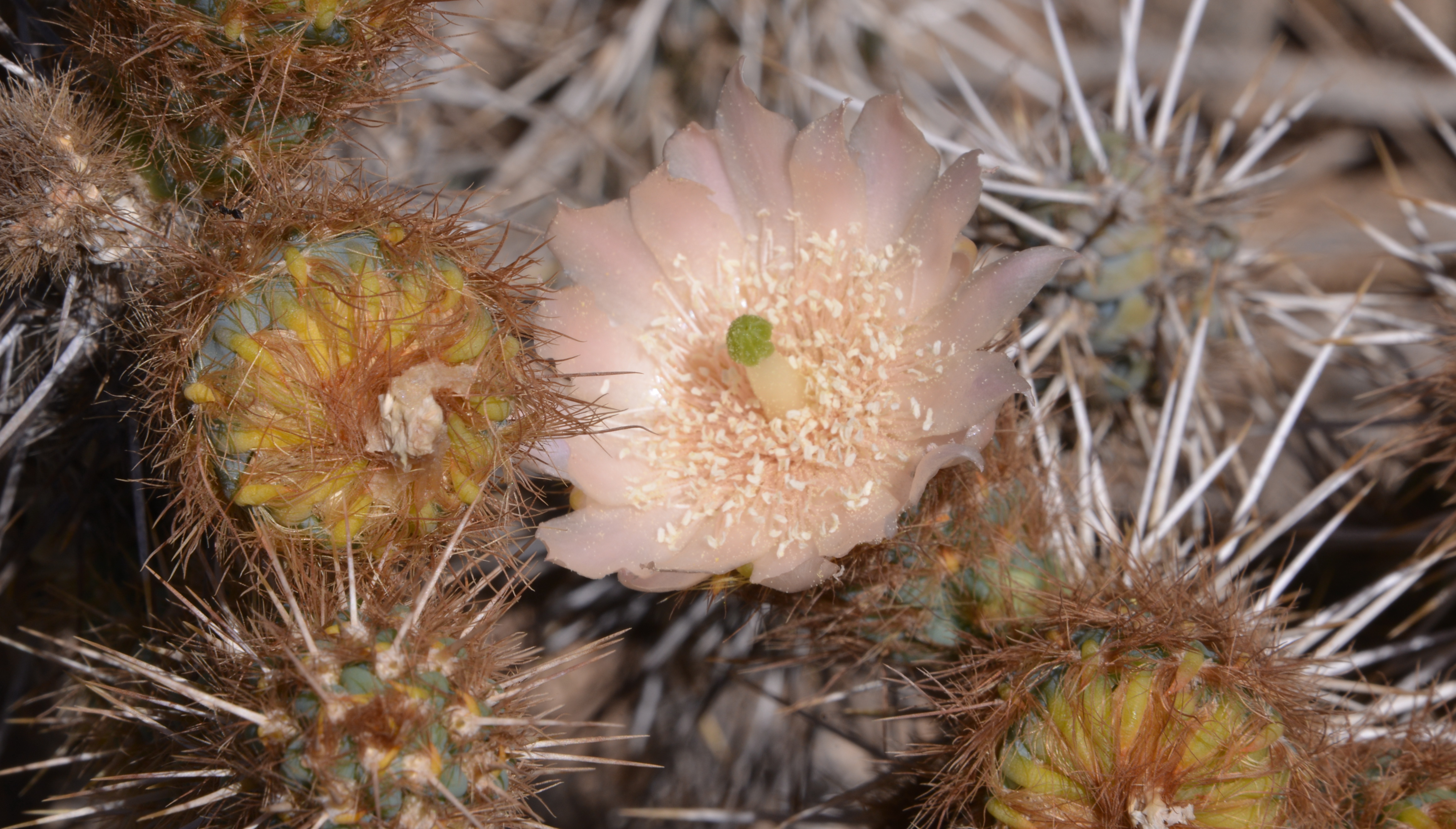
S2956 Copiapoa coquimbana

S2956 Copiapoa coquimbana

S2956 Copiapoa coquimbana (L) and Eulychnia castanea (R)

S2956 Copiapoa coquimbana (L) and Eulychnia castanea (R)

After a quick lunch at the Copec at Socos, there was plenty of time for another look at the Fray Jorge track. It was bright and sunny, so ideal to take another look at the spot where in less favourable conditions Jonathan made his first Chilean cactus stop early in November to see Eriosyce aurata, with the promise of more to come that I failed to keep later in the trip, due to the car problems with Nessy 1. It’s always good to have some unfinished business as an excuse to come back another time.

I wanted some more images of the agricultural developments along the track for a ‘now and then’ comparison in a future talk and so I made two stops (S2957 & S2958)along the track, found some E. aurata – but only a dozen at most, some in flower, and captured the rolling fields of grain that have now replaced the desert. The grain is planted so far apart that it is easy to see the soil between the stalks. To my untrained eyes, it seemed good fertile soil – the limiting factor as always in this area is lack of moisture. My worry would be that with a drying wind blowing continuously, that once the endeavour has failed, the topsoil will blow away and the erosion will cause a barren desert. Plan B seems already in progress as the bases of more wind turbines are already delivered.

S2958 Eriosyce aurata

S2958 Eriosyce aurata

I’ll come back here again in the next few days to drive down the track to the Ocean at Caleta El Sauce.

Wednesday, 20 November 2013 – The Airport Run

Yes, for the second time this trip I’ve made a dash for Santiago Airport to drop one of my travel companions off. It’s a 200 km trip, all on Ruta 5, the PanAmerican Highway, except the last 8km where in the past I got lost, following SatNav’s insistence on using Exit 16 but this time held my nerve and stuck on Vespucci until Exit 18 which, reassuringly, is signposted to the Airport.

We first took ‘Big Red’ the marvellous 3 litre 4×4 Toyota Hilux back to Europcar. It had served its purpose, to get JYC back to the Airport marvellously. We were allowed to keep our luggage in, until I had a replacement car from Alamo. Yes, I know, but I have paid for it, so was quite happy to take receipt of another Nissan XTrail, this time a white one. I have to say that for long journeys, they are more comfortable than a Hilux, which is a work horse, designed to get you almost anywhere.

After a call to head office, the car was provided with a minimum of fuss – just as well, as I was ready for an argument if that had been needed.

We quickly moved the luggage from Big Red to Nessy II, or should I give it a different name to avoid ‘Nessy’s Curse? Any suggestions welcome.

Brendan had mentioned that there had been massive traffic jams on R5 ‘South of Los Villos’, which covers a multitude of sins. It seems that our luck has not yet run out! After Lay Lay (Sounds like a Bob Dylan song!), around km 77, they are indeed blasting the hills to bits to widen R5 through here. When Brendan got back to the Airport, on Friday or Saturday, he got stuck in a 4 hour jam. Having thought that this was a false alarm, we came across the road work signs, but also saw a sign saying that the road would be closed from 12:00 to 14:00 for blasting. We passed through at 11:55!

When I came past there again on the way back, around 15:00, my side flowed freely, but there was a 3 km jam going the other way, now moving – presumably the left overs from the closure that we had narrowly avoided.

By 17:00 I was back at Pichidangui, in time to write this missive and have a rest before dinner. I’m in the same room as last night, a bit eery without my companion for the last 18 nights.

Tomorrow I’m off again to Guanaqueros, nice and cheap in the Cabañas and more excellent food, plus scope for more cactus related day trips than Pichidangui. I might take a more detailed look in Fray Jorge too.

No Stops made or cacti photographed today.

Tuesday, 19 November 2013 – Guanaqueros to Pichidangui

One of the disadvantages of staying in any set of cabañas is that there is no breakfast included. Never mind, something will be open at Guanaqueros to put food in our stomachs! Wrong!

Never mind, we’ll have coffee and bread rolls at the Pronto at the Ovalle turn off and then go to Fray Jorge for a more detailed look around. Wrong again – the Fray Jorge turning is north of, i.e. BEFORE the Pronto, so I missed breakfast – well, survived on a couple of chocolate drinks and biscuits, but managed lunch at the Copec! which, by the way, has been nicely refurbished, does a small range of hot snacks instead of just hot dogs, has a proper new seating area and a special Baños block. BTW, it looks as though there is a small new hotel next door as well that I might check out later.

We went back to Fray Jorge and this time went on to the entrance gate. (S2950). Same gate (but poorer condition) as always, since 2001, but completely different track. Looking back through my notes, the track changed to this one after our 2006 trip. But there are now many houses, some arranged into communities, along the track. As a result, the track has been re-drawn many times to include the optimum number of communities with new side tracks leading (sign-posted) to others.

Where once there were flat areas that were the home of Eriosyce aurata, perhaps threatened in their survival by goats trampling their seedlings, there were now fields of grain, a mixture of wheat, barley and oats (on the side), quite wide spread – a poor yield by European standards, and completely replacing any cacti. Perhaps the gate to the park had moved as well [PS, no, it hasn’t] – a wooden hut and a pile of stones are easily moved. In 2001, 2003 and 2004 I clearly remember many Puya and hills full of ceroids – now there were just a few of each. No signs of Eriosyce aurata here as there had been in the past. The track between R5 and the gate was wider and of a better quality, but longer. As in many other places, we felt more like tourists rather than explorers. Shame.

Other cars pulled up, the occupants spending an age smothering themselves with sunblock, before strapping on much-too-large rucksacks and boldly marching past the gate. We could see them hesitate as they reached the little empty hut, some 100 yards in, look at each other, drop their heads and come back out to disappear in a cloud of dust in their rental cars. Clearly first time European tourists.

No point creating a tourism image if you can’t live up to the billing when the tourists arrive.

On the way back we saw signs and a track for Caleta El Sauce and Caleta Tarcarucal, just north of the park and decided to follow the track. We had already passed tracks that warned us of ‘no entry’ with company names that we were to see again later as we passed the wind turbine parks along R5. Yes, they are also putting up wind turbines on the edge of Fray Jorge. Better than building another pollution belching fossil fuel power station anywhere or to drive by towns and villages deprived of electricity. The track went over the hills and eventually the Pacific Ocean opened up before us.

We stopped (S2951) and saw some ‘funny ceroids’ amongst the Trichoes and Eulychnia acida, so time for a closer look. Here, barely able to see the Ocean, was Eulychnia castanea, the farthest inland plants I have recorded. There were many ceroid crests on stems without evidence of flowering, so that we were unable to tell if they were Echinopsis / Trichocereus or Eulychnia. There were also Eriosyce, but not E. aurata. Where is Juan when you need him?

S2951 Eulychnia castanea - I can just see the Ocean - the plant can't!

S2951 Eulychnia castanea – I can just see the Ocean – the plant can’t!

S2951 Eriosyce sp.

S2951 Eriosyce sp.

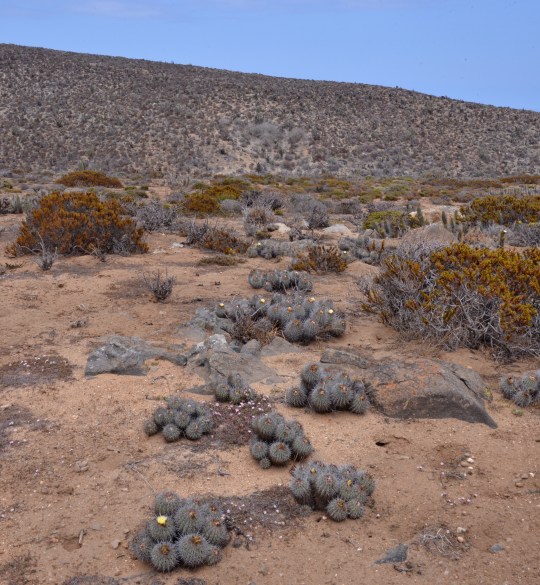
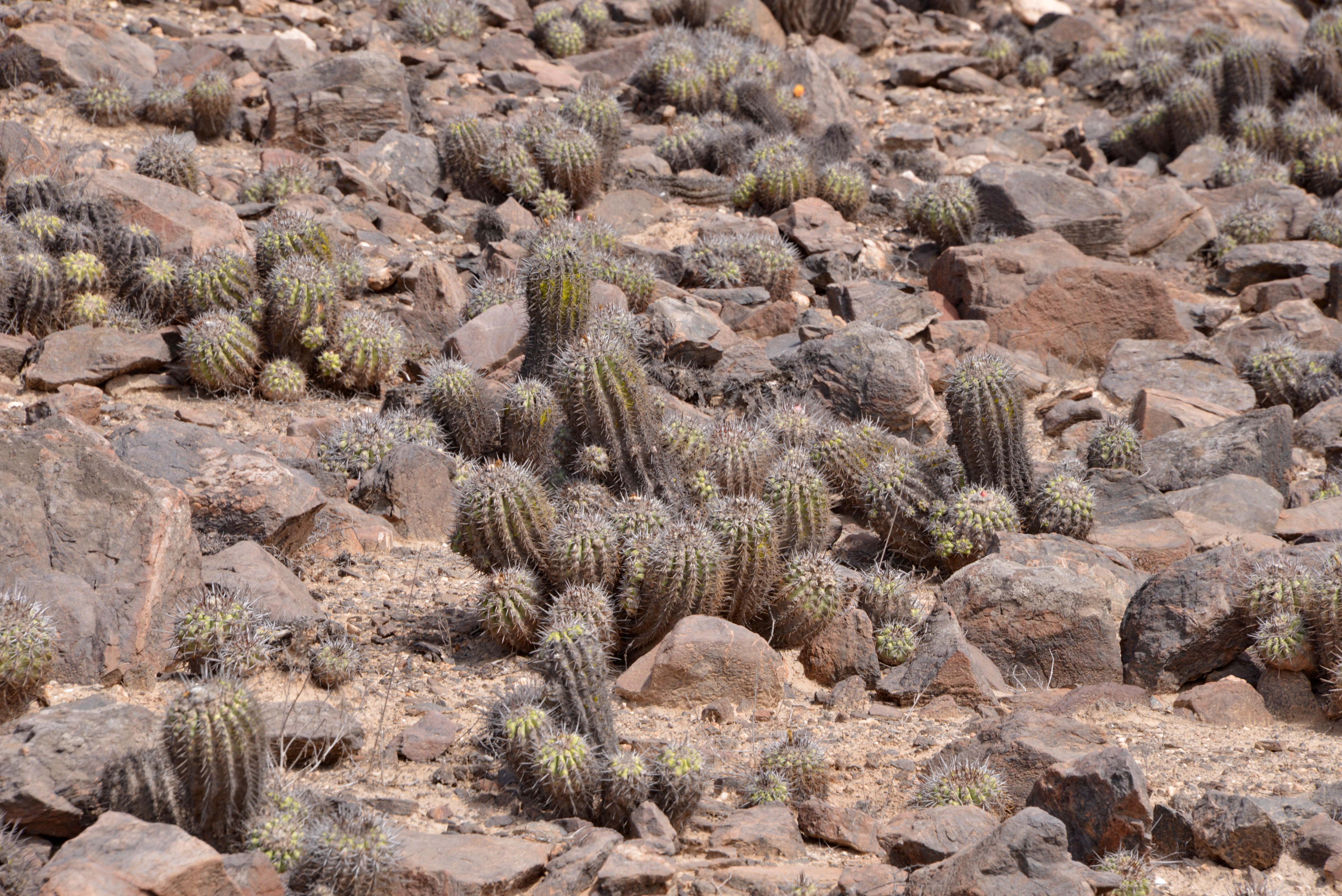
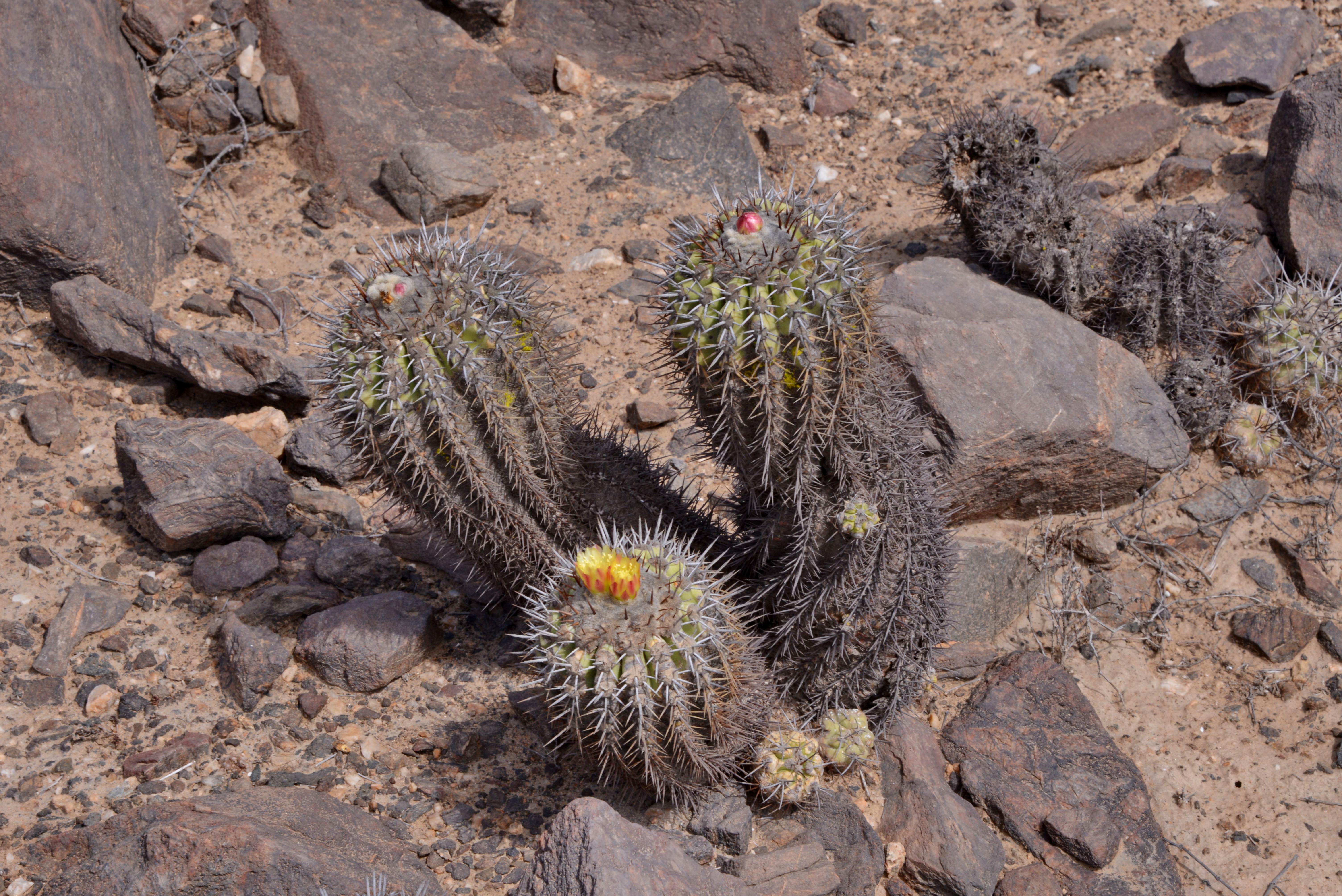
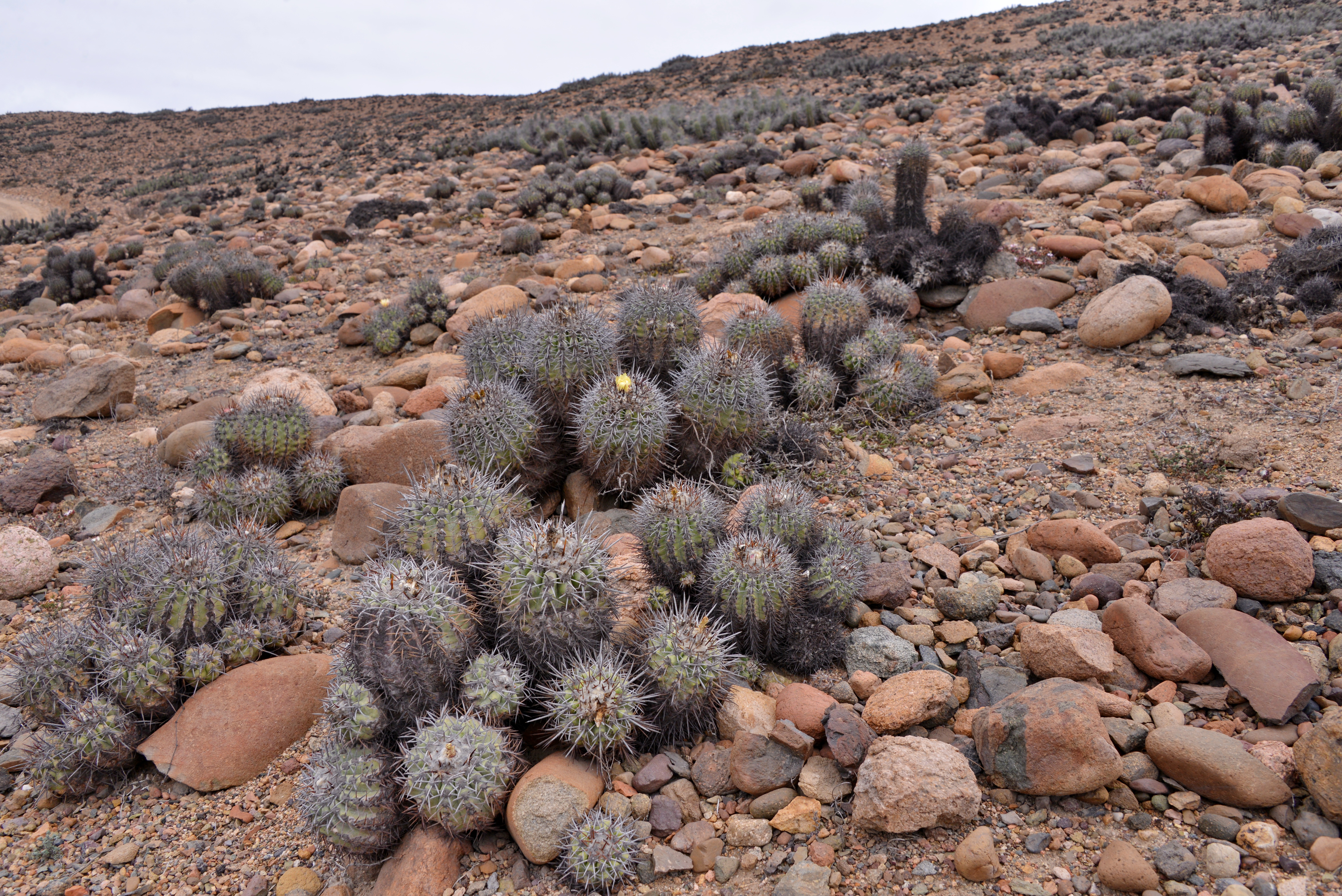
Then the road zigzagged down hill, twisting around the hillside along the way. Shortly before reaching the coast, there they were: Copiapoa coquimbana – a very nice stand of plants, many in flower S2952. I snapped away many shots while JYC was doing his analysis to discover where in his key to the genus these plants would come out. ‘Nice consistent plants, compared to Sunday’s bunch at Freirina?’ I asked. ‘No’ was the answer, much to my surprise, there are ribbed and tuberculate plants here and according to the description in the NCL, coquimbana is only supposed to have tuberculate stems – the key suggests that the ribbed plants are C. echinoides, which clearly they are not. To me the population looked to consist of one species, and JYC agreed, but I had not taken the more detailed look. What the plants actually showed and had in common were tuberculate ribs, with the degree of tubercles perhaps determined by age and/or turgidity, rather than genetic factors, but that is just an assumption. At least it explains why I wanted to make a Coquimbanathon because I believed that I saw more than one species amongst the plants south of the Rio Huasco (accepting fiedleriana and alticostata as odd-balls along the edges. Very interesting.
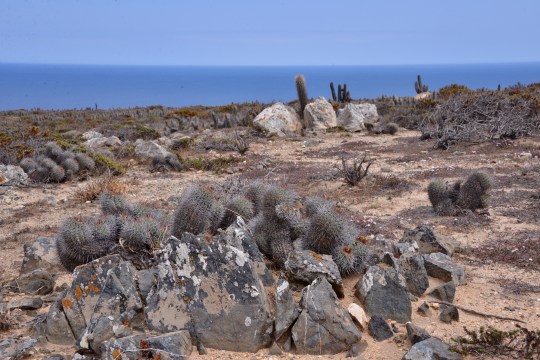
S2952 - Copiapoa coquimbana

S2952 – Copiapoa coquimbana

S2952 - Copiapoa coquimbana

S2952 – Copiapoa coquimbana

The E. castanea also looked a bit strange, with ripe fruits looking very scaly, more like E. acida, but then I had observed on earlier visits that ripe Eulychnia fruits shed their hairs when ripe enough to fall to the ground where they ‘explode’ on impact and scatter their seeds. so why not E. castanea? But there was more to come.

After finding the C. coquimbana stand we really had to turn round – I needed food. This track was ideal for a return visit in days to come, provided I get a suitable replacement vehicle tomorrow.

After hotdogs, oatmeal cookies and a double expresso at the Copec Punto, we headed south. As we passed Caleta La Cebada I told JYC that the next exit, at Bahia Teniente, was where the southernmost Copiapoa, C. coquimbana syn. C. pendulina grows. The problem was that access to these plants was difficult with the exit from R5 to Bahia Teniente now blocked – or was it? As we came down the hill I checked my rear view mirror for lorries thundering down the hill behind me – there were none. I slowed down and saw a small gap in the fence with a cattle grid to prevent goats etc escaping on to the PanAm. and so we found ourselves in, on a dirt track, bouncing towards the coast. I recognised the track and some rocks where I believed Leo, Juan and I had stopped on a previous visit, with appropriate GPS data, and had found the Copiapoa. This time, without GPS data and with the usual time constraints, we allowed ourselves a 30 minute look around (S2954) and found Eriosyce subgibbosa and Eulychnia castanea.
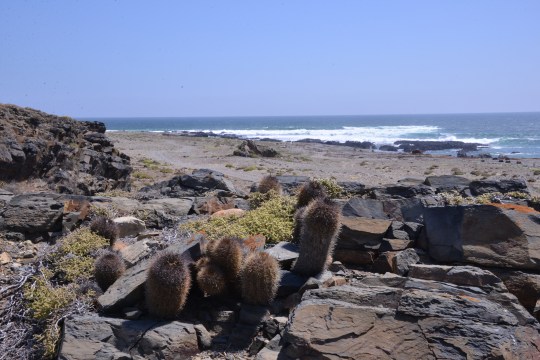
S2954 Eriosyce subgibbosa

S2954 Eriosyce subgibbosa

But on one spot, there was a typical sprawling Eulychnia castanea next to a very tall robust upright plant that I would assume was E. acida. Much to my surprise its hypanthium was covered in large scales (acida feature) and spines! (castanea feature) but the plants growth habit was wrong for E. castanea! Back to the drawing board. New species? No. Hybrid / intermediate? Who knows! Interesting? You bet!
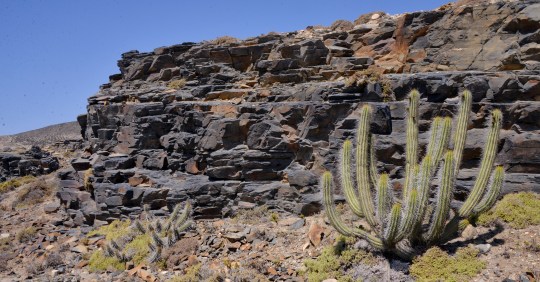
S2954 Eulychnia castanea (left) and E. acida (right) judging on growth habit
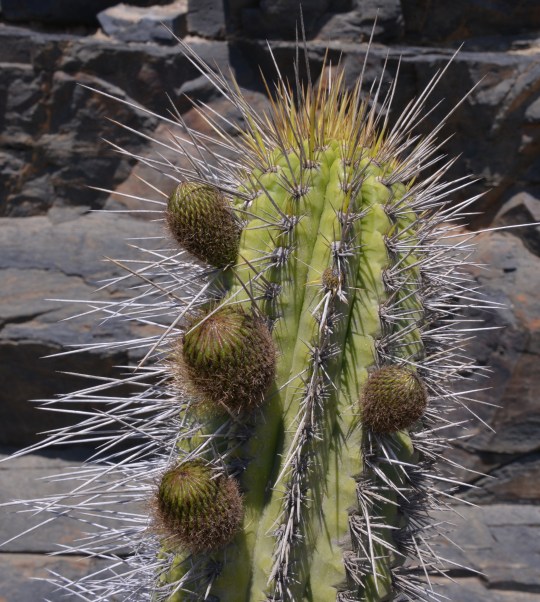
S2954 Eulychnia castanea (left) and E. acida (right) judging on growth habit

S2954 But based on the spiny hypanthium, it's Eulychnia castanea!

S2954 But based on the spiny hypanthium, it’s Eulychnia castanea!

We arrived in Pichidangui just before 18:00 hrs and found a room in Hotel Rosa Nautica, as before, and enjoyed our last dinner & wine together at Restaurant Nautiluz [sic]. The end of Jonathan’s trip, bar the Airport run and the flight home. Thanks for your company – we’ll have to do it again sometime.
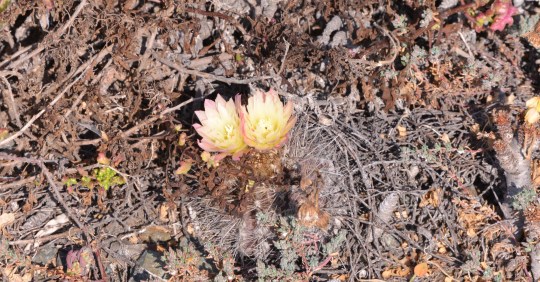
S2955 Eriosyce chilensis

S2955 Eriosyce chilensis
Monday, 18 November 2013 – Vallenar to Guanaqueros

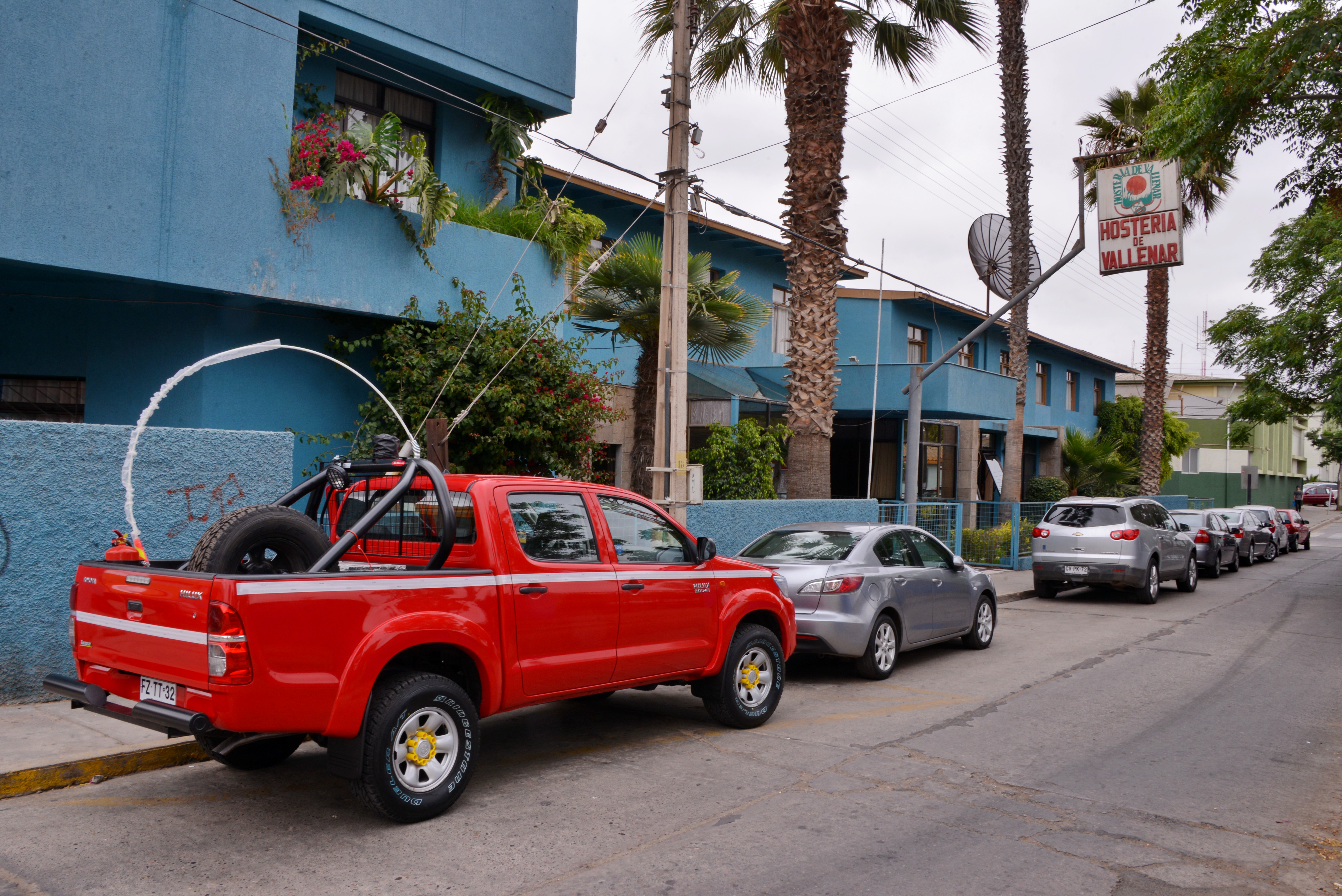
Yes, that’s right, we have a car! And not just any car, a bright red Toyota Hilux with boy racer whip – and only 871 km on the clock. The windows still had the delivery stickers on!

Our third car of the trip - Toyota Hilux 3.00 cc Diesel - but only for 3 days!

Our third car of the trip – Toyota Hilux 3.00 cc Diesel – but only for 3 days!

But first, we made a call to Alamo in Santiago – who were surprised that we were still in Vallenar! Not sure why they were surprised, but hey. Next they managed to contact the mechanic in Vallenar – always reactive.
Bad news! Our Nessy had been declared a write off!!! WHAT!?!?

It turned out that the clutch bearing had gone, and as the car was still under guarantee, it had to be taken back to the Nissan dealer in Santiago, in due course. They had no solution of how we might get back – you are on you’re own. Thanks!

Finding it difficult to believe that Europcar Vallenar had no cars at all, we asked the receptionist to call them and make some enquiries. Yes, just received, our Hilux! Could they bring it to the hotel so that we could complete the paper work? No, but she could come and pick us up and take us to the yard to complete formalities. Excellent!

Hosteria Vallenar has our vote for the nicest staff yet, as they allowed us to stay beyond the 12:00 check out time.

There was still a minor niggle that all I had as evidence of the $55,000 Chileno that I had paid out for getting us and the car back to Vallenar was the amount written on a piece of (clean) toilet paper. Again our super woman receptionist came to the rescue, called the man and demanded that he brought a receipt to us. I had given up all hope of seeing that happen, when he turned up with his wife, who did all the book keeping.
Our luck had finally changed.

It was an unbelievable relief to be back on the PanAm, with the sun in our faces, speeding once again through cactus land. Any thoughts of leaving early, as soon as I got to Santiago, were gone. It was like being King of the Road!

We made it to the Cabañas in Guanaqueros, where Walter, the German owner was a little surprised to see me turn up in the third car of the trip. ‘Are these rented or do you buy a new one each time that the ashtrays fill up?’

We’ve just enjoyed another great meal at the usual restaurant where this time we were the only guests. Back in the cabañas we’re enjoying a nice bottle of Missiones de Rengo Cabernet Sauvignon Reserva, yum yum.

Life is good!

Sunday, 17 November 2013 – Still in Vallenar

No, miracles do NOT happen on a Sunday, at least not on this Sunday.

We were woken up my voices outside in the street and saw a steady stream of people walking past the hotel towards the school. Today was election day and the school was a polling station.

There was no point in ringing anyone as they were all at home enjoying themselves, so I rang Angie and asked her to try and obtain some quotes for Europcar from England. No joy there either.

The hotel receptionist, who recognised me from previous visits, took pitty on us and when we asked her if she could get us a taxi who could take us to see cacti, she first thought this a bit strange but after a while came up with the goods! Praise goes to Jonathan for his persistence at a time when I was ready to curl up and sleep my way out of the crisis. I had given him little chance to pull off this cactus tour by taxi, but by 15:00 there we were, on our way to Freirina and the mixed population of Copiapoa coquimbana, C. echinoides and C. alticostata. Always nice when someone is already tending to confusion by seeing too many Copiapoa in habitat, to show them this lot. Work that one out!

Our first stop, S2948, was signposted to Freirina Airport! Honestly! The cacti here, as in other nearby C. alticostata on previous trips, were growing very densely together.

S2948 Copiapoa alticostata, C.coquimbana and C.  echinoides are all said to grow here, but which is which?

S2948 Copiapoa alticostata, C.coquimbana and C. echinoides are all said to grow here, but which is which?

But the timing was just right, having seen all but one of the more straight forward taxa, Jonathan was ready to be confused by this challenge.No conclusions yet, but lots of questions. Things were no easier at nearby S2949, with the same mix of taxa:

S2949 Copiapoa alticostata, C.coquimbana and C.  echinoides are all said to grow here, but which is which?

S2949 Copiapoa alticostata, C.coquimbana and C. echinoides are all said to grow here, but which is which?

S2949 Copiapoa alticostata, C.coquimbana and C.  echinoides are all said to grow here, but which is which?

S2949 Copiapoa alticostata, C.coquimbana and C. echinoides are all said to grow here, but which is which?

S2949 Copiapoa alticostata, C.coquimbana and C.  echinoides are all said to grow here, but which is which?

S2949 Copiapoa alticostata, C.coquimbana and C. echinoides are all said to grow here, but which is which?

At least we had seen cacti and exercised our shutter fingers! Great!!

At the pizzeria we discovered another feature of General Election day, no alcohol for sale! Alain take note – stock up before election day or be prepared to be dry!

Saturday, 16 November 2013 – IN Vallenar AGAIN!

Not much to say. We’re still here, ringing Alamo in Santiago who were trying to get hold of the mechanic who had our car, to learn what was wrong with it and when it could be fixed.

We were given an address in Vallenar, near the hotel where we stayed in 2001, but when we got there it turned out to be a private house, NOT a garage yard. We picked up courage and rang the bell – of course the lady who answered the door spoke as much English as we spoke Spanish, not a lot, and new nothing about the whole car business.

By 12:00 noon, Alamo in Santiago said that they were going home for the weekend. Cheers!

Looking back now (Monday) we were extremely stressed and kept going over possible plans of getting out of this situation. We kept going back to the same thing – we needed a car, any car. The internet offered one car retail company in Vallenar: Europcar. rental cars came up with a quote, but when I wanted to amend it to a smaller car and with a drop-off on the day that Jonathan flies back (Wednesday) the system reported that the quote had expired and there were no more cars in Vallenar. Aaarrrgghhh!

So back to the Pizzaria where we were now old regulars, welcomed with a 500 ml glass of Shop (draft beer) and worked our way through the main dishes and sweets.

Another disappointing days – no images taken, no Stops recorded. Tomorrow is another day, but miracles tend not to happen on Sundays, or do they?

Friday, 15 November 2013 – IN Vallenar

Yes, that’s right, IN, not around Vallenar.

We’ve been stuck in and around Hosteria Vallenar without a car, having been asked to check in with Alamos in Santiago every couple of hours as they try to get a progress report from the garage in Vallenar. I asked for the garages address to take a look myself, but they claim not to have their address. When the clutch on Brian’s car burned out in Brazil in 1999, he put himself in a chair in the workshop and watched four pairs of Brazilian underneath his car working to (sort of) fix the problem. I wouldn’t go that for but we don’t know for sure what is wrong and therefore the timescale in which it could be fixed.

We’ve spotted a Europcar franchise in town but it was shut when we went to take a look. Tonight we were promised that at 11:00 hrs tomorrow morning, the car would go on an inspection ramp and they’d take a look. Of course, to us it is the most important issue in the world, but I’m sure it’s the same for other customers who already had their cars booked in. Clearly Chile needs more mechanics. ‘Patience!’ is what I preach but find hard to take here.

That’s about as far as I can stretch out today’s non-report. No images taken – no Stops recorded. Hopefully more positive news tomorrow!

Interesting link

For all friends of Florencia and Juan, here is a link to the page covering the release of their book on the cacti of Chile:

http://chillanonlinenoticias.cl/2013/11/los-cactus-son-una-especie-endemica-de-chile-que-invitamos-a-identificar/

More pictures on their individual Facebook pages.

Thursday, 14 November 2013 – Around Vallenar: Domeyko

Well, we had an eventful day to say the least, arriving back at Hosteria Vallenar in a breakdown truck with Nessy on the back and us squeezed in next to the driver.

We had gone to Domeyko and stopped at km 16.4 – Ritter’s location for C. domeykoensis – these days just another C. coquimbana. Most of the plants at the base of the rock (one of the windiest places I know) looked dead, but a bit higher on the rocks was one nice plant and when I got to that, two more a bit higher up and so on, so that I ended up much higher than ever before, nearly being blown away in the process. Very nice stop, although for the first 24 images I still had my camera set to ISO 6,400 leading to the most overexposed images ever – but amazingly still rescuable as ‘for the record’ images. Luckily I was able to retake many of the images before we drove on.(S2944).

 S2944Copiapoa coquimbana - Ritter's  domeykoensis

S2944Copiapoa coquimbana – Ritter’s ‘domeykoensis’

I wanted to go to take a look at the El Sarco road and when we got to the junction there was a fine compacted gravel road – rather like Argentina, that allowed speeds of up to 80 – 90 km p. hr., sign posted to El Morado. Not familiar with that name but pleased to have such a good track compared to the previous bumps & grinds, we followed it for some 40 km when I decided that something was wrong. I had stopped seeing Eulychnia chorosensis and found E. acida instead. SatNav was completely lost, floating in nothingness, but when I zoomed out it seemed to have turned north! Time to take stock. (S2945). With just one car in an area where we had seen no other car for hours on end, with time ticking on, I suggested going back the way we came – making a GPS note of our turn around time to check where we had gotten to – I expect close to Labrar and the chimneys!

S2945 Miqueliopunia miquelii

S2945 Miqueliopunia miquelii

Back at the crossroads there seemed to be time for a nosy around Carrizalillo, where we had arrived on previous trips after a journey through very soft white sand. It seems that Nessy has limited 4×4 capability after all, but again, this was more a scouting trip to see if there was now a proper road or still a maze of tracks through soft sand. The latter! 😦 so we decided to go back the long way round, the way we had come. Imagine my surprise when some 20 km after we got back on track from the El Morado track, there was another turn, this time to Bahia Sarco – we had taken the wrong turning! Oops. We decided to leave that track (again, looking good at the junction) for another time.

We might have gotten back to Vallenar around 5, in time for a double Expresso and a slice of cake opposite the old Vallenar Copec.

As we passed km 16.4 again, JYC wondered if it was still windy, so I wanted to slow down to let him get out, BUT: no clutch pedal!! I used the brakes to slow down, worried that the rubber mat might have got caught over the clutch pedal but no – it seemed to have disappeared. I brought the car to a halt and let it stall – so no danger of a burned out clutch! Once I got on my knees, I found that the clutch pedal was just flopping around – either a broken cable or a failed hydraulic cylinder, what ever they use on this model. Not something you can fix with a screwdriver and a pair of nail clippers!

A truck stopped and the driver took a brief look and said that the clutch cable had gone – fluent in Spanish, not English.

With my limited mechanical knowledge matched by JYC, I worked out (from an old trick learned from my late father-in-law) that you can bump start a car using the starter motor to get it moving – a bit unusual, ‘cause usually a car not starting is caused by a flat battery, so no starter motor turning. I put the car in second, gave it a go and by the third turn, it burst into life! We were soon moving in second at 40 km.p.hr. at 4,000 revs – when Cliff would have shouted ‘change gear!’ but without that option available. And so we arrived at the Domeyko junction with R5, here a dual carriage way, with road works. I chickened out, 20 m before the junction – starting from Stop (Pare), crossing a dual carriage way to join the far carriageway and immediately climbing a hill was too much with the potential of huge trucks hammering down the previous hillside to kick you up the backside or worse.(S2947).

S2947 - car breakdown!

S2947 – car breakdown!

There are a huge array of radio masts on the hills around the junction, so JYC tried out his mobile phone reception and we managed to speak with rental cars.com in England. Great to hear an English voice offering help, even though it was a long distance away. He would ring Santiago – ten minutes later, no calls yet – It seemed best if we rang Santiago – great, but what is the number? Nothing on any of the documents! England gave us the Santiago number, but each time we dialled it, a nice Chilean lady from Entel spoke a recorded message explaining that we had dialled the wrong number or something like that. Back to London (or was it Manchester?) on JYC’s UK phone (costs can be claimed from the insurance) who said that they were able to dial the number, listen to the message that suggested that we should insert an extra ‘2’ Ah, we had understood ‘drop the 2’ so by putting two ‘2’s in we got though. ‘Do you speak English?’ ‘Yes’ came the reassuring reply! By this time, JYC had walked to R5 where a police car was flagging down cars for routine checks on their papers. Neither spoke each other’s language, but JYC managed to persuade the officer to drive him back to our car – ‘first ride in Chilean police car by a Copiapoathoner!’ The officer was using translation software on his iPhone to facilitate the process – very clever!

From then on in, anxiety levels faded away – our new friend in Santiago would contact a towing company in Vallenar to pick us and the car up and take us back to Hosteria Vallenar. He would ring the Hosteria, explain the problem and book us in for an extra night and he would despatch another truck with a replacement car from Santiago to be delivered in Vallenar tomorrow around midday. Wow – a very impressive service all-round! Thank you all!

We got in by 22:45 with the restaurant closing at 23:00 hrs, so just made it – staff agreed to stay open for us and made us chicken and fillet steak respectively washed down with beer.

All’s well that ends well! It could have been so much worse! Lucky us – again. Just the matter of waiting for a new car to arrive and we can continue the adventure.