Just another WordPress.com site

Archive for the ‘Mexico’ Category

Saturday 12 March 2016 – around Guerrero Negro

A quick look at the original itinerary just to confirm that we were on schedule revealed that we had a spare day left! Great!

Jonathan wanted to check out some more local Ferocactus locations and I wanted to take a look around El Arco which was reported as a location for Pachycereus (Lophocereus) schottii var. mickleanus aka the Totempole Cactus, the monstrose form of the plant that is more widespread and known in cultivation than seen in nature.

Right in the middle of the road works on MEX1, some 2o km south of Guerrero Negro we turned east on MEX18 to El Arco. The ‘MEX’ designation is a bit misleading as it is not a hardtop, but a gravel track, mostly in good shape. The first 12 km was clearly an extension of the Viscaino Desert – flat, dry, with minimal cacti on display at 60 kmh, so we made a stop (S3427) to check things out on foot. As I’m logging the co-ordinates for this stop, I notice that just 1.2 km back towards MEX1 an image has been posted of an incredibly colourful Desert in Flower. Wow! What a difference with what we saw! I wonder when that image was taken – what a shame that Google Earth does not include that information. Digging a bit deeper suggests that it was taken before 14 June 2010.

We walked through a dense forest of Fouquieria splendens, Mammillaria dioica (no flowers or fruit on display so not a clear-cut ID), Pachycereus (Lophocereus) schottii, Stenocereus (Machaerocereus) gummosus – creating the forest impression – and Yucca valida.

At S3428, on the outskirts of ‘town’ the same range of cacti and succulent plants plus Pachycereus pringlei were found.

At the coordinates that we had been aiming for (S3429) Jonathan was pleased to find Ferocactus peninsulae while the cacti already seen on the way here were seen again and photographed for the record.

On the way back, 7.8 km before hitting the road works on MEX1 (S3430) we were in the really dry bit typical of the Vizcaino Desert and found the Ferocactus that Jonathan had been looking for: Ferocactus fordii.

Finally we made S3431 before visiting the restaurant where passengers for the Pangas to watch the whales in Ojo de Liebre leave. No we didn’t go again; Angie and I had already made the trip here in 2013 and in any case, sailings for the day had stopped at 16:00.  I stayed in the car, nursing my back as it started to seize up after a long day.

If you want to know more about this El Arco, good luck! Searches on various internet search engines get plenty of hits but 99.9% refer to the rock formation at Los Cabos at the southern tip of the peninsula. Although the turning to ‘our’ arch is east off MEX1 on MEX 18 is also in Baja California Sur, MEX 18 heads back to the north, so look for El Arco, BC rather than in BCS.
Friday 11 March 2016 – Loreto to Guerrero Negro

What they say about busses is true. You don’t see one for ages and then a whole clutch of them appear!

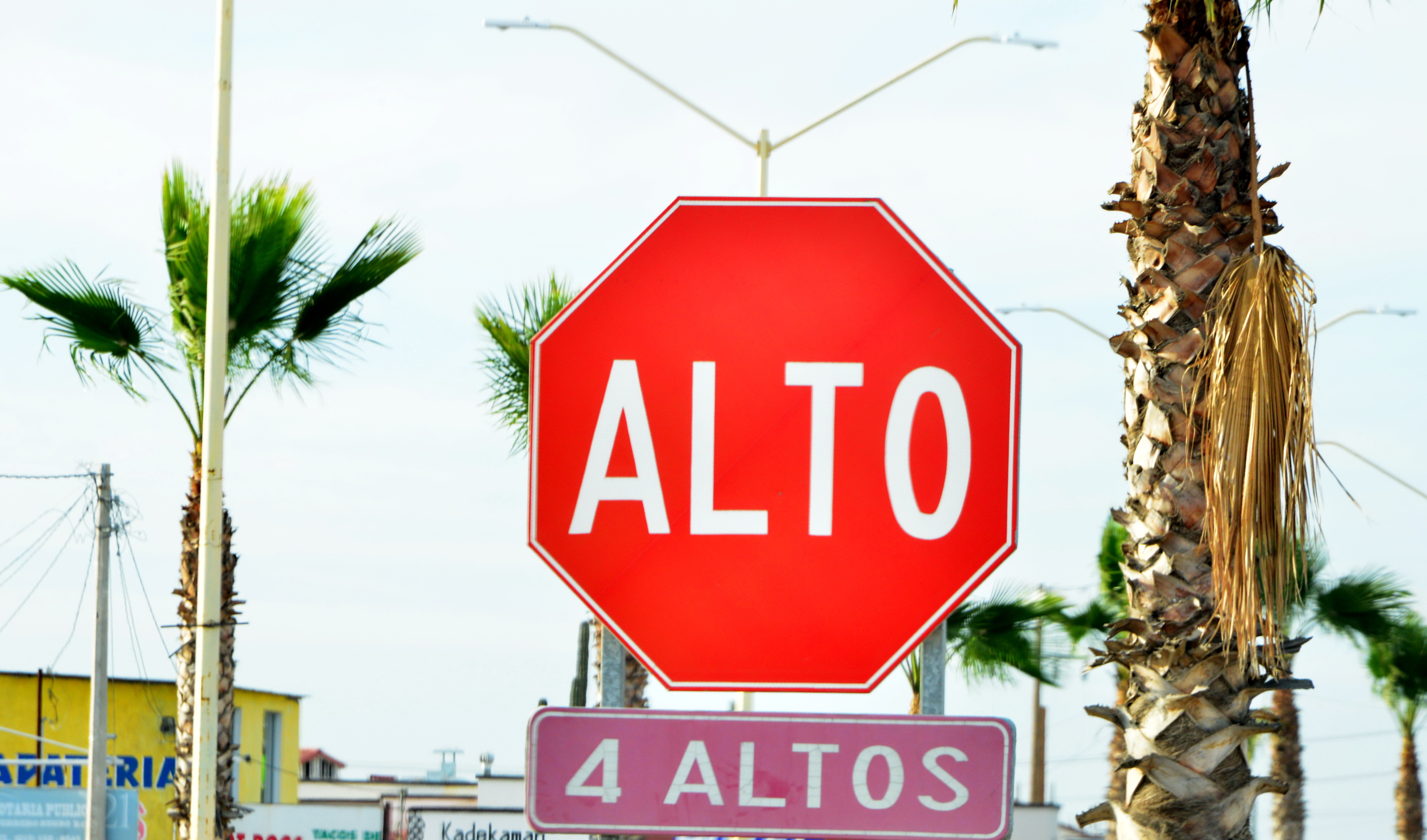
Four Altos

It’s the same when I spotted this sign for a ‘4 ways’ crossing. It’s a case where first come is first served at this cross road. We first saw this sign at the start of our trip in Ensenada but I was in the middle of rush hour traffic and I had the wrong camera in my lap.

This one, seen when leaving Loreto was at a quiet time of day and I was able to pull over and find the camera. If the 4 Altos were in town, what happened to the three tenors?

When we wanted to spend the night in San Ignacio on 3 March, on the way south, we were refused entry to the town as black clouds hung above it and flames leaped up from at least three places in the palm forest.  But it seems that fires here are a regular occurrence and that the palm trees are remarkably resistant, again, according to reports on Google Search.

Still, we were a little concerned as we drove into town, to show Jonathan the Mision. Yes, there were a significant number of blackened trees, but there were also a number of young trees growing in clearings made by the burning trees or in areas cleared by the fire brigade to contain the fire. It could have been so much worse (S3423).

The next three stops (S3424, S3425 and S3426) were made as we took the turning east of MEX1 into the Sierra San Francisco. This time we did not get to the village as the road had been damaged by a combination of water and possibly a rumble or two, so that we decided that turning round would be the wiser option.

Among the plants found were Echinocereus brandegeei, a short spined form of E. engelmannii, Ferocactus emoryi subsp rectispinus and Ferocactus peninsulae subsp peninsulae (?) with reddish flowers plus Mammillaria brandegeei (in flower).

On the way to Guerrero Negro we passed a turning east towards El Ar4co, but with day light fading we decided to come back tomorrow.

The first three hotels we tried, including the Desert Inn right on the border between Baja Norte and Baja Sur were full, but the next one (Posada Don Vincente) had space for two nights plus the bonus of being one of the cheaper hotels on the trip. Sadly hot water for a shower was not available.

Thursday 10 March 2016 – La Ventana to Loreto

All good things come to an end, and so today is our turn around point. First to La Paz Airport to allow Eunice to catch her flight back to Tijuana and from there walk into the USA. In the mean time, we have a driving day to Loreto where we managed to find rooms in the excellent Hotel Oasis.

I’m still suffering the effects of yesterday’s boat ride where one BANG as the boat slammed into a wave caused my back to smack against a ridge along the side of the boat. It doesn’t feel like the usual disc problem. I’ll survive (in pain) until I get back to the UK where doctors can take a look for free.

Very much a (410 km) driving day with the cameras only clicking three times – to take pictures of Hotel Kurt & Marina to remind us of the great time we had there.

Tomorrow we celebrate Jonathan’s birthday with a look at the damage caused by the fire in San Ignacio, a trip into the Sierra San Francisco to see Ferocactus rectispinus, a side trip to see Pachycereus (Lophocereus) schottii monstrose, the Totem Pole cactus before hitting the margaritas at Guerrero Negro.


Wednesday 9 March – around La Ventana pt2

I left my dear reader (s?) hanging on to see if the weather would change and we would make our trip to Isla Cerralvo. While we were enjoying a light drizzle at the hotel a message came in from our booking agent to say that there was a window of bright weather on its way and to come to his office to meet the team. Although less than a km from the hotel it takes a while for an email to sail across the broadband and arrive, so we were already an hour ‘late’ when we rolled up. By now it was dry so that we could join the team waiting for us only a few hundred meters from our hotel.

We performed the usual acrobatics to get into the boat – and that was with the boat on dry land! and off we went. It soon became clear that the sea was suffering the after affects of the earlier storm so that the waves had ‘kopjes’ (in Dutch) or white horses (English?). Whatever the name, the effect was the same: every few seconds the boat would almost lift out of the water and return back down with a firm thump.

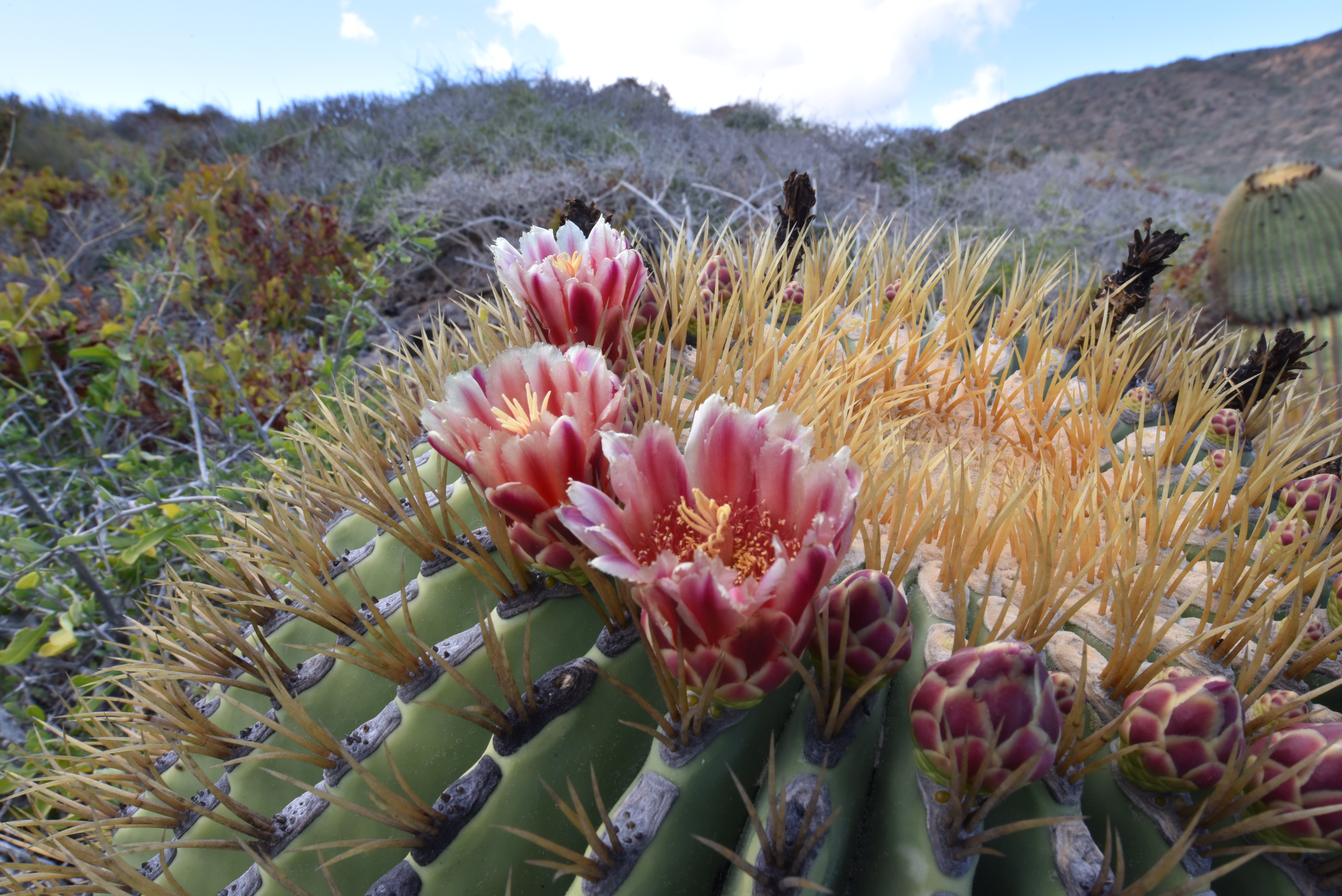
As regular readers will know, my old back has suffered the effect of many such trips so that it frequently goes into spasm. One really big bang and that theory was proven right again! ‘Everything all right?’ gestured El Capitain. I grimaced in pain, which he mistook for ‘yes, great!’ and on we speeded towards the island. More acrobatics and wet feet and we were on the beach. I struggled to put one foot in front of the other, but the huge Ferocactus diguetti were beckoning and in flower, so the last one up to the large giant was a sissy. That would be me then, but at least I made it!

And soon we also spotted two Mams. Back at the hotel I Googled images for Mammillaria cerralboa and M. evermannia to find a huge range of plants masquerading under these names. The yellow spined plant had to be the one named after the island. From a distance it looked to have yellow flowers but a closer look revealed these to be leaves from a neighbouring tree (Buresera?). The other Mam. was similar to the one we saw growing along the road on the way to the airport yesterday, so may be it is not a true island endemic. I’ll assume that it is M. evermannia for now until I can get to my library in England.

We walked inland along an arroyo that was nicely washed clean by yesterday’s rain. The excitement of being in this special place spurred me on despite the stabbing pain in my back and I came back with 230 images to add to the ever growing portfolio. Enrico saw us approaching the beach and directed his panga to meet us. More acrobatics to get on board, at least one of Angie’s pain killers was beginning to kick in. Do you want another stop? asked Enrico. Yes please! came my answer although the brain meant to say ‘Get me home to a comfortable chair and a bucket full of margaritas.’

The second stop had more of the same, but the highlight was probably provided by Jonathan as his face mirrored the concentration of an Olympic high jumper as he did his short run up and launched himself into the boat, made a neat roll to stop himself and knocking his head in the process. Angie has images.

Back in the hotel we downloaded our images and changed into dry clothes, making use of the spare time to add a collection of underpants and T shirts to the washing process, so that our balcony looks very festive.

What a relief and despite the aches and pains I’m very glad that we made the end goal for this trip and have a nice set of pics to remind us.

Ferocactus diguetii in flower on Isla Cerralboa

Ferocactus diguetii in flower on Isla Cerralboa


Tuesday 8 March 2016 – Around La Ventana

We had a date with Eunice to pick her up at La Paz Airport at 13:39. We woke up to black clouds over Isla Cerralvoa and spits of rain falling. Despite the less than ideal conditions, we decided to drive to the airport and hope for a few photo opportunities before getting there. A few km. from the hotel I spotted a parking place with a track leading away from the road. There was a Ferocactus near the edge of the road near where I parked the car, what a great omen. The Feros here are all said to be Ferocactus peninsulae. Checking the IUCN red list of threatened species I learned that ‘… that contrary to Hunt et al. (2006) F. santa-maria and F. townsendianus are treated as synonyms of F. peninsulae’ and not as their subspecies. That will make life interesting when I tell Jonathan tomorrow, as we’ve been having trouble distinguishing these taxa from each other. The plants around La Ventana seem to have a good amount of F. rectispinus genes in their make up as well, suggesting the need to ‘stir the mud’ some more in the hope to seek clarification.

We seem to be in the area where both Pachycereus pringlei and P. pectin-arboriginum grow together. Both were in flower and in fruit. The name pecten-aboriginum, is from the Latin, and means “native combs”, inspired by the use of the fruits as hair combs.

I also found just one white spined Mammillaria which means I’ll have to check out the distribution of M. albicans and M. slevenii that may be candidates for this plant’s ID. Shame that I could only find the one plant. There was also a small tree with peculiar fruits that caught my attention, was photographed and so will need to be hunted down for a name.

We arrived at the airport with enough spare time to enjoy a coffee and a piece of cake and to check out the facilities. I know that on my next Baja trip, I’ll be flying LHR – Mexico City – La Paz and so avoid all the hassle with ESTAS, 90 minute queues at immigration and car rental firms with a stock of -36 cars of the class that they were happy to take your money for on the internet. Eunice appeared 30 minutes after landing through the Arrival gate.

On the way ‘home’ to the hotel we attempted to make one more cactus stop, but as soon as we had found a suitable parking spot the rain started up again. We had an early dinner, just around the corner at El Rincon and watched as a thunderstorm let lose over the sea to the east and south of us. Spectacular flashes of sheet lightning lit up the skies, with the thunder following a long time afterwards, so the real trouble was several miles away.

The forecast for tomorrow is sunny with 0% chance of rain. That’s exactly what I had ordered for our boat trip to the island. Fingers crossed!

Monday 7 March 2016 – CD Constitucion to La Ventana

Just another brief stop gap entry:

We have arrived safely south of Las Paz, where tomorrow we pick up Eunice as she flies in from California Alto. We have booked the boat trip to Isla Cerralvoa – our skipper took a group of German Cactophiles there last week and they were very happy!

Yet another planning meeting

Yet another planning meeting (Image JYC)

Saturday 5 March 2016 – Loreto to Ciudad Constitucion

We opened the curtains of our room at the Desert Inn at Loreto early in the morning and watched another beautiful sunrise, framed by palm trees as a little dot on the horizon became a huge cruise liner. It dropped anchor as close to the shore as it dared. What was that scraping noise? Must have been the noise of the chain as the anchors went down. (S3407).

Around 11 a.m. we could all do with a leg stretch (S3408) and although we failed to spot Feros from the car at 100 kph, they soon appeared in their ones and twos once we walked into the desert. According to the distribution map in Nigel Taylor’s 1984 Bradleya article, we were now in Ferocactus peninsulae subspecies townsendianus country. While the books claim that this taxon is in the group that has hollow fruits from which the seeds escape through a pore created when the ripe fruit drops off the plant, the plant that we examined had a fruit that came off the plant easily but did not (yet?) have the pore and contained its seed in a very juicy mucilage. You just can’t trust cacti to read the books and live up to their descriptions!

We headed north at Ciudad Insurgentes and stopped at a small roadside chapel that are so common in Latin America. This one was a bit more sinister, judging by the art work:

Have a nice Day

Have a nice day!

We carried on to Puerto Adolpho Lopez Mateos, which people had recommended to us for a whale watching trip. We had planned to do this from San Ignacio but with all the upheaval with the fire there we had resigned ourselves to do this on the way home. As the opportunity was there and the price was right – a whole boat for the three of us without all the waiting, we jumped at the chance. The boat ride made a nice change after the hours spent in the car but the number of whales spotted was rather low. I guess that we’ve been spoilt by previous trips. Jonathan however was very pleased.


Friday 4 March 2016 – Santa Rosalia to Loreto

Apologies to regular readers for the break in communications. Yes, we are way ahead of schedule! Last night we were to have stayed in Guerrero Negro, but crossed into Baja California Sur so early that we decided to move on to San Ignacio, our next planned stop, especially as I had counted on gaining an hour by crossing into BC Sur. WRONG. You LOOSE an hour! As a result it became clear that we’d best make our planned side trip into the Sierra San Francisco in a few days time, on the way back north. You never can tell if there is space at the Hotel / Mission San Ignacio / Desert Inn, what ever they are called this year. I one or more tour busses are booked, then it is usually a tight squeeze, or a case of ‘no room at the inn’.

As we approached the usual security check point before the turning into town, there was a strong smell of smoke in the air. As we cleared the check point – all very relaxed and ‘have a nice day’ stuff, and turned around the bend in MEX 1, the cause of the fire became clear. As long as I have been to San Ignacio (since 2008) there is a large, dense, stand of palm trees. One year, Eunice and I even stayed in pre-erected tents between the palm trees! This time, they were on fire! It seems that by the time we arrived, it had been burning for a while, with the fire having jumped three different ways, each burning intensively. If we could get through, we get to the Mision San Ignacio hotel, but there was a huge bus blocking the way.  And there sirens all around us as fire brigade, ambulances and police drove past us. The smoke got very thick and there were glowing embers raining down on the car. A policeman pointed us to turn round and go back. There was quite an audience as we left town, all rubber necking. We had about an hour of daylight left and the nearest town was Santa Rosalia, 72 km up the road in the right direction  – there should be spare hotel beds there if we could get there before these rubber-neckers realised that they could not get through. We made it as the last day light went and stopped at the first hotel sign we saw. Full. Second hotel – no problem. Hotel del Real was perhaps not a natural first choice hotel and despite claims that they had wifi throughout, there was no evidence of it in the room. Hence no Diaries.

The previous night in Hotel Costa del Sol in Bahia de Los Angeles, things looked promising until a group of some 14 Swiss guests switched their computers and phones on. I guess the band was not broad enough, just like the night before that at Catavina where we were lucky to squeeze into the Mision Catavina Hotel before a tour busses arrived with their passengers bringing the wifi down.

In general terms, the three of us are having a great time, it’s hot (around 30 C) and sunny, the cacti abound and some are even in flower, while others will be on the way back. In 1983, Jonathan collaborated with Nigel Taylor for his final year’s degree project on a study of Ferocactus, with his contribution being the study of their seed. He has Feros in his collection and in the field so far was only familiar with F. viridescens at Torrey Pines, north of San Diego and F. cylindraceus at the Joshua Tree NM, so we made many stops this time to resolve many of the Ferocactus sp. stops from previous trips. Most Feros are roughly the same size as Copiapoa in Chile so Angie is enjoying the challenge of being the first to find them as they hide between the other cactus vegetation.

I’ll try to catch up with the backlog of diaries in days to come.

Wednesday 2 March – Catavina to Bahia de Los Angeles

We waited until we heard the tour party departing so that the coast was clear for us to enjoy breakfast. We were served by the guy who last night made us the excellent margaritas – breakfast was good too.

I took some more pictures of the scenery around the Mision Catavina hotel (S3392) and then stopped (S3393) as more Feros were spotted along MEX1 – time for a leg stretch. These were yellow flowered and although flower colour is said to be an unreliable means of IDing cacti, together with the weirdly twisting spines, we concluded that this was F. cylindraceus subsp. tortiluspinus. Echinocereus engelmannii was in bud, so should be in full flower by the time we pass by again on the way back. The small globular Mammillaria were without flower or fruits so for now were given the name M. dioica.

Just before the crossroads to Punta Prieta was the turn to San Felipe. There was a lot of road building activity around here so that it looks like in years to come, there will be a good paved road to San Felipe on the east coast of northern Baja. We followed the road for a mile or two until the Feros appeared alongside. Jonathan keyed these out to be ‘Ferocactus gracilis subspecies gracilis, with a hint of F. peninsularis’ – you need long labels for these plants! No flowers, no fruits but attractive broad spines (S3394).

S3395 was along the road to Bahia de Los Angeles and although I recall seeing F. gracilis here before, the Feros were in hiding today.

S3396 was the Ooh Ahh view overlooking the Bay of Bahia the Los Angeles, always spectacular. We stayed in Hotel Costa del Sol as usual. Great sunrise the next morning!


Monday 29 February 2016 – Ensenada to San Quintin

As last night we had crashed into bed exhausted at only 21:10, it was not surprising that we were awake early around 6 a.m. and so managed to get Saturday and Sunday’s missives out.  We had breakfast in a glass box in front of the hotel, right on the sidewalk, with people rushing to work passing by. Makes a change from breakfast television!

In the past we would have raced from San Diego to San Quintin for our first Baja day – quite a stretch. But starting from Ensenada it was a nice leisurely drive along MEX1. Things seemed very lush and green with lots of yellow and orange wild flowers along the side of the road and up the hills. I had expected to spot some Ferocactus viridescens from the car as an excuse for a stop. They are not the most exciting taxon in the genus, but, as a completist, they are a must for a stop. But they tend to be closer to the ground then the lush vegetation, so not spotted from the car. Never mind, there is always the way back in some three weeks time.

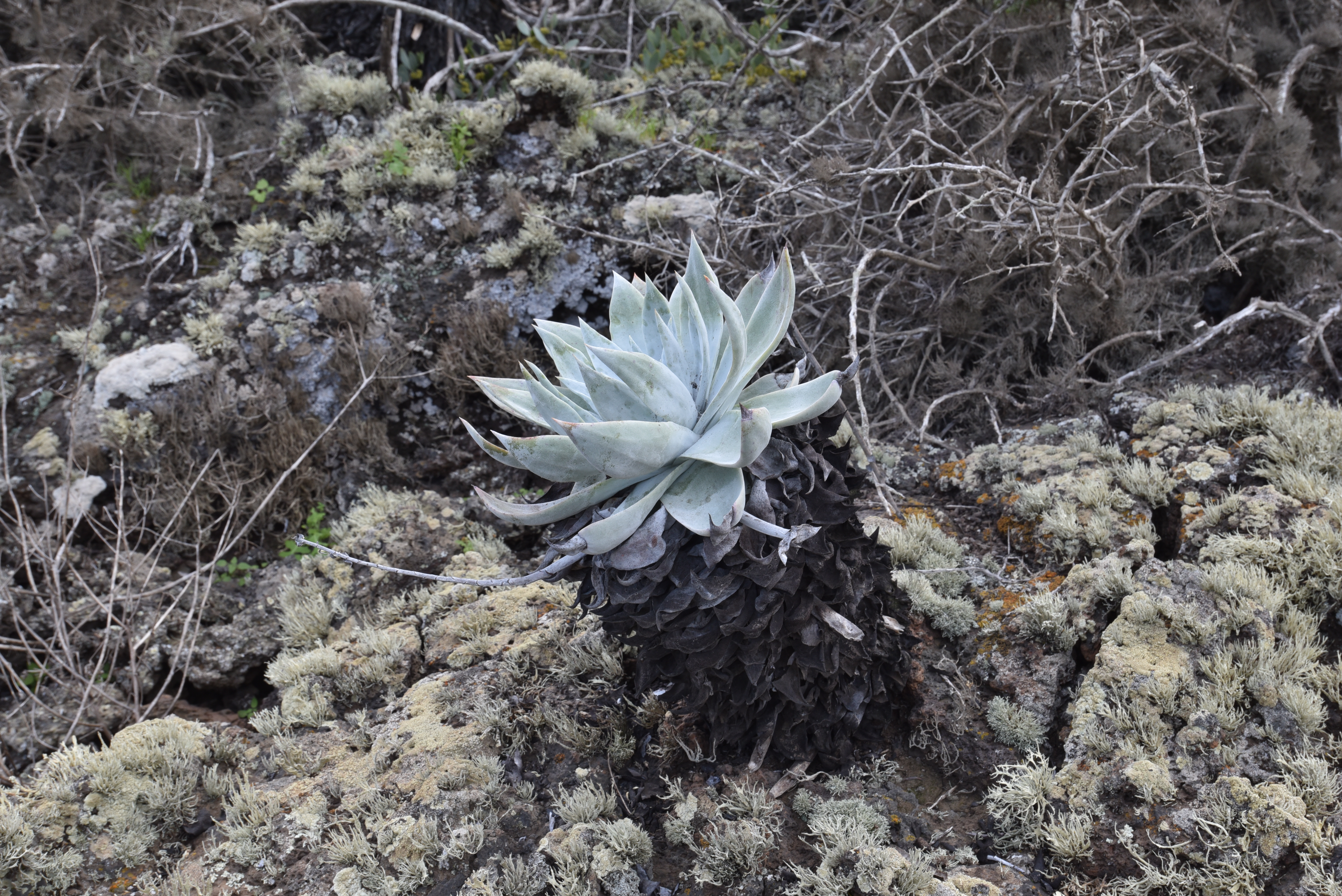
And so we arrived in the San Quintin area, where SatNav warned us that we should turn west towards the group of long extinguished volcanoes where Dudley anthonyi grows in a very photographic setting of an old lava flow overlooking a marshy coast line. The lava rock is covered in lichen that are worth the visit in their own right and the Dudleya sit proudly on top: dark trunks about the diameter of my arm, covered in the remains of the old leaves, with a large rosette of white farina covered leaves on top. Friends in the UK who are qualified BCSS judges have told me that in cultivation you should tidy the plant by removing the old leaves. If I catch anyone doing that here I’ll report them to the Dudleya anthonyi Protection Society!

Dudleya anthonyi

Dudleya cultrata (?) was here as well, but this is a green leaved plant which blends in with the other vegetation and only calls your attention by its yellow buds.  Also found: numerous clumps of Echinocereus maritimus just coming into growth and flower, a Mammillaria that I assume to be M. dioica as there were no flowers or fruits to aid ID. And we did get our picture of Ferocactus viridescens, although Jonathan wonders if it might be F. fordii.

I also took many images of the field flowers. I should have remembered their names from previous post trip investigations, searching the internet and the various flora of Baja guides and books. As to the lichen, they are way outside my scope. There must have been at least a dozen taxa here I guess.

We stayed at Hotel Mision Santa Maria just south of San Quintin. This was the hotel that Alain and I failed to find in 2008, when in the dark, we drove into wet sand that had been dumped on the track to deal with a minor flood. Our Nissan Altima became firmly stuck in the sand but we were rescued by a group of Mexicans returning from a day’s fishing on the nearby beaches.  It is not the easiest of hotels to find, but well worth the effort as it is comfortable and reasonably priced with excellent food.

Tomorrow we head into the Catavina Boulder Fields!