Just another WordPress.com site

Archive for the ‘Mexico’ Category

Saturday, 18 October 2014 – Vizarron to Rio Verde

Just 12 km from the hotel, heading north on Mex 120, we reached our favourite Strombo disciformis stop. Cliff had parked on an earlier pull over and so we slotted in too, always nice to see a ‘different’ location, even if it’s only some 200 m away: S3150a and S3150b. Again the density of Strombocactus here was fantastic and lots more pictures were taken, including of a bright coloured snake, still asleep, that relied on its camouflage until everyone had taken its picture and we prodded it with a stick. It’s waved its little rattle as it slid into the bushes, but I could hear no noise – too young to have fully developed a rattle? or me too deaf to hear it?

S3151 was again a stop from March, but again the scenery was so different with lush vegetation and the occotillos in full leaf, but yellowing.

Next it was a long drive along Mex 120 through the Sierra Gordano, high through the clouds, with fog and drizzle to keep us in the car.

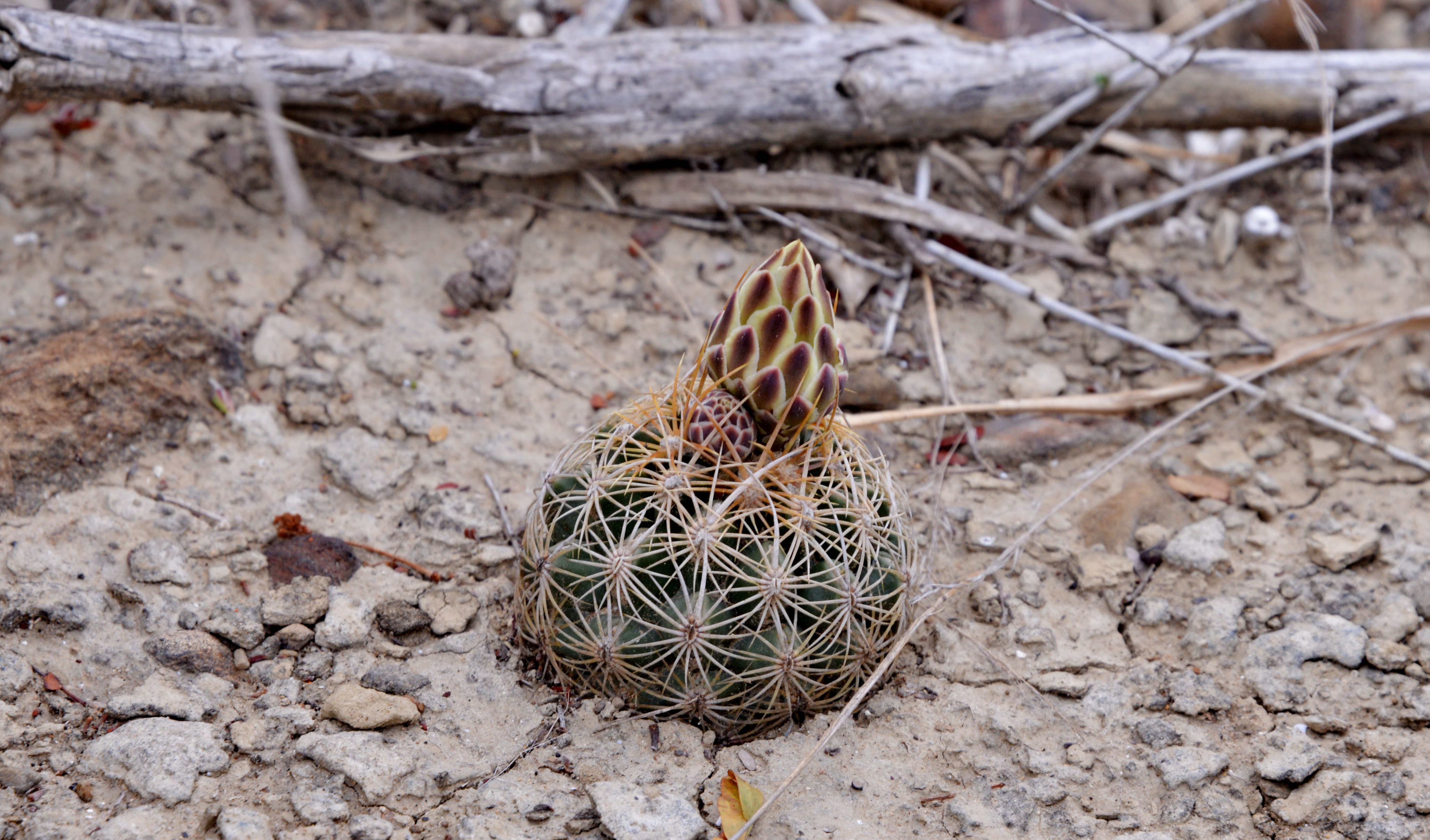
By 4 p.m. we were again at the Stop for Turbinicarpus lophophoroides (this time S3152) near Rio Verde where this time the plants were very turgid and mostly growing above ground, some with the remains of recent flowering, looking quite different from previous occasions.

We completed the day with one of the best meals to be had in Mexico, rib-eye steak and a remarkably nice Mexican Cabernet Sauvignon. Yum yum.

Sunday we should see E. platyacanthus ‘My Old Friend’ again, and ‘Michelinman’!
 

Friday, 17 October 2014 – Mexico City to Vizarron del Monte

Once again the LHR – MEX flight took exactly one hour less to land than scheduled. So we had to wait for Alain’s flight that was now due one hour after us and for Bart, who had set his alarm clock ion the hotel airport for our published arrival time.

Neither mattered, as Ian had switched car provider to Dollar, who were slightly cheaper, had to wait for their stand to open at 7:00. So Alain, Bart  & I were off after arranging to meet at a set of GPS coordinates along the MEX 120.

Bart drove for the first day, taking the more than tricky Mexico City stage. Some how we managed to avoid all the cars that seemed sure to be aiming for us. I heaved a sigh of relief as we found ourselves on MEX57 and at least all the cars were going the same way.  Around 9:00 we stopped for fuel and breakfast and it was still early as we turned off on to the 120 at San Juan del Rio.

We had were overtaken by Ian’s car party with Cliff and Sarda, but passed them again when they stopped to buy a month’s supply of oranges at a roadside stop. It appeared that there were two tracks to the site, we overshot the first one and took the second and so missed meeting the others at the first stop (S3147). Stenocactus sp , Myrtillocactus geometrizans, Corypantha sp and Ferocactus latispinus (just one plant, in bud) were found, with Mammilaria painteri also reported by the others.

With still plenty of tome to spare, we decided to drive on to the Zimapan lake and repeated last March’s experience stopping at the same spot (S3148) as in March to find Mammillaria perbella, M. elongata subsp echinaria, Neolloydia conoidea, Coryphantha octacantha (I have not yet counted the spines to confirm the name). I surprised myself by retracing a small Ferocactus glaucesence, growing in the shade of an overhanging rock, with a wonderful glaucus epidermis. In nature they tend to look more beaten up when exposed in full to the Mexican sun.

We drove down to the lake, passed through the tunnel and turned back again, along the road we had come, to the last stop made in March, full of Thelocactus leucacanthus (not in flower this time) and Ariocarpus kotschoubeyanus ‘elephantidens’. These are the target for this trip, or rather, catching them in flower. They had had the required rain and the whole scenery was much more lush than in March, making it much more difficult to find the Arios. Once we got our eyes in, they were quite easy to find again – there were so many – but only few plants were in bud. One plant had flowered – pale pink – but wildlife had nibbled away most of the petals. Good tip – don’t expect the plants too look as they do in pots in our collection, unless slugs and snails visit your collection.

And on to the Hotel Boca Sierra in Vizzaron where Ian, Sarda and Cliff had already secured the rooms to our liking, so a quick shower and off to dinner, where Cliff and Bart had two very interesting looking fish.

It seemed as though we were here only yesterday!


Thursday 16 October 2014 – Off again!

Just a week since I arrived back home, I’m off again. Another late night flight, so time to spare to set the scene for ‘Mexico 2014 Part II’.

Soon after the March trip to Mexico I mentioned to my fellow travelers that it would not take much arm twisting  for me to put the plans for Peru in October on ice and repeat the whole trip again to get the benefit of all those Ariocarpus that we saw, but this time in flower!

This time the Tres Amigos are joined by another three: Ian’s wife Sarda, keen to see what all the fuss is about, Alain Buffel from Oostende, Belgium and Bart Hensel, from Vinkeveen in the Netherlands, this time spread over two cars.

Alain has been in Texas and northern Mexico for the last month or so and confirms that the Arios are in bud, ready for our arrival. Some in Texas could just not wait and were already in flower. I’m told that the exact flowering time is determined by when the autumn rains took place. We’ll see. In any event, a stroll through the desert in the Mexican sun is more enjoyable than the cold wet weather that we have been enduring in the UK during the last week. Ironically the sun is out today and it looks like it could be a nice day, so I better get on with a last look at my plants piled in the conservatory and tell them to look after themselves for the coming month.

We arrive back on 10 November and last night I have already booked the ferry tickets for our next trip to Cologne, Germany and a long week at Angie’s Mum’s.

Jetlag? Doesn’t seem to happen if you keep on the move!

As usual, I’ll try to send out daily reports of what we see during the trip, wifi reception and health permitting.

Monday 24 March 2014 – Galeana to Jaumave

I ventured out for breakfast by myself as the others were still full from last night’s dinner and drinks. A bunch of teenage schoolgirls were giggling at me and pointed to my beard, an unusual sight in these parts of Mexico, and asked to take my picture. Sure! They were still there as we loaded up the car and now with my camera, I took a picture of them. Later we entered the state of Tamaulipas and the presence of armed forces increased steeply. This included inspection points where we were pulled over. Where are you from, was the question. Galeana would have done, but when Ian volunteered ‘Inglaterra’, the gents wanted to see passports. Cliff and I had our entry visas in our passports, but Ian had put his ‘in a safe place’, so that little beads of perspiration appeared on his forehead. He claims that I was not helping by suggesting that a few nights in prison would be even cheaper than some of the hotels where we had been staying. To divert the attention from his misplaced visa, when the police wanted to check the images on our cameras, Ian volunteered that I had been taking pictures of young girls on the square at Galeana. A career in the British diplomatic core is now out of the question for Ian, but the comments went straight over their heads fortunately. All images from the above incidents are filed under S3104. The entry visa was eventually found, so we will never know from this trip how Mexican cells get marked on Tripadvisor. After much driving – we were leaving the Sierra Madre Oriental and just like over a week and a bit ago, were heading to the relative lowlands of Tamaulipas. As we descended from c 1800 we could look down on the clouds below us. Minutes later we were in them and the temperature dropped by some 10 C. Windscreen wipers were switched on to keep the drizzle off, just like the UK. As we approached the first Astrophytum stop, disappointment. The track that we were supposed to turn on to no longer existed – well the data was more than 10 years old! We had more luck at the second spot (S3105). Our target plant was reported to grow with Thelocactus bicolor ssp schwarzii, and these could be seen from the car as Cliff was parking.

Thelocactus bicolor ssp schwarzii - S3105

Thelocactus bicolor ssp schwarzii – S3105

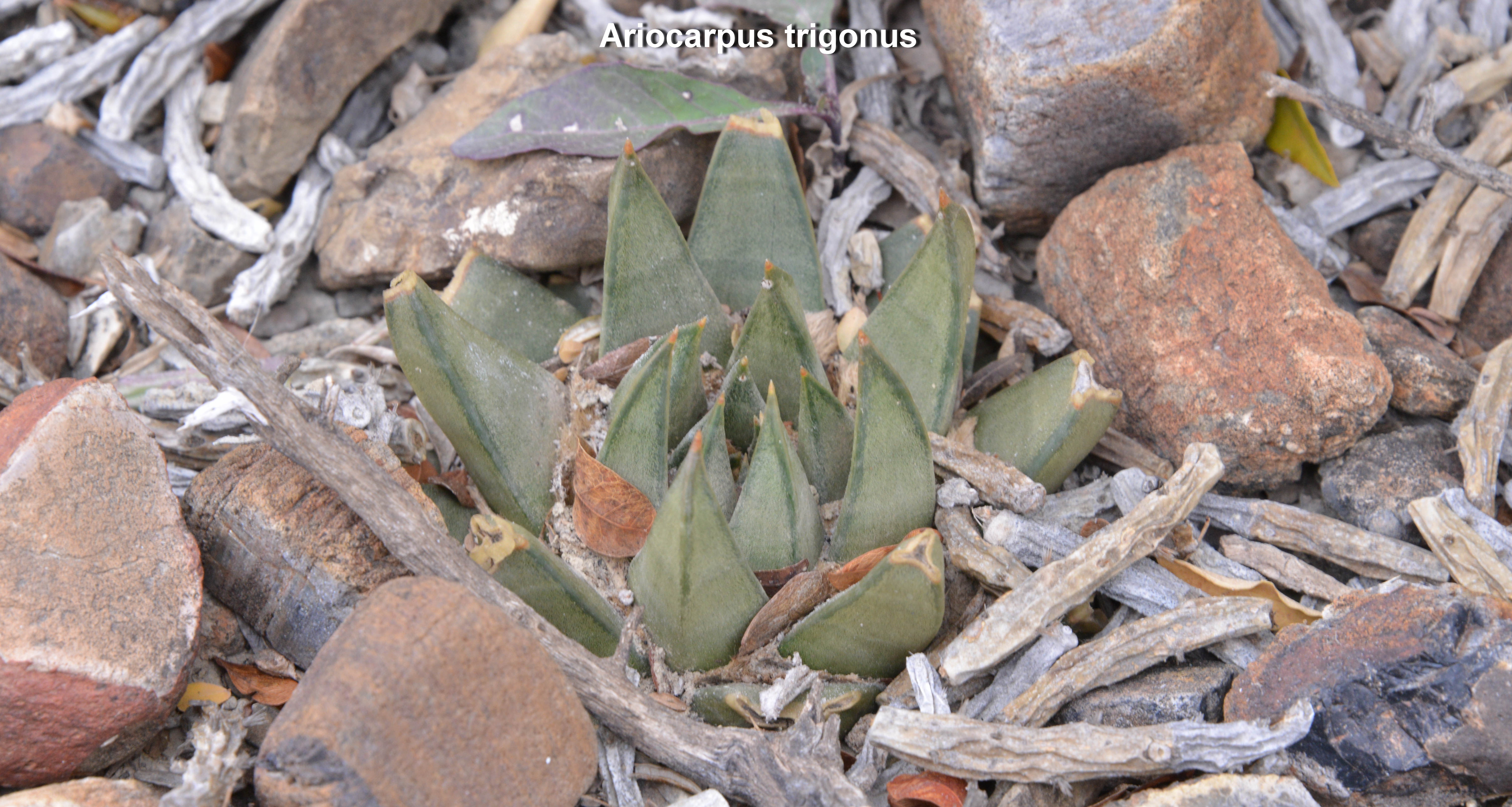
As soon as we had crossed a fence, the surprise of the day as we found Ariocarpus trigonus that we had been unaware of for this stop. A bonus!

Ariocarpus trigonus S3105

Ariocarpus trigonus S3105

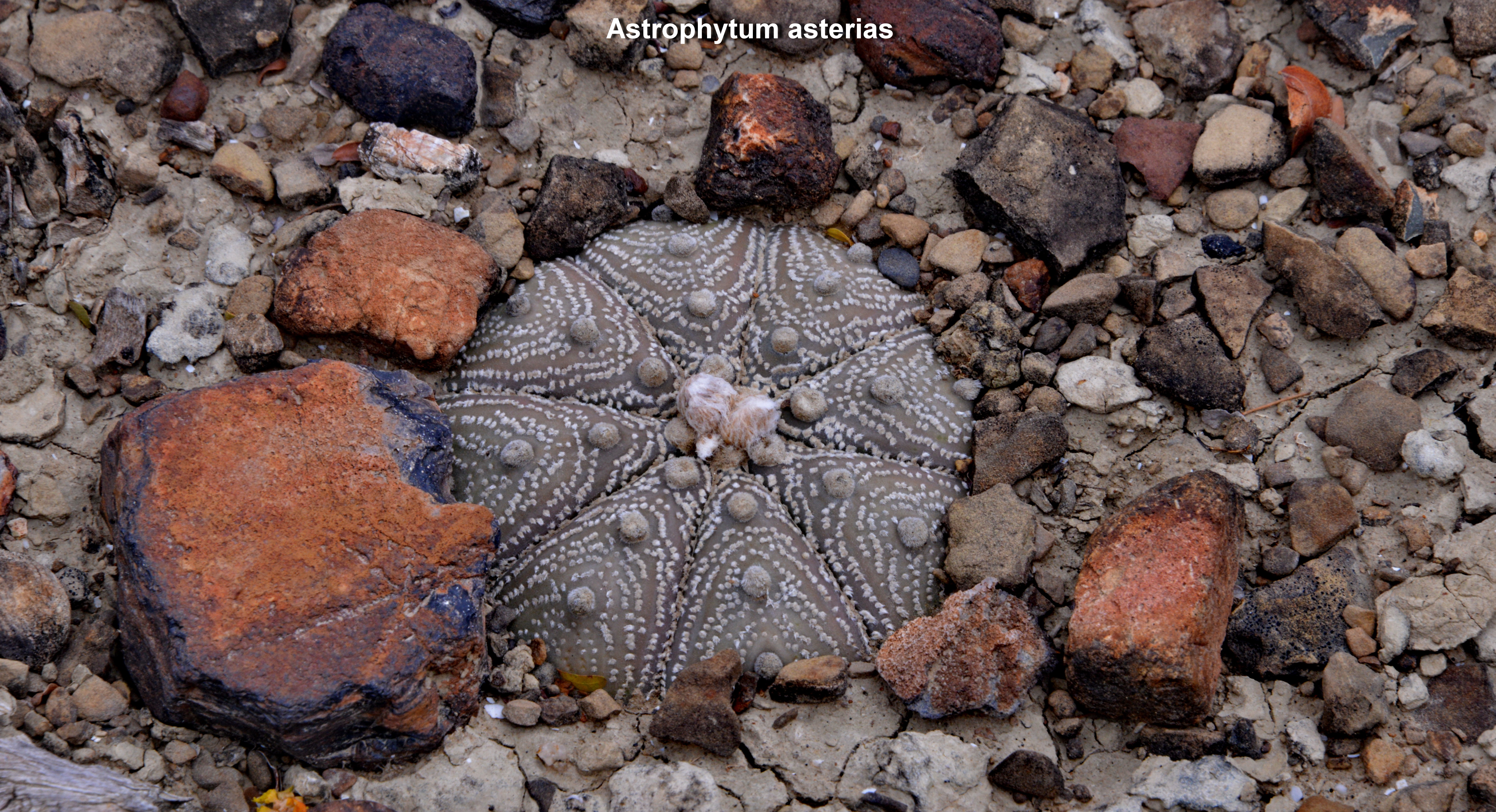
It took a while longer to find the actual target plant for this stop – Astrophytum asterias. Quite young plants looking like they were seedlings straight off the sales bench at a nursery in Europe.

Astrophytum asterias - S3105

Astrophytum asterias – S3105

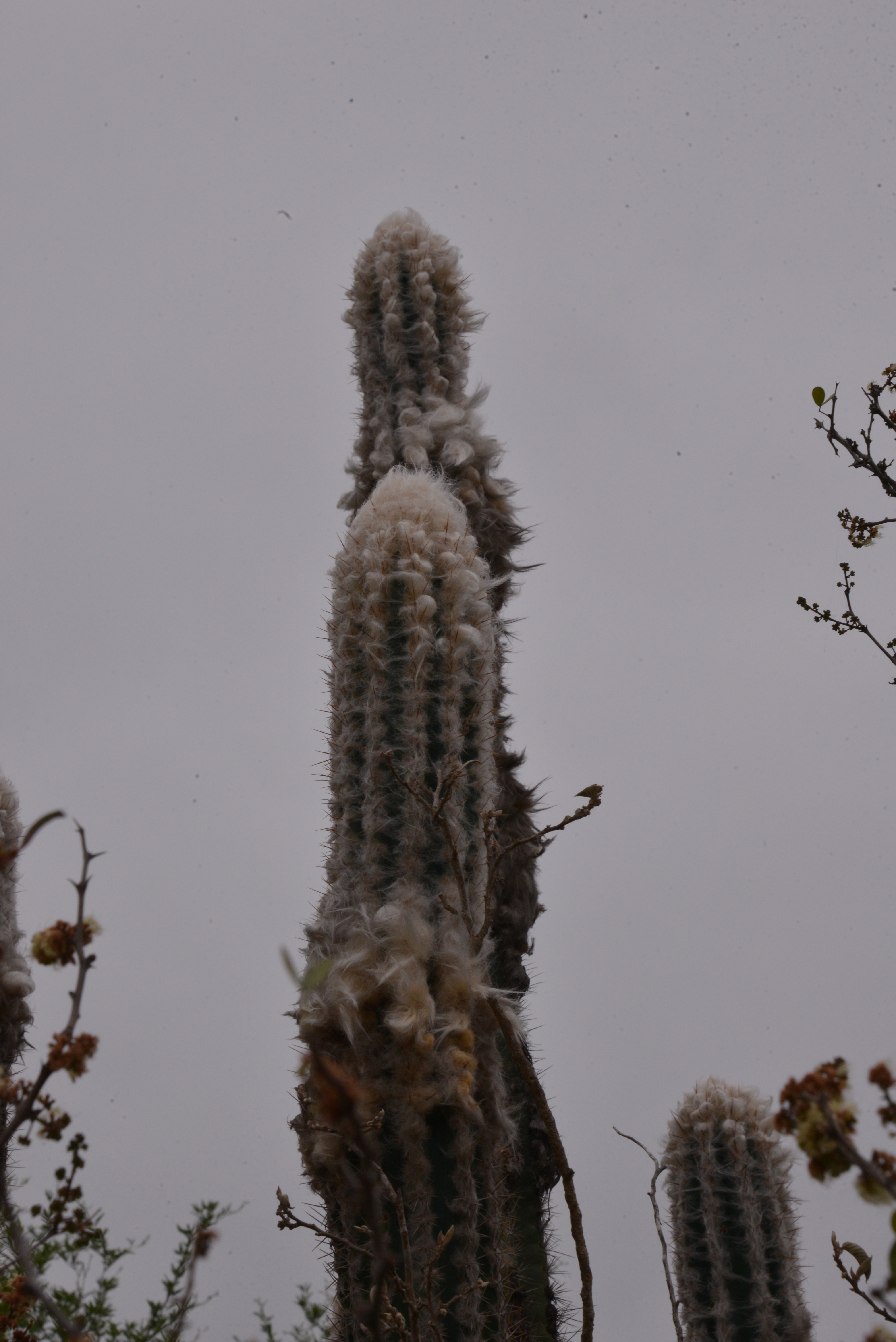
As we had approached this site we had seen the heads of a Pilosocereus poke above the tops of the low trees. Now, with the star (astro) of the day found, we made time for a brief stop (S3106) and pictures. Pilosocereus palmeri and Pilosocereus (Cephalocereus) leucocephalus are reported on Google as having been reported from Tamaulipas, as useful pointer for some hunting through books, back home. It turns out that P. palmeri is a synonym of P. leucocephalus. Wow, two ‘names’ in one go!

Pilosocereus leucocephalus - S3106

Pilosocereus leucocephalus – S3106

Thursday 20 March 2014 – south of Cuatro Cienegas

First thing Cliff and Ian went to search for a Vulka to sort out our tyre. They were back too soon – bad news, yesterday’s puncture had turned into a write off – our only luck had been that it lasted until we parked up at the hotel. The boys returned to break the news and planned to leave for Monclova to purchase a new one. While Cliff was breaking the bad news to me, Ian was chatting to one of the hotel staff who suggested he knew a place in town that could help us. Sure enough, the three went off and came back with a good quality but slightly wider second. Job done.

In the mean time I had enquired about the  availability of breakfast and was given a firm, ‘Yes, of course!’ This was followed by various members of staff being dispersed on shopping trips and the cook was called in. Eventually we sat down to a Full Mexican and then we set off.

Our target plant had been in doubt even during our planning stages in the UK. Thelocactus lausseri is only known from a private property (probably the size of Wiltshire) north of Cuatro Cienegas. We had coordinates for the gate, but it was known that the owner did not entertain cactophile callers. Well the news is that there are now gates 8.5 km from the gates for which we had the coordinates and that they were double padlocked.  So that was as far as it went for T. lausseri this time.

Expecting this outcome I had lined up some visits to local stops that had impressed me on previous visits. The first was one for Ariocarpus kotschoubeyanus where in the past we had followed the SatNav to reach the coordinates, open the car door and found that we had a few of the plants right below us. The same happened again this time. Unbelievable how many plants there were here for a plant that is CITES I status is Appendix I – Extremely endangered. But then it only takes one developer to see the potential of using the land to cover the area with solar panels to destroy all the Arios.

We moved (for the first time) closer to the mountains surrounding this area. It is easy to assume when you see the dried up marsh area (Cuatro Cinegas = 4 marshes) covered in Arios to assume that they cover the whole of the area, but walking from the foothills back into the dried up marsh revealed no Arios for up to a thousands meters. Just some Coryphantha poselgeriana and Echinocereus enneacanthus.

Next stop was the Fouquieria shreveii stop from 2010, with plants in full flower. Interesting, unusual plants but nothing else.

Finally, Ian had mentioned as we drove off road to the kotschoubeyanus site (unpaved track this time) unto MEX 30 that he had spotted what he thought were Astrophytum capricorne. We indulged his fantasies with a stop and found a large number of large Astros – well done Ian, fantastic eyesight for a youngster!

Then it was back to our hotel, where we nervously check the state of the tyres, just in case. All good so far…..

Tuesday, 11 February 2014 – Catavina to Bahia de Los Angeles

S2980 was just a few kilometers from La Mision Catavina, still in the Boulder Fields, along MEX1, prompted by Angie spotting a tall Ferocactus; well, taller than her 1.63 m (5 ft 3″) but not as tell as my 1.94 m (6 ft 4″). It looked taller, standing on a boulder itself.

We arrived in Bahia de los Angeles, via S2981, still along MEX1, at the Echinocereus lindsayi spot – usual number of plants found, S2982  and S2983 both along the Punta Prieta to Bahia de Los Angeles road, with S2983 from the spot overlooking the Bay with a handful of islands seemingly carelessly tossed in the water.

We made straight to Hotel Costa de Bahia where we had a comfortable stay in 2011 as our previous preferred haunt Raquel & Larry’s place, was no longer up to scratch now that Larry had been moved into care in the US by his kids.

Yes they had space for us and yes, I could start with a Margarita and was allowed to buy the glass, so I now have one for each of my stays here.I enquired about the where abouts of the huge Great Dane that had been here last time – sadly he had passed away.

It was the size of the two Margaritas that I downed and my health – yes, another post flight cold, that account for my early night and lack of Diaries. But fear not, all the names of the plants seen have been recorded since 2008 and will be added as soon as health and time-wealth permit.

The number of cacti that accompany us in Baja remains overwhelming.

SUNDAY, 9 FEBRUARY 2014 – CARLSBAD, CA, USA to San Quintin, Baja Norte

A quick breakfast at Denny’s and we were back on the road. The road to the border was quite straight forward and the volume of people crossing this Sunday morning was nice and light. The facilities in Tijuana have greatly improved since my first Bajathon in 2008 – officers now sit in comfortable brick build offices and there were smiles and relaxed chat rather than the tension between ‘customers’ and ‘service providers’ that I remember from past years. We were across in under an hour, despite being caught behind small party of Swiss  tourists who impressed by speaking fluent Spanish.

We found MEX1D with ease, much better signposted than on previous occasions. We had just paid our dues at the second Toll Plaza when we were directed off MEX1D and onto the old MEX1. We were aware that this would happen as close to La Mision with lots of Dudleya brittonii hanging from the road cutting, the Toll road had been destroyed by an earthquake. So no surprise, except why charge us for a road that is not accessible? I guess to pay for the repair works.

I thought that to reach our traditional Dudleya stop, we had to turn back a bit but realised that we had turned off too early. S2975. In fact we made three stops in very close succession, so S2975 (a), (b) and (c), with the last one back at the traditional stop. In addition to the Dudleya, Bergerocactus emoryi, Mammillaria dioica, Agave shawii and Ferocactus viridescens had their picture taken.

A Mexican, parked in front of us, came over for a chat. ‘What are you taking pictures of?’ We explaned that we are cactus & succulent plant freaks. Ah, great, I understand, we could not understand because with the beautiful Pacific Ocean bathing in sunshine and the beach below us, it all seemed a bit mad. Yep, that sums us up. Mad on cacti!

Usually we continue back on the toll road, but that was not an option this time. South of La Mision, the road took us past some dark rocks, rising some 10 m (30 ft) right along the road. They were covered in white Dudleya brittonii, but no place to pull over to take their picture or, with a huge truck on my backside, not even a chance to slow down for some on the fly pics. Never mind.

As a result of the detour we missed the Mirador that has been our second Baja stop in the past and arrived in Ensenada where we found a Calimex supermarket and an Oxxo to top up on supplies.

Angie was a little concerned when after passing through San Quintín I turned right onto a dirt track and I explained that this is where in 2008 Alain Buffel and I got stuck in wet sand, in the dark. and then failed to find the Hotel Mision Santa Maria. We found it thanks to a SatNav on later visits but my new SatNav had not a clue. Never mind, follow your instincts and sure enough after a longer while than I remembered, there was the hotel.

Follow the link http://www.misionsantamariahotelsanquintin.com/index.htm?lbl=ggl-en&gclid=CMXVxJPzwbwCFUdqfgod7yAACA to see how the other half live.

A large margarita prevented this Diary page from going out last night. Now breakfast calls, then the Catavina Boulder Fields!

Isla Cedros

Just some pictures to share with friends of a ovely day in March 2010.

Monday, 21 March 2011 – rest day in Bellflower, CA

Just a quick message to say that we arrived safely in Bellflower, late last night and in the pouring rain! The song says ‘It never rains in California.’  The song is wrong!!

We have had a number of extremely long driving days to get back to Bellflower, when on arrival each night I have been too tired to write up the Diary entries. On other occassions the wifi connections and my laptop problems prevented the Diaries to be written or published. I hope to rectify some of this over the next few days.

We now have a couple of days until Angie arrives on Wednesday for a 2 week look around the US SW area.

Sunday, 20 March, 2011 – Tucson to Bellflower

Tucson, AZ to Bellflower, CA is ‘only’ 487 miles (784 km) – 8 hours drive, which ever way you want to count it through some of the less inspiring landscapes on fast highways. That’s a full day’s task, so we were perhaps a bit silly to arrange a visit at Miles Anderson’s Miles to Go nursery out in the desert near Tucson (S2337). We managed to tear ourselves away just after noon, so expected to make it to Bellflower by 8 p.m. The visit was well worth it with excellent cactus chat and opportunities to photograph the cultivated versions of plants that we had seen shrivelled and dry during the last few weeks in habitat. Thanks Miles!

The weather forecast for California suggested rain – hard to believe when you’re standing in the burning (for a Dutchman) Arizona sunshine, but sure enough, as we approached Blythe, clouds gathered and by the time that we had some 100 miles left to go, it started to rain, ending up with a good old English style down pour.  It was at this time that Ruby, who had been so well-behaved during her Mexico adventure, started playing up. Warning lights that had told us that an oil change was due ‘soon’ started to insist that the time had come now, another cryptic message said that the right hand rear indicator light was malfunctioning and to cap it all, when the heavens were raining down at full strength, a new message told us that we had ‘low tyre pressure’, with an icon of a punctured tyre on display. We almost ‘swam’ off the highway and to a garage, fortunately where Eunice had studied at University, so where she was familiar, at least 30 years ago. The guy at the fuel station kindly switched on the air line but we had four round ones, and as far as I could tell in the wet and dark, the tyre pressures were fine. The temperature had fallen from 85 F to 40 F, so that might have caused a fluctuation in pressures? Or do cars in California really dislike ran?

The important thing was that we arrived safely home with Eunice driving the car through some awful conditions, avoiding the Californian drivers who still have a lot to learn about driving in these conditions.