
Just another WordPress.com site

We arrived safely and reasonably fresh at Santiago Airport, or, to give it its full name: Aeropuerto Internacional Arturo Merino Benitez at Pudahuel, where we were met by the manager and two representatives of LYS Rent a Car.  The cars were checked over and any superficial damage to the bodywork was noted (and photographed by Angie with her digital camera). Everything was in order, except that the tyres seemed a little on the soft side. These were inflated, but as we wanted to check the pressure in the spare tyre for the Nissan 21D, it appeared that the back bumper had some damage that prevented access to the spare wheel. ‘Not to worry’, said Andres, the manager, ‘Just follow us to our offices in down town Santiago and we’ll fix it’.

This was my cue to get worried. During Copiapoathon 2001, we made the mistake of spending our last night in Santiago and while I was most impressed with the volume of buses and taxis, I did not want to drive there myself. But needs must, so I followed Andres’ car as though I was glued to its back bumper, while Ian, driving the Nissan, was equally glued to mine. Things got interesting at traffic lights that changed colour mid-convoy, but as I am colour blind, I just drove on. Apparently Ian is also colour blind as he followed closely.

All’s well that ends well, and before too long we were on the Pan-American Highway (aka Ruta 5), heading north.

As we had anticipated being rather jet-lagged and possible delays of flights, we made swiftly for Pichidangui, some 35 km after the Panamerican (Ruta 5) hits the Pacific Coast.  As daylight was fading (at about 17:30), I stood again on the rocky coast at the west end of the town.  This was the last Stop (S107) of our 2001 trip, so nicely provided some continuity.  There is a small church (church of Santa Teresa) that has been built on a rock into the ocean. 

This time we clambered over the rocks north of the church (S108) and found Eriosyce subgibbosa and E. chilensis var. albidiflora (Ritter’s Pyrrhocactus chilensis var. albidiflora), Eulychnia castanea and two species of Echinopsis (Trichocereus): E. litoralis and E. chiloensis, all competing for space with a very lush vegetation of grasses, a succulent Oxalis, O. bulbocastanum as well as a range of imported succulents (including Mesembryanthemacea, Agave, Aloe arborescens etc).

I wanted to get to the south side of the church, as, on the flats right along side the road, we had found another Eriosyce, E. curvispina var. mutabilis (syn. Pyrrhocactus / Neochilenia odoriflora, Neoporteria horrida var. odoriflora), in 2001.  As I went to get the car, I noticed that the front tyre needed some air.  By the time that Angie & I got back after a quick look at the south side, the tyre had visibly gone down more.  It was now dusk, so instead of driving back through town to our planned accommodation at Cabañas Del Bosque, we booked in at the Cabañas of Hotel Kon-Tiki, right alongside the coast road.

After the first of many excellent meals (choice of beef, pork or fish, chips or rice and a range of salads to chose from), washed down with some equally excellent red Chilean wine, we retired for the night, all eight of us into a single cabaña.  The following morning we learned not to repeat the experience, with lengthy waits for toilet & shower.
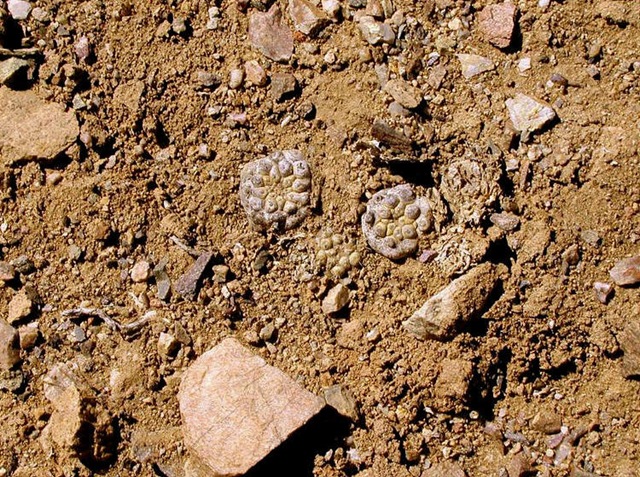
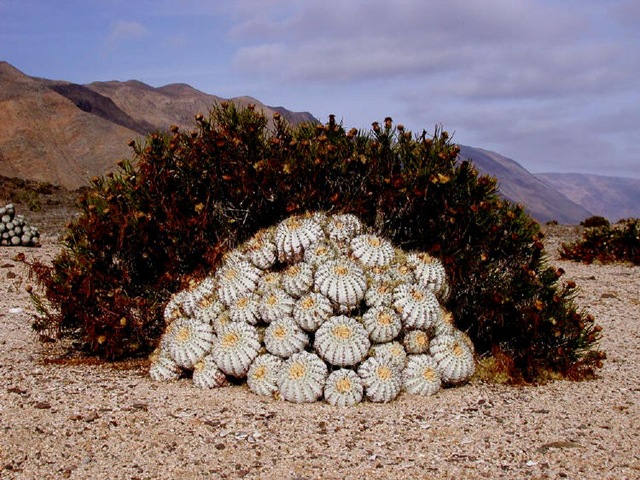
And so we reached our last day in Chile. The landscape, that had looked so dry when we had driven through it a month earlier, now looked distinctly green, compared to the really dry north where we had been.

Apparently deep in thought, digesting the glorious sights we had seen, we forgot that, even along the Pan American Highway, it is good to keep the fuel tank above half way full. As we were also running low on money, we passed by a petrol station that did not accept credit cards, thinking that we’d soon find another that did. Wrong!

As the fuel gauge approached empty, Leo slowed down to optimum speed, coasting down hills – anything to conserve fuel. We stopped at a small hamlet – Puenta Huentelaquin, some 38 km north of Los Villos where, according to the map, we would find our next petrol station. As we were convinced that we did not have enough fuel to get to Los Villos, we hoped to persuade people in the hamlet to sell us a few litres of petrol. We were in luck! The local tyre repair man had two very old pumps from which we were able to fill up the car – a close call!

We made only one stop today (S107), the last of the trip, at Pichidangui. How we wished we had more film and I made a note to return here on a future trip (see 4 June 2003) and to read up Fred Kattermann’s book Eriosyce before doing so.

Our original plan was to spend the last night at the El Parador cabañas near Calue, but as we had made good time, and Marlon’s flight to Brazil required a 6 a.m. check-in, we decided to spend the night in Santiago. However, we had to go to El Parador to return some spare car parts that we had borrowed on the way up and to cancel our bookings.

We arrived in Santiago, around sunset and made for the Airport, hoping to find some basic and affordable accommodation, but somehow got caught up in the flow of traffic, ending up in the centre of Santiago, surrounded by endless lanes and rows of busses.

We spotted a hotel sign, found a place to pull up and tired but happy booked in, to finish off the remainder of the red wine we had had on board while we did our final packing.

There’s not much left to report for the next day, other than that we made it safely to the airport, nearly missed the car-rental rep as he arrived just as we had to go to through customs into the departure launch.

It had been a fantastic trip: we had seen lots of marvellous plants and scenery, met some wonderful people and made some lasting friendships.

In the words of Arnold Schwarzenegger: ‘I’ll be back!’

We started the day with a stop in the town of Vallenar (S0102), on a field next to some building development work. If the form of Copiapoa coquimbana from this area is C. vallenarensis, then surely these plants, growing well within the town boundary, deserve this name. They may no longer be there as clearly, the field would be the next target for the developers.*

Km. 647 along Ruta 5 was our next stop (S0103), again with (taller) Copiapoa coquimbana, Cumulopuntia sphaerica, Miqueliopuntia miquelii and some Echinopsis (Trichocereus) chiloensis. 

With one more day to go, our mood had changed. Mentally, I’m sure we were all preparing for our home coming and a return to regular daily routines. We were running very low on film, so the urge to stay long at stops to take more pictures had gone. This ‘end of trip’ depression is also reflected in my notes, which are limited to only a stop number and GPS coordinates recorded for:

S0104 off Ruta 5 (The Pan Americana)

S0105 Quebrada Choros Altos

S0106 Quebrada Choros Altos, Chugungoe in 2006

* We returned here in 2006 and found that the local council had made an attempt to rescue these plants and had replanted them in a gentle sloping hillside. Some had survived, some had not. The building development had become established as a school. Let’s hope that looking after their local nature will be part of the school curriculum.

As we drove south along Ruta 5, the km. posts, showing the distance to Santiago showed less than 1,000 km to go – so a ‘homeward bound’ feeling crept over our party.

We stopped, at Ricardo’s suggestion, at a prominent shrine at km 950 along the Pan Americana (S097). We had stopped here on the way north, but purely to stretch our legs – the scenery of large boulders did not suggest a cactus habitat. Ricardo and Ingrid guided us between the boulders and pointed out the Copiapoa calderana var. spinosior that was growing here, as well a small Eriosyce (Neoporteria) pulchella.

A bit further along Ruta 5, (S098) we stopped again to look at ‘proper’ C. calderana and for our final goodbyes to Rudolf, Attila, Michelle, Ricardo and Ingrid – it had been great fun travelling in their company.

Things went quiet in our car, as the realisation that we’d be leaving in two days time hit home. We all agreed that we wanted to go back via Totoral and Carrizal Bajo to take another look and more photographs of the Copiapoa dealbata that impressed us so much on our way north at the start of our trip.

And so, we turned west off Ruta 5 and headed for Totoral, stopping a few km past the small village (S099) where we found two forms of C. echinoides :- the dark skinned C. dura and lighter coloured C. cuprea. Unfortunately, I had run out of charged batteries for my digital camera, so was only able to take slides of the plants here and at the next stop (S100), where C. echinoides was now growing right alongside C. dealbata / C. carrizalensis with both species in flower, without any obvious barriers to cross pollination between them.

This was a truly magnificent stop and I praised my digital camera, now recharged from the car’s cigarette lighter socket, as we were all running short of slide film. I had brought a laptop computer to down load the digital images from the Flashcards, but even this had its limitations and the 5GB hard drive (considered exceptionally large at the time!) was rapidly running out of space and would need some selective deleting of less than perfect images to allow me to down load today’s crop of pictures. Just as we’d decided that we had taken enough pictures, one of us would find another exceptionally nice plant or another spectacular cristate.

Time was pressing on, and as the track was one of the worst that we’d been on, it was difficult to guess when we would reach Carrizal Bajo and the better quality road to Ruta 5 and Vallenar.

We allowed ourselves one more stop (S101), to take pictures of C. echinata and it was near dusk before we could see the outline of Carrizal Bajo. What we had not counted on was that the sandbank that we had driven across on 14 May was a tidal feature and now – with the tide in – invisible. What to do? Leo shouted across the water to some local couples, out for a Sunday evening stroll to see the sunset. Their reply was not good – the tide would cover the track until early morning, there were no crossings further inland and the only way back seemed to be along the ‘bone-shaker’ track to Totoral. With heavy hearts we started the journey back. After a few km, Leo uttered some Dutch curses, turned the car round and we sat in silence as we drove towards the water’s edge, with the lights of Carrizal Bajo beckoning across the other side.

Our silence turned into screams of excitement, encouragement and fear as Leo selected the most appropriate gear, revved the engine hard and built up some speed before we hit the water. Yes, it was sheer madness, but none of us had really wanted to go through the ordeal of the overland journey via Totoral again. Our camera equipment and my laptop were on our laps, just in case the water should rise above the car’s sill or worse, in case we would have to evacuate the car. The locals on the beach joined in with our shouts and screams and cheered and applauded when we reached dry land. Never again!.*

*PS We were here again in November 2008 when good progress had been made to build a viaduct for a brand new motorway a little inland.

The Pan de Azucar National Park is just too large to see in one day, even if you only concentrate on the Copiapoa highlights.

First stop of the day (S091) was at a fluvial sand bed, but there were no signs of recent water flowing through here. The Copiapoa cinerea ssp. columna-alba here were young plants, compared to the old giants that we had seen elsewhere. But how young is ‘young’, when seedlings, molly-cuddled in our European collections, can take a decade or more to reach 10 cm in height?

Our next stop (S092) was a short valley running inland to the east of the track. Here we found C. cinarescens, some C. marginata and finally C. serpentisulcata, growing at the end of the valley. Usually C. cinarescens and C. serpentisulcata are easily distinguished, although both tend to form nice symmetrical mounds. But here, at the end of the valley, there were a large number of what can only be described as intermediates between the two. There were large numbers of unusually nice Eulychnia saint-pienna and it was interesting to see how C. marginata tended to grow at the foot of these Eulychnia ‘trees’, perhaps for protection, but more likely to benefit from moisture that would drop down these ‘natural fog nets’. Judging by the lichen and algae that grew on the Eulychnia, fog was a regular occurrence here. Here, the C. marginata tended to grow as single, solitary plants, dotted around the valley, rather than forming the clumps or dense stands that we had seen at Morro Copiapó.

Walking back to the main track, this time along the (shadow) south facing wall of the valley, Attila and I were excited to find a single ‘different’ Copiapoa – was this something new? It was certainly ‘different’ enough to mark the spot with a separate stop number (S093). Our answer came the next day, south of Chañaral, when we found lots more of these plants growing right along Ruta 5 and there more easily recognised as Copiapoa calderana var. spinosior.  

The next stop (S094), west of the track at the sign for Loberos, we found more C. cinarescens and C. serpentisulcata. The latter was also found at the next stop (S095), at sea level, along the beach.

We left the park through the Chañaral gate. As the mouth of the (dry) Rio Salado opened up before us, we followed a track along the southern hill slopes of the Pan de Azucar National Park. Ritter had reported C. hypogaea from ‘the hills north of Chañaral Airport’, so, as we could see the airport in the valley, we made some brief stops exploring the foothills (all recorded as S096) but only found an Eriosyce (Neoporteria) sp. There were some suggestions that in Ritter’s days, the Airport had been located further inland, but more exploration work during our 2003 indicated that Ritter must have walked over the hills, rather than stay near the track.

Back at the Hosteria in Chañaral, we compared notes before going for dinner (sea food, what else!) at a wonderful restaurant near Barquito, just south of Chañaral, as this was to be our last evening together as a large party.

We returned to the Pan de Azucar National Park and drove to the furthest point north – Las Lomitas (S085). This time the fog was out and we could enjoy the marvellous views. There are some cabins and fog nets and in summer, this must be a popular place to visit, evidenced by the three foxes that were tame enough to snatch some cream crackers from Leo and Attila. They scoffed them greedily only to discover their mistake when it came to needing a drink to wash them down – not in a desert!

Our next stop (S086) was home to a heavy spined form of Copiapoa cinerea ssp. columna-alba, plants that Ritter described as C. melanohystrix.

At our next stop (S087), we were surprised to find Opuntia tunicata, a North American Cylindropuntia that has escaped into the wild and is regarded to be a separate subspecies: chilensis.

We followed a track that ran along the edge of the cliffs overlooking the Pacific Ocean, stopping (S088) when we saw some typical Copiapoa flowers, emerging from the gravel. We took pictures of the plant after we had brushed away the dust and gravel – was this C. hypogaea? We thought so at the time, but having seen more readily recognisable plants in 2003, I’m not so sure.

We were looking for C. laui – not easy to find plants the size of matchstick heads! As there were 5 cars, we decided the stop 1 km apart from each other and cover the distance to the next car, along one side of the track and then repeat the search on the walk back, along the other side of the track. Not an easy task but as Michelle, Attila and I were about half way to the next car – there was a yellow flower, growing out of the gravel! C. laui. (S089).

The last stop of the day was at the Park’s Ranger Station, where a small garden (The Cactarium) was home to some of the Cactaceae reported from the Park.(S090).

S088_04

S088: Growing at the edge of the coastal hills over looking the Pacific Ocean,
south of Las Lomitas – is this Ritter’s C. esmeraldana?
or C hypogaea, as we thought at the time? or Doweld’s C. grandiflora ssp ritteri?

We started the morning by looking for some Eriosyce (Thelocephala) on the nearby hillside – Gustavo seemed to smell them from hundreds of meters away, while we had difficulty spotting them right in front of us.

Once the early morning dew had evaporated and our tents were dry enough to pack, we made for the Tigrillo Valley, the next valley north of Guanillos (S080). The Copiapoa here were still C. longistaminea, but different from the plants in the Guanillos Valley. This is the form that Karl Knize called C. trigrilensis.

Once again, many of the stems had a dark, corky base to the stem. We had seen this on other Copiapoa and were to see it again, particularly prominent on C. cinerea ssp. columna-alba. Raquel Pinto suggested that this was an organism called ‘Nostoc’, a cyanobacterium that grows on (and inside?) the spines and the epidermis of the plants.

We drove inland and found a valley with lots of small C. columna-alba (S081), growing alongside two different Eriosyce (Neoporteria) sp. and, on a flat, another small Copiapoa sp. growing pulled down into the gravel and dust Were these plants, with a narrow neck connecting the body to a large taproot, C. grandiflora?

Further inland still, in a wide, flat valley (S082) we found more plant that, from my notes, we IDed as C. grandiflora – single headed plants, pulled into the ground.

Marlon and I hitched a lift with Gustavo, back to Secret Valley and on, up a steep cliff track, to Las Lomitas (S083), a high cliff fog zone at the northern end of the Parque Nacional Pan de Azucar that offers spectacular views over the Pacific Ocean and the Esmeralda Valley – if it had not been for the fog. So instead, we focussed our cameras on objects closer to the lens: at guanacos and small desert foxes in a landscape dominated by Eulychnia, Echinopsis (Trichocereus) and low shrubs, all covered in lichen. We did not stay long, as we would be back with the rest of the party.

On the way to Chañaral, we made one more stop (S084), inside the National Park, at Playa Blanco, to take some pictures of the Copiapoa cinarescens, growing along the track.

At the Hosteria in Chañaral, we met up with two more Chileans with whom I had enjoyed email correspondence prior to the trip: Ricardo Keim and Ingrid Schaub and discussed our plans for the next few days.

S079_080

S079: C. longistaminea – like all of its hundreds of neighbours,
this plant would be guaranteed to win ‘Best Plant in Show’ at any cactus event –
if it could get there legally – but it’s best seen in nature, with its friends.

Our first stop of the day (S075) provided some marvellous Copiapoa grandiflora and C. longistaminea to point our cameras at. Some of the plants seemed to have a fungal or bacterial infection, causing black mucilage to seep out of the the stems.

Things got even better at the next stop (S076), when two more species of Copiapoa joined those seen at the previous stop. But the two ‘new boys’ were a lot more difficult to find. C laui was practically invisible, until I found one in flower. The small stems could easily be mistaken for old guanaco droppings. The second, tentatively identified as C. esmeraldana, was larger, but as 90% plus of the plant body was pulled into the ground and covered in dust and gravel, the yellow flowers popping out of the ground provided a good guide. There is some doubt about our ID of these plants, as seed from these plants and from C. grandiflora have germinated in the UK and are indistinguishable from each other. Did we get the ID wrong? Or did Ritter see two different generations of the same plant as different species?

Just to confuse matters a little more, Marlon was seen rushing about the place, chasing a single blow fly (or was it a small black bee) as it was flying from flower to flower, visiting all the four species in turn – so surely there should be some hybrids, or are some of the taxa we were looking at the hybrids? If so, which is which?

Too much excitement makes you hungry, so we went to the mouth of the Guanillos Valley for a spot of lunch on the beach (S077), among more clumps of C. longistaminea right opposite a guano covered island. 

Two more stops (S078 and S079) and more C. longistaminea and C. grandiflora, but these looked a bit different – could there be intermediates between the two?

And so, back for another night under canvas at ‘Secret Valley’.

S076_04

S076: We called this C. esmeraldana in 2001, but have learned since that
Ritter used this name for small plants growing high up the coastal hills over looking Esmeralda.
Plants growing in the Guanillos Valley have since been named Copiapoa angustiflora. WHY?

We got up early, ready for an ascend to the top of Cerro Perales. The track that we had explored earlier (25 May) had seemed to deteriorate beyond the point where we had turned around (S060), so we decided to all load up into the 3 4xWD cars, with surplus passengers hanging on for dear life in the back of the pick-up. Leo was determined to prove that his driving skills would make up for the extra power of the 4xWD and managed to push through in our Nissan, but with an empty car, as we preferred to observe his skills from the relative safety of the back of one of the other pick-ups. He proved his point!

And so we zig-zagged past huge stands of Copiapoa cinerea until their spination became weaker but denser, C. tenebrosa. Each time the road twisted round the south facing slopes, the sun loving Copiapoa disappeared with Eulychnia dominating the landscape, until another series of bends and we were once again climbing along the sunnier east, north or west facing slopes.

At around 800 m (measured on our GPS), we drove through the clouds, to emerge in bright sunshine, eventually reaching a dead end near the fog nets at the top of the mountain at 1,036 m (S072)

This is where Marlon found a vantage point, close to the radio mast at the very top of Cerro Perales, from where he took pictures that were posted on various cactus forums and are still talked about as some of the nicest cactus pictures people have seen: ‘Cacti above the clouds’. While Marlon was taking his pictures, I discovered that all my cameras had run out of film, memory and batteries at the same time. Bad planning, but no fear, I had plenty of supplies. However, in the time it took me to reload the cameras, the sun had evaporated much of the clouds, so that the best pictures were lost for me.

John and I drove one of the car’s back while the majority of the party followed Rudolf, who lead them down the western slope of the mountain, into the back of Quebrada San Ramon.

John and I did some more sight seeing in Taltal before meeting up with the others at the cabañas and a drive to Esmeralda. In the Guanillos Valley we stopped  (S073) to take pictures of Copiapoa longistaminea, C. grandiflora and Eriosyce (Thelocephala) krausei.

Time had come to think about accommodation for the night, so we were taken to a small canyon that Attila and Rudolf had christened ‘Secret Valley’ during their earlier trips to Chile (S074). It was not that ‘secret’, as the GPS data can be found in their book, ‘Copiapoa in their Environment’. So there, battling for space with C. columna-alba and C. longistaminea, we set up our tents and collected dead Eulychnia wood for a campfire.

Later that night, as we ran out of wood, Leo brought a 1m long stem of C. columna-alba that had long ago become uprooted and had started to ooze from the base. Rudolf used a oven thermometer as a probe to measure the temperature at the core of the plant: 21o C. By the time that all wine had been drunk and we extinguished the fire, ready for a night’s sleep, he took the smouldering stem’s temperature again: still 21o C., demonstrating the tremendous insulating properties of succulent stems – or perhaps that Rudolf needs to get a new thermometer.

We’d recovered from the night under canvas the previous night and woke up refreshed in the comfort of the cabañas at Taltal. As though we had not seen enough, we travelled back north on the coast road, making our first stop of the day (S069) not far from Taltal on the way to Paposo at what we were told was the type locality of Copiapoa cinerea ssp. gigantea. Apart from the massive stems, these plants were not dramatically different from the plants we had seen in Quebrada San Ramon and for me sit comfortably as member’s of the Cinerea complex. Is their size just an environmental feature or is this a ‘race’ of giant cinerea? Again, many plants had been damaged by mice, judging by the plentiful supply of mouse droppings.

Our resident mountain goat, Leo, climbed up the coastal hills, in search of C. oliviana that was reported from this area, but returned disappointed.

Next we turned south, past Taltal, towards Ruta 5, turning off for Cifuncho and stopping (S070) some 5 km past an earlier stop (S048), but this time found no cacti. Marlon walked on over the crest of a low hill and reports finding C. desertorum and Eriosyce taltalensis.

We carried on towards  Cifuncho and as the track reached the bay, (S071) we turned right (north), away from the village, until the track ran out, near an electricity substation on the shore. Here we found C. rupestris. On the way back towards the main track, we made several more (unnumbered) stops and found many more of the same plants.

It had been a relatively quiet and relaxing day, with time for some souvenir hunting and shopping for provisions at the market in Taltal, followed by an early night, so that we would be well rested for an early start the next day, to see the sun rise over Cerro Perales.

S071_21

S071: C. rupestris growing north of Cifuncho