Just another WordPress.com site

You might well think ‘What on earth has a drone to do with a Cactus Trip?’ Not sure exactly when, but it was probably seeing some footage in a David Attenborough TV documentary that showed footage taken by a camera afixed to a drone that made me think WOW! How good would it be to come home with footage of aerial views of The Atacama Desert in Flower, of the extent of the invassive nature of a foreign cactus invader from Mexico (Cylindropuntia tunicata), the barren landscape where we plan to look for Eriosyce laui and Copiapoa tocopillana etc. The implementation of this plan has proven to be a good deal more challenging than envisaged.

First hurdle: where do you buy such a toy? The obvious answer is The Internet. But the item was so new to us that I’d rather buy it from a store with knowledgeable staff and a range of models to hold and to discover practical facts about ease / difficulty in flying it. It can only be a matter of time before a chain of ‘Drones’R’Us’ will find their way onto shopping malls. During a random visit to Maplins in Salisbury, there they were!!

From my research on the internet I had put the DJI Phantom 3 Advance at the top of my Wish List. They did not have that one in stock. A week later another impromptu visit and there was the Phantom 3 on display! Just pack it up and bill me!

After downloading the volumous support and user documentation from the internet I managed to put my back out – a great opportunity to read and digest the documentation, but the pain killers had numbed my brain (my excuse) so that a lot of the information, especially concerning the rather specific range of mobile devices to down load the App that controls the steering of the camera fixed below the aircraft. Clearly I needed assistance from my co-traveller (for the last two weeks of my 5 weeks Chile trip), Dr. Jonathan Y. Clark. (a.k.a. Doctor Y, as oposed to Dr Who, get it?)

With my back on the mend and with Jonathan having managed to clear his busy Diary, last Sunday was the time to attempt Mr PKDrone’s maiden flight.  We had already learned that this was not a matter of ‘unpack, charge the batteries and fly’! And so, Jonathan & wife Rose’s kitchen was turned into a workshop to work carefully work step by step through the pre-flight check list.

Drone workshop in Jonathan's kitchen

Drone workshop in Jonathan’s kitchen

It’s a good bit more tricky, than plug in and play, not in the least because these products are new and ‘bleeding edge’, rather than ‘leading edge’.

Our first check point indoors was to get to the Aircraft Unit and the Control Unit to recognise each other and to let them go through a routine where the four motors were whirring away. Health & Safety wise you’re not supposed to fly it in a built up area, not ‘near’ neighbouring houses as it may invade their privacy, not near airports, not on / near military or other high secure areas (My home on Salisbury Plain is owned by the MOD (Ministry of Defence!) and so on. We wanted the weather to be dry without any strong and gusting winds. A mobile phone or tablet, Apple or Android, is connected to the Control Unit to control the camera. My iPhone5 is already too old to be used, the iPhone5S would have done, but we did not have one of those. I had already bought an Android tablet – a Prestigio Multipad WIZE3008. The DJI App refused to download and install to it, even though the Tablet was running Android v4.2 – higher than the minimum V4.1.2 and with a much better size monitor screen. But the App refused to download to it – no idea why. Jonathan’s iPhone6 did the trick, but I find the monitor too small for use in the field.

Next challenge, removing the clamps that hold the gimble in place while in transit, without breaking it was less obvious but eventually was achieved. Screwing the first propeller on: easy! But why would the second one not go on? Because if I had read the manual, I would have known that some propellers have a left hand thread while others have a right hand thread. That all worked. Then there was the pre-flight safety check list. Batteries were charged (takes c 2 hrs, but Jonathan had done this already before we arrived.

More fluffing around as the iPhone needed different cables to the Android tablet to connect it to the Control Unit.

The propellers were taken off so that we could test if the 4 motors would start and embed themselves. Hooray! But JC’s kitchen was deemed too small to try a test flight, so with daylight fading we moved to the garden, fitted the blades. Hooray! But it was now sitting on a table on a concrete patio – if it fell off, it would break. Also too close to the house. So we found a patch in the garden, put down a base in the soft too long grass and switched on again! Hooray!  Angie was filming and photographing all this. Jonathan joined in the photography with his 3D Camcorder. Let’s fly!

Pilot PK carefully moved one of the control sticks and we cheered as the drone took off, hovering at c 1 m altitude. We had set the ‘user level’ to Beginner, so that it limited itself to Max 30 m. but 1 m. was enough. Tried the right hand joystick and Mr PKDrone flew slowly c 2 m forward, towards the glass greenhouse that suddenly seemed a lot closer than I remembered.  The drone responded well to the joystick instructions. I landed it on the soft grass. Another cheer went up. Then a controlled shut down.

ready for lift off

MR PKDrone, ready for lift off

We have video footage taken by Angie on her Nikon P610, but putting this report together I need to discover how to insert a .MOVIE file into the Blog. (PS. success – see bottom of page.)

We then ran through the preflight check list again and found that in order to fly with the last remaining daylight, we had skipped ‘update firm ware’ for The Aircraft and the Control Unit. The Control Unit update went fine – this is not ‘rocket science’, although …. when it came to doing the Aircraft, it failed to upload the file downloaded from the DJI site, claiming that the
file was corrupt. We tried a number of times – whiping the card each time, down loading it from different computers on different cards etc – all with the same results. Of course the original software was (probably) now out of sync with that in the Control Unit. Various ways of destroying the hardware in use and slashing of wrists were considered. By now it was c 23:00 and way past my 7 p.m. dinner time, so it was agreed to leave the beast with Jonathan to sweat over to get things going by Thursday so that it can join us on our flight on Friday evening.

Late Monday night a much relieved Jonathan rang to triumphantly announce that he had succeeded to bring the firmware up to date – won’t do that again until we’re safely back in the UK.

No cacti were harmed in the process of the drone’s maiden flight, was it my imagination that they had faint smiles on their faces about the length that Homo sapiens will go through to take their picture?

PKDrone maiden flight

PKDrone maiden flight

Test Video
The countdown begins

BBC Weather announced this morning that today is (yet another) Start of Autumn (= Fall). As I live very close to Stonehenge these quarter dates take on greater significance. Daylight hours = no daylight hours and can trigger various events in nature.

As I dislike the dark days of winter, it’s time to escape to the sun, inspired by songs written by George Harrison: ‘Beware of Darkness’ and ‘Here Comes the Sun’.

The clocks in the UK change to Winter Time on the last weekend in October, so Angie and I are flying south on 23 October, once again heading to Chile, to spend some time with old friends, both people and cacti, and to make some new friends and to experience some new adventures. As usual, I aim to report here each day, as internet access permits.

As usual, once we land in Santiago, we’ll head north towards the Atacama Desert to photograph cacti in habitat and anything else that might be of interest to audiences in the UK and anywhere else in the world where I’m invited to present my ‘What I Saw Last Winter’ program, mainly to audiences at Cactus & Succulent Society meetings.

This time Angie and I will meet up with Pablo Weisser, a Chilean who moved to South Africa before retiring to Australia. He is known in the cactus world for discovering Thelocephala weisseri. When we arrive in Taltal, we’ll be joined by Brian Bates, formerly of Smethwick in the west Midlands in the UK who will have traveled by bus from Sucre, Bolivia, where he has lived since 1998. After three weeks we return to Santiago to enable Angie to catch her flight home, as work calls. We’ll ‘swap’ her for Jonathan Clark, a member of the BCSS Reading & Basingstoke Branch, who also traveled with us in 2013.  We hope to meet up with Florencia Señoret, probably around Santiago and with Juan Pablo Acosta, hopefully among the cacti in the Atacama and should meet up with another party of Brits headed by Roger Ferryman.

After five weeks, it will be time again for me to say ‘Cheerio Chile’ and fly back to England with my solar batteries fully charged until the next trip to Cactus Country in California and Baja California, Mexico.

I hope that you’ll join us here and follow this year’s adventures!

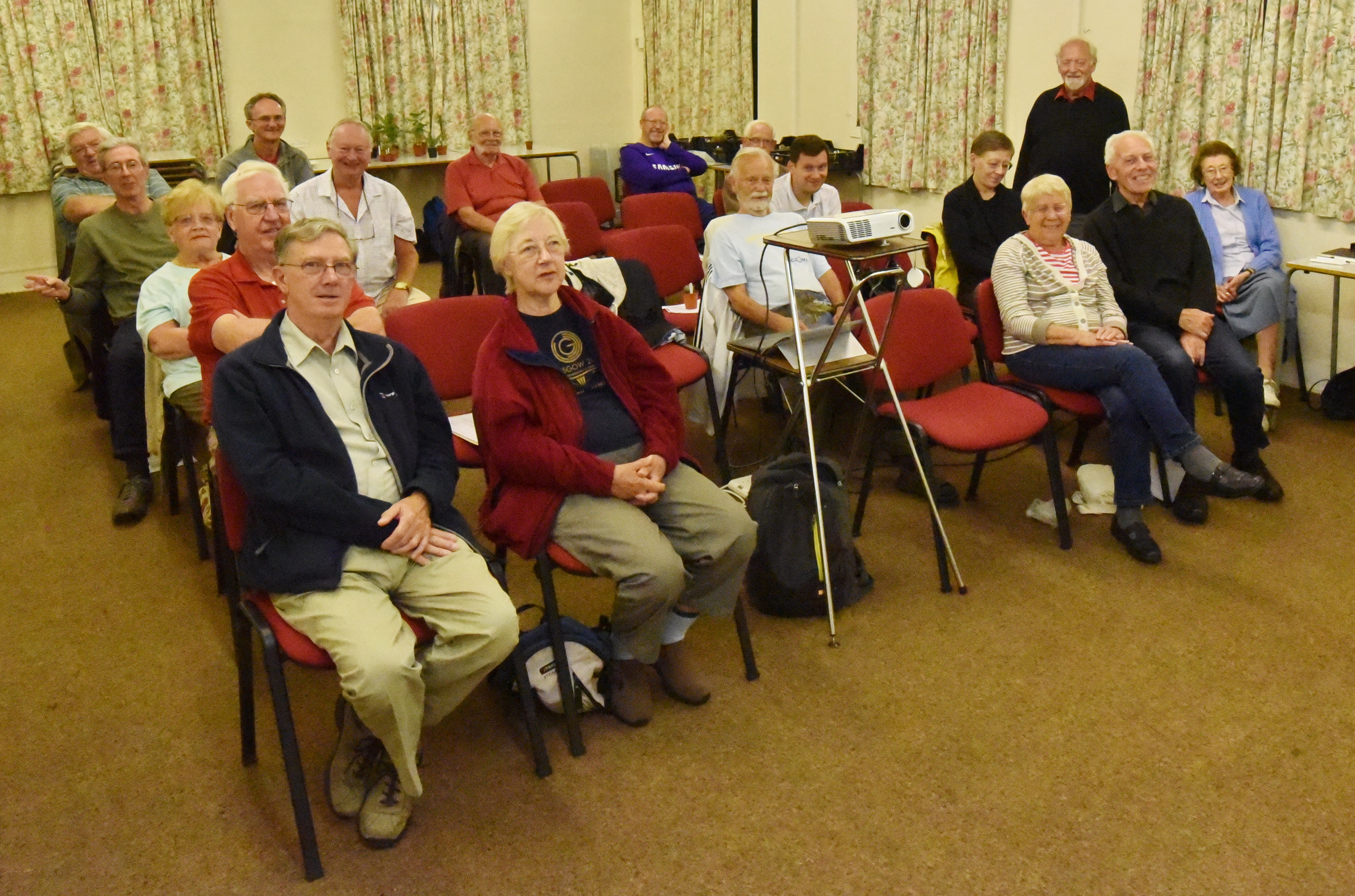
Another one of my regular annual appearances. For some reason I tend to refer to them as ‘Taunton Branch’ as they meet in the town by that name, in the County of Somerset. I’m due back again next year, assuming that travel plans do not get in the way.

BCSS Somerset Branch - Taunton

BCSS Somerset Branch – Taunton

As usual this year Part 1 of tonight’s presentation was ‘Presentations – Australian Succulenticon in Brisbane and February C&S Society meetings in California and Nevada’ and introduced the audience through my new hobby – pottery, inspired by seeing excellent plants in great pots at the USA meetings.

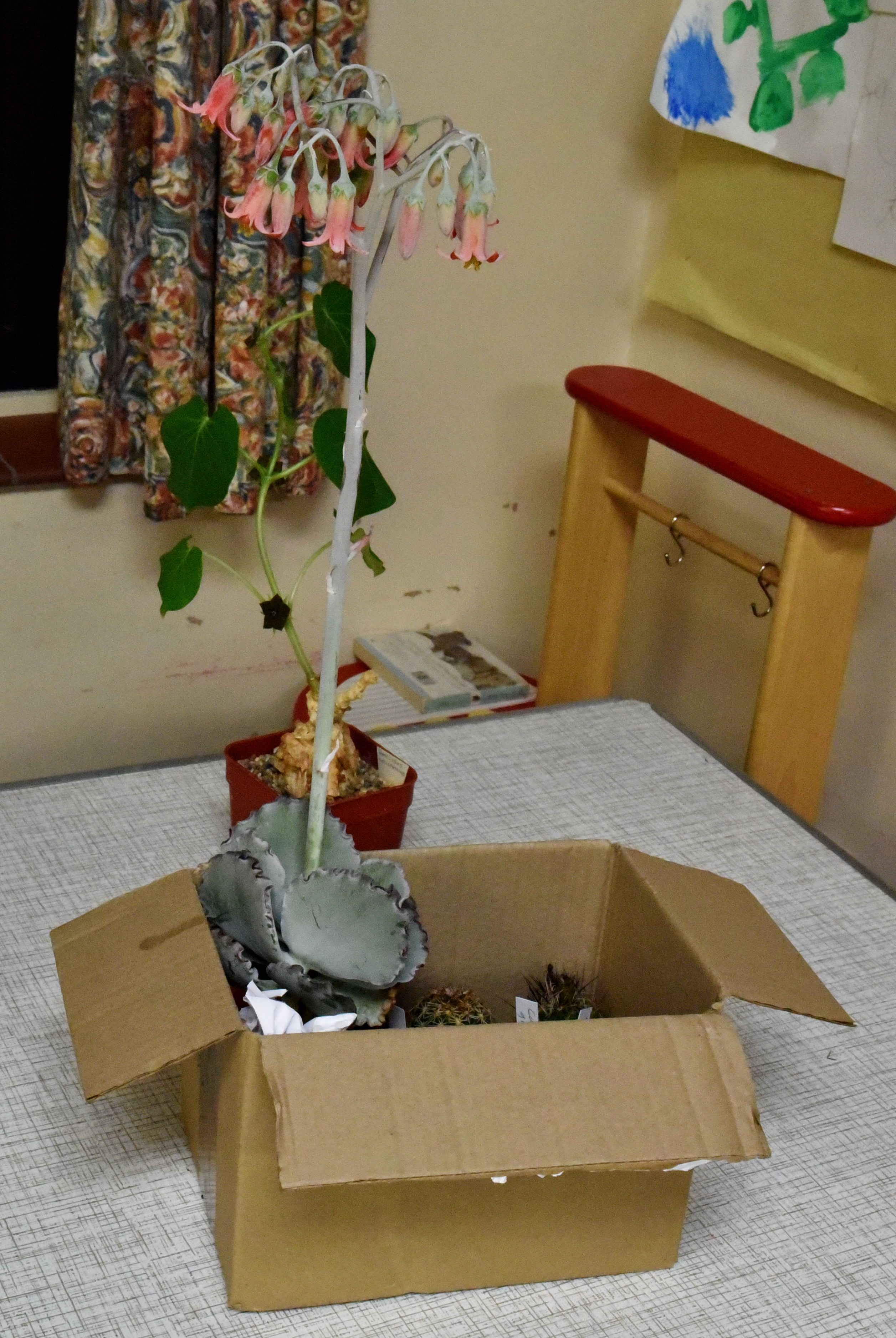
The Monthly Table Show (top left table in the background) featured a most unusual entry. Yes, it was in a plastic point but it would have been to check its pot size. The cardboard wrapping was aimed at protecting the plant in transit – the Crassula’s leaf was covered in attractive white farina. However, getting the plant into the box had proven more difficult than expected and its owner decided against taking the plant out of the box without damaging both plant and box. I awarded him second prize, even if under strict BCSS Rules I should perhaps have disqualified the entry. I believe that his effort to bring in the very nice plant should be awarded and checked with the Show Secretary that this was OK. I wonder if the plant had been potted in a heavier ceramic pot, reducing the risk of the pot toppling over, the cardboard box might have been redundant.

Table show entry I did not see a Novelty Pot class!

          Table show entry
I did not see a Novelty Pot class!

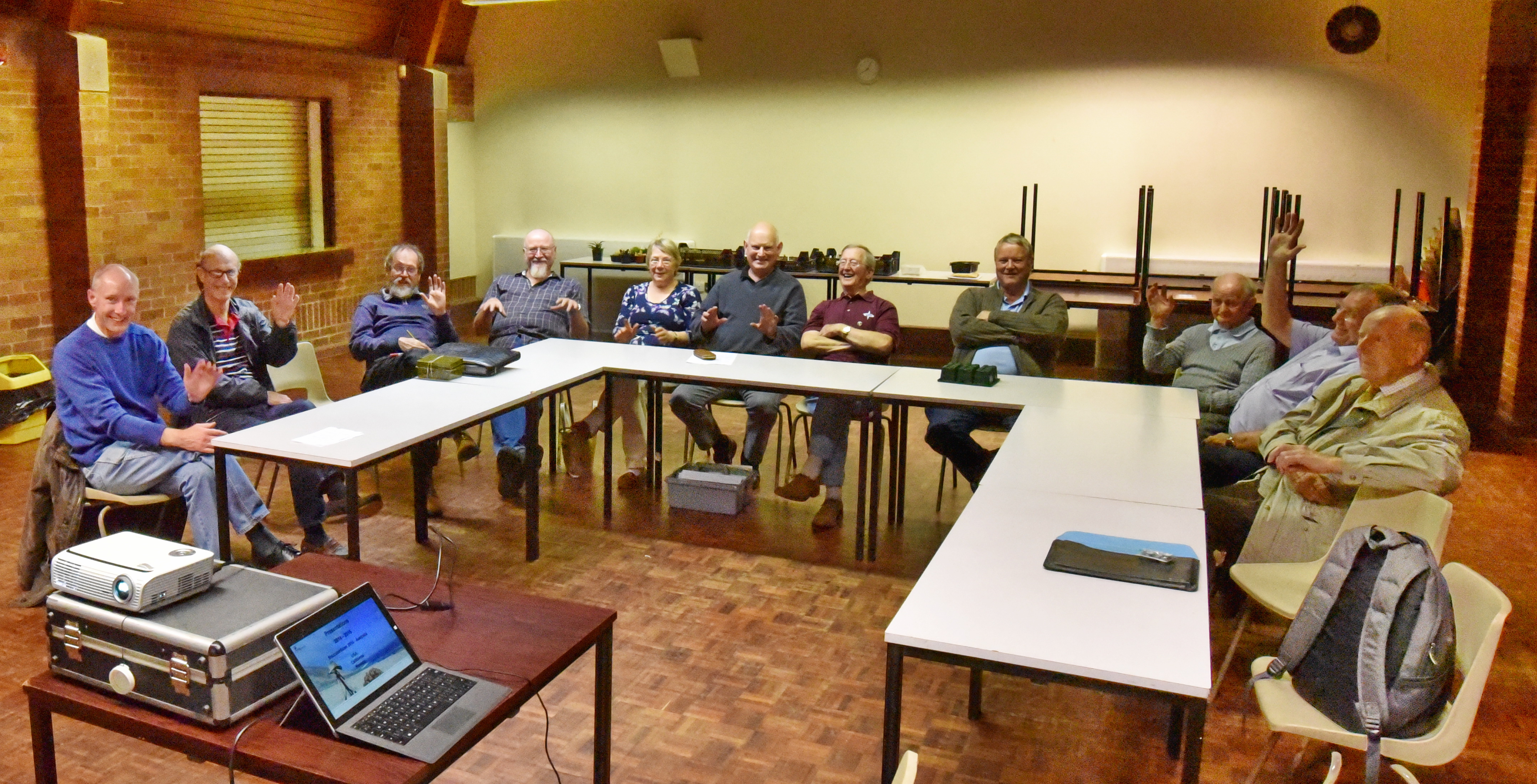
I am not quite sure when I first gave a presentation at Waltham Forest. I know that at the time I had to look up the address on Google Maps and was pleasantly surprised that although it was a fair distance away from home, I should be able to get back home at a reasonable time, some two and a half hours.

The journey from home was the usual night mare to be expected on a Friday afternoon on the M3 and M25, the London ring road. It took 5 hours and I arrived 10 minutes after the members had opened the hall, leaving 20 minutes to set up – ample time. It should take much less time to get home on empty roads.

Not this time! Just 45 minutes away from home, on the M3, we were unceremoniously directed off the motorway. I lost the diversion signs after the third roundabout with SatNav being very sure that I should go back and pick up the blocked road again.

BCSS Waltham Forest Branch

                                                BCSS Waltham Forest Branch

As in previous years, my second ‘gig’ of this mini tour of The Potteries took me to Stoke-on-Trent where a friend of many years, Maurice Williams would be my host. The number of glasshouses had greatly increased since my last visit a few years ago. The main feature was still a large collection of Matucana. There were many plants that looked very similar but with large labels recording many of the locations where the ex-habitat plants had come from – very mature plants from the days when it was still legal to import such plants and younger plants raised from ex-habitat seed a real collection aimed at studying the plants and to learn the similarities and affinities between the taxa and how to distinguish each from the other. I have a similar, but much smaller collection given to me by my good friend Bart Hensel from the Netherlands.

As is the case with most hobby collections the rarest thing to find is ‘Space’ Although I have visited Peru, they area where we travelled south of the capital Lima, the Matucana occur farther to the north and to the east. Another good friend, Leo van der Hoeven, had shown me pictures of his Peru adventures, one of which had been with Maurice, so I was at least in broad terms familiar with the genus and its habitat.

I grow my plants outside from mid-May to late September / early October, depending on when I set out on my own cactus adventures. During the winter, the whole collection is squeezed into my conservatory where the display crates are placed on racks, 3 to 5 shelves high with every other window panel able to tilt or fully open to provide plenty of air circulation as and when the weather allows. My new pottery hobby encouraged me to combine a stock take with an exercise of moving some plants from sometimes oversized plastic pots and trays into smaller ceramic pots. When I looked at the dozen or more Matucana haynei and M. weberbaueri taking up my display trays and wondered how they would all fit back into the Conservatory in months to come. I decided to surprise Maurice and make him a gift of these plants. Sadly, most had lost their labels – not important for an expert who had grown the many plants in the genus for many year. Sadly, with the names, the all important habitat data had also gone. Still, Maurice had soon found enough space to give my gift (originally Bart’s gift) a good home and once thoroughly studied might join the sales plants and perhaps benefit the Branch.

After a nice bite to eat at the local Toby Carvery we thought that we might be pushing it a bit, arriving at 19:10, but in fact turned out to be 20 minutes early.

Again the What I Saw Last Winter turned out to be a great success and resulted for another visit this time next year that I was happy to accept, subject to my travel plans falling into place.

BCSS Stoke-on-Trent branch

       BCSS Stoke-on-Trent branch

After the meeting we returned to Maurice’s where he impressed me with a nice bottle of Italian wine – I normally prefer Chilean Cabernet Sauvignon or Argentinian Malbec must will readily admit that I am by no means a wine buff and that much of the pleasure comes from the memories of visits to the countries where the wines hail from.

As the sun was now in a better angle we returned to Maurices greenhouses where it seemed that not only had his collection grown, but also the range of plants that now included Ariocarpus, Thelocactus and Stenocactus/Echinofossulocactus, many with ex-habitat information before setting off on my journey back to Wiltshire.

Maurice Williams and part of his collection of Matucana

Maurice Williams and part of his collection of Matucana

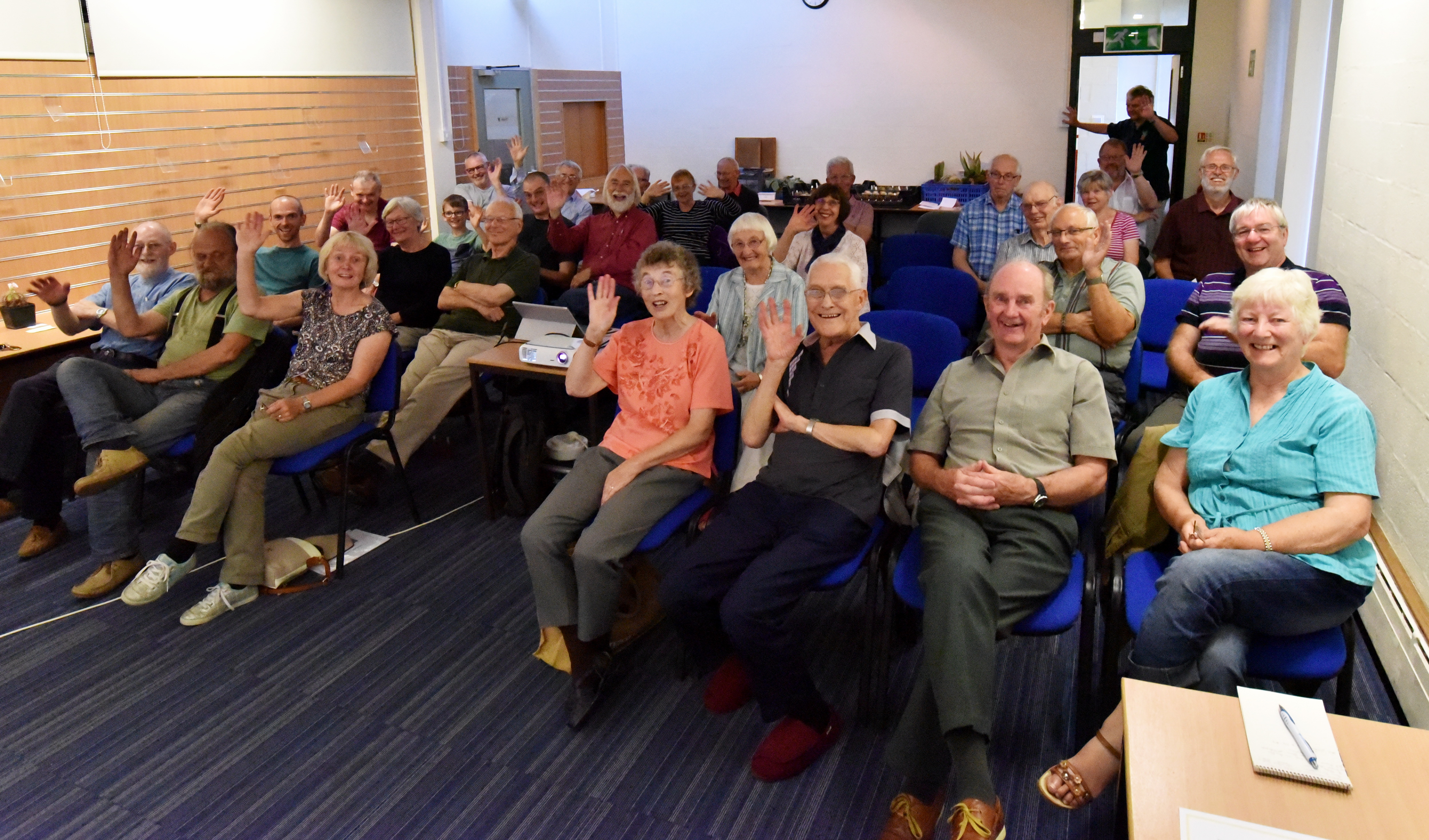
BCSS Macclesfield Branch

                                   BCSS Macclesfield Branch

The Macclesfield Branch is the first of my annual trip to the Potteries – an appropriate name given my new found interest in pottery, related of course to cactus pots.

It just so happens that my recommended supplier of clays is Valentine Clays who are based in Stoke-on-Trent. They were extremely helpful when I returned from my little speaking tour in California, where I picked up the Pottery bug and after some research came up with suitable clays available in the UK that compared to the clays used in California by Tom Glavitch who was kind enough to give me some insights to making the pots he makes. ‘It really is no rocket science!’ he told me, before admitting that he work at the Mars Project for NASA. However, he is not on the rocket building side! He also warned me that the first 1,000 pots that I’d make would not be good enough to use, but probably due to the teaching of our private potter in the UK, Jennie Gilbert, my first eight efforts have all proved good enough for me to use for plants in my own collection.

So it comes as no surprise that I made a quick visit to Valentine Clays to buy a special clay that I had seen a sample of at their Exeter distributor. Time only allowed a brief visit but it was good to check out the place as it is a small but well stocked industrial unit rather than a large shop and showroom where I could have shopped for pottery tools and some of the pottery samples displayed on their website. I had planned to come back on the way home if there had been any exciting browsing facilities.

I arrived at my hosts for the night, Margaret and Alasdair Glenn. One of the nice aspects of my presentations is the great hospitality I am treated to at every branch. I really don’t want to single out any one in particular as I’m bound to overlook somebody but will mention any special collections that I come across and where I obtain permission to share the experience – not everyone is willing to show off their plants – unfortunately there have been some incidents where plants have been stolen.

The next day Margaret and Alasdair take me around some member collections and this time, as often in the past, we visited the collection of Chair Person Julia. She has a large Auracaria tree in her garden and in the past had given me fruits (or are they seeds?)  that sadly failed to germinate. This time I was given some seeds that had already germinated in the tray where they had been left and forgotten after coming from the tree. They have been potted and look to be enjoying life.

These visits are often followed by lunch at a nearby pub. This time, due to a comedy of errors I lost contact with the lead car, turned back to Julia’s who had already disappeared. The nearest pub/restaurant with the same name was reported by SatNav to be 51 miles away – so clearly not where we supposed to lunch. I do not possess a mobile phone, so had no numbers to contact or anything to contact them with – phone boxes have all but disappeared and if found are usually vandalised.

So I resolved to go to my next contact point in the hope that he would be home so early – he was!

Original Publication

Copiapoa ahremephiana N.P.Taylor & G.J.Charles Syst. Init. 13: 15. 2002 [Apr 2002]
Cactaceae Systematics Initiatives: Bulletin of the International Cactaceae Systematics Group. England

Original Description

‘Full descriptions, illustrations and commentary for two new species from the Quebrada Botija will be published in a forthcoming issue of the British Cactus & Succulent Journal. Names for the species are validated below, with grateful thanks to Mrs Christine Barker (Herbarium, K) for checking the Latin diagnoses:

14001 Copiapoa ahremephiana N.P. Taylor & G. Charles species nova fortasse C. cinereae affinis sed habitu dense caespitoso et caulibus 3-4-plo minoribus pulvinos hemisphaericos formantibus differt. Holotypus: Chile, Antofagasta, c. 70 km N of Paposo, Quebrada Botija, Caleta Botija,Ferryman RMF 53 (K, in spirit).’

note: the promised article was published in BCSJ 22 (1) 23-27

Distribution (Map)

References in Literature

The Chileans: 16(53):86 Finding which sort of Copiapoa?
The Chileans: 16(53);91 Copiapoa paposoensis
The Chileans: 17(55):10a
Copiapoa variispinata
Roger Ferryman suggested that the Copiapoa sp., now known as C. ahremephiana, may be Ritter’s Copiapoa rarissima.
The Chileans: 17(55):10b The Quebrada Botija
Schulz, R & Kapitany, A, (1996) Copiapoa in their Environment The authors were at the time of the opinion that C. ahremphinana was in fact Ritter’s C. varispinata
Charles, G (1998) Copiapoa, Cactus File Handbook 4:6 Reports that the plant in circulation under field collection number RMF 53 needs to be described as a new species.
Doni C (2001) Quebrada Botija, Cactus & Co V (4) 211-218
Rebmann, N (2002) Copiapoa sp. nova Botija Valley, Succulenta 25(2):30-31 as C. ahremephiana
Charles, G (2004) The identification of the Copiapoaspecies from Quebrada Botija, Chile BCSJ 22 (1) 23-27 as C. ahremephiana
Hunt D. (Ed.) (2006)
The New Cactus Lexicon
as the most northern member of the cinerea group.
Schulz, R (2006)
Copiapoa 2006
as C. ahremephiana
PK Comments

The official naming of the species at the mouth of the Botija Valley was very welcome. Our impressions on visiting the habitat on two occasions in 2001 was of a plant that, in habitat, was unlike any that we had seen before (or afterwards).  However, I was very surprised to see plants raised in the UK from habitat seed – their appearance in cultivation is so different from the plants in habitat, that they may as well be different species – which, uncomfortably, brings us back to possible links withC. varispinata.

Copiapoathons: We saw Copiapoa ahremephiana at Caleta Botija and at the mouth of the Quebrada Botija, recorded at:

S0050
S0066
S0139
S0140
S0142
S0284
S0665
S1949
S2842
S2928

All material, except where otherwise credited, is Copyright
© 2001-2015 Paul Klaassen

Oops, quite a break since my last posting so suffice to say that I’ll fill in the gaps in days to come and confirm that I’ve arrived safely back in the UK where Spring has arrived causing an explosion of tree pollen so that I’m again battling itchy streaming eyes with antihistamine tablets.


Thanks for your patience.

After my last breakfast at Denny’s for a while, Eunice went to church and left me to do battle with my newly acquired books, pots and shopping from the Palm Springs Outlets. The check-in luggage was still some 4 kg below the permitted 23 kg limit, but needed quite some effort to close. My hand luggage now included a small roller case filled with pots, my ‘laptop bag’ filled to bursting with clothes and two large DSLR cameras in their cases. Although the weather was overcast, it was still warm enough not to need the jumper and jacket I would have to wear as they would not fit in my luggage.

At the Air New Zealand check in desk, I got even warmer as the check-in hostess refused to put an ‘approved hand luggage label’ on my roller bag. ‘See what they decide at the departure gate’ she said.

As our departure time approached, I was reassured to see many passengers with more items and larger sized items of hand luggage around me, only to become worried again when they went to the first and business class gate, where such things were permitted. In the end, the staff at the gate offered to add my roll on case to the check in luggage without any extra charge. I could only hope that the pots were strong enough to survive being thrown around.

We left 20 minutes late, but there was a strong tail wind so that we were still on schedule to arrive forty minutes early at Heathrow.

Why on earth would I go back to a place that I had visited so often? Well, because a review of previous visits revealed that there were still two species – one Mammillaria and one Dudleya that had somehow escaped my camera – Mammillaria tetrancistra and Dudley saxosa to be precise. The second reason of course is that we would pass Santa Ysabella where the Julian Pie Company serves up their excellent Apple Pie and may even sell you a whole one to have a second helping when you get home. Sadly we had completely run out of Apple Pie at Eunice’s kitchen.
Eunice had looked up location data on the on-line Jepson database from which I had made up entries on Google Earth, both for San Diego County (in and around Anza Borrego) and San Bernardino (in and around San Bernardino Co = Mojave State Park).
I selected just three locations from Google Earth based : a) on date, I did not want to check data reported in 1920 if there were locations available from 2009 b) on location: Anza Borrego is large and it would take several days to visit all spots. So I picked the first three along the 78 from Santa Ysabella (where a peach and apple frozen pie was purchased plus a slice of Apple-Dutch for lunch) and on to the first stop (data from 2009).
We pulled up in the first lay by after the location marker on SatNav, nearly a mile on (S3252). Lots of Echinocereus engelmannii here, clearly ready for the new season after having enjoyed some rain, but no obvious signs of buds yet, although based on previous visits, I expect them to be in full flower in a months time. There were also lots of Cylindropuntia, C. ganderi, not the prettiest in the genus. And finally, found by Eunice, a four headed plant that could be M. tetrancistra, but I’ve been caught out by look-alikes before elsewhere. How many central spines? 3-4? Difficult to tell, at least 2-3 dark spines per areole, but there were ‘invisible spines, that suddenly became visible when viewed from another angle. No flowers, but then it was too early for most other cacti to flower. I’ve learned since that this taxon has a different flowering season to the other cacti in the Park, waiting to the monsoon season in August, in Arizona before producing its flowers.
We went back to the actual location coordinates (S3253) and were able to park off the asphalt on the other side of the road. There was an outcrop of granite-like stone that had a number of Ferocactus cylindraceus growing on it, as well as all the cacti previously spotted. I walked up to the largest Ferro and found the first Mam. consistent with those found at the first stop. I wanted to take a shot of a group of young, still globular F. cylindraceus plants, but old enough to be full of yellow buds. I slid down the hillside to get a better angle and slid past three more M. tetrancistra and the first Dudleya saxosa, then a second and a third. I called Eunice over who found another growing almost in a clump of Echinocereus engelmannii, so success on finding both of today’s target plants. So why am I now confidently calling our find Mammillaria tetrancistra? Because just as I was about to cross the road on my way back to the car, Eunice called me back as she had found a plant in fruit with the characteristic large seeds inside.
We took a look at the second location (S3254), but this dated back to 1928. Earlier we had turned on the old, now out of use, CA78 and this had been narrower road – probably the 1928 version was little more than a track. Today’s main road had no space to pull over and was flanked by steep hillsides. Time was ticking on and if there were plants here, they would be in deep shade.
It was a good three hours drive back with the last hour in the dark, which Eunice did. After feeding Bosco (and my first attempt at a report) we went for dinner, again at the Lazy Dog restaurant which serves and excellent ‘Cadillac’ Margarita with a range of burgers and steak. It had become a regular place for dinner, outside, although tonight with the welcome help of an overhead heater.
Eunice had suggested a visit to one of the off-shore islands to look at some endemic Dudleya for Sunday, but the forecast suggests a drop in temperatures to 11C and a 50% chance of rain. We’ll see.
Early start tomorrow for a visit to Jürgen Menzel in the morning and to Steve Hammer in the afternoon.