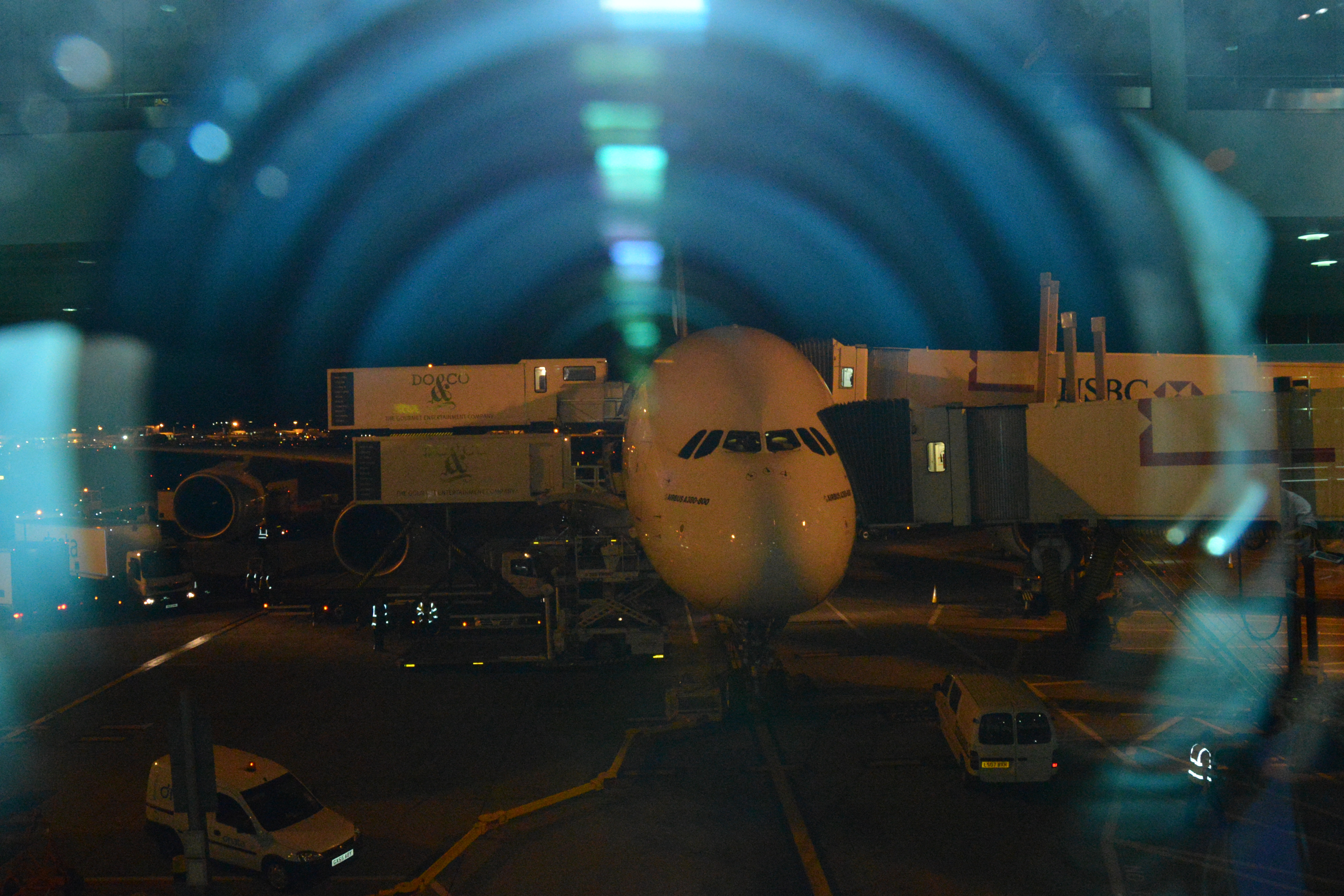
Just another WordPress.com site

The small family run Clanwilliam Hotel was full to the brim. We had been lucky to have found beds for the night as there was a large family wedding this weekend with many guests spending the weekend in town. At first our request for beds had been met with hesitation, but by moving some family members together they had freed up a triple room for the boys and another room, not usually used for guests, as a single for Eunice.  Unfortunately there was no wifi for the guests, so that this is where the backlog of my Diary reports from the field began. This was particularly frustrating as we could see a signal from the Clanwilliam Hotel router, but this was a secure network and the owners were not prepared to share its password with us during our stay. Shame.

Clanwilliam seemed a very quiet place, until I realised that my cold had impacted on my hearing and I was hearing things as if I was at the bottom of a swimming pool.

Today we had planned a day around Clanwilliam that resulted in 5 stops. We headed east out of town on the R364 and stopped on the ascend to the Pakhuispas (S2567) as David and Eunice had spotted clumps of Euphorbias (E. loricata and E. tuberculata) along the road, as well as the by now apparently omnipresent Tylecodon paniculatus. I recorded this plant at a total of 22 stops, and probably saw, but did not photograph it, at many more spots leaving me under the impression that it is one of the most common succulents in the Western and Northern Cape, also stretching into the little bit of the Eastern Cape that we saw, as far east as Graaf-Reinet and close to Port Elisabeth. I had heard that this plant, and other Tylecodon species were threatened as they were being removed from grazing land by farmers, as they are attractive, but poisonous to cattle, sheep and goats (and humans) due to poisons that can affect the nervous and muscle systems, causing ‘krimpsiekte’ (cramp disease) that can kill those that ingest parts of the plant. These poisons are also found in the closely related genus Cotyledon that are similarly removed if found by farmers. The extend of their range and the numbers that we saw gives the impression that they are as common as weeds and are far from being threatened with extinction. If, however, mankind should put its mind to eradicating these plants for economic reasons, than their numbers might well decrease.

S2568 was farther along the R364, near Soldaatkop (Soldier’s Head) rock on the Pakhuispas. Here we found an Aloe sp., Euphorbia loricata, a Pelargonium sp. and a Conophytum suggested by David as C. comptonii. There was also a strange but photogenic non-succulent plant: large very shiny leaves that seemed to cover the soil on which the plants grew like cling-film. A bit of searching soon revealed this to be Arctopus echinatus, a geophyte with spiny leaves. Finally, hiding in dark ledges in quite damp conditions grew a not particularly succulent Crassula capensis.

Arctopus echinatus

Arctopus echinatus

Farther along the R364 – east of the Pakhuispas we made another stop (S2569), this time for some wildflowers. The GPS data embedded in the images that I took, plotted onto Google Earth once I got home, reveals that we were 770 m west of  the grave of C Louis Leipoldt.

We took a track off the R364 for S2570, offering some nice views over Clanwilliam. Here the new plant on my list was Tylecodon wallachii. Again, due to novelty value and my ignorance, I took probably too many pictures of these plants, but like T. paniculatus, this would be another plant with a huge distribution area over which it was seen in large numbers. The long finger-like succulent leaves and the phyllopodia (swollen leaf bases – yes, I had to look that one up too) that are left on the stem as the leaves shrivel away as Spring turns to Summer, make it a plant that is easy to distinguish from the Boterboom.
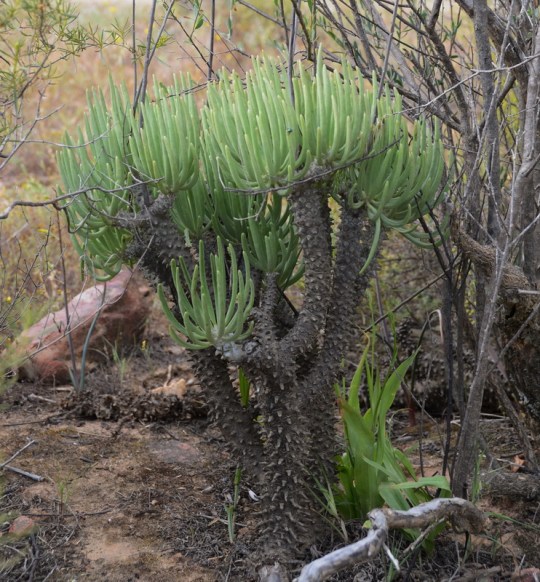
Tylecodon wallachii

Tylecodon wallachii

At S2571 the two Tylecodon species were growing side by side and the new kid on the block was Anacampseros retusa, a genus of which we would see other examples in weeks to come.

I’m not quite sure how I managed to get through the day and my memories of the day are somewhat vague as by now I was running a temperature, but kept telling myself that there was no time to be ill.

I discovered that the D600 works very well in point-and-shoot mode and, as I was still using a DX zoom lens on an FX camera, found the area that the camera could see, which is larger than the framed area in the centre of the view finder that will become the images when the shutter is pressed, quite useful in deciding if the composition could be improved by zooming in or out. With the D300 I tended to fine tune images quite often to reduce the exposure, contrast and fill in lighting. With the D600 I find the need to adjust images rarely, after setting the exposure to under-expose by one-third of a stop. No regrets at the impulse purchase.

 

Today our trip started properly. Instead of taking the N7 main road between Cape Town and Windhoek in Namibia, which would have taken us to Clanwilliam in just over three hours, we decided to take the slightly longer, scenic route via Paarl and Citrusdal, land of orchards.

We made six stops, having to turn off the main road to find opportunities to park the car.

S2561 was north of the village of Saron to photograph fields full of white and purple coloured wildflowers and bulbs. [PS: Although I have copies of John Manning’s excellent Wildflower book and The Colour Encyclopedia of Cape Bulbs by Manning, Goldblatt & Snijman, I’m prioritising finding IDs for the succulent plants that we saw but hope to come back to wildflowers and bulbs in months to come.]

At S2562, a little farther up the road, I did at least recognise bulb flowers from the genus Albuca that I had photographed (including labels) yesterday at Kirstenbosch.

After a hamburger and cola lunch, we took a turn west, signposted to Paleisheuvel (Palace Hill) and stopped for more wild flower photography (S2563). Here we spotted the first member of the Family Geraniaceae of the trip. I hope to see Sarcocaulon / Monsonia and had bought Charles Craib & John Lavranos’ book ‘The Bushman Candles’ that neatly sidesteps what to call these plants. I’ll be calling them Sarcocaulon in these Diaries. However, the plants here were not that genus. Pelargoniums? With 280 species in that genus, this plant too will take a while to ID. [PS: Pelargonium triste]

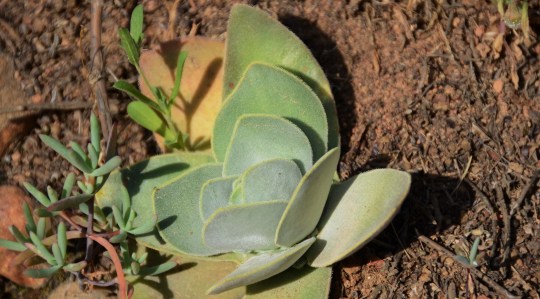
Next we took a track up the Middelbergpas, where under heavy clouds despite light drizzle and strong winds we made another stop (S2564) and I introduced my camera to its first succulent plant, probably an Adromischus (note to self: ask Father Christmas for the John Pilbeam, Chris Rodgerson, Derek Tribble Adromischus book).  Derek has a very useful website at http://myweb.tiscali.co.uk/adrodisp/ that covers lots of information about the genus from which I learned that identification of the 47 taxa in 5 Sections relies heavily on different flower structures. Great! Throughout our trip I saw no plants that I suspect to be members of this genus in flower – just dead flowerstalks, broken off around some 15 cm (6″) above the plant. So it’s down to searching for images that might provide a match and Google searches for genus + nearest town name to see what crops up (aka geographical botany, not perfect!)

Adromischus hemisphaericus near the summit of the Middelbergpas.

Adromischus hemisphaericus near the summit of the Middelbergpas.

I had a molar extracted a few days before our flight from the UK and the after effects were still bothering me. [a few days later this turned into a nasty sinus infection] so pointing my camera from underneath the hood of my jacket in a cold wind and drizzle I was not enjoying my first plant experiences of Africa. Fortunately I continued to take pictures so that I am now able to enjoy this stage of our trip.

We moved on, with me dozing in the back seat, until we stopped alongside a large lake, a man- made lake in the Olifants Rivier, created by the Clanwilliam dam (S2565). The weather had dried up again and there was some late afternoon sunshine as I photographed the Boterboom (Butter Tree, Tylecodon paniculatus), which is not a tree at all but rather a stem succulent in the family Crassulacae of some 1.5m  (5 ft) in height. The plants were in full leaf but, as we would hear many times during our stay, South Africa had experienced the wettest year recorded during the last fifty years, with the previous year also much wetter than usual. So while I was happy to take some nice pictures of this plant, I was disappointed that the fat stem, that is the reason why the plant is grown by hobbyists, was here largely obscured by other vegetation.

One thing that I was unsure of, through ignorance, for most succulents that we were to see, was how common or rare the plant in front of my camera was. So I treated each occasion as may be the only opportunity to take their picture. We were to see Tylecodon paniculatus many more times in weeks to come and I did get some nice shots of the exposed stems later in the arid areas in the north.

There were also some nice Crassula sp. here, with a thin row of hairs along the leaf’s edge. I’m provisionally calling it C. tomentosa, but am open to alternative suggestions.

Crassula tomentosa

C. tomentosa is reported to be a variable species.

It was more of the same, plant wise at the last stop of the day (S2566), farther along the reservoir.

Not a bad crop of images for the first day, despite me feeling like death warmed up and with weather conditions not what we had expected. It could get a lot better!

Today was an aclimatisation day, after yesterday’s flying day.

After a good night’s sleep and a leisurely breakfast we made our way to the Kirstenbosch National Botanical Gardens, a great opportunity to see South African flora with labels! Heavy overcast skies, Table Mountain hiding in the clouds and the occasional light drizzle made the Brits feel right at home. Eunice had been expecting Californian weather, but at least her UK all-weather gear could be put to good use.

We started off in the dry, under glass in the impressive glasshouse that I had become familiar with over the years from talks by other plant tourists. As if on queue, Ernst van Jaarsveld walked in, escorting a lady to the Welwitschia house where she was preparing some art work. Ernst promised to return and gave us somewhat of a guided tour including some of the glasshouses that are normally off-limits to visitors. Thanks Ernst, for taking the time to show us around.

Fortunately the weather had lightened up a bit so we ventured into the garden proper with its impressive setting at the foot of Table Mountain offering glimpses over Cape Town lower down the hill.

We finished off with a visit to the souvenir & bookshop to prove that my credit card worked in South Africa.

Tomorrow we head north and hopefully drier, warmer weather.

[This is the first of the catch up Diary entries after returning home safely to the UK]

We arrived in Dubai Airport in the middle of the night but despite the air-conditioning it was already very hot, but then I was of course still dressed for UK autumn weather with my jacket-with-many-pockets to extend my ‘hand-luggage’ allowance.  A quick look in the camera shop revealed that the D600 had not made it this far yet. I had feared that I could have bought it here at an even greater saving, so in a way, a result!

By 8:50 local time we were back in the air. The second leg of our journey was in a Boeing 777. Not quite the comfort ride of the A380, but still better than most long haul flights that I’ve been on.

We arrived safely and on time in Cape Town, around 16:25 local time for the usual queue snaking towards immigration and passport controls. Why are half the desks always unmanned? It would greatly enhance the welcome experience on entering a country – first impressions do count.

Just like Phoenix Airport, last April / May, the car rental companies were all housed in a separate building, but here we had to carry our luggage through an underpass. As usual it took a while to process the paperwork for our 9 week rental – done in two slices to overcome the problem of a maximum rental period.

Cliff took the steering wheel of our home for the coming two months, a Nissan Xtrail, and got us safely to the Upper Eastside Hotel, a modern and comfortable hotel where the car was safely tucked away in a multi storey underground car park in a neighbourhood undergoing a much needed facelift.

Our room offered a view to the Grote Schuur Hospital, the famous hospital where Professor Christiaan Barnard performed the first heart transplant operation. Set back a bit farther was Table Mountain, with a ‘table cloth’ of clouds covering the top. My UK autumn gear was not so silly here as the weather was as cool as an average spring day in the UK. TV weather reported a weather system coming in from the south (i.e. antarctic, still very cold this time of year).


Despite a morning of last minute panic of packing, while trying to get the last plants into the house for winter, I still managed to leave home without the boarding pass that I had printed off yesterday. Eunice Thompson saved the day by being able to download the boarding pass onto her iPhone and so we arrived in good time at Heathrow Terminal 3 where we met up with Cliff Thompson and David Neville.

Thanks Angie, for doing the annual airport run. At least next year you’ll be coming with us.

As some of you may know, I’m a bit of a camera nut and for the last 18 months had been searching on Nikon Rumours for details of a new affordable replacement for my D300. Well, about a week ago, the D600 was announced at Photokina in Cologne and said to be available in the UK from 18 September. Usually these are ‘wish dates’ rather than reality. The price was also higher than I was prepared to pay, so imagine my pleasant surprise when Eunice pointed out that the tax free camera shop had it in stock – body only, at more than GBP 400 below UK internet prices. Too good to miss, so I’m dragging yet another camera around.

Nothing else to report, except to say that Emirates gets my vote as my favourite airline. It was my first flight on an Airbus 380 (Thanks to Brian & Rene for spotting my dyslexic keyboard), the double decker monster that has the potential of making boarding and disembarking a nightmare, but it all went remarkably smoothly – well done! Comparatively spacious seating, much better than the usual flight food and excellent soundproofing. A very smooth flight.

Tomorrow we land in Dubai for a 2 hour stop over.

Our home LHR to Dubai

Our home LHR to Dubai

One month to go!

In exactly one month’s time we should be arriving in Cape Town in the Republic of South Africa. During the nine weeks that follow we’ll be travelling through the western provinces of South Africa and Namibia in search of interesting succulent plants plus anything else that we’ll see that seems worthy of having its picture taken.

I’m particularly looking forward to seeing the famous fog of the Namibian Desert as it will compliment what I saw in the Chilean Atacama Desert and in Baja California.

The outline of the trip is best seen in three phases:

Phase 1 is the journey from Cape Town to the border with Namibia

Phase 1 – South Africa

Phase 2 covers our time in Namibia

Phase 2 Namibia

Phase 3 sees us back in South Africa, traveling a bit more slowly through the famous areas that we’ll have driven through at the start of the trip: The Richtersveld, Namaqualand, the Knersvlakte etc before heading east as far as Somerset East. From there we’ll head back to Cape Town and the flight home on 20 November.

Phase 3 - back to South Africa

Phase 3 – back to South Africa

To follow us on a day by day account of the trip follow this link to

19 September 2012

Summer 2012

With the USA 2012 trip behind us, Angie & I start looking forward to the next six months.

I’ll be working on putting together a 45 minute presentation with the highlights of USA 2012 which together with a 45 minute presentation of Bolivia 2011 will form What I Saw Last Winter 2011-2012.

Angie has been invited to give 8 presentations as well this year including our first combined presentation, where we do a 45 minute programme each.

Our dates for 2012 are:

18 February Angie: California   & Arizon 2011 BCSS Portsmouth   Branch
21 Angie: California & Arizon 2011 BCSS Bristol
5 March Angie: California & Arizon 2011 BCSS Crawley
1 April What I Saw in   Mexico  – Baja Cactus and Succulent Society of Malta
What   I Saw in California
What   I Saw in Brazil – Rio Grande do Sul
Where   I Saw – Eriosyce – Thelocephala group
Where   I Saw – Eulychnia
What   I Saw in Chile – South of Santiago
3 What I Saw Last Winter 2010-2011 BCSS Lowestoft
4 What I Saw Last Winter 2011-2011 BCSS Norwich
10 May Angie: Frailea   hunting in Rio Grande do Sul BCSS Kingston-upon-Thames
12 Angie – Arizona & California 2011 BCSS Gloucester
26 What I Saw Last Winter 2011-2012 BCSS Woking
5 June What I Saw Last Winter 2011-2012 BCSS Southampton
6 What I Saw Last Winter 2011-2012 BCSS North Devon
7 What I Saw Last Winter 2011-2012 BCSS Exeter
8 What I Saw Last Winter 2011-2012 BCSS Cornwall
9 What I Saw Last Winter 2011-2012 BCSS Plymouth
11 What I Saw Last Winter 2011-2012 BCSS Eltham
14 What I Saw Last Winter 2011-2012 BCSS Kingston-upon-Thames
16 A   trio of South American cacti BCSS Havering Branch
Angie: Arizona and California 2011
11 July What I Saw Last Winter 2011-2012 BCSS Cardiff
13 What I Saw Last Winter 2011-2012 BCSS Waltham Forest
14 What I Saw Last Winter 2011-2012 BCSS Isle of Wight
18 Angie: Frailea Hunting in Rio Grandedo Sul BCSS Somerset (Taunton)
20 What I Saw Last Winter 2011-2012 BCSS Coventry
21 What I Saw Last Winter 2011-2012 BCSS Reading
2 August What I Saw Last Winter 2011-2012 BCSS Hastings
13 What I Saw Last Winter 2011-2012 BCSS Macclesfield
14 What I Saw Last Winter 2011-2012 BCSS Stoke-on-Trent
15 What I Saw Last Winter 2011-2012 BCSS Taunton
23 What I Saw Last Winter 2011-2012 BCSS Brighton
18 September What I Saw Last Winter 2011-2012 BCSS Bristol

On 19 September, David Neville, Cliff Thompson, Eunice Thompson and I are off for our next plant trip, a two month journey through South Africa and Namibia that is planned to feature in What I Saw Last Winter 2012 – 2013.

We had to check out of Motel 6 by noon, but by around 11:30 we had enough of sitting in the small room without having had breakfast. Angie wanted to find a Columbia shop to buy some more lightweight – easy washable etc shirts and via the internet we learned there was such a shop at the Anthem Retail Outlets, 39 miles from the Motel. We had plenty of fuel left in the tank; our Platinum deal with Dollar meant that we could return the car on empty.

At least the shops were airconditioned but once again, the desert air was scorching at 96 F. I couldn’t resist a couple more shirts myself – they are so much cheaper in the US, especially in these out of town Outlets.  The Columbia cash desk recognised my name from last year in Palm Springs and gave me another $14 discount as a result of reward points collected on that occasion. Thank you – that covered the cost of one of my shirts!

The rental car pick up and drop off points for a comprehensive range of rental companies is found in its own ‘terminal’ with shuttle bus services from each of the four flight terminals to it. Very well arranged! It’s the first time that we’ve come across this – well done Phoenix!

Mileage at the drop off was 17,652. That means that with a mileage of 14,468 miles at the pick up, we had driven 3,184 miles during 20 days, so averaging just 160 miles per day.

We took off as the sun was setting, but the windows on the plane were not clean enough at this stage to take any worthwhile pictures.

When we plan our trips we’ve learned to build in some ‘escape’ options in case we should run into health or car problems that can cause unexpected delays. This includes arriving at your final destination in Cactus Country with a day to spare – just in case. This is when we fit in goals such as botanic gardens and the Desert Botanical Garden proved to be a great was to spend the day. For the first time this trip I managed to fill an 8 GB memory card, with lots of cacti and other desert plants, many in flower – S2558. In 2000, the late Ted Anderson, then recently retired as curator at the DBS, had agreed to be a speaker at the Derek Desborough Memorial Lectures then organised by the Crawley Branch of the British Cactus & Succulent Society. The day after the lecture I took him to the Holly Gate Cactus Nursery, then managed by Terry Hewitt, where we had a great day taking pictures that Ted still needed for The Cactus Family book that he was writing. As I dropped him off at the house he was renting during his stay in the UK, he said that we had to do this again at ‘his place in Phoenix’. Sadly Ted died in 2001, but I felt that he was there as we walked between the plants.

My pictures of Saguaros on earlier visits usually failed to catch them in flower, but this time, a bit later in the year, we had hit the jackpot. I always envied those who had taken pictures of birds feeding on the flowers’ pollen and here they were, doing their thing – I should have some great shots of them. Also of hummingbirds, feeding on Lobivia huascha from north west Argentina, of a ground squirrel that seemed intent on catching our attention by giving us a little performance right along the side of a path in the Gardens and of a Harris’ Antelope Squirrel climbing up Ferocactus to get to the fruits and seeds. Angie did even better by catching them on video.

Walking through the garden in the heat – temperatures went past the 38 degrees C (100 F ) mark and all the water we had brought had gone. By around 15:00 we were reduced to sitting in the shade sipping ice-cold Colas. Time for that other ritual at the end of the trip – the car wash! Compared to other trips, this had been a fairly easy trip for our Ford Escape and it had treated us well, but had picked up some dirt both inside and out, so we treated it to a valet make over, inside and out.

Back in Motel 6 we started to solve the riddle of how to get everything that should come back to the UK inside our luggage. Worn out walking boots and jeans were sacrificed and despite the fact that they were way past their best by date, we still felt a little emotional saying goodbye to these items that had served us well for a number of years. We’re old softies really.

Late tomorrow afternoon we leave for the UK where we arrive on Sunday. By Sunday night I plan to post the final report of the trip.

A quick look at the UK weather forecast for Salisbury, England makes depressive reading: 9.7 C max. So that’s what we’ll have to look forward to when we get home on Sunday! Better make the best of the days that we have left in the USA.

Cliff had suggested that if we saw Jim Gray’s Petrified Wood Company, we stop, as this is where, years ago, he bought some great T-shirts that by now had served their time and needed replacing.. And soon after leaving Motel 6, there it was (S2554). It’s a cross between a builder’s yard where mechanical diggers are used to help you to take your shopping (lumps of petrified wood – to be used as garden landscape features) to your car. Not sure what you are supposed to do when you get home – how do you get several tons of stone out of the car? Inside, it is a cross between a museum – with cut and polished pieces of wood, plus fossils and crystals from every corner of the planet. Some are just exhibits (although I bet that at the right price you could take them home) while others are for sale, some at outside our budget prices, some outside our flight weight allowance but some very suitable as last-minute souvenir shopping. They no longer sold the line of T Shirts that Cliff wanted. Oh well.

Right on the Holbrook City limits – in fact, next to the sign – we stopped again to adjust the luggage as there was something knocking against something else. When you’re stopped, you may as well look around for plants right? Before too long, Cliff had found a small cactus on the gravely soil, probably Sclerocactus whipplei. Unlike our stop earlier this week at Mexican Hat, here the plants had finished flowering. We found about a dozen plants. (S2555)

As we carried, on the road crossed through an area of flat sandstone terraces, similar to where in Minas Gerais, Brazil, we had found Coleocephalocereus aurea, although there the terraces were made of limestone. Anyway: cactus country, so at the first available place we pulled off – S2556. Angie soon found a cactus in bud – Echinocereus sp. probably E. fendleri. The usual rule of thumb is: where there is one, there will be others, but during the 2 hours that we enjoyed out in the sun, this was the only Echinocereus found.

Throughout the trip, Cliff & I had told Angie to look out for Toumeya papyracantha, a master at mimicking its environment and almost indistinguishable from the grass clumps found just about everywhere in the desert.. She was still not 100% sure what these plants looked like, so Cliff obliged by spotting a single individual without the grass around it. It had recently flowered but the fruit was not ripe yet.

Pediocactus peeblesianus had been reported from around Holbrook, so, encouraged by our Toumeya find, we carried on looking while the temperature carried on going up and up. Cliff announced a find over the walkie talkies – small cactus, in flower under shrub. It did not look much like P. peeblesianus, but Cliff believes that it looks like Escobaria missouriensis that he used to grow in England. [Note to self: look up how a plant called missouriensis – from Missouri – ends up in Arizona. Answer: because it occurs over a huge distribution area in Arizona, Colorado, Kansas, Montana, Nebraska., New Mexico, North Dakota., Oklahoma, South Dakota, Texas, Utah and Wyoming) and northern Mexico (Nuevo Leon, but strangely Missouri is not mentioned. Why?].

Angie found her ‘own’ Toumeya and another E. missouriensis in flower in an almost identical location, hidden underneath a small shrub. If not in flower, we would have walked straight by it and probably had passed by hundreds more. It seemed as though the area had enjoyed some rains a short while ago. The reddish sand in the cracks between the smooth sand stone rocks still seemed slightly moist. It seemed that the rains had washed some of the fine sand away to collects against rocks. As soon as the brain had registered this, I spotted two tiny plants that appeared to have been covered by this silt like sand and then had started to swell due to the availability of water. The had recently flowered but again, the fruits were not yet ripe.

Excited by these finds we had stayed perhaps longer out in the heat than might have been advisable. My mouth was getting very dry. Normally we would have carried bottles of water, but we had expected just a quick look around, so had not bothered. Back in the car we realised that we still had a good four hours to drive before reaching Phoenix.

S2557 was for images taken from the car, some 50 miles north of Phoenix, as the first Saguaros along the road. As we got closer to Phoenix we saw that most were in full flower, but there were no places on the highway to pull over and after the long drive, we did not look too hard – we still have tomorrow to take a look.

Another great day, slightly sad in the knowledge that all too soon we’ll be back home.