Just another WordPress.com site

Yesterday we had solved the puzzle of how to get to Geohintonia mexicana and Aztekium hintonii, at least in theory. We returned full of confidence and continued S2285 with images from La Poza up the track suggested by SatNav. It was not the widest of tracks – OK for one car at the time but two cars coming from opposite directions need to negotiate an overtaking spot, with steep drops to one side and the rocky cliff face on the other.

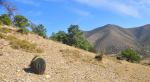
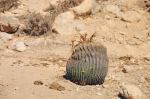
S2286 saw us arrive at a convenient roadside parking place some 400 m (according to SatNav) from the plants. Particularly when you are surrounded by masses of rocks, GPS systems can get a little confused when you’re practically on top of the coordinates. So it took a while before we were convinced that we were on the exact spot – no plants here. So we switched over to ‘manual’, or rather using our instincts. This took me to the top of a slow rising hill made of ‘white stuff’ lime stone or gypsum. It was very soft so that it was easy to see where water and hoof / foot prints had worn out paths. There were lots of tall Yucca and pine trees around – I guess the pine needles bring acidity to the very alkaline lime stone rocks. They make the rocks very slippery! Other vegetation on the rocks included the resurrection plant – Selaginella lepidophylla, looking from a distance like small globular cacti hanging from the cliff face. Half way up the hill I realised that some of the globular objects were in fact cacti – but not the ones that we were looking for. Nobody who has reported visiting this site mentioned other cacti – yet they are obvious to see, closer to the road. They do not look like typical Neolloydia conoidea, may be a Thelocactus conothelos form? A Coryphantha sp.?  Time will tell. But where were the stars of the show? Nowhere to be seen.

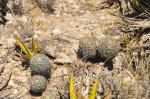
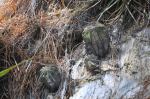
The late Keith Grantham had visited these plants in habitat during a Charlie Glass lead IOS expedition in the 90s. His pictures appear in The Plantfinders Guide to Cacti and Other Succulents as few of the habitat pictures. I was sure that he mentioned having to walk into a narrow canyon and sure enough there was such a canyon. It was a warm 27 C (80 F) on the exposed hill but near the canyon there was a nice cooling breeze. I was about to suggest trying a different spot when there, at my foot was a 4 cm (1.5″) globular cactus – G. mexicana!

I yelled my success to Eunice, some 100 m. behind. I indicated the size and where the plant was, which prompted her to look over the edge of the path where she stood: there was a group of seven plants right there! We spent at least an hour over this hill side, including my clinging on to narrow ledges to get face to face with the cacti. Only from close up could I tell the Geohintonia from A. hintonii. The farther we went into the canyon, the denser the plants grew together. There were a good few out of focus pictures in my shots, due to the gymnastics I had to perform to get near them. Eunice was more sensible and took equally good shots from near the foot of the hill.

Mission accomplished, we decided to find the excellent Highway 57, the main road south and head to Matehuala, crossing the border into San Luis Potosi.

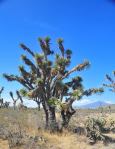
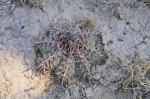
We made one more stop, S 2287, for a forest of tree-like Yucca and a leg stretch. There were some of the usual Opuntia, but also some plants that might be Echinocactus horizonthalonus. I was thrown by an a-typical specimen growing in the shade of a large Yucca. Whatever it is, it wins my prize for ‘best spination’ today (or probably this year! reminding me of Copiapoa echinoides near Totoral in Chile that had some very heavy spines.

Matehualla is a convenient town for a couple of days more exploring and we found the comfortable Las Palmas hotel right along the highway. Comfortable chalets, good restaurant and bar plus wifi in the rooms. Great. From here we’ll visit Aramberri and Dr. Aroyo etc. and the cactus locations that they’ve become famous for. 
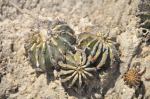
We agreed that today we would focus on finding Geohintonia mexicana and Aztekium hintonii. Our database had GPS coordinates to show that these two species shared the same habitat. The coordinates were not on any road that the SatNav system knew about. It sent us south along Highway 61 and suggested that just before Pablillo we should look for a couple of tracks east. All very well doing this armchair exploring, but it hardly prepares you for what you see. Yesterday proved that roads marked on maps as being of similar standard can vary immensely and that recent weather events can seriously change matters. Even road numbers change. What was marked as Highway 61 today used to be Highway 2 and is still marked as such on some roadside signs.

So it was good to find that today’s road was in tip top shape, apart from two short sections that needed to be scheduled for wear and tear repair work. We soon reached Pablillo and started our search for the expected track east – to no avail. Where SatNav showed a turning there was none. Where we found tracks, they took us through agricultural fields to dead ends at the foot of the snow white chalk hill sides. From there it became clear that our target plants must grow on the other side of the hills that we were looking at – far too far to hike.

What to do? Highway 61 leads to La Ascension and our records showed that there is a location for Ariocarpus retusus near the town. We decided to see what the road was like and to take a look around the town to see if there were hotels (no), Pemex stations for fuel (no) and banks (yes). It also boasted a couple of small pretty churches that were photo graphed. (S2281). But I run ahead of myself.

We had been seeing small shrub-like cacti along the road. An early toilet stop (S2278) confirmed that these were Cylindropuntia tunicata in really good shape. We took a few pictures and had hardly moved on when we screeched to a halt again, this time for a clump of Echinocereus. Both stops were so close together and with similar plants that pictures for both are filed under S2278. We found Agave asperrima (s.n. A. scabra), A. gentry (or was it A. montana?), Cylindropuntia tunicata, Echinocactus platyacanthus, Echinocereus parkeri, Opuntia rufida and another Opuntia sp., Thelocactus buekii, pulled deep into the soil, Tillandsia sp. in the trees and impressive specimen of Yucca faxoniana (s.n. Y. carnerosana).

S2279 was the point where we turned around at Pablillo. We found Opuntia and Cylindropuntia used to support the fences.

S2280 was at the foot hills, walking through white talcum-powder-like terrain. The tree like Yucca faxoniana was here and a few Cylindropuntia tunicata, but not much else. S2281 was the no plant stop in La Ascension, already mentioned.

Back on Highway 61 heading back towards Galeana, SatNav soon told us that we were at the Ariocarpus spot. This was a John Miller spot and usually his data is spot on, taken from the plant rather than from the car park from where you find the plants. There was the usual barbed wire fence along the road and we had to be some 400 m. in from the road. But wait – it seemed that there was a narrow path between two fenced off areas. I followed the path. Eunice followed, but stopped at the point where the GPS told her to cross the fence and head for the top of the low hill (Hill #1).  I was already at the end of the path that opened up to another area that had been grazed by cattle and donkeys and was half way another low hill (Hill #2) when I spotted the first A. retusus, and the second and the third, fourth etc. It was difficult to stand in one place without stepping onto the Ariocarpi of all sizes. They provided a good example of how variable this species is in terms of tubercle shape. Eunice quickly responded to my excited shouts.

There was much more to see than just Ariocarpus: Agave asperrima (s.n. A. scabra), two Cylindropuntia sp., Opuntia sp. Echinocactus platyacanthus and some small Echinocereus parkeri and many Thelocactus buekii, again pulled right down into the soil. We spent a good hour taking hundreds of images. Time to move on. As we walked by Hill #1, there was a nice clump of E. parkeri beckoning us to cross the fence. We had assumed that the vegetation here would be the same as hill #2. Wrong. There were many more A. scabra here. We walked to the exact JM coordinates but strangely did not find any Ariocarpus until we were right on the coordinates and then only found a dozen plants. Here were also some Neolloydia conoidia and as a final bonus, two large clumps of Ferocactus pilosus, the last one with four heads in flower. What a great location!

On the way back we stopped at another JM location (S2284). This time for Echinocereus knippelianus. But this time the plants must have died since their visit some ten years ago. There were some large Agave here, A. gentryi or A. montana. And Thelocactus bueki was also still here – very wide spread.

Time was moving on, so we headed back to Galeana, but at the major crossroads south of time I spotted a dirt track that seemed to lead straight into the valley the other side of the range where we had been. This HAD to be the way to Geohintonii. We followed the track for some 8 km and SatNav confirmed that we were heading straight for the honey pot. So we know what we’ll be doing tomorrow!

Originally we had planned to move on to Saltillo today, but a closer look at Google Earth with all my cactus data switched on suggested that, plant wise, we should be heading south. Where to? Geohintonia mexicana looked attractive and the nearby town of Galeana was said to have at least four hotels on the Plaza, with wifi. All we needed to do was to decide on which route to take to get there.

We settled on Highway 85 South and then take minor roads west, just south of Montemorelos, to Rayones. Highway 85 is fast and runs along a plain, with mountains, the Sierra Madre Oriental, to the west, so we would be heading into the mountains.

S2272 are for pictures taken between the Hwy 85 exit and Rayones, mainly scenery shots as we climbed zigzags into the Sierra Madre Oriental. We also made a few brief stops as the road in places cut through the mountains to see Echeveria sp, Sedum sp and various Agave.

S2273 was supposed to be an Ariocarpus stop but the coordinates did not make sense when seen in the flesh. Had time changed the scene?

As we drove into Rayones,  Eunice shouted ‘Stop! Cactus! Huge one!! There, on the hill (S2274), partly hidden by low shrubs, were dozens of Echinocactus platyacanthus. We had our pictures taken with these impressive giants, not knowing that they would follow at most stops over the coming week.

They were irresistible as, past Rayones towards another Ariocarpus stop, they came down the hill to the roadside. One or two had actually proven that living on the edge is not without its problems, as gravity had won and they lay by the side of the road. (S2275).

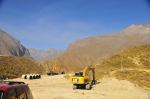
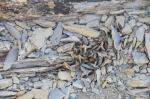
The sun was past it’s best when we reached the coordinates for S2276 for another attempt to find Ariocarpus scapharostris. My heart sank as we parked next to a huge CAT digger and watched a road building crew take down a small hill across the road and use it to replace the road that had been washed away. Progress has its cost. Fortunately the coordinates took us to another, undisturbed small hill with limestone and / or gypsum laid down in slate like fashion, but pushed with the thin sides up. Glad I did not have to walk barefoot across these razorblades. There was little evidence of plant life on this hill and we were about to give up when an unusual pattern in the regular shaped shadows of the slate caught my eye. Bingo!

Once we knew what we were looking for it became a bit easier as we spotted another dozen or so very dehydrated plants. Conscious of time pressures we regrettably said goodbye and considered that we could always come back tomorrow, as this site was only some 50 km from our intended hotel in Galeana.

We drove back through Rayones, quite pleased with today’s finds. Back at the cross roads out of town the sign post told us that it was only 28 km to Galeana. (pictures filed as S2277). Three hours later we realised that when the speedo indicates 10 kmph, that it really does take almost three hours to cover the 28 km, with the track at times practically non existent and at other times precariously close to deep ravines, with the sun, now very low in the sky, making it difficult to see where the road was, if indeed it was still there.

We arrived in Galeana near dusk, exhausted, and quickly cancelled any plans to take more pictures at S2276 tomorrow – that drive was enough of an adventure for this trip!  


We made an early (-ish) start and had agreed that after yesterday’s failure to find M. plumosa at the Horsetail Falls, we would make another attempt to find it at the Monterrey end of Huasteca Canyon.

But first we had to find the entrance to this National Parque, which last year proved a very frustrating affair. And it was no better this time, with the SatNav system trying to send us the wrong way up one way streets time after time. In the end there was no alternative but to return to the hotel, follow our instincts and visual observations to drive to Santa Catarina, ignoring the requests from the electronic wizard to take a 300 km detour. The hills at the entrance to the Parque stand out from a great distance and so it was not really too difficult to find if you knew what you were looking for.

Last year we were frustrated by similar problems finding the entrance. Then we headed first for a Michel Lacoste location for Mammillaria plumosa, M. melanocentra and M. multiceps and ended up again frustrated as we got lost in a warren of tracks in small communities that seemed to block the way to where we wanted to explore. We were on a limited time budget, so once we had spent as much time as was wise, considering our other goals, we moved on without finding the spot.

Today we had more time. It became immediately clear that the floods had done much damage here, but on the bright side for us, seemed to have erased many of the communities that had complicated life the previous year. We managed to park the car at a brand new radio mast station (?) unusually placed near the foot of a hill. A fence blocked our way to the hillside we wanted to explore, but some of the strands had already been persuaded to part so we managed to get in (and later out) without tears to clothes and our pride.

This was S2268. We had more time than in 2010, but still needed to be aware not to spend too long here. The first few meters were encauraging as we found lots of different cacti! Echinocereus adustus, E. viereckii, Neolloydia conoidia, Coryphantha sp. and two Mams that would fit the concept of M. multiceps and M. melanocentra that had been recorded before. Agave lechuguilla was scratching our legs and Acacia-like scrub was scratching at arms and legs. I set my mark to reach at some trees on a ridge near the top of the hill – well within the range of the coordinates on our GPS. Where were the M. plumosa? Another failed search? It was getting very hot on the hill and common sense dictates that you can not look forever for a plant that may no longer exist here. We started the journey back. Then, a tiny plant, slightly larger than my thumb nail caught my eye, growing in a crack on the goat track I had been following down. A closer look and sure enough – BINGO! How different this plant looked compared to the mounds filling up washing up bowls in Europe. Eunice had just walked past here. Was it worth coming back for a picture? I promised that she could have copies of mine if she wanted, but having seen it, I would not be surprised if she declined the offer. But at least another missed plant from the past had been laid to rest.

I decided to take a steeper route down the hill, often having to ease myself over the limestone rock face, putting hands and feet in narrow cracks (yes, not the thing I would advise others to do). As I put my hand down again I felt some fur and quickly pulled my hand back. Nothing moved. I took a look and found another, much larger M. plumosa – one that was well worth Eunice climbing the hill again. Great – mission accomplished – convincingly!

Before reading the next section, I urge you to point your browser to Google Search (or any other search engine that you fancy) and look up ‘Monterrey floods’ and ‘Huasteca floods’ and you will see the results of the rains in July 2010 that caused floods that made last year’s view of La Huasteca unrecognisable from the current pictures. The road and tracks we travelled on in 2010 were gone. There was much work in progress with workmen putting in pipes, drains and repairing cables.

We found the location of last year’s stop where we found a number of large Agave victoria-reginae growing on the flat, but had to cross the river to get there. Not a great chalenge as temporary bridges crisscrossed the massive, mainly dry, river bed, so it just meant going back 100 m. to the last crossing.  Here (S2269) I found plenty of angles and set ups to try to improve on the amazing pictures from last year. I’m sure that at least one will appear in the work in progress ‘Prickly Pictures and Succulent Sights’ photo book that will show of my favourite pics from trips to the US, Mexico and Cuba. ‘Prickly Pictures vol. I will be out by September and contains pictures of just cacti taken during ten years of visits to South America.’

S2270 is where the road / track stopped. There was just a pipeline in a concrete housing that provided a way across the water, but only on foot. We spoke to a Mexican who had passed us earlier on an ATV (All Terrain Vehicle) who said that if we crossed on foot, we could get to the bottom of the huge dam, the Presa Rompepicos, where last year we had driven through a gate that was meant to control the water flow – but then there had been no water.

We pointed our zoom lenses towards the surrounding hill-sides and again found A. victoria reginae among the plants clinging onto the rocks alongside Hechtias.

All other images of the day of our drive through this northern part of La Huasteca have been filed as S2271 and do not contain any specific plant images – just scenery. 

Another great day!

Tomorrow we move onto Saltillo and will try to get into the southern end of the Canyon track, but we are prepared to find our attempts again frustrated by washed out roads.

I can thoroughly recommend Monterrey as a place from which you can explore the rich diversity of Mexican cactus and succulent plants, nature in general and spectacular scenery. Do rent a 4×4 car to see nature in its raw, wild and wonderful state and pamper yourself by staying at one of the many nice hotels in town. We stayed 3 nights at the Holiday Express Inn and can recommend it without hesitation.

Last night we checked that Argentinean Malbec (Norton Reserva) tastes as nice in Mexico as it does in Mendoza. I think that it does, but we have brought along some more, to get a second and third opinion in nights to come. As a result, I was rather slow to get going this morning.

We went to the Cascada Cola de Caballo (the Horsetail Waterfalls) from where Mammilaria plumosa had been reported. A bit farther on, M. glassii was said to grow. With SatNav systems and GPS systems loaded we eventually got on the road for a nice drive on MEX 57 south. We left the Highway at the well signposted exit to this significant tourist attraction and found ourselves on Ruta 20, a reasonable quality tarmac (by Wiltshire, UK standards) but one bit was being repaired – looked like a bad flood damage – and we had to take a very adventurous detour for a couple of km.

We reached the centre fro the waterfalls, paid our 20 Pesos (£1) for the car park – I think we were the only visitors there and were greeted warmly by the stall holders of the various tourist focussed material for sale. It seemed that each vendor used the same wholesaler as all stalls offered the same good. They had worked hard to put down a good path, fenced off to satisfy Health & Safety no doubt, so that it became clear that we were unlikely to find Mammillaria plumosa here. We did however spot some Selenicereus sp. growing on a rock and a epiphytic Opuntia hanging from a tree. Nice waterfall though and nice big swallow tail butterflies. (S2264)

After the waterfall we decided to carry on, on the 20, which seemed to loop back to Saltillo (a 120 km loop) that took us up very scenic zigzags, up and down mountains with potentially spectacular views – potentially, as it was very hazy due to the heat – although it was much cooler (21C) in the mountains than in Monterrey.

We failed to find Mam. glassii at the next stop. I remembered hearing last summer about heavy rains and floods in this area and we saw evidence of lots of damage to roads and nature, washing lots of plants down hillsides.

With c. 80 km to go to the main highway to Saltillo, we were down to a crawl with a track barely wide enough for our car with the proper road just washed away or blocked by a landslide. Should we go on or go back? Either option could mean driving in the dark. Turning back certainly would – going on – who knows? The scenery just got better and better – this is just the other side of a huge mountain range from Huasteca Canyon that we enjoyed last year and plan to visit again tomorrow. I can certainly recommend this route for the scenery, but not for the cacti – or at least with the uncertainty that lay ahead we did not want to stop to explore so found none. Just three short stops to photograph the hills and canyons with brief rock wall inspections that gave us at S2265: 2x Agave sp., Bromeliad sp. (in flower), Opuntia sp., Echinocereus sp (probably E. scheeri) and some very nice Echeveria and Sedum (?) sp. all snapped thanks to the 200 mm end of the zoom lens – and Eunice’s 400 mm monster.

S2266 was another wall full of Agave sp. plus A. lechuguia and clumps of Echinocereus (E. vierecki?), Tillandsia usenoides, Yucca sp. and some Echeveria. The images also include a stretch of tarmac that we had driven over. It seems that there was nothing (!!!!) underneath the tarmac – just hanging there. We had watched a truck go over it before so dared to do it as well.

S2267 was for a group of Agave montana (?) with flower stalks boldly announcing their presence. By now we had moved out of the mountains and seemed to be in a high plains area with farming activities around us.

All’s well that ends well. We hit the main toll road to Saltillo around 5:30 and arrived at the hotel in Monterrey shortly after 6, exhausted. Dinner was a Chinese take away delivered to the room where we sorted images, did the accounts and were ready for bed by 9:30.

Tomorrow we’re off to Huasteca Canyon, but after today we realise that it may be quite different from last year, due to flood damage.

We just had one stop planned for today a John Miller stop for Ariocarpus trigonus was right along MEX85 as we headed for Monterrey. The weather forecast for today was HOT. 40C in Monclava, 38 C in Monterrey. We were in between, but in an airconditioned car. One stop sounded just fine.

And yet …. we followed MEX 30 from Villaldama to MEX85 and for part of the way were joined by a river to the left of the road, and a sheer rock wall, in the shade, to the right. As we drove by Eunice spotted Agave lophantha growing on the rockwall. We soon found a place to park and invited the greetings of cars passing by (hooting their horns at us pedestrians) as we explored the flora of this wall, S2261: Agave lophantha, Echeveria sp., Echinocereus scheeri, Escobaria sp., Ferocactus hamatacanthus, Mammillaria heyderi ssp meiacantha and Opuntia sp. (huge tree like plants hanging from the rocks) – not a bad rockery! and a great unexpected stop. And Honk Honk back to the cars that passed us!

S2262 was more of the same on road cuttings along MEX85. The Escobaria here has tentatively been identified by Juergen Menzel as Escobaria muehlbaueriana – not a name that I am familiar yet, but then I’m not a student of Escobaria. Thank you Juergen! The plant that Eunice sent Juergen a picture of was growing in a sheltered position while those growing in the open had a much denser spination but were not yet in flower or had already passed over. A bit more searching of the internet suggests that E. emskoetteriana may be the one favoured by followers of the New Cactus Lexicon – it has E. muehlbaueriana and E. runyoni, another candidate, as synonyms. Another great bonus stop – so often the unscheduled stops provide more interesting finds than hunting down a known location and not finding the target plants.

Talking of which, about 30 minutes later we arrived at our target stop, S2263. There had been a fire along the side of the road and as a result the fence posts had turned to piles of ash. It was as though someone left the door open and all we needed to do was walk in. Eunice used her handheld GPS to get to the exact coordinates while I walked around in the believe that plants grow in more than one finite spot. I found two small Coryphantha that were reported as C. salinensis but after some 15 minutes Eunice was the first and only one to claim her Ariocarpus find and then another, and another and another! Faster than I could photograph what I had found already. But then, despite another 15 minutes in the burning sun, no more Ariocarpus could be found. There were a number of square holes as though someone had used a machete to cut out a plant. Collecting? Who knows.

Eunice (again!) did find a huge very flat Ferocactus that I mistook for Ferocactus macrodiscus, but that would be way out of its range and the buds were wrong – our plant had dense bristly buds where as F. macrodiscus has bald buds, almost like a Gymnocalycium. Current thinking favours a very large Echinocactus texensis that was also reported from this area.

I can tell you that whether it was 38 or 40C out there, it was not healthy to be out in the sun for long.

Following the Baja trip I had already bought a 2 stop neutral density filter because even at the lowest ISO setting on my camera (L1.0), three licks less than ISO 200, many pictures still seemed over exposed. The filter works just great at ISO 200 but I have to remember to remove the filter when taking images of plants on shaded rock walls (or walk by the wall again to take the images again)

Tomorrow we revisit Huasteca Canyon, this time looking for the cacti that we missed in ignorance of their existence last year, distracted by so many other wonderful things to see and photograph.

Yesterday we got up in Alpine to sub-zero (centigrade – i.e. freezing) temperatures but during the day the temperatures soared, It seemed that Mexico seemed to be ‘enjoying’ a mini heat wave – after all, it is only February!

In 2010 we managed to get lost in an extensive quarry near Castaños, south of Monclova, that meets the need of the local cement factory. We had found some exciting plants, but failed to find Turbinicarpus valdezianus that seems to grow a bit farther along and a bit higher up. Then I was a bit sceptical to find Turbinicarpus so far north, expecting to have to travel farther south, but after doing some homework in the intervening summer months I learned that this plant does indeed get as far as Monclova, so we had another go, this time ignoring the reference to Ariocarpus, Epithelantha and friends that we already found last year. It took us several stabs to avoid the warren of tracks that would only have taken us to last year’s spots. But we were now farther away from the foot of the hills and a couple of hundred meters below where the books says it should grow – but plants don’t read books, do they?

S2257 was in a river bed that seemed not to have seen a drop of water in years. Now, looking for Thelocephala in the dry and bare Atacama Desert is one thing, especially when they are in flower, but these Turbinicarpus are at least as small and although the area was dry, it was covered by plants that included: Agave asperrima (s.n. A. scabra), A. lechuguilla, Coryphantha nickelsae, Echinocereus enneacanthus, E. pectinatus, Epithelantha micromeris (var. greggii is reported from here), Euphorbia misera, Mammillaria sp. and Opuntia sp. plus lots of dried grasses. So plenty of things to distract the camera and hide the plants that we were hoping to find. We did not find any Turbinicarpus.

Time was approaching noon and it got unbelievable warm – above 30C according to the car’s thermometer (yes Cliff, I realise that this is not the ‘real’ temperature, but it was the only indicator we had to quantify how hot it was.)

We tried another track to get to nearby S2258. We agreed a mark of a tree with large Agave to its right as the marker of how far we would try before turning back. We reached the spot and found only what we had seen already. A car engine started up at a nearby house and the truck went off along the track that we had come in on. He must have spotted us on the hill, because he turned round, parked his car near by and walked a couple of hundred meters to our car. Eunice was first back. What did we want? Photos. Of plants. Of cacti. We showed him some pics on the monitor of our cameras. Large or small? he asked. Small. I showed him the pics in the Turbinicarpus book (thanks Angie, for the loan). Ah, he said, overthere! pointing into the hills beyond his farm. How much time to get there? Eunice asked. 10 – 15 minutes. And so we abandoned our search at S2258 – to discover later that we had been 211 meters from the GPS co-ordinates for Turbinicarpus valdezianus.

The track that he had pointed to was soon getting to a state where we needed to think about our tyres and hence our health and safety. Why do rental companies provide meaty all weather / terrain tyres. I guess they do if you ask, then charge a lot more for the heavy duty off-roading that they expect you need them for.  Common sense told us to turn round and we agreed.

I’m convinced that the 211 m. distance did not prevent us from finding the turb. It was probably where we had been looking and it was just too dry and overgrown for us to spot them. The time budget was spent and the heat made the airconditioned car a much more attractive place and so we moved on.

We had to drive right through Monclova to take Highway 30 towards Candela and Bustamante. Eunice had a spot for Agave victoria-reginae. My worst fears were confirmed when we got there – S2259. ‘Vicky’ tends to like growing on sheer rockwalls and although the hillsides here were not sheer, they were across a fence with a good 500 m. walk to get to the bottom of the hills. A few km earlier we had been stopped and questioned by an army patrol. These ad-hoc blockades are always more tense than the fixed inspection points where the soldiers are usually bored after days of routine checks that turn up nothing – all the bandits know how to avoid them! I felt uncomfortable about crossing the fence here – Eunice agreed and the sun was a good partner to convince us – too hot!

We did look through binoculars and zoom lenses and blew up the images later, but the stalks that we saw were wrong for ‘Vicky’.

We drove on to Bustamante and after in to Hotel Ancira where we were greeted as old friends after our stay last year we went to the last stop of the day, this time S2260 (S1793 last year). The sun, now low in the sky, was giving plants and landscape a warm hue but a brisk wind was cooling us down. Followers of the Stonehenge Hattery will be glad to know that the new hat I bought at REI (Recreation Equipment Inc.) in LA has a chin strap that made sure that this hat stayed on. Oh yes, what did we see? Agave asperrima (s.n. A. scabra), A. lechuguilla, Cylindropuntia leptocaulis, Echinocereus enneacanthus, E. pectinatus, Epithelantha micromeris and Mammillaria sp.

Bustamante is a really nice cozy village and I can recommend it to anyone travelling through the area, with Hotel Ancira as a good place to lay your head.

We have driven 1,100 miles from LAX to Alpine and have travelled about half the width of the USA. So far we have few cactus images to show for our troubles, but that is all part of the plan. The elite of Mexican cactus flora, the Connoisseur Cacti as John Pilbeam might call them, occur farther south then we managed to get last year when Saltillo was about as far south as we travelled. Our options are to fly into Mexico City, rent a car there and head north or to drive from where I was staying in the LA area, following much the same route that we had followed last year.

As a result we had been very disciplined as far as making time consuming stops was concerned and had been eating miles and now, in Mexico, kilometers.

Today’s thirteen images are all scenic and are not filed under a specific stop number.

This time we crossed the border at Del Rio into Acuna. This is a small crossing, open 24 hours per day and probably the most relaxed and friendly crossing between the US and Mexico yet. Last year we crossed at Eagle Pass, a bit farther to the east, but had to drive some 50 km south to Allende to complete the temporary car import formalities. At Acuna, this could all be done at the border so that once formalities had been completed we could drive to our destination without interruption.

For anyone wishing to try this themselves in a rented car, our experience is that Dollar are (possibly the only) one that allows renters to take their vehicles into Mexico. You need to buy Mexico Insurance on top of the usual rental / insurance costs and the current cost is US$27.80 per day. You also need a letter of authority from the rental company, granting you permission to take the car out of the US. The Mexican authorities require photocopies of all these documents plus copies of your passport page with the photograph, of your driving licence and of your Mexico Tourist Visa. Passport and driving licence photocopies are also needed for any co-drivers. If you are smart, you can save time by taking these in advance. We were not that smart and so had to we walk a couple of hundred meters in the burning sun (temperatures were up to 30C) to a money change office that also did photocopies, all for the sum of US$1. By the way, there was a photocopier behind the lady that wanted the copies, but it was not allowed for her to take the copies. There was no one else in the queue, but the whole process still took one hour.

Just as last year you have to pay US$35.82 for the equivalent of a UK motor vehicle licence and a US$ 400 deposit (cash or credit card) that you get back when you leave the country. We had the correct amount of cash and thought that the Mex Government holding this was probably safer then us carrying it around with us for 4 weeks.

During this time we were watched by armed soldiers with machine guns and Balaclava masks, on the square, at the entrance to the Customs office and even inside the offices. Perhaps the most worrying time was when suddenly they all disappeared on the double. Did they know of something coming? No idea. Everything went smoothly and the town of Acuna is actually a very nice little town for a bit of tourist shopping or a bite to eat. On the US side, there are plenty of good hotels to use as a spring plank for an early crossing into Mexico or to find a bed if you arrive from Mexico late at night.

Tomorrow we head for Bustamante for a bit of plant hunting.

We had a day sightseeing in Big Bend. Unlike last year, when we hunted down some 6 GPS locations and found the plants expected at these stops, this time we went to tourists spots such as an overlook and a canyon in the Rio Grande and watched people walk through the water from Mexico and the US. Stop numbers are S2252 (scenery), S2253, at the northern entrance to the park, coming from Marathon, S2254 at the Fossil Bone Exhibit, S2255 at the Rio Grande Overlook and S2256 at the Boquillas Canyon Trail. We asked at two of the visitor’s centres to see the local cactus experts. As usual they were out elsewhere. At one of the centres, a nice lady, who was on leave from her regular job as a warden at a Park in Alaska, tried to remember what she had been taught when she joined, which took us to the Rio Grande Overlook where we failed to see Epithelantha and Lophophora, but we had seen plenty of those elsewhere last year.

Tomorrow we cross into Mexico

And of course we looked around for cacti and found Echincereus engelmannii, E. dasyacanthus, lots of Cylindropuntia and Opuntia sp., Escobaria tuberculosa, Mammillaria pottsii and Ariocarpus fissuaratus – some dozen plants before we got fed up with taking their picture.

The most interesting information gained today came from a geology book (too heavy to bring back to the UK, and a cactus book that I bought here last year – but of course left back at home in the UK. Echinocereus viridiflorus ssp davisii and Coryphantha nellii are said to occur near Marathon and we were driving backwards and forwards along US Highway 385 from and to the town. The cactus book told us to look along the 385, around c 10 miles south of Marathon where it has a very restricted distribution growing on novaculite. The geology book told us that south of Marathon novaculite occurs folded so as to form horseshoe shaped layers, similar in shape to those that we saw in NW Argentina. The map told us that we were driving along the Caballos Mountains, with geological structures as described. Caballos is Spanish for Horseshoes. Stories picked up back home in the UK suggest that the plants grow on private property with owners who do not take kindly to visitors on their property. I am glad to know where to look on a future occasion and to try to contact the owners by email in advance for a future visit.

In exactly 4 weeks, Angie arrives in California for a whirlwind 2 week look at the highlights of my previous visits. We hope to squeeze in a trip to Tucson so I’ve been making notes of things to see and what to avoid.

But today we focus on Day 2 of the 2011 Mexico trip as we drive to Alpine, Texas where we aim to stay in the Best Western which impressed us last year.

This is another driving day and much of the landscape is flat and boring with any cactus or succulent that resides here having been snapped on previous trips. So the ideal conditions to set the cruise control to the maximum speed permitted plus the 5 mph grace on top and take it in turn to hold the steering wheel, with toilet breaks as necessary.

The result was just one plant stop, S2251, as we turned off Interstate 10 about one exit before last year’s exit at the Dragoon Road. At this spot we found Ferocactus wislizeni, Yucca sp. and Opuntia santa-rita, that I think is called O. macrocentra these days.

We had agreed not to stop at Van Horn for the night that provided one of the worst nights in the US last year, mainly because of the rather sleazy customers at the fast food places on the outskirts in town that seemed the only places open when we arrived after dark. That time we had also ‘enjoyed’ a thorough search of car and clothes by the US Border Patrol station just out of town, triggered by the sniffer dog finding Eunice’s ground coffee for the trip. This apparently is a popular decoy to put sniffer dogs off illegal drugs. Needles to say we left with a clear record but the thoroughness of the search when we were tired after a long drive was unsettling.

This time we had left earlier and made fewer stops so that we could drive straight on to Alpine, Texas.

Tomorrow we take another look at Big Bend.