Just another WordPress.com site

Today was an earlier than usual start for Cliff and myself. We had been happy to get up at 7, breakfast at 8 and on the road my 9, after all, this had been a 7 days per week routine for us since November – the rather more hectic pace required for the larger group to see as much as possible in Rio Grande do Sul is just not sustainable on a longer term, if it has to remain fun.

We have a policy of ‘no driving in the dark’ so with sunset at just after 6 p.m. – always (?) I tend to be asleep between nine and ten, so getting up ‘early’ is not that much of an issue for me.

Today we were out on the road by 7:45 a.m. and Marlon had suggested a ‘no guarantee of success exploration’ to see if we could find the recently described Melocactus braunii, described by …….. guess who. To this end we drove to the village of Campo Formoso and (by car) climbed two mountains with radio masts and microwave towers to investigate what grew on top. Nothing, cactus wise, on the first (S1625) but on the second (S1626) we found a cluster of Melocactus zehntneri on one large rock outcrop near the radio mast.

The remaining stops (S1627, S1628, S1629) were stops between Jaguarari and Flamingo for plants in the northern population of Espostoopsis dybowskii, showing the different settings where this can be found. You should recognise all the accompanying cacti in the pictures by now, so I won’t bore you here with that detail.

We made it to the town of Petrolina, just across the Rio Sao Francisco, in the State of Pernambuco (better hotels) where we plan to stay 3 nights, (with internet) as a base to do a mixture of exploration and checking out Discocactus sites from Marlon’s Masters studies.

The night ended on a high for me as we managed to find a very drinkable Brazilian Cabernet Sauvignon (2006) at a reasonable price, with grapes grown in the Sao Francisco Valley. It was my first wine since October!

Not much to report really. 506 km of driving (well done Cliff) and a bit of a crisis at the Airport where we arrived late (heavy traffic) but John had been waiting only some 20 minutes, so no panic there. BUT the Fiat Doblo that we had booked to swap for our little Chevy was not available – the booking could not be found and they had none spare, flowing the after Christmas rush. In the end, we settled on extending the contracts for the Chevy, it’s a bit tight, but only for two weeks and most of us stored unnecessary luggage at Marlon’s, so everything fits.

Marlon had planned one stop, just a leg stretch on this driving day, where we could expect the same plants that we saw yesterday, just in a different setting. Thunderstorms were gathering and just as we were at the spot, the heavens were in full flow. As we left our diving gear at home, we decided to give this stop a miss and hope for better weather tomorrow which is scheduled to be a cactus day.

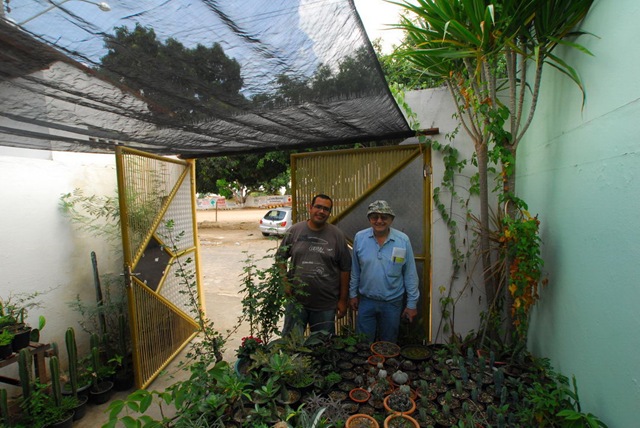
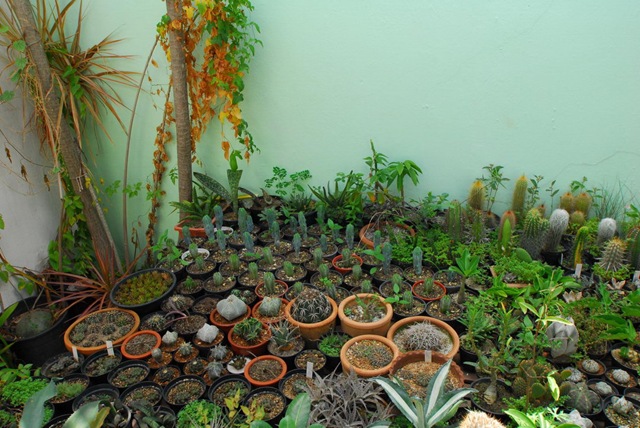
As a result, no pictures of cacti in habitat – just a couple of Marlon’s collection.

2009-12-28 14-21-46 2009-12-28 14-22-47

Today was much of a driving day, 276 km (c 4 hours) to arrive at Marlon’s home in Feira de Santana. From here, we’ll make a 7 o’clock start to Salvador Airport to pick up John Senior from New Jersey for his second stint on the Brazil circuit (just check back to the Rio Grande do Sul notes for October and early November). We’ll also change our little Chevrolet Minerva for a larger Fiat Doblo.

Just one cactus stop today, (S1624) which was our third stop in 1999 and then our first opportunity to see lots of Melocacti in habitat. So Melocactus ernestii, Tacinga inamoena ssp subcylindrica and Cereus jamacaru were all photographed for comparisons with ten years ago.

Soon after arriving at Marlon’s the heavens opened and his cactus collection, outside under shade cloth, got a good watering. We went out for a meal + beers, just around the corner, where they had a special promotion, buy one beer, get one free – so we bought seven bottles after which Marlon managed to negotiate another beer ‘on the house’ which of course deserved a free one as well. We have to get up at 6 tomorrow morning ……!

I’ll start with a link to the Pousada Ecologica das Bromelias, where we have enjoyed our Christmas stay. No snow and ice, but then we did not come here for the winter sports and ski slopes!

http://www.brasiladentro.com.br/112261/br/hoteis-pousadas

It had rained during the night and a steady drizzle fell as we set out this morning. Delmar was going to take us to locations: Tabuleiro das Duas Irmãs and the turning, off BA-052 to Cafernaum where on the east side of the road is the western limit (?) of the habitat range of Discocactus zehntneri ssp boomianus.

By the time that we arrived at Tabuleiro das Duas Irmãs (S1622) it was still drizzling, but our worries that the dirt track from the BA-052 (little more than a dirt track itself in places) would be impassable once wet were unfounded. I’m sure that Cliff can give a better geological explanation, but it appeared to me that this Tabuleiro was a white sand in-fill between a pushed up layer of conglomerate rock. In real terms it was like walking through soft sand with just a thin top layer wetted by the rain. There was quite a caatinga vegetation here, so we were soon soaked from both the bottom up, as we brushed against wet vegetation and from the head down, from the rain. As it was still hot, any bits not affected by rain or wet leaves was soon soaked in our sweat! It was an easy place to get lost in, as large rock outcrops needed to be negotiated round the correct way, or else long detours were necessary to get to where you wanted to be. Even Delmar missed a turn in the track occasionally, so that we had to retrieve our steps.

Cactus wise, I think that we have now just about seen all the cactus taxa that the area has to offer. The sandy Tabuleiro was once again the home for Micranthocereus polyanthus ssp alvinii with Melocactus concinnus, M. paucispinus, Stephanocereus leutzelburgii, Micranthocereus purpureus, Pilosocereus pachycladus and as well as lots of different Orchids (not in flower), bromeliads and a charming little Eriocaulaceae sp. The rain had also brought out a large number of apparently solitary giant ants, about one inch long. It was easy to see their pincer mouth parts with the naked eye. Cliff found one carrying a large berry! But bad light made it very difficult to get a good depth-of-field picture of it close up.

As skies darkened we got back in the car and once back on BA-052, the heavens really did open for a while. Stretches of the road had been patched up with sand and on previous days had caused a huge dust cloud for every vehicle that met up from the opposite direction or overtook us. Today, the road surface floated slowly down the slopes and off to the side of the road. As we approached the roundabout for the turn south to Cafernaum, the rain stopped and the sun came out!

We had soon found the tell tale rocky hillsides and found a place to park. Again, as soon as we had fought our way through a small forest that separates the hillside from the road, we were amidst thousands of D. z. boomianus! (S1623). Unlike the visits to the previous boomianus locations, many plants here were in fruit, with fruits half full with what looks like viable seeds and the other half full of small ants. Fortunately they were not the 1" version that would have had your finger off.

Reviewing the pictures there are some truly impressive skies on display. Strangely, it stayed dry here.

Tomorrow we leave Morro do Chapéu and travel to Feira de Santana to meet Marlon at his flat. Then on 28 December we race to Salvador to pick up John Senior, who is already fed up with cold winters in New Jersey. The four of us will then go on a two week Marlon guided tour of northern Bahia – all new territory for me.

Today was the first time for a long time (ever?) that I was in a church on Christmas Day. This time it was not for a religious service, but as part of a visit to the near ghost town of Ventura. Many years ago, I worked on a small project to put out of print texts of cactus books on-line, making sure that we retained the original pagination (for reference purposes) but modifying the text format to suit on-line reading. The only book that was ever produced was ‘Brazil and its Columnar cacti’ by Erich Werdermann, published in German in 1933. In it is a picture of the house that he used in 1932 as a base for his stay in Ventura.

Delmar Alvin was again with us as a useful guide, despite mutual language problems. Werdermann’s house has since been demolished. All my pictures for the visit to the village and the track to it are filed as S1619. It includes Marlon’s BR055 from where he reports Pseudoacanthocereus brasiliensis. We found the spot without problems. It was where a cattle gate had to be opened and cacti could be seen in the shrubbery. We found six cacti taxa here. Arrojadoa penicilata was easy to identify once we had discovered the one and only ring cephalium. If it does not get enough light, such as here in the shrubs, it just keeps growing without flowering. This plant had stems over 3 m long! The second cactus were young seedlings of Tacinga funalis, not a  plant often seen in cultivation in Europe and when you see the plant, it’s easy to understand why. Just thin sticks. Cliff ran his fingers up one of the stems and confirmed its ID as glochids stuck in his fingers. Next may be the reported Pseudoacanthocereus brasiliensis but as we have no good pictures to assist in the ID, Marlon will have to confirm this in a few days time. Another Tacinga was seen in the forest, spiny, but with thinner pads than I had seen on T. palmadora. Possibly T. brauniiCereus jamacaru and Pilosocereus glaucochrus completed the picture.

The Cachoeira Ferro Doido (waterfall) is a very nice place located 18 km to the east of Morro do Chapéu on the main road to Feira de Santana. Plants seen and photographed (S1620) were Micranthocereus purpureus, Melocactus oreas subsp. cremnophilus, Stephanocereus luetzelburgii, Pilosocereus glaucochrous, Pilosocereus pachycladus, and also the small Euphorbia appariciana. The place is very scenic, the river bed makes two canyons before the drop of the waterfall. As in 1999, there was no water falling, but the thunderstorms raging around us could change that in days to come. Remembering how a pose on a rock overhang a few weeks ago caused Marylan to gain the nickname ‘Crazy Woman’ I felt that I had to go one better, mainly in terms of potential distance to fall before going splat. There was a perfect rock overhang and Cliff was in charge of pointing the camera while I posed on the rock. Breath taking scenery!.  

With time to spare, Delmar suggested one more stop at a location he called ‘Tabuleiro Pachala Sergio’. The Tabuleiros seem to be the flat areas with fine white sand with variable density of vegetation. The common factor seems to be that M. polyanthus ssp. alvinii grows there. In this case we also found Stephanocereus luetzelburgii, Melocactus paucispinus and Pilosocereus glaucochorus. Delmar was busy gathering a wide range of fruits  from the low scrub, enough to supply a small grocery store.

We went back to the hotel and then got dressed up in our ‘finest’ to take Delmar out for our Christmas meal – to an Italian restaurant, just as in Famatina in 2008, but this time we had steak chips and salad instead of hamburger and pizza.

Another great day and a Christmas to remember in years to come. As far as the last picture in today’s album is concerned. No, Cliff has not bought the Italian restaurant in Morro do Chapéu! He is just waiting behind the bar to have his credit card payment cleared.

Over breakfast, Cliff & I remembered back to Christmas Eve 2008 when we were with Juan Acosta in Famatina, Argentina, taking pictures of Echinopsis (Lobivia) famatinensis. A hard act to follow. But we did our best!

We managed a total of four stops and 469 pictures that are downloading while all around firework crackers are being let off to herald the start of the festive season proper.

Our day started early, as we had arranged to meet Delmar Alvin at 8 a.m. I think he was a little surprised that, with the help of Marlon’s notes and my well trained GPS, we were anticipating all his directions. When we were here in 1999 with Delmar, he told us that the land was for sale and could be bought and treated as a private nature reserve. Keith Grantham and I pledged to find the money, but Brazilian law dictates that only Brazilians can buy land here. The solution was for a Brazilian Company to be set up with Marlon as Chief Executive, who could then invite foreigners to join him on the board and pay in funds. When Keith died, Leo van der Hoeven took over the commitment to co-fund the project. Marlon has since bought the land, we understand, but his studies abroad have gotten in the way of his setting up the necessary formalities to make it legal for our money to be paid in.

It was the first time since 1999 that I had been back here. Nothing much had changed. Marlon has since described the Micranthocereus that grows here as M. polyanthus ssp alvini, in honour of Delmar Alvin. So for the second tie this trip, we were at the type locality of a cactus with the person that it was named for (S1615). Delmar told us that Micranthocereus tend to flower here around June – which is why they looked good and in flower in May 1999, but rather tired and dried out this time round. Melocactus paucispinus and M. concinnus (?) were growing here too, with a few Stephanocereus leutzelburgii, again the one branching profusely from the base with a less pronounced  bottle shape then we have seen elsewhere and with Pilosocereus gounellei. Everything was very dry which was confirmed by dry water holes dug to see where the water table was – some 16 m down!

I had forgotten how large this area was and with deep dry white sand to walk through, quite exhausting in the heat.

Our next stop, S1616, was near the village of São Rafael for the type population of Discocactus bahiensis ssp gracilis (HU 485, BRAUN 642) Melocactus concinnus, M. zehntneri, Pilosocereus gounellei, Tacinga inamoena. I had never seen this plant in habitat before, but Leo’s pictures suggested a miniature Gymnocalycium spegazzini from Argentina. We were not disappointed, but the habitat is a lot more restricted from what we have seen so far than of the Spegs.

Back out of São Rafael travelling north towards Tareco, Marlon recommended a road side stop (S1617) just outside of São Rafael for ‘some beautiful stands of golden spined Pilosocereus gounellei’. Sure enough, they had not moved! We also found Melocactus zehntneri, the blue form which was described as M. douradaensis as well as the green form – M. zehntneri. A bit confusing here as young plants would seem to be blue, but mature plants with a cephalium seem to lose their glaucus appearance and are green.

Finally, we visited the D. zehntneri ssp boomianus location that we visited in 1999 (this time S1618). Marlon writes:

‘The most interesting are the extensive rock outcrops 21 km to the west of Morro do Chapéu along the road BA 052 towards Irecê. A total of 16 cactus taxa grow there: Arrojadoa rhodantha, Discocactus zehntneri subsp. boomianus, Melocactus glaucescens, Melocactus ernestii (erythracanthus), Melocactus albicephalus, Melocactus concinnus, Micranthocereus flaviflorus (densiflorus), Pilosocereus pachycladus, Pilosocereus gounellei, Cereus albicaulis, Cereus jamacaru, Leocereus bahiensis, Pereskia bahiensis, Tacinga inamoena, Tacinga funalis, Tacinga werneri, and also the succulents Euphorbia phosphorea and Euphorbia sarcodes.’

I think that I managed 13, missing out on Cereus albicaulis, T. funalis and T. werneri that I had already seen elsewhere. Not bad as I was doing my best not to trip over the Discocactus and Melocactus plants. I wonder if this is a record for the number of cacti & other succulent plant taxa found in one location (other than a botanical garden – and some of those would struggle to come up with that many!!) I’ll leave Marlon to confirm which Melocactus is which.

Have a great Christmas. I know that we will!

Marlon had put together an intensive program for our stay here. In fact, his last line in the 19(!) page document says: ‘Well, I believe these locations will keep you busy for a while!!!

I’m sure that they will! The last 6 pages are dedicated to things to see around Morro do Chapéu alone! Mind you, one is a 150 km trip (and 150 km back?) that we might struggle to fit in. Most of the activities here were organised by taxon, so I spent last night separating them out into North, East, West and South of the town. Today we did some of the stops suggested for the north. We drove along the road to Jacobina (now a well patched up asphalt road, (dirt in 1999) and took the turning west at Ico, and from there proceeded to Brejões.  All the instructions fitted, except that when we moved from location #1 (S1611) to #2 (across the river from white sand stone rock to limestone rock) the limestone was not there. We took pics at the #2 location, to prove that we were there. Not to worry, we enjoyed seeing Melocactus glaucescens, with spination like M. paucispinus, but white cephalium, Micranthocereus polyanthus ssp alvinii. Harissia adscendens, Pilosocereus pachycladus, Tacinga inamoena and T. palmadora. The ones that ‘escaped’, at least our attention, are T. funalis and Leocereus bahiensis. We found an enormous Euphorbia tree, but doubt that it is E. phosphorea. No flowers found.

On the way back to Brejões we stopped by a huge C. jamacaru. We measured the stem’s diameter: 125 cm. a giant!

S1612 was a random stop along the Jacobina – Morro do Chapeu road. I remembered that in the caatinga forest we found some Melocacti and Arrojadoa rhodacantha in 1999. This time, Cliff was sceptical about the terrain, we went our own way and I found no cacti, axcept for Tacinga palmadora. Cliff eventually emerged with a huge grin on his face, claiming to have seen lots of Melos, many bluish in colour, but none with a good cephalium. Old mature plants were already dying and had very grubby cephalia. Could it be M paucispinus here? I do not believe that it was M. zehntneri that we found near here in ’99. Cliff also found Cereus albicaulis, T. inamoena, Pilosocereus pachycladus and P. glaucochrus, plus Arrojadoa rhodantha while I managed a number of passion flowers wide open and some butterflies.

S1613 was for what could be the largest Cereus jamacaru on record today. Marlon first photographed it in 2002 and it appears as the inside header page of Nigel & Daniela’s book of the Cacti of NE Brazil. The hotel has a picture taken in 2006. It is huge! Reckoned to be 18 m tall and probably with an arm span of 10 m. So our picture today is the most recent one. We asked the owner of the shack if we could come into his yard and take its picture. The lady called hubby and in free translation shouted something along the lines of ‘There are some more crazy foreigners to look at our cactus!’  Amazing plant, but UK Show judges would criticize it for being marked and lack of evidence of recent flowering.

With time left to kill, I quickly looked up info of how to get to a spot that in 1999 we called the Radio Mast Stop. These days it is the Microwave hill with half a dozen masts still being added to as we were there.  It was my 7th stop on a cactus trip and now 1607 stops later as S1614, it was great to make its re-acquaintance. In 1999 I believe we made this a morning stop, while today it was a late afternoon stop. This time everything looked a lot drier, with the Micranthocereus purpureus looking ‘dirty’, in need of a good shower to wash off the dust. Stephanocereus leutzelburgii looked badly marked, as though they had seen some rough times. Some of the Bromeliads looked in great shape but the Peperomia that we found in ’99 seemed to have gone into hiding.

Despite the additional towers, this habitat seems safe. Fires have swept through the lower part of the hill, but there seemed to be no great number of cacti there. I’ll have to come back to check out this favourite rock garden in years to come and do some ‘now & then’ comparisons when I get home between 1999 and 2009.

With the help of Google Translator we had managed to tell the hotel receptionist that we’d like to contact Delmar Alvin, whom we met in 1999, M. polyanthus ssp alvinii was named in his honour. We’ll meet him again at 8 in the morning for a visit to ‘his’ plant. Great!!

Many thanks to all of you who sent us Happy Christmas messages. As you’ll understand, there are no post cards, stamps and letter boxes in the places that we look for cacti, so you’ll only get these images, taken in Rio Grande do Sul in a huge shopping Mall in Caxias do Sul. When they saw us taking pictures, they switched on the animation for the characters, but my cam-corder was in the car.

Very best wishes for 2010!

We’ve reached the final location of our southern Bahia trip. We’ll stay here until 27 September, when we’ll travel to Feira de Santana to meet Marlon. So no more humping luggage around between car and room for a few days. It also means that we’ll have a comfortable roof over our heads for Christmas, leaving only food to sort out.

Were staying in Pousada Ecológical das Bromélias and it seems that we are the only guests, so the kitchen is closed.

We arrived here too early to book in, so went straight away along BR-052 for some 27 km to the turning to Cafernaun. At this junction there are some stone pebbled hills to the north of the road. Again, I have to say that the size of top dressing used here is ridiculous, but the cacti seem to like it. We saw Discocactus zehntneri ssp boomianus in both its mature and juvenile spination. The strange thing is that it already flowers when the spination is still in its juvenile phase. Also, lots of Micranthocereus flaviflorus (densiflorus), not looking as good as I remembered from 1999 and non in flower, Melocactus glaucescens, at least I think its this plant, not M. azureus, as it has a white cephalium. Cliff found one plant with a red cephalium, but I have not seen the pictures yet. Also found: Pilosocereus pachycladus, P. gounellei, Cereus jamacaru and Pereskia bahiensis.

If today is just a taster of what is to come as we travel around here, then we are in for a treat!

Yes, how vague can you get! Marlon’s itinerary suggested that we would spend tonight in Lençois, possibly in a hotel with wifi. Instead, we are saving some 50 km+ by staying in the Tropical Paradise Hotel somewhere along the BR-242, but without internet facilities, so delayed posting, as tomorrow we travel to Morro do Chapéu.

Marlon’s suggested itinerary saw us visiting Mucugê today, to see Arrojadoa (or Pierrebraunia) bahiensis. We had tried here in 1999, but it is pitiful to see how naive we were 10 years + ago, thinking that by turning up at the town, we would find it ‘in the rocks above the town’ This time we had a visible clue, a tombstone in the cemetery above the town (S1606). And sure enough, there they were. Not in great numbers, as this is a well-known locations and every hobbyist visiting thinks that he/she can’t be doing any harm by just taking one or two species. They can do damage, as evidenced by the small number of specimens found. The plant is available in Europe, usually grafted, from ex-habitat seed from selected growers. There is no need to collect your own specimen that in habitat has the potential of producing many generations from seed, if left in place. We were very happy to just take pictures.

The plants were not in great shape, growing in the shade with marks suggesting ‘cold’ temperatures, rather like the seed raised plant in my collection before it eventually died.

The cemetery is remarkable in that it is visible from a long distance away, with all tombs painted a brilliant white. At night, they seem to be lit up by strong sodium lights, which in turn attract a large number of hawk moths that were sitting around, waiting for night. In the mean time, a large number of lizards, including a large monitor lizard type, was pleased to visit the ‘hawk-moth-fast-food’ restaurant.

2009-12-21 13-47-33 (2)a

The other plant growing here is Micranthocereus purpureus that we’ll see over and over again as we travel to and around Morro do Chapéu in days to come.

As we travelled here from Seabra on good hard-top roads, averaging 100 km.p.h. we had plenty of opportunity to make a few stops on the way back to BR-242. However, we were disappointed to find that the diversity of cacti was limited to M. purpureus (at each of S1607, S1608 and S1609). At S1607 there were also a good number of Stephanocereus leutzelburgii but at the other stops just M. purpureus, plus some different bromeliad sp., a Begonia sp. and several members of the Orchidaceae, some in flower.

Another excellent day, particularly when on the TV News tonight, they featured pictures of the UK grinding to a halt through snow!