Just another WordPress.com site

Archive for December, 2009

Friday, 4 December – Pedra Azul to Itaobim

We had really enjoyed our time around Pedra Azul but once again, time had come to move on.

You’ll remember (or may be not) that on Wednesday we followed Marlon’s instruction to find a track that I thought would lead us to a wonder 1999 stop, but that this track had now all but grown over. I was going to recheck my data, but Marlon beat me to it, advising that the distance he had provided to the turning was actually from the town, not from BR 116. We had more or less come to the same conclusion and had earmarked three tracks for further investigation. It turned out that one of them was indeed the right track and Marlon’s email saved us driving up two duds (or prevented us from finding endless new populations? 🙂

The location was exactly as I remembered it – but wetter. The forecast was temperatures of 29 C and more thunderstorms and they were building already. The track continued over the granite rocks and into the forest so we decided to continue. A few km farther along we found another, very similar site and again all the plants expected were readily seen as we drove through. We continued until a light drizzle started and we reached a gate. A sign surely that we should go back and look at these two locations in more detail.

S1567 was the ‘new’ stop. A gentle sloping granite rock face to the left, quite a steeper one coming down from the right – too steep to climb. Marling this location on Google Earth reveals this to be Marlon’s stop Ettax, what ever that means, so not a new startling discovery after all. The purpose of today was to find one of my favourite 99 stops and anything else was a bonus. We had seen all the plants already, had plenty of good photos, so for me this was just a nice relaxed photography day. For the first time my ‘spare’ camera came out of the bag so that I could vary perspective of the pics by using the 11-18 mm zoom lens – an excellent wide angle range. At home I never seem to find the time or the right subject to try out this end of the range. My pics so far have been taken with an 18-200 mm lens and my eyes and brain have grown accustomed to ‘seeing’ a potential shot the way that the lens sees it. Changing the lens is actually quite strange as you are seeing everything ‘differently.’ More practice and the eyes / brain will hopefully extend to handle the full 11-200 mm range.

S1567 gave us Coleocephalocereus aureus, Pilosocereus multicostatus, Euphorbia attastoma, Orthophytum sp., Tacinga inamoena, Brasilicereus phaeacanthus, Ceiba jasminodorus, Ceiba jasminodorus, Tillandsia sp. and, yes, water lilies! (in a small puddle that must remain wet all year round). Of course, as with all other stops, other plants grew here as well and many others were photographed but will ultimately be recorded as ‘unidentified genus/species’ as life is too short to know every plant in the universe, or even in these parts of Brazil.

S1568, between the showers, offered the same plant list plus P. floccosus ssp quadricostatus, Melocactus ernestii (s.n. M. azulensis) and an Orchid sp. with large pseudobulbs and yellow flowers. Many of the Melocactus had more than one cephalium, but usually just a double, in one case a quadruple cephalium had formed.

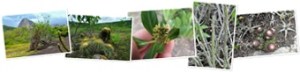
Marlon had drawn our attention to a small sprawling Asclepiad sp. that formed a caudex. The words ‘large’, ‘interesting’ and ‘attractive’ would be inappropriate, but that is just a personal evaluation. Marlon asked if we could take some pictures of the small flowers and two pictures, one from Cliff, one from me, are included in today’s album.

On our way to Itaobim, I could not help but take a picture of a man in a bus shelter who was not going to allow to let the grass grow under his feet.

Past Medina, we saw evidence that the right granite is in global demand for ornamental bathroom and kitchen fittings. It was being mined here by the hillside. By the time that the whole world has a granite kitchen and bathroom, these magnificent domes will be gone!
Thursday, 3 December – around Pedra Azul

The sky was still overcast but seemed to be brightening as we set off. Yesterday morning Google Earth had mysteriously disappeared from my laptop so there was little point in looking up finds from this area, so we decided to explore on instinct. The (poor quality) map suggested that the granite domes that we were enjoying around Pedra Azul might extend south, so we decided to follow the road (track) to the town of Jequitinhonha. Sadly the domes (technically termed ‘bosses’) soon disappeared. We carried on a fair distance (some 20 km) but either side of the road was just dense, impenetrable forest.  We had agreed that by 11:00 a.m. we would turn round. On the way back we stopped briefly to take pictures of a snake (soon to join the road kill statistics). We thought that it was dead already, but as Cliff got closer (I have a better zoom lens :-)) it moved briefly and seemed to grasp for air (or was it making a last attempt to sink its teeth into Cliff’s boot? It would clearly fall victim to the next car along, so Cliff picked it up by the tail and moved it to the side of the road, without protest. Another quick stop was of some Passionflowers in full bloom along the side of the road – always a stunning sight. All the shots taken so far today have been filed as S1563.

We had taken a track headed west once we were near the dome hills and waited patiently until they reached the track that disappeared off to a farm. (S1564). The morning TV weather forecast had predicted temperatures of 32-36 C and thunderstorms. It was certainly warm and the skies once again threatened. We had agreed that anywhere that we would find this type of rock, provided that the slope was not too steep – some rose straight up like a wall – and had the right aspect: open or north facing, then the chances of finding Coleocephalocereus aureus would be excellent. The exciting part would be finding what other cacti we would find. Here we were fortunate to have found another dense population. We had agreed that we’d make a quick stop, taking just ‘for the record’ pictures of the cacti spotted. Right! We arrived at  12:20 and left just before 14:00, with an extra 147 images on my memory card. Ah well. Many of the C. aureus were approaching the 90 cm (3 ft) mark set by ‘elongata’ seen earlier near Salinas.

We had recently missed a mass flowering of Pilosocereus multicostatus, judging by stems heavy with unripe fruit. When studying other people’s pictures of C. aureus back at the Stonehenge Cinema, Wine bar, No Star Hotel and Cactarium (otherwise known as home), we had wondered if what looked like offsets really were or were they plants that had germinated and grown in the debris caught in the areole? As there were many offsetting plants here, I checked and the evidence here was ‘true offsets’.

As the plants shared their habitat from time to time with cattle, a number of plants had been kicked over to reveal their extremely shallow root system. Cultivation tip, based on what we saw here: grow in large, flat Bonsai dishes, maximum 5 cm deep, in gravel, mixed in with well decayed cow dung. Water regularly and allow to dry out in between watering. Keep the temperature around 30C in bright sunlight. Good luck!!

At the bottom of the hill we had to cross a small stream of water still draining away after recent rains. It drained into a small pond with water lilies. As we left, just across the brook were hundreds of butterflies, each seemingly different in colour and pattern, each refusing to pose for a picture. I managed to catch just a couple. This place would have been heaven to any butterfly fan!

The rain came down at 14:00, accompanied by distant thunderclaps. By 14:45 the worst was over.

S1565 was nearer to town, where yesterday we had looked for a location of Pilosocereus azulensis, that incorrectly I thought was a natural hybrid between P. quadricostatus and P. multicostatus. It is in fact a good, rare species, but not one of the prettiest. We believe we found it. Not many plants and hidden in the forest at the top of a granite slope perhaps too steep and the wrong aspect for C. aureus. Cliff walked farther along the rock while I nosed around in the forest and he reports that C. aureus was just around the corner. The forest had been hacked about by machete’s or heavier duty tools. We still need to buy ours. Where do they sell these? A macheteria? Any supermarket or hardware shop?

One more stop (S1566) was another side track that ran out near a farm. We could park the car on the granite slab. We found Brasilicereus phaeachanthus, P. multicostatus, Tacinga inamoena (also found at every stop today), T. werneri or was it T.palmadora? plus Cieba jasminodorus, the latter not a cactus but a tree with huge thorns on its stem. Oh, and there was also some orchids and bromeliads waiting for an ID ….. maybe.

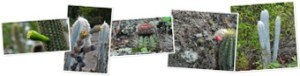
Picture wise, I could have shown you plenty more of the same things that I have included during the last couple of days, but instead I have chosen to show you pictures that illustrate dense, impenetrable forest, the snake story especially for John, the passion flower that was growing as a weed along the side of the road and a picture taken as the rains came down. Fellow travellers in the Atacama Desert will appreciate how rare a sight this would have been there!

Wednesday, 2 December – around Pedra Azul

The area around Pedra Azul features huge granite domes, hundreds of meters high, that can rise straight out of the surrounding countryside and that make very photogenic subjects. In between are forested areas and green meadows where herds of Brahman cattle graze. In between these forests and meadows are open rocky clearings where nothing will grow to harvest or graze on. These rock sheets are where members of the Buiningia group in the genus Coleocephalocereus grow. They have green to yellow flowers that gave them their specific name: aureus. The last few days we had seen populations where stems reached to 100 cm (c. 3 ft) in height. Here they averaged out at 60 cm (2ft) for the tallest plants.

Marlon had again provided us with instructions of how to reach some of these populations but sadly time changes things. The track that he recommended was possibly the same one that we had followed in 1999 to a Fazienda where we had stayed the night. The next morning the owner showed us a wonderful location of these plants, but the additional feature was the huge number of other cactus genera and species that could be found here.

This time the track was overgrown and after about 1 km a farmer was putting up a barbed wire fence across it.  Again language should have been a problem but was not, as talking with hands and feet I managed to ask him if we could pass to see cacti growing on rocks. He nodded his approval and cleared his tools and barbed wire off the track. One km farther along we were forced to turn around. The track was covered in cut down shrubs – the spiny kind – and once we had cleared that it became too steep and uneven with wheels spinning on the wet grass after last night’s rain. The area looked to offer so many alternatives that are easier to reach that we cut our losses and turned around. The farmer again cleared his tools out of the way. The smile on his face told us that he had expected this outcome but could not make us understand.

Earlier we had spotted the ideal Buiningia rock right along the main road leading from BR 116 into town and we returned here for a look around (S1560). Tacinga inamoena was the first cactus to be spotted for a ‘for the record’ picture. They were soon joined by Melocactus ernestii (s.n. Melocactus azulensis) as we looked among the vegetation that had washed – as plants or as seed – from the smooth rock surface higher up. We found a couple of plants with a double cephalium and one with a triple! Always guaranteed to go down well in presentations. We also found a Bromeliad, recorded as Orthophytum sp. and of course C. aureus. Some of the plants had spines up to 7cm in length!

To add extra interest we were being observed by a couple of  small owls – not sure if they were young or adults.

For our second stop we moved to the other side of the town to look for a location where Pilosocereus azulensis had previously been recorded in very small numbers. When we arrived at the appropriate coordinates we found no obvious cacti and the area did not look promising for a look around. Two motorists racing down the hill nearly crashed into our car, parked on the edge of a wide dirt track.

We drove down this track until we met a ‘cross track’ and took the left turn. Soon the track opened up to a gentle sloping granite hillside, bare of vegetation except for thousands of C. aureus. Although I had just taken nearly 100 images at the previous stop, here ( S1561), I managed another 148 images here. It was remarkable that here there were no Melocactus found, unlike all the previous finds.  At the edge of this large area there were a few Pilosocereus multicostatus  but no ‘blue’ Pilosos. It was a wonderful therapeutic site to try to improve on images of these plants already taken. Behind us was the dramatic scenery of the colossal rocks, to one side the daily thunderstorm was darkening the sky while the other side offered white fluffy clouds against a blue sky. The ninety minutes here were pure self indulgence in a peaceful setting.

S1562 was back to the main track to Almenara and straight across to the other track at these ‘cross-tracks’. As we drove on, through a herd of white Brahman cattle, we felt that we were getting farther and farther away from potential cactus sites, so turned around and at the base of one of the granite domes made our last stop of the day. There were comparatively few C. aureus plants here (only about a dozen spotted) but then the rumble of thunder was getting closer and we had satisfied our appetite for cactus photography and decided to return to our Pousada, but not before snapping the other species here: Tacinga inamoena, T. werneri,  Brazilicereus phaeacanthus, P. multicostatus and possibly one hacked stem, regenerating of P. azulensis.

Another excellent day, finished off with a Pizza and a couple of beers.

Tuesday, 1 December – Salinas to Pedra Azul

Today we had considered (last minute) to go back to Mato Verde to find what we had missed, but when we drove back it rained (not hard), during the night it rained (leaving large puddles, so quite hard?) and when we left it still rained. So we decided against 50 km of dirt – mud.

As we dove along BR 251 it brightened up a bit and at one point, I looked over my shoulder and saw ‘Buiningia habitat cliffs’. Cliff did a U-turn and we found a track. We agreed that as we did not have far to go today, we’d take a look at the condition of the track. There were a couple of gates and bridges (all painfully noted on the way back for future use) and then the track opened out at a magnificent Coleocephalocereus aureus site, the same form (s.n. Buiningia brevicylindrica var. elongata) as on Sunday’s stop. But here we could drive to it!

When we arrived at our hotel in Pedra Azul, yes, one with wifi, I could hardly wait to tell Marlon that we had found yet another location for this plant. He had written five emails while we were on the road, one with a large attachment (thanks Marlon!) and by the time that I was about to start my email, this morning’s images had downloaded. I wanted to send him a screen shot of Google Earth to show him how the three sites lined up, his original site that we had looked for on Sunday, our Sunday site and this one. Much to my surprise, this morning’s location was exactly on Marlon’s site. At least we had gotten here independently (even if it was through my stupidity that we missed the location on Sunday.)

As a result, I can give you Marlon’s account of what grows here:

Plants seen: Pilosocereus pachycladus (s.n. P. cenepequei), Pilosocereus multicostatus, Melocactus bahiensis subsp. amethystinus, Coleocephalocereus aureus, Tacinga inamoena, Ceiba jasminodora, Orthophytum falconii.

We managed to recognise all of them except the Orthophytum, which on the internet appears to be a small and insignificant Bromeliad. I can hear cries of outrage from the Bromeliad fans!!

After booking into our hotel, we went for a stroll around the town. It was prettier than I remember, but then in 1999 we stayed at a farm outside of town and only drove through to climb 365 steps to a cross on the huge rock overlooking the town, so did not really see much of the colonial architecture claiming to date back to around 1919. Suddenly we were accosted by a woman and two teenage girls. They asked us questions in Portuguese and were disappointed that we could not speak Portuguese. They ran off in a hurry, to look for other men?

Towards the end of our stroll, we passed a park where some sort of activity event was in progress. Lots of teenagers running around, voices over P.A. systems and lots of laughter. We went to take a look. Again I got accosted by a lady, again she was disappointed that I did not speak Portuguese. Then another lady appeared. She spoke a little English and explained that today, 1 December, was HIV-AIDS awareness day and handed me a leaflet. It seemed to be a world wide event and as Cliff & I represented ‘the rest of the world’, could I say some words in English to the audience? Never afraid of a public speaking engagement, I had a microphone pushed in my hand. I had heard enough BBC Radio 1 Roadshows in my younger days to know what was expected.

My thunderous ‘Hello Pedra Azul!!!’ was greeted by a tremendous cheer. ‘HIV-AIDS is a world wide concern. It affects people in England as well as Brazil. Take it very seriously. Many famous music and film stars in the world have died of it and many more ordinary people. Be careful and follow the advice of your teachers!’ Loud applause.

There then followed a competition of which team could fill the condom that were being given away with the most tap water. For a second we were worried that the first price was to throw the filled condoms at the English, but that was not the case. Cliff & I privately judged the ‘Wet T shirt’ competition that resulted. 

As we left the park, the ground was littered with what looked like used condoms, as if a very aware orgy had just taken place (I imagine).

Tomorrow we’ll return to cactus hunting.