Just another WordPress.com site

Archive for the ‘Chile 2010’ Category

Wednesday 5 November 2014 – Visit to Xichu

The ‘rolled up piza in a roll’ that we had last night had not agreed with Bart, who after several visits to the toilet and running a bit of a temperature decided to have a rest day, while Alain and I visited Xichu for a look at the Turbinicarpus alonsoi.

The first images of the day were again a study in Topes, the humps and bumps that certainly don’t benefit travellers in cars with back problems. Here I focussed on the metal balls, half burried that cause a jarr to the back bone.

S3212 was a No Cactus stop in the Zona de Niebla in the Valle de Xichu, as I misjudged the next stop S3213, where we checked on the Mammillaria muehlenpfordtii seen here on previous occasions. They were still there, although I’m not sure for how much longer as rocks along the road seem to be ground down and used to build the roads and reinforce more formidable rock faces. There was a lot of evidence of rock fall during this trip – signs of regular minor earth quakes or of a reduction in the budgets to clear the roads from natural erosion?

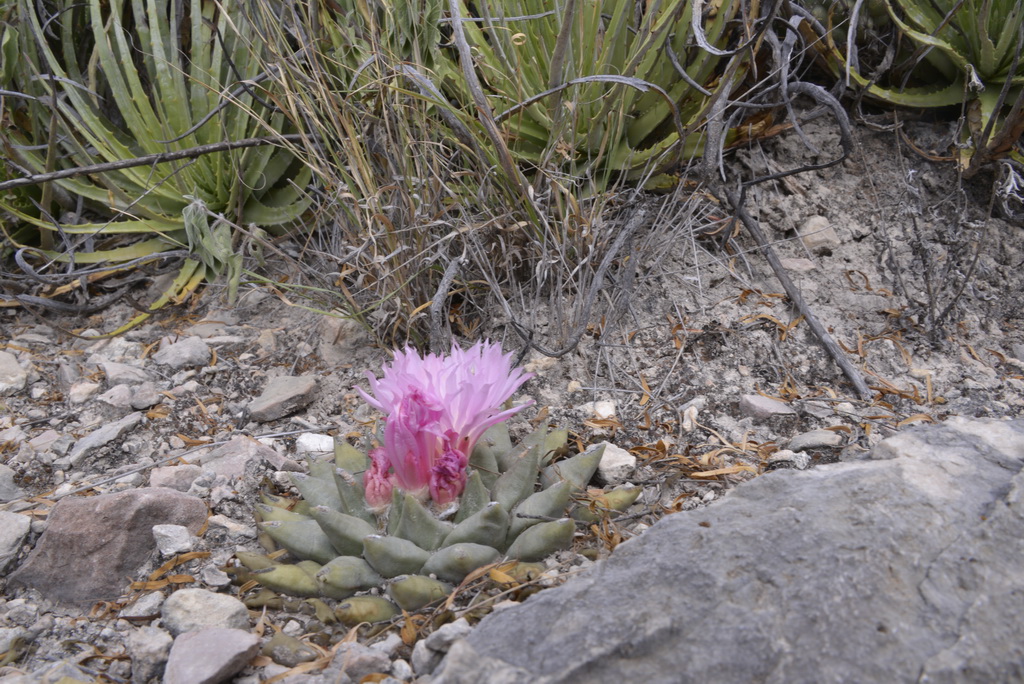
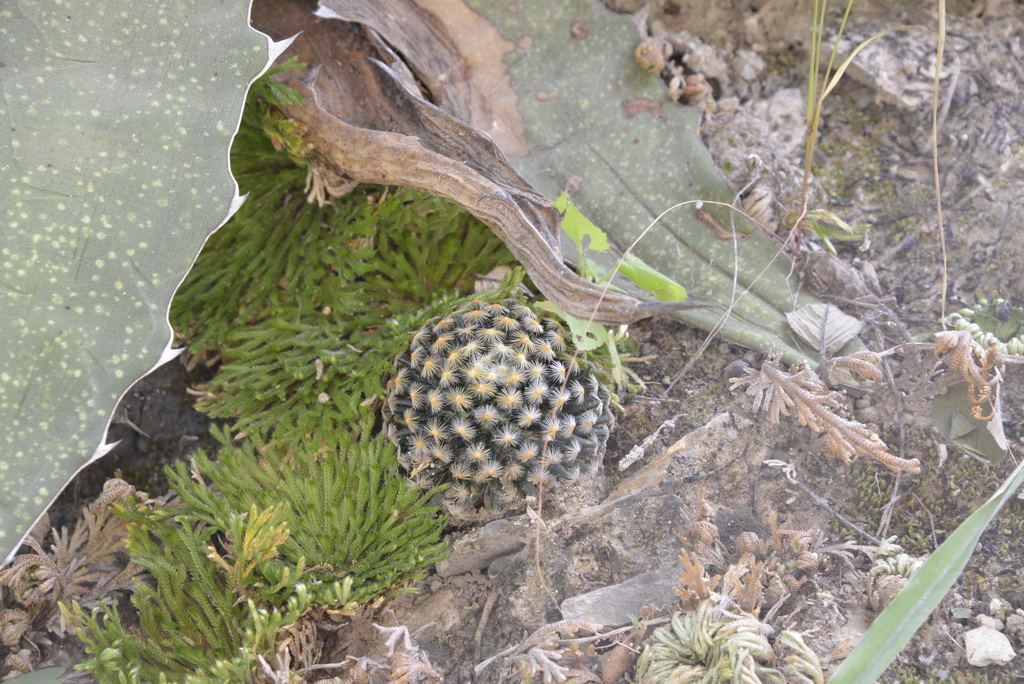
S3214 combined pictures of plants growing along the rock cutting as we drove out of Xichu towards the T. alonsoii. Here too the roadside rocks had been cut up to make space for concrete poles to cary elecytricity and / or telephony I assume. There certainly was not the variety of plants here that we had seen in March. Waling into the canyon where the plants grew it did not take long to find the first plants. They looked to have had a good year and were plumped up, but not in flower. On the opposite, shaded wall, there were mopre Mammillaria schiedeana than I remember seeing before – all small UK nursery seized , I do not recall seeing large plants in nature. These plants seem to live ion almost permanent shade, so don’t be fooled in giving these Mexican plants the full sun treatment in the UK.
Mammillaria schiedeana (S3214)

Mammillaria schiedeana (S3214)

As we were about to to return to the car, Alain mentioned that we had company. As I looked in the direction indicated I saw a white somprero ducking behind the shrubs. I called out ‘Buenos dias, Senor’ but there was no reply. We carried on strolling back, taking pictures of plants spotted as we went. Near the canyon’s exit our Mexican frien reappeared and gave us a talk in much too fast Spanish for us to understand that we needed permission to be on this private land. We were surprised that this was private land as, unlike his land across the road, there were no fences or signs to indicate this. I said that in Europe where we came from unfenced land without signage was considered common land for all people to enjoy. We then said sorry. We left with a friendly hand shake, but heeded his comments that ther Policia or worse, vigilantes, might have caught us with dire consequenses.

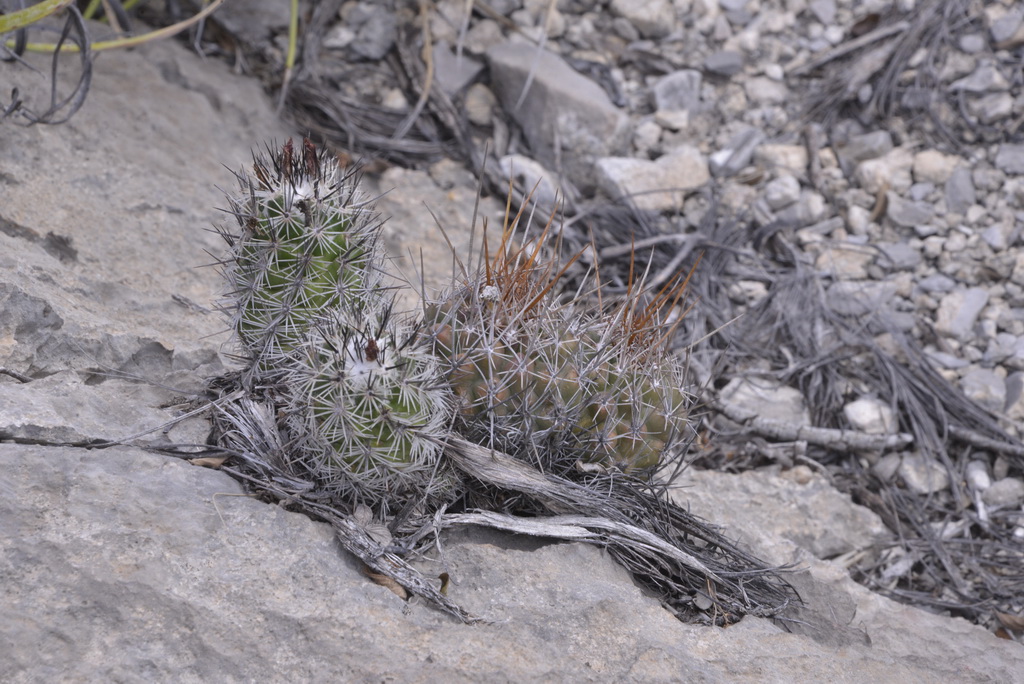
On the way back to San Jose Iturbide, Alain wanted to make a comfort stop and then called me over to take a look at a cactus growing behind the tree that he had selected for his privacy. There on the ground was a cactus that I had been aware grew in this area but that we had never found: Ferocactus macrodiscus ssp. septentrionalis. It was certainly not a show plant by any means, but it was still nice top add another taxon to our species list of plants seen in nature. Where there is one, there should be more, so we took a stroll along the edge of the field across the road where Alain found another group of four, growing among and hidden by the tall grass. There were people working in the fields some distance away and remembering the words of the old man in Xichu we decided not to cross the new fence to do a bit of gardening to expose the plants.

Alain had discovered a great restaurant at Hotel Los Arcos on the town square where the two of us enjoyed Marguaritas and Steak while Bart was well enough to join us for chicken soup.

We hope that Cliff, Ian and Sarda safely got away on their flight
Monday 3 November 2014 – Tula to Rio Verde

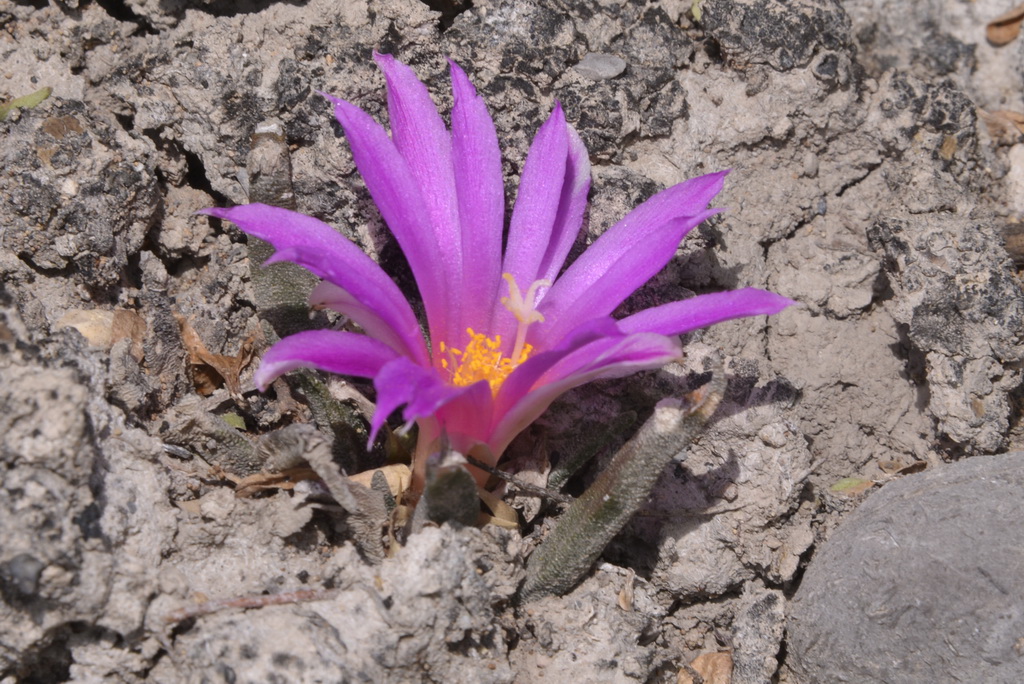
A great day! Not just because we were on the way home, slowly, but because 4.1 km from the hotel (the same one where we stayed in 2011 – the caretaker / owner was still drunk!) we completed our challenge of seeing every major taxon of Ariocarpus in flower, by finding A. agavoides (S3205). The plants would have been a real challenge to find if they had not been in flower! A couple of German cactus explorers were also staying in the hotel and as we stood on the hill, they must have seen our cars and parked behind us, climbing up as we were coming back. We told them the good news, that they were in the right place and that the flowers were waiting for them!

Ariocarpus agavoides (S3205)

Ariocarpus agavoides (S3205)

S3206 was a stop from last March and probably also from 2011 – it all seemed very familiar as we saw some lovely Astrophytum myriostigma, Thelocactus tulensis, Neolloydia conoidea, and of course an Ariocarpus, not in flower, so not sure if these were members of the confused A. confusus gang; the tubercles can be quite variable in retusus.

Neolloydia conoidea and Thelocactus tulensis at S3206

Neolloydia conoidea and Thelocactus tulensis at S3206

We turned south for Palomas and Las Tablas and made a stop (S3207) to stretch our legs – we’ve rarely been disappointed making an ad-hoc stop along this road! S3207 was no exception. There were some nice Asdtrophytum myriostigma almost next to where Bart had parked the car.

There are too many nice white spined Mams to know what we were looking at here – their appearance can vary depending on exposure to the sun or in a shady spot between Agave lechuguila, Hechtias and other things to tear at your ankles. I had wandered off in one direction and when I got back to the car, Bart & Alain asked, ‘Did you see the flowering Ariocarpus?’ No! and so we went back through the shrubs – everything has thorns or spines and is out to get you!

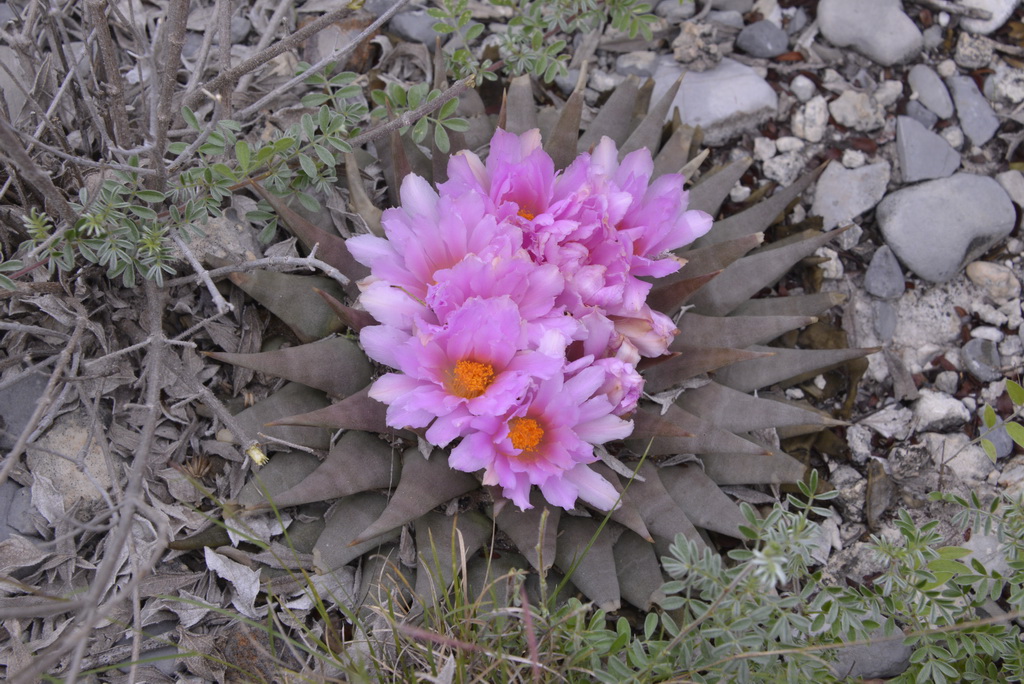
The Arios here had big chunky tubercles and pink / purple / magenta coloured flowers – the confusion arises from people with different native languages describing colours, including me who is colour blind!

Ariocarpus confusus? S3207

Ariocarpus confusus? S3207

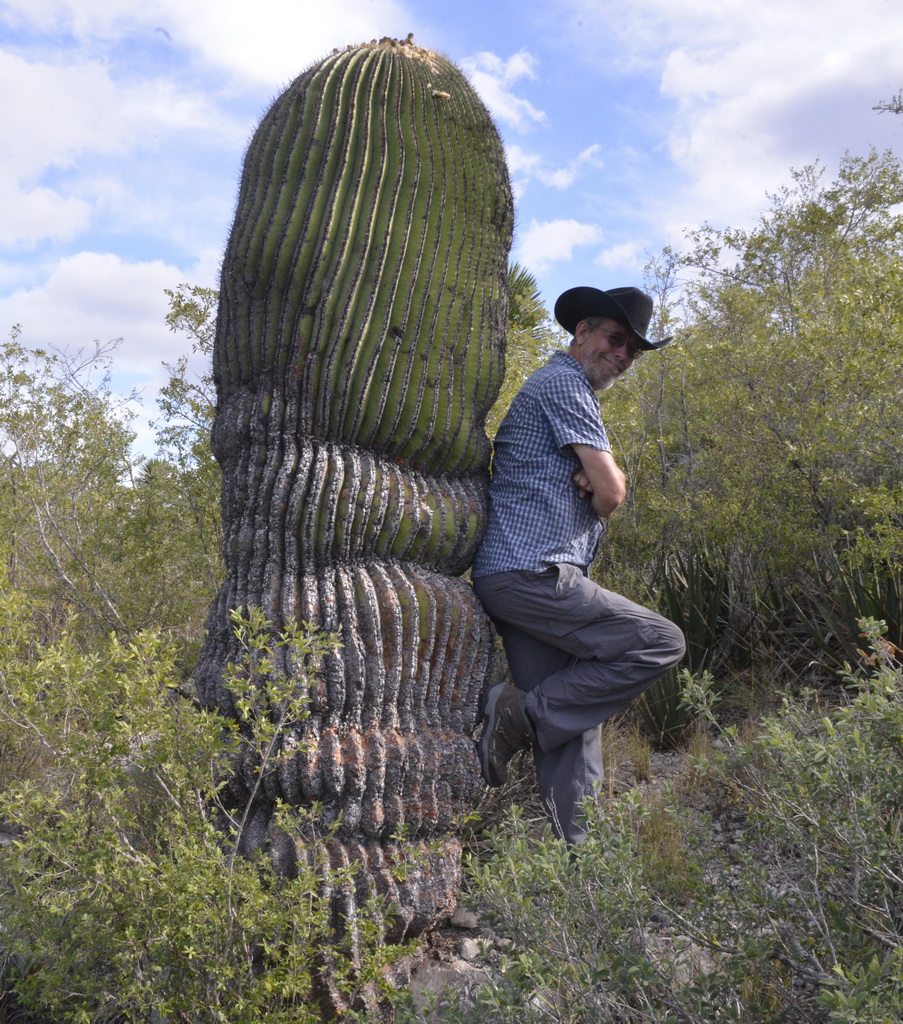
S3208 was a rendez vous with an Old Friend, the Echinocactus platyacanthus known by me as ‘Old Friend’ from 2011 and March 2014 visits and ‘Giant’ (over 3m tall). I’ll suggest here that this is the tallest Echinocactus platyacanthus ever, until somebody else shows me a larger specimen to take over the title (so that I’ll have to go back and give some fertiliser to this one!)

My Old Friend and I (S3208)

My Old Friend and I (S3208)

We had a great time crawling all over the hill before returning to the car, with Alain finding another multi-headed Ariocarpus in full (19!!!) flower. We’ve christened this Super Ario, but you’ll have to wait a bit before I share this in my talks.

We stayed again at Hotel Premier, where the wifi remembered us from previous visits after a reboot of the router and soon were off to Café La Granja where we have enjoyed excellent rib-eye steaks before, and again tonight, washed down with a bottle of Concha y Toro’s Seleccion, a blend of Cabernet Sauvignon and Merlot.

Saturday 1 November 2014 – Matehuela to Aramberri

Our goal today was to see some of the interesting cacti reported from around Aramberri. Just two stops today.

S3199 sounded interesting enough, just a few km off the main road from Dr. Arroyo, before La Escondida where we would turn east to Aramberri. Gymnocactus subterraneus and Turbinicarpus pseudopectinatus were listed amongst the cacti found at this stop. We were to be disappointed, seeing just Thelocactus buekii, Echinocactus platyacanthus, Feriocactus pilosus and Mammillaria formosa and M. candida. Of course there were numerous unidentified Opuntia and Cylindropuntia as well, plants that were so common that you’d hardly notice them after a while. Not as common were the huge plants of Dasylirion that need more research later to identify the species. The data we had suggested a 200 m walk up a hill to find our target plants. Common sense told us that these target plants were extremely small and were not expected to be in flower, so chances of finding them were slim. After a while it became clear that we were not going to find them, when the sound of a car crunching the grit on the track alerted us of approaching traffic, in the form of a mini bus. We were by now high on a hill top and watched as the minibus stopped near our cars and a man got out and walked around our vehicles. A bit later, Bart emerged at the car, having chosen to look at the other side of the track. Through my zoom lens I could see him talking with the person from the passing vehicle who then returned to the car. We had all decided that it was time to come down the hill, where we learned that the mini bus had been occupied by Czech cactus tourists. The one person who had spoken with Bart only spoke Czech and a little bit of Spanish, so the conversation had been limited to mutual nodding at the names of plants that we had already seen and had hoped to see. Lots of smiles and friendly sounding words and off they went, back to the main road, to be followed by us after we had gathered the troops, and never to be seen again by us, at least not today.

The scenery at S3199 was quite dramatic with camanchaca-like clouds drifting over the distant hills; perhaps another fog related presentation could focus on plants where hill fog provided important regular humidity to support succulent plant life.

After the turning at La Escondida we agreed that the first task should be to secure accommodation for the night. SatNav suggested Hotel Esmeralda which we eventually found by parking on the square and sending Ian and Alain on a run around the town. SatNav insisted every time on sending us the wrong way up one way streets. On foot, that tends to create fewer problems. So the hotel was found and rooms were booked, leaving us free to take a look at one of the many locations to the north of the town for Ariocarpus confusus. A strange name? Not really, for a plant that has tubercles somewhere between A. retusus and A. trigonus and a highly variable flower colour, from white to pink to magenta, with yellow also reported but not seen.

To get to the location coordinates, we had to cross a small stream. The ford was flooded and so we sent Alain and Sarda on foot through the fast flowing water to establish the depth. Encouraged by the result, Bart was the first to drive our car through, quickly followed by Cliff in the other car – too fast for me to catch it on video.

Once at our location (S3200) we quickly found huge numbers of Thelocactus conothelos, as well as many large Echinocactus platyacanthus. We realised that we were on the northern side of the hill – fine for cacti on the southern hemisphere, but not so good here in Mexico – so climbed to the top and on the crest of the hill soon found our Ariocarpus in large numbers and in flower!

Ariocarpus confusus, north of Aramberri (S3200)

Ariocarpus confusus, north of Aramberri (S3200)

A great stop, that also provided the first time that I remember seeing E. platyacanthus in flower.

We made sure that we were first to cross the river again, so that we were sure to have our cameras in video mode, ready to catch the other car coming through. They arrived … and stopped. Then Ian got out, rolled up his trouser legs and walked through the water, to join us in our video exercise. Then Cliff followed in the car – all captured on video – a nice change in future presentations from endless pictures of Ariocarpus in flower!

Thursday 9 October 2014 – last day

Normally the day of the flight is a matter of getting up and then waiting. But my flight was not until 23:35, so that would be a long wait.

Ruth and John must have understood and decided to pamper me for one more day by taking me for a day out at Crocodile Steve Irwin’s Australia Zoo!

We had a wonderful day, despite a brief rain shower and sat in the famous Crocoseum, an arena where we were treated to endemic birds such as parrots and raptors and (carefully) hand fed crocs.

All the entertainment made the day soon pass and after uneventful flights I safely arrived back home in the UK.

Certainly a very memorable experience with a heap more friends added to my virtual Christmas card list (I’m actually the world’s worst sender of Christmas cards so don’t be disappointed that a seasonal wish here to all my friends around the globe is all there is. It avoids the risk of missing someone out.

CRICKEY!!!

CRICKEY!!!


Wednesday 8 October – visit to Terry Tierney

Angie reported that temperatures back home in England had dropped to -1 C during the night but had climbed back to double figures during the day.

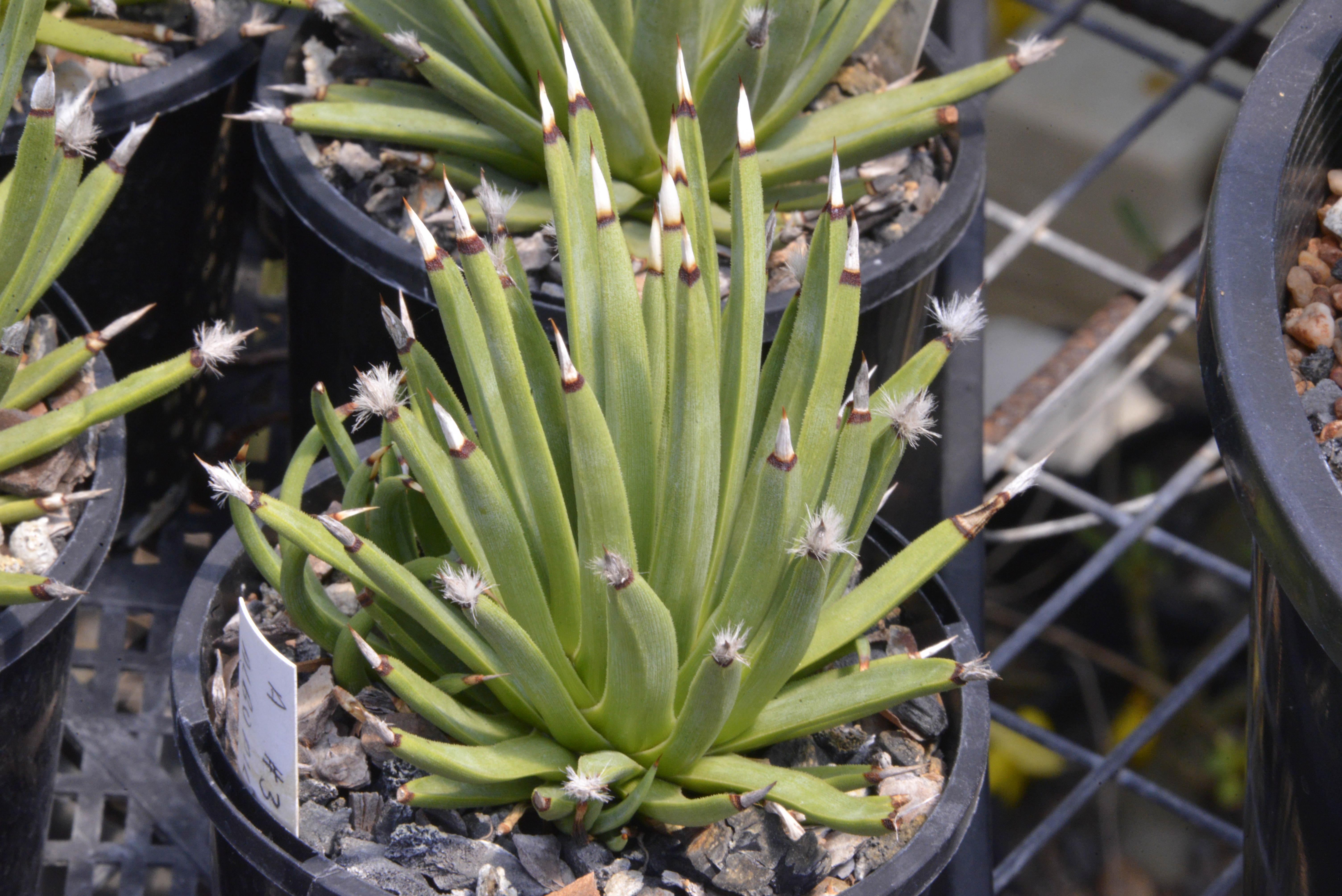
Here in Australia, Spring produced higher temperatures than England in the heat of summer!  At the Convention I had shown John and Terry a 6 minute movie clip from a trip through Huasteca Canyon, near Monterrey, NL, that included images of Agave albipilosa. These would be highly desirable plants if  the fluffy bits at the end of the leaves were present by the time that nursery men like to take their plants to market, at around 18 months. In England, plants raised from seed some five years ago were still without fluffy bits. Terry said that his plants were some three years of age and had produced their fluffy bits after three years, so I was happy to take some pictures.

Agave albipillosa at some three years of age, complete with fluffy bits

Agave albipillosa at some three years of age, complete with fluffy bits

I had already seen evidence of Terry’s growing skills in his Asclepiad presentation, but I was now looking at quite a number of plants representing all the taxa in the impossible to grow (for me) Pseudolithos. It turns out that these plants all come from Somalia, probably in another fog desert. More travelling for me? No thanks, Somalia is currently just a little bit too dangerous for my liking.

Some of the Pseudolithos plants looking in great shape. In England the frequent sound of rain on the greenhouse roof might kill them!

Some of the Pseudolithos plants looking in great shape. In England the frequent sound of rain on the greenhouse roof might kill them!

While enjoying our chat about cultivation tips, I suddenly came over very dizzy. I beat a hasty retreat to the shade of the veranda where Terry’s wife provided a couple of glasses of cold water that I sipped down and immediately started feeling better. The temperature on the shaded veranda was 34 C, while where Terry and I had been chatting in the sun, the temperature was around 45 C. A timely warning of how high temperatures can creep up on you when you’re distracted by great plants! I’ll be sure to wear my hat and look for the shade in Mexico, where in autumn / Fall, temperatures can still soar.


Tuesday 7 October 2014 – at home with Ruth and John

By the time that I got up, Karen and Debra had already been taken to the airport for their early morning flight to Newe Zealand for a short holiday break. Sorry to have missed you, but hope to see you in California in February 2015.

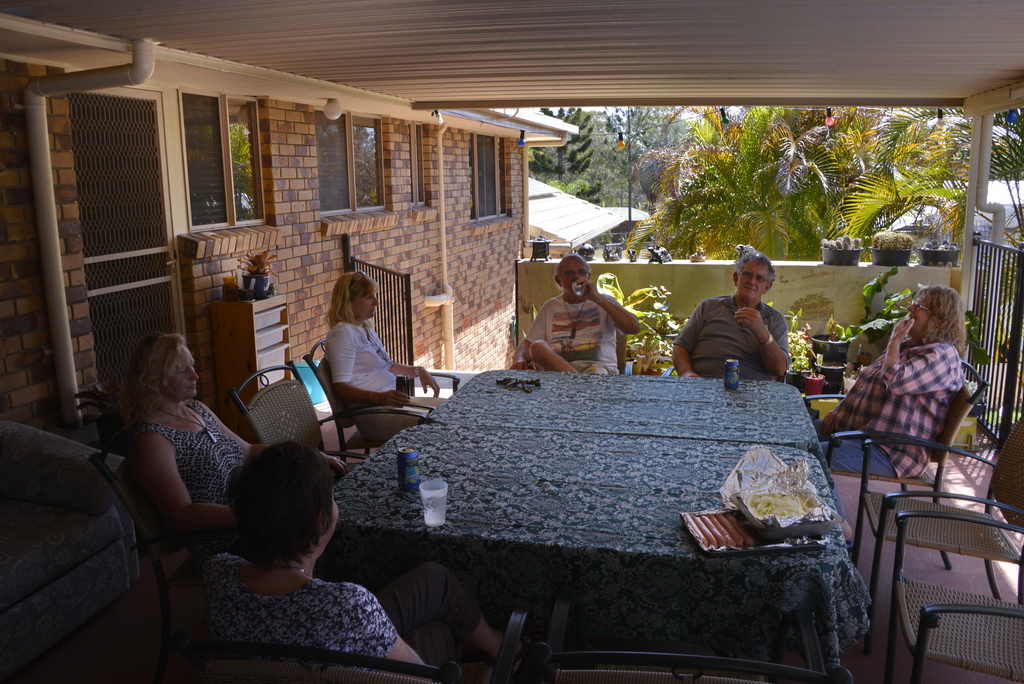
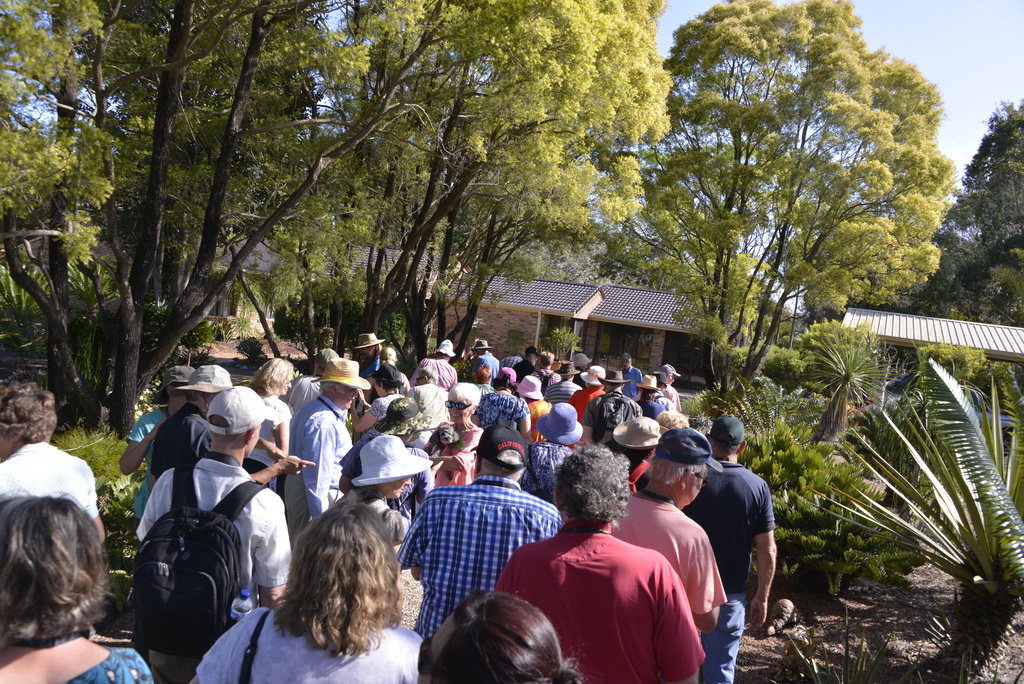
Today a few cars of delegates game by for a look around their collection, a bite to eat and a drink.

The New Zealand contingent waiting patiently while out of sight John is firing up the BBQ and Ruth is preparing salad in the kitchen

The New Zealand contingent waiting patiently while out of sight John is firing up the BBQ and Ruth is preparing salad in the kitchen

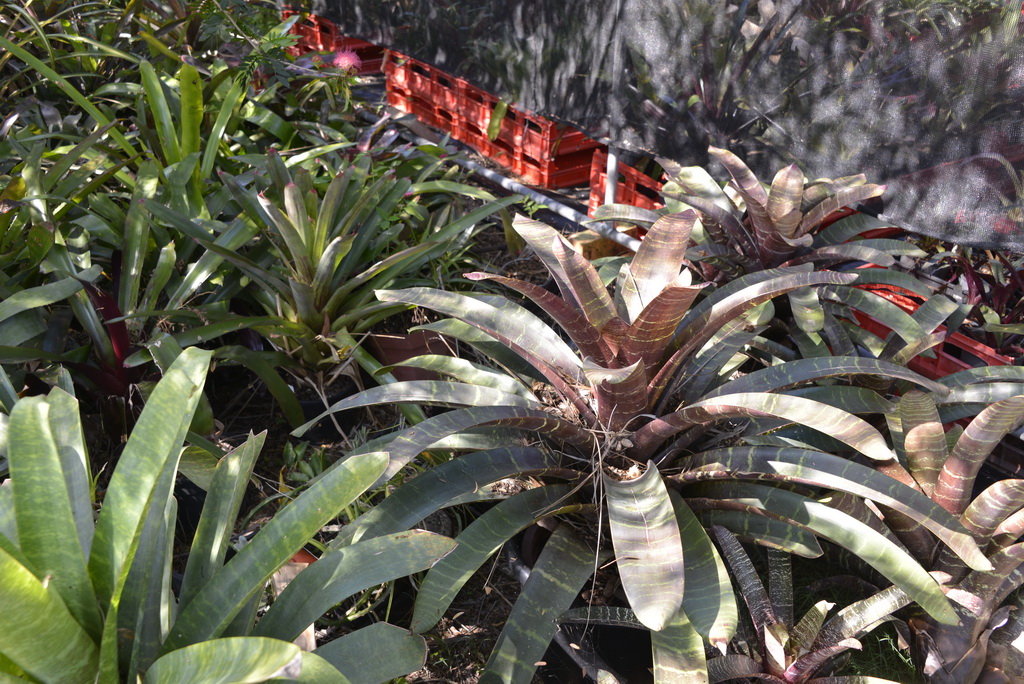
The perfect opportunity to join in with the visitors for the guided collection tour. Again, the collection included a large number of Bromeliads, reflecting the fact that John is a past President of the Bromeliad Society. While air-plants take up relatively  little space, quite a few of the terrestrial Bromeliads get quite large.

Lovely markings and colours on these Bromeliads - sorry, I could not find a label.

Lovely markings and colours on these Bromeliads – sorry, I could not find a label.

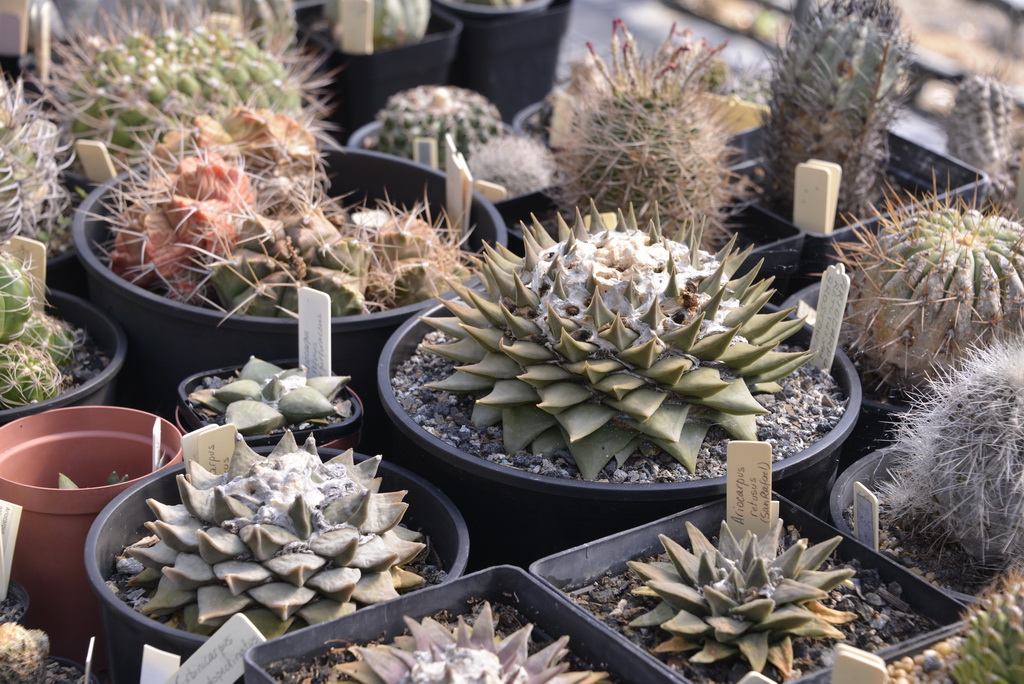
Some great and mature Ariocarpus again reminded of plants I'd see in nature in a few days time.

Some great and mature Ariocarpus again reminded of plants I’d see in nature in a few days time.


John is a true collector and has collections of the least likely of objects including a group of garden gnomes living in the garage. No worries, no pictures – just of plants.

Another plant inspection.

Another plant inspection.

Monday 6 October 2014 – Day 4: more presentations

A quick summary of the last day of the official convention:

Breakfast at 7:15 preceded the final plant sales and at 8:55 the bell called us back to the hall where I was first on the bill, presenting the ‘world premiere’ of a new presentation called ‘FOG’, the result of (another) night of too much Belgian beer at ELK when I observed that after seeing the camanchaca in Chile, the garua in Peru, the ‘marine layer’ in California, I should really go and see the results of a similar fog along the Skeleton Coast along the edge of the Namib Desert. In 2012 I went on a 9 week trip to South Africa and Namibia to do just that and so built up a nice portfolio of the flora that is found at and around the tropics of Cancer and Capricorne. A great excuse to show a very diverse selection of plants that thrive (or perhaps ‘survive’ is more appropriate) in these hard environments. Living on the edge!

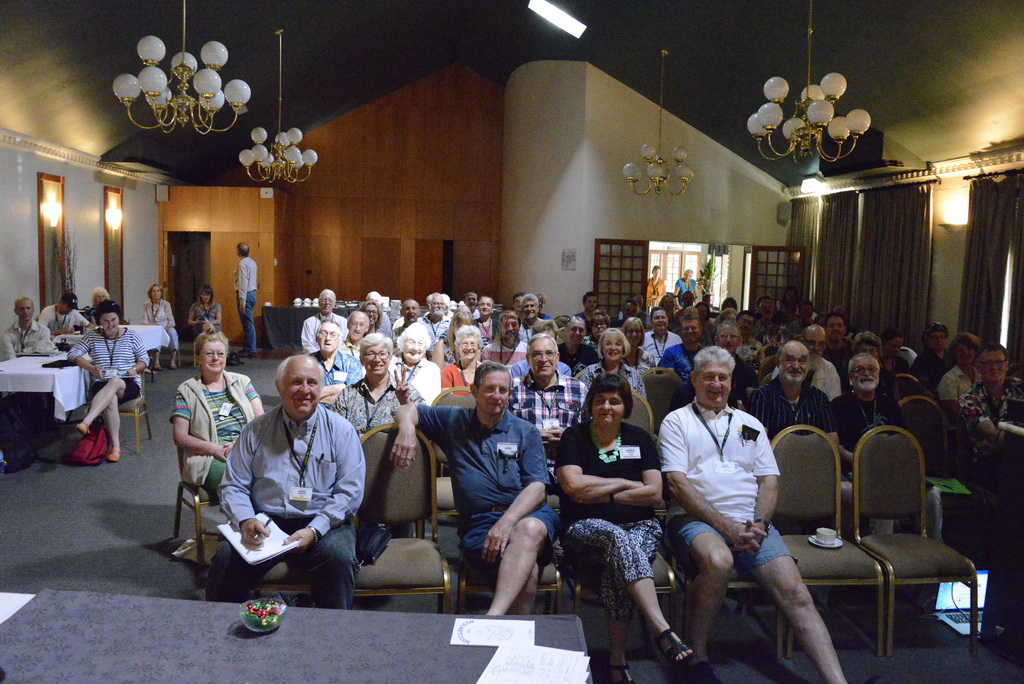
A speaker's view: my audience at the start of the world premiere of FOG that I hope touise in next year's What I Saw Last Winter presentations.

A speaker’s view: my audience at the start of the world premiere of FOG that I hope to use in next year’s ‘What I Saw Last Winter’ presentations.

Next, Ruth Higgins showed us the Crassulaceae seen in Oaxaca, Mexico, an excellent presentation of what I can look forward when I plan to visit the area in 2015.

After the morning tea break Terry Tierney showed off some of his Asclepiadaceae, of which we’ll see more when Ruth and John take me on a private visit later during my stay.

Karen Zimmerman followed with her second presentation: An Insider’s Tour of the Desert Collections, in the place where she works, The Huntington Botanic Gardens in San Marino in California. I visit this garden every time that I’m in LA and already look forward to my next visit in February 2015. Again, the corner where the Creeping Devils creep around was a highlight for me.

Paul Forster presented the Haworthia Wars Part II, explaining the rational behind the splitting of this popular genus into three. In the absence of a taxonomy police to inspect the labeling of our plants, I wonder how long it will take before all the labels in our collections have been changed.

After lunch, Dan Downie presented Lophophora – the Peyote Cactus, a courageous talk without the distraction of digital wizardry to read out some interesting facts about what must be the most written about cactus on the planet.I find that all the taxa in the genus look very similar, but understand that each differ in the alkaloids that they contain, so I guess that one needs to have a good chew on them when encountered in the field, to be able to decide on the species name.

Ernst van Jaarsveld closed the proceedings with a very interesting talk: Welwitschia mirabilis – a living fossil from the Namib Desert. Again, for me, the talk was a mixture of bringing back happy memories of seeing this icon of the Namib fog desert in the wild and learning (for me) new facts about this plant such as the fact that fossil evidence has been found in NW Brasil that suggests that this plant was around at the time that the continents split and Dinosaurs walked the planet. As I mentioned earlier, I am very happy to have the biggest and best book ever produced on a single taxon, well two if you count the namibian and angolan subspecies.

Image

Sunday 5 October 2014 – Day 3 : more bus trips

As you can tell from the previous few day’s reports, I had a great time and probably spent a little longer on them than I should, considering that in about 24 hours time I’m off for four weeks in Mexico. There is still last minute packing to do and a final attempt to track down some habitat locations along the route that are worth a stop to stretch our legs.

So, my attempt to be brief on the remaining pages is by no means a reflection of my lesser enjoyment of the events.

Starting at 8 a.m. we were again on a Magical Mystery Tour, with Bus #1 visiting the collections of Greg & Alice Daniels, Bob & Judi Proctor finishing with afternoon tea at Paul Forster’s. I must have been on Bus #2, as we made the trip in reverse order, meeting up with Bus #1 at Bob & Judi Proctor’s for a BBQ lunch.

Rather than waffle on again, I’ll make this an illustrated report:

Paul Forster’s

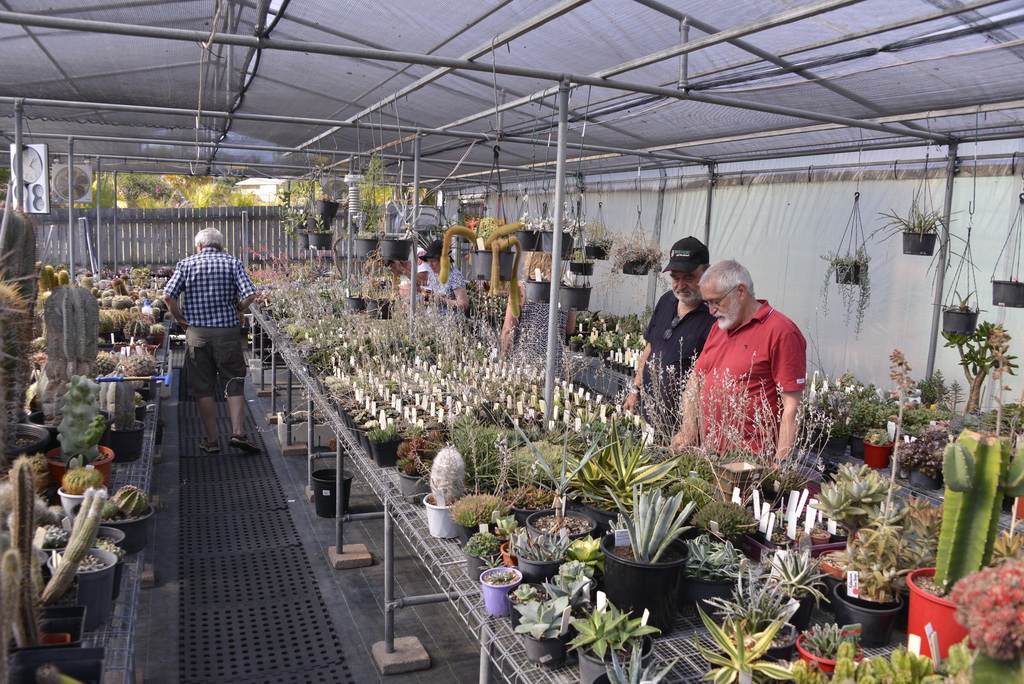
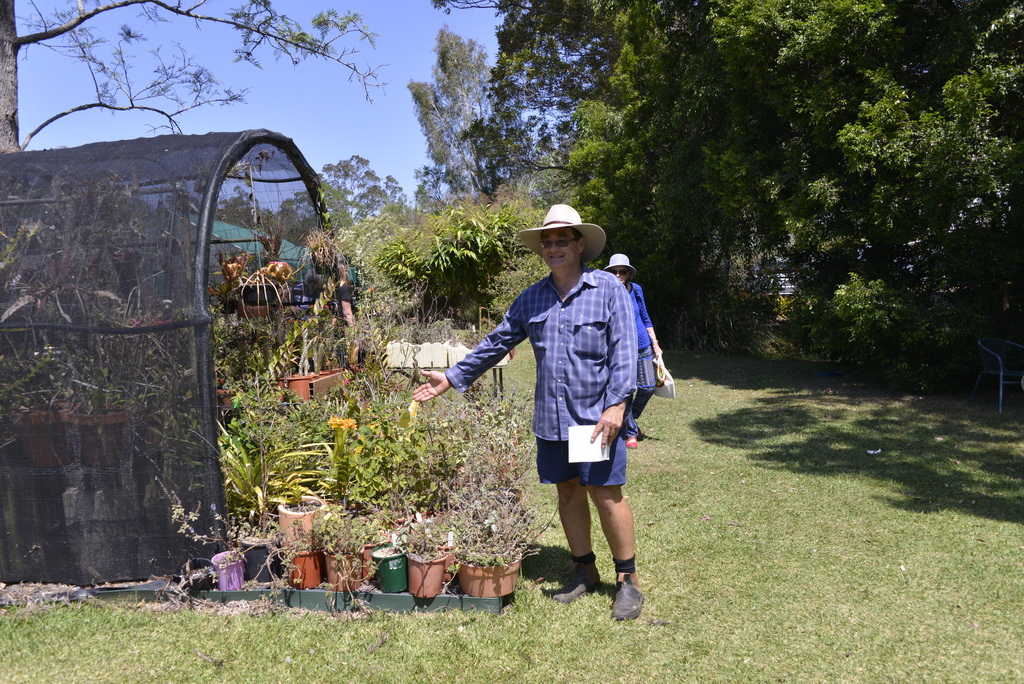
Paul Forster showing us his plants growing in green houses spread over his property.

Paul Forster showing us his plants growing in green houses spread over his property – here mainly Bromeliads in a poly-tunnel structure covered in shade cloth.

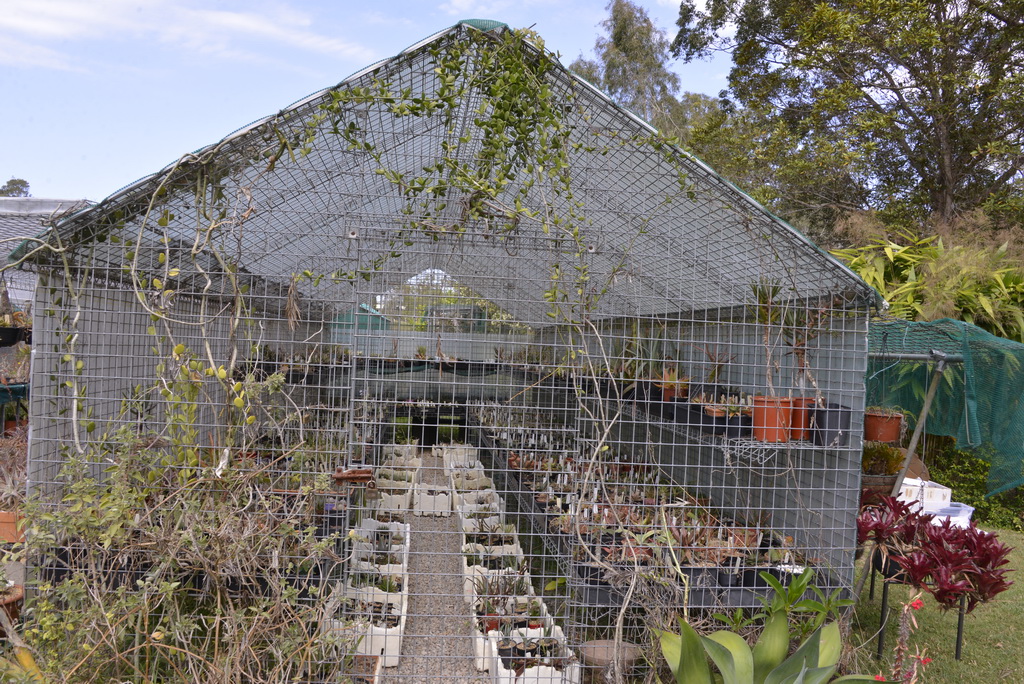
Protection: from what for who?

Protection: from what for who?

Horticulture often involves growing exotic plants in a controlled environment. Even endemic plants might need some help to look their best. Unlike in England, where we need structures to keep our plants warm and dry, while here the aim is to protect plants from too intense light and heat while ensuring good air circulation. The cage above would also assist in keeping young children and pets at bay or are kangaroos and wallabies a real threat?

Unfortunately, in waiting for the crowds to pass on to give my camera a free run at the plants, it turns out that I missed seeing Paul’s excellent Haworthia collection that every one was talking about once we were back on the coach.

Bob & Judi Proctor

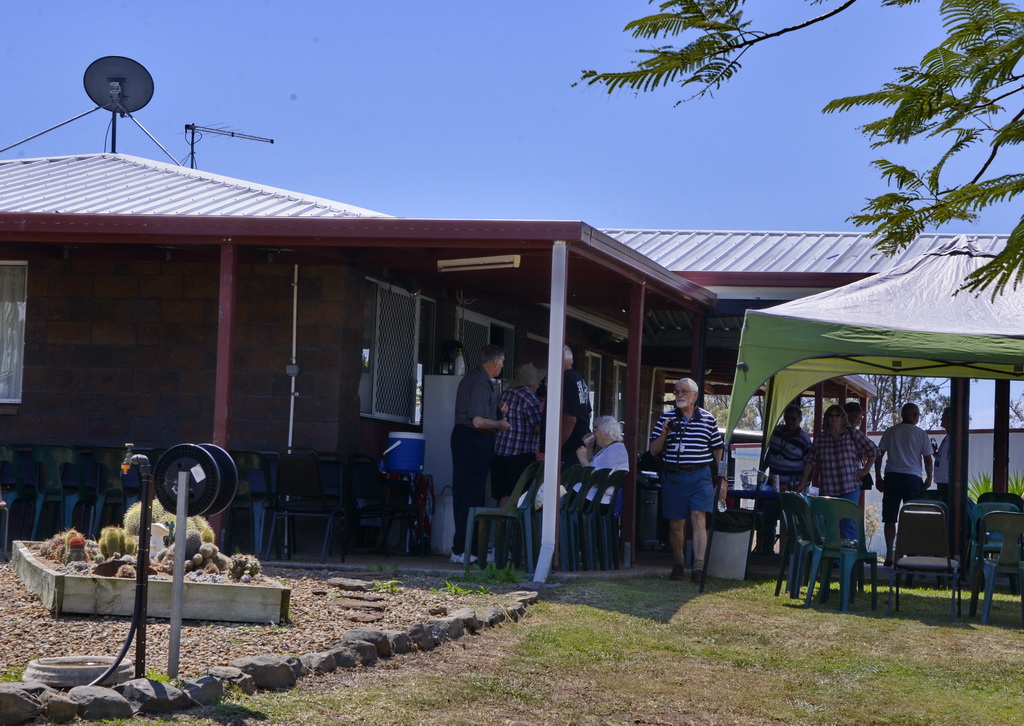
Bob & Judi Proctor's BBQ lunch

Bob & Judi Proctor’s BBQ lunch

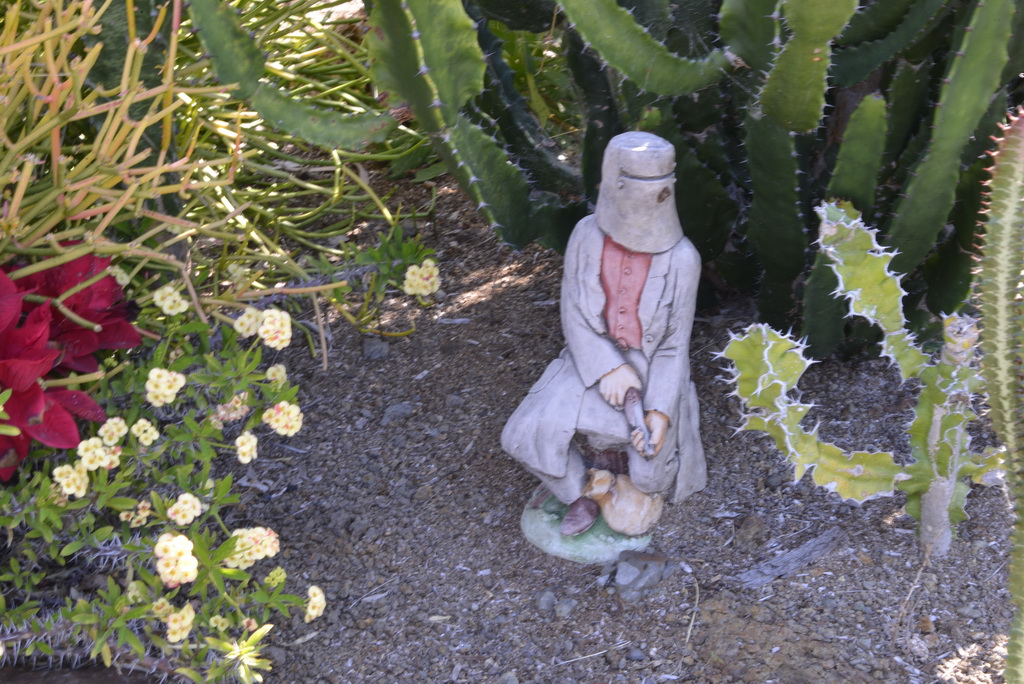
Australian folklore: Ned Kelly

Australian folklore: Ned Kelly

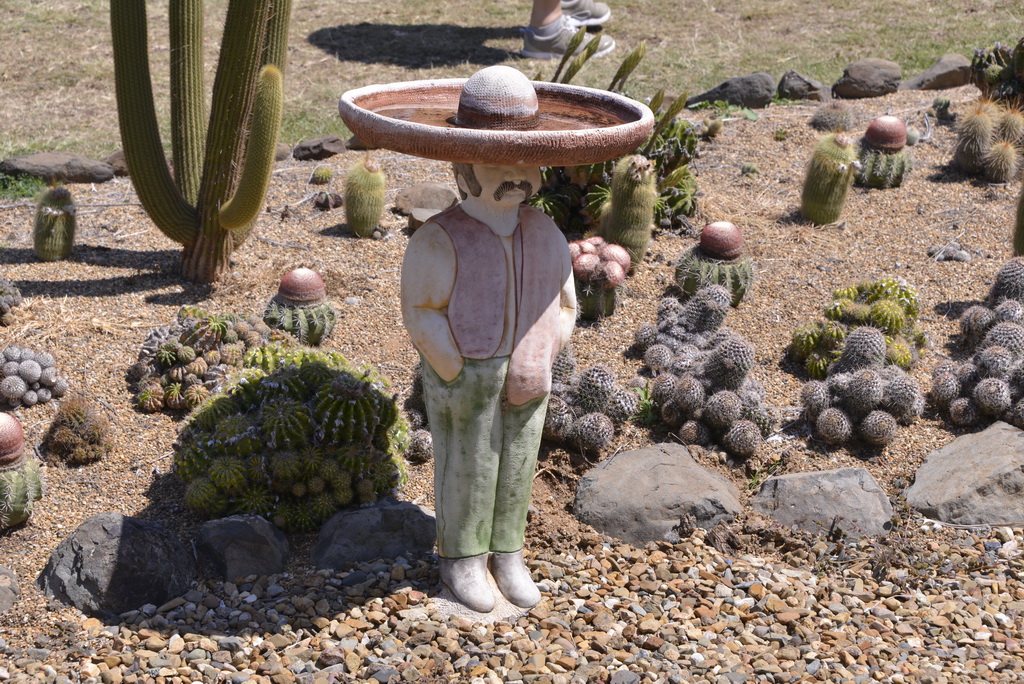
Getting me in a Mexican mood

Getting me in a Mexican mood

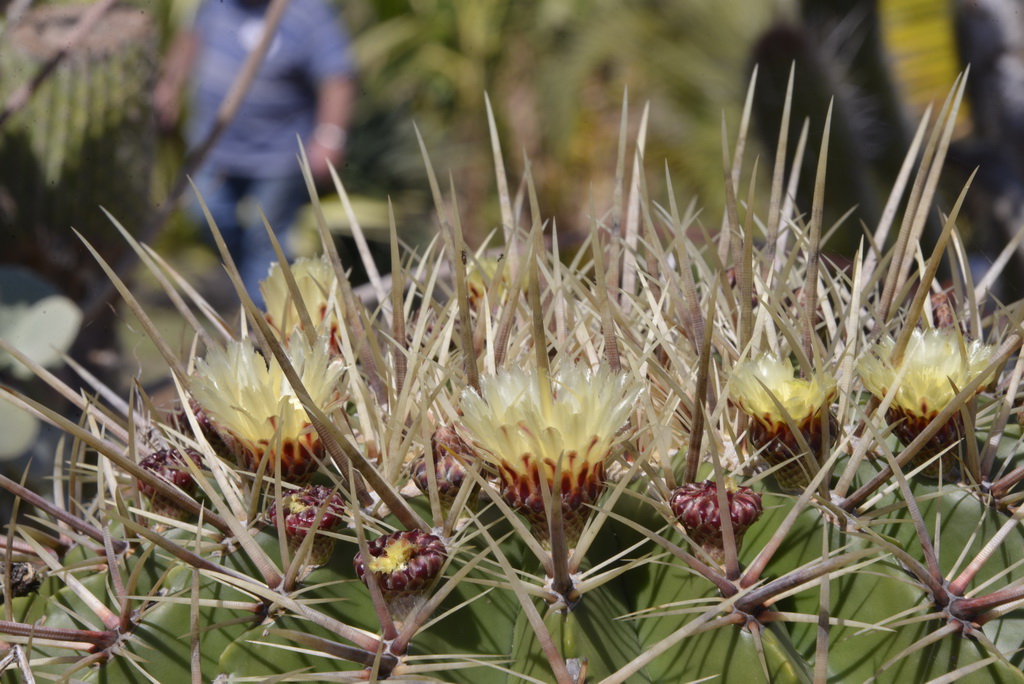
... and another reminder of where I'll be in 2 weeks time: Ferocactus histrix

… and another reminder of where I’ll be in 2 weeks time: Ferocactus histrix

Greg & Alice Daniels

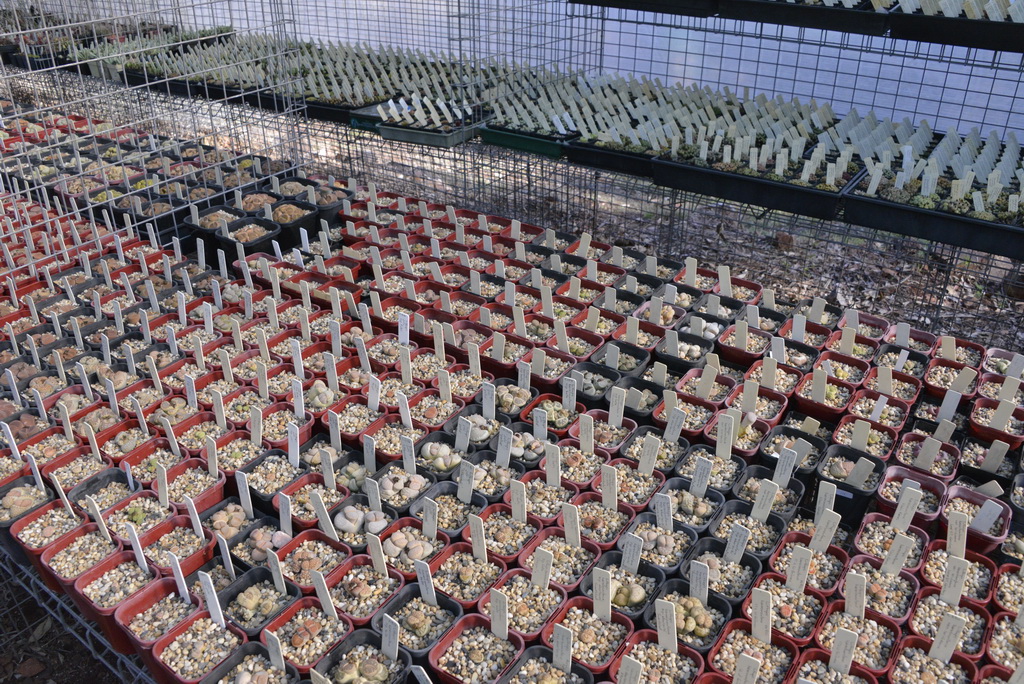
Detailed, well labelled collection, with plants for sale - here are the Lithops

Detailed, well labelled collection, with plants for sale – here are the Lithops

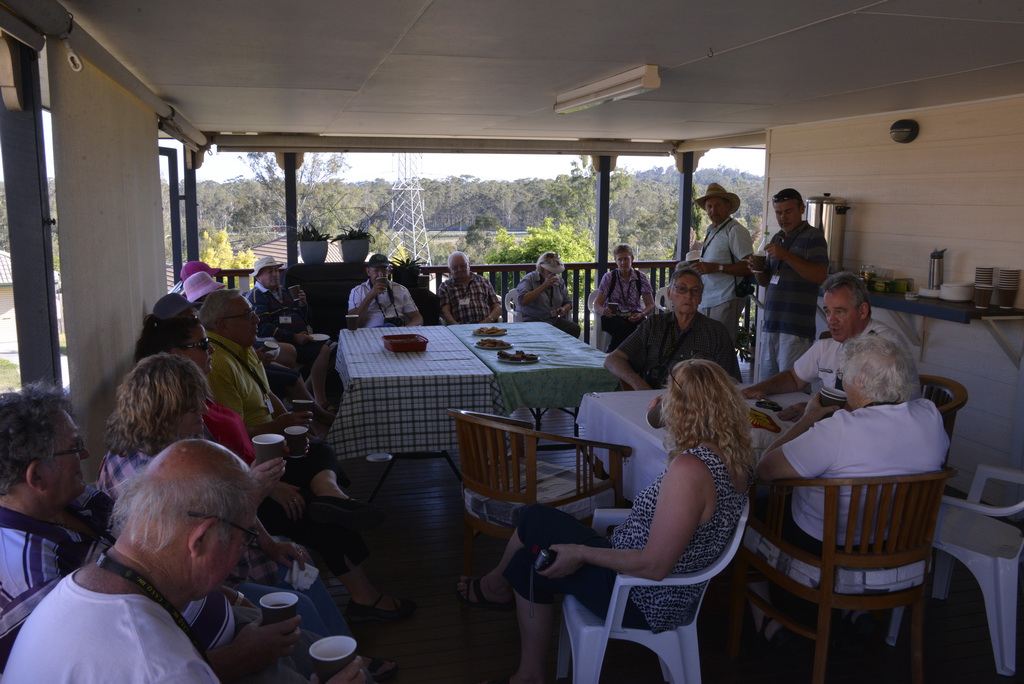
If an army marches on its stomach, so does a C&S convention, more great Ozzie hospitality

If an army marches on its stomach, so does a C&S convention, more great Ozzie hospitality!


Saturday 4 October 2014 – Day 2: presentations

Today was jam packed with talks, presentations, programs, lectures, which ever term you prefer.

After the official welcome, Ernst van Jaarsveld kicked off with ‘Succulent Plant Exploration in Southern Africa – Cape Agulhas to Southern Angola’ and showed us the huge range of succulent plants that this area has to offer.  Many of the delegates had traveled in the area and could readily identify with most of the plants that we were shown but still learned some interesting facts about others. I spent 9 weeks travelling in South Africa and Namibia in 2012 and am making plans for another, shorter visit in 2016. Great speaker, great presentation, great plants!

Next was Queensland member Greg Daniels who spoke on ‘Granite and the unexpected’

Kim Holbrook followed with ‘In search of the Devil’. The devil in question was Stenocereus eruca, the Creeping Devil of Baja California and again, seeing images from an area that I have visited quite regularly during the last 6 years was wonderful.

Doug Binns took us into his collection and shared his interest for Discocactus with us. Again, I have been fortunate to see many of these plants in Nature and enjoyed an interesting chat with Doug over lunch.

David Bromwich told us that The Limit is the Sky where we were encouraged to try to see the world from the plant’s point of view. All plants need light to survive and grow, but there is more to light than we can see. David moved through a fellow member’s garden with various tools to measure the amounts of visible and invisible (to humans) light and how this affected plant growth. Any presentation that triggers further reading later on is great by me and I moved a few things around in my conservatory since I have been home, where plants are stacked 4 high protected from moisture and the cold to see them through winter .

Time for lunch and plant sales and 75 minutes later, back to the hall for Attila Kapitany who enthused about Two Other Stars of California – Dudleya and Agave. In May 2014 he had a similar journey of discovery for both these genera that I have enjoyed on visits to California, guided by Eunice Thompson’s enthusiasm for these plants. Kelly Griifin seems to be at the root of generating interest in these and we saw some great images of the taxonomic mystery that Dudleyas can present, where plants in habitat readily hybridise creating a challenge for those who need names for the plants that they photograph. The Agaves that Attila showed us were in the variable Agave utahensis group. Again, it triggered memories of a trip in the Californian and Nevada deserts, ‘stalking’ the Agaves. The flower stalks of these plants not only announce the death of the plants, but guide Agave tourists to their habitats high on the hills. To make this a greater challenge, many stalks are knocked over as collectors hunt for the seed, so that knowing where to start your hunt can be very useful.

I had traveled with Attila and his wife in Chile and 2001 and meeting them again made the 13 years that had passed melt away. We’ll meet again, who knows where!

Next was Karen Zimmerman who showed us that she had Aloes on her Mind. Karen and Kelly Griffin are at the forefront of the current interest in Aloe hybrids. When these first came out I was rather skeptical – my love is for plants in nature and not for those created in almost laboratory conditions. But visiting them ‘at home’ in California I was impressed by the beautiful works of art that they had created, just as valid as any statue or painting that we admire as works of art. Karen explained how she selects plants with the best features such as colour, texture and teeth along the leaves’ edge and comes up with breathtaking plants that then presents them with the challenge to create an interesting and relevant name. Sadly, once the master pieces have been created, there seems to be nothing to stop anyone who has bought them to take cuttings and pass them on without paying copy right acknowledgements to the originator. I’ll have to make a list of the small number of Aloe hybrids on my windowsill, all acquired in Europe, and discover the name of the artist who created it. Karen also showed us examples where crosses that seemed to have great potential turned out to be disappointing and made their way to the compost heap. The interest in these plants was confirmed later in the plant auction where some of the ‘test tube babies’ reached fantastic bids.

After a quick break for tea, Merv Whitehouse climbed on his stage, built up from plant crates and gave us a practical presentation of various potting mixes, pot sizes and how different sized sponges – representing potting mixes – would ‘soak up’ water to the same height, irrespective of their size. Obvious once you think about it, but illustrating that often we don’t think too hard when selecting a new pot for your plants.

Finally it was my turn to take the floor, with ‘Mexico 2014 – a Thelothon’. This talk had already been on a tour in England as part of my annual ‘What I Saw Last Winter’ offering, and focused on many members of the genus Thelocactus that we saw in habitat growing alongside many slow growing cacti, which John Pilbeam refers to as ‘cacti for the Connoisseur’. These cacti are relatively slow and can demand special cultivation treatment and so are not too popular with mass production nurseries where the aim is to move plants from seed to sales bench in under 18 months. So the small number of plants offered for sale often come from hobby growers when they sell surplus seedlings from home raised batches of 20 seeds. In my plants this ‘rarity’was also expected in habitat, yet in many places we found cacti such as Ariocarpus growing in such large numbers and over such a wide area that was a great eye opener. While the Thelocactus and many of their other cousins were in the peak of glowering, the Ariocarpus delay flowering to late September / early October, so it comes as no surprise that in some 2 weeks time, I’m off to Mexico I’m off to Mexico again this time to photograph Ariocarpus in flower.

What impressed us all, judging by the chat at the official dinner, every one was very pleased with the varied range of presentations, all well presented, with full credit to Greg Daniels and Katherine Kok (?) who ensured that the technical side of digital projectors, computers and PA systems worked perfectly.

I enjoyed my introduction to Australian wine at the Official Dinner, admired the paintings that were entered as raffle prizes, but that were unfortunately to take home or to hang on my wall at home. The Society is fortunate to have a master auctioneer in Ian Hay who entertained us while encouraging us to raise our bids to new heights. I gather that it is not the first convention that he performed this role and his experience showed.

Once again I fell into bed, exhausted after a very full day.

Friday 3 October 2014 – Day 1: bus trips

It soon became clear that like many conventions, the social aspect of old friends meeting up again was an important part of the event. The Ozzies and Kiwis are a friendly bunch, despite the impressions to outsiders that could be created by the ‘friendly’ banter related to rugby. I’m used to it after years of living in the UK. I soon found myself chatting with more people than I can remember. I blame my age for not remembering every person who made me feel welcome. Fortunately the delegate’s registration pack included a full list of those who had made reservations, very useful when you get Facebook requests to remain in contact. I’m not a great user of Facebook, so don ‘t expect a daily updates and lots of activity.

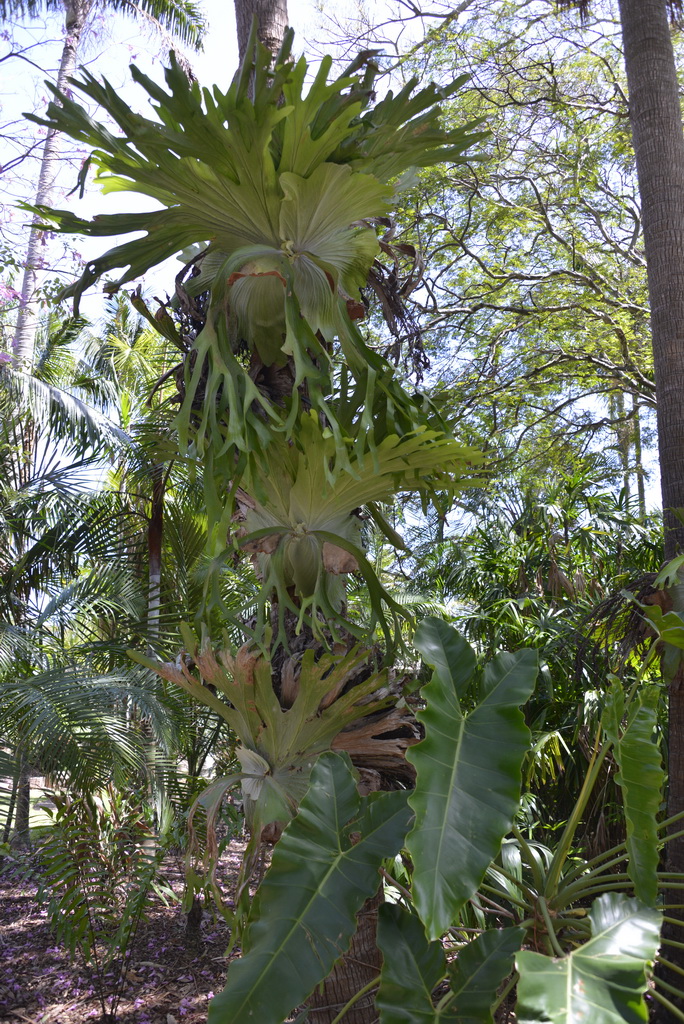
By noon we were all invited to get on 2 buses for a Magical Mystery Tour (well, it was for me!) to collections, first to Stan & Jane Walkley at Plantation 2000, offering wholesale palms and cycads. But there was so much more to see, this time captured on digital images. Clearly the climatic conditions in Queensland are quite different to those in the UK. Along the entrance path there were endemic orchids and staghorn ferns (Platycerium). I first saw a Staghorn fern in the living room of an auntie in Den Haag. It was an old venerable plant and uncle and auntie impressed on me that these required a lot more care and attention than the cacti that I was showing a keen interest in. Centrally heated houses are not the best location for these magnificent plants. Using Google, I learned that there are some 18 species that are found in nature in South America, Africa, Southeast Asia, Australia and New Guinea. This was the first time I had seen them growing (cultivated) outside, mounted on trees. Just as well that I took up growing cacti – these plants can grow to a significant size, several meters in diameter!

Platycerium at Plantation 2000

Platycerium at Plantation 2000

At the nursery there were ‘cages’ made of a large mesh panels, such as used for fencing, positioned in the shade of trees, bedecked with Tillandsia. I had already noted that Bromeliads were to be found in large numbers in the collections of C&S hobbyists. In fact, the local C&S at first covered Bromeliads as well until a growing membership was able to support two separate organisations.

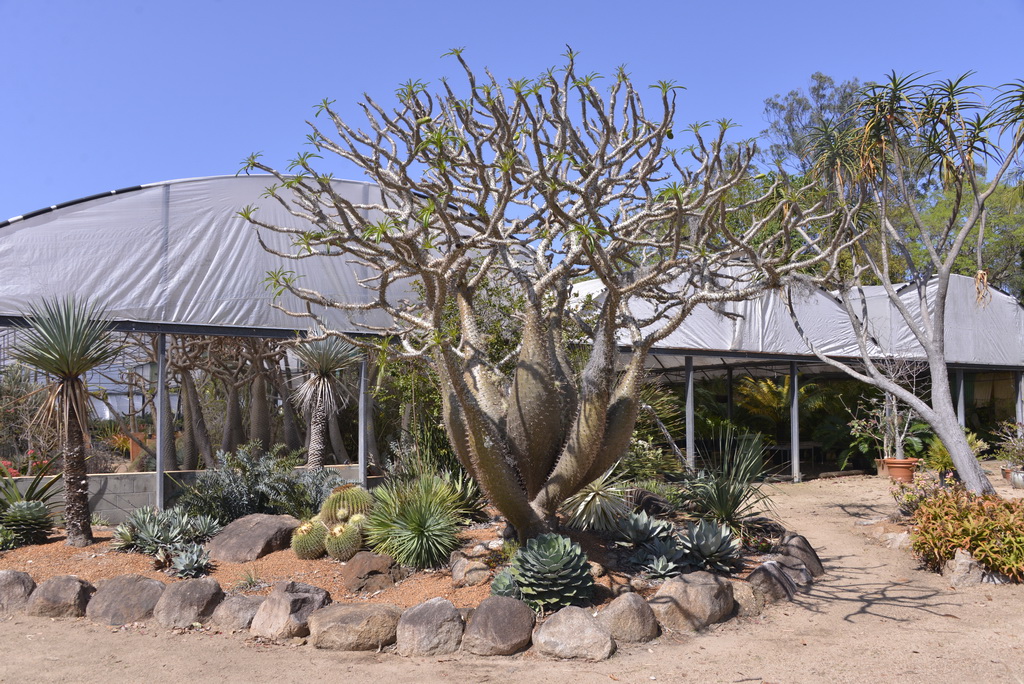
The other plants that impressed were the huge pachycaul trees – plants that in the UK are hard to obtain – I bought my few plants from Exotica, the nursery in Germany run by Ernst and Martina Specks. I had only seen plants of the sizes seen here from images taken by friends in the field.

Pachypodium sp

Talking of large plants, when I took several steps back I found that I had been standing in the shade of a Bunya Pine (Araucaria bidwillii). Its size made it tricky to take its picture, but I have at least one that I could use along Araucaria araucana (the Monkey Puzzle Tree) seen in Patagonia on both the Chilean and Argentinean side of the border and of Araucaria angustifolia, seen in Rio Grande do Sul in southern Brasil. There are 19 species all from the southern hemisphere, that originally date back to the days that the Southern continent were joined together.

Large Cycads and mature Melocacti were among the other impressive range of plants offered for sale. Several boxes of plants found their way back on the coach. But first we enjoyed a welcome buffet lunch and an opportunity to take on water – boy, it had grown warm!

And so the Magical Mystery Tour moved on to the collection of Lou & Tish Randall for afternoon tea.

Arriving at Lou & Tish Randall's collection for afternoon tea

Arriving at Lou & Tish Randall’s collection for afternoon tea

Here, most of the plants already seen at Plantation 2000 were seen planted out in a large landscaped garden. Clearly the amount of time, energy and resources that people put into the hobby knows no limits. Clearly the Queensland climate around Brisbane is not dissimilar to that of Madagascar as huge specimen of the  Didiereaceae and Madagascan Pachypodium showed. A generous afternoon tree made sure that we did not get hungry.

Tensions were building after seeing so many plants and there was a bit of a feeding frenzy when back at the Convention Center the plant sales opened. How frustrating that I was not able to take any plants back to the UK, without probably a huge amount of paper work and administrative costs. Good job there was a book sale as well, with offers from Attila Kapitany and Kim (Holbrook?). I bought a book on the cacti of Texas and chatting with Ernst van Jaarsveld , ensured that one of the four Welwitschia books that he brought to Australia would come home with me to the UK.

The biggest surprise was meeting Pablo Weisser, now living in Australia. Pablo is a Chilean who would make expeditions with Hans Lembcke in the Atacama Desert to collect seed for Friedrich Ritter that would be sold in Europe through his sister’s, Hilda Winter, seedlists during the late 1950s and early 60s. Cactophiles who specialise in South American cacti hold Ritter and the plants he  described in high regard. There is a Thelocephala weisseri that I have photographed in nature, but that these days seems to be ‘lost’ as a synonym in the Eriosyce odieri complex. Pablo provides an interesting insight to the history of Chilean cacti from the ‘Ritter days’ and it would be great to travel with him in the country of his birth and to learn of past adventures – we have it so easy these days in 4×4 cars on tarmac roads.