Just another WordPress.com site

Archive for the ‘Namibia’ Category

Monday, 1 October 2012 – Keetmanshoop to Windhoek

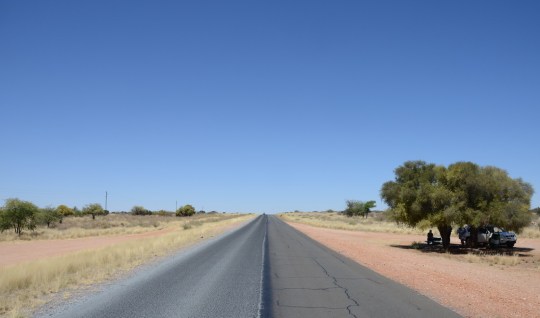
The 500 km from Keetmanshoop to Windhoek competes with a number of other desert drives for the title of most boring stretch of road. The majority of the distance is driven through flat as a pancake terrain on roads where a bend is likely to provide the only excitement of the day. Northern Chile, Patagonia, the Vizcaino Desert in Baja California all join in the competition.

To avoid drivers falling asleep at the wheel, it’s recommended to make periodic stops on the lay bys provided.

S2607 - pull over in the shade of an Acacia tree

S2607 – pull over in the shade of an Acacia tree

Here the excitement is provided by us crossing an invisible line from the subtropics into the Tropics.

S2608 - Tropic of Capricorn

S2608 – Tropic of Capricorn

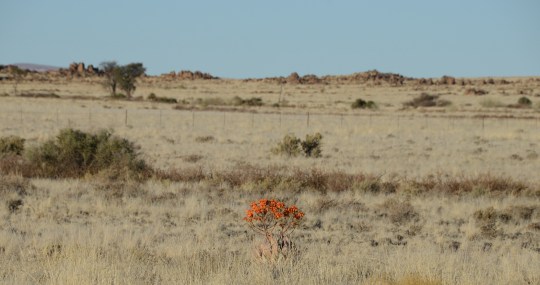
It was almost a shock to pass this stand of Aloes by the side of the road.

S2609 - Aloe sp.

S2609 – Aloe sp.

OK, the rain has gone, the sun is out, it’s warm, can we have some succulent plants tomorrow please?

Sunday, 30 September 2012 – Grunau to Keetmanshoop

The Cape Town to Windhoek main road, the N7 in South Africa changes its number to the B1 in Namibia. The difficulties in finding suitable places to pull over whenever an interesting plant is seen are the same. So we decided to take the longer and (possibly) more scenic route west of the B1, but did still failed to spot intyeresting looking plants along the road. This was flat arid land, not unlike northern Chile, probably with similar ‘hardly any’ rainfall statistics.

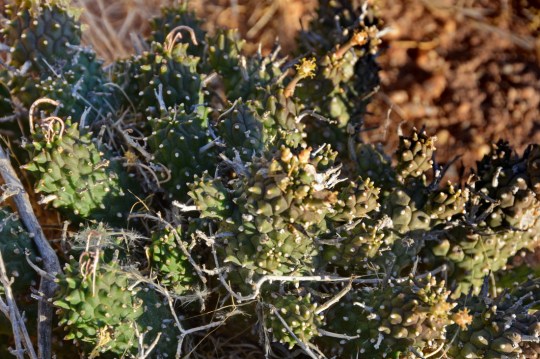
S2600 was for an official pull over, with just some stick Euphorbias to photograph, to keep the shutter exercised. S2601 was similarly disappointing, this time just one Monsonia (Sarcocaulon) sp.  without foliage or flowers so not much to go on for identification, except perhaps its geography.

S2602 was prompted by a small group of steenbokken crossing the road – no problems with fences for them, they simply leaped over them! Euphorbia virosa appeared in the back ground, more ‘stick’ Euphorbia in the foreground. We didn’t stop long.

S2603 was for some Aloe dichotoma growing on some very dark, almost black, rock cubes that appeared to have been neatly piled up. Mother Nature at work again. My antibiotics seemed to have won the battle – I set my sights on one of the Kokerbomen and marched towards it at a brisk pace, surprising myself that I was not exhausted and completed the loop back to the car.

As a result of these few brief stops we arrived at our planned accommodation at the Quivertree Forest Restcamp on the Gariganus Farm near Keetmanshoop by mid afternoon. As the name implies, this included a Quivertree Forest (S2604).

We took a look and lots of pictures, then went back to take some pictures of the curious domeshaped structures where we would spend the night (S2605). Eunice and I also went to the Cheetah feeding session. The farm is also a Cheetah Reserve.

Cheetahs and humans do not co-exist happily, especially when the cheetahs learn that the goats and sheep and even young calves provide easy prey. They can decimate a herd in a very short time. Farmers have the right to shoot the cheetahs on their property to solve the problem. Alternatively, the farmer can call on a Cheetah Rescue service that catches the cheetah and keeps it in a nature reserve, generating income as a tourist attraction to pay for their care. At the feeding session, Eunice and I joined about a dozen other guests in an area surrounded by a high fence where we were joined by two youngish cheetahs that were born in the reserve.Their mother broke out of her and when recaptured turned out to be pregnant. A few years ago (2010), our friends Alain & Greet Buffel visited this reserve and had their picture taken stroking the two young kittens. I’m glad that this was not part of today’s session, as the brithers had now grown up and would soon need to be split up. Being in the same enclosure with these two animals was quite an experience!

There was more to come! In another area we watched their mother being fed. Over the years, this animal had become accustomed to people to the extent that we could take it in turn to walk up to her keeper while the big cat was eating and under her close supervision, scratch the cheetah behind its ears, while fellow visitors took pictures. Again, quite an experience. I still have mixed feelings about these reserves – I would much rather see these animals in the wild, but realise that in the struggle for survival, they would fight a losing battle against humans.

We returned to the Quiver trees for some sunset pictures.

S2604 Aloe dichotoma sunset

S2604 Aloe dichotoma sunset

Saturday, 29 September 2012 – Daytrip to Fish River Canyon

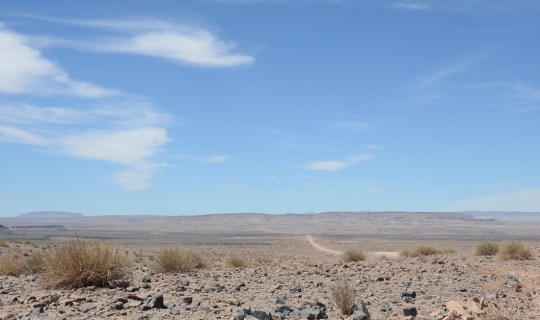
Things had changed a bit after crossing the Oranje Rivier. David had not spent much time in Namibia so the wealth of plants that we had seen in South Africa would have to be found by looking for likely spots, usually suggested by a clearly visible succulent plant, in the hope that there would be smaller stuff of interest around once we gave the area a closer inspection on foot. Where as in South Africa it seemed that at every stop we could guarantee at least half a dozen interesting plants, here we struggled to find any. So why did we go to Fish River Canyon? All Namibia tourist guides claimed that it was a must-see spot and this had been echoed by John Ede and in Alain Buffel’s diaries (in Dutch on a Belgian gardening website). We were here, might never come back, so we might as well take a look.

The fact that we made six stops today and that I took 160 images might suggest that we saw lots of plants. Not so – I seem to have a need to regularly exercise my right index finger by pressing a camera shutter when I’m on a plant trip.

David was the first to call for a Stop (S2594). He had spotted something red in the field, some 30 m from the road, but the high fence seemed too formidable a barrier. Looking through zoomlenses and binoculars we confirmed that there was an Aloe in flower. David was the first to cross the fence. The rest of us decided to wait until easier opportunities presented themselves, which happened 5 minutes later although there were no plants in flower here.

S2594 - Aloe asperifolia

S2594 – Aloe asperifolia

Aloe asperifolia is also known as the Sandpaper Aloe – asperifolia means ‘rough leaf’. It is widespread in central and northern Namibia, so we will see it again. Just like Agave, the upper surface of the leaf has an imprint of the teeth along the edge of the leaf above it.

I photographed an enormous, to 2 m tall, clump of a stick Euphorbia at the next stop – S2595. I have had some nasty allergy reactions to Euphorbia latex, so a zoom lens was a good tool.

S2596 - overview

S2596 – overview

As you can see – clear skies, so no rain and it had suddenly turned very hot – around the 30 C mark – why do our plants like such extremes? Actually, that’s why I like succulent plants.

S2597 was at the Fish River Canyon main view-point. We were the only visitors there. The toilets were locked to prevent them being damaged by baboons, or so the sign explained. The Canyon is certainly impressive but it was probably previous visits to the Grand Canyon in Arizona and the Goosenecks at Mexican Hat, Utah, not to forget Copper Canyon in northern Mexico that had spoiled us for such geological miracles.

Plant wise we saw Aloe dichotoma and A. asperifolia as well as this Euphorbia virosa in impressive setting.

S2597 Euphorbia virosa

S2597 Euphorbia virosa at Fish River Canyon

We were beginning to feel like real tourists so S2598 was a leg stretch at the Canyon Roadhouse, a quirky hotel and restaurant with old cars and other assorted scrap metal with local flora as a theme that carried on both inside and outside the building. But this is the Diary of a plant trip Diary and you can find plenty of images of this place by Googling Canyon Roadhouse.

S2599 was prompted by a couple of ostriches, still a novelty in the wild for us. As we had stopped anyway, a stroll around revealed another Euphorbia near the entrance / exit of the Gondwana Canyon Park .

S2599 - Euphorbia sp

S2599 – Euphorbia sp

Any suggestions for a name?
 
Also included in S2599 are images (taken by zoomlens from the roadside of the formidable fence) of the red flowering Aloes that David had spotted at the start of the day. These turned out to be different to the Aloe asperifolia that we had seen at S2594, these here had broad, spreading racemes with reddish to orange coloured flowers. David made it over the fence. We didn’t. A look through The Aloes of South Africa suggests that this is the widespread Aloe hereroensis.
S2599 - Aloe hereroensis

S2599 – Aloe hereroensis

One month to go!

In exactly one month’s time we should be arriving in Cape Town in the Republic of South Africa. During the nine weeks that follow we’ll be travelling through the western provinces of South Africa and Namibia in search of interesting succulent plants plus anything else that we’ll see that seems worthy of having its picture taken.

I’m particularly looking forward to seeing the famous fog of the Namibian Desert as it will compliment what I saw in the Chilean Atacama Desert and in Baja California.

The outline of the trip is best seen in three phases:

Phase 1 is the journey from Cape Town to the border with Namibia

Phase 1 – South Africa

Phase 2 covers our time in Namibia

Phase 2 Namibia

Phase 3 sees us back in South Africa, traveling a bit more slowly through the famous areas that we’ll have driven through at the start of the trip: The Richtersveld, Namaqualand, the Knersvlakte etc before heading east as far as Somerset East. From there we’ll head back to Cape Town and the flight home on 20 November.

Phase 3 - back to South Africa

Phase 3 – back to South Africa

To follow us on a day by day account of the trip follow this link to

19 September 2012