Just another WordPress.com site

Archive for the ‘South Africa 2012’ Category

Sunday, 21 October 2012 – Springbok to Pofadder

There had to be a reason why we had included Pofadder in our itinerary, but if there was, I forgot why. In the UK, Timbuktu is used to describe a place that is so remote and bland that you would not want to visit unless you had to. I understand that in the US, Kalamazoo has the same reputation. In South Africa, this honour goes to Pofadder and after our visit there, I can understand why.

We had only explored a modest distance east of Springbok, at Smorgenskadu farm, a few days ago and very much liked what we had seen. Yesterday we had been north of Springbok and got wet. The weather at Pofadder was said to be much warmer and drier; perhaps that’s why we went, although it does not explain why it was on the menu in the first place.

We had a fair distance to cover, but fortunately on good tarmac, with the only holdup caused by crews putting another layer on top of what seemed to be a pretty sound surface. S2706 was 3.6 km north-east of Aggeneys Airport. It seemed as though we were back in het Sperrgebiet, with signage everywhere discouraging us to go off the main road. The weather had certainly improved and now the heat was discouraging us from staying out of the air-conditioned car for too long.

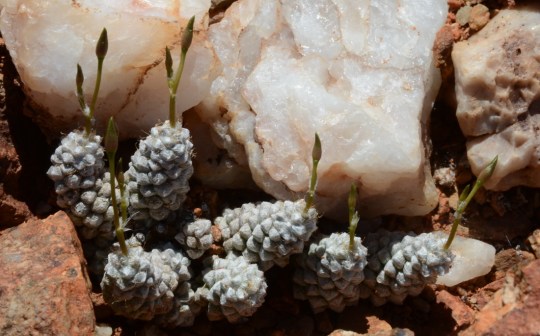
S2706 - Lapidaria margaretae

S2706 – Lapidaria margaretae

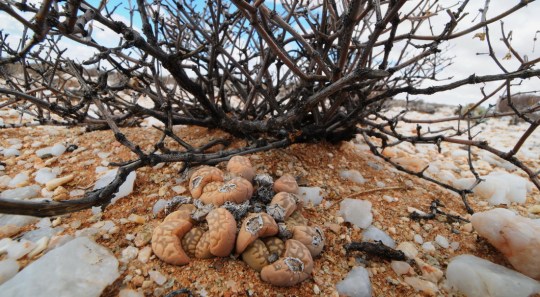
The new kid on the block here was Lapidaria margaretae, the only taxon in a monotypic genus that used to be included in Argyroderma. Such nice plants deserve two images, don’t you think? But most plants that were here were old friends, even if they have not yet been introduced to me by name.

S2706 - Lapidaria margaretae

S2706 – Lapidaria margaretae

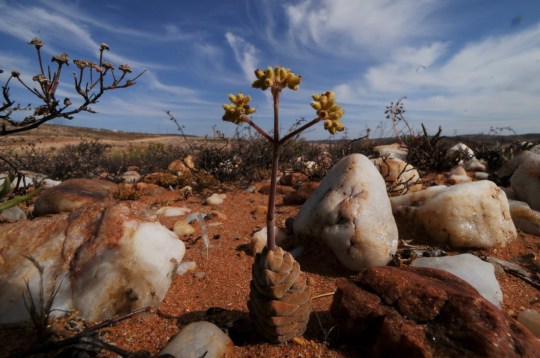
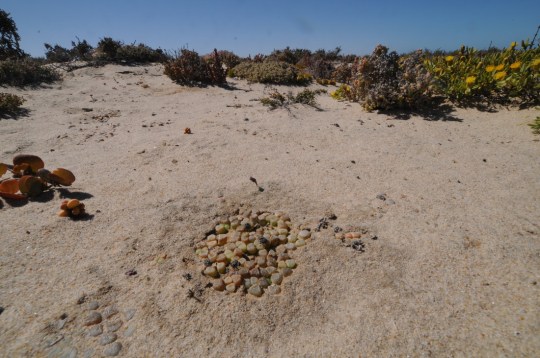
At 2707, a bit farther along, things looked really dry. Lapidaria margaretae was still here, but if my camera can be believed, nothing else, just a large expanse of sand and quartz.

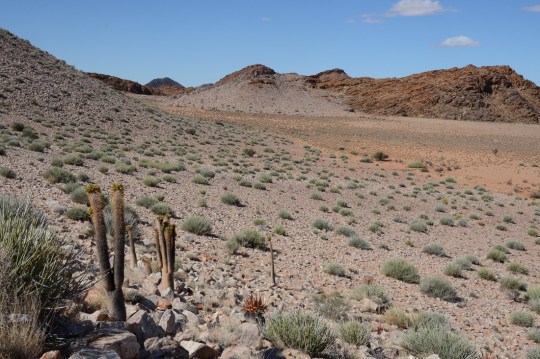
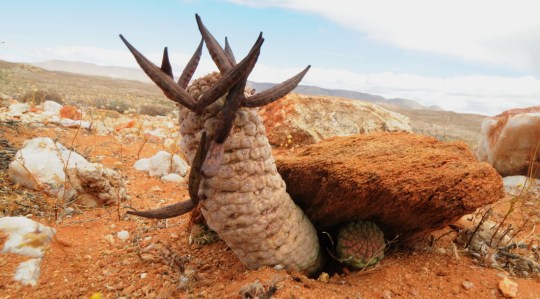
Following directions from friends back in the UK and asking directions from the odd Meerkat that we saw, we reached our goal: (ah, so there was a reason for coming here!) a hillside with the densest population that we had seen of:

S2708 - Pachypodium namaquanum

S2708 – Pachypodium namaquanum

We stayed at the Pofadder Hotel. If you are familiar with the UK TV sitcom series Fawlty Towers, you’ll agree that the following scene could have come straight out of the series:

We had an OK dinner and asked to see the menu to look over the deserts. After a long wait, four deserts were served. Not sure what they were, but we explained that we had asked for the menu, so that we could make our selection. Another long wait – it was 10:15 by now. The menu arrived and we called the waitron (Afrikaanse term for waitress) over to take our order. She came back 10 minutes later to explain that the kitchen closed at 10, so no sweets for us. Ah well, there was always the bar!

We had thought to stay two nights but after a quick consultation decided to go back to Springbok tomorrow for another steak at the Tauren Steak House!

Saturday, 20 October 2012 – Yesterday once more

The words of this song by the Carpenters went through my mind as we set off in the morning, each of us having agreed that we would spend the day on a wild goose chase for a needle in a haystack. But we could imagine what we would have felt like if we had lost something quite valuable and had missed on the opportunity to go and look for it. We’re just softies, I guess.

Fortunately my camera had recorded the GPS data for each of our stops so we had no problem retrieving our tyre marks. Yesterday had been cool and breezy, today the windchill factor was stronger and occasional drizzle ensured that we did not hang around outside of the car too long. As a result there were fewer images taken and little that was new or different from yesterday to show you.

S2700 - various

S2700 – various

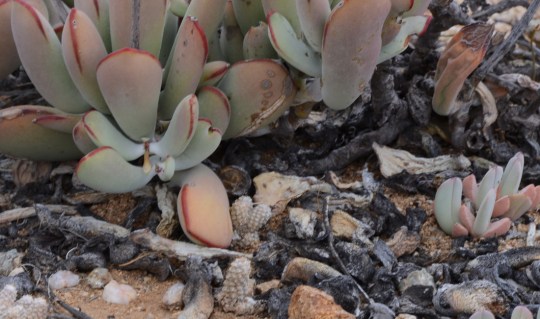
While a single image can give a good view of a single plant or a wide scenery shot of the environment, I have not included too many shot here to show how many plants are found growing together, as if in a botanical garden. Here a Cotyledon sp, Anacampseros filamentosa and a Cheiridopsis sp are growing in close proximity of each other. This image was taken at yesterday’s S2693.

Although all four of us made a serious attempt at retracing footsteps and looked in and underneath the low shrubs, there was no sign of Eunice’s iPhone.

S2702 - rain

S2702 – rain

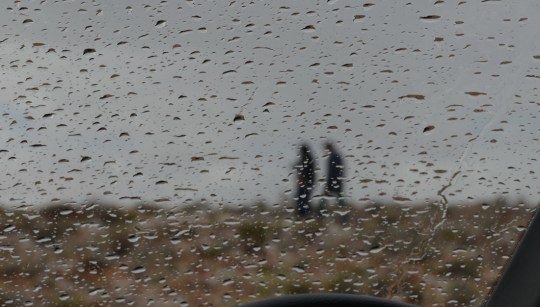
The view from the car as two of my fellow travellers are making their way back through the rain. Still no joy in our search. We joked that somewhere a baboon was showing it off to his mates, proud that he had discovered how to switch it on but cursing the fact that there was no charger left with his new-found toy. Eunice was beginning to see that today’s search might have a disappointing ending.

S2704 - Larryleachia cactiforme

S2704 – Larryleachia cactiforme

The weather had cleared a bit and the light was now better than it had been yesterday. I like this shot!

S2705 - Lithops marmorata elisea

S2705 – Lithops marmorata elisea

And also the shot of these Lithops that illustrate that the better plants grow protected from strong sun and grazing animals and their trampling feet, under the low shrubs.

We got back to our hotel earlier than yesterday, so an opportunity to catch up with sorting out images and a chat with Angie at the appropriately called Titbits Restaurant.

Today marks the halfway point of our trip, in terms of days on the ground. Browsing back through my images I was struck how much we had seen already and very pleased with the diversity of plants that we had covered. I have seen many presentations of trips in this area and it seemed that there was a bias in the places and images taken towards the plant Families that were of greatest interest to the persons on that trip. And why not? We seemed to have covered a bit of everything so that I can look forward to preparing a good broad view of what we saw for the 2013 round of What I Saw Last Winter talks in the UK.

We retired to our favourite Restaurant for yet another steak (at least for me – I’ll check if I’m growing horns once I get home) which tonight was on Eunice as a thank you for us spending the day looking for her iPhone.

Friday, 19 October 2012 – So where is Umdaus?

Having taken a look to the east and south of Springbok over the last few days, it was time to finish our look at the Richtersveld where the north eastern part still needed a visit. Readers of articles and books on visits to the Richtersveld will have come across the name Umdaus with plants recorded from there. In fact, it almost seems as though this ‘place’ had to be a succulent plant paradise! We looked at the rather inadequate maps that we had with us – nothing. We asked at the hotel where we were staying – blank looks. I spent an hour or so at THE bookshop in Springbok, the one where I bought enough books and maps to cause concern about exceeding the hold luggage weight allowance but again, nothing. I asked the guy (I should have asked his name) who was very helpful and seemed quite knowledgeable about the plants and geography of the area and although he seemed to have heard of name, could not pin it down on a map. He suggested that I’d browse through some books about the history of the area and from these I gleaned that Umdaus was a holding area for cattle that had been driven south, across the Orange River. But where was it? Roughly north-east of Springbok, but it seemed unlikely that we would find anything actually bearing the name. of course, many of the books I bought were published by Umdaus Press and their website rather mysteriously states: ‘Umdaus is the Nama name of a hilly area, very succulent rich, in the Richtersveld. Plants like Pachypodium namaquanum, Hoodia gordonia, Hoodia alstonii, Aloe gariepensis, several species of Conophytum and many others may occur here.’

May? Of course they do! That’s why we wanted to go there, but where was it? Friends from England had given us details of plants growing at Umdaus, as though they were talking about something well-defined and known, like Piccadilly Circus in London.

We started near the turning north off the R382, the Port Nolloth to Steinkopf road, just to the east of the Anenous Pass, an area that we had visited on the 16th. We made seven stops, so I’ll limit myself to one image per stop.

S2693 - Sarcocaulon sp.

S2693 – Monsonia (Sarcocaulon) herrei

Tracking down a name for this Bushmans Candle took me to the book of that name by Charles Craib & John Lavranos (highly recommended) and there, on P 109, another clue to the where abouts of Umdaus: ‘The Wyepoort Valley, also known as Umdaus …..’ Now all I have to do is find Wyepoort on a map – Google Earth draws a blank.

S2694 - Pachypodium namaquanum

S2694 – Pachypodium namaquanum

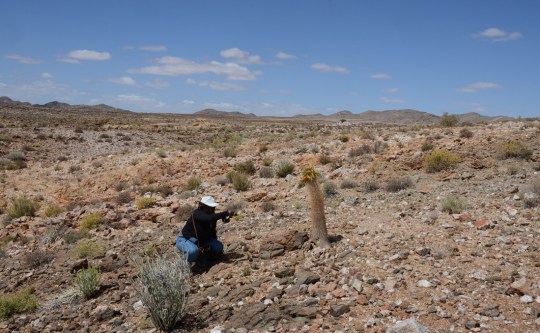
Although our eyes are mostly focussed on what grows in the ground around the car, occasional glancing up hillsides also helps, and so we came across this population of the Halfmens. Zoom lenses are great, but can also create the impression that we are too lazy to climb to the top for close up. These were a lot farther away than the image may suggest and the hillside that we would have to conquer was pretty unstable, so for now, we were happy with these shots.

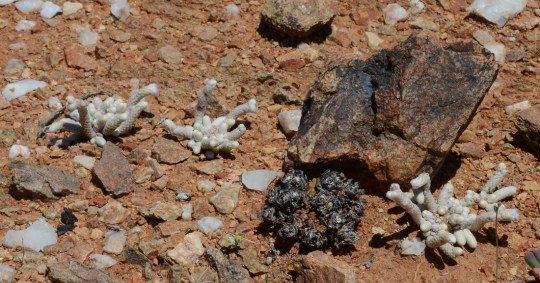
S2695 - Conophytum sp

S2695 – Conophytum sp

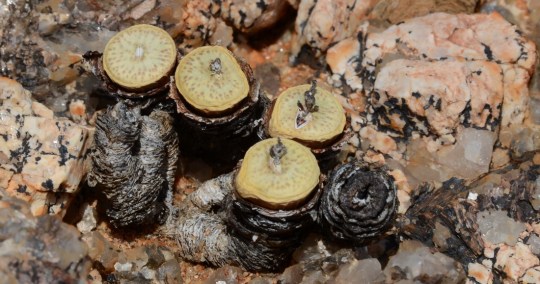
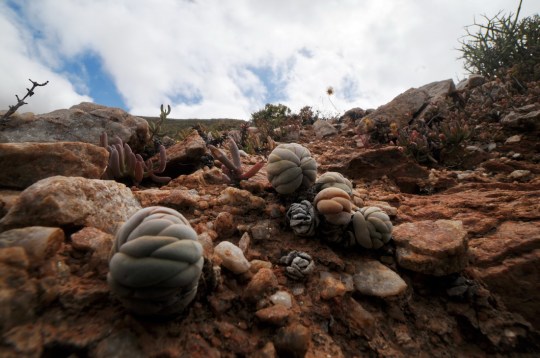
We had seen plenty of Conophytum, even if our ability to name them was somewhat hindered by the fact that most of them were at rest. This surviving quartette impressed me because of their trunk-like stems that suggested that these plants were of significant age. Having killed Conophytums in my own collection, mainly by treating them like cacti where growing and resting seasons were concerned, I had never considered these plants to be long-lived.

S2696 - Larryleachia cactiforme

S2696 – Larryleachia cactiforme

I guess it is because my first love is cacti, that I can’t help myself taking images of cactus-like succulents, even though the typical Asclepiad seed horns have no equivalent in the Cactaceae.

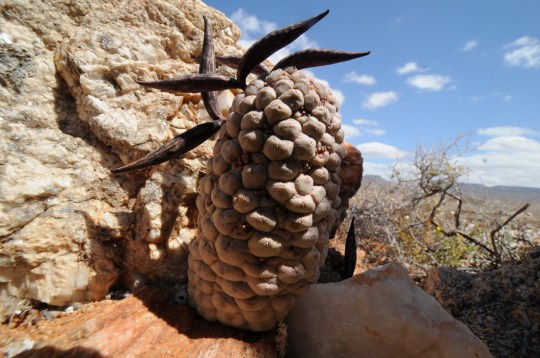
S2697 - Pachypodium namaquanum

S2697 – Pachypodium namaquanum

We had been right not to risk our legs and necks on a long climb up a steep hill with unstable soils underfoot. We had hoped that sooner or later the plants would come to us, well, one anyway, and it had!

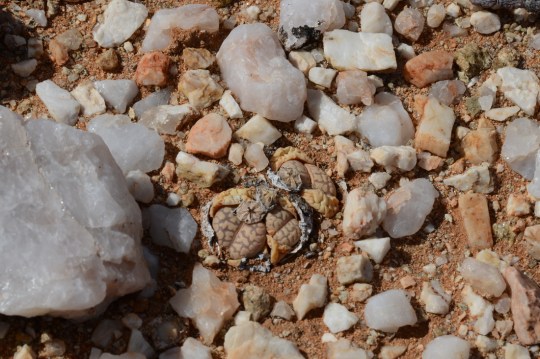
S2698 - C252 - TL Lithops marmorata elisae

S2698 – C252 – TL Lithops marmorata elisae

I can’t recall what prompted S2698, certainly not this Lithops, much too small to spot from a moving car. Some 16 years ago I went through a ‘Lithops’ phase and ordered seed for all the Cole numbers from Steven Hammer. Germination was spectacular and the plants were well on their way, until a year later I returned from a trip to find that all had been taken out by sciara fly larvae. Amazing that plants survive here in such harsh conditions when they die so easily when mollycoddled. Cacti & succulent plants thrive on neglect! Hobbyists kill more plants in their care by providing too much water and food in an environment where pests such as sciara fly abound.

I promised an image from each of today’s stops but S2699 is just two images of a gate, where we managed to get on to the N7 for a quick journey back to Springbok.

Today’s story is not finished here. When we met up for dinner, Eunice broke the news that her iPhone had somehow managed to fall out of her pocket during the day and despite a thorough search of her room and the car with all the many bags for cameras and gadgets that she had brought along, could not be found. She believed that the iPhone would have been switched off, to safe the batteries, so ringing it, to see where it was, proved not to be an option.

Would we consider going back over today’s route tomorrow? We were not keen!

Thursday, 18 October 2012 – South of Springbok

Today we had opted for a day to the south of Springbok, aiming for Soebatsfontein. We headed south along the N7 and then turned west towards the Namaqua National Park.

After an hour’s drive we were looking for somewhere to stretch our legs when we saw a hillside covered in tall (1m 50 or 5ft tall) flower stems, now passed over, clearly with a bulb below the soil. We passed a farm, sign posted as the Zandkraal Farm, the property of Jan & Vicky Engelbreght and I went to ask permission to look around on the nearby hillside. There were actually three residencies here at the end of the track. Looking for signs of life, I had to choose between the house to the left, with some huge dogs trying to break through the fence and one on the right where two people were doing some gardening – an easy choice. The gardeners spoke Afrikaans, not too great a challenge as I am Dutch and took me to de baas, (the boss) who was fluent in English and keen to have a chat. People living in these isolated locations often don’t see strangers for weeks on end and love to have a chat. Hearing that I was from Holland he told me that his daughter was married to a Belgian and lived in Oostende. I told him that I had friends in Oostende and after a few minutes got round to asking permission to take photos on the hill on his side of the track leading to the Zandkraal. No problem, came the answer.

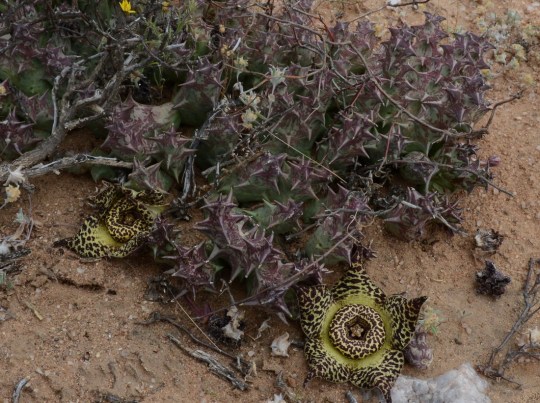
As soon as we had crossed the fence, our attention was drawn to several Asclepiads, provisionally identified as Quaqua sp.

S2690 - Quaqua sp

S2690 – Quaqua sp


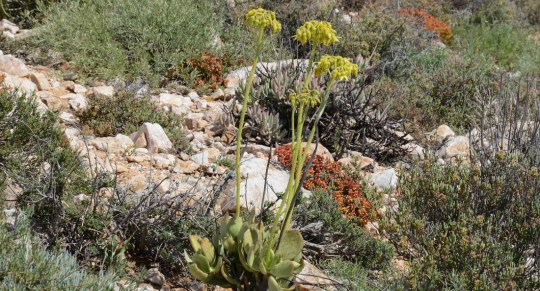
More flower stalks – this time Cotyledon sp in full flower, rather than bulbs.

S2690 - Cotyledon sp

S2690 – Cotyledon sp

I went back down the hill to pick up the car and meet the others at the gate. I was met by an angry couple, what was I doing on their land?  I explained that I had been to the farm and had obtained permission to look for plants on the quartz hill. I tried to provide details to convince them that I had honestly asked permission. The man shrugged his shoulders and told me to leave. His wife carried on telling me off. I explained that the man I had spoken to had a daughter who had married a Belgian. Ah, the penny dropped. I had spoken to their neighbour but his land was on the other side of the hill; we were on their property. That calmed her a bit, she explained that they had some sheep stolen a few days ago and were tense about more rustlers in the area. All was well that ends well.

For S2691 we had now entered the Namaqua National Park and were descending the Wildeperdehoekpass (Wild Horses Pass) with some wonderful views that would have even better without the low clouds drifting in from the Ocean, some 25 km (25 miles) away. We found a nice quartz patch, so again started the puzzle of identifying what we saw – Ah, never mind, here are some images. The nicest plants here were probably Crassula alstonii, but I have already shown images of that plant at previous stops.

S2691 Conophytum sp.

S2691 Conophytum sp.

Ah, good, C. alstonii managed to creep into the image as well! Here is another two plants in one shot:

S2691 Conophytum and Tylecodon

S2691 Conophytum and Tylecodon

And so on to S2692, for which I won’t give away any location details as we had been entrusted with data for a quite desirable and, from what we could see, a rare plant

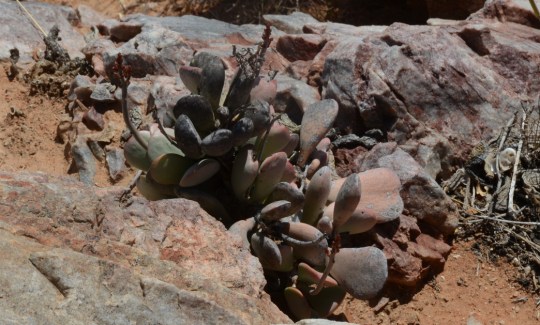
S2692 - Crassula susannae

S2692 – Crassula susannae

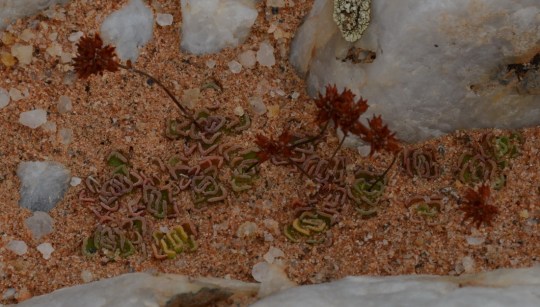
As is usual with rare and sought after plants, they were minute and when David first found them, they were completely covered in sand. A few huffs and puffs later gave a better view of the plants. We made sure that our footprints and plants were covered up and hidden again before we left.

Wednesday, 17 October 2012 – around Springbok

Just two stops today, very different from each other, both very enjoyable.

The first, S2688, was another of David’s must-see recommendations and again we were not disappointed. David gave a strange, foreign sounding name; something like Smørrebrød Kadu, sounding like a Danish open sandwich. As we pulled up to the gate of a farm, it suddenly clicked: the name of the farm was sMorgenskadu,

sMorgenskadu

S2688 – sMorgenskadu

Morgen Schaduw in Dutch, Morning Shadow in English. Looking at the hillside where David told us the plants grew, I also understood why:

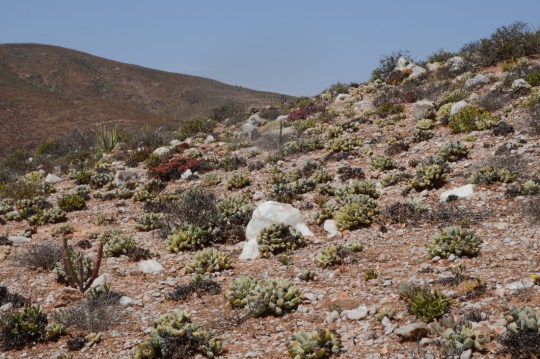
Hillside near S2688 - sMorgenskadu Farm

Hillside near S2688 – sMorgenskadu Farm

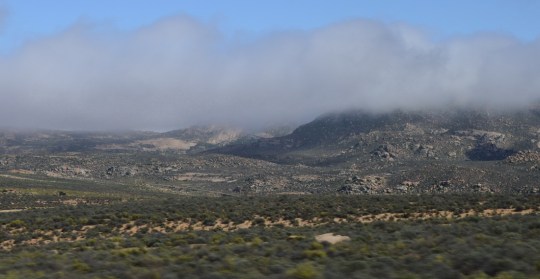
The west (Ocean facing) slope of the hills benefit from low cloud and no doubt also fogs drifting in from the Ocean, even though it is 122 km (76 miles) away, as the crow flies, so in the mornings, the hillside is in the shadow of cloud cover, hence the name. As we were eyeing up the scenery, a bakkie pulled up to the gate and we asked permission to take some photos of plants on the hill, which was granted without problem.

We stayed for over three and a half hours – it was one of those stops where I will struggle to find just one or two images from the following plant list and from 191 images:

Aloe dichotoma, Aloe sp., Anacampseros filamentosa, Aptosimum sp (Karoo violet) this sp. larger than the bonsai-like plants seen more commonly, Avonia papyracea ?, Ceraria namaquensis, Cheiridopsis sp. Conophytum sp – C calculus?, Conophytum maughanii – formerly  Ophthalmophyllum maughanii, they all resemble each other and are easy to recognize as a group – another Conophytum sp., Cotyledon sp., Crassula plegmatoides, Crassula sp 1, Crassula sp 2, Lithops marmorata Desmond Coles C058 – TL Lithops marmorata v. marmorata (*framesii) is here, Sarcocaulon sp white flowers and Tylecodon paniculatus.

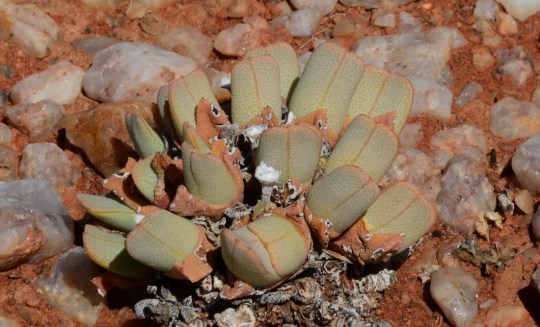
I have to pick Conophytum maughanii, if only because it was the plant that David was most keen to show us and it was the most difficult one to find. SB802 originates from this location. Since Opthalmophyllum and Conophytum were merged it is of course Conophytum maughanii. Googling Smorgenskadu reveals that Conophytum lydiae `spathulatum’ is also reported from here.  I’ll stick with the first name.

S2688 - Conophytum (Ophthalmophylum) maughanii

S2688 – Conophytum (Ophthalmophylum) maughanii

I can assure you that I selected the best looking image of the best looking plant, honest!

The next image highlights another problem that we encountered:

S2688 - Conophytum sp

S2688 – Conophytum sp

When Conophytums are at rest (a) they are hardly worth taking a picture of and (b) trying to put a name to them, at least with my minimal knowledge, is impossible. Steve Hammer’s 1993 Conography reports that (at the time) there are about 450 names for plants at about 1,800! populations. As new populations are found, surely these numbers must have increased. How can we possibly check that the ‘populations’ that we found are already known or new?  Is there a register available that we can readily inspect and, if need be, add to?

The Smorgenskadu has been thoroughly explored to I assume all the Conos here have already been recorded and identified. The following names have been reported from here: C. smorekaduense, C. hermarium, C. lithopsoides and C. marginatum SB632. I’d be happy to hear any suggestions from people far more knowledgeable on the subject and their suggestion for this other (?) Cono found here: maybe C. flavum?

S2688 - Conophytum sp #2

S2688 – Conophytum sp #2

While searching for Cono info for this location, I also learned of a Cheiridopsis reported from here and in the absence of other information, will use that name here:

C2688 - Cheiridopsis subaequalis

C2688 – Cheiridopsis subaequalis

Having already included far more images than intended, I can’t help but include this nice Monsonia / Sarcocaulon sp:

S2688 - Sarcocaulon sp

S2688 – Sarcocaulon sp

and this other minature Mesmb.

S2688 - Lithops marmorata v. marmorata 'framesii'

S2688 – Lithops marmorata v. marmorata ‘framesii’

Desmond Cole’s C058 comes from here.

Easy to see why we took so long here and why I could not limit myself to just one image.

S2689 was an afternoon visit to the Goegap Nature Reserve, to the south east of Springbok. We only had a little over an hour before they closed their gates for the day, but did not want to leave until we had taken a look around so that we could report back to Anthony Mitchell, our friend from the Isle of Wight, who had spent quite some time in South Africa some 30 years ago, exploring on his bicycle! I understand that many of his collections were housed here when he returned to the UK.

It was useful to see some plants that we had already seen in nature, here with labels – of course you can never be 100% that the labels are right.

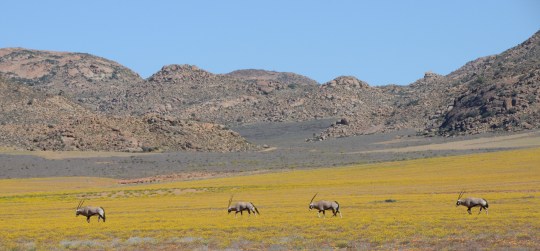
S2689 - Oryx at Goegap Nature Reserve

S2689 – Oryx at Goegap Nature Reserve

Tuesday, 16 October 2012 – Port Nolloth to Springbok

It was time to leave Port Nolloth and move on to Springbok, from where we would make some more excursions into the Richtersveld and to the south into Namaqualand (by the way, it seems that the Richtersveld is part of Namaqualand – maps are rather vague on the subject.)  We stopped at a pull-over on the R382, at the 47 km marker and during our look around came across Crassula alstonii. It seemed that like quite a few African succulents it is not as rare as I had believed and occurs in disjunct populations over quite an area.

S2684 Crassula alstonii

S2684 Crassula alstonii

I found a plant that had been kicked out by a passing animal and was surprised to see that the leaf bases had already started to form roots. I might try this at home as I believe that this species, like many of its cousins, is monocarpic and dies as soon as it has flowered, so that it would be good to have a few leaf cuttings on the go in case the main plant flowers.

S2684 Crassula alstonii

S2684 Crassula alstonii

We drove on to the scenic Anenous Pass (S2685), which David remembered as a must-see stop from previous trips. We were not disappointed.

S2685 Cotyledon sp

S2685 Cotyledon sp

S2685 - Cheiridopsis sp

S2685 – Cheiridopsis sp.

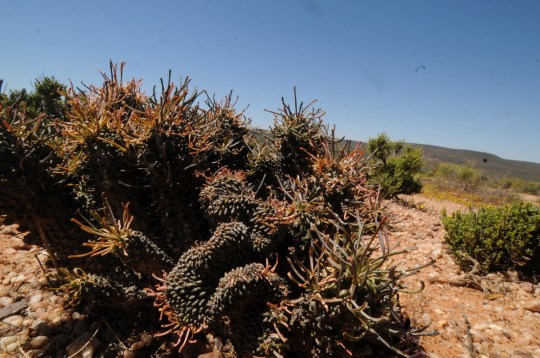
With plenty of time left, we decided to explore a bit by heading back towards the Richtersveld, making a stop near a low hill where David and Eunice had spotted some Aloes. (S2686) Like many of the genera already mentioned, Aloe IDs too  can be problematic. This large specimen looked rather majestic with many years worth of dead leaves covering a magnificent trunk.

S2686 Aloe sp

S2686 Aloe sp

We had not really prepared for this bit of exploration, took a few side tracks, changed our minds, took another and so on until, with the car stopped so that we could decide where we were and where to go next, a Euphorbia was spotted right alongside the car. As we had not seen any other cars since pulling off the R382, and without space on the track to pull over, we just dumped it where we stood and went off to take pictures of the Euphorbias, soon spotting this crested plant that was awarded best plant in show, at least as far as the Euphorbia class at this stop was concerned.

S2687 Euphorbia crest

S2687 Euphorbia crest

We looked to see if we could improve on this crested plant and instead stumbled across some other nice plants:

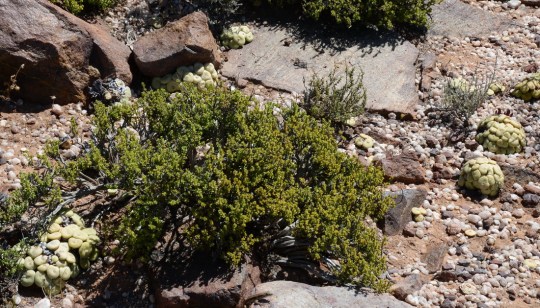
S2687 - Conophytum wettsteinii

S2687 – Conophytum wettsteinii

We had walked into a dense population of Conophytum, provisionally IDed as C. wettsteinii. It seemed that they grew in symbiosis with the little bonsai shrubs seen in the image. They grew on a small patch of hillside, some 30 x 30 m in size and there was no apparent reason what caused the invisible boundary, but all of a sudden, both species stopped at the same time. Strange and curious.

Another great day. Tomorrow we take a look to the east of Springbok.

Monday, 15 October 2012 – Richtersveld part 3

During any trip, there can be the odd day when things go a bit flat, often for different participants for different reasons on different days. Judging by the few pictures I took, today was a flat day for me, although no particularly negative reason springs to mind. Selecting images to include on these pages, I struggle to find anything different to what I have shown already or anything that was so nice that it was worthy of repitition.

Perhaps the solid work on the Diaries, with only breaks to help out with Christmas shopping etc in the pouring rain is causing the flatness – who knows. No point in forcing the issue, I’ll share what we saw and have selected just two images. I can always come back later if something worthwhile springs to mind.

Yesterday, after leaving Port Nolloth, we had taken a turning north off the R382, Port Nolloth to Springbok road, some 20 km out of Port Nolloth, signposted to Lekkersing.  The signpost mentioned Eksteenfontein, well into the Richterveld, as a second destination.  From there we drove another 25 km for our first (and farthest) stop of the day S2680 and I see that the first images were taken around 12:30. I guess that one reason for the lack of images was that we had seen everything up to Lekkersing already. From memory we were looking for the Blackhill that from the email that David was quoting from, seemed such an obvious feature that we could not miss it. There were no sign posts to help us out and a farmer who overtook us in his bakkie (pick up truck) suggested that we may have already gone too far.

Looking through my images again, I’ve selected another picture, this one of Avonia sp.

S2680 - Avonia

S2680 – Avonia sp.

Ignorance is a wonderful things, so I’ve filed any pictures of whitish Avonia under the name Avonia papyracea while the plant that reminds me of a can of worms (A. quinaria). I struggle with seeing the detail of miniature plants in the field. Conditions are often not ideal – too bright, too windy or a recurring mild eye infections causes tears to run down my cheeks. I should really take the time to disect plants to look for the minute details that give away the plant’s ID but I’d rather spend the time taking another dozen images. So inevitably I am a happy lumper. Today’s magnificent cameras sometimes help, allowing me to blow up images in the comfort of my home, with a book open alongside me to learn what details I should be looking for, such as the stipules (papery scales) of these plants. Looking at these here I am still none the wiser. Avonia albissima?

S2681 Anacampseros

S2681 Anacampseros sp.

Anacampseros, the genus that Avonia used to belong to, is just as tricky for this newbie. We saw lots of plants in bud but never saw the flower open. Are they night flowering?

S2683 - Adromischus

S2683 – Adromischus sp.

Finally an image to help you to understand that ‘plants growing on quartz patches’ does not always mean ‘quartz gravel’. Here the plants were growing on large quartz rocks and boulders.

Sunday, 14 October 2012 – Richtersveld pt2

Encouraged by yesterday’s excellent guided tour into the Richtersveld, we decided to take another look by ourselves, this time a little farther east and south, and to take a look at what grows between Port Nolloth and Lekkersing. The small settlement of Lekkersing was established in 1926 and lies 60km east of Port Nolloth. It is said that its name (which means to sing joyfully or beautifully) originated from the fact that a small fountain in the area ‘sang’ so beautifully that an early resident promptly named the village. Incidentally the residents of Lekkersing claim to be very good singers!

David recommended a visit to a hillside that he had visited on previous visits, at Augrabies Farm. This is a good time to take a look at the issue of climbing over fences to take a look at and photograph plants on land that belongs to a farmer or a company; it’s what we tend to do just about anywhere in the world in our pursuit of our hobby, our love for succulent plants. Each country has its own, mostly unwritten rules and etiquettes on the subject. It is said that trespassers in Texas are shot at before being asked to leave – but we have never experienced that. Fences are the common way to mark land ownership. They can help to keep cattle and other farm animals in, from straying onto neighbouring property or onto roads or they can aim to keep animals, including people out. The latter is usually emphasised by signs warning that trespassers will be prosecuted. Think of your own property, no matter how large or small – would you mind if four strangers asked if they could take pictures of plants that grew there? Chances are that you would invite them in and curiously watch as they go about their work – no harm done. And this again is what we have found all over the world. But often these farms are enormous and it is not clear where we should ask for permission. Trying to sort out such matters can be time-consuming and language barriers can make them difficult. In Brazil we saw workmen mending a fence and asked if we could pass through to see Parodia magnifica that grew some kilometers farther. We were taken to the house of the owners and the lady of the house escorted us to the best spot to see the plants and told stories of how they used to have picnics here, many years ago. But often it’s not clear how to contact the owners. In Chihuahua, Mexico, there are farms with a total area of Belgium or Holland. In Namibia we stayed in a B&B in Grunau where the owner told us that her property stretched over an area roughly equal to the country of Luxembourg. So often we assume that the fence is merely there to mark a boundary and to keep animals in.

In this case, David knew where to find the owner of Augrabies Farm and went to explain our wish to visit the land and ask permission that was readily granted. And so we could be relaxed about crossing the fence here and enjoy the plants that grew on the hill-side. Although there was not a cloud in the sky, with flat lands all the way to the coast, it was easy to see how any regular cloud cover and fog would drift in and be of benefit to the plants growing here. It was a delightful spot where we spent some 90 minutes during which I took 212 pictures! Looking through the images I recorded plant from 18 taxa and suspect that there were at least three times more of that number that I did not see or recognise as different. The most time-consuming aspect of preparing these diaries and the talks that I will be giving during 2013 is to select my favourite images. It is also one of the most enjoyable aspects but a particularly difficult task for this stop:

S2676 - Tylecodon sp

S2676 – Adromischus filicaulis subsp. filicaulis

I know that in my favourite plant group, the Cactaceae, hobbyists can feel uneasy when a genus consists of a mixture of huge and tiny plants. How can a huge clump of Copiapoa solaris be the same genus as the tiny match stick head size C. laui? Well, that’s the intriguing thing about nature and while I was introduced to the 1.50 m (5 ft) tall T. paniculatus with big fat stems, early on in the trip, I have learned that there are quite a number of charming miniatures in the genus too. I hope that some one can confirm this and tell me which one. [PS I posted this image on iSpot and even as I’m writing this posting, the correct identification of Adromischus filicaulis subsp. filicaulis came through.]

Other plants at this stop include two species of Conophytum, Geranium sp, Pelargonium sp, Sarcocaulon sp, several species of Crassula, small and large and Mesemb shrubs, plus a Gasteria and a Haworthia, so an excellent stop.

Just 7 km up the road, we stopped again for a hillside full of clumps of Cheiridopsis:

S2677 - overview

S2677 – overview

I’ll include this image of an Adromischus sp(?)  at S2678 as a thank you to Derek Tribble who has been helping me with IDs by email and on iSpot – thank you Derek!

S2678 - Adromischus sp

S2678 – Adromischus sp

S2679 was prompted by some yet to be identified Asclepiads sp. but the picture I’ve selected is of a Crassula sp in bud. It’s not C. columnaris nor C. deceptor, but something in between. More checking images and books, but a nice plant irrespective of its name.

S2679 - Crassula sp

S2679 – Crassula sp

 We drove on to Lekkersing and had a brief look around, but were unable to find anyone singing and returned home, having proven that some parts of the Richtersveld can be reached with a 2 wheel drive car.

We’ll have another go tomorrow, with Eksteenfontein as our goal.

Saturday, 13 October 2012 – Guided tour – western Richtersveld

When we arrived at the hotel in Port Nolloth, Eunice had spotted a leaflet advertising guided tours into the Richtersveld. Curious as to what might be covered, she asked hotel reception to contact the guide for a chat, so last night, impressed with what was on offer, we arranged to be driven around for a change.
Aukwa Towa Tours

Aukwa Towa Tours

It was an early start, compared to our usual work-day-like 9 a.m. start and it was quite cozy in the Toyota Hilux with our guide Conrad behind the steering wheel, Cliff riding shotgun, David and Eunice in the back seat, with me squeezed in the middle and Conrad’s assistant, Flooris lying on top of the luggage for the day, in the back.

The weather was typically for the northern South African coast – low clouds / coastal fog, a stiff breeze and at times a light drizzle so it was with some reluctance that I got out of the car at our first stop (S2664, the Western Cape Lichen Field near Alexander Bay. We had driven past this two days earlier, but at the end of the day, with day light fading and the uncertainty about the availability of a bed for the night. Conrad took us through a few gates that would have kept us out if we had been on our own. I was unaware that lichen could grow so large and be so colourful, amazing, but what a shame that the light was too poor to realise its full potential. Once again I was glad to be wearing my ski jacket with a jumper underneath. The camera spent most of the time inside the jacket, to protect it from the drizzle. Despite this, we saw some wonderful plants such as Lithops herrei, the nearest Cole number, C237, is the type locality of Lithops herrei ‘translucens’  and, thanks to Conrad’s persistence, Fenestraria rhopalophylla, again not in flower, so I can only assume that it is subsp. aurantiaca due to its coastal location. For me, these were the stars of this stop, mainly because I was already familiar with them in cultivation and had never expected to see them growing in such harsh conditions. There was also a Euphorbia (the names E. ramiglans and E. stapelioides have been suggested), some Mesemb clumps – Cheiridopsis brownie is reported from the area, as well as a number of Crassulas. My challenge now is to select just one image to show here.
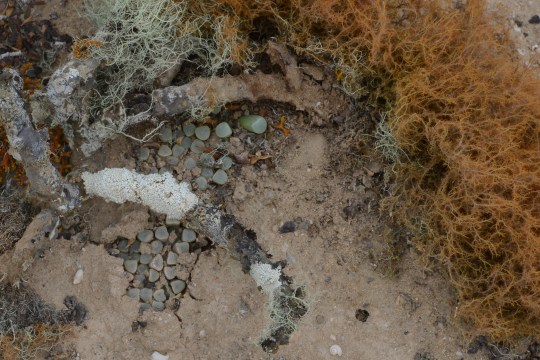
S2664 - Fenestraria rhopalophylla ssp. aurantiaca

S2664 – Fenestraria rhopalophylla ssp. aurantiaca

I chose this because it also shows some of the lichen, especially the large reddish one on the right, the Cape Hair Lichen – Teloschistes capensis.

S2665 was a small hill just past Alexander Bay with views over the Oranje Rivier, now that the sky was clearing a bit. This image illustrates some of the difficulties of plant ID in the field
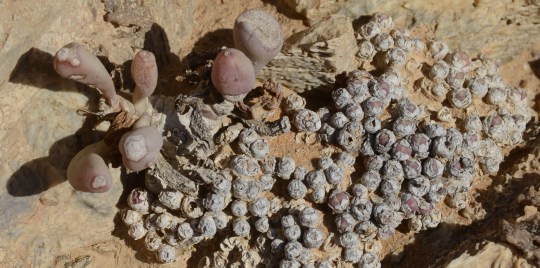
S2665 - Conophytum sp

S2665 – Conophytum sp

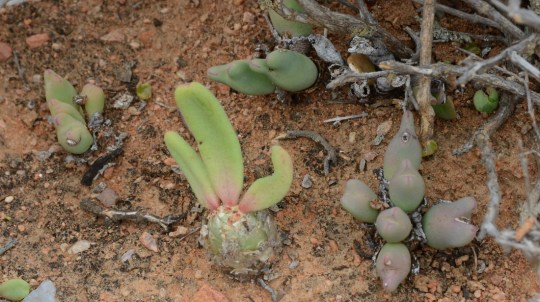
 The small globular things resembling rabbit or goat droppings are probably Conophytum at rest, covered in papery skins and the somewhat beaten up plant above them could be a Tylecodon sp. (or a Crassula or Mesemb for that matter). If you meet plants out of their growing season then often, certainly as a newbie, relying on finding a name by looking through books and the internet, you’re stuck. People publishing images to share with others tend to pick plants looking their best, in optimum growing conditions, not the way that you find them when you happen to see them in nature. I probably have a few hundred images of Conophytum looking like this ‘Conophytum shrivelled-ianus’ from a range of locations, almost certainly all different species or at least subspecies, but all (to me) looking the same.

Conrad next took us to Cornellskop, a low hill, famous for its stand of Aloe pillansii (S2666)
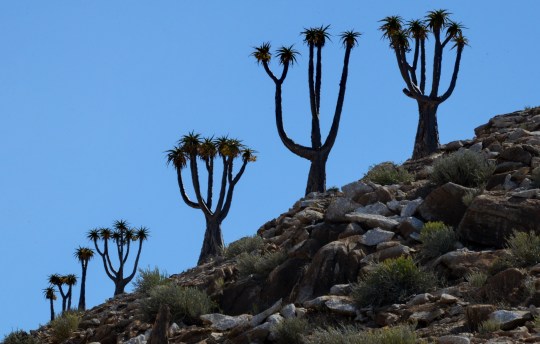
S2666 - Aloe pillansii

S2666 – Aloe pillansii

We had been looking for this two days ago, but had driven straight past it, mainly because the stand of Aloes grows on the other side of the hill, when seen from the road. How could we have missed it? Then we had just stopped (S2656) for  a single A. pillansii near the road and were side tracked by magnificent A. striata subsp. karasbergensis and so found ourselves rather pushed for time.

Much later (Christmas Eve 2012) whilst looking through succulent plant literature, I came across Bradleya #16 (1998) with a familiar looking Aloe on the cover, posing next to Sir David Attenborough! The picture was taken during the filming of ‘The Private Life of Plants’ (1993). Inside the cover is a very interesting article by Graham Williamson on the ecological status of Aloe pillansii (Aloaceae) in the Richtersveld with particular reference to Cornellskop. Ittranspires that this is the type locality of the species.  The article expresses concern about the future of Aloe pillansii and of the plants at this location in particular. A number of observations and suggestions are made to protect the plants, but the images taken during our visit do not show any evidence that any of these have been implemented. Keeping our fingers crossed for the future may not be enough.

On to S2657, where according to Google Earth we were at Halfmenspas. We saw our first Pachypodium namaquanum in habitat but I have chosen this picture of a Hoodia, as we’d be seeing better examples of the Halfmens at the next stop:

S2667 - Hoodia alstonii

S2667 – Hoodia alstonii

We had been calling it Hoodia flavum at the time, but Graham Williamson in the latest edition of his Richtersveld book calls it H. alstonii. Checking descriptions later, in front of the tellie back home, I agree with Graham.

As promised, we saw more Pachypodium namaquensis near by, at our next stop (S2668), still in Halfmenspas, the Afrikaner name for this plant is Halfmens – half human.
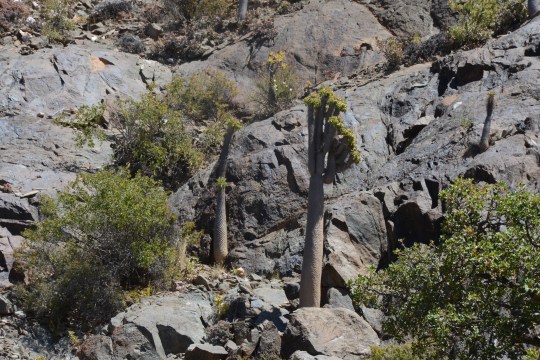
S2668 - Pachypodium namaquanum

S2668 – Pachypodium namaquanum

Unlike my observations earlier for Conophytum, we had timed it spot on for the Pachypodium, finding it in leaf and in flower everywhere we saw it.

And on to S2669, south of the Akkedispas. Although Afrikaans and Dutch are quite similar, it sometimes takes a bit of imagination to work out its origin. The pass here is the Lizard Pass. The Afrikaans Akkedis derives from the Dutch Hagedis. A lot can change over four centuries, including the modern Dutch that I’m comparing with the Afrikaans. The image I’ve selected here is of a Conophytum that has not yet shrivelled away. Any suggestions for a name?
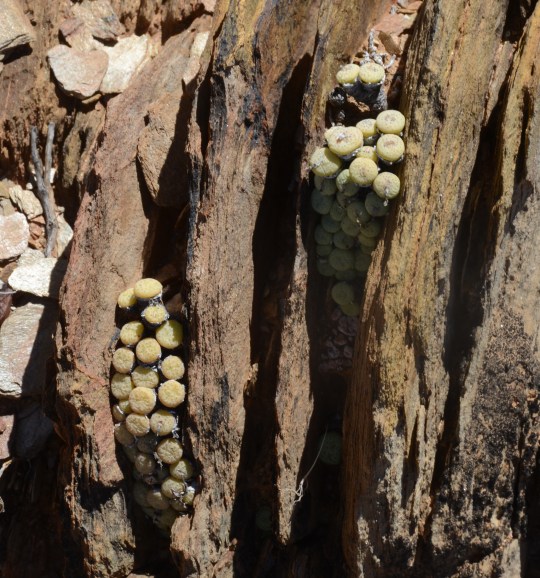
S2669 - Conophytum sp

S2669 – Conophytum sp

The next stop, S2670, was for lunch and as I’m trying to be economic with my limited free space allowance on this blog, I’ll skip lunch pictures and include two from S2671:

S2671 - Asclepiad sp

S2671 – Asclepiad sp

S2671 - Tylecodon paniculatus

S2671 – Tylecodon paniculatus

Unlike the Boterboom seen early on in the trip, where their magnificent stems were hidden by dense vegetation, due to generous rains before our arrival, here they were nicely exposed.

The hairy flowered Asclepiad contrasts nicely with the brightly coloured flower seen at the next stop S2672
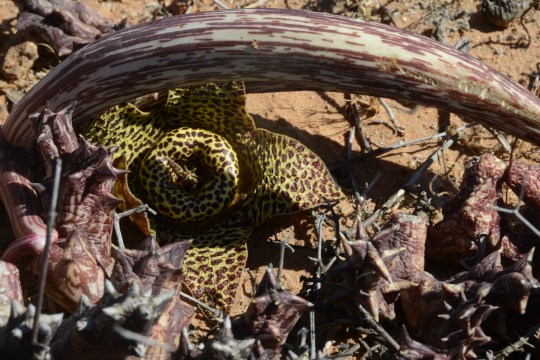
S2672 - Orbea carnosa

S2672 – Orbea carnosa

Notice the huge seed horn that almost obscures the bright flower. We were now in the Hellskloofpass, Hell’s Canyon Pass, and we were very glad to be in the 4×4 Toyota rather than in our Nissan XTrail. I wouldn’t have taken the Nissan over this track.

S2673 was for the amazing valley full of Aloe pearsonii – I believe that this is the only place where it occurs in nature.
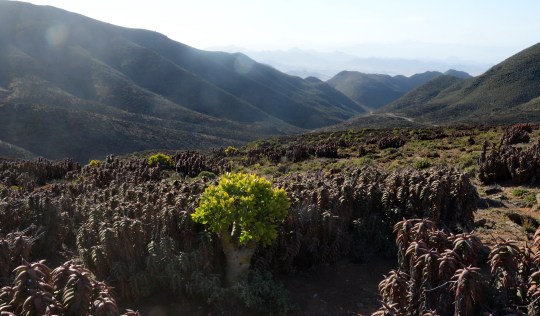
S2674 - Aloe pearsonii Tylecodon paniculatus

S2674 – A few Tylecodon paniculatus in a valley full of Aloe pearsonii

S2675 - Aloe garipensis

S2675 – Aloe garipensis

We arrived back at Port Nolloth in the dark. Thanks to Conrad and Flooris we saw many more interesting plants than we could have seen on our own and the 4×4 took us where our car would have struggled. Many thanks – we had a great day!

Friday, 12 October 2012 – South of Port Nolloth

I felt that by crossing back into South Africa a phase of our trip had been completed. Time for some reflection. I have never before been on a plant focussed trip where I did not have names for so many of the plants photographed. As I’m now, after the event, learning about the plants we saw, it strikes me that we must have passed by so many that now, on paper, look quite interesting but that so far I have not been able to spot in my pictures and had never heard of before the trip. I guess that I’m unusual in the Cactus & Succulent hobby in that most people will have grown a group of plants for years in their greenhouses and on their windowsills before finally seeing their friends in nature – one of the ultimate rewards in the hobby. I’m a cactus freak and you’ll find very few of the other succulents in my collection, although there has been a small influx of Haworthia, Crassulas and Mesembs this year since plans for this trip were being hatched. Should I have done more preparation?

As I sit at home, a few days before Christmas with the rain bouncing off the windows and more reports of local flooding on the news, I think not. This is the ideal time to look through my images, relive the experiences and search through literature and the internet for IDs. Anyway, where would you start? In a way, I felt like one of the early explorers, just about everything I saw plant wise was new and unknown to me. Like the early plant explorers, often people with a variable background and knowledge in botany driven by a natural curiosity and interest in their environment, I have a need to put names to what I saw – I have already been booked for some 30 talks of What I Saw Last Winter to UK branches of the British Cactus & Succulent Society for 2013 and there is an expectation that the plants that you show have a name and that the presenter knows them. Fortunately I believe that I have sufficient nice pictures of plants for which I have names and iSpot provides invaluable help in suggesting names for plants in images that would further improve a presentation. And fortunately I travelled with people who knew more than I did and offered names, if only my memory could hold on to them.

Back to Africa and today’s outing, south of Port Nolloth. Over the next five days we would use Port Nolloth as a base to make day trips into northern Namaqualand and the Richtersveld. I see that I took 1,588 images during that time; the comparative photographic draught of plant images in Namibia was over!

Our first stop of the day was at McDougall Bay, a few km south of Port Nolloth, where David had promised to show us a plant that at least I was familiar with – ‘Baby Toes’!

S2657 - Fenestraria rhopalophylla

S2657 – Fenestraria rhopalophylla ssp aurantiaca

There were some anxious minutes before we found the first plant. Were they still here? It had been seven years since David had last been here! We need not have worried. The center of the picture shows plant exposed after blowing away a layer of sand. Bottom left you can see some windows of plants covered in sand that illustrates the way we found the plant originally. Tip: carry a soft paint brush to clean up plants like this or make sure that the wind is blowing away from you as you get down on hands and knees to blow away the surface layer, unlike I did.

Fifteen minutes after posting this image on iSpot, Alan Horstmann added this comment: ‘Subsp aurantiaca prefers the littoral sands of the south and subsp rhopalophylla prefers the calciferous sands of the northern part of the distribution’. What a great site, thank you Alan!

We followed a track south, running some 10 km away from the coast towards Kleinsee. S2658 was prompted by Cliff rescuing a tortoise that was crossing the road. To be honest, it would have been fine if we had just driven around it, we saw less than one car per hour and tortoises can move remarkably fast once they’ve made up their mind where they are going. Cliff learned the hard way that tortoises empty their bladder as a form of defence when they are picked up. We used the opportunity to photograph the numerous ‘Cheiridopsis‘ (my broad concept) and ‘Mesemb shrub – purple flowers’.

S2658 - Drosanthemum luederitzii

S2658 – Drosanthemum luederitzii

A bit farther along the track, at S2659, we stopped again for nice clumps of another clumping Mesemb, provisionally identified as an Argyroderma sp., but with leaves that seem too angular for this genus.  Any ideas? [Identified on iSpot as Cheiridopsis glomerata, Thanks Derek!]

S2659 - Argyroderma sp

S2659 – Cheiridopsis glomerata

S2660 was just a quick stop to take a picture of a traffic sign – a red-edged warning triangle with a drawing of a tortoise! To celebrate this, my 101st stop since Kirstenbosch on 21 September, I also photographed this Mesemb shrub.

S2660 - Mesemb shrub

S2660 – Mesemb shrub

We reached Kleinsee and this diamond mining town, owned by De Beers, seemed to be the end of the road, with a guarded gate blocking the way. We explained that we had hoped to drive inland to Komaggas so had to register our passports to get a permit to drive on – quite easy really.

After racing some ostriches along the fence alongside the road, David spotted the bright red flowers of Aloes above the low shrubs (S2661). Not sure how often, if ever, security checks these tracks (we had not seen any cars) we decided to pop over the fence for some quick pictures, more weary of any ostriches than security!
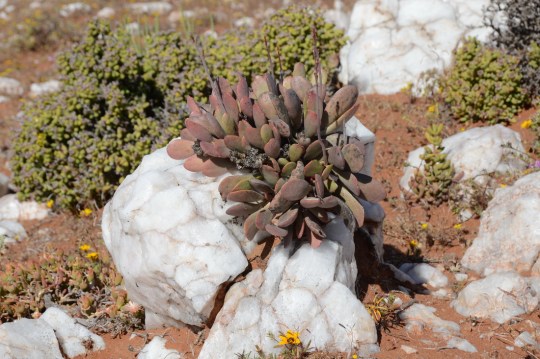
S2661 - Aloe arenicola

S2661 – Aloe arenicola

S2661 - Aloe arenicola

S2661 – Aloe arenicola

Near Komaggas we found a nice hillside, no barbed wire and on this sunny and warm afternoon we spread out over the hill and enjoyed ourselves taking pictures – I left here with 146 images taken during 104 minutes; that’s just over 1.4 images per minute! Not bad with images like this one:
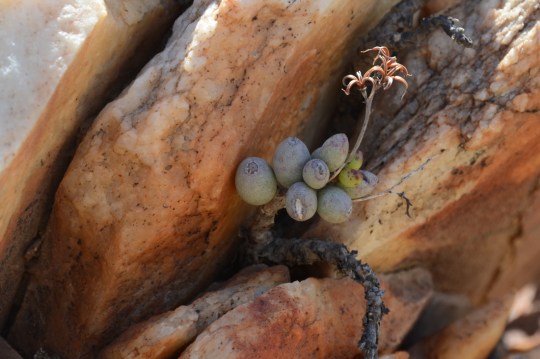
S2662 - Crassula deceptor

S2662 – Crassula deceptor and Haworthia arachnoidea plus friends

We found time for one more quick stop (2663), as the sun was going down quickly, throwing long shadows. It took a bit longer than planned after David discovered the plant of the day:

S2663 - Crassula alstonii

S2663 – Crassula alstonii

The tracks that we had been on all day were of a good quality, but now things started to deteriorate. Fading daylight did not help much either. We slid around on the soft sand, trying to keep going to avoid getting stuck in the sand. Fortunately Cliff again got us back safely to the hotel, well done Cliff!