Just another WordPress.com site

The name Domeyko has intrigued me each time that I see it on maps during trip planning or reviews and as I see the signs to the village as we speed past in on our way north or south. This intrigue is probably caused by the name Copiapoa domeykoensis on a label of one of the Copiapoa coquimbana in my collection – not a very dynamic or attractive plant, but a Copiapoa none the less.

In 2001, at the start of our trip, we had actually stopped in the village to buy some bananas. We were still naive enough to believe that we’d find plants of C. domeykoensis near the name plate where the track entered the village. Since then I have learned how widespread the name Domeyko is. In addition to this village (population 936 according to recent statistics) there is also the Cordillera de Domeyko that could be described as the Chilean foothills to the Andes in Northern Chile.

A close look at the map near Domeyko also draws attention to another Chilean (or rather South American?) feature, that of the same geographical names cropping up time and time again, so confusing to those relying on type locality information to assist in determining the true identity of a plant.

When driving north past Domeyko, it is usually the lure of other, better known and arguably more dynamic Copiapoa locations laying in wait, that prevents a longer stay in the area. But on the return leg south, there is often a couple of hours spare time and this otherwise boring stretch of Ruta 5 sets the mind to thinking of ways to fill this time. In 2003, it was a photo stop to take pictures of peppers or tomatoes lying in the sun to dry, followed by a brief exploratory trip to the west, turning off Ruta 5 at Trapiche (S202), along the Quebrada do los Choros where we found some wonderful C. coquimbana (S203).

This time I had looked at the Ritter’s original description for C. domeykoensis, or rather his C. pseudocoquimbana var. domeykoensis and had learned that this grows 18 km south west of Domeyko. Ritter preferred his epithet pseudocoquimbana to the rather brief and much older description (1886) for Echinocactus coquimbana and so opened up another chapter of Copiapoa intrigue (a.k.a. ‘another can of worms’) that is worthy of a full chapter in a book on Copiapoa (Rudolf, please note!) rather than a few lines here. Ritter quotes FR 1091 as the type and Englera 16 – the bible for Ritter Freaks – indicates that the plant was collected from 4 locations, 18 km south west-, 16.5 km west-, 20 km west- and 18 km west of Domeyko respectively, all sold and presented as FR 1091!

And so we turned west at Domeyko, and followed Ritter’s trail, driving along the Quebrada Chañaral (giving rise to Ritter’s C. pseudocoquimbana var chaniarensis) and Quebrada Carrizalillo (depending on which map you use) to Carrizalillo, a village situated on the plain that lies at the mouth of this Quebrada) and stopped at km 16.5 (S314) and again at km 29.2 (S315) and took pictures of the Copiapoa growing alongside the track, the most likely ancestors of C. pseudocoquimbana var. domeykoensis or perhaps the very plants on which his description was based.

As the valley widens out into a broad plain, we took numerous pictures of the Desierto Florido and of the round-up of donkeys by local farmers on horseback – the nearest that I’ll get to witnessing the sort of North American wild west scenes that first attracted me to the plants that appeared as unpaid extras in the cast of ‘Cowboy films’.

We made two more cactus stops (S316 and S317) on the track from Carrizalillo to Caleta Chañaral, where we found the most attractive individual Eulychnia that I’d ever seen, as well as lots more C. pseudocoquimbana – probably accounting for all the Ritter varieties at his splitting peak. At S317 there were several large clumps displaying enough body and spine variability to account for all of them! Some even reminded me of C. echinoides, but that’s another story.

Time passes too quickly when you are enjoying yourself and I realised that the track from Carrizalillo to Trapiche was easier to find on the map than in real life, so that returning the way we had come would be a longer drive, but a better, safer option.

It had the added benefit of passing the ‘donkey derby’ again, know in full flow and a real bonus for future talks, as it will add some variety to the hundreds of pictures of Copiapoa 🙂

The last stop of the day was along Ruta 5, just past Los Hornos (S318) – the stop that  I use to gauge seasonal / climatic trends, comparing scenery from the start and end of  each trip. My conclusion was that flowering had peaked. No doubt Graham Charles, doing this trips a few weeks behind us, will tell me different. No doubt we’ll have to get together and compare pictures over a few bottles of wine. It’s a hard life!

We stayed the night in Guanaqueros.
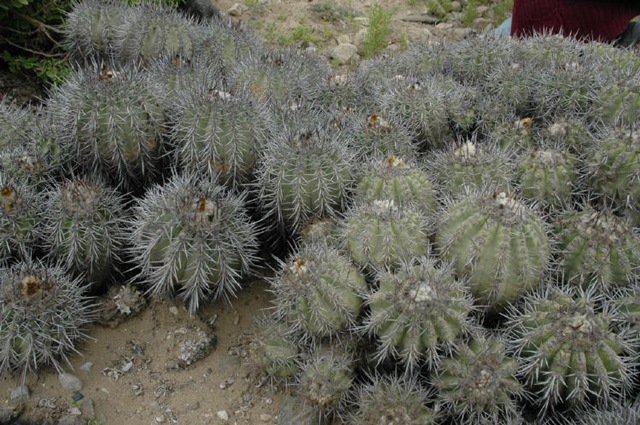
s317_0008

S317: Variability in C. coquimbana

Earlier this year, the British Cactus & Succulent Society’s Journal contained a review by Paul Hoxey of Copiapoa humilis and its many wide spread locations, where small differences with plants at the Paposo type locality had created a series of taxa, some of which Paul recognised as subspecies.(BCSJ 22(1):29-42). He had added a new one, Copiapoa humilis ssp australis – the most southern form, from a hill top south of Huasco. I was highly sceptical. Plants from the Humilis group are generally regarded as not coming down this far south and the Huasco river is regarded to be the northern border of the Coquimbana group, with C. fiedleriana the common form around Huasco. 

Rudolf Schulz, Ingrid Schaub and Ricardo Keim had carried out some searches in the area earlier in 2004, without positive success, although, as a ‘negative success’, they had narrowed down the number of hill tops that still required exploration, to a manageable number.

We decided to start at our usual stop (2001/S024 and 2003/S118), this time S308. Here too, we were amazed at the amount of greenery and wild flowers, especially as previous visits had been to soot covered scenery and plants. It was easy to spot the first Eriosyce napina as they were pumped up and either in flower or with recent flower remains (but no ripe fruits yet). As we started to take their pictures it soon became clear that there were so many napina that it was difficult not to stand on a few while taking pictures of the others. Copiapoa fiedleriana was also looking a lot happier than on previous occasions when the plants had looked so dry that it had been difficult to identify the genus, let alone the species to which these plants belong.  The patch that had been in contact with Euphorbia latex on previous days started to itch again – a sure sign that there were more of these plants to be found, confirmed by E. thinophila weeping with latex next to the napina that we had just photographed.

But the real reason that I had come back to Huasco was to look for Copiapoa humilis ssp australis,  We decided that if this plant exists, it had to be reasonably near by and that we could discount hill tops already checked out by Rudolf, Ingrid and Ricardo during the summer. Looking at the maps on my laptop left one candidate, for which I took an approximate GPS reading. We drove up a track away from the coast and with the aid of Bart’s and my GPS readings identified the hill that for most of the morning had been shrouded in clouds. At this spot (S309) the ground was carpeted with a white to light purplish lily that has tentatively IDed as Zephyra elegans. A wonderful excuse for some marvellous pictures, while the cloud over the hill slowly lifted.

The clouds actually made sense – C. humilis likes to grow in high altitude fog zones. We found a suitable place to park (S310), so that our ascend would be as short as possible. Bart and I were the only cactophiles mad enough to have a go. I was amazed at the speed with which Bart disappeared up the hill. I remembered previous climbs and the need to pace oneself, plus my scepticism acted as a powerful break. If C. humilis did grow on this hill, there would be no need to go all the way to the top, but at Bart’s speed, there was little chance of his spotting any growing at lower levels, or of my keeping up with him. I followed at a more leisurely pace.

There seemed to be a smallish plateau at around 300 m. altitude. I decided to take some scenic pictures, to at least  prove to Paul H. that we’d been on ‘his’ hill and to make a thorough search (hands & knees) of this area, but only found more typical C. fiedleriana. I felt sure that Paul H. and his companions (Clark Brunt, Jonas Luethy and Simon Mentha) could tell these from humilis. I carried on, up the hill, more sceptical than ever. Another ‘wrong hill’? Or was Paul’s diagnosis incorrect? I was shaken out of my thoughts, as a snake (only the second that I had encountered on the three trips) dashed past me. It seemed as shocked as I was. I was comforted by the belief (true or not) that there are no poisonous snakes native to the north of Chile, but there is nothing like a face to face confrontation to start questioning your believes. And poisonous or not, I’d rather avoid a bite. The last time I had encountered a very similar looking snake had been on level ground, near the entrance to Fray Jorge N.P. The one today had found me clambering up a fairly steep hillside with lots of lose rocks and the shock of our encounter had made me slip some metres back down the hillside, so I was actually ‘face to face’ with my reptile friend, although some distance apart. We looked at each other, as though to size each other up. I managed to take its picture, but Snakey had quickly moved out of sight by the time I had found a better, more stable position to take further pictures. The encounter had left me quite exhausted and, added to my scepticism,  was enough to dissuade me from continuing to the top.

There was no need, as the sound of small rocks rolling down the hill announced Bart’s descend, long before I caught sight of him. Leo, Rudolf: I think you have another candidate to compete with for the official title of ‘Copiapoathon Mountain Goat’!

Bart amazed me by confirming that he had indeed found Copiapoa humilis growing at the top of the hill. He had taken several pictures, but we’ll have to wait for the slides to be developed and duplicated / scanned before knowing exactly what Bart found, but some heads that had become dislodged by his climbing activities had come down the hill as evidence and were duly digitalised so that Alain can include them in his daily images.

This population, by far the most southern of any previously known humilis locality, appears to indicate that once upon a time humilis was a widely distributed taxon, but that, as the climate became drier, is currently only to be found at a number of quite widely distributed remnant populations. So how many of these are there left to be discovered? Surely enough to warrant further visits to Chile. And the prospect of speculating when and where during dark winter evenings back in Europe with a few bottles of Pisco Sour and Cabernet Sauvignon is another thing to look forward to.

Satisfied to place another ‘tick’ on my initial wish list for the trip, we had lunch and drove to Freirina for some sightseeing and another 2003 stop (S117), at Maitencillo, where alongside C. coquimbana and / or C. fiedleriana (these plants still looked very dry) we found Eriosyce napina ssp lembckei (S311).  The rate at which Maitencillo was expanding and the agricultural development that seems to accompany this are worthy of praise, while I fear for the future of the cacti at this locality. So how far did it extend? We drove some 5 km along the track, sign posted for Ojo de Agua and found many more plants in much healthier condition (S312), and confirmed these observations again some 5 km further on (S313), before returning to Huasco and our farewell meal with Bart & Marijke. Time for our return to Europe was approaching.

It was becoming a familiar rather than surprising sight, waking up in Copiapó’s Hotel Miramonte, with the Ruta 5 bridge over the Rio Copiapó shrouded  in fog, just as in 2003.  However, by the time that we had finished breakfast, it had already started to lift and continued to lift as we drove up the Rio Copiapó valley to Paipote. My aim was to familiarise myself with another of the northern Chilean river valleys, having made similar inland sojourns up the Rio Limari / Rio Grande valley (2003), Rio Elqui (2001 and 2003) and Rio Huasco (2001). Like the other valleys, the water flow is now controlled by a dam (at Embalsa Lautaro) that stores water in a man-made lake.

We did not go that far, having planned to turn west at Puente Potrero Seco. Like the other valleys, the stored water is used to good effect in irrigating the valley and surrounding lower hill sides with extensive vineyards all around. Ironic that the activities that threatens the survival of cacti in the wild – change of land use; here agriculture – had clearly lead to increased prosperity of the local human population and had provided us with numerous pleasant evenings back in Europe as we enjoyed our bottles of Chilean wine at our Copiapoathon reunions. In addition, this valley has extensive mining activity, with mines determining the quality of the roads and where in the valley they lead. This tends to be in the green centre of the valley, rather than close to the hill sides with the opportunity to explore some of the tracks leading further up hill.

We followed a sign west to Ruta 5, believing that the confusing intersection we had reached was at Potrero Seco. It was not, and so we followed an excellent road that runs from Nantoco over the hills to Ruta 5. New vineyards were in the process of being established, in various stages of progress from freshly ploughed fields to newly planted areas and others where the first crop seemed to be harvested.

We stopped soon after we reached the top of the hills (S301) at 1,041 m. altitude according to my GPS. We found the omni-present Cumulopuntia sphaerica, Miqueliopuntia miqueli and statuesque, lichen covered, Eulychnia and looked to the west on the cloud cover that seemed to lie on top of the Pan Americana as it ran between Copiapó and Vallenar. It seems that the valley between these hills and the coastal hills further west is an excellent fog catcher, so that it is no coincidence that the area is most frequently featured in articles and photographs about el Desierto Florido – The Flowering Desert. 

Soon we were on Ruta 5, but fortunately the fog was just a low cloud base over our heads that soon burned off as the sun 28 degrees South packs quite a punch in October. There was another surprise, as instead of having to play ‘spot-the-turn-off’ for the track to Carrizal Bajo, it was properly sign posted and the track had turned into an excellent tarmac road. Having read many of Ritter’s travelogues, it is hard to imagine that he’d get his car stuck in sand here on a regular basis. Again – road building does destroy habitats, but it also opens up so much more country to be explored. Let’s hope that this in turn does not lead to ultimate total habitat destruction. We stopped at km 48.5 from Ruta 5 (S302) and found Copiapoa echinata and Eulychnia, some with the buds bare, apart from small soft scales, characteristic of E. acida and some with almost white woolly buds, associated with E. breviflora / iquiquensis. Some of the Eulychnia were in flower. 

S303 was last year’s S198 – irresistible as the first Copiapoa dealbata appeared alongside the track. These are among the most impressive Copiapoa, forming huge clumps of white-waxed heads. The variability in spination, stem shape and colour is amazing. We also found an interesting red lily, Leontochir ovallei (Garra de léon – the Lion’s claw) among the desert flowers that increased in number as we came closer to the coast. Apparently this is among the most sought after of Chilean lilies, referred to as ‘the holy grail’ on a US bulb hobby list.

We showed Alain Carrizal Bajo – again with signs of growth and development all around, with a sign indicating that an Airport (Aerodromo Gran Cañon) is planned for the outskirts of town, at this time, covered in wild flowers (S304).The bright yellow flowers of Cruckshanksia pumila, a small shrub, prompted another stop, too close to the last one to take a GPS reading – it was difficult to progress as every ten metres some new plants seemed to jump into the scenery.

S305, near Caleta Sarco del Norte, was another 2003 stop, but this time, with non-cactus flora dominating the scenery, it was difficult to spot the large clumps of C. dealbata that stood out so prominently last year. 

S306 was prompted by a rocky outcrop with C. echinoides, on a sandy plain. Alain and my built-in Euphorbia-spotting allergy concurred –  in the sand we found the cousin of Euphorbia copiapina – the straight leaved E. thinophila, again in great numbers and by no means a rarity – when it is visible.

How many times does an event need to be repeated to become ‘a tradition’? If three is enough, then we had reached the traditional spot for the Copiapoathon Group Photo – this time S307 (S200 in 2003 and S030 in 2001) – the sloping side of a water run-off covered in large mounds of C. dealbata, with small C. echinata also dotted around. Last year, we took a look on the other side of the slope and found many small Eriosyce (Thelocephala) sp., probably a form of E. napina. They were quite easy to find this time, as most had very recent flower remains (no ripe seed) and were plumped up from recent moisture. Some were still in flower.  All good things come to an end (for now) and so it was time to move on to Huasco.

What a day! We had to pinch ourselves during that evening’s slide show in Hostal San Fernando, to check that we were not just dreaming of the huge range of plants and scenery that we had seen all in the space of 12 hours. How could we improve on this tomorrow?

s303_0007

S303: C. dealbata, inland from Carrizal Bajo

At 8:30 a.m. we’d had breakfast, bought provisions for a lunch time snack and were topping up the cars with fuel at the Copec station, some 20 km west of Copiapó, on Ruta 5. We carried on driving towards Caldera, while I offered to drop Alain any where he wanted, to dig in the ‘sand dunes near Copiapó’, the only details we had for finding a plant on his wish list: Euphorbia copiapina. Alain reminded me of the Adidas poster we had seen near the petrol station: ‘Impossible is Nothing’.

Ricardo Keim had provided us with some suggestions for C. megarhiza and C. echinoides locations on a track off the Pan Americana, sign-posted for Barranquillas. This would take us through the flat and almost featureless ‘flood plain’ that is the mouth of the Rio Copiapó. The term ‘flood plain’ seems somewhat inappropriate for a river that usually contains no more than a trickle of water, but I guess that during it’s long history, things have not always been this dry. As we drove along this area on Ruta 5 the previous day, we had noticed another patch of ‘purple haze’, but nothing could have prepared us for the sight that unfolded before us. This is why Hendrix must have written ‘Purple Haze’ and must have inspired Prince to write ‘Purple Rain’ – mile after mile of (primarily) purple Calandrinia longiscapa. Each flower is no more than a couple of centimetres in diameter, they are relatively widely spaced on the desert floor and in addition to purple, they also come in yellow, white and red to name but a few colours. But it is the unbelievable number of these small plants that create the overwhelming spectacle (S294).  

As I lay flat on the desert to get a good picture just over the top of the flowers, my hand started itching and stinging – a typical allergy reaction. The reason soon became obvious, as the plant I had rested my hand on was bleeding white latex. I know that I am very sensitive to Euphorbia latex, but never thought to turn it to my advantage as a detector for Euphorbia copiapina.  I shouted to Alain and Bart to share my exciting discovery, but already found them in the traditional posture for looking at small plants in the desert: head down and rear end pointing at the sky. They too had found the plants. And so we had succeeded in one of the goals to find this rare and much sought after Euphorbia. It soon became clear that the only reason that it is regarded as rare, is that it is invisible unless the right conditions for the desert to spring into flower present themselves. When visible, they are as numerous as any weed, with plants at least every meter (c. 3 ft) apart. Plants were in flower and in (unfortunately still unripe) fruit.

Words really won’t do this spectacle justice, so Alain’s picture site will have to fill in. It was not easy to drive on, as each turn seemed to present a different angle on the flowers, bringing out new hues and colours, so the stop number actually refers to frequent stops along several km. of track. You  also have to imagine Alain chasing some of the millions of attractive beetles through the desert with his digital camera, taking short bursts of video, and to hear the bird song that had replaced the usual deadly hush. Those who know me will recognise how unusual it is for me to spend so many words on non-cactus matters. So things could only get better when we approached the hills mentioned by Ricardo, also covered in flowers, but now joined by an Eriosyce sp. (help Ricardo, which one?) on one of the hills (S295) and C. megarhiza (var. borealis) on the neighbouring hill (S296) that Bart decided to explore instead.

All good things come to an end, and so the huge areas of the flowering desert became more like the usual scenery, although still with a lot more signs of recent rain and resulting flowering then I had seen before. S297 was a ‘leg stretch’ to see if there were any cacti at all – we only found some recently flowered Trichocereus – and S298 was prompted by the sight of some large clumps of Copiapoa echinoides that were full of fruit. This also revealed some much smaller and spinier C. echinata, but without signs of buds and flowering. Similarly, lots of C. echinoides further on at S299.

And so we approached the km 22 marker on the track from Totoral to Ruta 5 (S300). Another Dutch friend, Evert Smienk, had been here in 2002 and reported seeing plants that he thought were ‘different’ and perhaps worthy of describing. He had been very kind in giving me a number of seedlings raised from seed collected from these plants. I showed these seedlings to Benjy Oliver, for me the best person to put a reliable ID to young Copiapoa seedlings. He did not hesitate and declared ‘definitely echinoides‘. I promised Evert to try to see these particular plants in habitat but at first it seemed that I would have to file a disappointing report, as there was no sign of cacti at the km 22 marker, but plenty of tracks of diggers  etc. However, a little further up the road, Anne had noticed some shrubs and a nice Eulychnia. As we walked over we found clumps of C. echinoides, including the very individual shaped plant of which Evert had sent me a picture and which had been the mother to his seedlings. I’d have to explain at this stage that I regard C. echinoides as a broad species that includes such names as C. dura and C. cuprea.

s296_0020

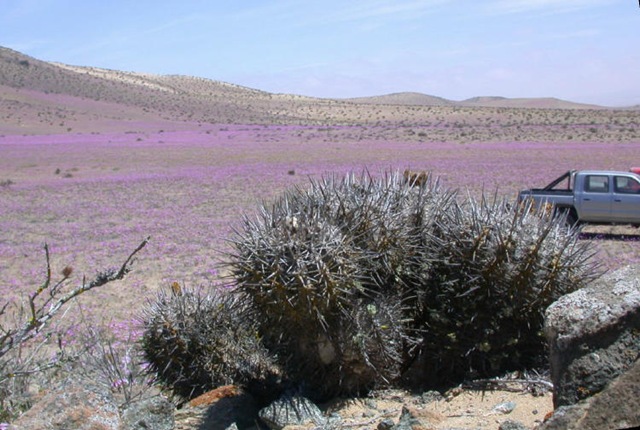
S296: C. megarhiza (var borealis) amidst the Purple Haze of Calandrinia

We had arranged to meet Bart & Marijke Hensel at their hotel in Taltal at 9:00 a.m. and were ready in plenty of time. So, with about 20 minutes to go, while taking a last look at the rescued Copiapoa planted out at the cabañas, we were surprised to see Bart arrive in his car. Was anything wrong? It was a mutual question although we did not understand why Bart asked us, until he explained that we were 40 minutes late! Apparently, we had been unaware that the clocks had changed from winter time to summer time the previous weekend, so that for 8 days we had been an hour behind ‘real’ time. No problem, as we had no appointments with the cacti we had seen, but it would have been, in a few days time, when we were due to fly back to Europe!

The Pan Americana from Taltal to Chañaral can not be accused of passing through the most exciting scenery. In fact, battling boredom – as the lifeless scenery passes by – is perhaps the greatest challenge, until the road descends towards Chañaral and passes some interesting coloured hills. What a difference to the parallel route, along the much slower coast road / track that we had taken on 5 and 6 October, through Pan de Azucar, down to Esmeralda, followed by some ‘valley-hopping’ to Cifuncho – as that is prime Copiapoa country. But here, in the rain shadow of the high coastal hills, the scenery looks extremely harsh and dry – despite the signs that warns drivers to switch on their headlights in dense fog!.

In 2003, we had made a number of  stops between Chañaral and Copiapó (S180 – S186) to study the different forms of Copiapoa as C. cinerascens blends into C. calderana that in turn seems to merge into C. marginata. At the same time, Rudolf Schulz and Leo van der Hoeven had visited some locations further inland and from this, Rudolf had given me some directions to a hilltop ‘above / behind’ Barquito, overlooking some prominent fuel tanks close to the Ocean. I had kept an eye open for suitable turnings as we drove north some two weeks earlier, but had found none. We did spot three prominent fuel tanks and so we tried a track into Barquito that unfortunately led to a large modern supermarket. Following our instincts we turned into tracks that seemed to offer the best options for getting up the hill, until spotting five (different!) prominent fuel tanks below us. The track ended at a private residence, so we decided to abort this mission and carry on south on Ruta 5.

We stopped (S292) at last year’s S180, near a sign pointing to Parque Diego de Almeida, where Angie and I had found some nice Eriosyce rodentiophila growing right alongside the road. Again, there were signs of ‘progress’ with the strip where the plants had been having recently been cleared with a digger. Fortunately, a little further from the road I still found the C. cinerascens intermediates with C. serpentisulcata and possibly with C. calderana var. spinosior.  The others had combed through some land nearer the car, where in addition to the plants I had found, they had also found a good number of E. rodentiophila.

There was still quite some distance to go, so our next stop (S293) as close to Caldera – close to last year’s S185. Here, as at S185, we found some nice white waxed C. calderana, but also some green plants and a couple of C. marginata. This again offers the opportunity of lots of speculation as to what Ritter had in mind when he found and later described C. calderana – but this too would take up much too much space to discuss here.

And so we arrived in good time in Copiapó. Contrary to some speakers in the UK, I find it quite a nice town.  We stayed again at Hotel Miramonte, right along the Pan Americana, with a secure, underground car park and only a short walk from the centre of the town. So, after our luggage had been safely installed in our rooms, we walked to the plaza and enjoyed a few beers in the very modern shopping centre.

We spent the morning doing a spot of shopping and sightseeing in Taltal. I took many digital images, so that I could show the changes and progress to my companions from previous Copiapoathons and to capture the current look and feel of the town so that I can use it as a basis for comparison for future visits.

After lunch, the cacti and the desert called again and we decided to go and have another look at in the Quebrada los Zaniones (S289), to the east of Cifuncho and to the south of Taltal. We had been here twice before this week – S260 (10 October) and S275 (13 October) and on previous trips (S052 and S070 in 2001 and S128 in 2003). There are two different Copiapoa here – C. columna-alba with plenty of flowers and fruits in 2001 and 2003 and a plant that forms large mounds of small, tight heads that on those earlier visits had not been in flower and that we had identified as C. desertorum. These days, this is regarded to be synonymous with (or at most a form of) C. rupestris. C. rubriflora also comes from the area between Cifuncho and Taltal and again has been lumped in with C.rupestris. To add to the confusion, I gather that all three taxa are to be moved to synonymy under C. taltalensis, an earlier name described by Werdermann.

Earlier in the week, we had seen these plants in bud and in flower and they had looked pinkish to red. So why am I so fascinated by these plants? Because Copiapoa have yellow flowers, although their buds often have a red appearance before the flower has fully developed. So Copiapoa have the ability to produce red pigmentation in their flowers. From my observations of plants in cultivation in the UK, I noted that the degree to which this pigmentation is present can vary from plant, irrespective of what species it belongs to and can also vary from flower to flower on the same plant between different times of the year. The depth of the (pinkish) red colour also seems to vary during the duration that the flowers are open. So, if the pinkish-red flower colour is not limited to a single species, what plant did Ritter use this name for and where did it grow?  

This is not the place to discuss this issue in any detail, so I’ll cover it in a separate message at some time in the near future.

Having taken pictures of all the plants on which we could find buds and or flowers (and also having checked them in vain for seed), we decided to take a look at Cifuncho and to follow the track that leads north along the bay to S290, marked on our topo-maps as Punta Garcia at Bahia Lavata. Here we found C. rupestris, but as there were no buds or flowers, we could not exclude the possibility that these might have ‘rubriflora‘.

Next we followed a track to the south-east of Cifuncho but this came to a halt where, it seemed quite some years ago, a landslide had blocked off the valley (S291). We looked around for cacti, but only found a couple of ‘lost’ C. columna-alba and a few individual Eriosyce rodentiophila.

That evening we enjoyed our last meal in Club Taltal and looked forward to the next day, when we would drive to Copiapó and meet up with some Dutch friends, Bart and Marijke Hensel. So we were a little surprised that they walked through the door at Club Taltal as we were tucking into our deserts. 

My original plan had been to explore the Izcugña Valley, the ‘next valley south of Botija’, where in 2001 the others saw Ritter’s Copiapoa varispinata while I was digging the car out of the sand at the mouth of the valley.

As we passed Paposo, I realised that I should have brought my laptop along – as it contained all the data (GPS information and detailed topographical maps) that I would need for a meaningful exploration. However, I had left them at the cabañas in Taltal.

I tried to find Izcugña from the sketchy details on a stop list print out and from my memories of 2001. One or two places looked like possible candidates, but did not have the stretch of sand where I had got stuck, so were dismissed. Never mind – return visits to previously visited locations had shown how these places can appear quite different on different occasions.

Rudolf had reported that during his visit in August 2004, Copiapoa solaris had been in bud and I was sure that the two most recently (2002) described Copiapoa species, (C. ahremephiana and C. decorticans), both from Botija, would be of great interest to Alain.

We had no trouble finding Botija (S284) and parked the car where on previous occasions we had set up the tents. The remains of our 2003 campfire were still there and, as I closed my eyes, I could almost hear the voices of the 2001 and 2003 Copiapoathoners laughing and joking as the bottles of wine came out in preparation for the night. But this time it would just  be a day trip, as there were still more things to see around Taltal.

I had lost plants of C. ahremephiana in cultivation through rot, with the stem tissue bright orange as I threw the dying plants out.  Time had come to examine a few plants in habitat – bright orange stem tissue! Were all these plants infected by a virus? Similar tests on C. decorticans and C. atacamensis showed ‘healthy and normal’ stem tissue, but C. solaris also had this orange stem tissue. Did this species also suffer from the same disease? Or is it merely a common feature of healthy plants, with potential for use as a diagnostic feature? Or do all Copiapoa display this feature after extraordinary long periods of draught? Most of the C. solaris that Rudolf reported in bud 2 months earlier must have aborted, as there was no sign of buds, recent flowering or fruits. Anne found some plants in flower, with the flowers a similar reddish colour to the C. desertorum at Cifuncho!. None of the signs of recent rains seemed to have extended this far north – why?

We made four stops (S285, S286, S287 and S288) on the way home, all before reaching Paposo. As a result I have more images of Copiapoa haseltoniana at different locations to check out.

s284_0052

S284: Survival – This healthy and flowering stem of C. decorticans is
all that is left of a large clump that has sacrificed its other stems.

I guess it had to happen. One of my favourite cactus spots on this planet, the Quebrada San Ramon, now has a public car park at its entrance. Well, it’s not quite that bad, the pending and expanding tourist trade in Taltal has given rise to some well prepared car parks with picnic and camping facilities. One of these spots is near the entrance to the quarry at the mouth of the Quebrada.

This was my fourth visit to this location and we agreed that we’d march some 7 km straight in, without too much stopping. This would get us to the point where Copiapoa krainziana and Copiapoa rupestris grow side by side.

During my second visit, in 2001, we saw C. krainziana growing along the western side of a quebrada that comes into San Ramon from the north, but these plants look quite different from that population. Here, the clumps have fewer heads, with longer stems. The spines here are extremely brittle and come off the plant at the slightest touch. As a result, the old stems look like ageing punk rockers, with just a tuft of white spines at the apex.   

The rain that we had experienced a week earlier had left damp patches along the valley floor. Annuals were starting to appear and shrubs were coming into leaf and flower.

It brought home the fact that I could spend a complete three week trip in the Quebrada and still not see ‘everything’ – to explore the side canyons and the hillsides. Even then, it would only be a three week snapshot in time – perhaps it would be better to make various visits during different months of the year to gain some appreciation of how the scenery changes during the seasons. But then, the local concept of seasons is quite different from what I’m used to in Europe, with its fairly regular and predictable four seasons per annual cycle. Sure, there seem to be similar seasons here, but they seem to be very similar. There is another, much more significant seasonal cycle that is influenced by the El Nino effect. I have now seen this Quebrada in May 2001, June 2003 and October 2004. It will take many more visits to gain even a basic appreciation. Perhaps I should move to Taltal ☺

The cameras were snapping all through the Quebrada and have been arranged into 5 stops:

  • S278 – at the mouth of the Quebrada,  nearest the Ocean, so with the first and last pictures of the day

  • S279 – from about the first 20% to 33% of the valley

  • S280 – roughly the second third into the valley

  • S281 – roughly the last third  – where C. krainziana grows

  • S282 – as far as we got today – stopped for lunch and then went back

As usual, we returned to the cabañas tired but satisfied with what we had seen and with the images that we had taken. Tomorrow we’d leave early to go to my other favourite Quebrada, at Botija..

s279_0037

S279: Variability and diversity are the key issue to resolve in Copiapoa taxonomy.
Here an offset of a C. cinerea fa. could (in splitter’s terms)
be considered to be a different taxon, based on its appearance.

Following our 2001 trip, Marlon Machado’s ‘Cacti above the clouds’ pictures, taken on the summit of Mt. Perales, rapidly became everyone’s favourite cactus picture. I always regretted that both my SLR cameras and my digital camera at the time were having minor problems, with batteries, film and memory running out on each, just as I wanted to capture the moment. By the time that they were all up and running again, the sun had burned away the clouds, so all I was left  with were pictures of nice cacti growing on a hill.

In 2003, I had really built this location up to my fellow travellers and was bitterly disappointed on the day that we were to repeat the experience, to wake up to a clear blue sky. We drove the tricky track to the top anyway and enjoyed the wonderful views over and beyond Taltal – a breath taking view in its own right. So, when the top of the Cerro Perales was veiled in clouds when we woke up this morning, things looked promising for a repeat of 2001.

As you drive from Ruta 5 into Taltal, there is now a sign post indicating the turning to Cerro Perales. Things seemed to get easier all the time – but ….. On previous occasions, after turning off the main road, we followed a track that ran parallel to the main road for a few km before heading up into the mountains. We did so again this time, but failed to recognise any landmarks. There were some large Copiapoa cinerea around, so we made a couple of stops (S267 & S268), as much to check GPS references as to  take some pictures and look for seed. I was worried though, that as time progressed, the clouds would evaporate, as they had done in 2001, before I had taken my pictures.

We went back to the point where the sign took us off the main road and this time did the obvious thing at the first crossroads (cross-track?), i.e. continue in the direction indicated by the earlier sign, instead of following the track alongside the main road. This proved the right thing to do – as soon the familiar sight of the small farm house with 3 palm trees appeared – the half way mark for our ascend.

And so we arrived at the summit. The clouds were still there and I wasted no time to get to the spots that I had selected on previous occasions. (S269) I can’t complain about the results, and yet, third time round, to my eyes they lack the impact that the wonder and surprise of the first visit added to Marlon’s pictures. 

As usual, we paused on the way down hill at a spot that probably best shows the track winding down the hillside, with the Quebrada Taltal and the Taltal to Ruta 5 road in the back ground. It  also has, to my mind, the finest stand of white-waxed, clean Copiapoa cinerea (S270).

It was still early, with plenty of time to have lunch in Taltal, followed with a trip along the coast road south to Cifuncho, to check up on the flower colour of C. desertorum – or should it be C.  rubriflora – at around 2 p.m. We made a few short stops:- S271 – with a few C. columna-alba; S272 near sign post to Las Guaneras – no cacti found; S273 – no cacti found and S274, marked on the map as Caleta San Pedro, where we found C. desertorum.

Then, the moment of truth, as we reached S275 – the same spot as S260, two days earlier. There were the plants, there were the flowers – as open as the spines were going to allow them to be, and despite being colour blind, I had to admit that these flowers were red enough to justify the name. Having taken all the pictures possible, we headed back to Taltal, only to be tempted to a sign to Las Tortolas. The track leads through a fairly wide Quebrada with a dense population of C. columna-alba. These reduce in number as the valley narrows, close to the coast. On reaching the coast, the track splits, one heading north, the other south. This is Caleta Tortolas (S276), and has been marked on the map for future exploration, as now, we had once again run out of time. We made one more stop on the way home (S277), among the C. columna-alba, more to get another GPS reading to plot on the map, rather than to explore and report on.

s275_0001

S275: But C. rubriflora is supposed to be synonymous with C. rupestris, not C. desertorum
OR There are red flowered forms of several taxa of Copiapoa.

A quick rain and health check revealed that all was A OK. We decided to take a drive to Paposo, to see how the weather had affected things along the coast road. Another guest staying at the cabañas was Michael Dillon – amongst other things – a well known author of many papers about the South American flora, particularly of Chile and Peru and particularly on the vegetation of desert oases – lomas regions – and the plants in the genus Nolana. We had some correspondence in 2001 in advance of my first trip to Chile. Michael reported that there had been two short showers in Taltal during the previous couple of weeks – presumably those that we had witnessed. One had produced 20 mm of rain, the other 35 mm. However, without detailed rainfall statistics, I have no idea if this is usual or very rare – more things to look up when I get back home.

After getting our punctured tire fixed, we set off for Paposo and noticed the intensive work that was in progress to straighten, widen and surface the coast road – Ruta 1. As we drove past the entrance to the Quebrada San Ramon, scheduled for a visit in two days time, we noticed that the quarry at the Ocean end of the valley was back in use – the first time that I had seen activity here. It took exactly an hour to drive the 56 km to Paposo – a great improvement, despite some hold ups where diggers and trucks had been blocking the road as part of their activities.  But at what expense to the plants? In 2001 we had come across a large number of uprooted Copiapoa albispina / gigantea along the road. The plants had been tagged and treated with sulphur dust against rot. At first we thought we had stumbled on a commercial collector’s pick up point, but later Attila and Rudolf met a lady botanist, employed by the military, who also seemed to be responsible for the actual road building work. She explained that her task was to scout ahead of the road-crews and identify populations of plants that had to be moved and that would be replanted in a safe place.

In 2003, we found many of these plants replanted a little distance from the road. They had not appeared in top shape and obviously it would be difficult to provide the extra care required for a plant to re-establish itself in these harsh conditions. Some of the rescue plants from mining projects had found their way to the Cabañas Caleta Hueso, to the small garden belonging to the mine manager, next to Quebrada San Ramon and to the small botanic garden being constructed in Taltal. Here, with regular care, the plants would have a better chance, but with plants rescued from a large area now standing side by side in the open air, pollinators would soon ensure that some not-so-natural hybrids would result.

Our first stop (S261) was at the Paposo Cemetery, where the expression ‘Rest in Peace’ seems inappropriate – right next to the power station. There was evidence of some recent rain, with clumps of Copiapoa haseltoniana close to the track looking as if they had been placed in recently prepared cement that was still setting. Only time will tell if we should modify our soil tips for these plants in cultivation – the rain had been too recent to produce a reaction from the Copiapoa or from Eriosyce taltalensis ssp paucicostata or the Eulychnia.

Next stop was at the Virgen de la Puntila -‘ the Paposo Shrine’ (S262), on the road above the village that ultimately leads to Ruta 5. Again, things had changed, with a huge caterpillar (the digger, not the butterfly larva type) taking up the spot where in previous years we had parked our cars. The Copiapoa humilis and Eriosyce taltalensis here were in good shape.

The track leading to the fog zone above Paposo (S263), that is part of the Reserva Nacional Paposo, seemed to have suffered from rainfall since June 2003. It seemed as if water had washed away most of the sand, leaving large boulders to bounce the car off. Unlike 2003, the fog was out, with the cloud base around the tops of the electricity pylons that form a neat row up the 700 m. hill from the power station below at the cemetery. There is a plot of rescued Eulychnia iquiquensis along the edge of the hill and Euphorbia lactiflua was in full flower as was another yellow flowered non-succulent plant believed to be Balbisia peduncularis. The improved light conditions, compared to 2003, enabled me to get the digital images that were difficult to get last time round.
There was time to take a look at the high altitude Copiapoa cinerea from Paposo – C. eremophila, but once again, we just had enough time to look at the plants growing along the road to Ruta 5 (S264) – not the best looking plants, covered in cement-like dust. There were several lilies and other wild flowers that cheered up the otherwise grey hill side.

On the way to Paposo, we had noticed that the effort of straightening the coast road had involved ‘clearing’ some large rock formations, presumably with explosives. As a result, an entrance to a Quebrada had appeared that I can’t remember seeing on previous trip. We agreed to take a closer look (S265). There is no name on the topographical maps we have, so for now, I’ve called it ‘Quebrada Nova’. We walked into the Quebrada for about 45 minutes and found a range of Copiapoa cinerea, rather like in San Ramon, that  might be called C. haseltoniana or C. gigantea, depending on your taxonomic preferences. However, the range of variability was significantly less than that found at San Ramon.

Time was getting on and there was one more newly exposed Quebrada to take a look at, nearer Taltal. The time was now 5:30 p.m. and the light was not good for more photography, so we limited our efforts to taking a GPS reading that, according to the maps, corresponds to Quebrada del Hueso Parada (S266) (NOT Quebrada Hueso, near the cabañas where we were staying). This quebrada will have to wait until a future visit for a more detailed look.

s263_0041

S263: C. humilis, above Paposo.