Just another WordPress.com site

Not for the first time, Cliff and I set off for the tyre repair man before breakfast. We were shown the damage done and had to agree that while it was possible to put on an emergency patch, just to get us back to civilisation should the need arise, this tyre too had to be replaced. It was a familiar problem – there was no stock of this particular tyre size but the new tyre would be here first thing the next day, except that …. there had been some problems on the N2, the main road from Cape Town along the south coast. Last August, five workers had been killed at a protest meeting about low wages and working conditions at a mine near Johannesburg. After the riots that followed, things – as far as the daily UK news services where concerned – had settled down, but we had at times sensed an underlying tension. Now, things appeared to have hotted up again. The tensions were not primarily racist, but as is quite common around the world, it’s tension between the ‘haves’ and ‘have nots’ complicated by cheap labour from outside the country. We understand that the seasonal workers in the wine industry, many from Lesotho and Zimbabwe, were protesting by blockading the main motor ways, like the N2, stopping tyre deliveries and more. We had come across a similar situation much earlier in the trip, at Rosh Pinah, Namibia where there was a rumour that due to road blocks and truck drivers striking, petrol was in short supply, immediately leading to long queues at the pumps. The tyre company had an outlet in Swellendam, our next ‘home’ for a few days, so they ordered the tyre to be delivered in Swellendam where it would be fitted when we got there. So we had another few days driving on a temporary tyre with a dodgy spare. We had survived before in much more remote areas, we’d survive again.

We had selected some more Haworthia spots to investigate today, which took us near the N2, so we could take a look at things for ourselves and once again, would keep an eye on fuel levels to avoid being caught out if things should escalate.

S2808 was only 1 km from the N2 as the crow flies, but we must have driven at least ten times that distance from the N2 to get there. No signs of anything unusual by the way. I can’t remember which Haworthia we were looking for, it mattered not, as we did not find it where it was supposed to be. In fact the images I took suggest that we did not find anything else of interest, we were surrounded by agricultural developments. Never mind, we had seen so many fine plants already on this trip that the urgency / slight anxiety feeling that sometimes drives you at the start of a trip seemed to have worn off. Appetites were satisfied. It was good that we were now counting down to our flight home in days rather than weeks. Earlier on the N2 we had even spotted Cape Town on the direction signs. Hmm. if we had to, we could do it on one tank of fuel.

S2809 was always likely to be a more certain target, one that told us that we had arrived:

S2809 - Haworthia magnifica ssp splendens reserve

S2809 – Haworthia magnifica ssp splendens reserve

Clearly this visit should have benefitted from some preparation. We would need to get somewhere where our South Africa bought mobile phone could get a signal, wait to see if the contact was available – it was unreasonable to expect him to drop everything and race over, and even if he could, how long would that take? Common sense suggested that what grows inside the fenced off area might also grow outside and so we took a look around near where we had parked the car and before too long:
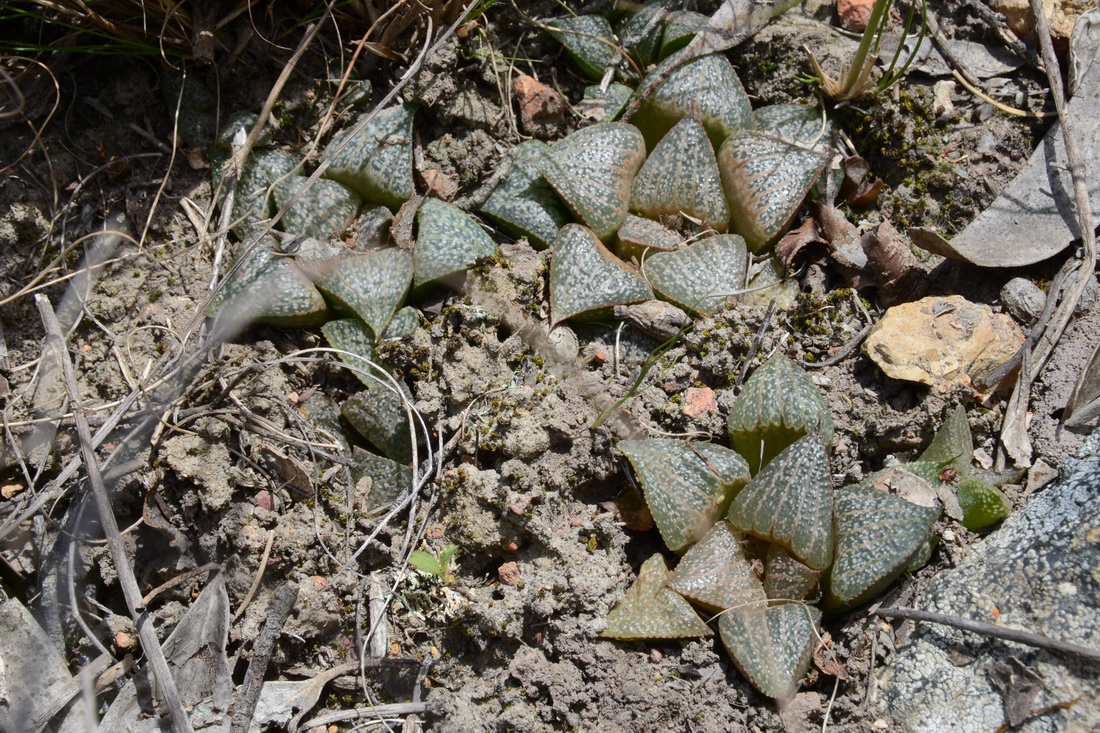
S2809 - Haworthia magnifica ssp splendens

S2809 – Haworthia magnifica ssp splendens

… we had found 17 plants. Great, no need to enter the reserve and hang around!. Our goal had always been just to photograph the plants in nature. The fenced off reserves are a necessary evil, the efforts to protect endangered plants in nature is to be applauded, but it’s always more satisfying to see them ‘truly wild’. After all, we could have saved ourselves a lot of time, money and effort by going on a short trip of specialist nurseries in Europe or the US if all we had wanted was a picture of the plants.

You could tell that we had arrived in a much more populated part of the world, along the famous Garden and Wine Routes, with a much greater emphasis on tourism. While we are all aware of the medicinal properties of Aloe vera, I was surprised to see a number of Aloe themed tourist attractions popping up along the N2. We had to stop at one, just to see what it was all about (S2810). Back in the UK I had spent some time volunteering at the now defunct Holly Gate Cactus Nursery and had learned that minor skin blemishes, especially inflamed cactus spines under the skin, would benefit from the application of the slimy juice of an(y) Aloe leaf on the area. At the Aloe Fer Aloe Farm, the shop had an amazing array of Aloe based products, cremes, lotions, drinks, sweets etc. Posters told the story of the plant and its magical properties that you can read about elsewhere on the internet. I learned however that the much larger Aloe ferox is a much better source for the commercial production of Aloe related products than Aloe vera. Despite this plant related subject, I find that I pointed my camera primarily at a series of garden furniture statues that perhaps provided an insight of how we might look on future plant trips – much farther in the future I hope!!!
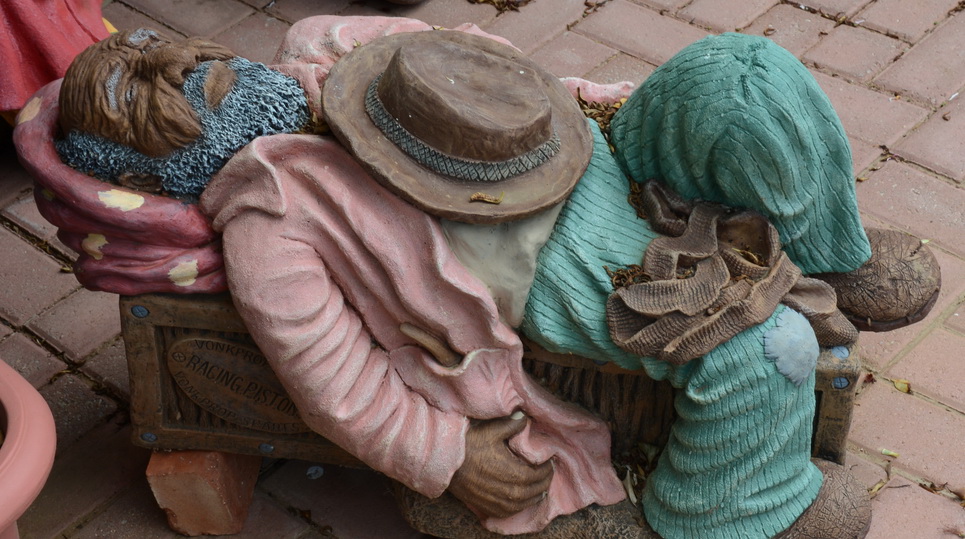
S2810 - just a few more years

S2810 – just a few more years

I can’t think what S2811 was about – it must have been another failed Haworthia stop as all I have are two images of terrain as flat as Holland at its flattest but without the windmills, with views up and down the track.

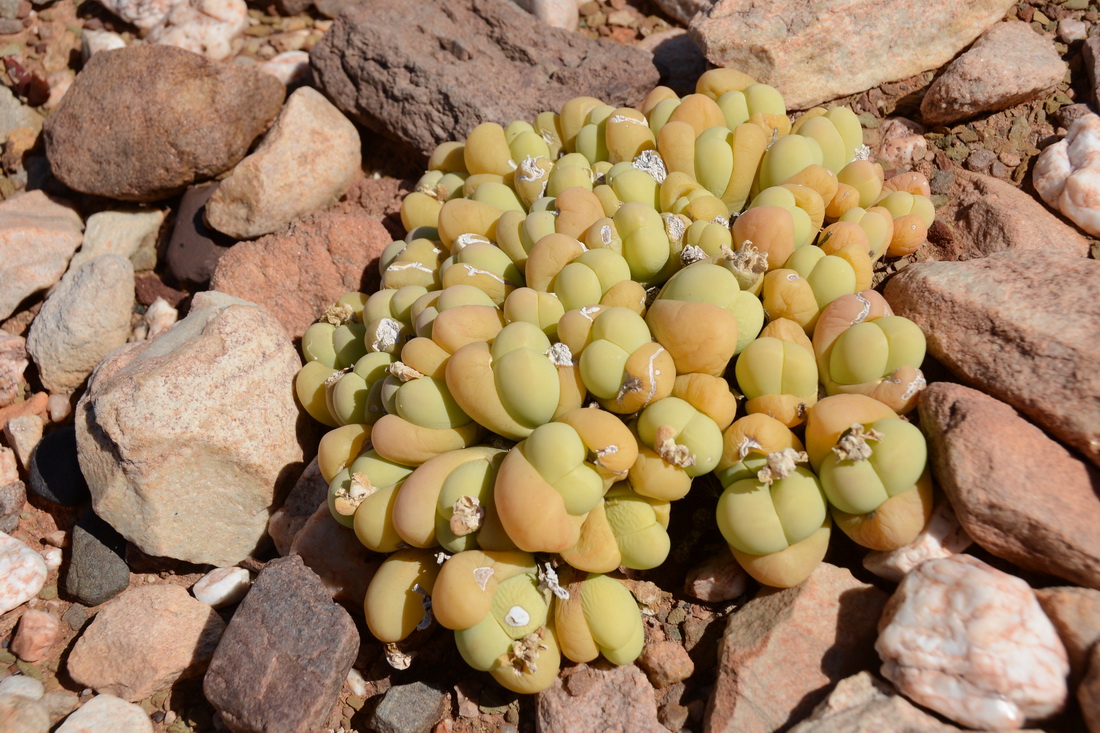
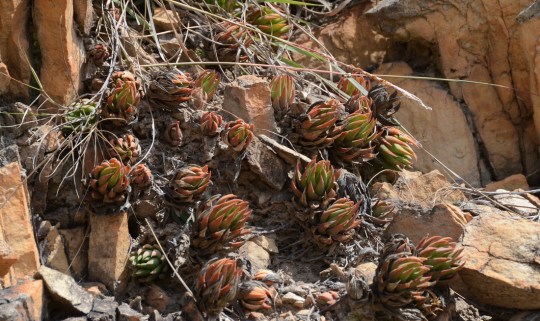
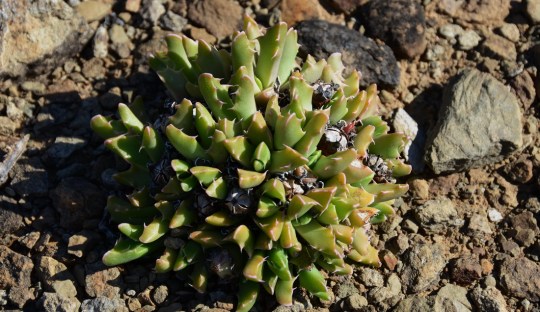
We had more luck at the last stop today, S2812, surprisingly only 5 km from the Ocean, near a place called Vermaaklikheid where it is associated with limestone. As the name paradoxa suggests, authors seem unsure of where it belongs – it has a number of synonyms: H. maraisii var. paradoxa, H. magnifica var. paradoxa, H. mirabilis var. paradoxa.

The plants grew not far from the road, but on the edge of a steep and eroded slope down to the valley some distance below us. I’m sure that during heavy rains, some of this habitat end up somewhere in the inaccessible valley below us – we were keen not to go the same way. Nice plants!
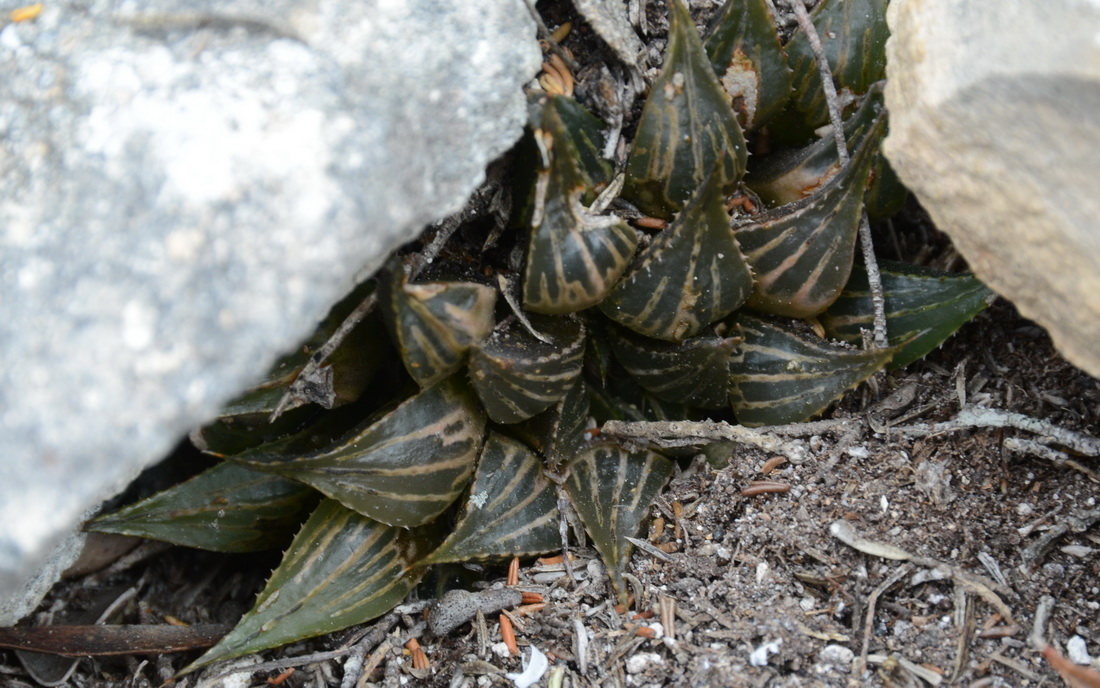
S2812 - Haworthia paradoxa

S2812 – Haworthia paradoxa
S2812 - Haworthia paradoxa

S2812 – Haworthia paradoxa
After four nights at the same hotel, time had come once again to pack our suitcases and load up the car. We headed west on the R62 and David told us that we were now in the middle of Ostrich country, Ostrich farming that is! We had already seen many signs to ostrich farms and to ostrich themed tourist attractions, but the expected fields full of these massive birds were missing, although the tall fences, needed to keep them in, were in place. Along the tune of Marlene Dietrich’s famous song, we asked ‘Where have all the ostriches gone….?’

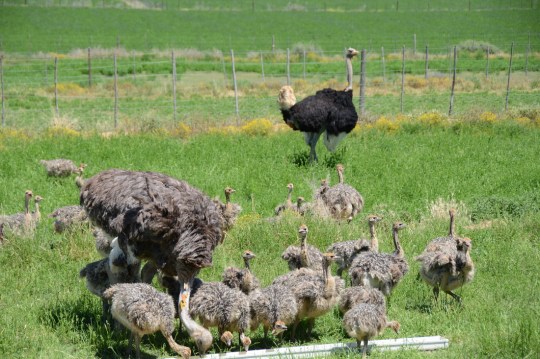
We made a legstretch stop (S2800) but saw nothing exciting, while south of Calitzdorp our question was answered (S2801):

S2801 - Ostriches

S2801 – Ostriches

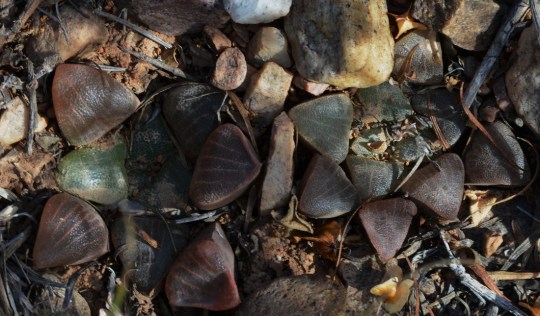
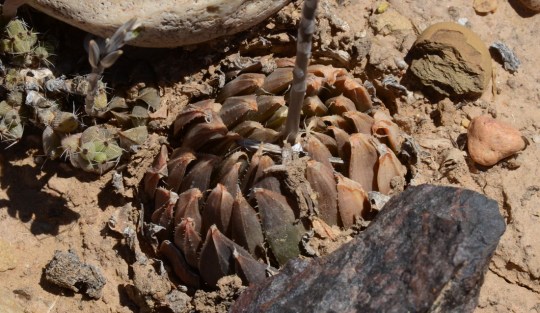
David mentioned that this was nothing compared to 2005. A few more km up the road we stopped (S2802) hopeful to find another Haworthia, H. scottii, a 2003 Ingo Breuer name. After a lot of searching it would appear that there is a Bayer name as well; Haworthia arachnoidea var nigricans.

S2802 - Haworthia arachnoidea var nigricans sensu Bayer - Haworthia scottii sensu Breuer

S2802 – Haworthia arachnoidea var nigricans sensu Bayer – Haworthia scottii sensu Breuer

Still bemused with the taxonomic challenges posed by Haworthia – in my case, getting a credible label for my images – and remembering the mysteries around naming the various taxa of Argyroderma in the Knersvlakte, here we were presented with yet another challenge: the genus Gibbaeum. I think that there might be two different taxa here, let’s see if you agree the provisional IDs: [PS: Looking at my images in the British winter light, I only see one taxon. I had noted G. heathii as well, but now would not know which plant to put that name too.]
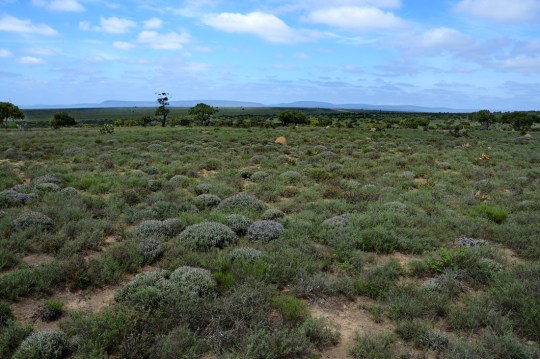
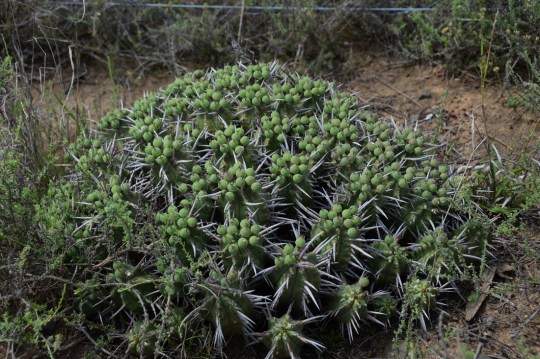
S2802 - Gibbaeum nuciforme (G. cryptopodium)

S2802 – Gibbaeum nuciforme (G. cryptopodium)

I was able to download Nel’s Gibbaeum Handbook from the internet and although it was published almost 60 years ago, there have not been too many changes. One change is that G. nuciforme used to be G. cryptopodium (Latin for ‘hidden foot’) as most of the plant is below ground level – we believed the literature on this point at it was boiling hot and I left my JCB digger at home. It is said to have pink flowers – but that did not help as there were no flowers on show.

A male ostrich at the top of the hill was taking a fancy to us and was making peculiar snorting noises, not unlike those that my room mates accuse me from making while I sleep. Was the ostrich’s noise a mating call or a warning to go away?

The next stop (S2803) had been recommended again, by Gerhard I believe, and was at a succulent plant nursery: The Douw-Karoo Succulant [sic] Nursery. The owner, Nellis janse van Rensburg showed us around and we had a nice chat about the local plants.  Nellis suggested he’d squeeze in the car with us and show us some of the local plants, growing in fields near by. Great!

At S2804 we were not disappointed. Nellis explained that the high-fenced fields and pens had been for ostriches but since the bird-flu out break (WHAT?!? – they kept that quiet on the UK news!) the bottom had dropped out of the ostrich meat trade when the US and Europe banned the import of ostrich meat. Most of the birds were destroyed with some of the feathers going to Brasil for use in the Carnavals. With the economy flat / shrinking, there did not seem to be money available to invest in redeveloping the land. Government agencies were encouraging farmers to let the fields go unattended to give the original local flora a chance to re-establish, call it conservation if you like. When we stopped there was encouraging evidence of this recovery. We found or rather were shown a miniature Aloe, A. longistyla, two different Anacampseros sp. two different Asclepiads, Avonia papyracea (? in my own ignorant broad sense), Crassula columnaris, Crassula hemisphaerica ? Crassula tecta Crassula tetragona. a Euphorbia sp. Glottiphyllum regium, Haworthia truncata, intermediates with A maughanii, Sarcocaulon sp and a couple of bulbs, bare and sitting on top of the soil, some with their leaves eaten away by tortoises.

GS2804 - Aloe longistyla Glottiphyllum regiumlottiphyllum

S2804 – Aloe longistyla regium

S2804 - Haworthia truncata fa and Crassula tecta

S2804 – Haworthia truncata fa and Crassula tecta

We carried on deeper into the old ostrich farm area. Nellis used the term ‘Triangle Farm’ for this area which once belonged to a single farm, but over the years has become broken up into smaller parcels. Years ago (as David remembers) this area had also been intensively used for Ostrich farming.

Here we were shown more Gibbaeum – this looked to be the G. heathii that I had noted from the earlier stop, but now could not find. Nellis confirmed the ID.

S2805 - Gibbaeum heathii

S2805 – Gibbaeum heathii

Back at the nursery we were each given an envelope with Aloe seed – a new challenge for Spring. Thank you Nellis!

Taking his advice, we took the scenic route over the hills rather than the somewhat faster route over the main road. Eunice advised that there was another location of Haworthia emelyae sensu Bayer; Haworthia picta sensu Breuer, ahead of us. Well, as we were passing anyway, we might as well take a look, although our appetite for Haworthias seemed to have been largely filled. There was a slight delay as we circumnavigated and photographed an amorous tortoise couple. She was much larger than the male and he was struggling to keep up with her. I’m sure that we can all think of human parallels in our own circle of friends and acquaintances. By the time we arrived at S2806 we were well past ‘best light’ time, but still managed to take some OK pictures:

S2806 - Haworthia emelyae sensu Bayer Haworthia picta sensu Breuer

S2806 – Haworthia emelyae sensu Bayer or Haworthia picta sensu Breuer

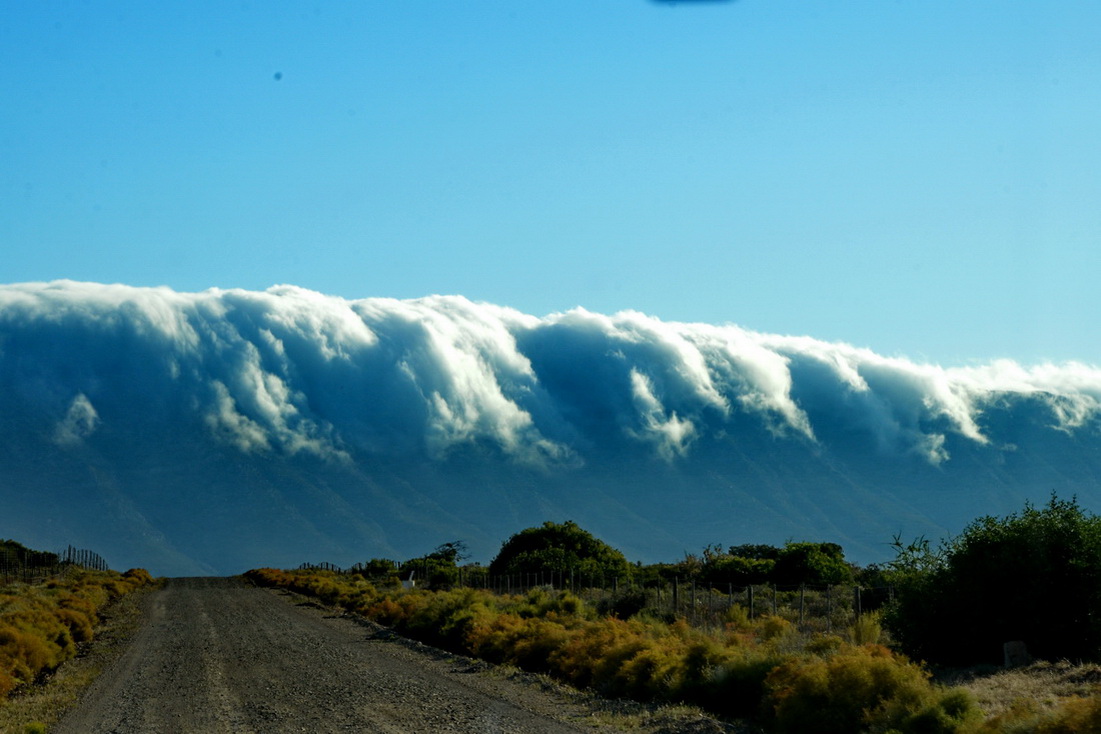
We still had one more treat in store. I’ve mentioned before that the geography of this part of South Africa reminds me of a piece of paper where two opposite edges are pushed together, forming ripples in the paper. We found ourselves on a road that followed the east-west valley with ridges on either side. These ridges were the ripples that I alluded to. Here, a mass of clouds was pouring over the ridge to the south, probably the last ridge between us and the ocean. I say pouring, because the clouds moved at breakneck speed. It was watching an enormous wave coming at us, but as the clouds streamed down the hillside, they suddenly evaporated into nothing. More and more mist followed, but again evaporated, I suppose as it hits warmer air rising from the base of the hill. With it came a very strong wind that made the car swerve all over the road and the temperature outside the car dropped quickly by some 10-15 C. Amazing! We had seen similar scenes, but from a greater distance, along the coastal range in Chile, as clouds from the Pacific hit the mountains that create one of the driest places on earth in its shadow. I had also seen clouds roll over the island off the Baja coast at San Quintin. Useful images for a future talk on fog! We stopped to take pictures (S2807).

S2807 - Camanchaca

S2807 – Camanchaca

We found Riversdale much as we had expected to find it late on a Sunday afternoon – deserted.

We turned down one hotel as there was an unpleasant smell in the rooms, but there was plenty of choice. Enjoying a refreshing drink before dinner, the bar man checked if we were the owners of the Nissan XTrail parked in front of the hotel. Yes we were, although it is a rental car. ‘You’ve got a rear wheel puncture’. Great! Not. At least we knew what we’d be doing first thing in the morning: get it fixed!

If you don’t like Haworthia, then you might as well move on to another day or even to a different website, because enthused by Gerhard Marx on the subject of this genus and with more tips of what to see where, it was inevitable that we followed some more of these leads – well, we were here anyway, so why not!

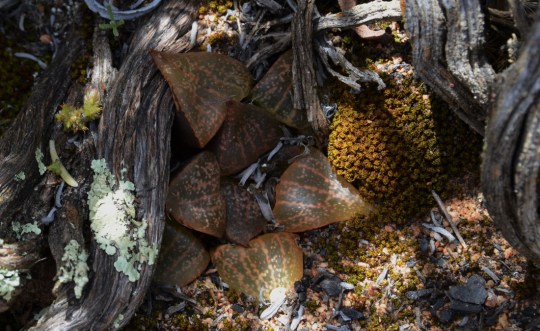
First we headed to Bakenskraal, to a piece of wasteland along the Olifants River (no, not the same Olifants River that we had seen in Vredendal; there is even a third river with the same name in Limpopo) taking a turning east of the N12 (S2795). I found that we either stumbled across Haworthia at ad hoc stops and might have easily overlooked the plants at the many stops we had made already. At other times, such as today, we were hoping to find specific Haworthia at specific spots and just about every time when we parked the car, I thought ‘I wonder if we made a mistake when we wrote down the coordinates’. Most of the time we would find a small number of plants at a fairly small spot – it seems that many taxa grow in small isolated / disjunct populations. Enough speculation. Here is what we saw:

S2795 - Haworthia mucronata var morrisea sensu Bayer H sakaii sensu Breuer

S2795 – Haworthia mucronata var morrisea sensu Bayer H sakaii sensu Breuer

Again it seems that I can put at least two ticks on my checklist, more if I count the synonyms.

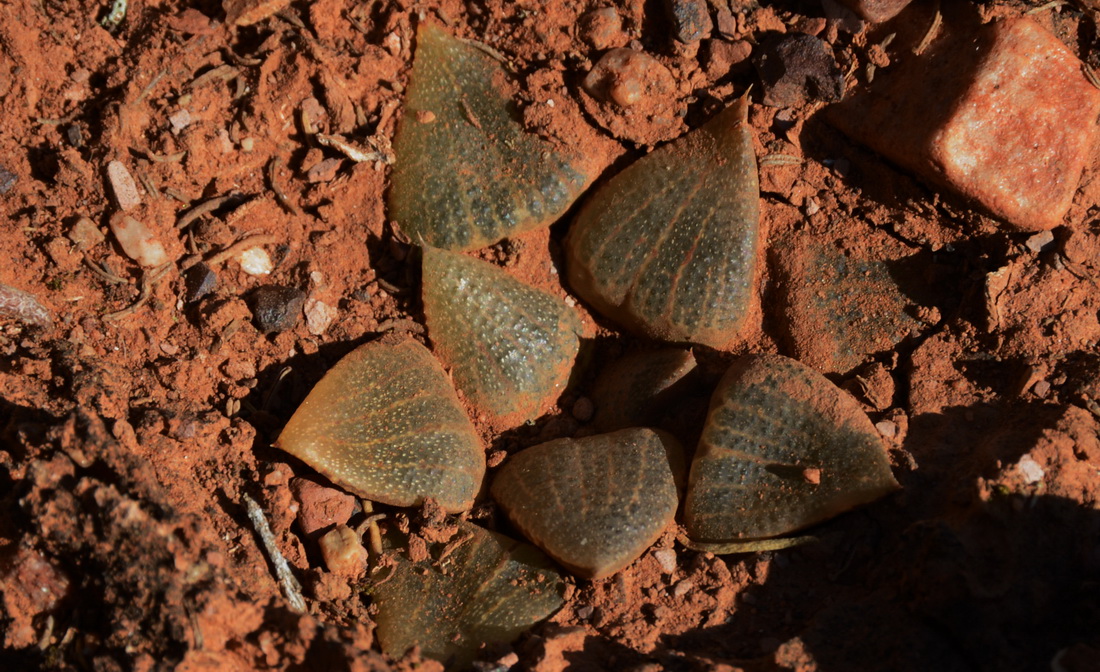
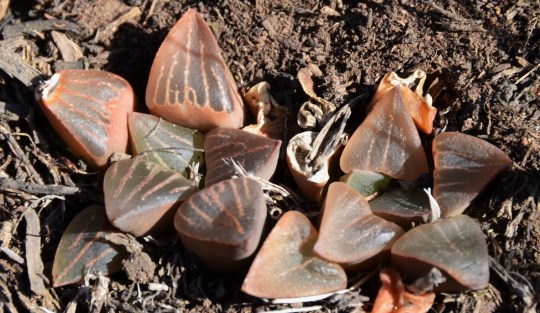
Two days ago, we looked along the N12 for H. picta and found just one plant outside the fence – I was not too impressed. Fortunately we now had another spot for a Haworthia a bit farther along the N12, this one for H. emelyae (S2796). Reading up on Haworthia on the internet, I learned that H. picta and H. emelyae are in fact the same thing, depending on whose naming you follow. Just as well that our list had the alternative name because based on Thursday’s experience, I would have given another picta stop a miss.

S2796 - Haworthia emelyae sensu Bayer Haworthia picta sensu Breuer

S2796 – Haworthia emelyae sensu Bayer Haworthia picta sensu Breuer

As you can see, I was glad that we made this stop – these are gorgeous plants. The plant grew again on a piece of wasteland, this time a narrow strip between the N12 and the railway line that runs along it, but this time, it was fenced off. We had been warned that although the land was not in use, the owner was not sympathetic towards people trespassing on to his land for whatever reason. So we first looked on the wide strip of land on the roadside of the fence, before David crossed the fence and soon reported that he had found the plants growing beneath shrubs. He did not hang about for long and on his return to the ‘safe’ side of the fence, we took it in turns to walk quickly to the spot where he had seen the plants, take pictures and back out to the roadside. It added a sense of adventure to the pictures that we came back with.

The N12 next climbed quite fast up the Outeniqua Mountains, one of the ‘ripples’ that I referred to a few days ago, part of a mountain range that runs parallel with the coast. At the top, the Outeniqua Pass, we pulled over and stopped (S2797) to take pictures of the spectacular views down to the coast – no plants photographed for a change.

We zigzagged down the hill and decided to have lunch in Mossel Bay, almost behaving like normal tourists (S2798) again, no plants were photographed.

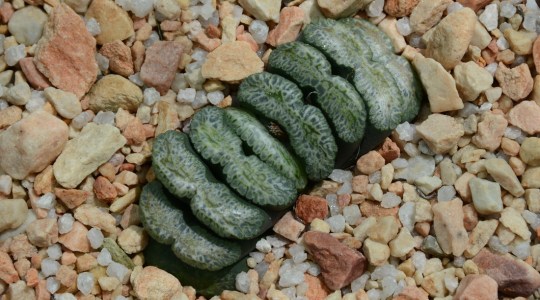
Next we drove to the last plant spot planned for the day and again thought that we were in the wrong place or that development had overtaken us and what once had been a nature area was now built up. SatNav pointed us along the N2 motorway and just past the spot where the coordinates were flagged, pointed is into an Engen 1 Stop service station! We decided to keep faith with the SatNav – it had been right more often than not – parked the car and walked over a freshly mown lawn to a path that might be used by others taking a break for walking their dog. After a brief stroll the landscape was more natural and we were beginning to be hopeful. Before too long we found Haworthia growing in small rock bowls. We had to clear away the lush grass that was protecting plants from view – and from the sun (so we covered the plants again after taking our pictures)  (S2799).

S2799 - Haworthia pygmaea

S2799 – Haworthia pygmaea

S2799 - Haworthia pygmaea

S2799 – Haworthia pygmaea

It seems that for once, authorities agree on the name as I can’t find alternatives. Angie has grown this plant in the UK and I remember a plant with papillate leaf surfaces, the stronger the texture the better. So a fair amount of selection had to be done at the point of purchase to get the ‘best’ plant. I can imagine that a fair amount of selection had already taken place, original in nature to propagate from the ‘best’ material available. The plants here, while still with somewhat scabrid leaf surfaces, were smoother than the plants in Angie’s collection. It seems that as humans we are keen to give precise names for plants found in nature, often debating the merit of one name over another passionately and emotionally and then, through selection for plants that display the best features, end up with a plant with the desired name on the label even though it deviates in appearance from its original ‘wild’ ancestors. We’re strange creatures!

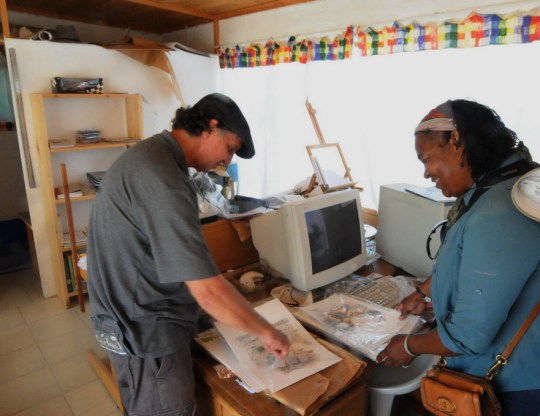
For most people in the hobby of growing and studying cacti and other succulents, the name Gerhard Marx needs little introduction. Not only has he penned many articles about the succulent plants of southern Africa, but his drawings have graced many a book and journal cover where in one drawing, he is able to reflect all the features of the plant that sets that species apart from other related taxa. Evidence of a great eye for detail.

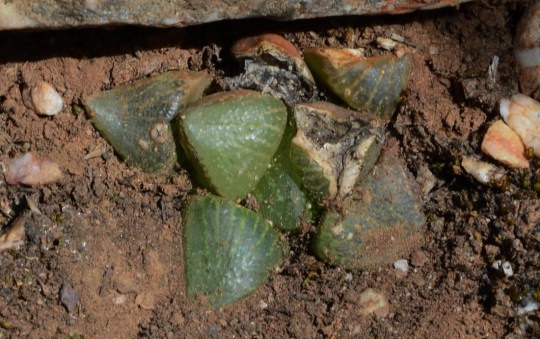
But first we had to take our trusted Nissan XTrail to the dealer for its service. The courtesy car was the smallest model in the range and I worried if the four of us could squeeze in. Fortunately it was only a short journey to the hillside to the south of Oudtshoorn where we folded ourselves out of the car and for more than two hours were shown around the shade houses, enjoyed great entertaining and educational chat while taking pictures of some amazing plants. The Haworthia truncata that we saw in nature yesterday looked nothing like the plants on display here, specially selected for the unique markings on their leaves, each a unique work of art in its own right.

S2793 Haworthia truncata cv

S2793 Haworthia truncata cv

We then followed Gerhard to his studio where he had created some fantastic painting. Art work on the walls was evidence that he did not just indulge in botanical art!

S2794 - Gerhard Marx teaching Eunice how to draw plants

S2794 – Gerhard Marx teaching Eunice how to draw plants

We also had a look around the grounds where of course there were some succulents that were already growing here before the nursery, house and studio were built. We each received a copy of the set of Four Southern African Aloes that I had seen hanging, framed, in the rooms of friends back in the UK. Gerhard also sketched out instructions of how to get to some more plant stops in days to come and we made sure that these sketches too were signed – another Marx original.

We had a great time Gerhard, thank you for a memorable morning.

Back in Oudtshoorn, our car had not only been serviced, buty it had also been given a thourough wash and brush up – we could hardly recognise it!

Tomorrow we’re back looking for plants in habitat.

If you remember (I did!) when we were in Worcester a week or so ago, we asked Budget rental cars to book our car in for its 60,000 km service with the Nissan dealer in Oudtshoorn. This was now significantly overdue. It seemed sensible to introduce ourselves and to check that arrangements for the courtesy car were in place for tomorrow. We need not have worried – everything was arranged. And they are only just around the corner from our Hotel / apartment!

So where shall we go today? We were fortunate to be visiting the well-known botanic artist and plant connoisseur Gerhard Marx at his nursery tomorrow. As he was too busy to join us on any outings, he had produced a list of suggested spots to see Haworthia and so Eunice started the task of plotting locations for some of the most interesting taxa and seeing what we migh conveniently pass on the way.

We did not have much luck at the first stop (S2788) for H. picta. We found just one plant and learned later that we should have crossed the fence to find the core population, however, this spot was right along the main N12 with the car parked in full view of passing traffic – and this stretch was unusually busy. Plus, this was not a user-friendly fence; the wires were pulled tight and a bit higher than convenient. Looking on the internet, there are some amazingly beautiful plants on display under this name. Our plant looked rather run of the mill, ordinary. I wonder if we found the right plant?

S2788 - Haworthia picta

S2788 – Haworthia picta

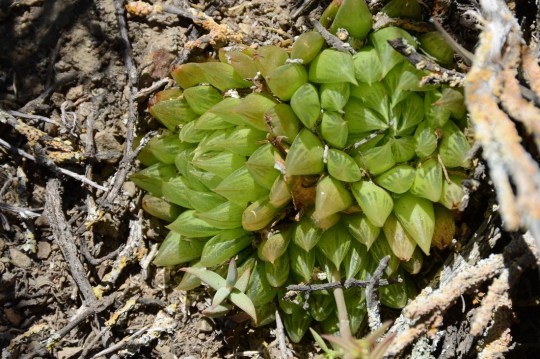
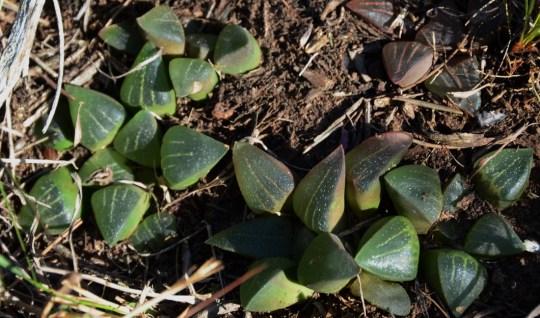
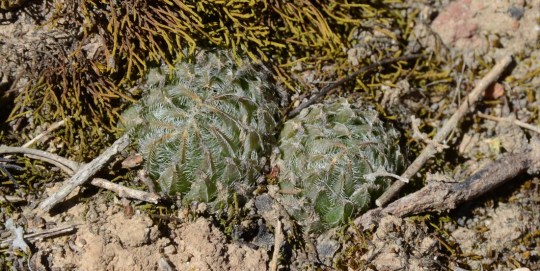
We had more luck at the next stop, near Herold (S2789) but ran into taxonomic difficulties. There appear to be (at least) two schools of often opposing thoughts on Haworthia taxonomy, in alphabetical order (in fear of picking sides) of South African Bruce Bayer and German Ingo Breuer and it seems that by selecting a name, you could be accused of picking a side.  But should I confuse matters by giving two names for each plant? One from each source? It seems that lists of names accepted by either of these gentlemen are quite fluid, so it’s difficult to pin down a name that would still be recognised when you read this page. In the end I’ve settled on using three names, the original name by which these plants were known, the Bayer name and the Breuer name, so that you can track these and make up which one you want to use. And I thought that cactus names were frustratingly unstable!!! Do all these changes really help anyone or anything? Other than editors needing to fill pages in journals with new names? How many labels should we put in our pots?

S2789 - Haworthia helmiae - outeniquensis Bayer - heroldia Breuer

S2789 – Haworthia helmiae – H. outeniquensis sensu Bayer – heroldia sensu Breuer

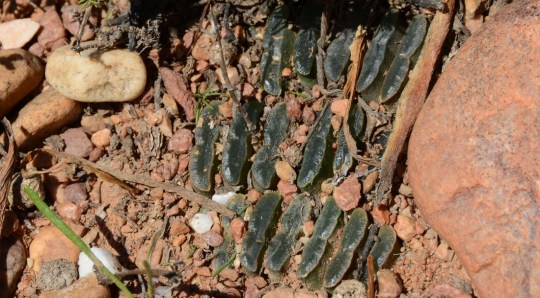
I’d have to say that in this case, the picture flatters the plant; the light caught it just right. I would describe it as a rather boring green mat-forming plant with the only surprise being that it grows in pine needles in the shade of trees. At least when we saw it on this date. Jakub Jilemicky reports on his website that when he visited the location (H. heroldia is only known from this, the Type Locality) more or less all the big exotic pine trees had been burned. I’d say that there were still a fair few left. So, one stop, three ticks on my ‘plants seen in nature’ check list! Oh well!

S2790 - Haworthia arachnoidea ssp

S2790 – Haworthia arachnoidea ssp

S2790 - Haworthia arachnoidea ssp

S2791 – Haworthia truncata

There are various populations of Haworthia truncata and the one we visited was on the outskirts of Dysselsdorp (S2791). The plants were quite abundant in the small area where we looked; they even grew in the dirt track that we had arrived on. Lifting some of the branches of the shrubs to see what was hiding underneath revealed huge patches of plants of up to 1 x 1 m (3 x 3 ft).

You might get the impression from my reporting that Haworthia were the only plants of interest that we were seeing or photographing. Far from it, but many of the other genera have already featured in quite some detail before and the reason for our detour to the east on the way down from Namibia was to see Haworthia. To redress the balance somewhat, There was a very nice miniature Aloe growing here. In fact, I was taking its picture when I noticed the first H. truncata all over the place around it.

S2791 - Aloe humilis  and Haworthia truncata

S2791 – Aloe humilis and Haworthia truncata

Looking through my list for this stop, we also saw Anacampseros and Asclepiads here as well as Opuntia sp, Trichocereus sp. and Agave americana – the latter three escaped imports from the Americas.

Using our SatNav system we moved on to the last stop of the day, near the town of De Rust. Like many towns in South Africa there was the town itself and a km or two down the road was the ‘township’. SatNav was taking us along the shortest route, straight through the township. We felt not a little uncomfortable and conspicuous as three white blokes driving through a black neighbourhood, but Eunice, of Afro Caribbean origin, promised to look after us. Thinking about it – it was not the colour of the skin of the people around us that made us feel uncomfortable – I am colour blind and often joke that it has helped me to see people, rather than skin colours – but the poverty of the living conditions where these people live. South Africa has come a tremendous way since the break up of Apartheid but still has a long way to go to erase inequalities between people living together. And yet, everywhere we looked, people were smiling and when, shyly, we waved out of the car window, were ready to wave back and made us feel welcome. On to the plants:

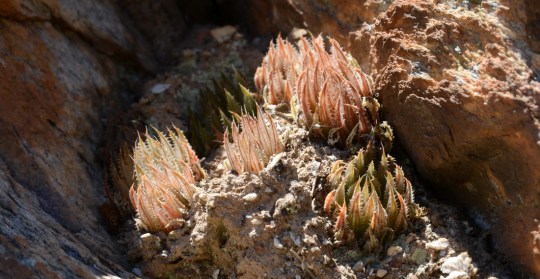
S2792 - Haworthia bayerii

S2792 – Haworthia bayeri

S2792 - Haworthia bayerii

S2792 – Haworthia bayeri

There was one more feature that will ensure that this place will stay in our memories for many more years – the cemetery. I had noted huge cemeteries outside many villages in South Africa, far  larger than one would imagine for a community of its size. I had imagined that these might have been war graves from the days of the Boer War, as some of these village names rang a bell in terms of African Boer War history. When I talked about this with our hosts at family hotels, they smiled sadly and explained that these graves were very recent – from the last ten years. They were the victims of HIV-AIDS that only in recent years is getting the attention and aid that is needed to get this disease back under control. It left us all very quiet as we drove past the cemetery again on our way back to Oudtshoorn.

It would be hard to follow up yesterday’s Haworthia springbokvlakensis stop with another such an exciting day, so we didn’t. We headed for Uniondale, where we knew that a wonderful ‘blue’ Euphorbia horrida grows. We followed the R329 and after some 75 km felt the need for a legstretch (S2783), I only took three not very good images of a not very exciting Euphorbia.

Now on the R332, south out of Willowmore, a single lane cement road was as straight as a road could be. The sign along the road was a bit disheartening: Humansdorp 214 km. That’s a long way to go and we didn’t even know where Humansdorp was or if we wanted / needed to go there. We took a turning east for a legstretch and soon found the perfect if somewhat surprising excuse, Echinopsis oxygona in full flower (S2784).

S2784 - Echinopsis oxygona

S2784 – Echinopsis oxygona

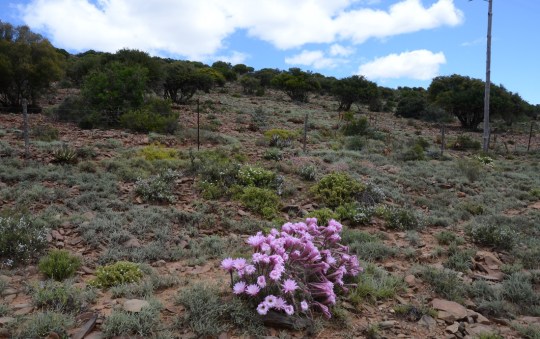
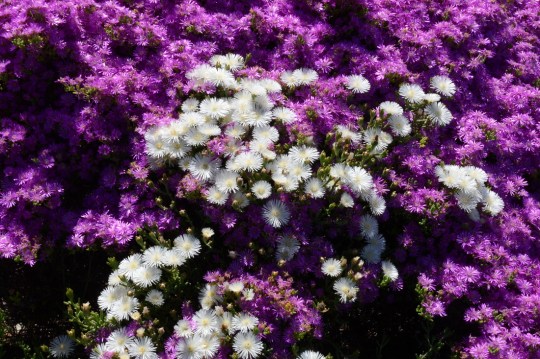
We had returned to the N9 driving towards Uniondale, passed roadsides covered in Mesemb shrubs in full flower, pink – purple and some white, this stop at some road works (S2785).

S2785 - Mesembs in flower

S2785 – Mesembs in flower

Still on the N9, Gasteria flowers were spotted, poking above the vegetation. We stopped (S2786) and although I took some pictures, the leaves were too hidden in the surrounding vegetation to show the plants off properly.

We now approached Uniondale and … drove straight past the Euphorbia horrida location! It can be quite tricky to stop on a main road with traffic on our tail, but at least we managed to spot a safe pull over point. As I have been economic with pictures of some of today’s other stops, here are two from this one. Brilliant photogenic plants.

S2787 - Euphorbia horrida

S2787 – Euphorbia horrida

S2787 - Euphorbia horrida

S2787 – Euphorbia horrida

Just as I thought that I could comfortably identify these plants, seen in many C&S shows in the UK, I read (Doreen Court – Succulent Flora of Southern Africa; 3rde Ed. 2010) that E. horrida became a synonym of E. polygona in 2006. I even became the proud owner of one old and large specimen during my 2012 speaking tour. As is often the case, plants are offered to branch members or auctioned when a member dies, but large plants are difficult to find a good home for as space in any collection is often at a premium. Apparently the main difference between these two taxa is found in their cyathia. E. horrida bears green cyathia that sometimes may turn brownish with the age while the cyathia of E. polygona are red to deep purple. I nowhave to wait for my plant to flower to confirm which one I have!

Last night I finally spotted a reasonably priced leather African safari hat. I have a collection of hats from various trips, more as souvenirs, one day to be displayed (gather dust?) at home rather than to ‘blend in with the natives’, as an American friend had told me he tried to do in Argentina – he failed, so I have no reason to believe that I could do any better. The hat was carefully examined for tell-tale signs to suggest that it was not authentic – signs such as ‘Made in China’. I was assured by the shop owner that the manufacturer was an authentic traditional African hat maker. I could now at least proudly walk along David who had worn a similar hat since day one of our trip, until this morning he revealed that his hat was Australian. Oh, well.

Our goal today was to find a rather choice Haworthia. Back in the UK we had received a map with some pencil markings and photo taken by a friend standing at the location that we were looking for with a view to a farm and some stables – land marks that should help us to find this spot. There had been some very detailed verbal instructions as well, but by now you’ll have got a feel for the reliability of my memory so I’ll say it again: in future I will write it down. So, my  fingers were crossed as we left Addo.

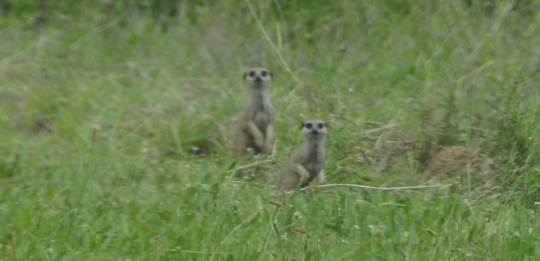
Today I am again relying on images taken at each stop to shake off the cobwebs and remind me of what we saw and where we saw it – yesterday’s attempt to write the Diaries this way were very enjoyable, like reliving the best parts of the trip again. We took the R336 and headed west out of Addo. After the deserted track yesterday afternoon, we had now landed in a tourist hotspot surrounded by guesthouses and B&Bs. Some 30 km after leaving the bungalow apartment in Addo we stopped off the R336 (S2777). No new or exciting plants here, but included in this Stop’s folder the only and best pictures I could manage of an animal I had hoped to see more of – they make it all look so easy on TV;

S2777 - roadside Meerkats

S2777 – roadside Meerkats

I had even brought along a T-shirt, showing a family of these entertaining creatures posing among some empty beer cans with the slogan ‘Beerkats’. Angie and I must have hundreds of images of these animals in zoos, wildlife- and safari parks, most much better than this image – but these are the real thing, in nature and I was probably the only one in the car to catch them posing.

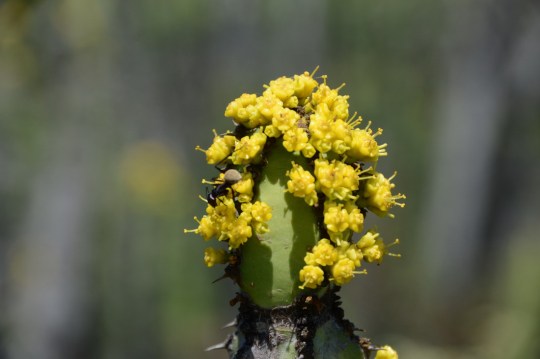
We found the R75 and headed for Kleinpoort. Just before the village, we stopped (S2778) to take a picture of this ant:

S2778 - Euphorbia sp

S2778 – Euphorbia sp

or to be precise, for a stand of Euphorbia, many stems over 2 m (6 ft) tall and covered in these yellow cyathia (‘flowers’).

Soon after we set off again, we took the road signposted to Springbokvlakte, the name of the farm where ‘our’ Haworthia, H. springbokvlakensis comes from. The road was cut through a stony ridge and as we dropped some 50 m in altitude we spotted very picturesque Euphorbia growing on the rocks.

S2779 - Euphorbia polygona Aloe striata

S2779 – Euphorbia polygona & Aloe striata

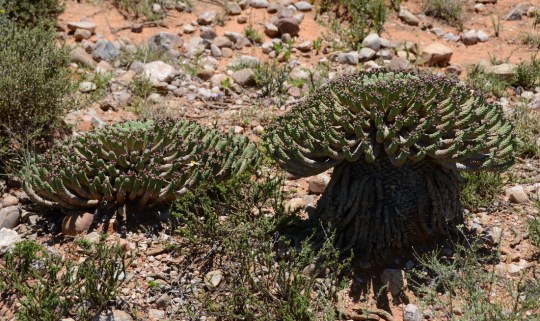
S2780 was another stop for a field of medusoid Euphorbia, just like the yellow flowered fields a few days back, but this time with flowering mostly over and just one or two white cyathia lefty. I understand that this is Euphorbia inermis or is it E. esculenta? These plants looked as thoughh they were of significant age, with lower arms having died off leaving a thick trunk, making some plants look like massive mushrooms.

S2780 - Euphorbia inermis

S2780 – Euphorbia inermis

By now I had the printout of the map and the photo taken at the location in my hand and it struck me that although things had seemed very clear back home, here, in the field, we had another needle in a haystack. Eunice’s SatNav had confusing locations for the farm and the alternative mapping program now running on her laptop suggested that there were at least five farms of this name. The other complication was that farms that we passed had no names at the roadside, just name plates on the farmhouse, too far from the road to read and often with huge dogs along the path between the gate and the house. This was not going to be easy.

We made a few stops (grouped as S2781) in the faint and stupid hope that by standing near the roadside fence, the plants would see us, wave at us and shout ‘We’re here!!’ which of course did not happen.

S2781 - Asclepiad sp.

S2781 – Asclepiad sp.

The scenery certainly suggested that we were in the right place; ‘vlakte’ means ‘plain’ in Dutch and landscapes do not get much plainer than this:

S2781 - Springbokvlakte

S2781 – Springbokvlakte

We hit the jackpot at the next stop and met the very nice owners of the farm (S2782) and were taken to the plants. These Diaries are not the place to tell the full story, but don’t be surprised is one or more of pen an article for this visit. In the mean time, enjoy the pictures. You’ll have to imagine the 30C degrees heat that we experienced while taking them.

S2782 - Euphorbia stellata

S2782 – Euphorbia stellata

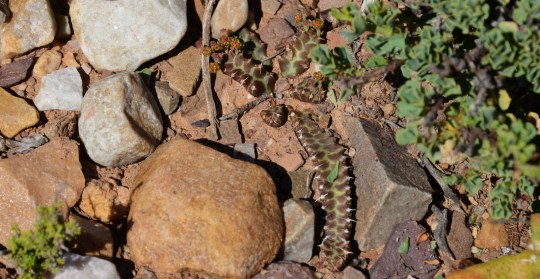
S2782 - Haworthia springbokvlakensis

S2782 – Haworthia springbokvlakensis

S2782 - Aloinopsis schooneesii

S2782 – Aloinopsis schooneesii

We found comfortable accommodation in Steyterville, a town that I had not heard off until we got there. We’d had another great day!

Very little of today was planned, least of all today’s 8 stops and our final destination, Addo, a place I had never heard of before today. As it had been a fairly blank day on the itinerary, we should have been heading to Jeffrey’s Bay, my memory banks for this stop were blank. Now, almost two months later, I struggled to remember where it was that we spent the night. I Googled Somerset East Accommodation and as soon as I spotted the Angler and Antelope Guesthouse, the memories came flooding back., of the lodgings at least, and all good ones, especially of the huge collections of single malt whiskeys that Cliff formed an opinion on.

Nothing to do with the whiskey the night before, but my memories of today’s stops are very limited. I do recall that we took a track that looked a fairly main road and had been given a ‘proper’ road number that suggested a good surface allowing an average speed of 50-70 km per hour. Not sure if the detoriation happened recently but in many places, we struggled to reach 10 km.p.hr. So going through today’s images selection will be as much a voyage of (re-) discovery for me as it is for you.

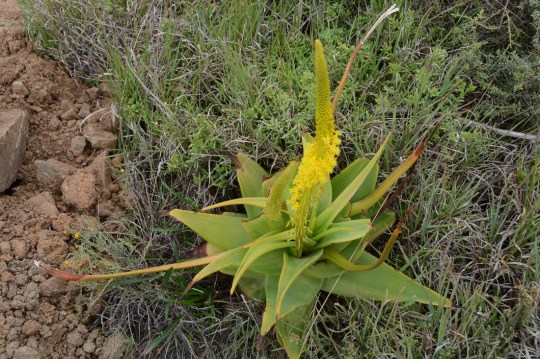
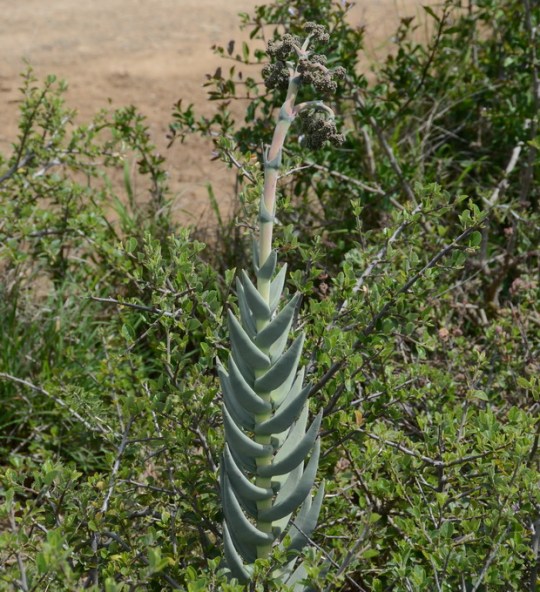
We had taken the N10 south out of Somerset East and again these major roads are no good for making ad hoc stops, so turned west on a narrow track and took stock of where we were some 7 km farther along (S2769) prompted by another dense stand of Aloe ferox. I thought to have found another, smaller Aloe, in flower with nice yellow flowers. Time for another plant lesson from David. ‘Feel the leaves.’ he suggested. My late Mum used to tell me always to do as I was told, and so I was surprised to discover the soft texture of the succulent leaves. ‘Typical Bulbine.’ Always keen to know more, I asked which one? I’m still waiting for the answer on that one. Hmmmm, a Bulbine that looks like an Aloe…….. Google reveals that Bulbine alooides grows in the area, I switched to image mode and hey presto, I have another name on my list! That was easier than I imagined. If I got it right that is!

S2769 - Bulbine alooides

S2769 – Bulbine alooides

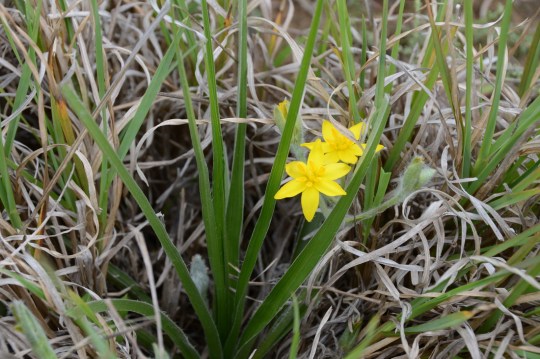
I took a look at Bulbine on Wikipedia and learned that the genus has some 160 species! Also at S2769 was a Bulbine that superficially reminded me of a daffodil and among the species list on Wikipedia was an entry for Bulbine narcissifolia.

S2769 - Bulbine narcissifolia

S2769 – Bulbine narcissifolia


We had already earmarked a spot almost at the junction with the N10 as our next stop, S2770. The plant that had attracted our attention was this one:

S2770 - Crassula perfoliata

S2770 – Crassula perfoliata

Back along the N10, driving south, we took the first east, signposted to Sheldon Station, but we never got that far, screaching to a halt for a field jam-packed with clumps of Euphorbia (S2771). Was somebody farming these here for commercial purposes? Why?

S2771 - Euphorbia sp

S2771 – Euphorbia sp.


S2771 - Euphorbia sp- clump

S2771 – Euphorbia sp- clump


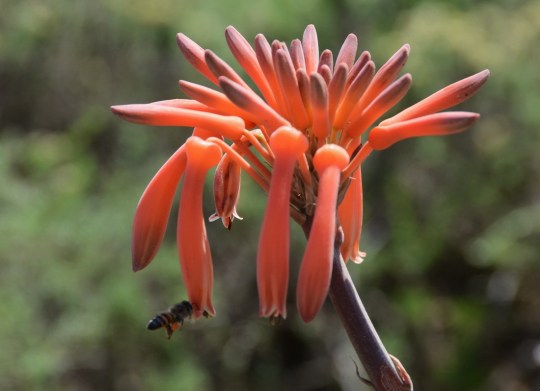
S2772 - Aloe striata and bee

S2772 – Aloe striata flower and bee


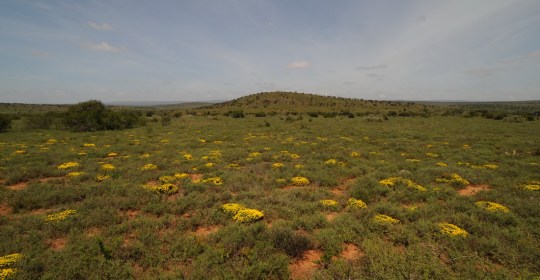
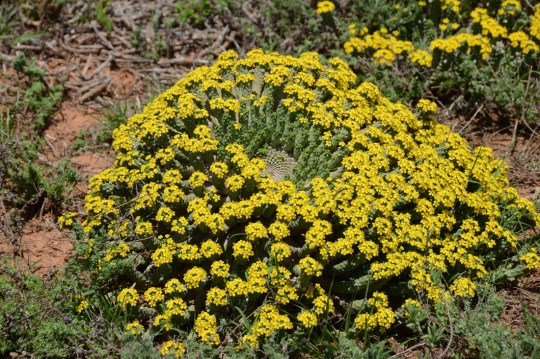
The next turning off the N10, west again took us to S2773, the farthest stop East of our trip. It was amazing! After fields full of Euphorbia clumps at S2771, here was another but all clumps were covered with yellow flowers. The smell of pollen and nectar filled the air, like standing next to a field of the ‘yellow peril’ (rape seed) in the UK in Spring. Again, it felt like an invisible hand got hold of my throat as a allergy reaction in protest. Millions of bees were buzzing around. I wonder if these plants were here for the honey industry.

S2773 - Euphorbia inermis ssp huttoniea

S2773 – Euphorbia inermis ssp huttoniea

An impressive scene with impressive scent to go with it …

S2773 - Euphorbia inermis ssp huttoniea

S2773 – Euphorbia inermis ssp huttoniea

… from thousands of impressive plants like this one.

We tore ourselves away, probably just as well, as we were in danger of being overwhelmed by the scent. I see that Google Earth’s image from this area was taken in March – apparently without the flowering Euphorbia – I’m sure the satellite camera would have picked them up.

S2774 - Crassula perfoliata ssp falcata

S2774 – Crassula perfoliata ssp falcata

Another stretch of N10 and another turn west had gotten us on the R335 for a stop at S2774. Not sure if the spots on the Crassula are part of the plant’s natural genetic design or were created by its natural pests as puncture marks.

S2775 - Haworthia sp

S2775 – Haworthia sp

I’m sure that we had a name for this Haworthia, at S2775 but allas, it’s gone from my memory bank – I should have written it down at the time. If my fellow travellers are reading this, please help me out!

We made very poor progress as the road had been madly torn up, probably by a recent flood – we understand that there had been heavy rains here a few weeks ago – a bit like the UK then! S2776 was amazing as suddenly we seemed to be in a subtropical rainforest as the road wound down quite fast – this turned out to be the Zuurbergpas, near the Addo Elephant National Park. Cliff and I were reminded of the subtropical rain forest near Salta in Argentina, but there are no Bromeliads in Africa – unless they are escapees from horticulture.

There were (probably) at least two species each of Crassula, Bulbine, Aloe and Euphorbia and dozens (?) of Geranium sp. Now armed with the names of some local landmarks, searches for plants found in the area were a bit more focussed, until I discovered there was another Zuurberg above Ceres, hundreds of km. away and an alternative spelling for both: Suurberg. Back to the drawing board. And some intriguing names come up for plants from the area that I don’t recall seeing, such as cycads, there are at least three species mentioned from the area with the Suurberg Cycad (Encephalartos longifolius) as the main candidate – how did we miss them? Or did we? I’ll have to come back to this stop for another close look at the images.

These tree Euphorbia are the overwhelming memory (yes, it’s coming back) from this stretch, even without an ID.

S2776 - tree Euphorbia sp.

S2776 – tree Euphorbia sp.

Yesterday, Johanus had suggested showing us some plant sights around the town culminating at  the Valley of Desolation. Johanus and Egmont met us at around 8 a.m.in front of the Obesa Lodge and less that 30 minutes later we were at the first stop of the day, S2762, offering some nice views over the town and obviously a place popular with local people to enjoy nature so close to their home. Some of the plants photographed here were new to us on this trip and yet a few of them were very familiar to me. Last year, back in the UK, a lady contacted the Portsmouth branch of the BCSS to ask for a good home for some large succulent plants as she had to move to smaller accommodation. I now have two ‘bonsai trees’ of Crassula ovata, the Money Tree, that live on my patio from May to October and squat in my living room during the winter months where today, early January, one of them is covered in flowers. It has grown so large that I’m not sure if we’ll be able to get it back to the patio in Spring. Every time these plants are moved, they ‘self-prune’, dropping short branches on the soil of the pot and, if not removed, these root down and start growing on their own. Here it was in nature.I tried to find an angle to take images that made this plant look good here, but failed. There was too much competition and the plant that won the coveted ‘plant of the Stop’ image is

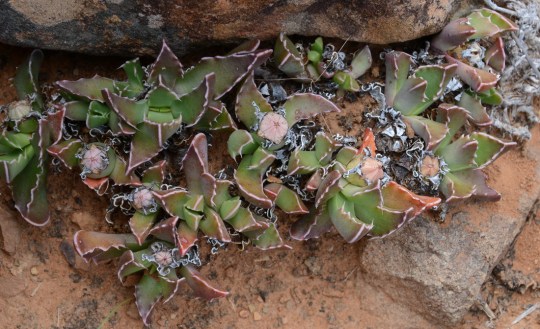
S2762 - Faucaria bosscheana

S2762 – Faucaria bosscheana

During my ‘first phase’ in the hobby – I started at the age of 6 in the Netherlands! – Faucaria were among my favourite plants, partly due to names such as F. tigrina, Tiger’s Teeth, that appeals to youngsters; I was also collecting plastic dinosaurs at the time! Seeing a Faucaria here in nature touched a chord.

We passed through the entrance of the Camdeboo National Park and at the next stop, S2763, found this plant waiting for us.

S2763 - Pachypodium succulentum

S2763 – Pachypodium succulentum

Much more recently, September 2011 to be precise, at ELK I spotted three large caudexes in a pot. As Angie says: ‘The plant spoke to me’ and as a result came home and spends the winter in my living room next to the Money Tree. In the summer I’m not sure what to do with it – afraid to over water it, it sat on the patio and enjoyed a few showers, but as we had the wettest summer on record, it also spent lots of time indoors. It dropped its leaves but they came back in Spring, but it had not flowered. Seeing these plants in nature and hearing of the conditions it endures there (light frost, tropical storms, long periods of drought and high temperatures), plus seeing that the caudexes were hidden below the soil in all but two cases, where erosion had washed the top soil away. The Ladybird was a nice added extra – Nature’s pest control!

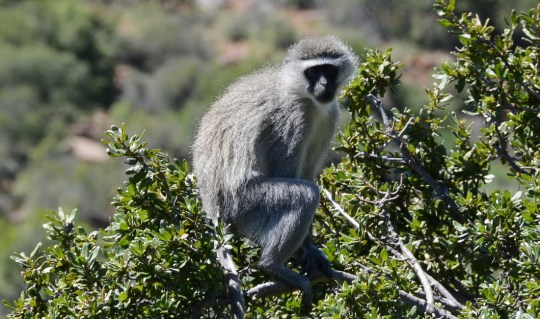
As a plant trip, all the images taken have a great bias to plant photography. Here however, the sole purpose of this stop was to try to get images of the vervet monkeys that were enjoying the sunshine in the trees by the side of the road. Zoom lenses are great!

S2764 - vervet monkey

S2764 – vervet monkey

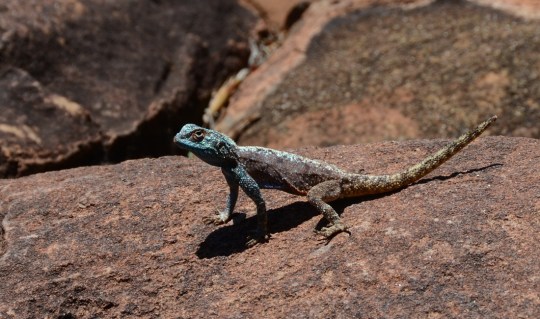
We reached the end of this morning’s excursion, S2765, the Valley of Desolation. A dramatic name and the foot path from the car park took us to some dramatic views and another animal begged to be in the picture

S2765 - East Cape Crag Lizard

S2765 – East Cape Crag Lizard

We said our goodbyes and thank yous to Johanus and Egmont, they had been very generous with their time showing us places that in the limited time here we would never have seen. Thank you very much!

From here we would make our own way down to town and from there to our next destination, Somerset East. Johanus had given us some tips for stops on the way down the hill, as well as what to avoid: the ostriches were in their breeding season and the male birds could be quite aggressive and territorial this time of year. One kick of their powerful legs could land you in hospital or worse!

Past the ostriches but still along the Nqweba Dam Reservoir we felt safe enough for another brief stomp around (our term for a random plant stop) (S2766) and I could not resist another picture of:

S2766 - Faucaria bosscheana

S2766 – Faucaria bosscheana

A bit farther along, we stopped at a lay by on the R63 (S2767) to check where we were and where we were going. Just as we were about to pull away, we spotted plants on the rocks along the opposite side of the road, opposite the Nqweba Dam Reservoir. This was the star of the show

S2767 - Cotyledon sp

S2767 – Cotyledon sp

It was only some 125 km to Somerset East, so there was time for another leg stretch, roughly at the half way point (S2768). Again this random stop produced an interesting set of plant images, including:

S2767 - Sansevieria sp.

S2767 – Sansevieria sp.

Sansevieria are a permanent childhood memory, on Grandma’s windowsill in Breda in the Netherlands. In many Dutch households at the time, the ‘Mother-in-Law’s tongues’ would be a substitute for net curtains to stop passers-by looking in while the occupants could watch the world go by. Here, a different species, grew in nature.

We made one more brief stop for a Euphorbia sp. spotted along the side of the road. That makes it sounds as though spotting succulent plants from the car was a rare event. Not at all, but they became the excuse for stops when spotting them coincided with the need for a toilet stop or, for Eunice, a nicotine stop. How are the New Year’s resolutions going, Eunice?

S2768 - Euphorbia sp

S2768 – Euphorbia sp

We were reminded that everything is closed in South Africa on a Sunday afternoon as we drove into Somerset East, including the main Hotel and one of the B&Bs that we tried. Without too much trouble we found accommodation in the very nice and comfortable Angler and Antelope Guesthouse, with welcoming hosts and even met up with a couple on a motorbike touring holiday – we recognised seeing each other at the Camdeboo National Park.

Tomorrow we would reach the eastern most point of this trip, another indicator, as we turned back west, that we were on the way back home – all good things come to an end. We still have more than two weeks to go!

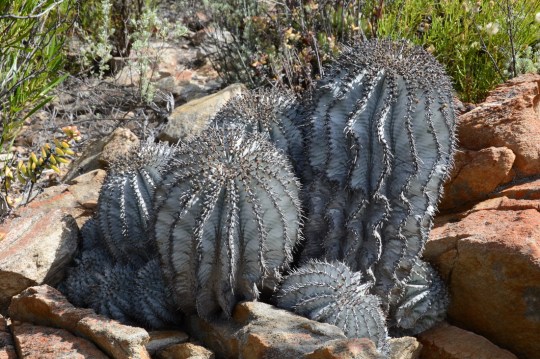
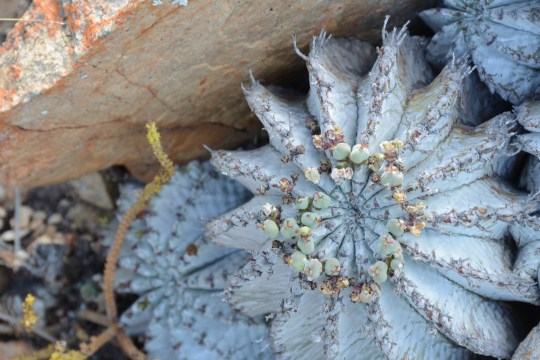
We had booked into the Obesa Lodge in Graaff-Reinet, quite appropriate as we were hoping to see the rare-in-nature, common-in-cultivation Euphorbia obesa that grows near the town. The Lodge is a series of B&B lodgings but, if required, breakfast is prepared away from the apartments and served at the requested time.

Last night we had asked the owner, Sonja Bouwer about the origins of the name and that of the Obesa Cactus Garden across the road. She confirmed that both were named after the Euphorbia. I asked if she knew Albert and Daphne Pritchard who had been active in setting up funding for a fence around the site to protect the plants from poachers as part of a conservation project funded by the British Cactus & Succulent Society (BCSS). Yes, she knew them very well, but in recent years had lost contact. I explained that Albert had passed away a few years ago and that Daphne seemed to have disappeared off the succulent hobby scene in England since then. I don’t know how to get in contact with Daphne, but if you should read this and are still in contact with her, please pass on Sonja’s best wishes. Her son Egmont would contact her ex-husband to arrange a visit of the Cactus Garden this morning. Johanus also remembered Daphne and Albert and also passes on his best wishes to Daphne.

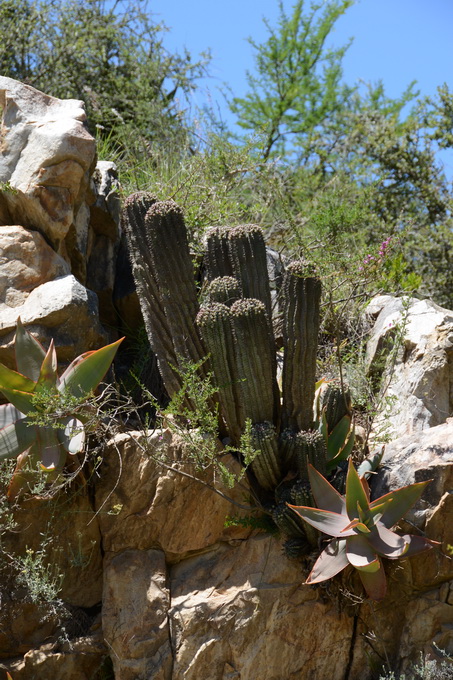
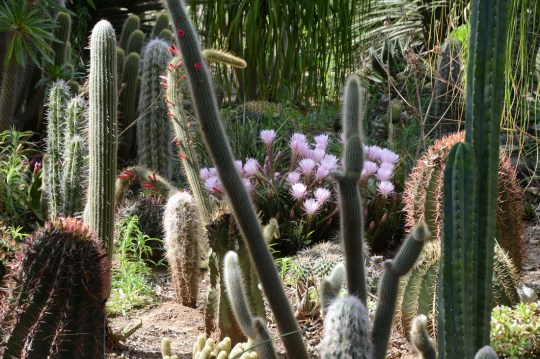
We had a great time exploring around this impressive if slightly overgrown garden with many mature specimen cacti planted out in the open and obviously enjoying the conditions away from home – almost all cacti are endemic to the Americas but some have been brought over to South Africa and have escaped into nature. All images around the garden are filed as S2759

S2759 - Obesa Cactus Garden

S2759 – Obesa Cactus Garden

Johan and Egmont promised to take us to the Euphorbia obesa site in the afternoon. They had to return to town once we had reached the spot (S2760) and left instructions how where we might find the owner of the estate. The gates along the road were all labelled ‘Kendrew Estate’ but where would we find the owner? And would they grant us permission to see the plants? We asked more directions from workers in a nearby field and found the owner’s house.

We were greeted by Lynda Charles who made us some refreshments while we waited for her husband, Garth, to return. Both were charming and very hospitable and after our drinks Garth and his daughter lead the way to the entrance to a field through which the obesa site could be entered.

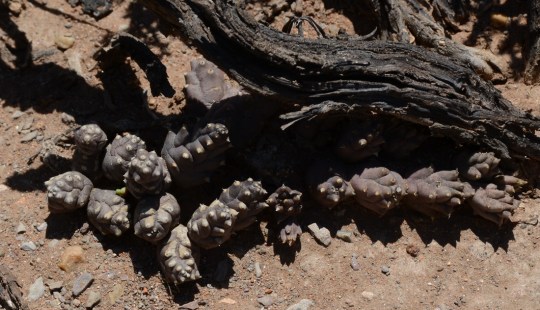
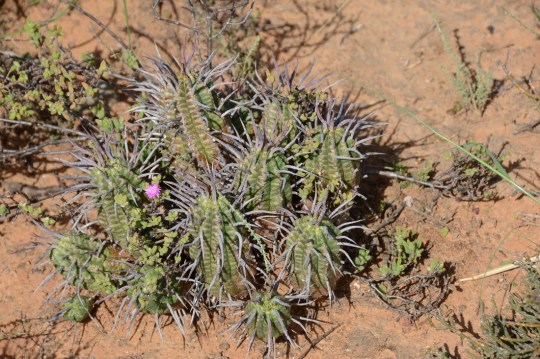
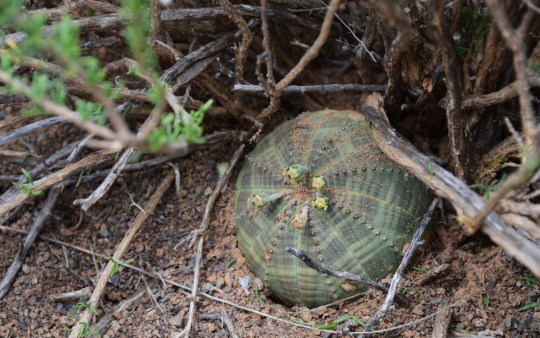
S2761 - Euphorbia obesa

S2761 – Euphorbia obesa

We were surprised to learn that last winter, these plants (not unusually) had experienced frost and snow, that goats and sheep often grazed here, but had no interest in these Euphorbias (I thought goats at everything and anything) and that about a year ago local boys were caught stealing some 500 plants for sale. We had seen some real poverty during our stay in South Africa and it is therefore not too surprising that some people are tempted with the relatively small reward of poaching and selling plants. But as always in such cases, if there is no demand from hobbyists for ex-habitat plants – particularly when I have seen nurseries in the Netherlands and in the UK where these plants are grown in their millions – there would be no illegal trade.

Conservation begins at home and we can all contribute to the cause by refusing to buy plants from ex-habitat sources.