Just another WordPress.com site

My reason for wanting to visit Namibia was to see the fog – this is one of three of the world’s main fog deserts, along with the Atacama Desert in Chile and Baja California in Mexico. All three of these deserts are found along the coast where a cold polar gulf stream flows past a landmass warmed up by the sun around the Tropic of Capricorn or (in the northern hemisphere) the Tropic of Cancer. To be more specific, I wanted to photograph the flora that relies on such regular fogs for their survival.

I knew from my visits to Chile and Baja, that the phenomenon extends for quite a distance along the coast and also to a varying extend inland, depending on the geography. If you are reading these Diaries with a map near by, you’ll see that Swakopmund is situated along the Atlantic Ocean at about 22 degrees 40′ South and you’ll remember that we crossed the Tropic of Capricorn, at 23 degrees 30′ South on two days ago, so it was no real surprise that it was foggy when we walked across the B&B’s car park for breakfast. A chat with the owner confirmed that waking up to fog was typical for the area and that this might lift by late morning. The traffic sign along the coast road as we headed north said it all:

S2617 - fog

S2617 – Fog

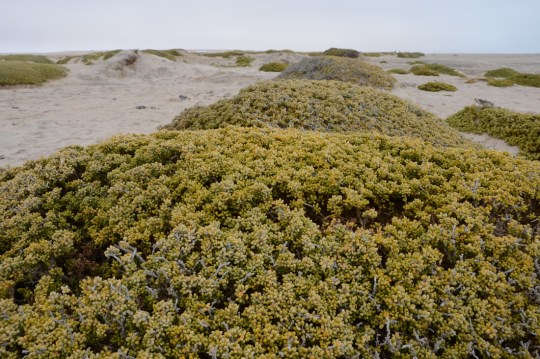
We stopped at the wreck of a stranded trawler (this area is known as the Skeleton Coast) and saw the beach covered in what looked like a succulent plant.
S2618-3

S2618 – Tetraena clavata

As we were in Africa, my first thought was that these belonged to the family Mesembryanthema-ceae or Crassulaceae, but without buds, flowers or fruits to help identification I could not decide.  I remembered seeing similar plants in the Chilean fog zone, the Chilean Bell Flower of the genus Nolana, in the Family Solanaceae, so more searching to be done. Any thoughts?

[PS: Many thanks to Derek Trible for suggesting the iSpot website, a project run jointly between the South African National Biodiversity Institute (SANBI) and the Open University. I took a look, joined and tried them out using this plant and within the hour had a name (Zygophyllum) that, after some more Googling, fits, although there is a view that this name is synonymous with the name Tetraena clavata.]

Unlike Chile, where the fog often drifts in as low cloud, at about 400 m until it hits the coastal hills that are a significant barrier to moisture extending farther inland and rise up almost straight out of the (Pacific) Ocean, here the land is again as flat as a pancake so that with a following wind, mist and fogs can drift in for many kilometers.

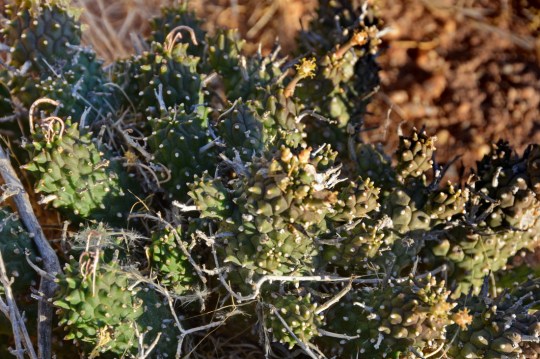
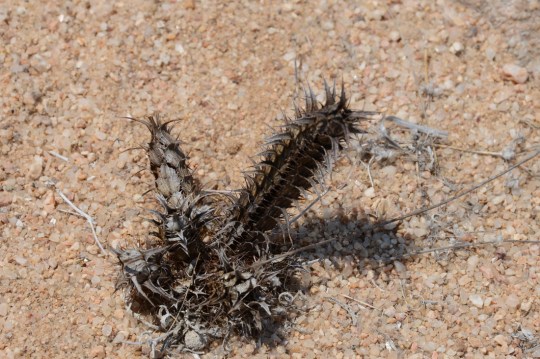
To record this fact digitally, I asked for a stop and to my amazement saw a small plant that at first sight looked like a cactus!
S2619 - Acanthopsis sp

S2619 – Acanthopsis sp

We saw it again later on the trip and learned that these plants belong to the genus Acanthopsis, where the members are difficult to tell apart, so ‘sp.’ will do. In the Richtersveld, in days to come, I was told that this plant is known in Afrikaans as a ‘verneuk halfmens’, a ‘false Pachypodium namaquanum’ and I guess that seedlings of the Pachypodium resemble this plant. It seems a tough customer, as it was the only plant found in this part of the desert.

Nothing new to report plant wise at the next few stops which was disappointing as I had hoped to see Welwitschia mirabilis, the icon of the Namibian fog desert. I had expected to see this plant near the beach and I had location data of plants growing in a protected area with one, in a cage. We dislike such artificial conditions so, with limited time, I suggest that we’d look for these plants growing in their natural environment. As the day went on and we drove farther away from the coast, I wondered if I had made the right choice.

We passed a village with souvenir stall along the road and with local Damara people in their costumes selling home-made jewelry and pottery.

S2622 - Eunice going back to her roots

S2622 – Eunice going back to her roots

Eunice asked the ladies if they would pose with her for a picture. No problem!

At our next stop, it was back to succulent plants, or rather pachycauls, fat stemmed trees.

S2623 - Adansonia digitata

S2623 – Adansonia digitata

Again, I’m completely out of my depth on names, so this is my best guess and a reminder to carry a pen and notebook into the field and write down the names suggested by friends as they are given. It’s not a plant I would grow back in the UK.

Light was failing as, around 17:00 hrs we were approaching Khorixas. I was dozing in the back seat, as usual, when Eunice, almost immediately followed by Cliff and David shouted ‘Welwitschia – STOP!’  And there they were, growing just a few meters from the road in large numbers. Fading light was our only problem. We decided to take the best pictures possible now – we could always come back tomorrow for more, if needed.

S2624 Welwitschia mirabilis

S2624 Welwitschia mirabilis

Our excitement was cooled a bit when, soon after continuing our journey, we picked up a puncture.

Later, at our hotel I learned that the town of Khorixas was previously known as Welwitsch, after the Austrian botanist / explorer Friedrich Martin Josef Welwitsch. The Welwitchia Primary and Secondary Schools in town remain as a tribute to the good Doctor who found the plants both in what is now northern Namibia and southern Angola.
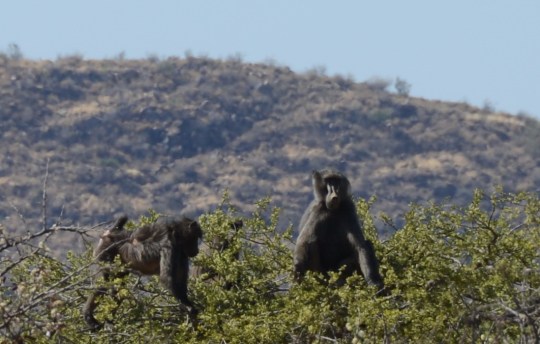
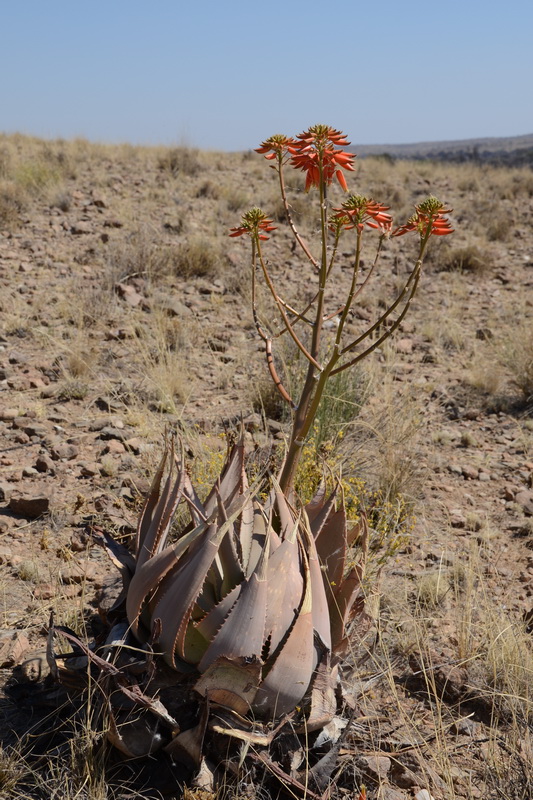
At least today’s scenery was a bit more varied than yesterday and various animals helped to keep us alert, like these baboons

S2610 - baboons

S2610 – baboons

near S2610 we saw these Aloes:

S2610 - Aloe hereroensis

S2610 – Aloe hereroensis?

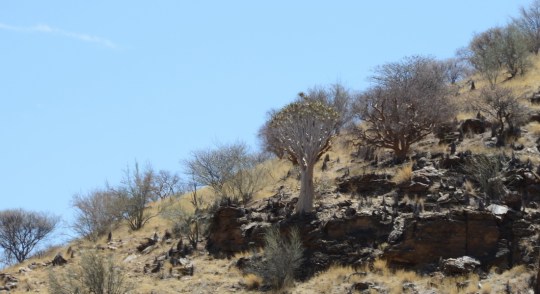
By S2612 the scenery had changed from flat to hilly as we started our descend down the Gamsberg Pass and began to see the first ‘Fat Trees’ which were so loved by my fellow travellers. I’m not so sure, but judge for yourself:

S2612 - Aloe dichotoma and the first Fat Trees

S2612 – Aloe dichotoma and the first Fat Trees in the Gamsberg Pass

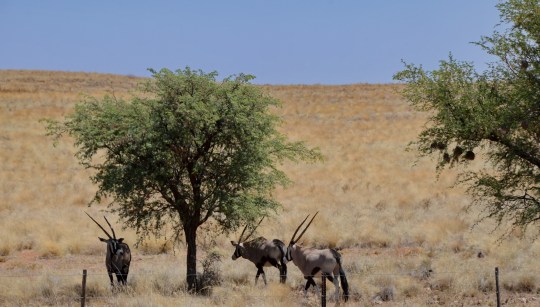
… but today the animals made the day

S2613 - Oryx

S2613 – Oryx gazella, the Gemsbok

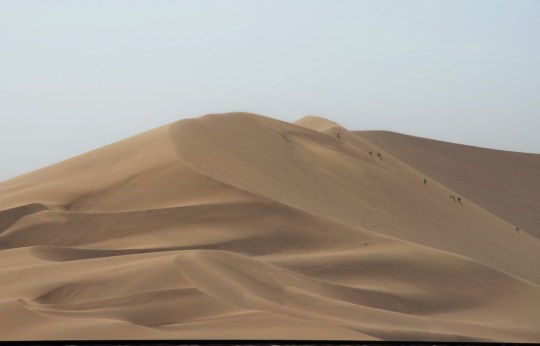
until we got to the coast and the famous Dune 7:

S2615 - Dune 7 Swakopmund

S2615 – Dune 7, Swakopmund

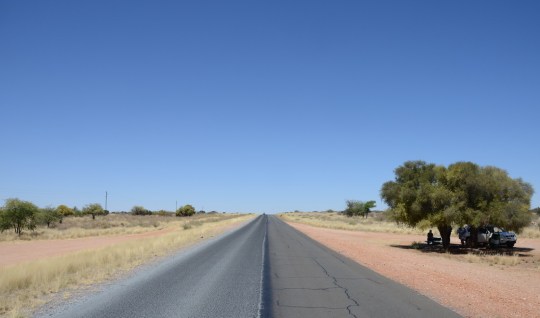
S2617 - come on David not far now

S2617 – come on David, not far to go now!

The 500 km from Keetmanshoop to Windhoek competes with a number of other desert drives for the title of most boring stretch of road. The majority of the distance is driven through flat as a pancake terrain on roads where a bend is likely to provide the only excitement of the day. Northern Chile, Patagonia, the Vizcaino Desert in Baja California all join in the competition.

To avoid drivers falling asleep at the wheel, it’s recommended to make periodic stops on the lay bys provided.

S2607 - pull over in the shade of an Acacia tree

S2607 – pull over in the shade of an Acacia tree

Here the excitement is provided by us crossing an invisible line from the subtropics into the Tropics.

S2608 - Tropic of Capricorn

S2608 – Tropic of Capricorn

It was almost a shock to pass this stand of Aloes by the side of the road.

S2609 - Aloe sp.

S2609 – Aloe sp.

OK, the rain has gone, the sun is out, it’s warm, can we have some succulent plants tomorrow please?

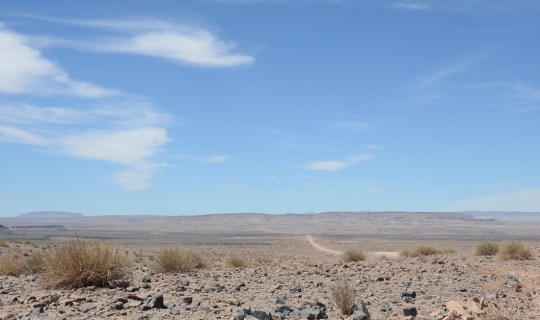
The Cape Town to Windhoek main road, the N7 in South Africa changes its number to the B1 in Namibia. The difficulties in finding suitable places to pull over whenever an interesting plant is seen are the same. So we decided to take the longer and (possibly) more scenic route west of the B1, but did still failed to spot intyeresting looking plants along the road. This was flat arid land, not unlike northern Chile, probably with similar ‘hardly any’ rainfall statistics.
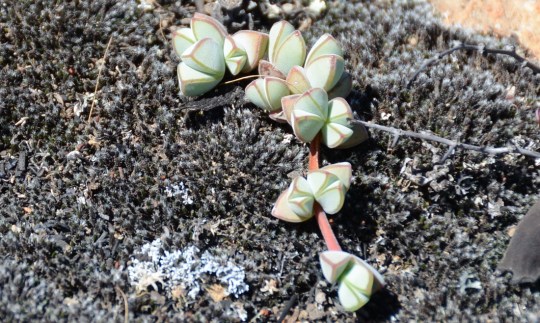
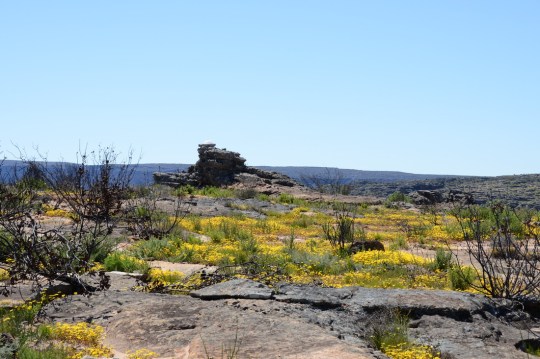
S2600 was for an official pull over, with just some stick Euphorbias to photograph, to keep the shutter exercised. S2601 was similarly disappointing, this time just one Monsonia (Sarcocaulon) sp.  without foliage or flowers so not much to go on for identification, except perhaps its geography.

S2602 was prompted by a small group of steenbokken crossing the road – no problems with fences for them, they simply leaped over them! Euphorbia virosa appeared in the back ground, more ‘stick’ Euphorbia in the foreground. We didn’t stop long.

S2603 was for some Aloe dichotoma growing on some very dark, almost black, rock cubes that appeared to have been neatly piled up. Mother Nature at work again. My antibiotics seemed to have won the battle – I set my sights on one of the Kokerbomen and marched towards it at a brisk pace, surprising myself that I was not exhausted and completed the loop back to the car.

As a result of these few brief stops we arrived at our planned accommodation at the Quivertree Forest Restcamp on the Gariganus Farm near Keetmanshoop by mid afternoon. As the name implies, this included a Quivertree Forest (S2604).

We took a look and lots of pictures, then went back to take some pictures of the curious domeshaped structures where we would spend the night (S2605). Eunice and I also went to the Cheetah feeding session. The farm is also a Cheetah Reserve.

Cheetahs and humans do not co-exist happily, especially when the cheetahs learn that the goats and sheep and even young calves provide easy prey. They can decimate a herd in a very short time. Farmers have the right to shoot the cheetahs on their property to solve the problem. Alternatively, the farmer can call on a Cheetah Rescue service that catches the cheetah and keeps it in a nature reserve, generating income as a tourist attraction to pay for their care. At the feeding session, Eunice and I joined about a dozen other guests in an area surrounded by a high fence where we were joined by two youngish cheetahs that were born in the reserve.Their mother broke out of her and when recaptured turned out to be pregnant. A few years ago (2010), our friends Alain & Greet Buffel visited this reserve and had their picture taken stroking the two young kittens. I’m glad that this was not part of today’s session, as the brithers had now grown up and would soon need to be split up. Being in the same enclosure with these two animals was quite an experience!

There was more to come! In another area we watched their mother being fed. Over the years, this animal had become accustomed to people to the extent that we could take it in turn to walk up to her keeper while the big cat was eating and under her close supervision, scratch the cheetah behind its ears, while fellow visitors took pictures. Again, quite an experience. I still have mixed feelings about these reserves – I would much rather see these animals in the wild, but realise that in the struggle for survival, they would fight a losing battle against humans.

We returned to the Quiver trees for some sunset pictures.

S2604 Aloe dichotoma sunset

S2604 Aloe dichotoma sunset

Things had changed a bit after crossing the Oranje Rivier. David had not spent much time in Namibia so the wealth of plants that we had seen in South Africa would have to be found by looking for likely spots, usually suggested by a clearly visible succulent plant, in the hope that there would be smaller stuff of interest around once we gave the area a closer inspection on foot. Where as in South Africa it seemed that at every stop we could guarantee at least half a dozen interesting plants, here we struggled to find any. So why did we go to Fish River Canyon? All Namibia tourist guides claimed that it was a must-see spot and this had been echoed by John Ede and in Alain Buffel’s diaries (in Dutch on a Belgian gardening website). We were here, might never come back, so we might as well take a look.

The fact that we made six stops today and that I took 160 images might suggest that we saw lots of plants. Not so – I seem to have a need to regularly exercise my right index finger by pressing a camera shutter when I’m on a plant trip.

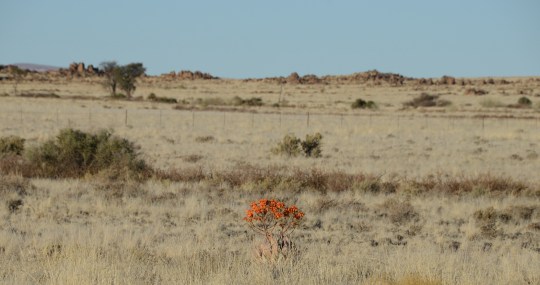
David was the first to call for a Stop (S2594). He had spotted something red in the field, some 30 m from the road, but the high fence seemed too formidable a barrier. Looking through zoomlenses and binoculars we confirmed that there was an Aloe in flower. David was the first to cross the fence. The rest of us decided to wait until easier opportunities presented themselves, which happened 5 minutes later although there were no plants in flower here.

S2594 - Aloe asperifolia

S2594 – Aloe asperifolia

Aloe asperifolia is also known as the Sandpaper Aloe – asperifolia means ‘rough leaf’. It is widespread in central and northern Namibia, so we will see it again. Just like Agave, the upper surface of the leaf has an imprint of the teeth along the edge of the leaf above it.

I photographed an enormous, to 2 m tall, clump of a stick Euphorbia at the next stop – S2595. I have had some nasty allergy reactions to Euphorbia latex, so a zoom lens was a good tool.

S2596 - overview

S2596 – overview

As you can see – clear skies, so no rain and it had suddenly turned very hot – around the 30 C mark – why do our plants like such extremes? Actually, that’s why I like succulent plants.

S2597 was at the Fish River Canyon main view-point. We were the only visitors there. The toilets were locked to prevent them being damaged by baboons, or so the sign explained. The Canyon is certainly impressive but it was probably previous visits to the Grand Canyon in Arizona and the Goosenecks at Mexican Hat, Utah, not to forget Copper Canyon in northern Mexico that had spoiled us for such geological miracles.

Plant wise we saw Aloe dichotoma and A. asperifolia as well as this Euphorbia virosa in impressive setting.

S2597 Euphorbia virosa

S2597 Euphorbia virosa at Fish River Canyon

We were beginning to feel like real tourists so S2598 was a leg stretch at the Canyon Roadhouse, a quirky hotel and restaurant with old cars and other assorted scrap metal with local flora as a theme that carried on both inside and outside the building. But this is the Diary of a plant trip Diary and you can find plenty of images of this place by Googling Canyon Roadhouse.

S2599 was prompted by a couple of ostriches, still a novelty in the wild for us. As we had stopped anyway, a stroll around revealed another Euphorbia near the entrance / exit of the Gondwana Canyon Park .

S2599 - Euphorbia sp

S2599 – Euphorbia sp

Any suggestions for a name?
 
Also included in S2599 are images (taken by zoomlens from the roadside of the formidable fence) of the red flowering Aloes that David had spotted at the start of the day. These turned out to be different to the Aloe asperifolia that we had seen at S2594, these here had broad, spreading racemes with reddish to orange coloured flowers. David made it over the fence. We didn’t. A look through The Aloes of South Africa suggests that this is the widespread Aloe hereroensis.
S2599 - Aloe hereroensis

S2599 – Aloe hereroensis

By now we were confident that we’d make it into Namibia today. So confident that we took up David’s suggestion to take a look not too far along the track from the N7 to Henkries (S2593) where he had seen some excellent succulent plants on a previous trip with David & Margaret Corrina. It was the only stop today, but lasted two and a half hours, despite the fact that Eunice was still feeling bad with her cold and all of us were wrapped up against a strong wind with frequent ice-cold showers – the outside temperature on the car’s thermometer (not the most reliable instrument in any car) suggested a temperature of 6 C. The wind chill factor made it feel close to freezing. Cliff had put on gloves, but of course was still in shorts. Had he even brought long trousers?

Although my antibiotics were beginning to kick in after a few days, is still felt rough, with cotton wool in my head and particularly in my ears. With the strong wind it was impossible to hear anything. I decided that my best course of action was to shadow David, without getting in his way and to take a look at what he was taking pictures of and then to take a look to see if there was anything interesting to point my camera at. I took 128 images and looking back over them now, I must have had a great time if only I had not felt so bad.

Enjoy the images and feel free to suggest some names for the ‘sp’ or corrections to the names.

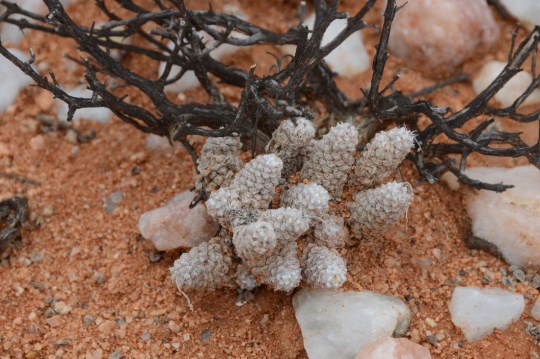
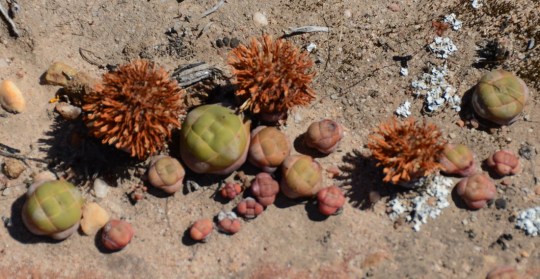
I guess my magic moment at this stop was seeing my first Lithops. L. helmutii (C271) is reported from along the track we were on, 3.5 km south-west of where we had parked the car while L. marmorata (C163) comes from 6 km farther along, north-east to our parking space, although from memory we had walked quite a distance in that direction, to a low ridge. L. marmorata pictured in Desmond Cole’s book is a good match for what we saw:

S2593 - Lithops marmorata

S2593 – Lithops marmorata

Having already been confused by the Avonia, here Anacampseros sp. added to my confusion:

S2593 - Anacampseros sp

S2593 – Anacampseros sp.

The Stomatium sp looked the same as the one we had seen yesterday; Stomatium  suaveolens?

S2593 - Stomatium  suaveolens

S2593 – Stomatium suaveolens?

At times it felt as though we were looking at the succulent bed in a botanical garden, with the plants neatly laid out – but somebody left out the labels.

S2593 - Argyroderma sp

S2593 – Argyroderma sp

S2593 - Cheiridopsis sp and Sarcocaulon sp

S2593 – Cheiridopsis sp. and Sarcocaulon sp.

S2593 - Crassula deceptor Avonia papyracea Conophytum sp

S2593 – Crassula deceptor, Avonia papyracea and Conophytum sp.

The crossing over the Oranje Rivier into Namibia was tedious and time-consuming, being passed from one counter to another – immigration, customs and the police. At customs we had to complete a list of all electronic equipment, such as cameras, lenses, laptops etc. Between us we had so much that we had to go back for a second sheet of paper – on top of that Eunice required a sheet all to herself for her cameras, lenses, etc.

Noordoewer turned out to be a disappointment in terms of accommodation. Two guesthouses we tried were fully booked – coach parties. We took a turning suggested by the SatNav and ended up in a township. We did ignored the SatNav to turn around and get back to the main road.

We decided to drive on to Grunau, where the one and only hotel was full, expecting a coach party later that night, but where we directed to a B&B that turned out very comfortable and reasonably priced, so we booked in for two nights.

We had planned to head north at a steady pace, but due to the inclement weather, decided to put some haste behind our drive towards Namibia. The weather was not too bad (typical), and the N7 is not the best road to make stops to explore for plants, so we turned east on to the Garies to Loeriesfontein road (R385), for a detour that produced all of today’s eight stops, before we rejoined the N7 near Leliefontein beginning here with S2585 – Cheiridopsis sp?

S2585 Cheiridopsis sp

S2585 Cheiridopsis sp

This seems an appropriate time to explain my approach during the trip for a practical way of provisionally identifying plants, in this case Mesembs, to at least genus level. Apart from the genera Conophytum and Lithops, that I believe are quite distinct from the others, I would lump clumps of aparent stemless Mesembs (I did not take much time to confirm how ‘stemless’) under the name Cheiridopsis if they had long paired leaves. In and around the Knersvlakte, I would provisionally file those with short leaves as Argyroderma sp while west of Oudtshoorn I would call the Gibbaeum sp. If they were not ‘clumping stemless Mesembs’ I grouped images of Mesembs under the heading ‘Mesemb shrub, followed by my interpretation (I am colour blind!) of the flower colour – white, pink, purple, red and yellow with another category of ‘not in flower’. Not very scientific, but it will have to do for now. With Mesembs I’m now at the stage where I have consulted Mesembs of the World by Gideon Smith et al and although it has helped me with a few genera, it has also has helped to confuse me with many more, to me unfamiliar, names than I can process right now, along all the other families. So do help me to speed up the process with any useful tips or hints.

The next stop, S2586, nicely illustrates my naming concepts for the genus Avonia. Before this trip, I was familiar with only two species of what at the time were called Anacampseros, A. payracea and A. alstonii that I would see on offer in European nurseries and that had a reputation of being difficult in cultivation reflected in an above average price on the sales bench, so I was quite excited to now see these plants in nature, especially here, growing side by side.

S2586 Avonia quinaria L and A papyracea R

S2586 Avonia quinaria (left) and A. papyracea (top right)

I have since learned that Gordon Rowley proposed a separate genus, Avonia, for the paper scale covered Anacampseros, with some 13 taxa. The plants are all miniatures, so that in theory it should not be too difficult for a hobbyist to grow the complete set of 13 in a small tray in the green house – IF (intentionally a big if!) you can get hold of them from nurseries – difficult plants (in Europe) tend to lead to limited availability and high prices – simple economics. Anacampseros alstonii is now Avonia quinaria ssp alstonii while I can still use ‘A. papyracea’ as the two genera share the first letter of their name.

To me, judging by the pictures and images that I found in books and on the internet, the 13 taxa are all fairly similar, requiring a close look at details, such as flowers. I read that Avonia flowers open only for one hour! So there is a challenge!! For reasons of practicality, in the field such detailed analysis is not possible, so images are filed according to size either as ‘quinaria’ or ‘papyracea’ in the knowledge that here too there is a lot more sorting to do after I have tracked down Gordon’s article proposing Avonia as a genus in Bradleya.

At S2587 I took this picture of ‘Mesemb shrub – no flowers’ – any suggestions? Clearly I need help!

S2587 Mesemb shrub, no flowers

S2587 Mesemb shrub, no flowers

S2588  taught me another Mesemb genus: Stomatium, but which species is this? My money is on Stomatium suaveolens, but I’m aware that I haven’t seen all the species in this genus and have no idea if there are other Mesemb genera that look like this:

S2588 - Stomatium suaveolens?

S2588 – Stomatium suaveolens?

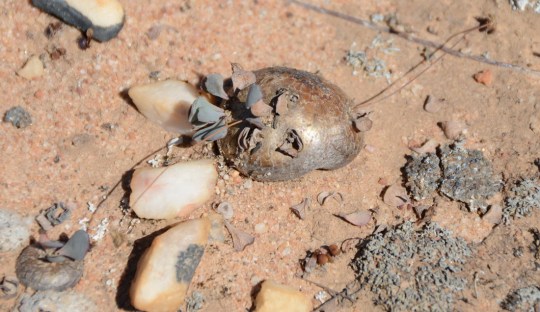
And what is this Mesemb, waking up for Spring?

S2588 - Argyroderma sp

S2588 – Argyroderma sp.?

And so on to S2589 where we saw Monsonia / Sarcocaulon sp, some white-flowered plants:

S2589 - Monsonia (Sarcocaulon) sp white flowered

S2589 – Monsonia (Sarcocaulon) sp white flowered

and some with buds suggesting yellow-flowered plants – different taxa or is flower colour not important in this genus?

S2589 - Monsonia (Sarcocaulon) sp yellow flower

S2589 – Monsonia (Sarcocaulon) sp yellow flower

The remaining stops today had much the same as what we had seen before, although it was suggested that this Tylecodon might be T. pearsonii. Can anyone confirm this?

S2590 - Tylecodon pearsonii

S2590 – Tylecodon pearsonii?

We spent the night at the Okiep Country Hotel, just a 100 km from Vioolsdrift and the border with Namibia, an easy goal for tomorrow. Hopefully it would be a bit warmer and sunnier. We had not found the sunshine yet!

Many people had told us of the magnificent views from Compton’s Corner at the top of the Vanrhynsdorppas. As David drove us from Vredendal to Vanrhynsdorp, the Matzikana Mountains were shrouded in clouds – not a good sign! We had been very lucky with the weather yesterday. Despite me and now also Eunice suffering from bad colds – not surprising considering the amount of time that we spent in the same car, we carried on.

As we drove up the pass, the wows, yelps and other exclaimations were not for the view, but because the fog and mist were getting thicker and thicker – we were not reassured when our driver said that he could not see the edge of the road! So we screamed each time another car loomed out of the fog on its way down hill.

S2581 approach to Vanrhynsdorp Pass

Approach to Vanrhynsdorp Pass

Since there was no reason to stop at Compton’s Corner at the top of the Pass – we had driven past the entrance to the car park before we realised it was there – we turned off the main road following signs to the waterfall. People back home had suggested that this would not be worth a visit as it never seems to be in flow. Not this time! And the fog seemed to be lifting a little too, but it was not much fun in the drizzle – Eunice stayed with car.

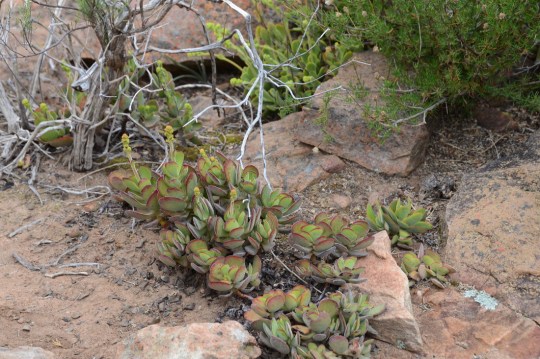
I’ll include this image of a Crassula sp in the hope that somebody can suggest the species name.

S2581 Crassula sp

S2581 Crassula sp

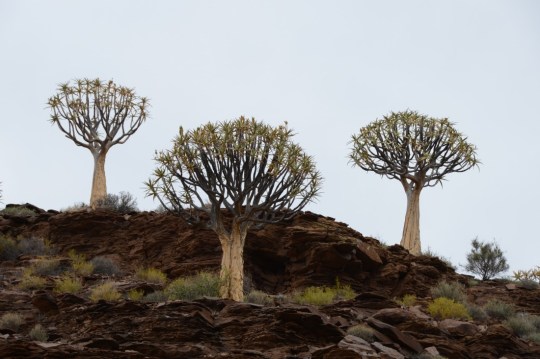
Back towards Nieuwoudtville we saw a sign to a Quiver Tree forest and with little else to tempt us in this weather, we took a look (S2582). Even in the wet, these plants looked impressive enough for me to add another 60 images to my collection.

s2582 Aaloe dichotoma in the Kokerboom forest

s2582 Aloe dichotoma in the Kokerboom forest

Eunice, now shivvering with fever, despite being wrapped up in jumpers and coats, asked if we could drop her off back at the hotel in Vredendal. Sensible. So what to do for the afternoon? Curled up in the corner of the car and by now taking antibiotics, I suggested a trip to the beach. Cliff & David looked at me as if I had lost my mind, but with no other suggestions on the table, we headed off to Luderitzville and from there took the turning to Strandfontein where I had vague memories of someone telling me at ELK of an interesting Mesemb growing on the beach. We looked, but failed to find anything of interest.(S2583). On the way back, with daylight quickly fading under the overcast sky, I spotted something growing along the side of the road – interesting enough for me to shout ‘Stop!’ It turned out that on the otherside of a too high to climb fence, there were quite a few Euphorbia, later identified as E. schoenlandii, nice plants, but in poor light. With nothing to lose, I pushed the ISO ratings on the camera up, increasing its light sensitivity but at the expense of quality, caused by ‘noise’ in digital photography. The D600 did very well, producing some useable shots, after I had spotted a stretch where the fence had fallen over. (S2584)

S2584 Euphorbia schoenlandii

S2584 Euphorbia schoenlandii

Pleased with this late-in-the-day succcess we returned to Vredendal, looking forward to another fillet steak at a very reasonable price at Paiter’s Grill & Restaurant.

Tomorrow we’ll head north at a faster rate than planned, hoping to find dry weather, warmth and sunshine closer to the equator, and hoping that the weather will have improved by the time that we get back here in just under a month’s time.

The Matzikama region borders the Atlantic Ocean to the west and includes the Sandveld, Knersvlakte and the Matzikamma Mountain range. The region takes pride in their mountain peaks such as the Gifberg, Maskam and Koebee, while the coastal region is a haven to migrating whales from July.    In the Nama language, Mitzikama means ‘Give me water’. In recent days that wish seemed to have been fulfilled as, unusually, there were some puddles to dodge as  we were looking for succulent plants!

Today our plan was to drive up the Maskam and drive along the top to ‘the hill next door’ (to the south) to the Gifberg.

Our first brief stop (S3577) was for some low growing Aloes that looked as if they had a bad dose of mealy bug or similar, but any clean plant found looked very nice.

S2578 was a brief stop as we climbed the mountain and caught glimpses of the Knersvlakte through the kloof that the track went through.

We then spent some four and a half hours wandering around the top of the Gifberg (stops S2579 and S2580) that resulted in 168 images of 39 taxa (including some duplicates ).

Again, it would be boring to list the plant list for each stop, especially as, although I have made some progress of putting names to some of the plants, too many are still simply recorded as ‘Genus-name sp’, with probably still quite a few errors even in that vague ID. So I’ll include some of my favourite images:

S2579 Othonna cacalioides

S2579 Othonna cacalioides

S2579 Mesemb sp

S2579 Mesemb sp

S2579 habitat overview

S2579 habitat overview

S2579 Crassula tomentosa

S2579 Crassula tomentosa

S2579 Conophytum sp

S2579 Conophytum sp

S2579 Adromischus sp

S2579 Adromischus sp

S2579 was around a cross road at the top of the Gifberg while for S2580 we took the exit heading south and saw these plants:

S2580 Crassula columnaris

S2580 Crassula columnaris

S2580 Crassula columnaris

S2580 Crassula columnaris

S2580 Drossera sp

S2580 Drossera sp

S2580 Haworthia arachnoidea

S2580 Haworthia arachnoidea

Good luck with the plant ID and do let me know your suggestions or tell me of any errors that you find in the IDs.


[The following text was written ‘live’ from the field.]

Sorry for the break in communications – too tired (I’m recovering from a bad sinus infection after a tooth extraction two days before flying out) and no internet facilities in Clanwilliam with the internet cafe closed due to a Bank Holiday weekend.

These diaries are going to be more difficult to do on the road than I had imagined. I took 853 images of the nice plants and scenery that we saw during the last few days, but for many I’m not even sure of the genus, let alone the species.  David Neville is great and patient at telling me names over and over, but my short term memory is worryingly poor. Even then, an attempt to get the spelling approximate enough to be recognised and to decide whose classification / taxonomy to use for each family is very difficult on the road, without internet access.

We’re here to take pictures – sorting out names we can do later. Perhaps I should switch to a photo album approach with minimal text to give you all the opportunity to tell me what I saw. Just one image of each species that we saw. We’ll see.

We’re in the Hotel Vredendal for two more nights so should have internet access during that time.

[what follows is a PS written on 12/12/12, from the comforts of my living room in the UK]

We started the day with a look at the Clanwilliamdam, but somehow this did not get a formal Stop number. Apart from images from the dam itself we amused ourselves by taking pictures of the weavebirds that had made their nests in the trees in the car park.

We made another five stops: S2572 – S2576. I usually do a ‘plant list’ for each stop but today I realised how impractical this will be for this trip as the number of different plants at each of these stops just grew and grew. At two of today’s stops I managed to record 19 different species. That might still be manageable if I had accurate names for them, but although I have made progress in identifying some plants, from books in my library and from Google searches on the internet, and plant list would still include some 50% of names where I can do no better at the moment than ‘Genus sp.’ So I’ll focus on the stars of the day, the plants that for some reason justify a special mention and will include my favourite images of the day.

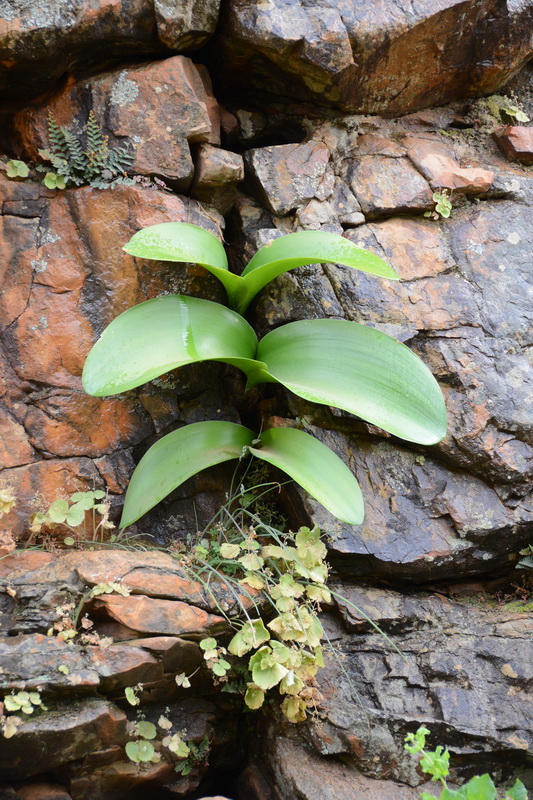
I’ll start with our brief stop S2572 where we saw some ‘large leaves’ growing alongside the track, possibly a Massonia sp?

Massonia sp

Massonia sp

The small plants at the bottom of the picture are Crassula capensis.

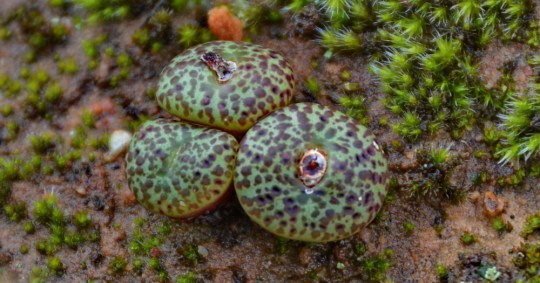
A bit farther along the track David recognised the scenery of a place that he had explored with the late David & Margaret Corrina during their trip in 2005. Here Conophytum obcordellum stole the show for me.

Conophytum obcordellum

Conophytum obcordellum

As you might be able to tell, these plants were soaking wet after overnight rain and I was still wearing a coat over my jumper.

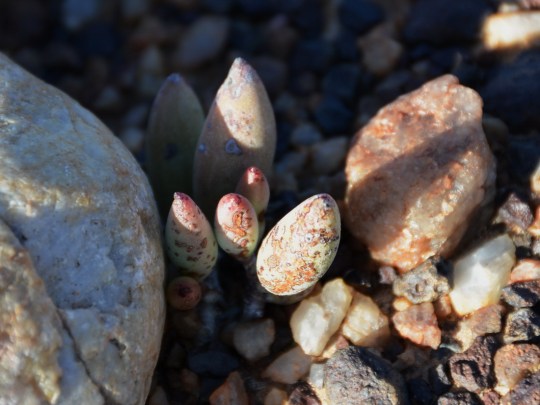
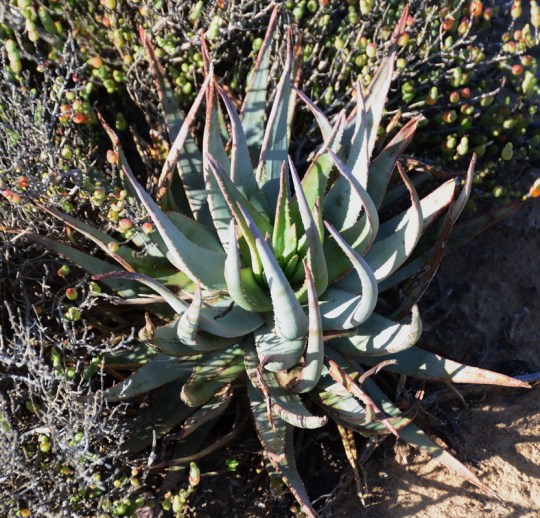
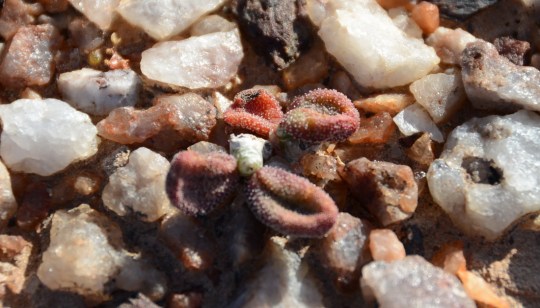
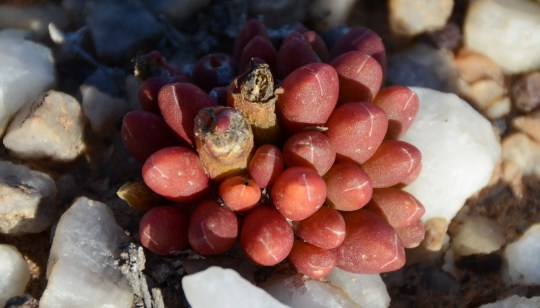
We had learned in Clanwilliam that we were still at the end of the bulb flowering season that attracts many tourists to the area, putting pressure on hotels, so we arrived in Vredendal early in the afternoon, got our ro0oms in the almost empty 51-room Vredendal Hotel. With beds for the night sorted we headed west towards Luderitzville where David took us to another location from previous trips, this time S2576. As at the previous stop (S2575) about 6 km north-west from Lutzville, S2576, 9 km farther along the R363, I recorded 19 plants from each! I get the impression that the R363 Nuwerus to Lutzville road is the western boundary of the Knersvlakte, a region of a hilly terrain covered with quartz gravel in Namaqualand in the north-west corner of the Western Cape Province – there is no formal indication on maps where this legendary (to succulent plant freaks) starts or ends. I’ll give you the plant list for S2576 as a sample of the diversity of the succulent plant flora of the area and my lack of knowledge of the plants I photographed:

Adromischus sp. ? But yellow composite flowers rules out Crassulaceae, what Asteraceae has leaves like a Cotelydon / Adromischus?); Adromischus sp. or Crassula sp.; Aloe sp. ; Argyroderma congregatum ? another Argyroderma sp. Cheiridopsis sp ? Conophytum sp, Crassula columnaris Crassula sp – long pointed leaves; Crassula sp ? Large yellow flowers; Mesemb sp. small clumping;
Mesemb sp. shrub, purple flowers; Mesemb sp. shrub, white flowers; Monilaria sp; Monsonia/ Sarcocaulon sp.; Tylecodon sp.; Unidentified genus species – Gazenia? and another Unidentified genus species.

I have put together a gallery for this stop – feel free to suggest names for any of these plants or to tell me if you find misidentified plants anywhere in the Diaries.

A

2012-09-24 14-40-55a

B

2012-09-24 14-46-13

C

2012-09-24 14-46-24a

D

2012-09-24 14-56-39a

E

2012-09-24 15-04-13

F

2012-09-24 15-09-23

G

2012-09-24 15-13-11a

H

2012-09-24 15-16-01a

I

2012-09-24 15-20-14a

J

2012-09-24 15-20-31a

K

2012-09-24 15-35-38a

L

2012-09-24 15-51-56a

M

2012-09-24 16-03-55a

N

2012-09-24 16-09-46a

            Good Luck!