Just another WordPress.com site

Archive for the ‘Chile 2010’ Category

Thursday, 14 November 2013 – Around Vallenar: Domeyko

Well, we had an eventful day to say the least, arriving back at Hosteria Vallenar in a breakdown truck with Nessy on the back and us squeezed in next to the driver.

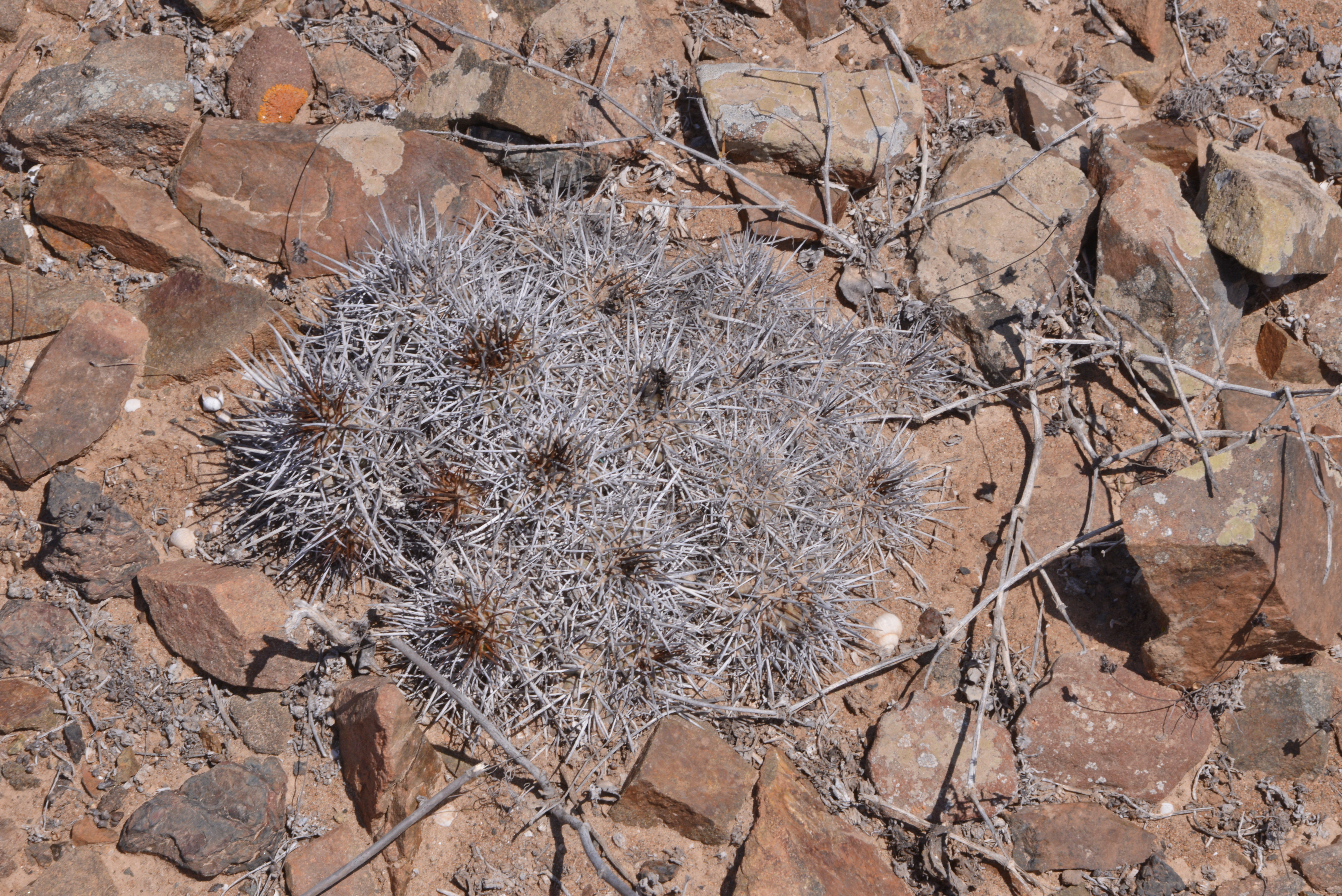
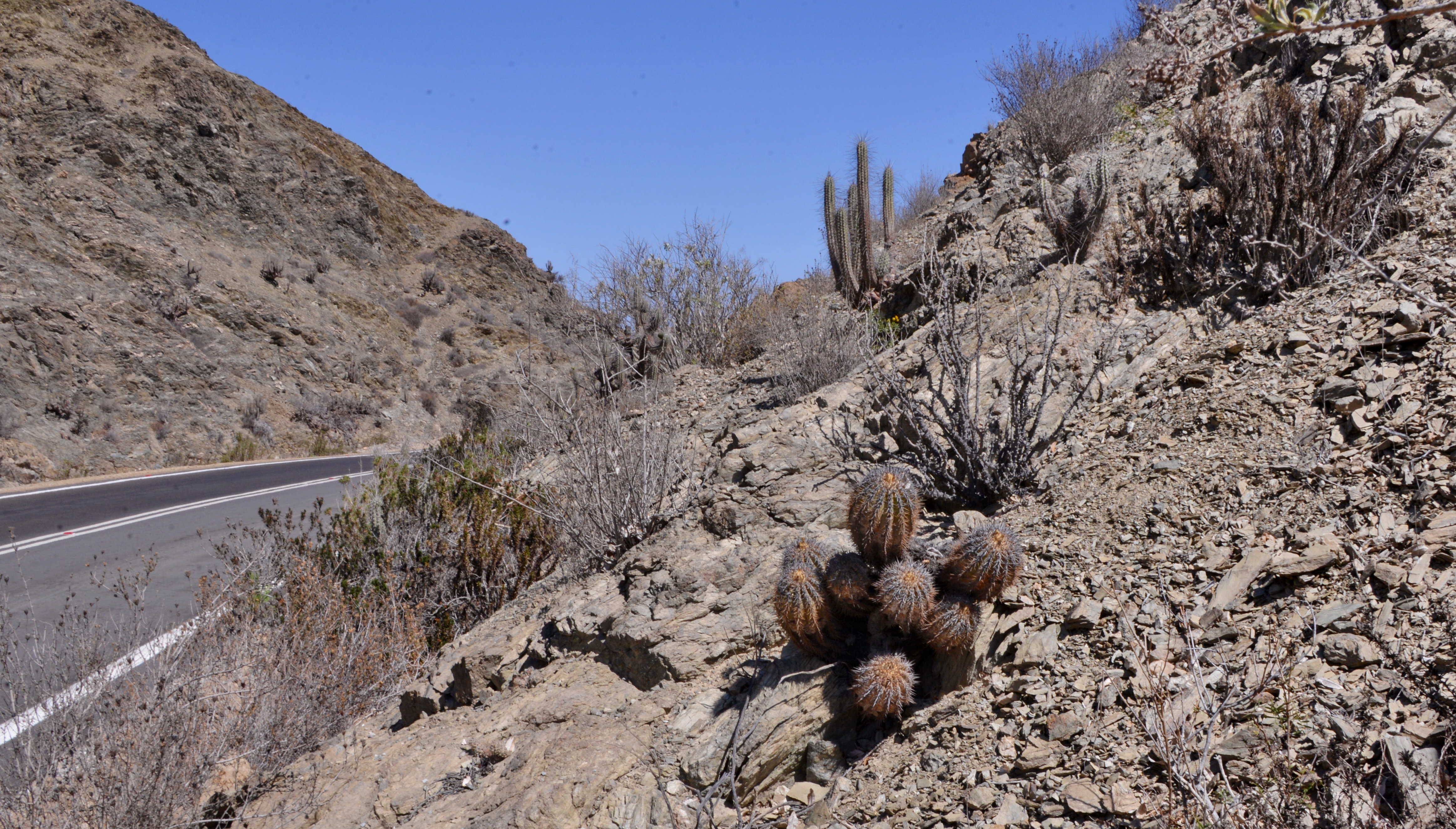
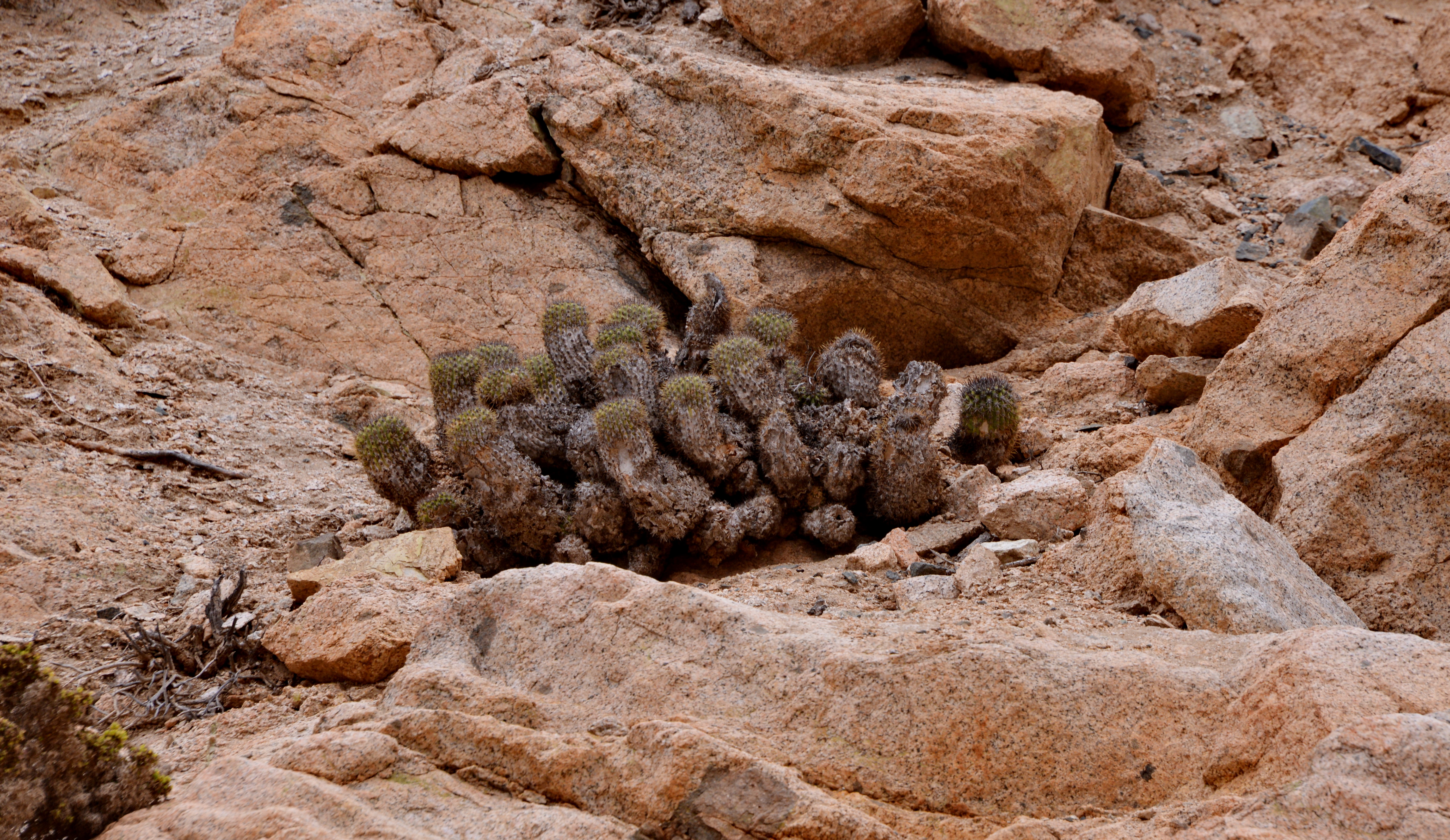
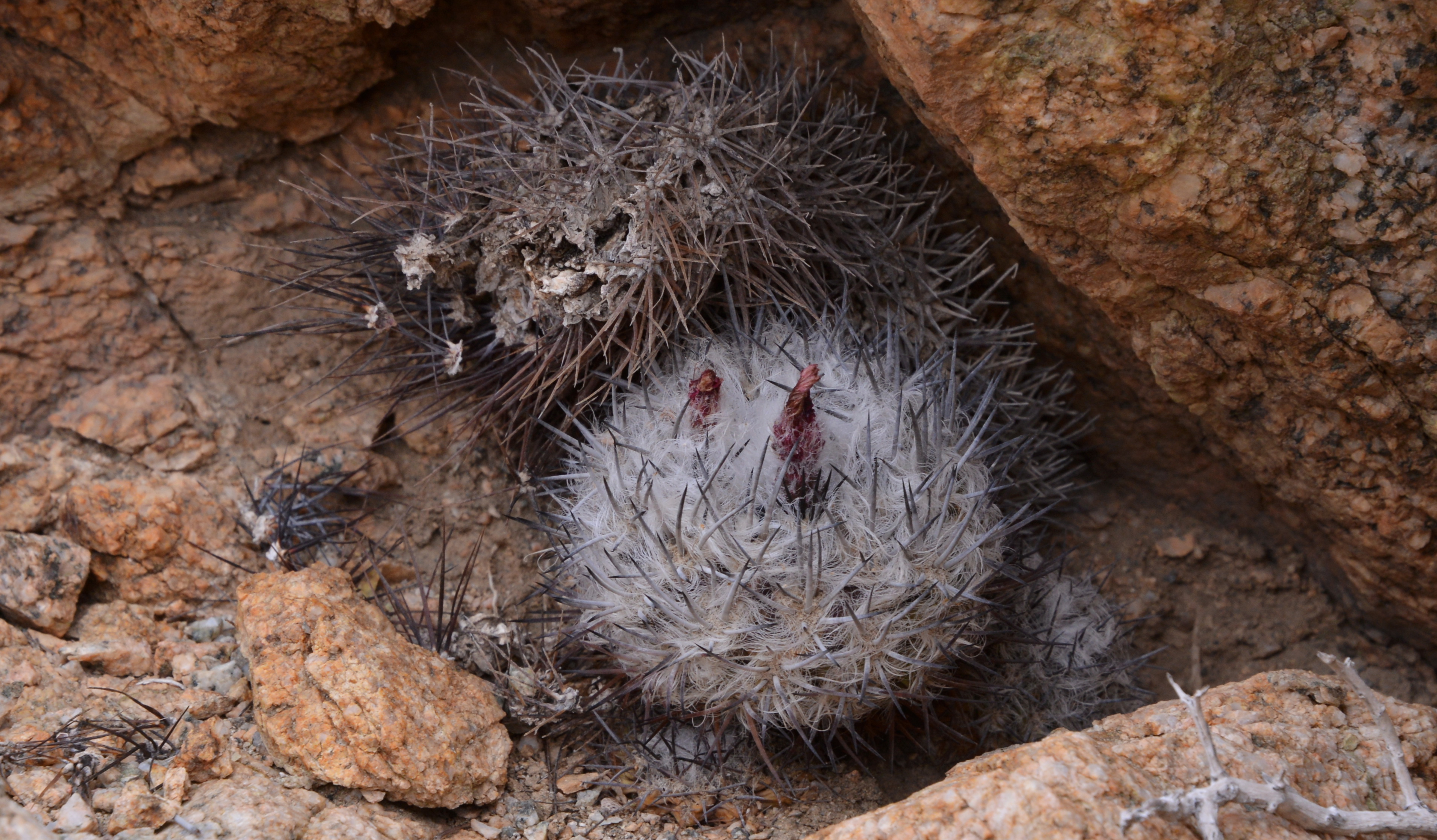
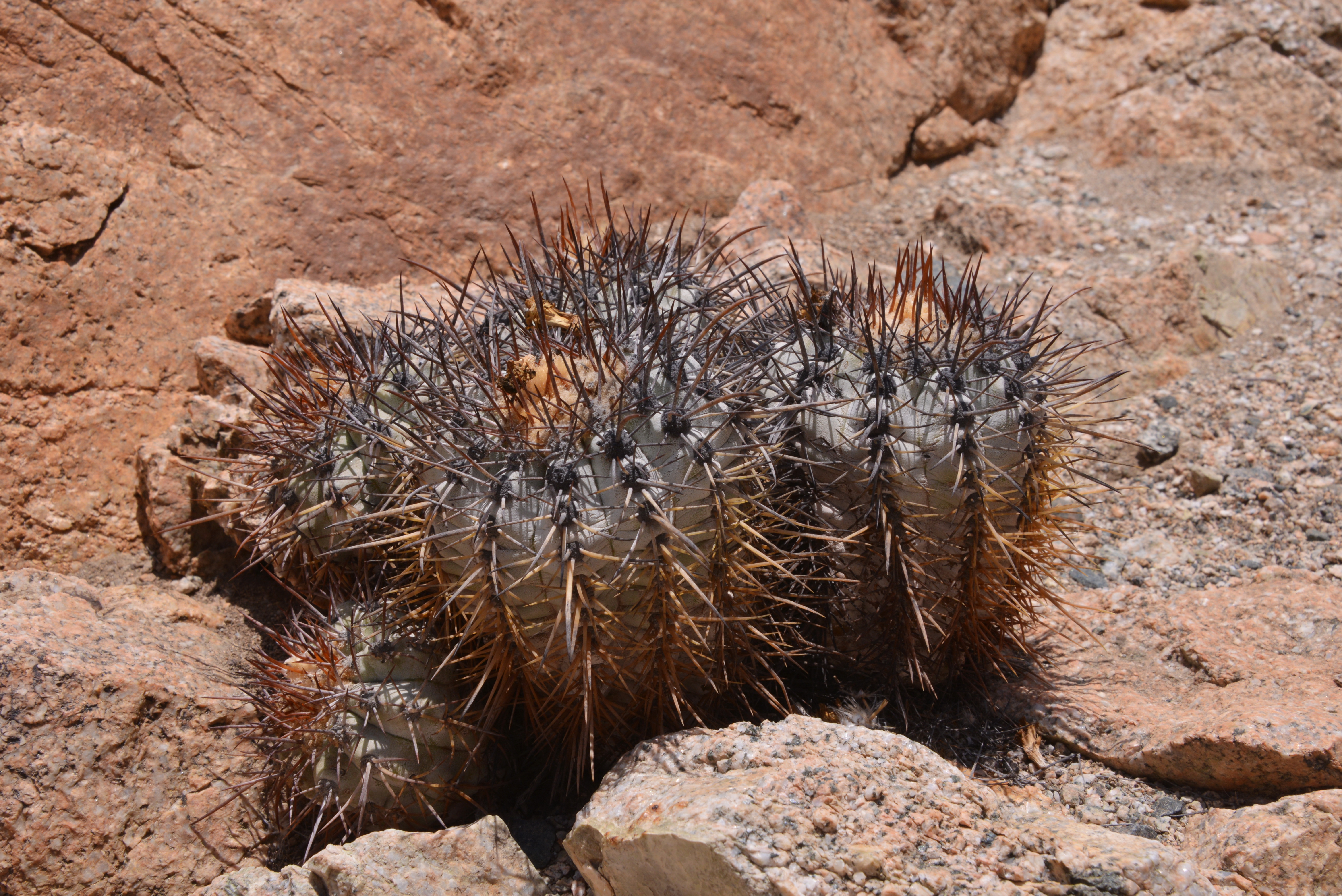
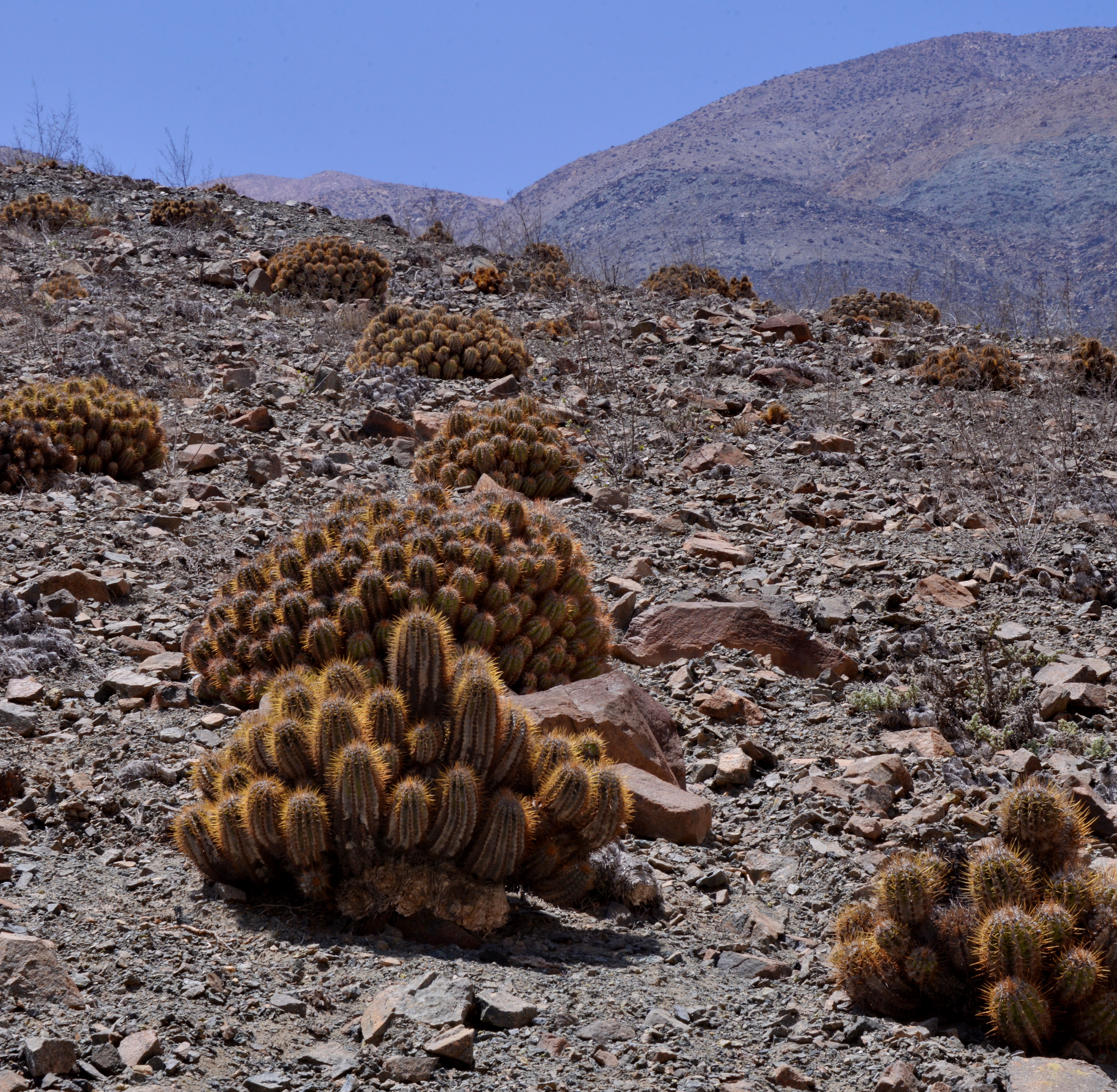
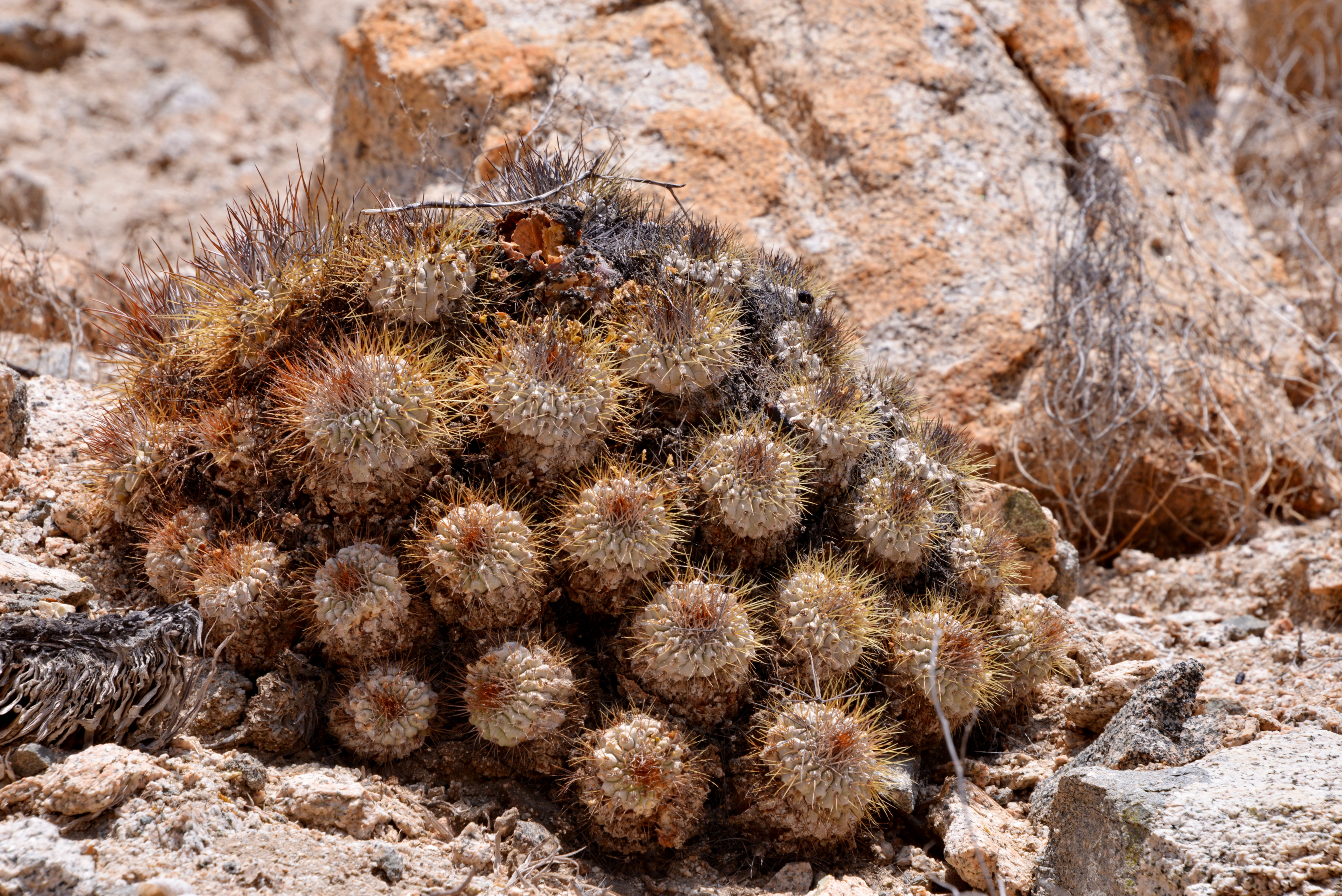
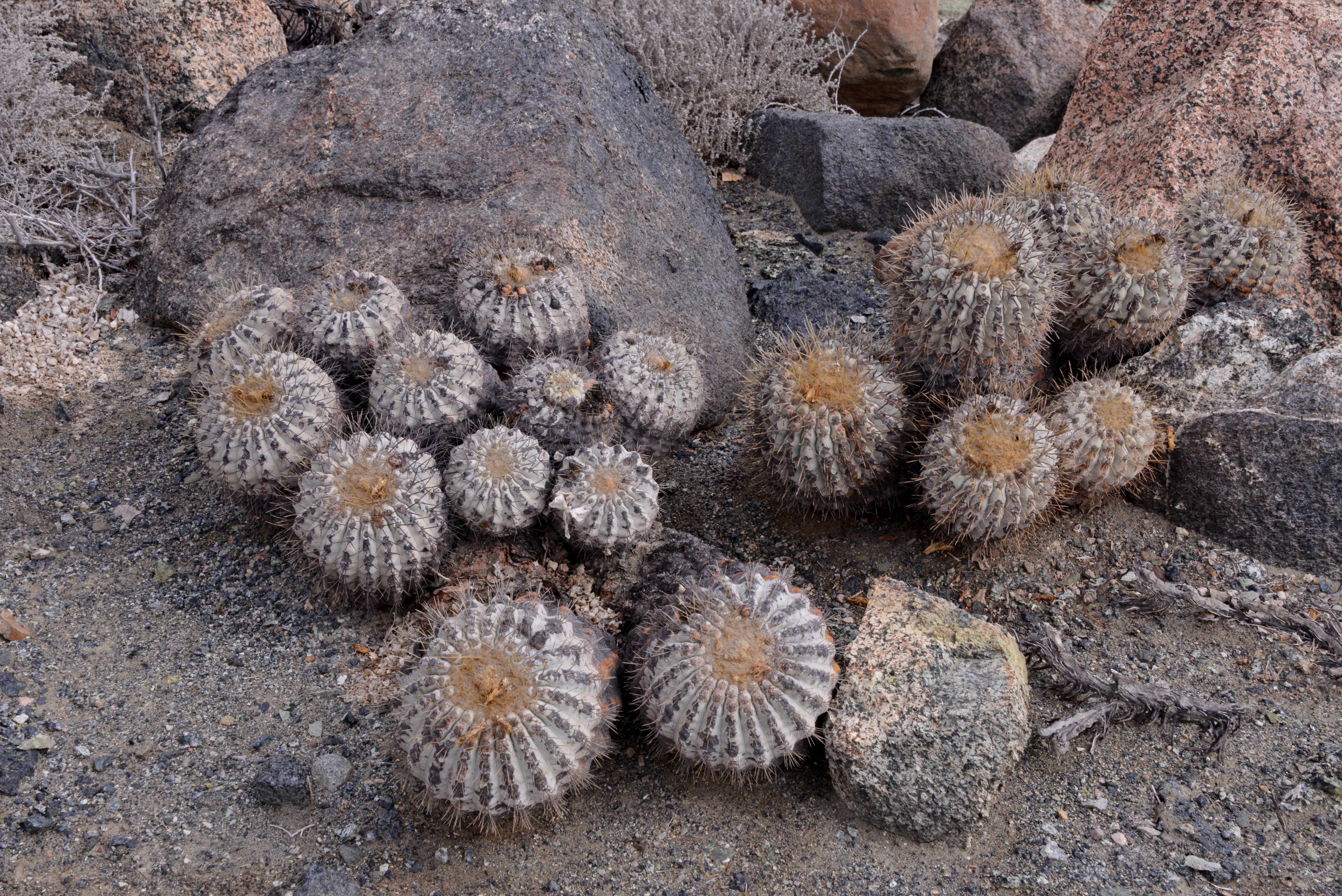
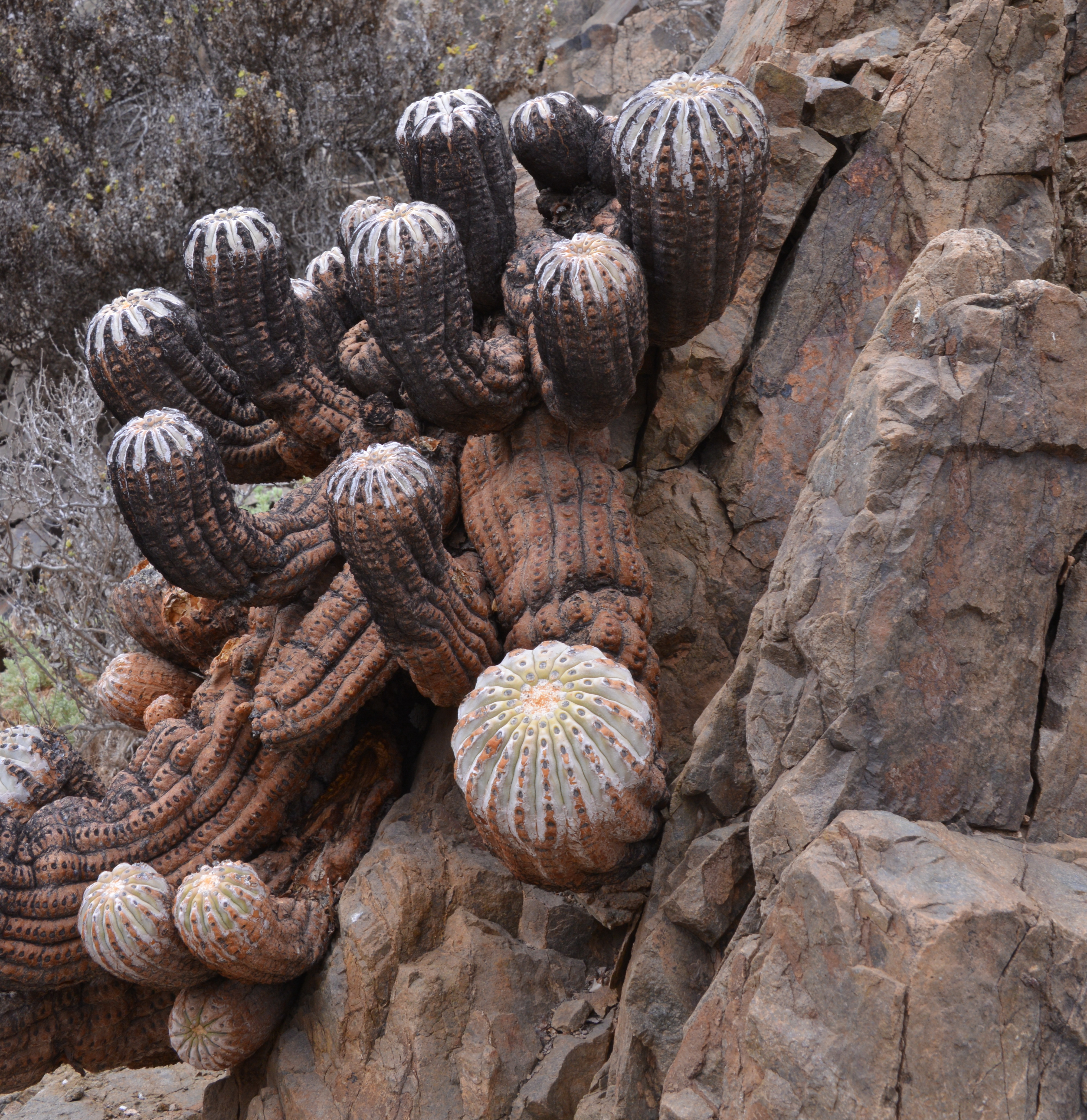
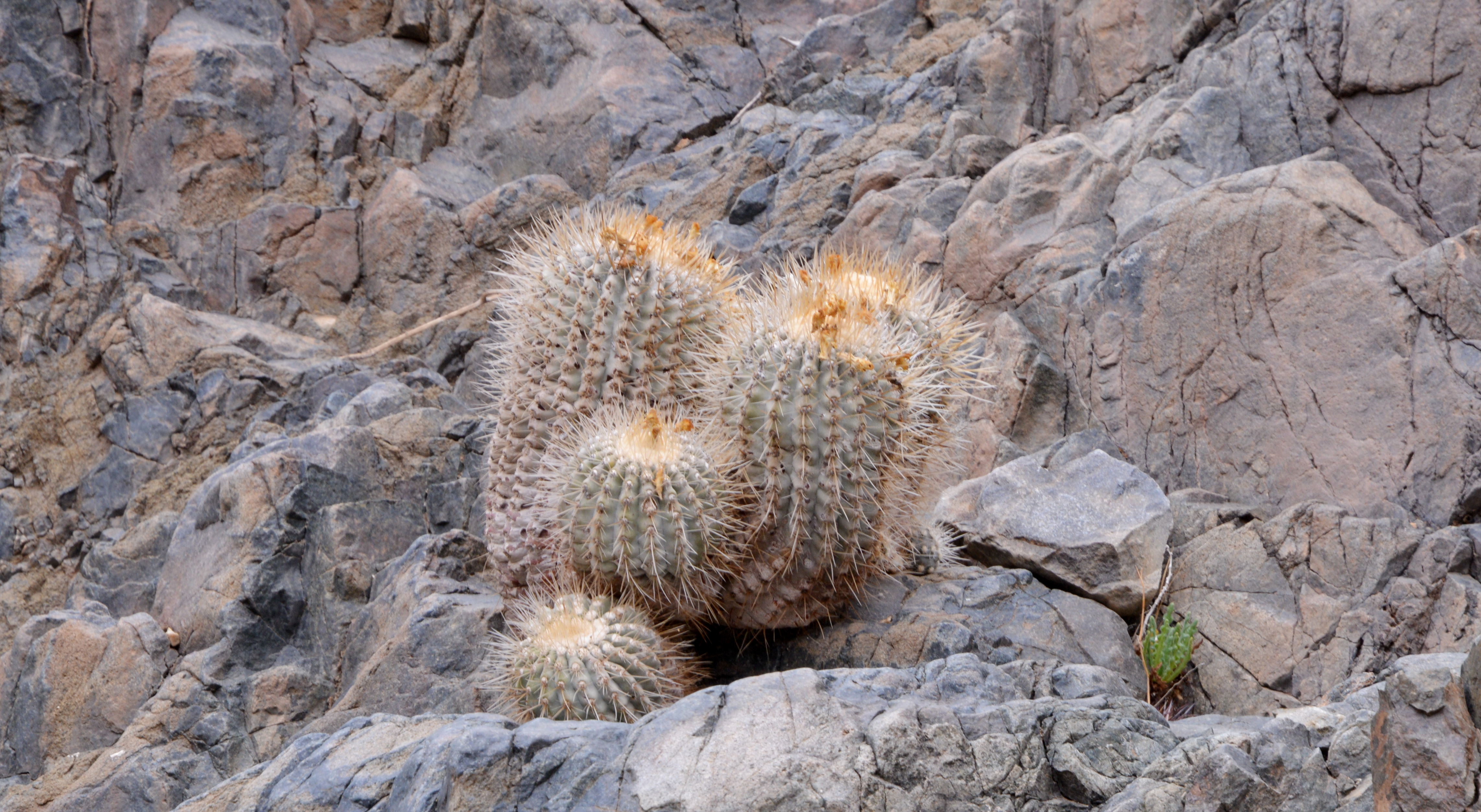
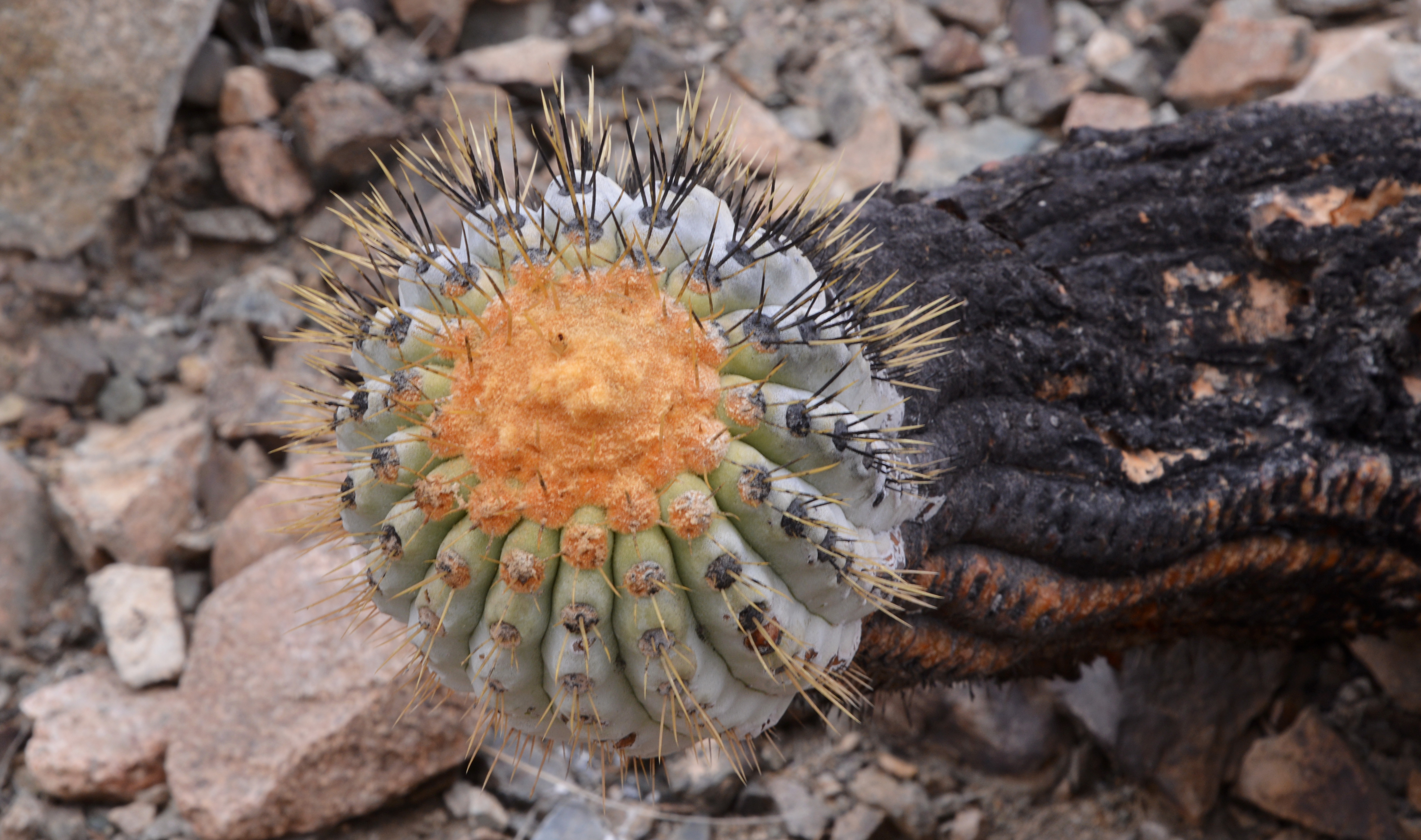
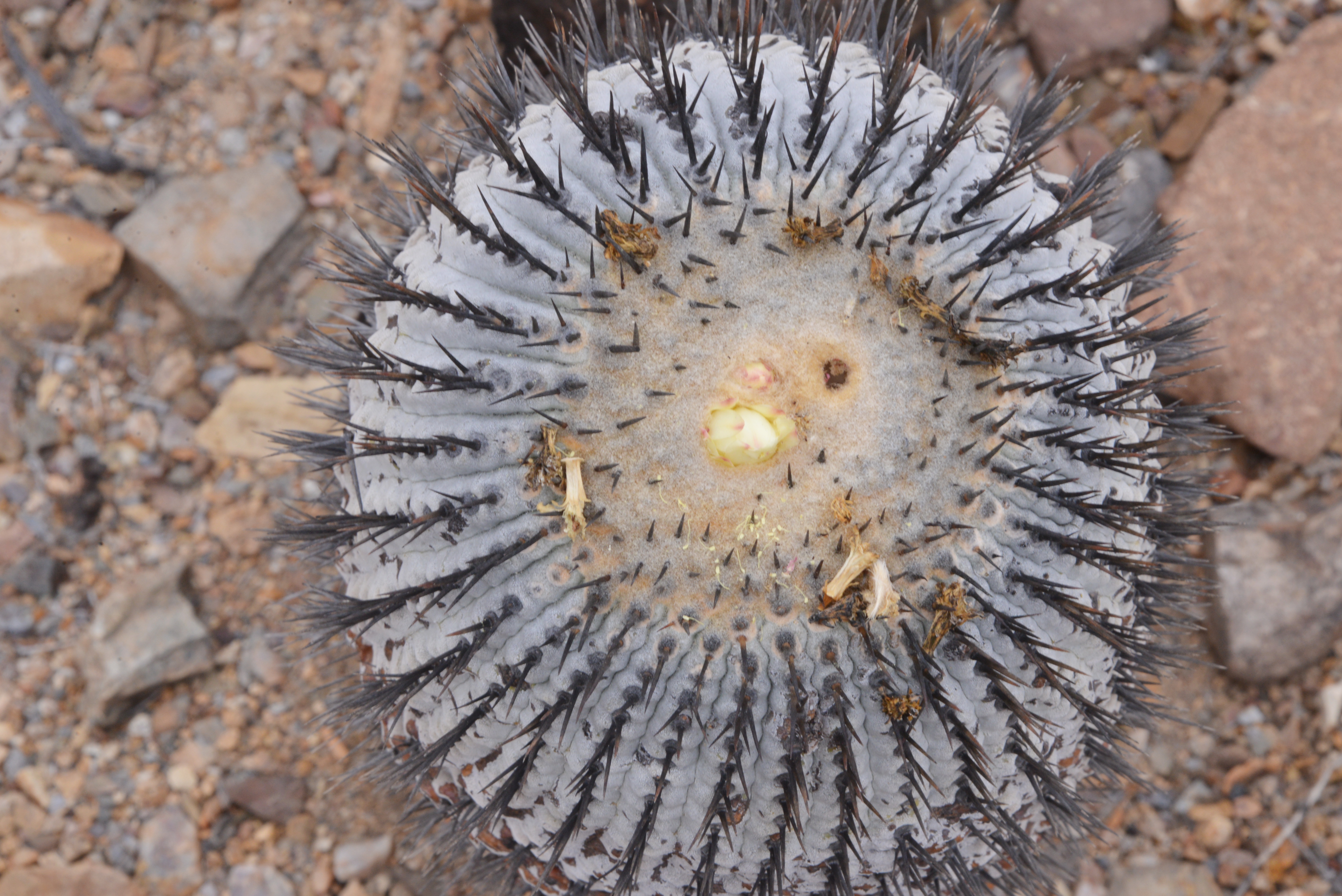
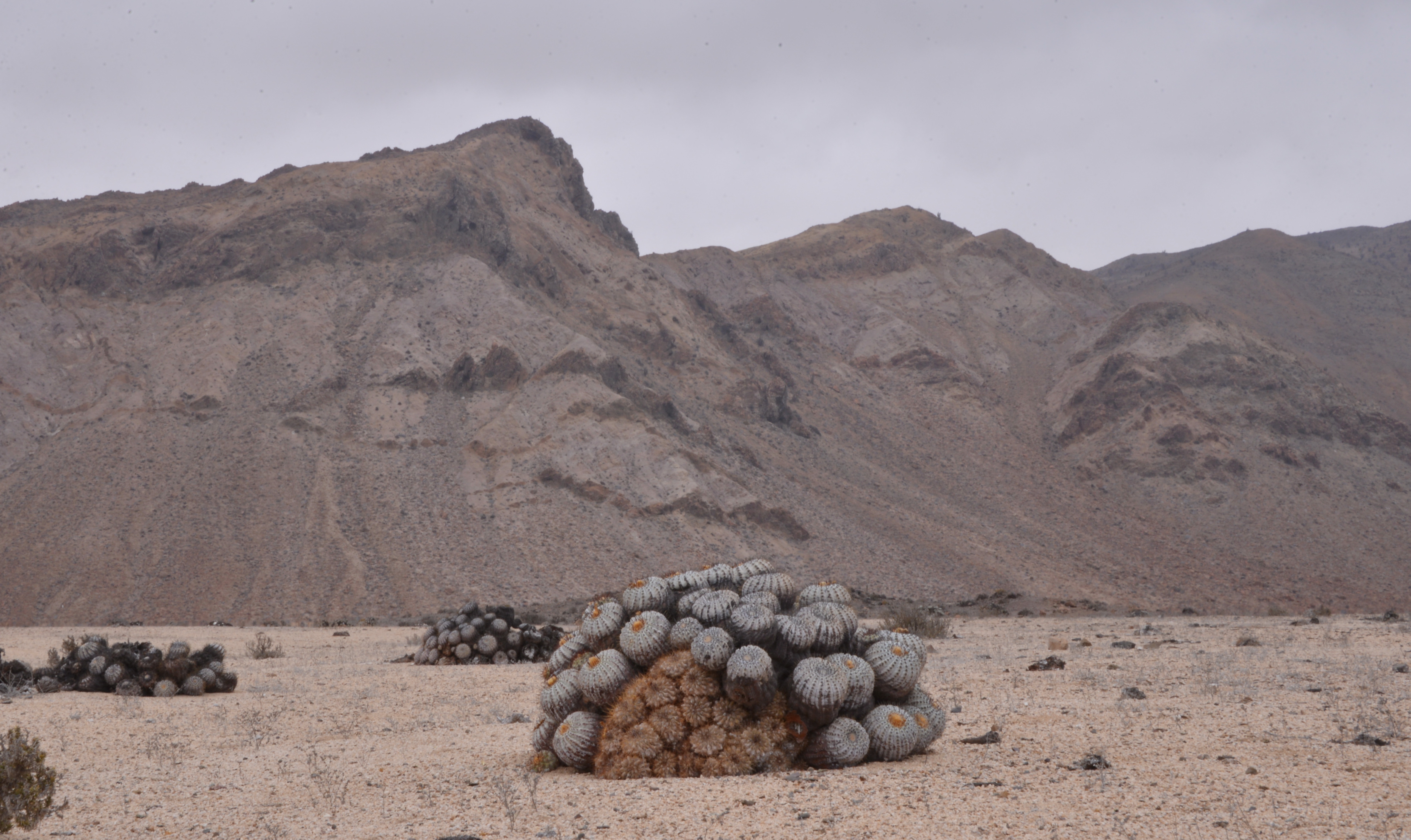
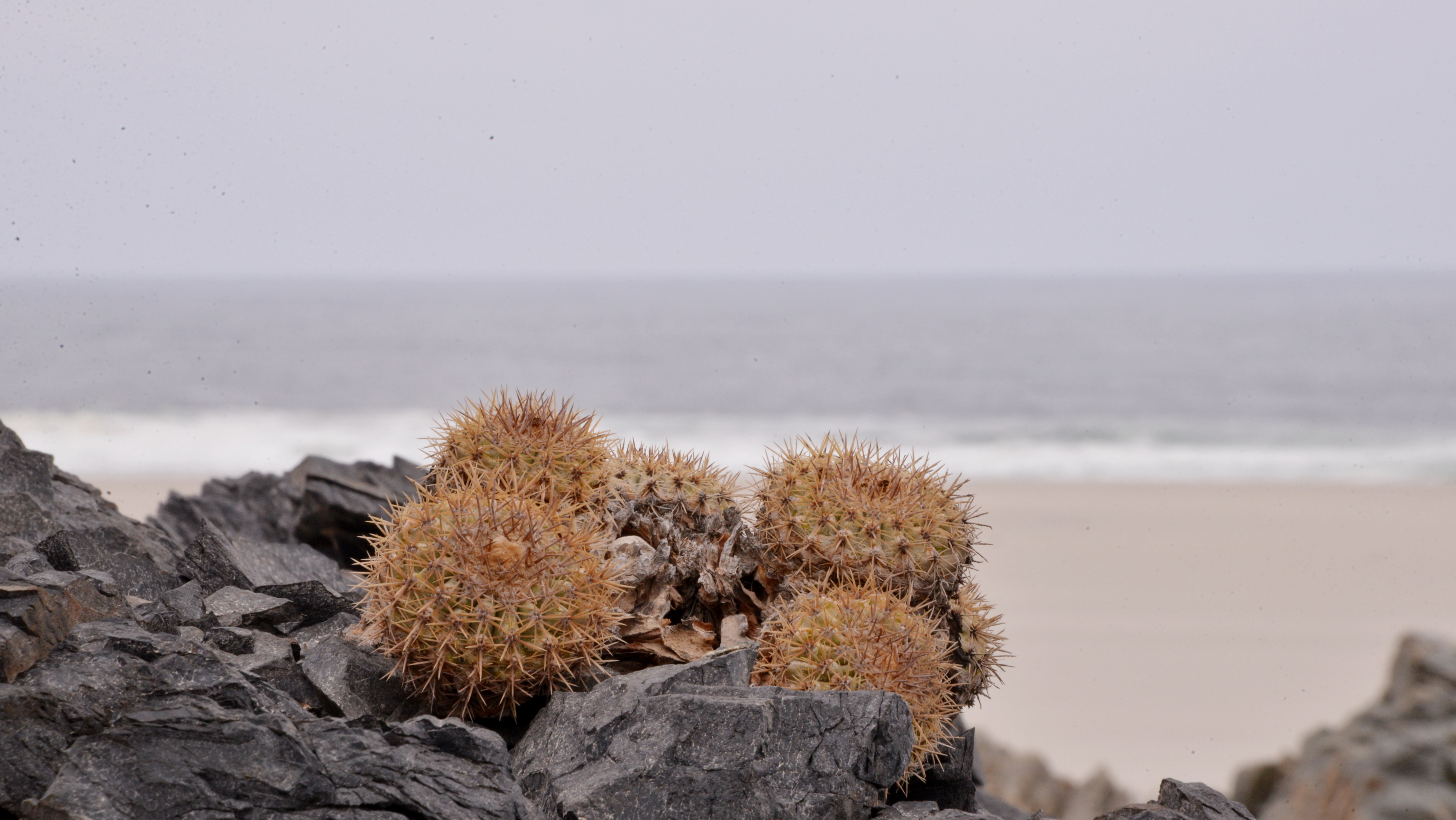
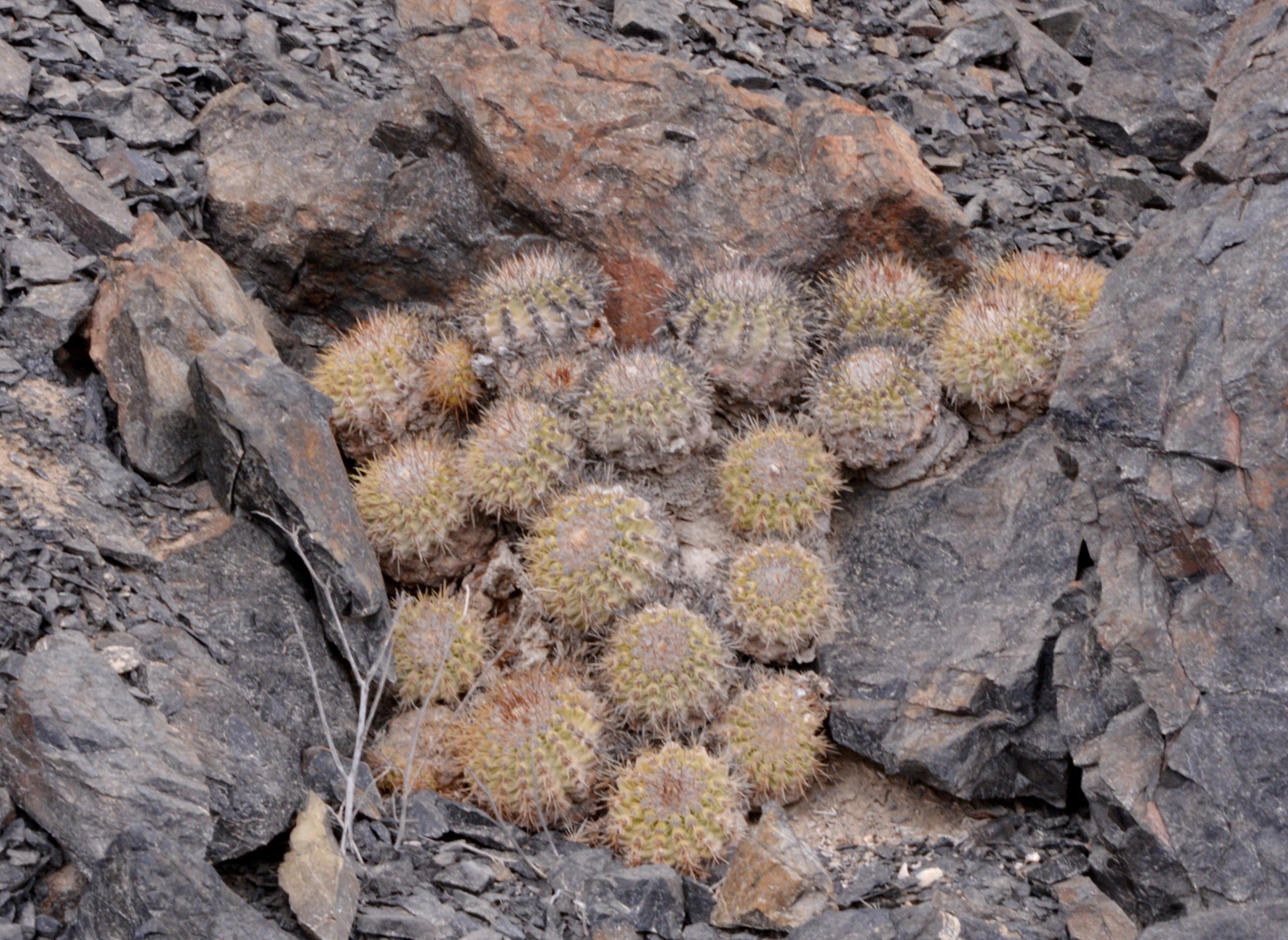
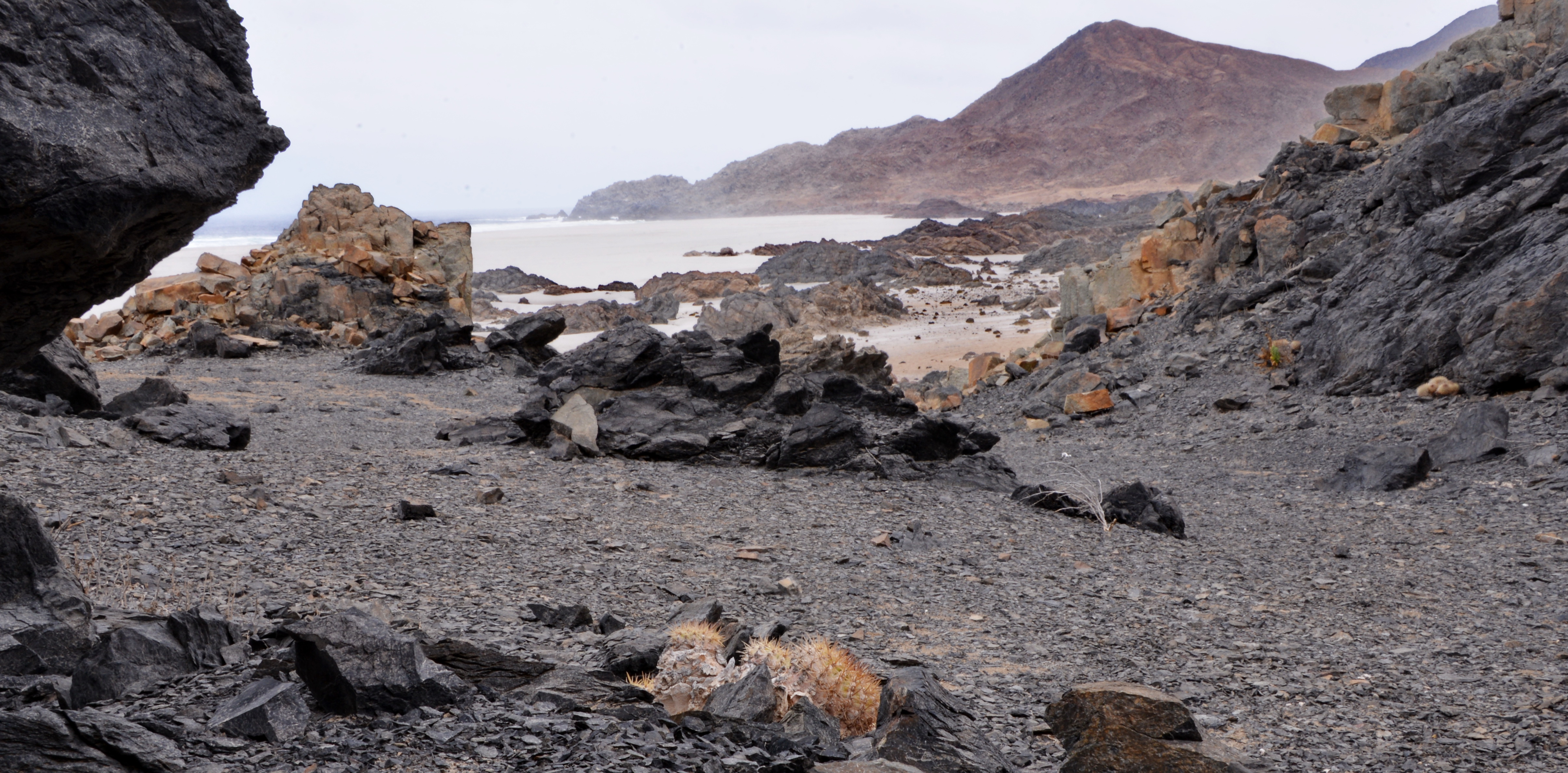
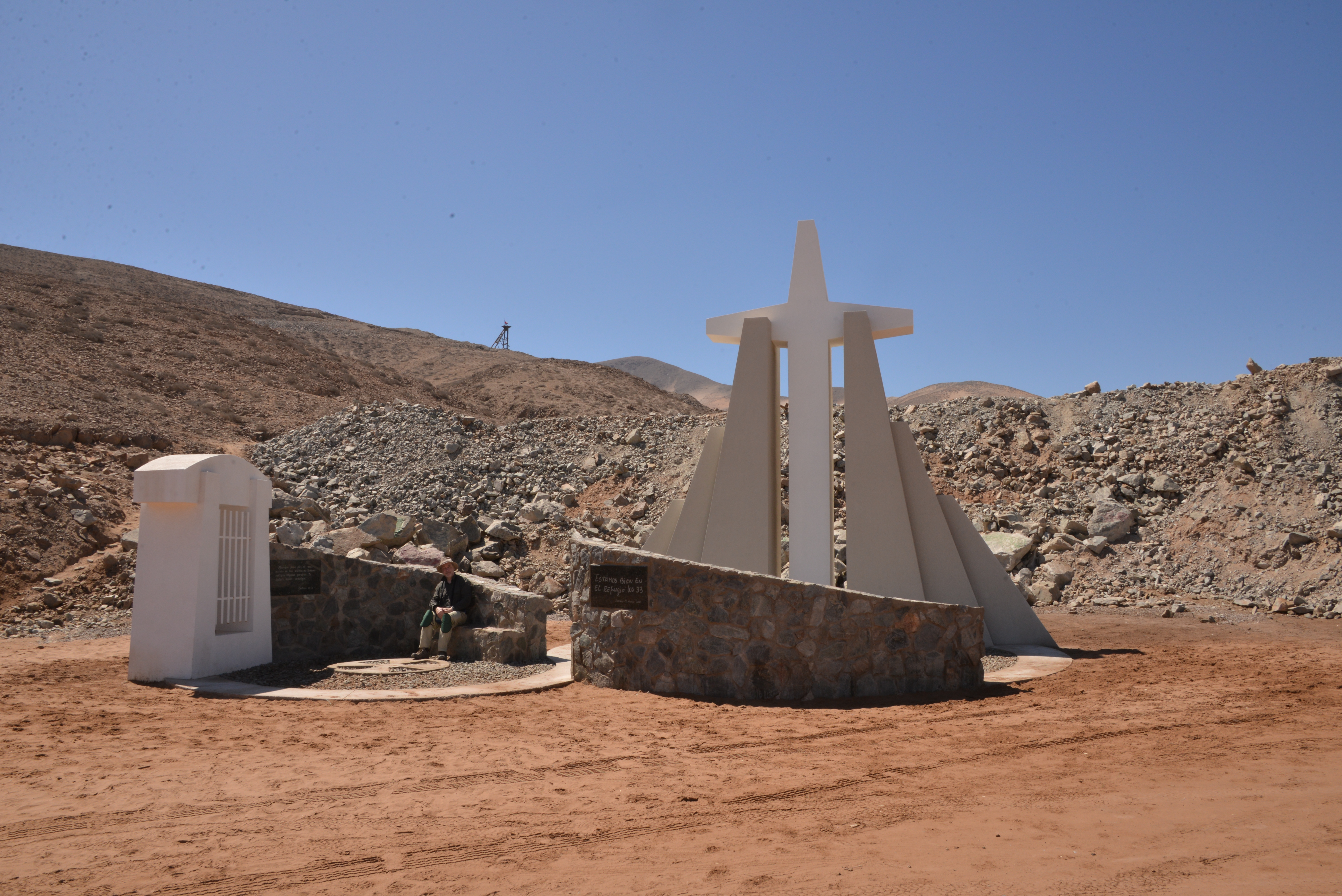
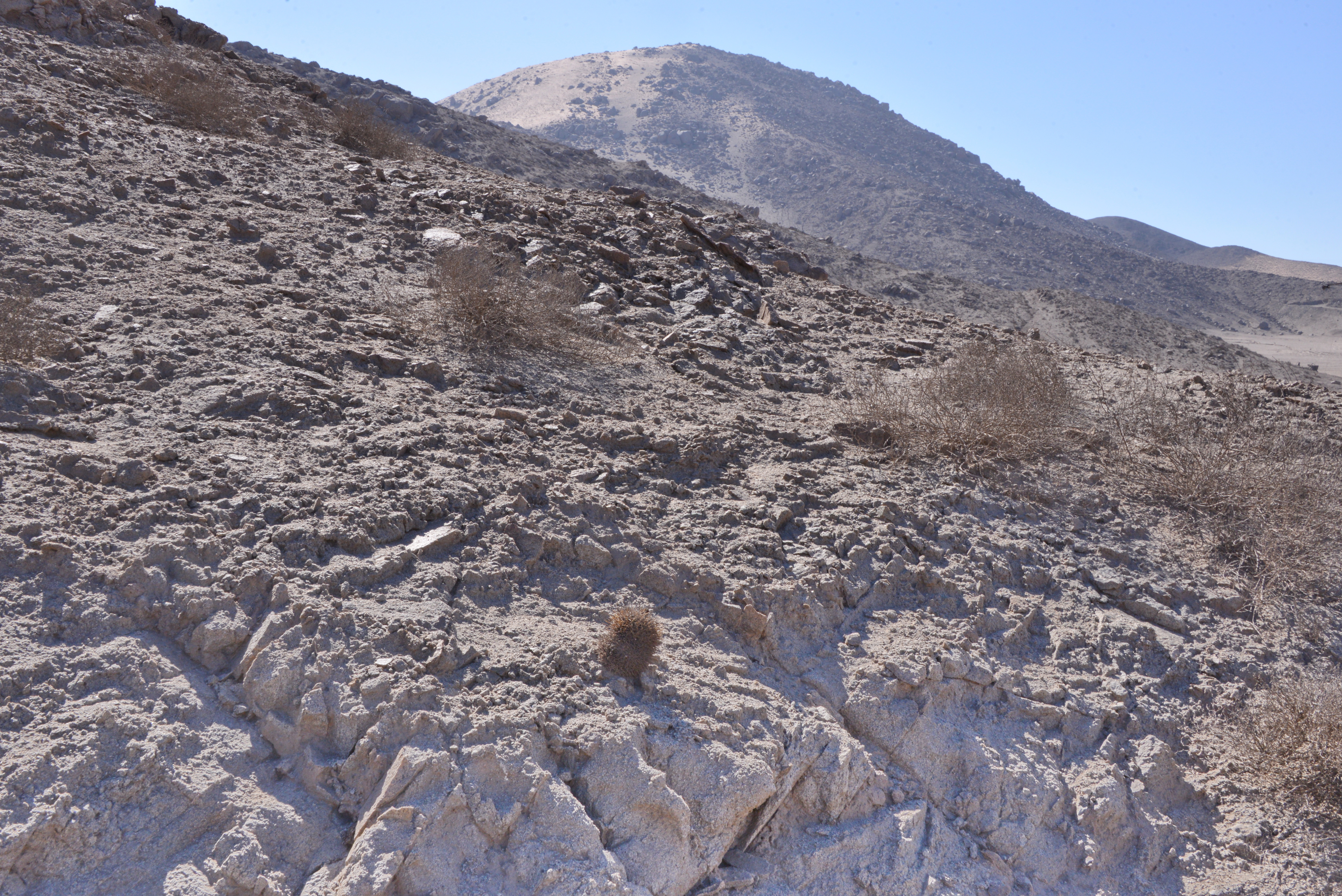
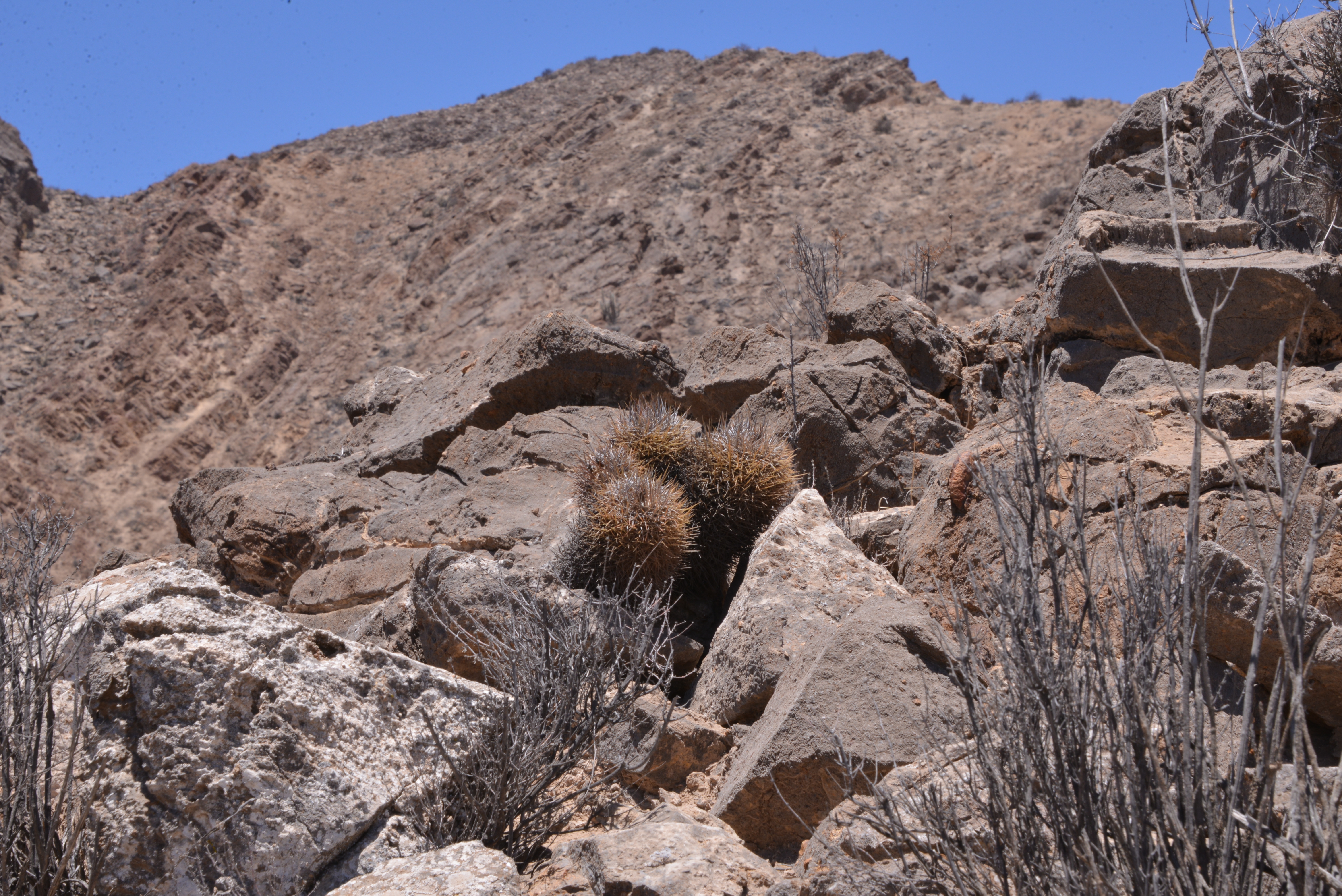
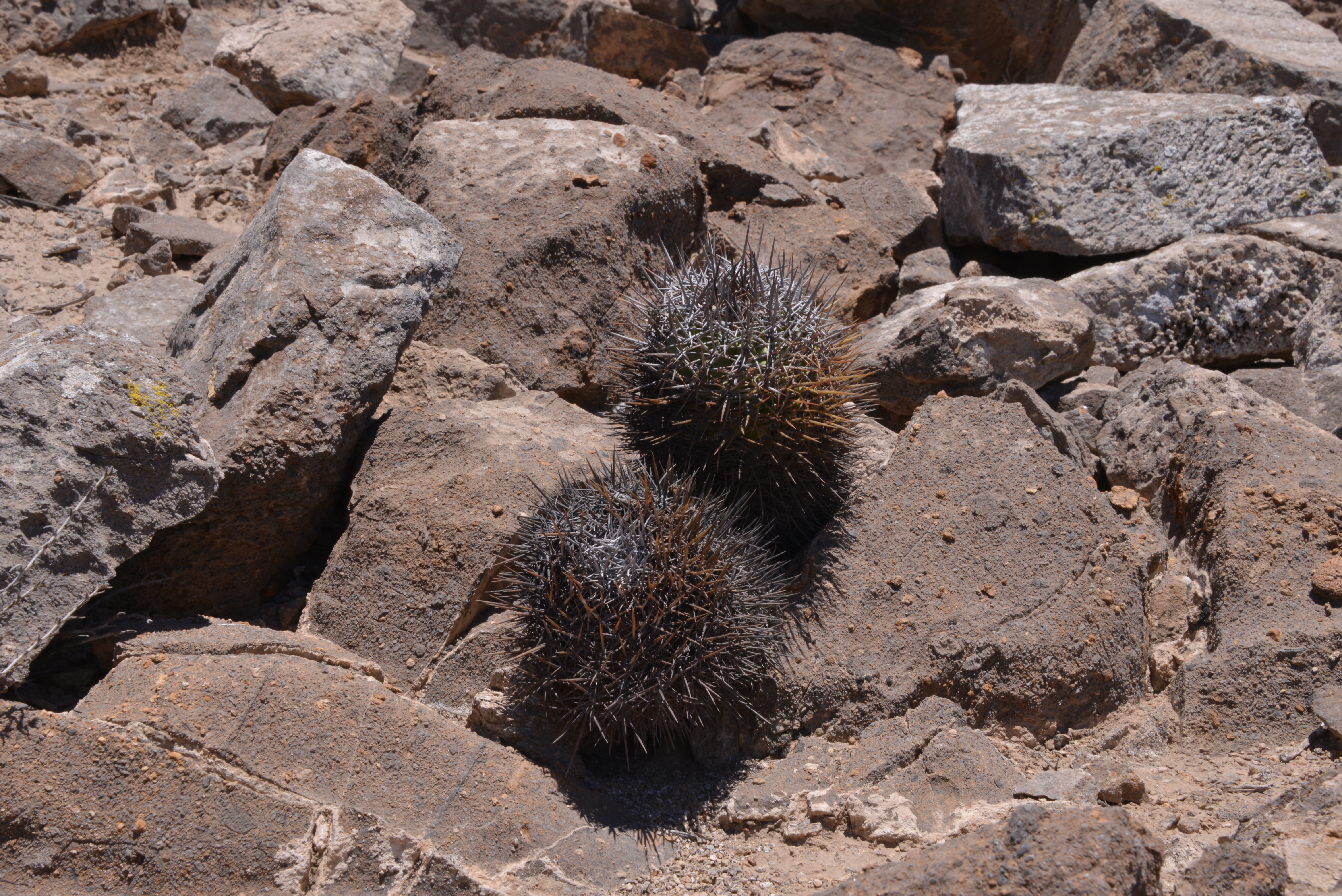
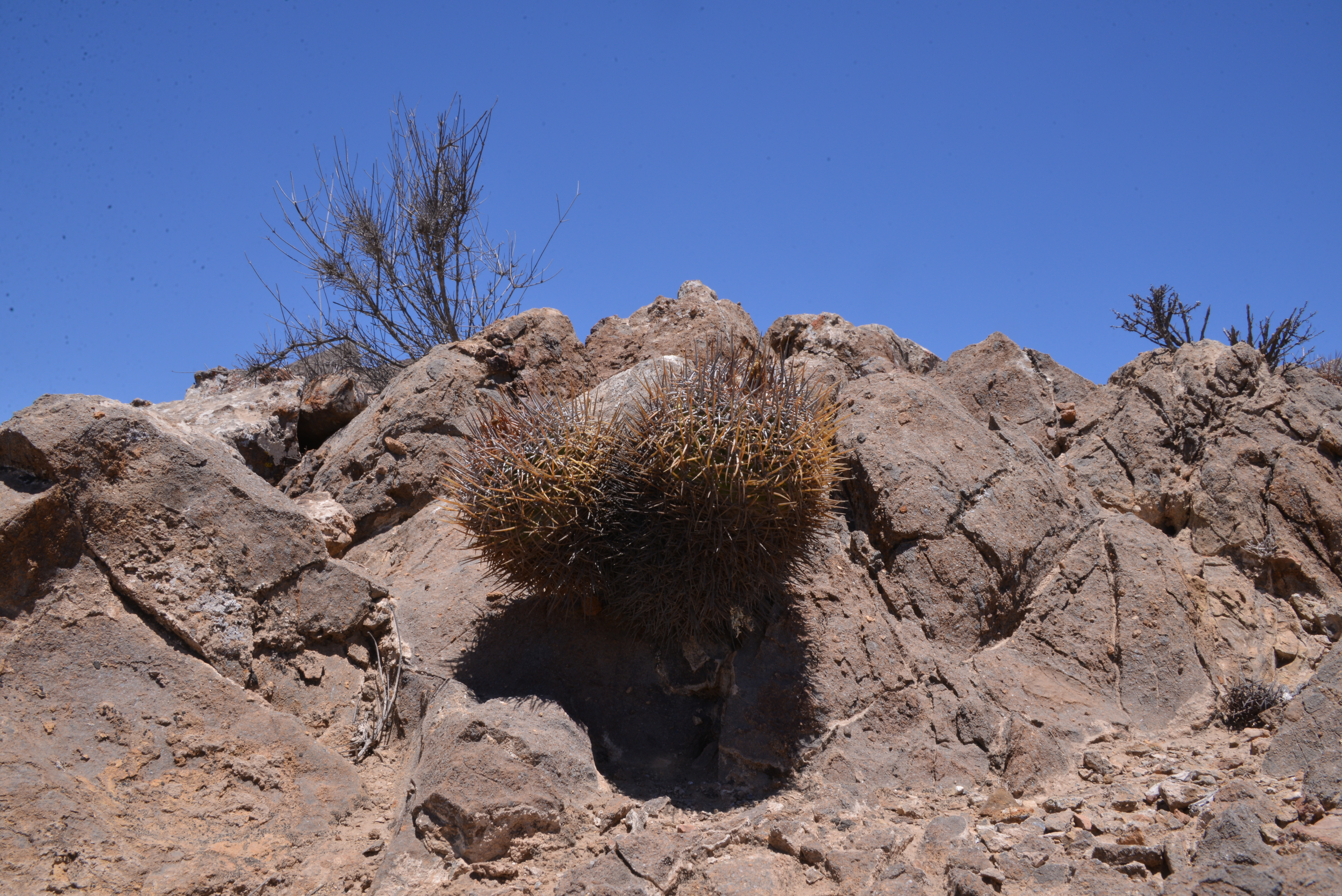
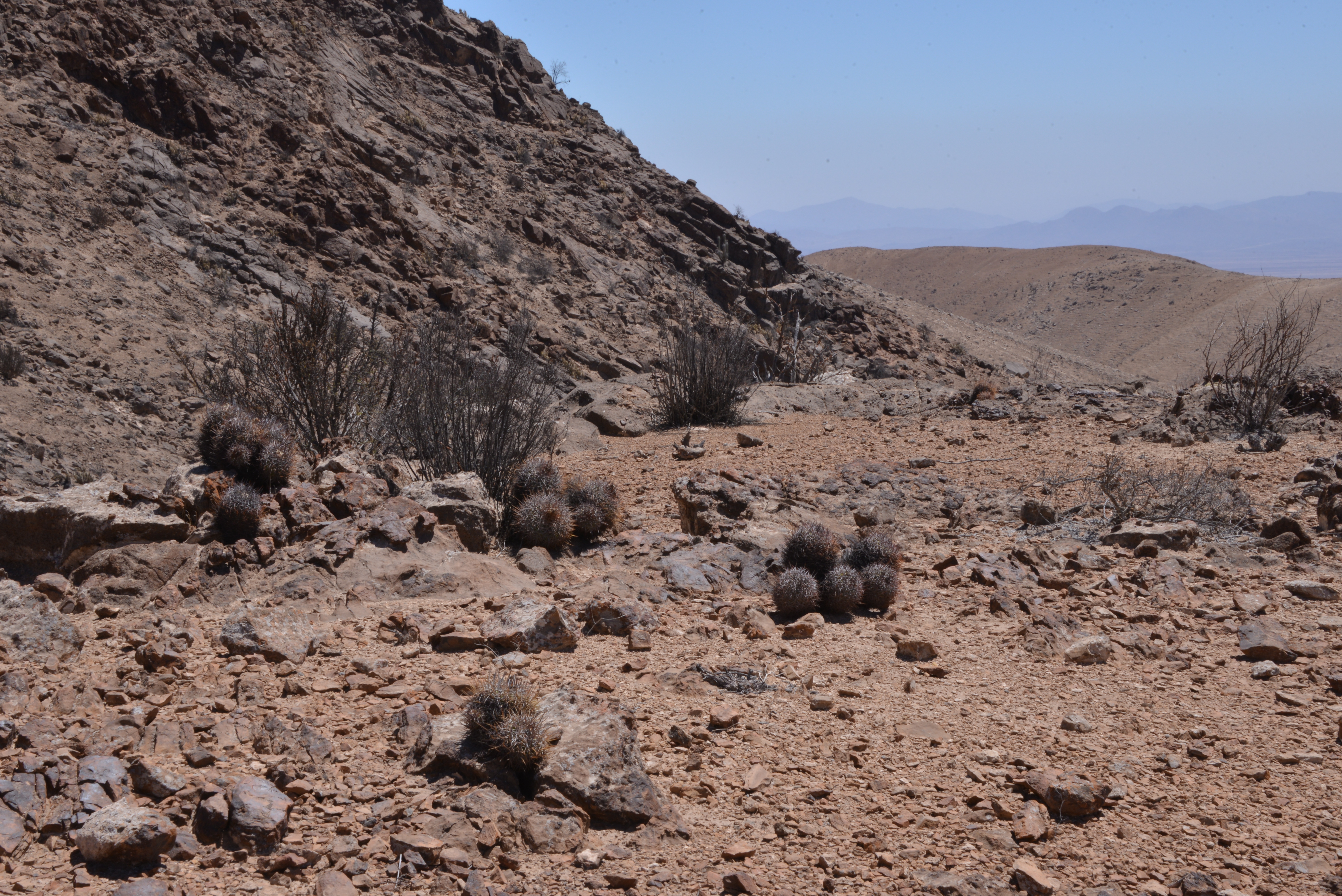
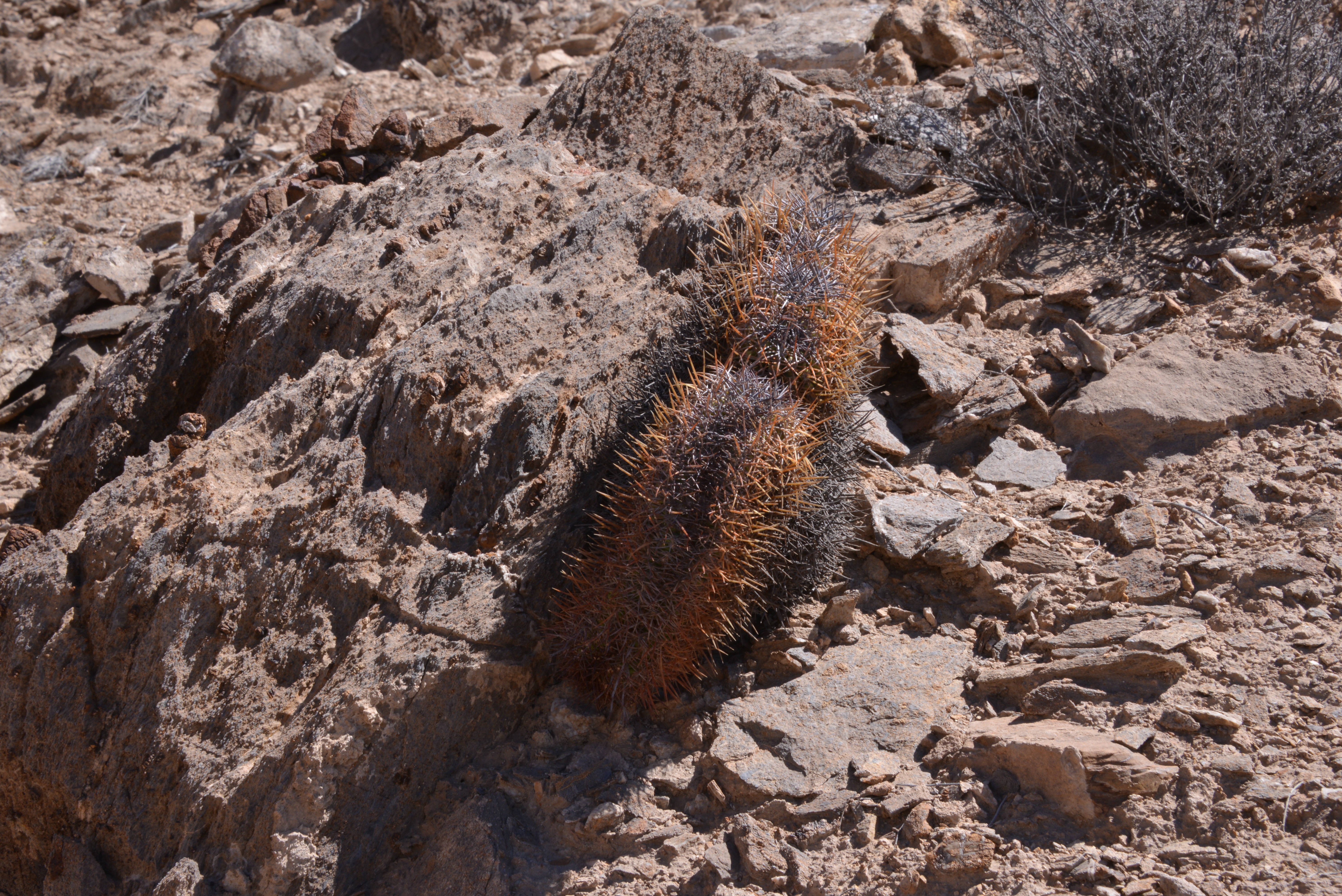
We had gone to Domeyko and stopped at km 16.4 – Ritter’s location for C. domeykoensis – these days just another C. coquimbana. Most of the plants at the base of the rock (one of the windiest places I know) looked dead, but a bit higher on the rocks was one nice plant and when I got to that, two more a bit higher up and so on, so that I ended up much higher than ever before, nearly being blown away in the process. Very nice stop, although for the first 24 images I still had my camera set to ISO 6,400 leading to the most overexposed images ever – but amazingly still rescuable as ‘for the record’ images. Luckily I was able to retake many of the images before we drove on.(S2944).

 S2944Copiapoa coquimbana - Ritter's  domeykoensis

S2944Copiapoa coquimbana – Ritter’s ‘domeykoensis’

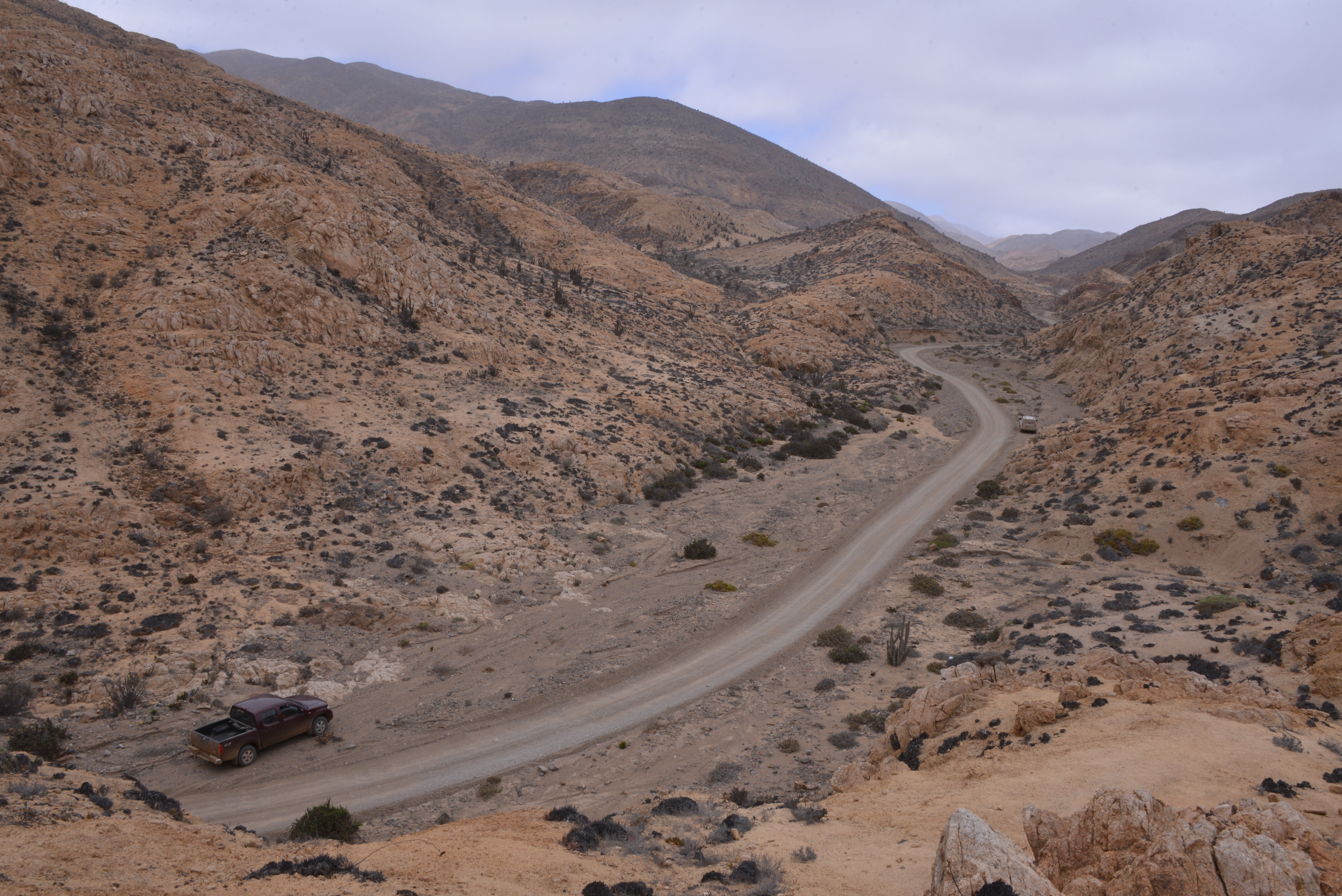
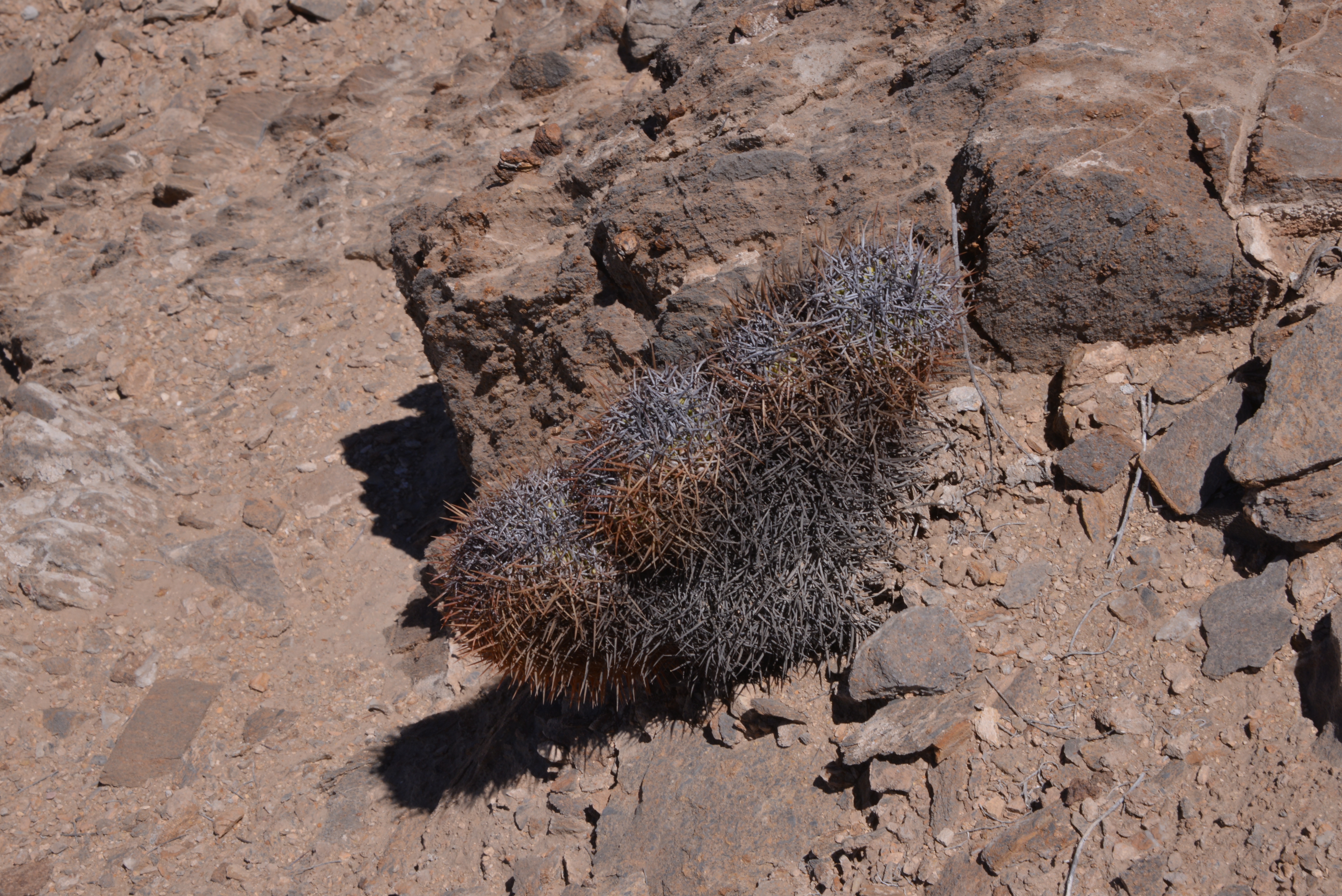
I wanted to go to take a look at the El Sarco road and when we got to the junction there was a fine compacted gravel road – rather like Argentina, that allowed speeds of up to 80 – 90 km p. hr., sign posted to El Morado. Not familiar with that name but pleased to have such a good track compared to the previous bumps & grinds, we followed it for some 40 km when I decided that something was wrong. I had stopped seeing Eulychnia chorosensis and found E. acida instead. SatNav was completely lost, floating in nothingness, but when I zoomed out it seemed to have turned north! Time to take stock. (S2945). With just one car in an area where we had seen no other car for hours on end, with time ticking on, I suggested going back the way we came – making a GPS note of our turn around time to check where we had gotten to – I expect close to Labrar and the chimneys!
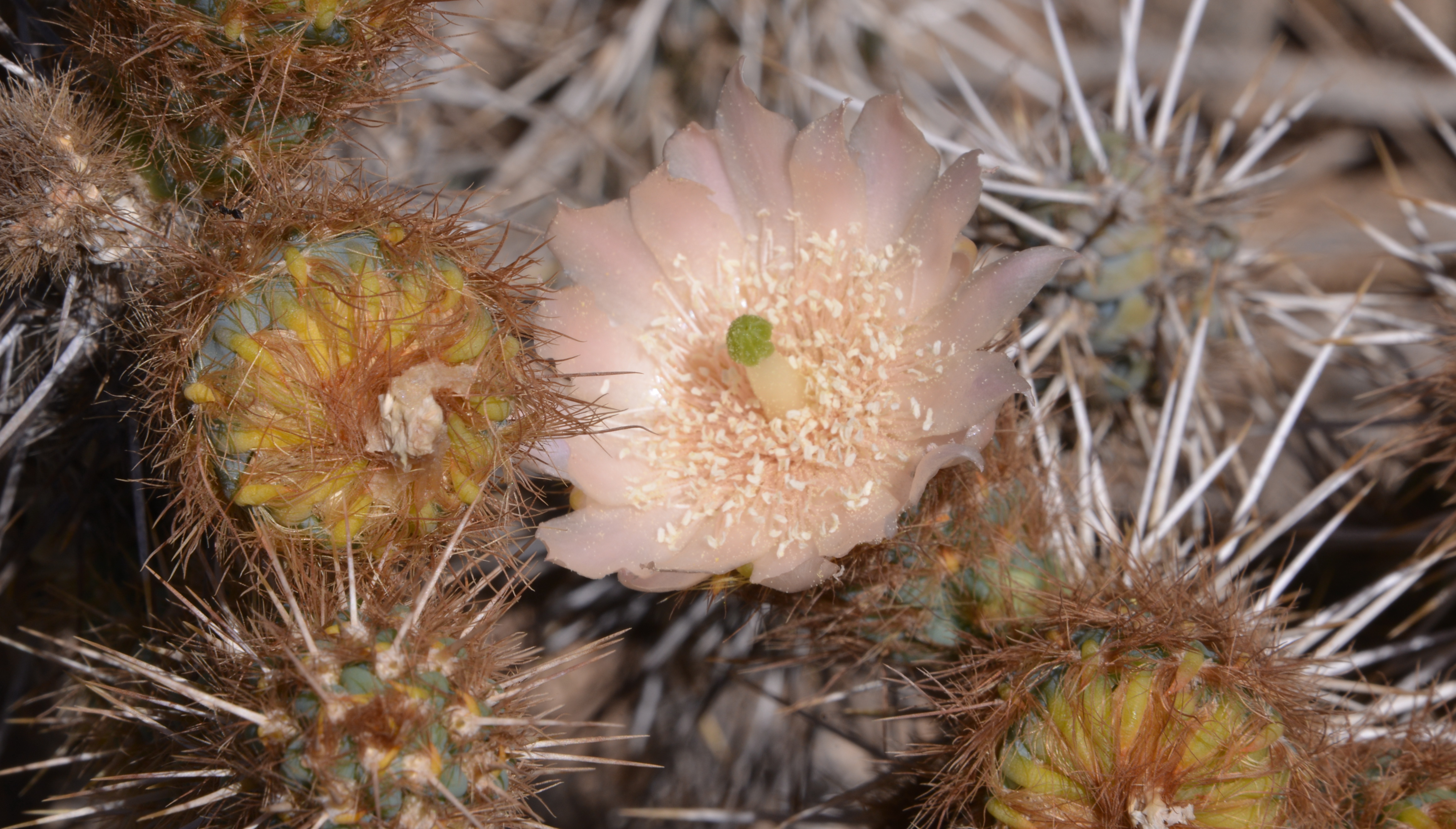
S2945 Miqueliopunia miquelii

S2945 Miqueliopunia miquelii

Back at the crossroads there seemed to be time for a nosy around Carrizalillo, where we had arrived on previous trips after a journey through very soft white sand. It seems that Nessy has limited 4×4 capability after all, but again, this was more a scouting trip to see if there was now a proper road or still a maze of tracks through soft sand. The latter! 😦 so we decided to go back the long way round, the way we had come. Imagine my surprise when some 20 km after we got back on track from the El Morado track, there was another turn, this time to Bahia Sarco – we had taken the wrong turning! Oops. We decided to leave that track (again, looking good at the junction) for another time.

We might have gotten back to Vallenar around 5, in time for a double Expresso and a slice of cake opposite the old Vallenar Copec.

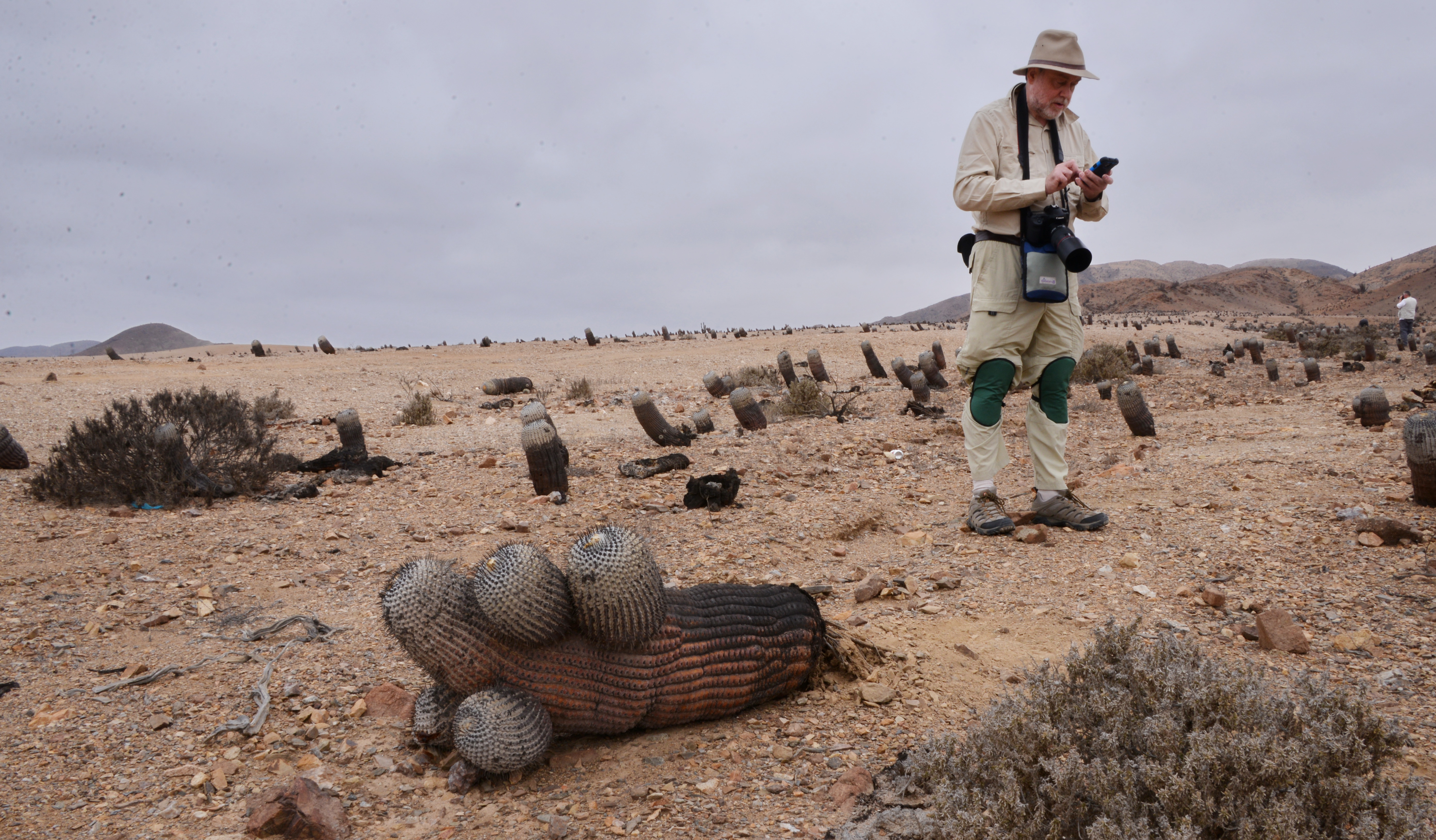
As we passed km 16.4 again, JYC wondered if it was still windy, so I wanted to slow down to let him get out, BUT: no clutch pedal!! I used the brakes to slow down, worried that the rubber mat might have got caught over the clutch pedal but no – it seemed to have disappeared. I brought the car to a halt and let it stall – so no danger of a burned out clutch! Once I got on my knees, I found that the clutch pedal was just flopping around – either a broken cable or a failed hydraulic cylinder, what ever they use on this model. Not something you can fix with a screwdriver and a pair of nail clippers!

A truck stopped and the driver took a brief look and said that the clutch cable had gone – fluent in Spanish, not English.

With my limited mechanical knowledge matched by JYC, I worked out (from an old trick learned from my late father-in-law) that you can bump start a car using the starter motor to get it moving – a bit unusual, ‘cause usually a car not starting is caused by a flat battery, so no starter motor turning. I put the car in second, gave it a go and by the third turn, it burst into life! We were soon moving in second at 40 km.p.hr. at 4,000 revs – when Cliff would have shouted ‘change gear!’ but without that option available. And so we arrived at the Domeyko junction with R5, here a dual carriage way, with road works. I chickened out, 20 m before the junction – starting from Stop (Pare), crossing a dual carriage way to join the far carriageway and immediately climbing a hill was too much with the potential of huge trucks hammering down the previous hillside to kick you up the backside or worse.(S2947).

S2947 - car breakdown!

S2947 – car breakdown!

There are a huge array of radio masts on the hills around the junction, so JYC tried out his mobile phone reception and we managed to speak with rental cars.com in England. Great to hear an English voice offering help, even though it was a long distance away. He would ring Santiago – ten minutes later, no calls yet – It seemed best if we rang Santiago – great, but what is the number? Nothing on any of the documents! England gave us the Santiago number, but each time we dialled it, a nice Chilean lady from Entel spoke a recorded message explaining that we had dialled the wrong number or something like that. Back to London (or was it Manchester?) on JYC’s UK phone (costs can be claimed from the insurance) who said that they were able to dial the number, listen to the message that suggested that we should insert an extra ‘2’ Ah, we had understood ‘drop the 2’ so by putting two ‘2’s in we got though. ‘Do you speak English?’ ‘Yes’ came the reassuring reply! By this time, JYC had walked to R5 where a police car was flagging down cars for routine checks on their papers. Neither spoke each other’s language, but JYC managed to persuade the officer to drive him back to our car – ‘first ride in Chilean police car by a Copiapoathoner!’ The officer was using translation software on his iPhone to facilitate the process – very clever!

From then on in, anxiety levels faded away – our new friend in Santiago would contact a towing company in Vallenar to pick us and the car up and take us back to Hosteria Vallenar. He would ring the Hosteria, explain the problem and book us in for an extra night and he would despatch another truck with a replacement car from Santiago to be delivered in Vallenar tomorrow around midday. Wow – a very impressive service all-round! Thank you all!

We got in by 22:45 with the restaurant closing at 23:00 hrs, so just made it – staff agreed to stay open for us and made us chicken and fillet steak respectively washed down with beer.

All’s well that ends well! It could have been so much worse! Lucky us – again. Just the matter of waiting for a new car to arrive and we can continue the adventure.
Wednesday, 13 November 2013 – Caldera to Vallenar

There was no breakfast included with our stay at Mirador, so we managed to get breakfast at Puerto del Sol – not a bad set up – the rooms in Mirador were better!

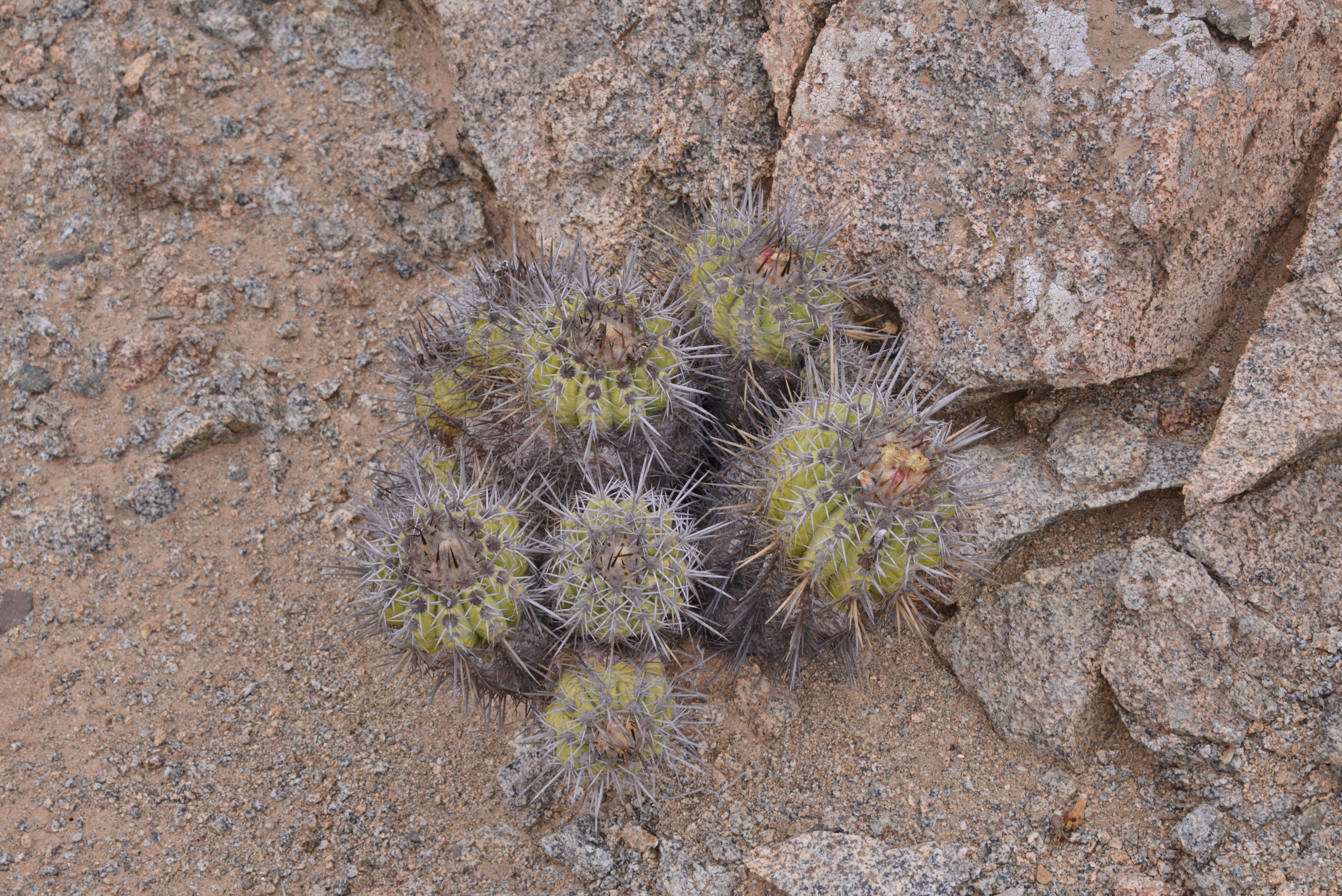
Having only seen a few plants of C. marginata on the Bahia Inglesa side of the Morro, today we went to take a look at the other side – one stop at a track a bit too far down – where we stopped in 2003 while the others were fossil hunting (S2936)

S2936 Copiapoa marginata at its Type Location

S2936 Copiapoa marginata at its Type Location

and finally our traditional stop. (S2938). This is also the TL for Eriosyce (Thelocephala) odieri, but where were they hiding? At long last I found one plant, level with the soil and covered with remains of an annual that had disappeared a long time ago. I found one more nearby, this time a five headed clump. I could relax with my pride intact – but I’m glad that it’s not this year that I am planning a Chilean Thelothon!

S2938 Eriosyce (Thelocephala) odieri

S2938 Eriosyce (Thelocephala) odieri at its Type Locality

As C. marginata still keyed out as C. echinoides on JYC’s app. it was time to look for the real thing at Totoral, but not before I spotted a large number of what I believe these days passes under the name C. megarhiza spp borealis, formerly Ritter’s C. echinata (S2941).

S2941 Copiapoa megarhiza ssp borealis - syn. Copiapoa echinata

S2941 Copiapoa megarhiza ssp borealis – syn. Copiapoa echinata

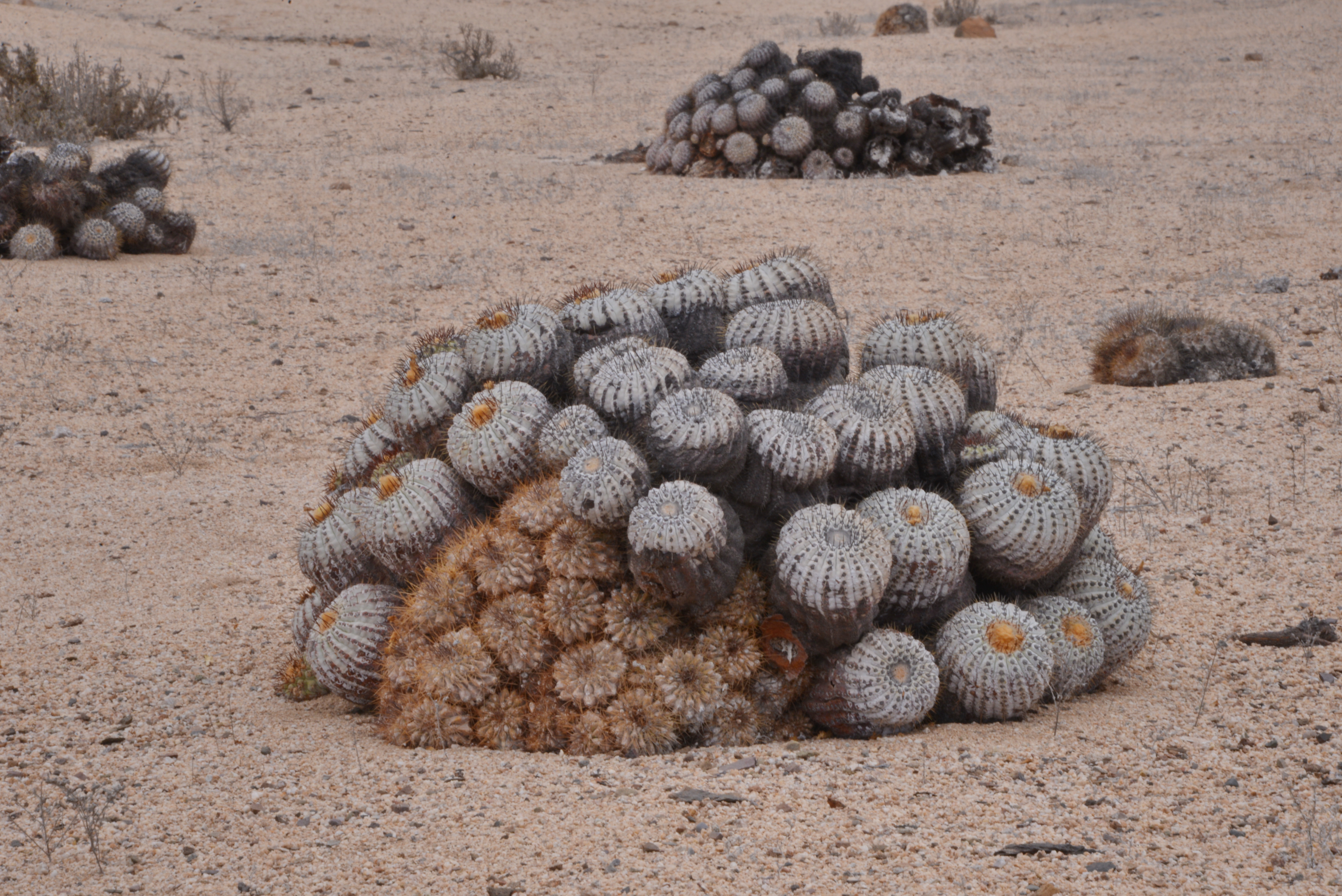
We were not disappointed, closer to Totoral and found the C. echinoides (S2942 and S2943).

 S2943 Copiapoa echinoides

S2943 Copiapoa echinoides

With the Copiapoa for today out of the way, we could head for Vallenar where we are booked into the Hosteria for the next two nights. We ended up at the Pizzaria on the Plaza out of habit I guess and were not the only ones: Brendan & Lucy wondered in half way through our meal – this is a Copiapoathoner’s rendez-vous after all, just read the 2003 story when taxi drivers took us all over Copiapo!

At least we have a good wifi signal for two days, so that I can keep up with the Diaries!

Tuesday, 12 November 2013 – Taltal to Caldera

Sadly time had come to say ‘see you later’ to Bart & Marijke and Brendan & Lucy. There was a last minute panic while JYC remembered that he had left his trip logger in Brendan’s car, but that was retrieved before they set out on the exploits.

We took the traditional Welcome to Taltal picture – it seems more appropriate when you leave – kind of preparation for the next visit.

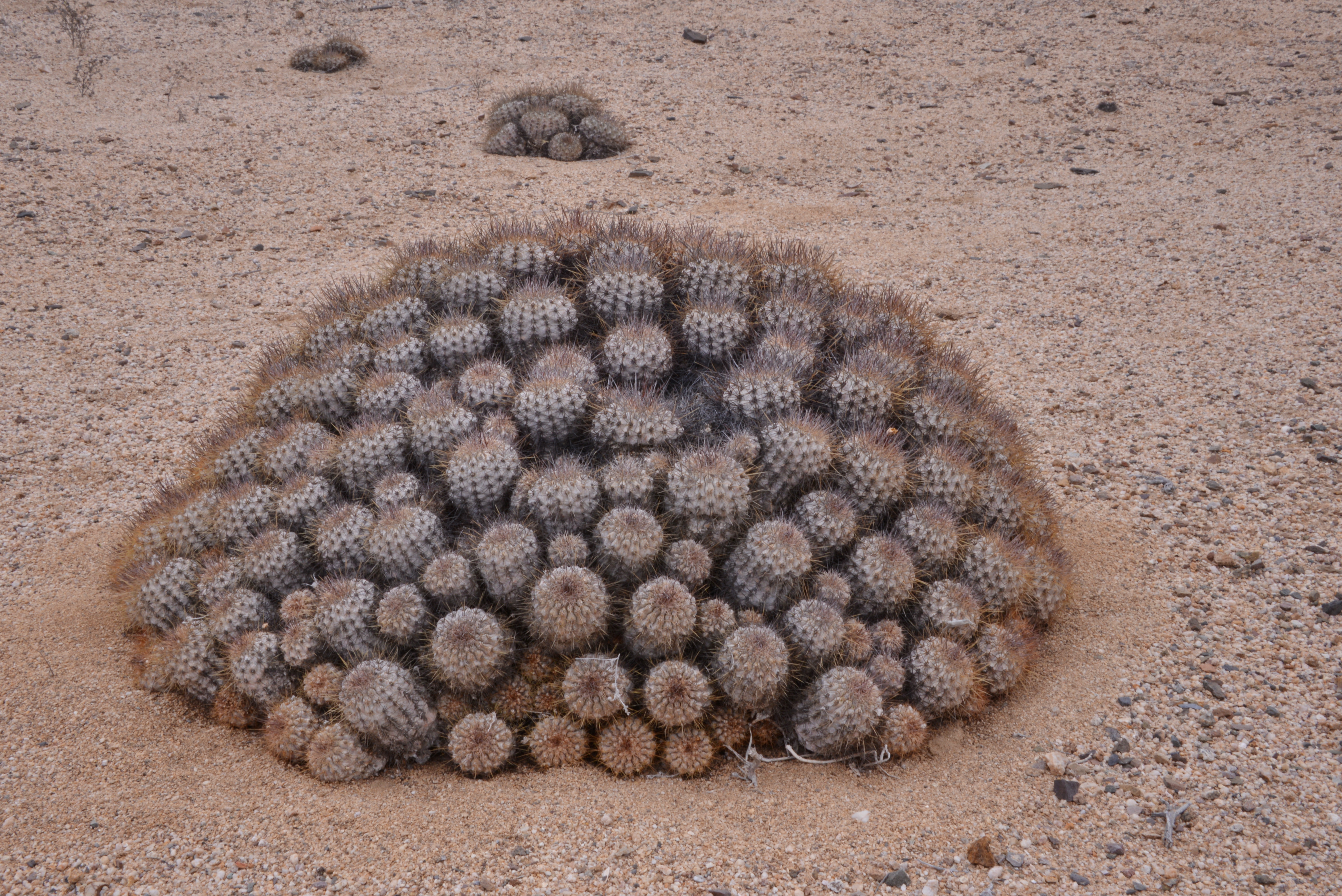
We decided to go home through the Pan de Azucar and could not pass Smiler without another visit – he says hello!(S2934)  I remembered that I had seen a couple of C. serpentisulcata there in 2003 – towards the back of the place (or front, depending which way you’re facing). I was surprised that I had remembered correctly and that they were still there. JYC keyed them into his Copiapoa ID App and it reported them as C. serpentisulcata without any help from me, so well done!

S2934 Copiapoa serpentisulcata

S2934 Copiapoa serpentisulcata

A quick Expresso & Hot Dog at the Copec in Caldera and a drive through the town – seemed tidier since previous visits! and on to Bahia Inglesa and Morro Copiapo as JYC still needed to see C. marginata (C. bridgesii ‘cultivated’ in Pan de Azucar’s Cactarium does not count). We stayed at the bay side of the Morro (S2935) as time was clicking by and we still needed accommodation. We found a few plants that keyed out as C. echinoides. Bit more work to be done.
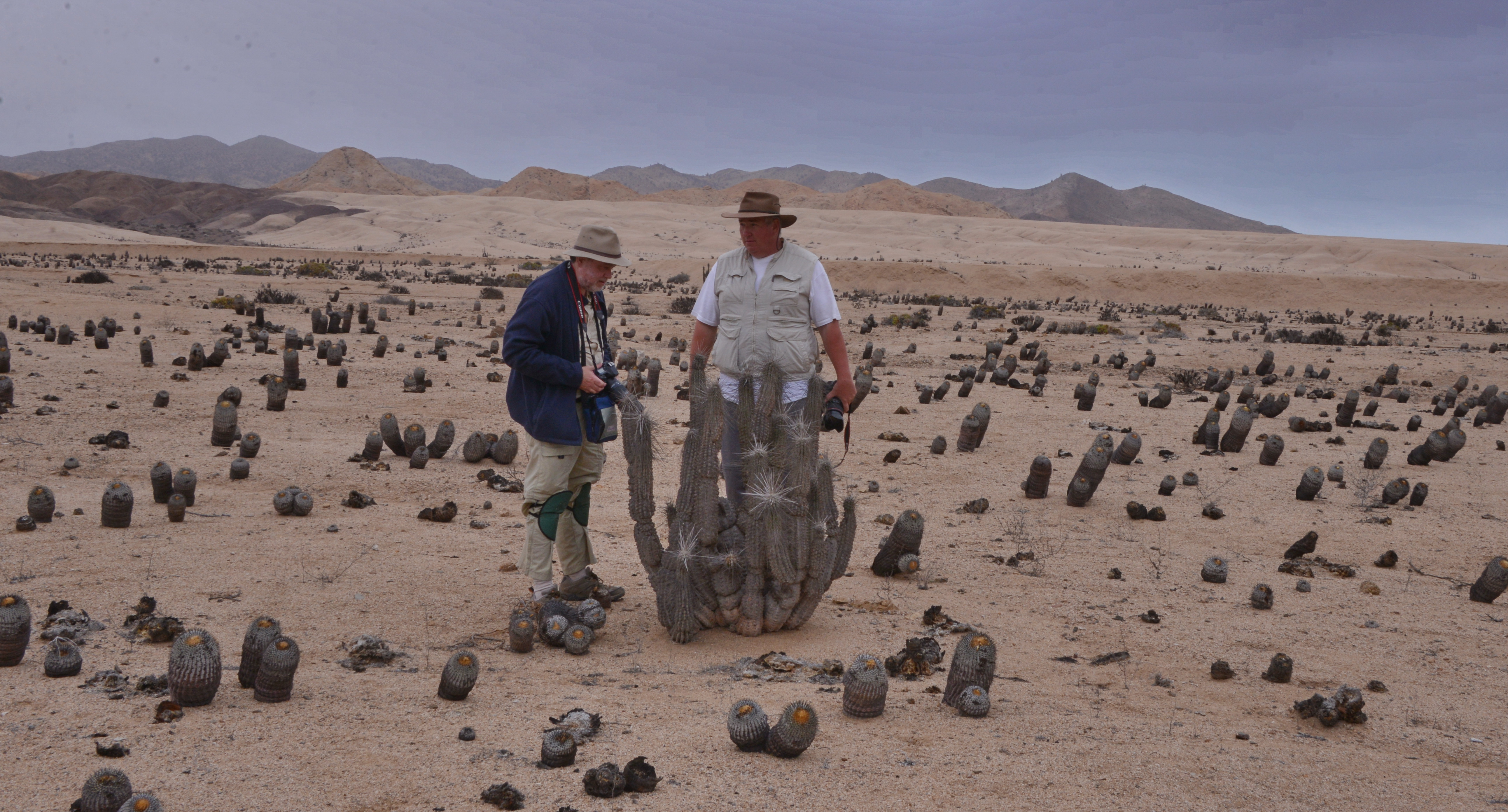
S2935 Jonathan keys out details for Copiapoa marginata

S2935 Jonathan keys out details for Copiapoa marginata

Accommodation turned out to be a problem. There was a mining conference on (in Roccas de Bahia? There was a fleet of some 30 cars waiting outside!) but the hotel that Brendan & Lucy had tried earlier was full too. So on to Caldera where we first tried Puerto del Sol – full. Time was moving on now and I thought about heading for Vallenar, but e.t.a. there would have been close to 21:00. So I tried SatNav which found a new (to us) hotel, Mirador, on the outskirts of town. They were full too, but the owner was keen to squeeze us in and showed us the emergency room, next to the office. One double bed only and while JYC & I remain good friends, not THAT good!

Another room was found, this time with 2 beds, so all was well. But where to eat? Puerto del Sol was good last time and the Dutch speaking waiter let us in. Sorted!

Monday, 11 November 2013 – Around Taltal: Cerro Perales

After two relatively active days, Bart had suggested an easy day today – 10 a.m start and an leisurely drive, with Bart & Brendan driving, up to Cerro Perales (S29. The track for the first part of the journey trip had been greatly improved – even the man at ‘Three Palm Farm’ had tidied his yard and put his pig in a sty!

Farther along the track had some rough patches but no worse than on previous occasions. Once at the top, I enjoyed the view (unlike 2001, it was a clear day) and the plants (Ritter’s C. tenabrosa) as usual (S2931).

 S2931A particularly tightly spined (dehydrated?) Copiapoa cinerea - Ritter's C .tenabrosa)

S2931A particularly tightly spined (dehydrated?) Copiapoa cinerea – Ritter’s C .tenabrosa)

Sad to see that the fog nets were reduced to a pile of rubble, but I guess that it had only been an experimental site and the experiment seemed to have been finished some time ago. Bart mentioned that he had data that suggested that there is a population of C. krainziana just 500 m from the top of Perales! Wow!!

But looking at maps & GPS it seemed to me ‘500 m as the crow flies’, which would mean 3 km down & up steep hills. I had been expecting an easy day – no walking boots, no water, no oatmeal cookies! I ruled myself out of the exploration. As did Marijke & Lucy. JYC & Brendan went along. I watched them gingerly follow ‘Guanaco Bart’ gallop down and back and away. The other two could just not keep up and we saw Bart disappear just one last time. It was an hour later that I heard his excited cry in Dutch: ‘I’ve got them!!!’ but the sound echoed around the hills so I had no idea where it might have come from.

It was then another 2:30 hrs before he appeared back at the antennas – very excited! He was able to point at the exact spot down the hill and suggest an exact route that would take mere mortals like me c 1 hr to reach the plants – better than the conventional way in! AND the population here are the ‘REAL’ kranziana : snow white – fluffy spines! BUT the way back is a hard steep climb with stretches on hands & feet, that took him 2:30 hrs – probably 3 for me. Brendan & JYC hung around at the spot where they had last seen Bart and loyally stood in the hot sun waiting for his return. Having taken all the images I needed from Mt Perales & more, I headed back to the car where Lucy poured me two big cups of Cola Light! Thanks Lucy!!

With the help of some 300 mm zoom-lens images, it is just about possible to imagine krainziana at the place pointed out by Bart. Certainly an expedition worth trying on a future occasion with better preparation. This is likely to be the same location that Rudolf & Leo got to, climbing up from the parcelas – kind of allotments, but this route seems a lot more straight forward. Perhaps walk in from the top of the hill and out through the parcels with some volunteers driving the cars down?

With time to spare I joined Brendan’s car for a stop at the bottom of the hill, where Brendan found the crested cinerea from which Rudolf had offered seed for sale with his 1996 book.(S2932)

S2832 Copiapoa cinerea crest

S2832 Copiapoa cinerea crest

I wonder what came up from those seeds. Any crests? What %age?

We next took a look at the classic C. cinerea location at Breas, (S2933) including the spot where many of the plants had cristate heads. Brendan may well have some seed for sale when he is back in the UK.

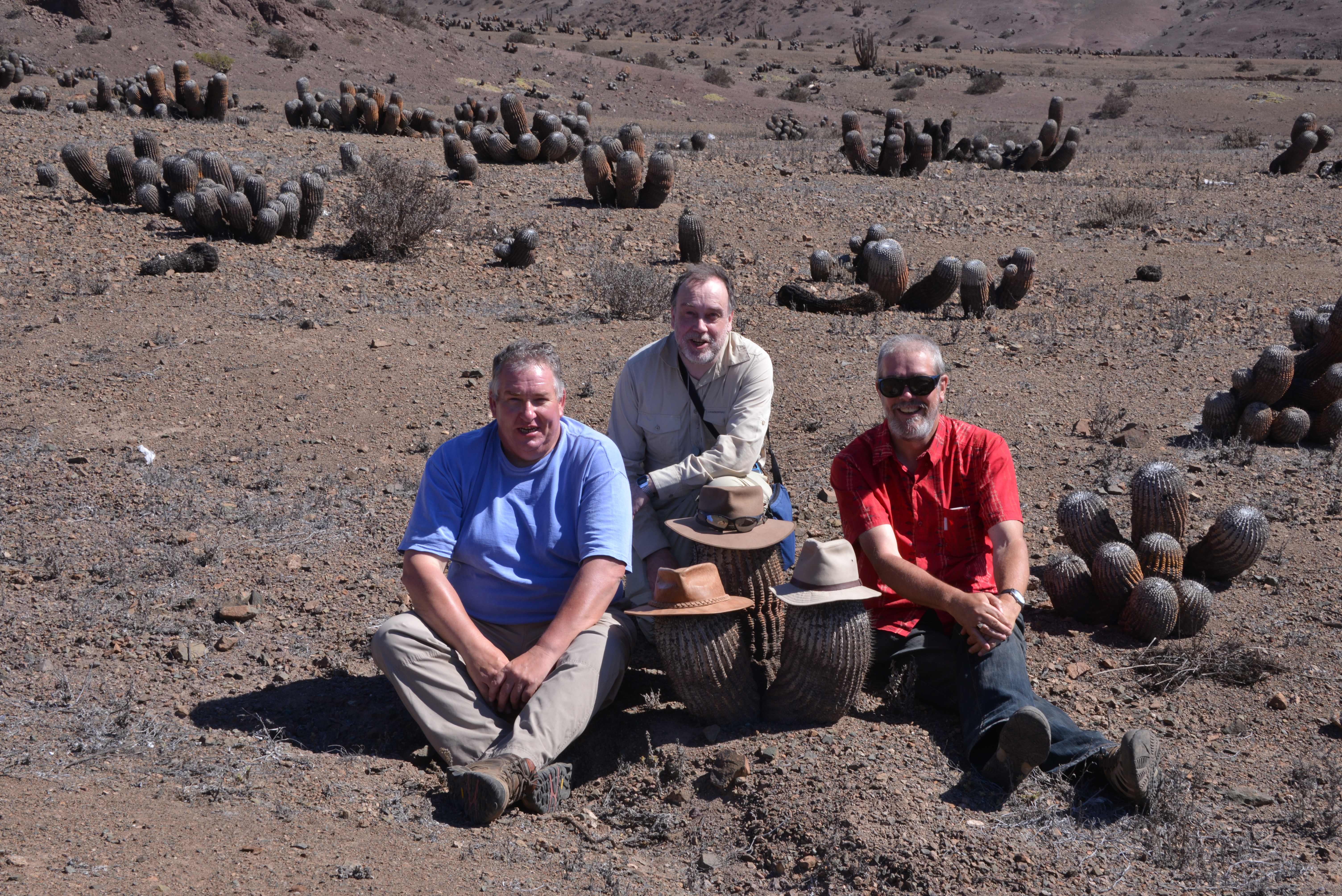
The Tres Amigos - Brendan, Jonathan and Paul with Copiapoa cinerea

The Tres Amigos – Brendan, Jonathan and Paul with Copiapoa cinerea

We enjoyed a last night at Club Taltal and today are off slowly to the south.

Sunday, 10 November 2013 – Around Taltal: Botija

Just a look back to last night when we were joined in Club Taltal by the Chavez family. If you have ever used the hardware shop near Hotel Gali, you might have met them – they own it. Also, their family run Hotel Gali. When Brendan Burke was after a bag of cement many years ago to build Alan Craig’s monument, he got to know them and they have been good friends ever since – he is not allowed to stay in a hotel when in Taltal, he has to stay with them.

And so we learned that in June 2013, it had snowed in Taltal, with snow lying on the hill tops and stopping traffic coming in from R5 from Antofagasta. No wonder the Eulychnia looked a little worse for wear! Apparently this was the first snow in more than 60 years.

Also it has been extremely and unusually dry, without any rains here since March. Until Saturday night when I was woken up by the sound of a good old English downpour on the tin roofs. I thought I could see lightening, but instead of the sound of thunder, I heard the commotion of folks running round (presumably with torches) reporting leaks and finding buckets to place under the affected areas.

All was dry again by the time we went to breakfast, an early start, as we were off to Botija where JYC could put another four ticks against his Copiapoa checklist. It’s still a long drive, even though asphalt extends to 18 km north of Paposo. Why stop there?

We had left Nessy (our Nissan Xtrail) at home, accepting lifts from Brendan & Osvaldo (JYC) and Bart (me) in the 4x4s in the hope that we could drive in again. The track had deteriorated since 2010 and there were some hard scrapes, but we managed to get to within 400 m of the ‘T-junction’, before a massive stone ‘threshold’, over 3 ft high, blocked our way. Where had that come from? Not carried by water! A rumble?

I just relaxed sitting between the Copiapoa solaris and C. calderana ssp atacamensis plants, watching JYC with his studies of Copiapoa and sliding down hills, while resting my own aching knees and ankles. Old timers? The others had headed off towards the south. It seemed a good idea to stroll back towards the mouth of the Quebrada so that Jonathan could take a closer look at C. decorticans and C. ahremephiana. We actually managed to find a few plants that we could get close enough to, to touch, rather than just capture them with the aid of a 300 mm zoom lens. Amazing how the climb to the plants is always easy, while the return trip can be very slow and treacherous.

Every C. ahremephiana I showed JYC added another dilemma to his understanding of the genus. Surely this plant was a C. haseltoniana? and surely that one was a C. calderana? But how could they be heads on the same plant? Those of us who’ve been here will have seen this and done that. Things become a little easier back home when seed collected in habitat at least produces plants that are consistent in appearance. So clearly, the different appearances in habitat on one plant are due to environmental issues – it did seem that there was some consistency in the appearance of heads on the north side of plants that differed to those growing on the south side.

In 2001 we had stopped here not knowing where exactly we were as we travelled from San Pedro de Atacama to Taltal. Marlon Machado & I compared notes later and both of us had noted ‘two small Copiapoa species growing along the track, one looking like a tiny C. haseltoniana, the other like a different ‘sp.’ When we returned a few days later with Rudolf Schulz & Attila Kapitany, were were amazed to learn that this was the famous Quebrada Botija and that the one species that grew at the mouth of the Quebrada had not yet been named and was known simply as Copiapoa sp. Botija 1, while C. decorticates was sp. Botija 2.

Just as we wondered about strolling back towards the cars, they appeared in view – excellent timing. Although we all had a great day and were excited about what we had seen, sitting on the sunny side of the car, being rocked by the ripio track, it took no time at all before my snoring joined in with sound of the car’s engine.

Back in the hotel, we had time to download images and change as we had been invited to the home of Osvaldo Snr and his wife Marie for a BBQ. There seems to be very little time for anything like shopping and laundry. Today’s images were filed as follows

S2925 C. decorticans

S2925 - Copiapoa decorticans

S2925 – Copiapoa decorticans

S2926 C. atamanesis and C. solaris

Eriosyce pygmaea

Eriosyce pygmaea

S2926 Copiapoa calderana ssp atacamensis

S2926 Copiapoa calderana ssp atacamensis

S2926 Copiapoa solaris

S2926 Copiapoa solaris

S2927 C. decorticans

S2927 Copiapoa decorticans

S2927 Copiapoa decorticans

S2928 C. ahremephiana

S2928 Copiapoa ahremephiana

S2928 Copiapoa ahremephiana

S2829 images from minor stops between Botija and Paposo of Copiapoa cinerea ssp haseltoniana.

S2929 Copiapoa cinerea ssp haseltoniana

S2929 Copiapoa cinerea ssp haseltoniana

So tomorrow we’ll have a 10 a.m. start and have an easier day, taking a ride to the top of Mt Perales. Osvaldo Snr, a building contractor, was responsible for the erection of the radio masts and constructing the track to the top. Why did he not build a nice smooth asphalt road and a coffee shop / ice cream parlour at the top?! Budget constraints!

Saturday, 9 November 2013 – Around Taltal: Quebrada San Ramon

Well, the time had come for one of the marches of this holiday, a stroll into the Quebrada San Ramon to add Copiapoa taltalensis and C. krainziana to the every growing list of Copiapoas to show Jonathan.

Bart & Marijke + Brendan plus their Chilean friend Osvaldo and his girlfriend had decided to take the hike up the hill near the entrance of the Quebrada to see C. montana and Lucy decided to stay near the car.

JYC was suitably impressed with the diversity of Copiapoa here – it has baffled many a cactophile over the years. I noticed how many human footprints were here and how some of the well known features had changed, some probably by human activity, others perhaps by earthquakes. The floor of the canyon that is often littered with dried remains of annual plants was now covered by shrubby plants in leaf and some flowers – ID’s to be found later. The ‘Boggy areas’ that are a feature of the regular hike, seemed to have increased in area and the plants in size. There were some ‘caves’ that I did not recognise, clearly used for camping and it seemed that a new side canyon had opened up that threw me for a while, making me think that I had taken a wrong turn. We carried on and what seemed like an age (caused by my self doubt) there was the first C. taltalensis – we had to be on the right trail. Shortly after, the first C. krainziana – what a relief, imagine the embarrassment at not being able to find this key plant of the trip! Phew!

The walk back went a lot faster – down hill and with JYC already having recorded the details for the Copiapoa. I suggested that if we got to the car in time, we would have time to see C. humilis at the Monument to the Virgin above Paposo. It was also Jonathan’s first detailed look at C. cinerea ssp haseltoniana, so all in all, a good score for the day!

Today’s images are filed as S2921 – diverse C. cinerea forms in San Ramon between the entrance and the point where C. taltalensis begins.

S2921 Jonathan, about to start the hike of a life time - Quebrada San Ramon

S2921 Jonathan, about to start the hike of a life time – Quebrada San Ramon

S2921 Copiapoa cinerea 'inermis'

S2921 Copiapoa cinerea ‘inermis’

 S2921Copiapoa cinerea 'albispina'

S2921Copiapoa cinerea ‘albispina’

S2921 Copiapoa ssp cinerea

S2921 Copiapoa ssp cinerea

S2922 – C. taltalensis and C. krainziana

S2922 Copiapoa krainziana

S2922 Copiapoa krainziana

S2922 Copiapoa taltalensis

S2922 Copiapoa taltalensis

S2923 – Way back to the entrance

S2923 Copiapoa cinerea ssp haseltoniana

S2923 Copiapoa cinerea ssp haseltoniana

S2923 Copiapoa cinerea ssp haseltoniana

S2923 Copiapoa cinerea ssp haseltoniana

S2924 – Monument to the Virgin at Paposo

S2924 Copiapoa humilis

S2924 Copiapoa humilis


Friday, 8 November 2013 – around Taltal – Guanillos

Taxi for Klaassen! It was 9:00 and Bart & Marijke had come to pick me up for today’s drive, while Brendan & Lucy had come for JYC. There was no need for three cars and 4x4s were best today, although our Nissan Xtrail would have easily coped. Still, very nice to have a break from driving!

First on today’s agenda was a stop (S2912) for a huge area covered in Copiapoa cinerea ssp column-alba off the Taltal-Cifuncho coast road. The plants here were the size of seals and the felt disc at the apex had grown since I visited C. column-alba in the region with Angie in October – life was returning to cactus country.

S2912 Copiapoa cinerea ssp columna-alba

S2912 Copiapoa cinerea ssp columna-alba

S2912 Jonathan Clark tests his prototype Copiapoa ID App out on C. cinerea ssp columna-alba

S2912 Jonathan Clark tests his prototype Copiapoa ID App out on C. cinerea ssp columna-alba

The second stop (S2913) was at the usual C. desertorum stop, perhaps a little closer to Taltal than usual. One or two plants were in flower – red as usual although there were some plants with a peculiar reddish yellowish in colour; not ‘bright red’ as say, in red flowered Rebutia, but ‘reddish’, as is the expected yellow pigment was missing, allowing the usual red pigment found on the outside of the tepals . Brendan claims to have seen ‘normal Copiapoa-yellow’ flowers on clumps here and nearby, but in January. I have only ever recorded reddish flowers on desertorum ,so that it could be that there are two cryptic taxa with different flower colours that flower at different times. Also here were lots of small seedlings, the size of a pound coin upwards. I had not recorded such rejuvenation of the population closer to Cifucho.

I’ve never been convinced with this species status as a subspecies of C. taltalensis – where is the evidence?

S2913 Copiapoa taltalensis ssp desertorum

S2913 Copiapoa taltalensis ssp desertorum

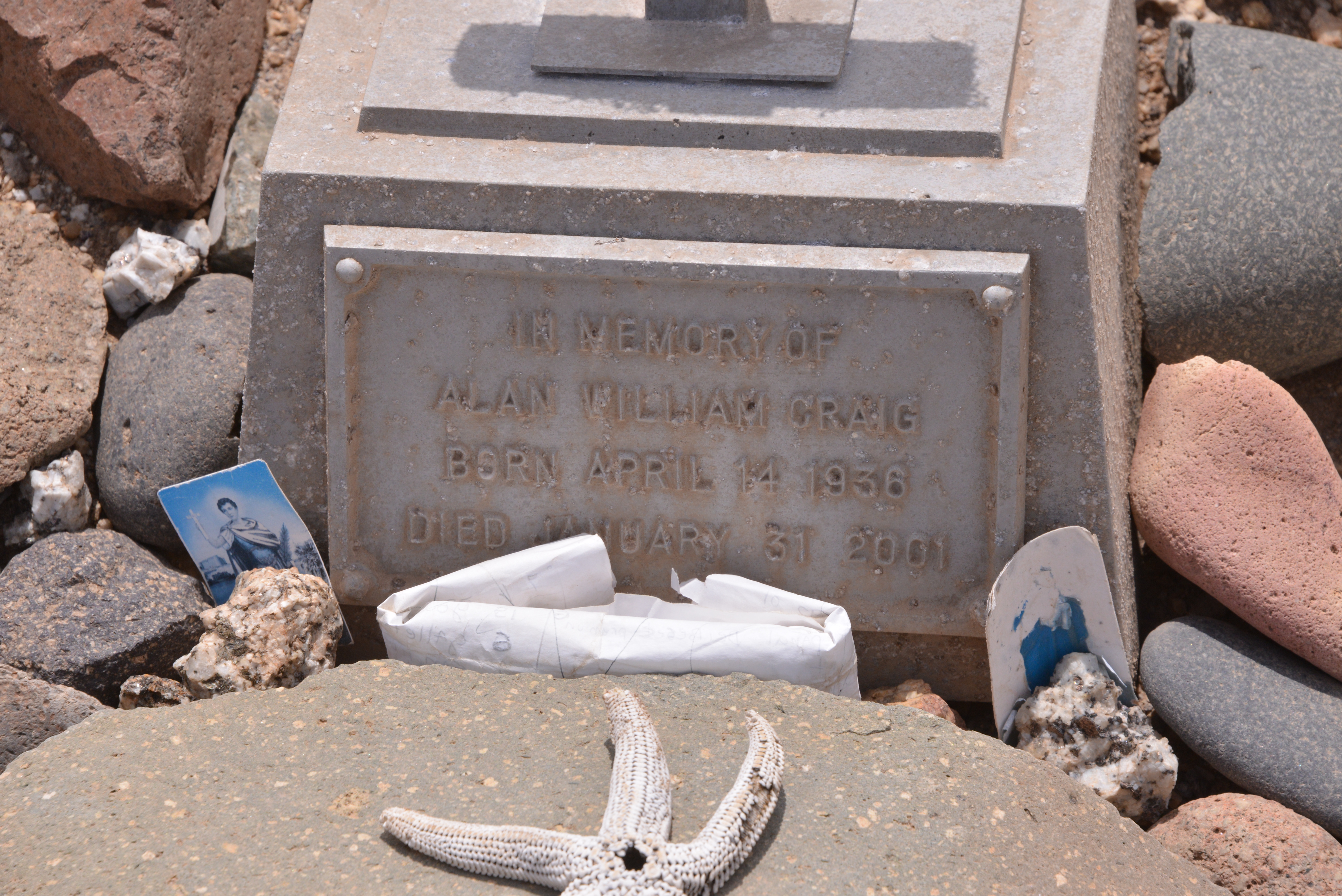
Next we paid our respects to Alan Craig, our friend who died in 2001 and who asked for his ashes to be taken to Chile and left with his favourite plants. Brendan accompanied Alan’s widow on his last journey and we’ve visited the little monument that marks the spot on each of our visits to Chile. All was well at the monument, with local algae fisherman apparently still looking after it in Brendan’s absence. This time they left a lighter and some pictures of saints near the cross. In the past we had shared cigarettes with the local fisherman, as a thank you for looking after Alan. Perhaps the lighter was in hope that it would bring them more ciggies? (S2914)

S2914 Copiapoa longistaminea

S2914 Copiapoa longistaminea

S2914 - AWC

S2914 – AWC

In the past I had always admired a large C. longistaminea near the small mount but this had been uprooted with heads broken off. Animals? or human vandals? We replanted the plant in the hope that it might survive. Brendan showed us the near by site where he had camped in 2010. He had dug a base into which the tent would fit and when they left he had written his initials, BJB, in the sand. Today those initials were still clear and could easily be read, 3 years later!

The sun had come out and the scene on the Ocean shore with the guano covered island in the background was very peaceful. See you next time, Alan!

Next we set off to a section of beach below Las Lomitas that we had christened ‘Puma Bay’ after an earlier visit when we had camped here. Two favourite plants, one a clump with both C. longistaminea and C. grandiflora growing as one and another where Marlon Machado and I had found a large crested head at the base of the plant when we had first seen it in 2001 were still there. By 2004 I was sad to find that the crested head had been chopped off. The large plant that remains still bears the scars. Both plants looked to be struggling – too dry for too long?

S2915 Copiapoa longistaminea

S2915 Copiapoa longistaminea

S2915 Copiapoa grandiflora growing 'inside' C longistaminea

S2915 Copiapoa grandiflora growing ‘inside’ C longistaminea

S2915 Copiapoa grandiflora growing 'inside' C longistaminea on the beach below Las Lomitas

S2915 Copiapoa grandiflora growing ‘inside’ C longistaminea on the beach below Las Lomitas

We had another ‘Neil Armstrong/Buzz Aldrin moment’ when a fisherman walked up to us out of nowhere for a chat. Unlike us, he was fluent in Spanish. He was very pleased that we were so keen on Chilean plants and explained that he had a vegetable garden at home. He was quite insistent that we’d come and see it – quite interesting what could be done at Esmeralda under a plastic cover: tomatoes, melons, ornamental flowers etc. (S2916).

He also explained that his job consisted of walking out onto the rocks with a machete, chop off the algae and then drag them ashore. He and his neighbours had each been awarded a small claim to harvest and periodically a car would come and collect the 25 kg bales of seaweed after it had been dried. He also told us that it was possible to drive in a car (4×4 we assume) from Pan de Azucar village, along the base of the coastal hills to Esmeralda and beyond to Tigrillo. Worth remembering for a future trip!

S2916 -  'Allotment gardening', Esmeralda style'

S2916 – ‘Allotment gardening’, Esmeralda style’

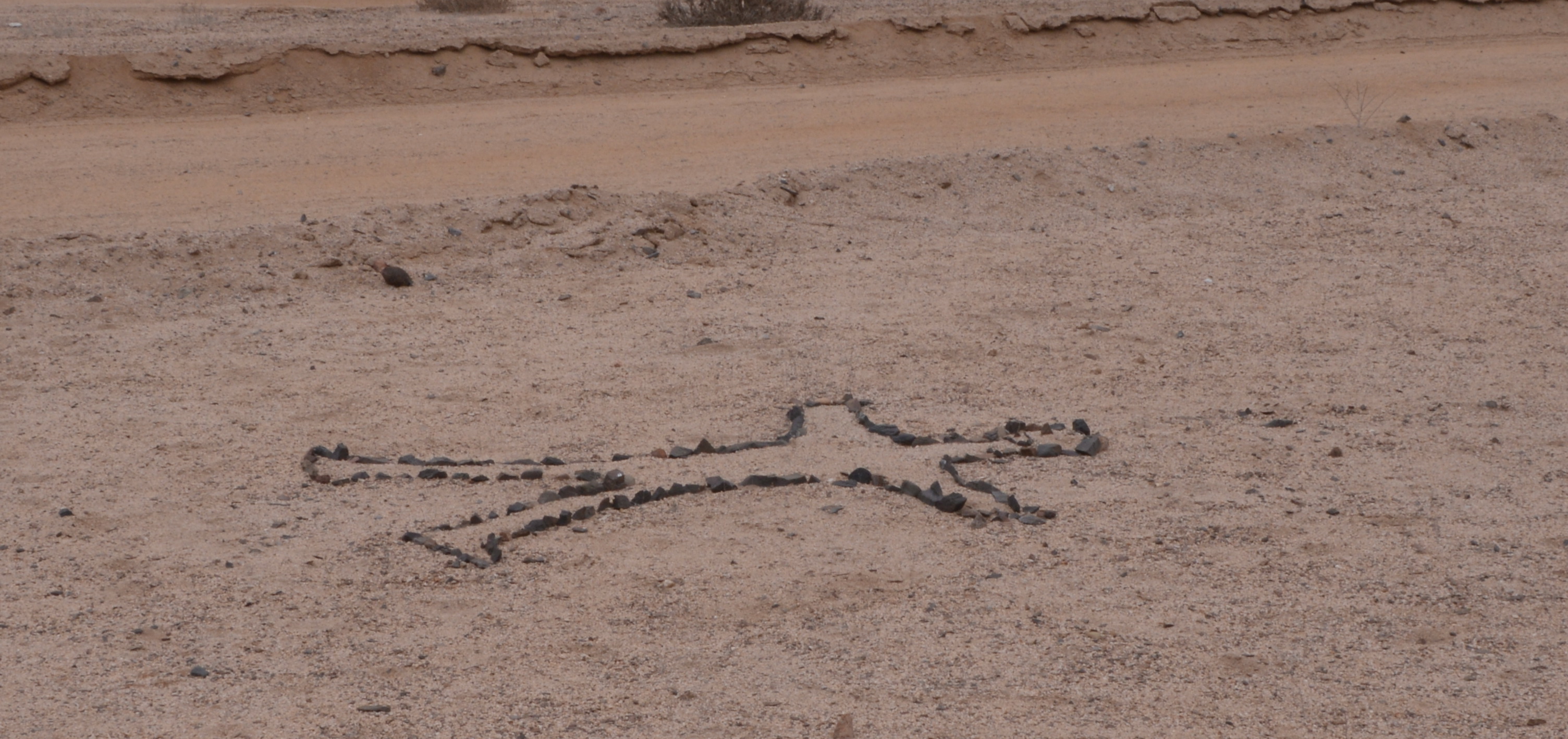
He also told horror stories of bodies being washed ashore with their legs cut off – men wearing shirts with brass buttons and bullet holes in the back of their heads – reminders from the days of the Pinochette regime! A recent find had been outlined using dark stones at S2915:

S2915 - a leg less body was found, washed up here - spooky!

S2915 – a leg less body was found, washed up here – spooky!

Next we headed back through the Guanillos (Huanillos?) Valley to a spot where we should find C. laui. After a bit of searching, Lucy was the first to find the first of thousands tiny, match-stick sized heads.

S2917 Guanillos Valley

S2917 Guanillos Valley

S2917 Copiapoa laui

S2917 Copiapoa laui

Next we headed to Ritter’s TL for C. columna-alba. (S2918) We took a quick look at the northern entrance to the Pan de Azucar that in 2010 had been blocked to prevent illegal entry to the park. The barriers had been torn down and a local van drove in, seemingly on his way to Chanaral or Pan de Azucar village. Good news!

And so first Brendan & I, then JYC & Brendan re-enacted Ritter’s photo at the TL. Together with Rudolf Schulz’s images at this spot for his 2006 book and again during our visit in 2007, we should have a good picture of how much / little things change here over the years.

S2919 Ritter's TL for columna-alba - wrong camera angle

S2919 Ritter’s TL for columna-alba – wrong camera angle

Bart made one more stop, for what he believes to be Ritter’s C. horniloensis – currently passing under the name C. taltalensis, but while we found the plants, it turned out that we were somewhere different to where we thought we were – but still found the plants!

I was glad that I was not driving as I fell asleep on the backseat for the journey home – another great day!!

Thursday, 7 November 2013 – Bahia Inglesa to Taltal

The beauty of a group party with independent (car) means is that while Bart & Marijke chose to have a restful morning at Roccas de Bahia, Brendan, Lucy, JYC and I decided on a series of short stops to get to the Pan de Azucar NP.

People have asked me what the ‘Y’ in JYC (Jonathan’s initials) stand for. Due to his academic achievements, he can lay claim to the title of Doctor. Now, we have all heard of Doctor Who, and you can’t have two of those in parallel, so he is Doctor Why, Y for short.

First stop today was at the regular location for Copiapoa calderana. Ritter seems slightly confused about this taxon as in his notes for Frau Winter’s seed list he puts a different emphasis on the whiteness or otherwise of these plants compared to his original description of them. Having been here a couple of times now in quick succession, I thought my mind was playing tricks, or at least my memory, as the degree of ‘whiteness’ seemed different each time. Now we all know that our cacti take on different hues and colours after they have had a good overhead drink and while we had certainly not had any rain as such, today started again with a very low cloud cover that again made it necessary to engage the windscreenwhipers. It seems that this small amount of moisture in the air is enough to affect the colour of the calderanas. Certainly in the bright sunshine, they seem much lighter.

S2905 Copiapoa calderana

S2905 Copiapoa calderana

We moved on to the usual ‘Hoot the Virgin’ stop (S2906) and again found a nice set of C. calderana ‘spinosior’ plants before Brendan & Lucy had to drive on to meet Bart & Marijke at the little chapel along the track to the southern entrance to Pan de Azucar.

 S2906 Copiapoa calderana 'spinosior'

S2906 Copiapoa calderana ‘spinosior’

S2906 'Hoot the Virgin' Monument

S2906 ‘Hoot the Virgin’ Monument

Brendan was going to follow Bart up the hill to see C. serpentisulcata ‘proper’ at the top of what we’ve christened ‘Radiomast’ and ‘Fognet’ Hill. Strange names but self explanatory when you see them.

JYC and I found time for an Expresso at the Copec in Chañaral, before saying hello to Marijke & Lucy who had decided to stay at the base of the hill and watch their men’s progress through binoculars as they climbed to the summit. We drove on to photograph C. cinarescens at various spots – some covered in dust, others nice and clean on almost black rocks, with the Ocean in the background.

S2908 Copiapoa cinerascens

S2908 Copiapoa cinerascens

S2908 Copiapoa cinerascens

S2908 Copiapoa cinerascens

S2908 Copiapoa cinerascens

S2908 Copiapoa cinerascens

Then on to see Smiler, Angie’s crested plant of C. cinerea ssp column-alba that we visit each time that we pass. Would I be able to find it without her ability to walk straight up to a single plant in the midst of thousands? I did!

S2911 - Smiler - Copiapoa cinerea ssp columna-alba

S2911 – Smiler – Copiapoa cinerea ssp columna-alba

We were just commenting on the peace and solitude at this spot when while taking our pictures suddenly a man came walking out of nowhere – one of the rangers who introduced himself as Alfonso, nickname ‘Poncho’ – it was unreal! Like the first men on the moon – Neil Armstrong & Buzz Aldrin, suddenly being tapped on the shoulder and asked ‘What are you doing here?’

It seemed that today was another public holiday and he was just taking a walk rather than ‘on duty’ He spoke a bit of English and might be a useful contact in days to come.

It was still quite a drive to Taltal, where again we found rooms at Hotel Plaza, while Bart & Marijke are at the Cabanas and Brendan and Lucy are staying with friends.

Wednesday, 6 November 2013 – Huasco to Bahia Inglesa

Greetings from Hotel Rocas de Bahia in Bahia Inglesa. After three nights in cheap accommodation we’re treating ourselves to a night of greater relative luxury, but as usual, at a cost. Bart & Marijke have the nice suite above the swimming pool but when we got our room (same price) it’s on floor 1 (below the swimming pool) just behind reception. The upside is that I have excellent wifi reception but that Jonathan (his turn for the large double tonight) on the other side of the room, is out of range.It was dark, dank & overcast this morning as we left San Fernando in Huasco. Past Carrizal Bajo, I put on the windscreen wipers and could not see a thing! Fortunately Marijke had bought Bart some windscreen cleaner (Bart said that he would buy her some vacuum cleaner bags in return) and this cut right through the grime & grease of the specks thrown up from oil / salt roads. I guess that these are rare events in Chile – almost like a light drizzle,but actually just a matter of driving through a cloud – fog. By the time that I thought to take some pictures of Eulychnia in the fog, spines heavy with water droplets, it was dry again.

We took the new coast road from Huasco to Caldera as this road is now just as fast as Ruta 5, which still has stretches under construction with hold ups, avoids R5 tolls and saves miles as it cuts off the corner past the town of Copiapó. Plus, there are hardly any places where you can’t pull off to look for plants. We had hoped to succeed where Angie & I had failed to find Thelocephala a few weeks ago.(this time S2901)  I need to check how the places where we failed to find any Thelocephala that time compare to those in 2010 when it seemed that with random stops, we simply could not avoid these tiny plants, especially as they were in flower. This time, nothing!

We found a few clumps of Copiapoa echinoides, some massive Eulychnia acida and one single plant with a pretty, delicate flower that Jonathan has tentatively IDed as a Scrophulariaceae sp (?). How could such nice little plant survive on its own or was it the first of many to cover the ground once the time had come this year?

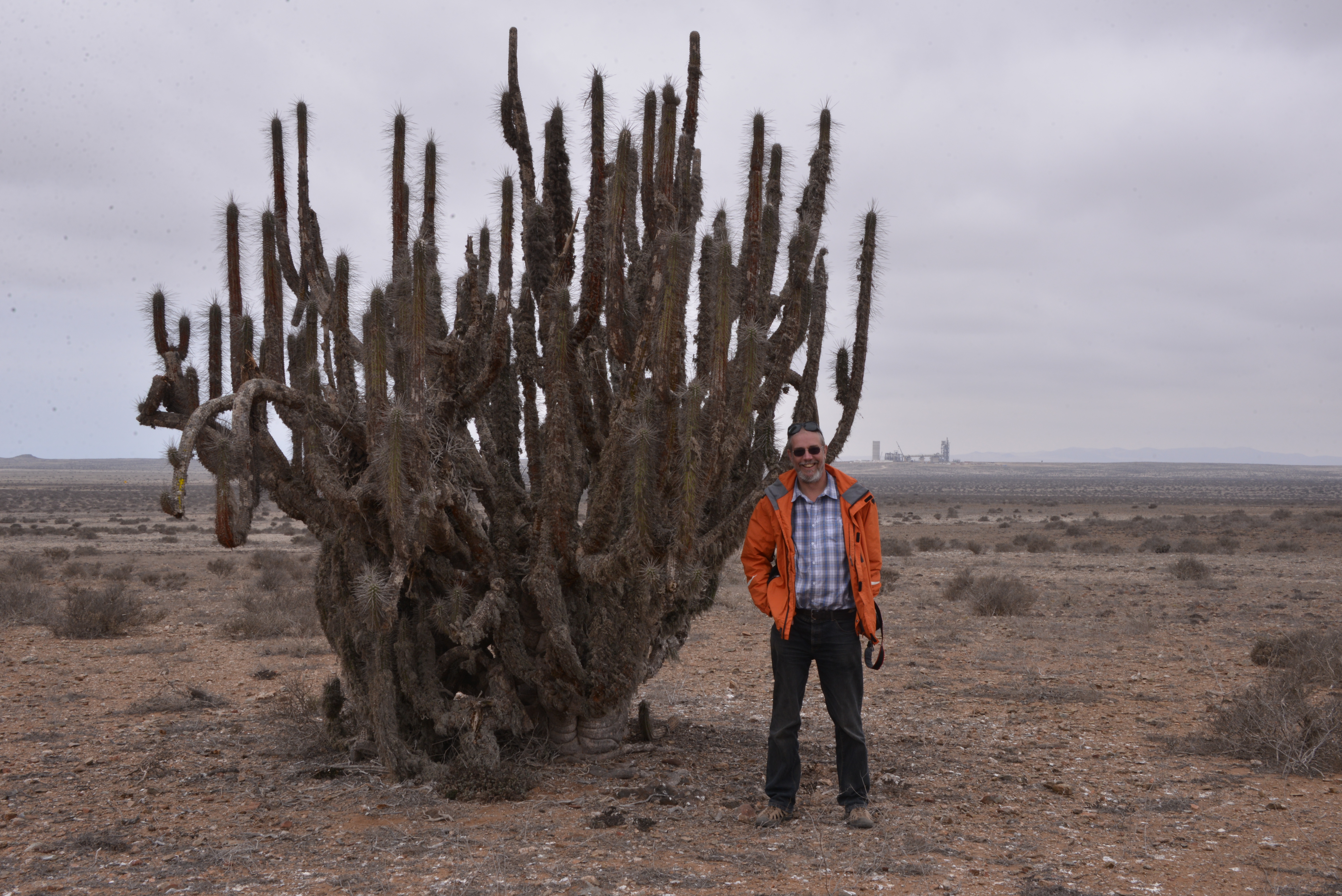
S2901 - Massive Eulychnia acida + me for scale. I wonder what the construction is in the back ground?

S2901 – Massive Eulychnia acida + me for scale. I wonder what the construction is in the back ground?

Once we reached R5 it was just a few minutes until we reached the side road next to the Caldera Copec – the track signposted to Mina San Jose – the mine that was the subject of 31 miners stuck underground for weeks on end in 2010 before they were famously brought back to the surface safely.

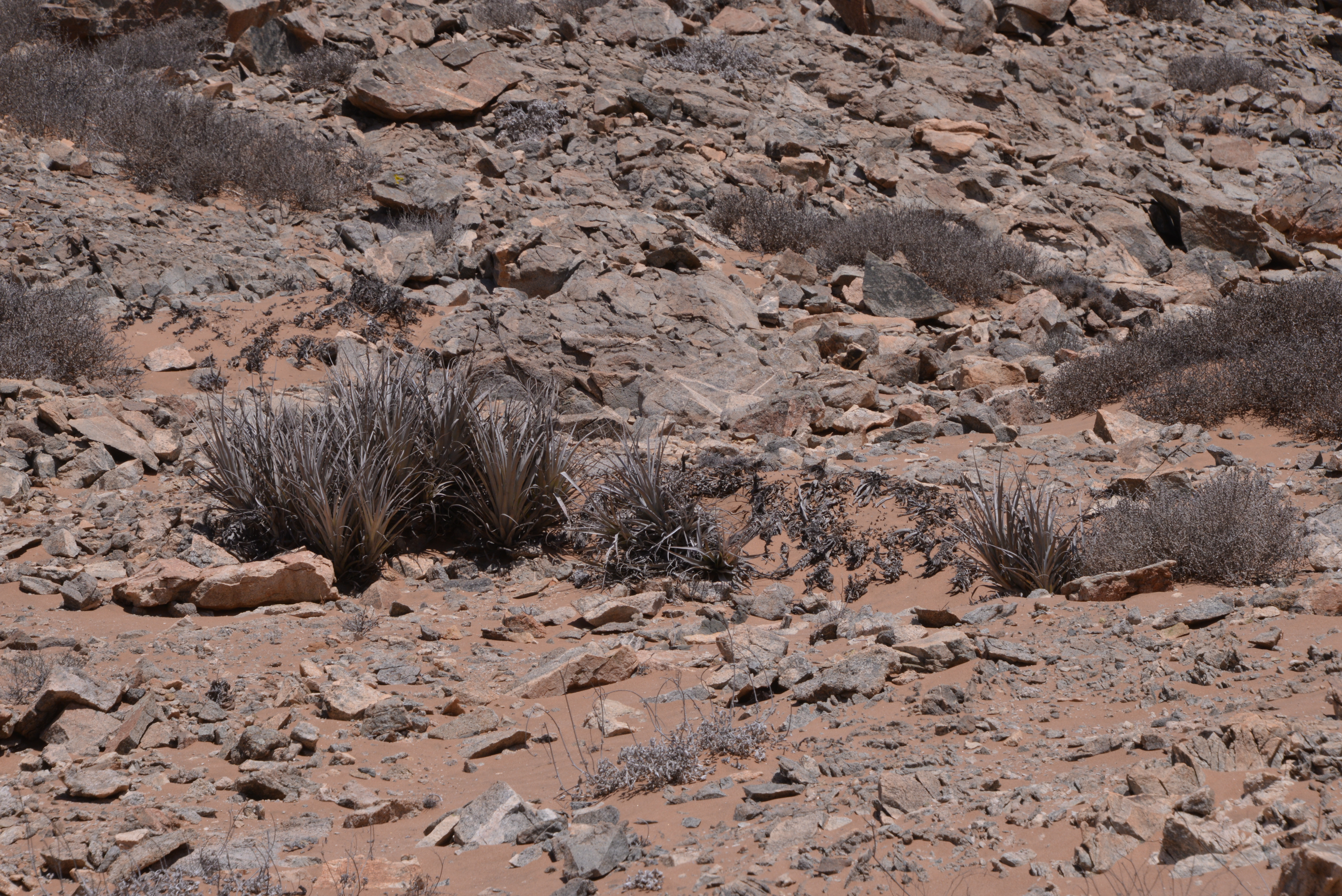
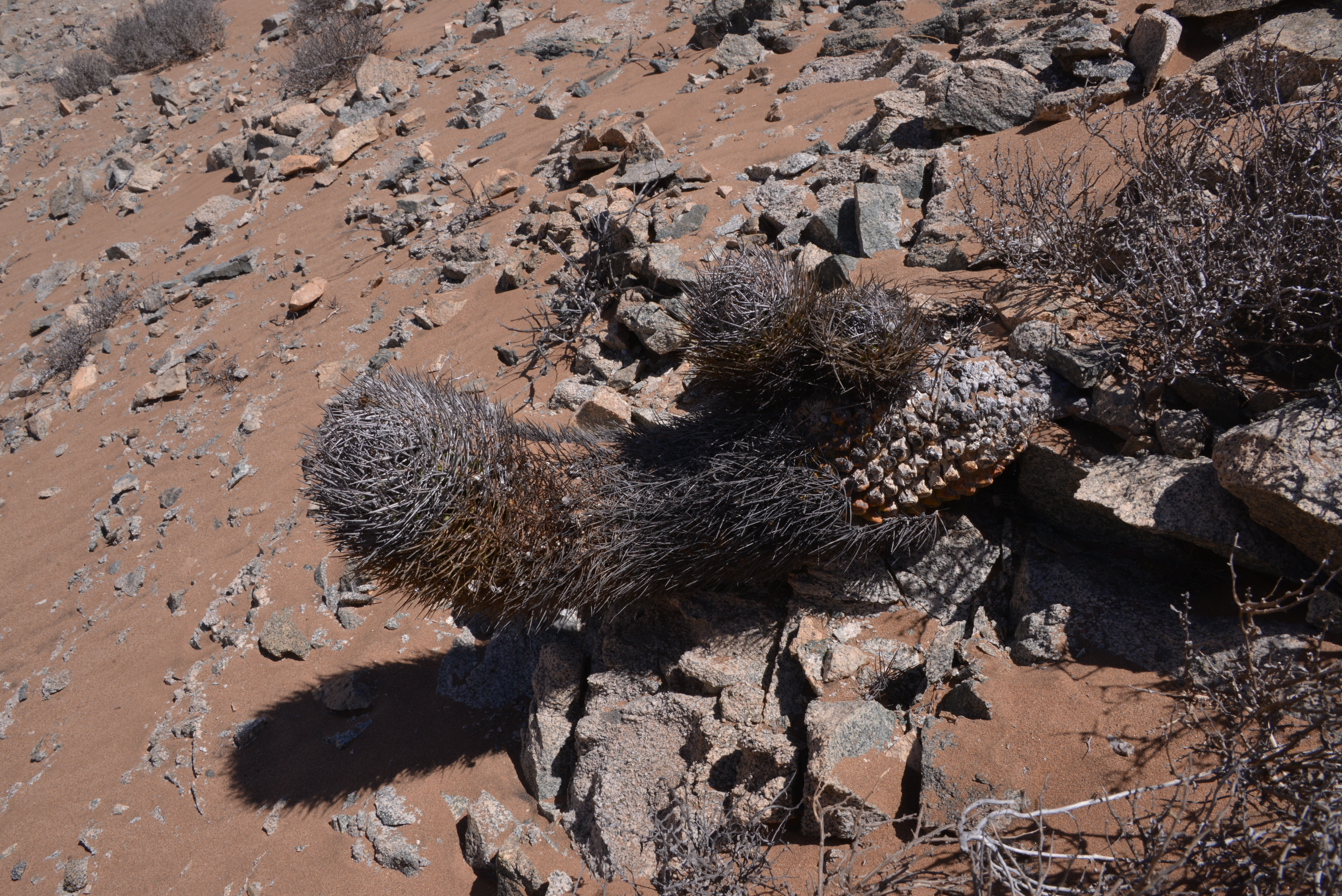
First Bart wanted to show us a location (S2902) that he had found last year for some Eriosyce – maybe E. kunzleri? E calderana? Tillandsia landbeckii and another Tillandsia were also found here.

S2902 Tillandsia sp

S2902 Tillandsia sp

S2902 Eriosyce sp

S2902 Eriosyce sp

S2902 Tillandsia landbeckii

S2902 Tillandsia landbeckii

This mine now seemed more famous than any of the other – still working safely without accidents – mines in the area. We had been back to the mine about a month after the rescues in 2010 when the left overs were guarded by ten policemen playing cards. Today the area had been tidied up – 31 flags to honour the miners, were stood on the hill and a monument stood at the entrance, but behind the monument a huge wall of earth blocked the view of the true entrance. A man and half a dozen dogs stood on guard. I drove up to him and in best Spenglish asked if this was the famous mine that I had seen in England? He shrugged his shoulders, perhaps jealous of all the intention his comrades had received. ‘Is there a museum?’ I asked half seriously and half mocking. This time a smile and a shrug – this man was no trainee tourist guide practicing how to make friends and influence people.

S2902b Mina San Jose - Monument for the miners who were trapped here in 2010.

S2902b Mina San Jose – Monument for the miners who were trapped here in 2010.

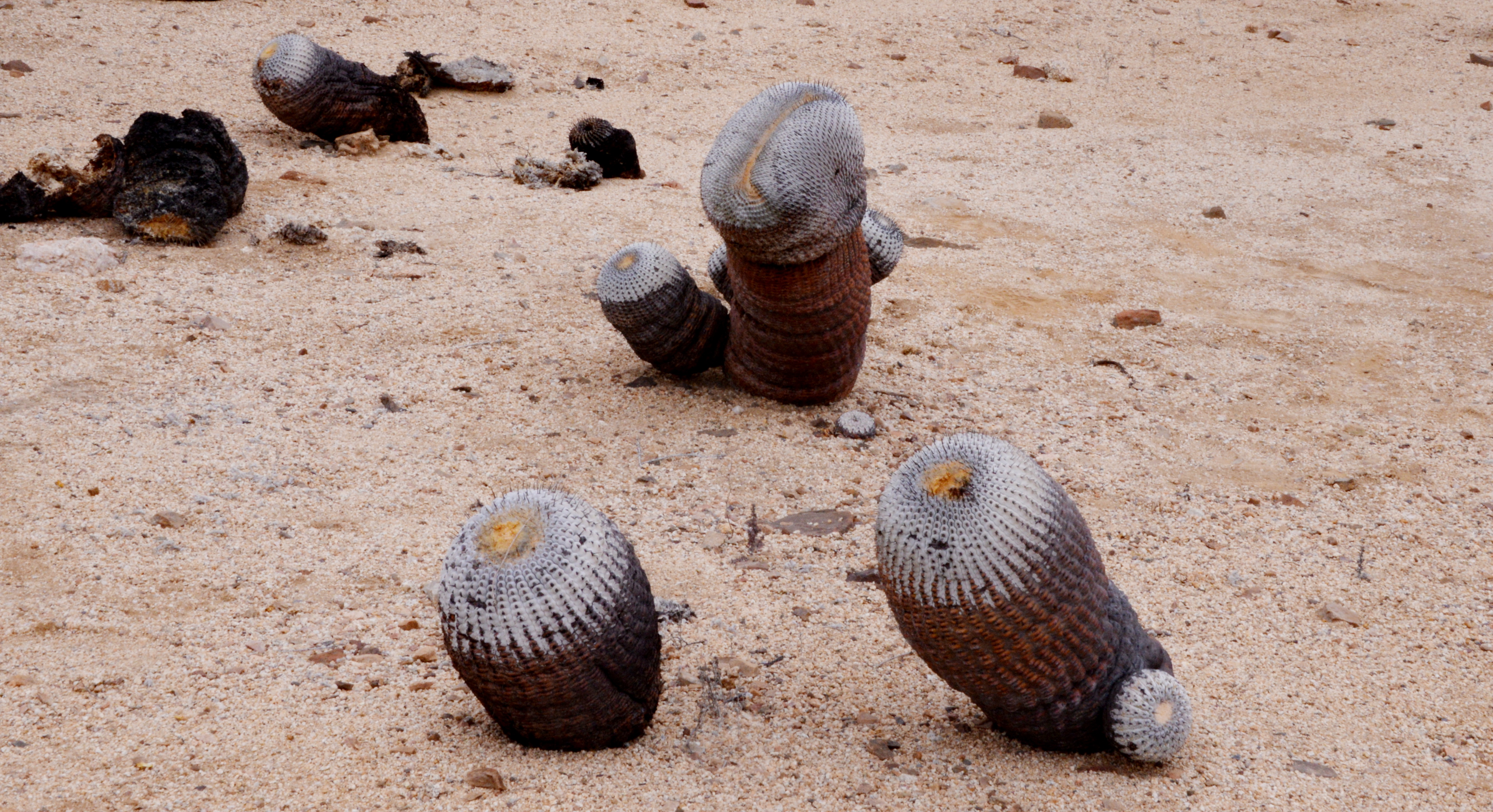
We took pictures, waved and were off, looking for an excellent location for C. megarhiza from 2010. Frankly the plants at this spot were a disappointment – very dehydrated, just tight short columns of impenetrable spines. How can one ID such plants, other than by location – C. megarhiza is the only Copiapoa reported from around here. Yesterday’s C. andina had also been very tightly spined and dry. How different were these plants? Very difficult to tell from such dehydrated plants. If C. andina is a subspecies of C. coquimbana, could it be that C. coquimbana and C. megarhiza are in fact the same species – C. coquimbana would have priority as the earlier name, with C. megarhiza as the tighter high altitude / farther inland / drier habitat form – like C. cinerea ssp cinerea and Ritter’s C. tenabrosa, like C. cinerea ssp. haseltonia and Ritter’s C. eramophila and like C. cinerea ssp columna-alba and Ritter’s C. melanohysterix? More study needed I think.

S2903 Copiapoa megarhiza

S2903 Copiapoa megarhiza

Tuesday, 5 November 2013 – around Huasco (2)

Angie & I had earlier failed to find the usual sign for El Donkey along R5, but had spotted fence posts and barbed wire to mark off the territory reserved for the R5 widening scheme. Today Bart wanted to show us a new (to us) location for Copiapoa andina that grows off the El Donkey track. Fortunately his notes gave the exact km reading for the turning to El Donkey and at the appointed spot there was indeed a turning, a gap in the fence and a small sign.

I have no means of accessing the data in my MS Access database as there is no Apple software capable of reading it, but I’m told that we stopped at one of my stops where we had found this plant. I could not recall this location but in any event we did not find any Copiapoa here.

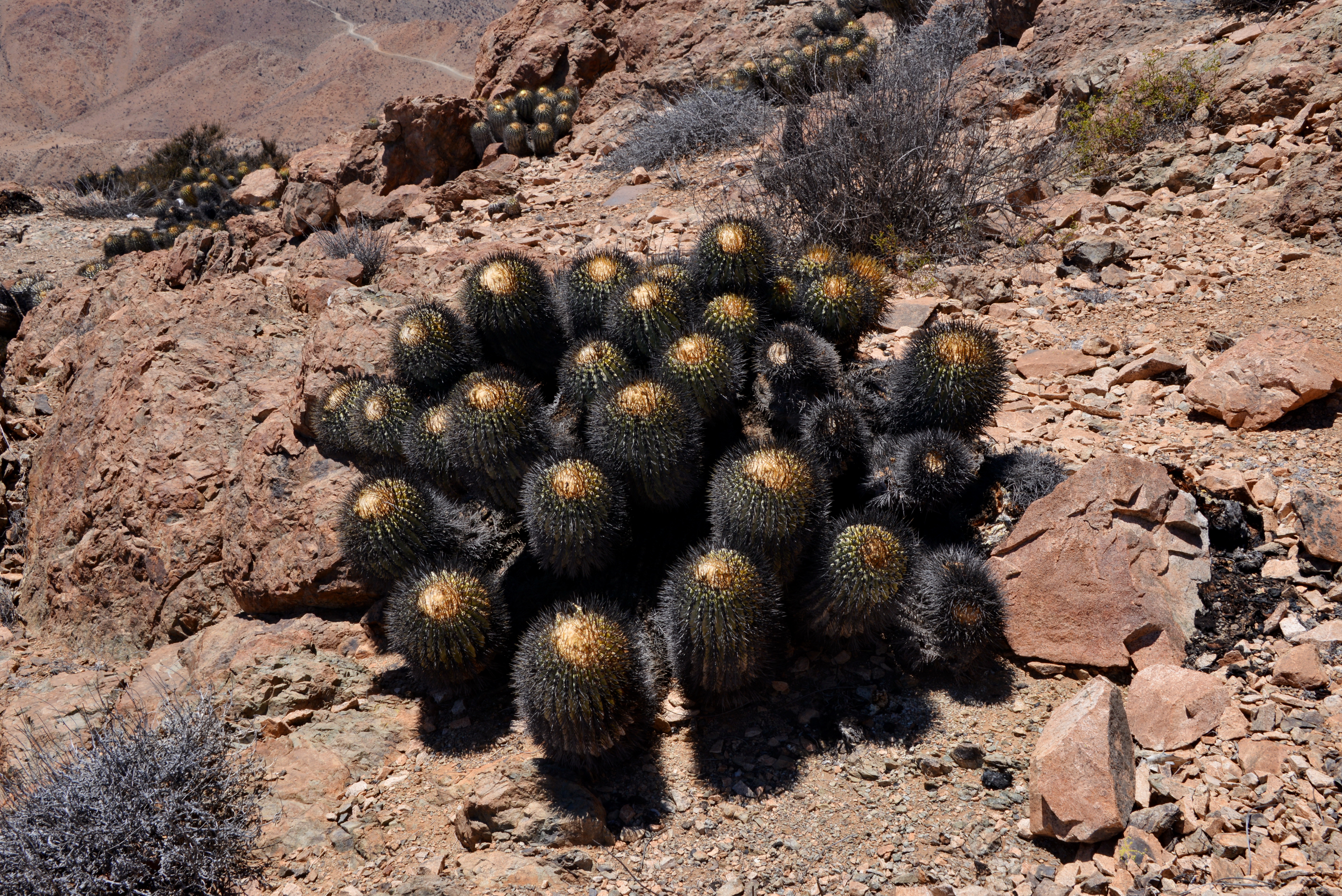
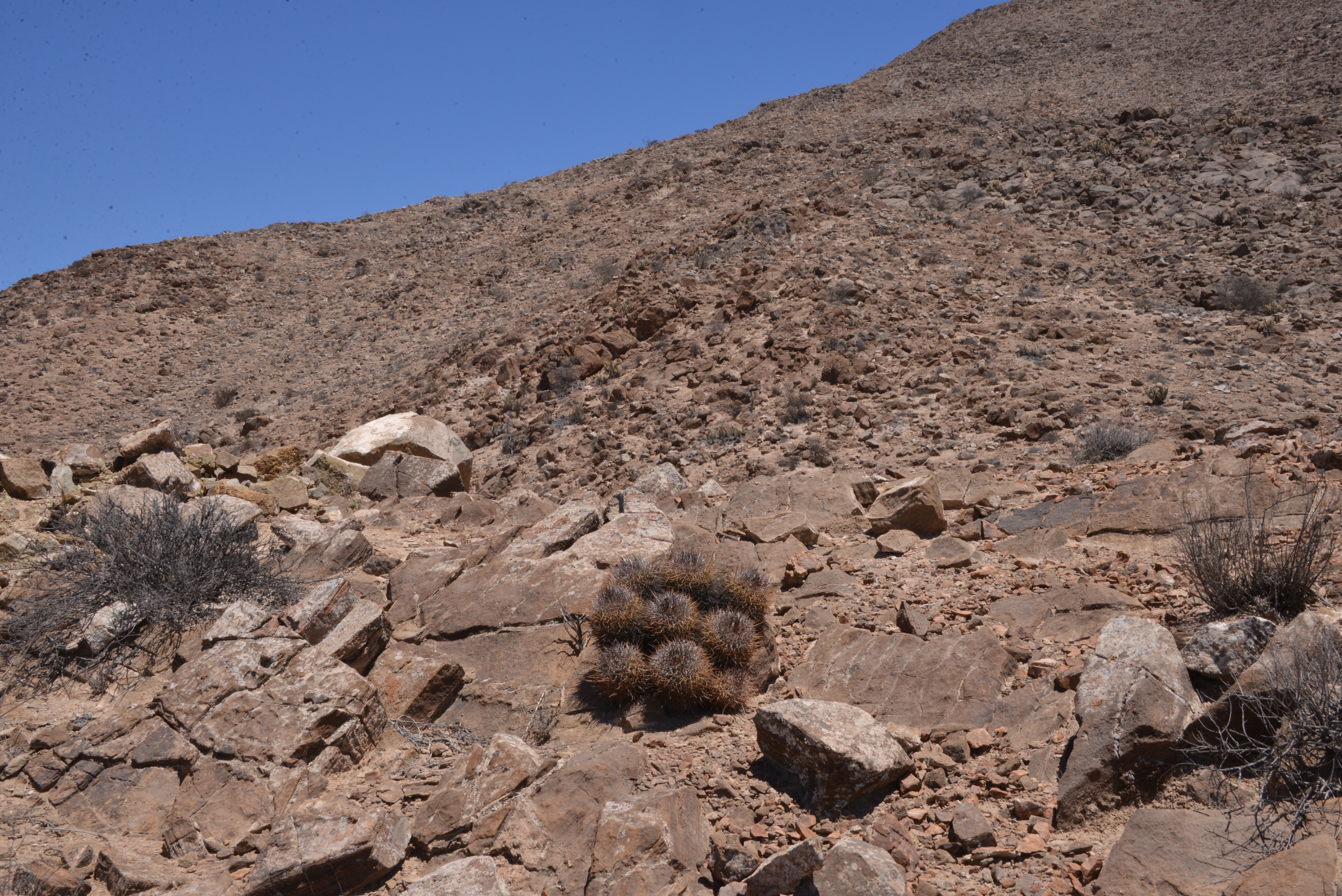
Bart & Marijke had gone back 5 km to find a turning onto a track where they had found a new population, and came back with the good news that they had found it. The bad news was that the track was only really accessible for a 4×4 and Jonathan & my car was just 2x drive, but luggage and washing drying were soon moved to make space for us in Brendan & Lucy’s car. We parked our car in a suitable space in the desert (no car park charges here) and bounced along the track for a number of km until Bart stopped and announced that we had arrived (S2897). The plants were magnificent – lovely coloured spines and present in all sizes. I still think that this plant is more closely related to C. megarhiza than to C. coquimbana. I would have named it as a species in its own right and let the ‘experts’ argue as to whether it is only a subspecies and of what.

Copiapoa andina (S2897)

Copiapoa andina (S2897)

Copiapoa andina (S2897)

Copiapoa andina (S2897)

Copiapoa andina (S2897)

Copiapoa andina (S2897)

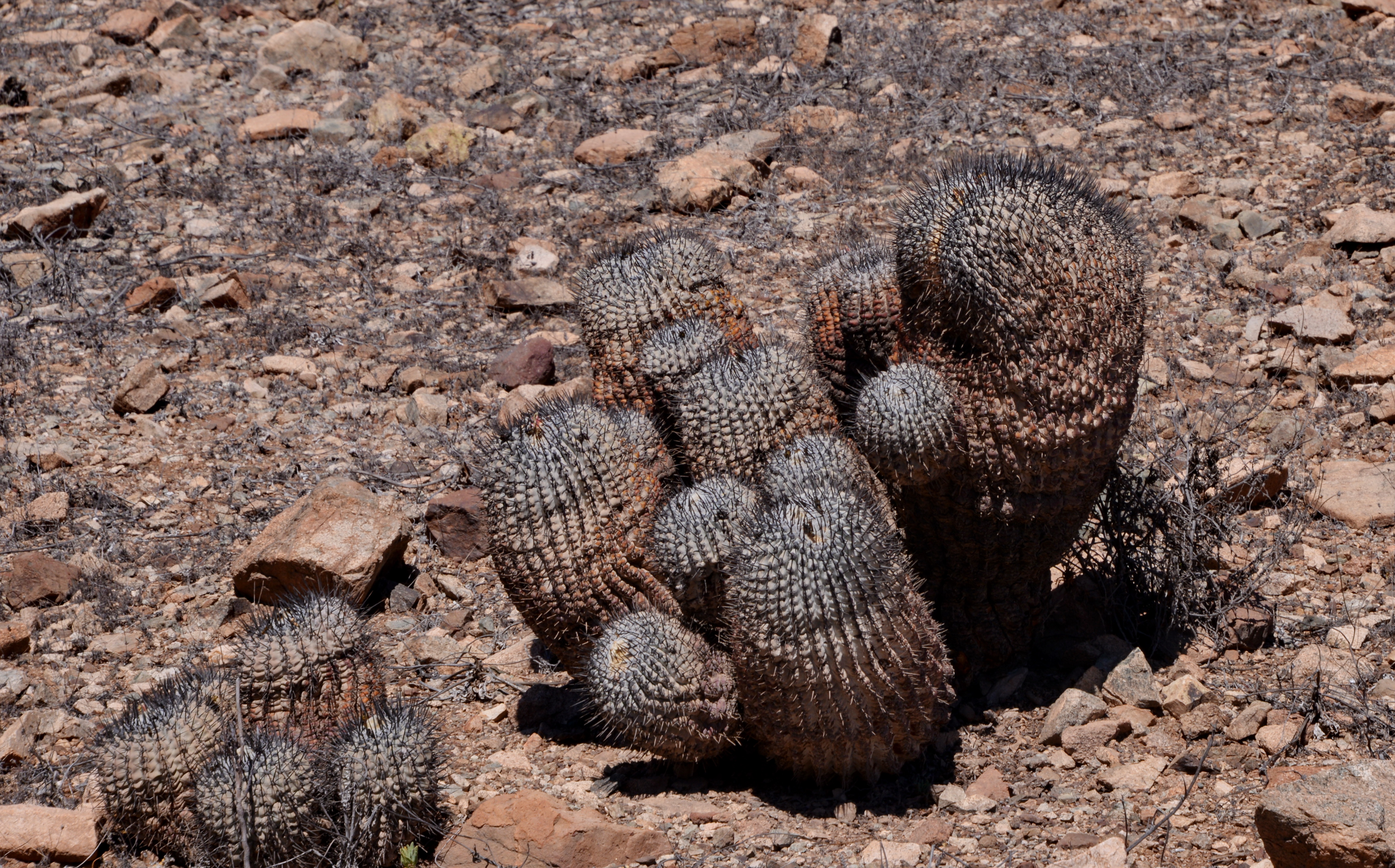
On their previous visit Bart & Marijke had been pleased to find the new spot but did not have time to explore a little farther to check the extent of the population. I checked out another rocky west facing outcrop through my 300 mm zoom lens and thought that I could see more globular cacti there. Fortunately it seemed that the track zigzagged onward towards these outcrops and so we went to take a look. There was a suggestion that as we got higher, the larger the plants became, perhaps benefitting from more fog. From this second location (S2898) we could see yet another rocky outcrop and here(S2899) too were more plants – this was really a very good day!

Copiapoa andina (S2898)

Copiapoa andina (S2898)

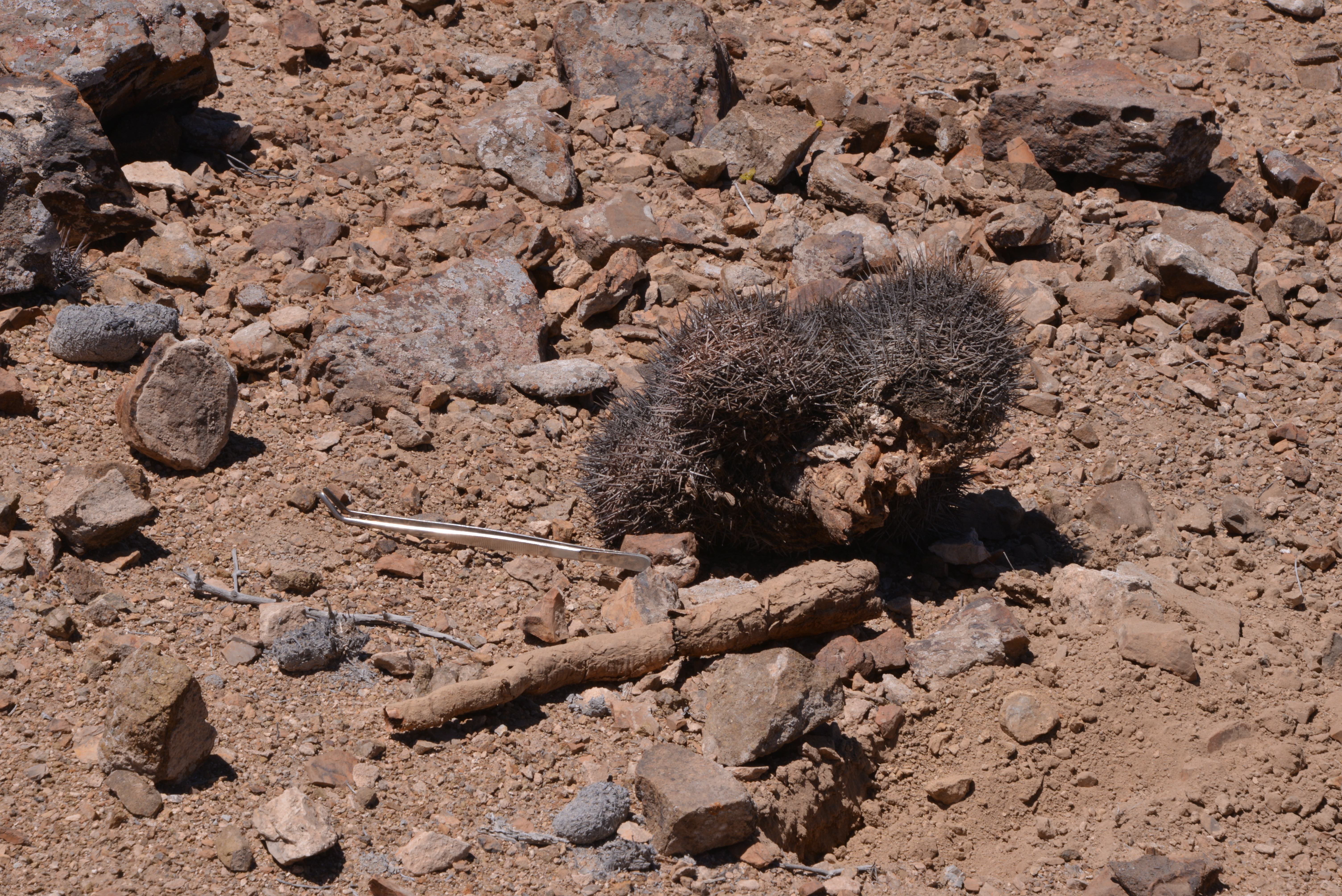
MEGArhiza tuber on this kicked out Copiapoa andina at S2898

MEGArhiza tuber on this kicked out Copiapoa andina at S2898


Copiapoa andina (S2898)

Copiapoa andina (S2898)

It only got better when here we found a crested plant (S2899). Bart found some fruits with viable seed but we failed to find plants in flower – Chile’s spring was late this year – or would it pass by unnoticed this year?

Copiapoa andina crest (S2899)

Copiapoa andina crest (S2899)

Copiapoa andina crest (S2899)

Copiapoa andina crest (S2899)

On the way back, we managed to retrieve our car from the ‘car park’ without any problem – quite amazing when you imagine the small speck in the huge desert we were in. On the way back we stopped at the start of the hills on which C. andina is found and here we found another group of plants confirming for me that the plant that we had been chasing through the hills was indeed the plant discovered and described by Ricardo Keim & Ingrid Schaub. We recorded it at altitudes of around 1,100 m compared to the 1,200 – 1,400 m in their description – even so, this is the highest Copiapoa I know, growing the farthest inland.

Our days of exploring were beginning to resemble regular work days more and more as we stopped off at the newly found coffee shop opposite the Copec on the old R5 outside Vallenar. Today there was an enormous selection of cream cakes on display and this time Lucy and Marijke, our Spanish linguists, were able to enquire into the availability of slices of these magnificent creations. One or two could be cut up, but most were only available complete, but we wisely decided this to be outside our sugar & cholesterol tolerances. So a nice cup of coffee and a slice of cake could now find itself onto the future timetables of Copiapoathons and the like. Very civilised – not so healthy!