Just another WordPress.com site

Archive for December, 2009

Merry Christmas

Many thanks to all of you who sent us Happy Christmas messages. As you’ll understand, there are no post cards, stamps and letter boxes in the places that we look for cacti, so you’ll only get these images, taken in Rio Grande do Sul in a huge shopping Mall in Caxias do Sul. When they saw us taking pictures, they switched on the animation for the characters, but my cam-corder was in the car.

Very best wishes for 2010!

Tuesday, 22 December – somewhere along BR-242 to Morro do Chapéu

We’ve reached the final location of our southern Bahia trip. We’ll stay here until 27 September, when we’ll travel to Feira de Santana to meet Marlon. So no more humping luggage around between car and room for a few days. It also means that we’ll have a comfortable roof over our heads for Christmas, leaving only food to sort out.

Were staying in Pousada Ecológical das Bromélias and it seems that we are the only guests, so the kitchen is closed.

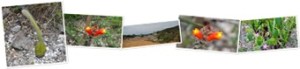
We arrived here too early to book in, so went straight away along BR-052 for some 27 km to the turning to Cafernaun. At this junction there are some stone pebbled hills to the north of the road. Again, I have to say that the size of top dressing used here is ridiculous, but the cacti seem to like it. We saw Discocactus zehntneri ssp boomianus in both its mature and juvenile spination. The strange thing is that it already flowers when the spination is still in its juvenile phase. Also, lots of Micranthocereus flaviflorus (densiflorus), not looking as good as I remembered from 1999 and non in flower, Melocactus glaucescens, at least I think its this plant, not M. azureus, as it has a white cephalium. Cliff found one plant with a red cephalium, but I have not seen the pictures yet. Also found: Pilosocereus pachycladus, P. gounellei, Cereus jamacaru and Pereskia bahiensis.

If today is just a taster of what is to come as we travel around here, then we are in for a treat!

Monday, 21 December – Seabra to somewhere along BR-242

Yes, how vague can you get! Marlon’s itinerary suggested that we would spend tonight in Lençois, possibly in a hotel with wifi. Instead, we are saving some 50 km+ by staying in the Tropical Paradise Hotel somewhere along the BR-242, but without internet facilities, so delayed posting, as tomorrow we travel to Morro do Chapéu.

Marlon’s suggested itinerary saw us visiting Mucugê today, to see Arrojadoa (or Pierrebraunia) bahiensis. We had tried here in 1999, but it is pitiful to see how naive we were 10 years + ago, thinking that by turning up at the town, we would find it ‘in the rocks above the town’ This time we had a visible clue, a tombstone in the cemetery above the town (S1606). And sure enough, there they were. Not in great numbers, as this is a well-known locations and every hobbyist visiting thinks that he/she can’t be doing any harm by just taking one or two species. They can do damage, as evidenced by the small number of specimens found. The plant is available in Europe, usually grafted, from ex-habitat seed from selected growers. There is no need to collect your own specimen that in habitat has the potential of producing many generations from seed, if left in place. We were very happy to just take pictures.

The plants were not in great shape, growing in the shade with marks suggesting ‘cold’ temperatures, rather like the seed raised plant in my collection before it eventually died.

The cemetery is remarkable in that it is visible from a long distance away, with all tombs painted a brilliant white. At night, they seem to be lit up by strong sodium lights, which in turn attract a large number of hawk moths that were sitting around, waiting for night. In the mean time, a large number of lizards, including a large monitor lizard type, was pleased to visit the ‘hawk-moth-fast-food’ restaurant.

2009-12-21 13-47-33 (2)a

The other plant growing here is Micranthocereus purpureus that we’ll see over and over again as we travel to and around Morro do Chapéu in days to come.

As we travelled here from Seabra on good hard-top roads, averaging 100 km.p.h. we had plenty of opportunity to make a few stops on the way back to BR-242. However, we were disappointed to find that the diversity of cacti was limited to M. purpureus (at each of S1607, S1608 and S1609). At S1607 there were also a good number of Stephanocereus leutzelburgii but at the other stops just M. purpureus, plus some different bromeliad sp., a Begonia sp. and several members of the Orchidaceae, some in flower.

Another excellent day, particularly when on the TV News tonight, they featured pictures of the UK grinding to a halt through snow!

Sunday, 20 December – Seabra to Piatã and back

Angie reported some problems with yesterday’s photo album, where pictures became corrupted during the upload process. I have now corrected this.

Today was another one of those days where we proved that our sanity is in doubt. We drove 100 km to see one taxon (and found another as a bonus) and then drove 100 km back!

The taxon in question is Micranthocereus hofackerianus about which Marlon has an article in the BCSS Forum, going back to 2007. Not sure if it has been published in paper form yet.

You can check it out at:
http://www.bcss.org.uk/forum/read.php?41,75226

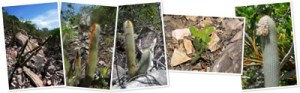
He reports that the plants are threatened by a sand quarry and indeed it seems that three such small operations are active one way or another. We managed to find a total of four plants during the 45 minutes at the first quarry, mainly because the first plant we saw was in flower. The second quarry, some 200 m farther along the track, was now a landfill site with rubbish dumped and being sorted by an army of recyclers for tin cans and plastic bottles. The smell did not encourage further investigation here. Another 200 m and a track to the left (by foot only) and we were at a third sandpit, snow white quartz sand here at the foot of a rocky hill. Plenty of Stephanocereus leutzelburgii here, but M. hofackerianus? Not a trace.

I’ll let the pictures do the talking.

Saturday, 19 December – Bom Jesus da Lapa to Seabra

I have probably said this before, but I’ll say it again: Brazil is BIG!

Today we drove some 300 km, half of which was marked ‘poor condition’, just as yesterday’s disaster area. Today, the map was wrong and the first 109 km out of 136 was smooth and wonderful, with average speed in excess of 100 km.p.hr.  The last stretch was rough again, but percentage wise, we were well pleased to reach Ibotirama so quickly. 14 km out of town was our first designated stop where Marlon tells us we saw the rare Pilosocereus aureispinus (this is type locality, HU 391), and also Facheiroa squamosa. I think that we only saw the Pilosocereus, but will have to look up pictures to confirm the ID. That’s the trouble with rare plants, you don’t see them often in the flesh and in this case this applies to habitat and cultivation in Europe (S1602).

S1603, at the village of Palmeira dos Mendes, some 28 km west of Seabra, brought back more memories of 1999, as we had stopped here to look for Micranthocereus streckeri. We were a bit tense because we had just lost three days due to a burnt out clutch on Brian’s Nissan Patrol. And although three pairs of legs had been under the car for three days, we believe the gents were just getting out of the sun and having a rest, as there were no proper spare parts available. Instead they ripped a ‘good’ clutch out of an old American make car and said that it would be OK. So, we were a bit tense as I recall when we made our first stop since the repairs, in 1999.

No such worries this time. Cliff went up one way and found a foot path to the top – jammy bugger – and was back at the car while I was still crawling up the exposed steep side of the hill the hard way. But at least we had both found M. streckeri that grows only here and was accompanied by Micranthocereus purpureus that is similar when young, but you can easily tell them apart when they have cephalia – bristly and orange in M. streckeri, woolly and yellowish in M. purpureus. Other cacti were Pilosocereus pachycladus, P. glaucochrous, Cereus jamacaru, Tacinga inamoena, and Melocactus paucispinus (the last one only seen and photographed by Cliff as I spent too long getting up and down the hill).

Exhausted (well, I was) we arrived in Seabra where this time there was a whole range of hotels on offer.

Friday, 18 December – Bom Jesus da Lapa to Porto Novo and back

Today the standard of Brazilian hard top roads hit a new low. It seems that as soon as we crossed the Rio Sao Francisco, any standard of road building went out of the window. Yes, it had been bad in 1999 too but it seemed that no attempt had been made to improve the situation since. As a result our maximum speed, that we normally assume to be 80 km.p.hr on asphalt, was closer to 30 km.p.hr. plus we must have driven some 25% more as we continually zigzagged across the road to avoid the worst. In fact, we noticed that local people had made ripio roads either side of the disaster area and for a change, these were preferable to the main road. Unfortunately they were at a lower level and it seemed that there had been some heavy showers during the last 72 hours, so that these lower tracks had their own mud splashes to give our car that authentic ‘Explorers’ look.

I remembered this area (although a few 100 km farther to the south) from 1999 and expected to find a similar scenery, driving through Brazilian Baobab forests. Wrong! Here we were driving through cultivated farm land and in particularly, between banana plantations.

After 50 km of being shaken and bumped around, we were glad to reach the side track, north, to Porto Novo. Here we had to cross the Rio Corrente and for this purpose a nice small ferry, with tug boat as engine, was available …. on the opposite shore. Memories of 1999 again struck, as I remember having to wait a few hours for the ferry to come and pick us up, but that was because it was lunch time and today we were at the ferry at 11:00. After a few minutes, things stirred and we crossed safely.

We arrive at our first stop (S1599) around midday. This was a limestone rock outcrop that had come to very close to the road. In fact it was the ‘back garden’ of some houses where the owners were happy to let us walk through to the rocks. Marlon had promised that we would see Micranthocereus (Siccobaccatus) dolichospermaticus, Melocactus levitestatus, Pilosocereus densiareolatus, P. pachycladus, P. gounellei ssp. zehntneri (P. braunii), Tacinga saxatilis, Arrojadoa rhodhantha, Euphorbia attastoma, plus xerophytic bromeliads and the bottletree Cavanilesia arborea. In addition we photographed the red flowers on a Pereskia sp. and Cliff ‘found’ Jatropha urens, an evil stinger that seemed to be everywhere. When I get home, I must try to match these names to all the plants in the pictures. We could have stayed here for hours more, but the poor road had slowed us up and would do so again on the way back and we had two more locations to visit, so we were under time pressure.

S1600 (200 stops since we arrived in Brazil mid October) was disappointing. Marlon;s notes suggested that we’d find Discocactus catingicola (nigrisaetosus), Arrojadoa rhodantha, Cereus mirabella and Pilosocereus pachycladus. We did, plus C. jamacaru. As the name suggests, this Disco grows in the Caatinga forest, in dappled shade of the surrounding trees. The patch we found had suffered burn damage in the past and still seemed to be part of the cattle track, judging by the damage done. Not the most photogenic plants or conditions, but still good to add a few more taxa to the ever growing list of taxa seen in nature.

The pressure was now on to get to the final location of the day. The ferry crossing back was fast and, once on the main road, we seemed to be making good time despite the pot holes. We had to turn south on BR-161 to a village called Agrovila 6. The numbered villages reminded us of driving through meninite country in Chihuahua last March. Despite its impressive road number, my GPS unit was blissfully unaware of the roads around here. Perhaps potholes don’t show up on the technology used to put these road maps together?

We passed a turning to Agrovila 20, drove on a few more miles and then headed back, as there were no other turnings and the GPS wanted to go ‘cross country’ to our goal, 18 km south. After some 5 km the GPS wanted us to head south east, but the choice was either south or east. Realising that perhaps we were not on BR-161 (there were tall weeds growing on the track now) we elected to go east, hoping that the ‘real’ BR-161 would reveal itself. Actually, these tracks were better and allowed us to drive faster than the potholed main road! Eventually our strategy paid off and we arrived at our goal (S1601) at 17:32, with sundown soon after 6! Light was not at its best, but it was great to visit this site that I had seen many times in Leo’s pictures. He had visited here soon after heavy rains that must have made the tracks here even more of a night mare. But his pictures show Melocactus levitestatus (the blue bodied form a.k.a. M. warasii) growing on small islands in what looks like a huge lake. Today, everything was bone dry. The cacti were huge but many had been damaged by cattle, fires and humans, chopped up with machetes for no obvious purpose. I see that I still managed to take 74 pictures in the 30 minutes before bad light stopped play. And I’m pleased to say that they all turned out OK.

Driving on pot holed roads was a new experience, one that we’ll aim not to repeat again, but we arrived back at the hotel safely and knackered.

Thursday, 17 December – Caetité to Bom Jesus da Lapa

Due to Tuesday’s late start, we had missed some stops south out Caetité. One of them was only some 12 km south of the town, with the unmarked turning to the track to Brejinho das Ametistas opposite the turning to Bom Jesus da Lapa, that we would take later.

Google Maps, Google Earth and the GPS all wanted us to make make a 140 km detour. Zooming in on Google Maps revealed that there was about 100 m of track missing connecting the track to the main road. We went to take a look. Fortunately reality was different.

Soon after 9:00 we stood along the side of the road (S1596), near a ‘cross-tracks’ (i.e. a cross-road-of-tracks) and set off for our target plant: Arrojadoa multiflora, Not an easy plant to find in low, dense shrubbery. Also growing here were Pilosocereus pachycladus and Tacinga inamoena. Cliff managed to find two plants, one short stem on the path that we were following and the other, three stems growing together, probably one plant, and despite the name multiflora, just one flower only.

Unfortunately we decided that there was no time to go on to the other two stops suggested in Marlon’s notes. Instead we set off for Bom Jesus da Lapa and a couple of stops for more, but different Melocactus deinacanthus, that looked remarkably like the M. levitestatus that we had seen yesterday.

S1597 was just north of a small village called Juá. The inselberg near the village is the type locality of M. deinacanthus (HU 153) and was used as a quarry to gather road building material. There also grows Facheiroa squamosa, Tacinga inamoena and Arrojadoa rhodantha.

We drove to Bom Jesus da Lapa, found the nice and reasonably priced Bahia Plaza Hotel, but as it was still early, decided to drive back to Juá and look at another M. deinacanthus population (S1598). We were attracted by the words ‘flat’ and ‘by the side of the track’ in Marlon’s notes . We were not disappointed. Thousands of plants in the middle of a flat limestone area with M. zehntneri growing in the shrubbery along the edges and hybrids occurring as a result.

I have always been envious of photos showing hummingbirds drinking nectar from Melocactus flowers and hoped that on this trip, I could try my luck at shooting some myself.

As I was photographing the flowers on M. zehntneri in the shrubbery, with the sun already low in the sky and giving everything a reddish tinge a hummer flew right at me, startled, as it was hoping to feed from the very flowers I was photographing. I was startled too. Then realised the missed opportunity and with drew into the shrubbery, but making sure that I had a clear line of vision on one plant still bathing in sunlight, and a less than perfect view of three other plants that the bird had visited on the same feed run.

I sat tight for 15-20 minutes, not easy with a bad back, during which time the bird had some arguments with neighbours to sort out and then sat at a safe distance observing this addition to its memorised landscape. It flew over once or twice, but I stayed still. Eventually it started feeding again, first on the Melos with the worst line of vision to my camera, but then to my  prime target. I let off a burst of 10 shots in about 3 seconds and watched the bird fly off. It came back a few times more, but never to my target plant.

Had the shots come out? Were they sharp? I could hardly wait until we got back to the hotel and for the down load to finish. A bit of cropping and I now have at least 10 images that I’m really chuffed with. I’ll just include one here. The rest you can see at one of my talks next year!

The last picture in today’s album sums it up for me: ‘I can do this until the cows come home’ and after the cows had trotted off home, so did we, for well deserved beers at our hotel.

What a great day. But hang on for tomorrow, which, by my reckoning, will be better yet!

Wednesday, 16 December – Caetité to Iuiú and back

Today we did the sort of thing that helps us to explain to others that we are ‘cactus loco’. First, as I lifted one of my cameras on our way out, I put my back out (again!).

Next, we drove 126 km along some of the worst asphalt roads that we have seen, ever. On the bright side, there were lots of people hard at work to repair the worst holes in some places and to transform this into a nice smooth asphalt road in others. I guess about 50 km was excellent, but we spent most of the time on the very poor remainder.

Next, with my ignorance of getting data into GPS units the hard way cured by Marlon’s teach-in last Sunday, we set off full of confidence on a 1.2 km hike (in midday heat!!) where every step got us closer and closer to our goal – until I was entirely tangled up in vines in front of a 40 m rock face going straight up. At that stage, 40 m up would have got me 10 cm closer on the GPS read out, so I learned that this was not the best approach.

Cliff had actually found a path, something that Marlon’s notes referred to, but an idea that we decided to abort when our city slicker car was having increasingly worse problems dealing with a track, damaged by recent heavy rains. We had a set of walkie talkies, but like true idiots, we had left them in the car. Shouting in a forest to see where the other person is is entirely ineffective (cactus explorer’s lesson # 5,346), so it was a minor miracle that we both eventually found the path and reached the top of the hill where in an open space the cacti were presented as a miniature botanical rock garden.

Why? So that we could see Melocactus levitestatus in one of its habitats, at Iuiú, again on limestone rocks (S1595). Marlon’s ‘Bahia travel tips’ suggested that we should find Melocactus levitestatus, Facheiroa estevesii, and the fantastic, new bottle tree species with red flowers, Ceiba rubriflora.

We found a number of bottle trees, some that we could identify as Ceiba sp. but as they were not in flower, we can’t confirm that they were rubriflora. Other cacti reported include Pilosocereus gounellei (not seen), Quiabentia zehntneri, Arrojadoa rhodantha (not seen), Pilosocereus pachycladus and Cereus jamacaru.

Earlier in the day, we had spent an hour at an alternative site that was easier to get to , again, suggested by Marlon’s route, but when we arrived at the exact GPS coordinates, I was hugging another Ceiba, again not in flower, that was probably the reason for Marlon’s visit here. One or two P. pachycladus and C. jamacaru (but it seemed to us to be a different form to the one that we had grown used to seeing)  and that was it.

Just another 126 km back to the hotel, where the restaurants were closed and companies were having their Christmas parties so that there was no where open for us to eat and that sums up perfectly the typical day of a couple of ‘Cactus locos’ in Brazil.

Tuesday, 15 December – Vitoria da Conquista to Caetité

I guess that Diaries should cover the whole day, but sometimes it is more convenient to post an entry towards the end of the day and then miss out what happened next.

Well, today started at about 1:30 a.m. when Alvado drove us back to the hotel after we had dinner with his charming family and had drunk most of his beer. The life of a Cactus Explorer is a hard one.

The getting up the next morning was harder, but fine as long as you take things at an easy pace.

We had a 256 km drive to Caetité ahead of us, on asphalt, which this time turned out to be more of a handicap than a benefit, as the road was in such bad state of repair with holes so large that you could lose a cyclist in them! But the good news is that work is in progress to turn it into smooth new hard top with some stretches already finished.

We found a nice hotel with wifi and despite the early hour, decided to use the rest of the day as a ‘catch up day’, especially now that Marlon had shown me hot to get data into my GPS manually, the hard way! Well that was on Sunday. By this afternoon I was again wrecking my brain as I must have missed out a critical step. But, perseverance pays off, so I now have the next few days of planned stops safely stored away – but had wasted (or rather, invested?) a couple of hours in the process.

No pictures taken at all today, so a chance to catch up and reducing the back log.

Monday, 14 December – around Vitória da Conquista

Today was another day that you can only dream about.

In May 1999, Marlon, Brian Bates and the late Keith Grantham toured here. Marlon told us how he had friends here who were involved in a cactus conservation project concerning Melocactus conoideus that only occurs in a range near the town of Vitória da Conquista. In their original description in 1973, Buining and Brederoo mention that the type locality where the plant was found was at the cross overlooking the city. I’m not sure of the population of the town at that time, but today ….. over 300,000!

At that time, the area had been used by local people to quarry in small quantities for building materials. They would destroy the vegetation to get to their materials and that vegetation included the Melocacti. The local action group drew the town council’s attention to the problem and they agreed to fence off part of the area so that the Melocacti had a chance to recover. Unfortunately, the area is regularly affected by fires and these would burn down the fence poles so that once again the plants were exposed to builders’ digging.

They were considering this dilemma at the time of our visit. The logical answer was to use concrete posts that would withstand the fire. The materials for building the posts was the natural material of the hillside, but it would require a team of people to do the work and this cost needed to be met. Keith suggested the BCSS conservation fund might help and the Vitória da Conquista team plus Marlon submitted an application that I passed on to Keith to present to the Conservation Committee. The request was granted just as Portsmouth Branch’s President, Ken Etheridge, a lover of Melocacti, had died. The auction of his plants and books raised considerable amount of money and the request was made that if this was passed as a donation to the Conservation Fund, could this be used towards this Melocactus related project. I understand that such requests are not normally granted but in this case the application for funds and the bequest came so perfectly tied that this is what we understand to have happened. Marlon wrote a report for the BCS Journal reporting that the work had been done and now, some 9 years later, Cliff and I had an opportunity to see its affect.

In 1999 I believe we only spotted six plants and recorded plenty of evidence of damage inflicted by the digging activities. This time, a guide appointed by the Mayor’s office showed us around (S1592) and we could not believe our eyes, seeing how nature had recovered from the threatened disaster. There were now thousands of plants in the smaller part of the project that we had a chance to view. This was the part that had the worst damage inflicted in 1999. 

The authorities had left the terrain more or less they way we had found it in ’99, with plenty of evidence of the digging ten years ago. But now there were thousands of Melocacti growing in the rubble. Some magnificent adult specimens with well developed cephalia, but more important, a greater number of seedlings of all sizes. We also noticed that there seemed to have been far fewer, if any, fires, suggesting that these were man made to facilitate getting to the gravel.

This project deserves recognition as one of the most successful cactus conservation projects that I am aware of. Local people had identified the risk, as had Nigel Taylor’s work in preparation of the Red List of endangered species. They had found a solution that would suit the inhabitants of the town, by only fencing part of the area that was used for quarrying, respecting the age old tradition of this activity. They had some set backs but persisted over a number of years. The BCSS contribution made a significant difference to just one of the challenges that they faced and showed that there was wider support for the issue without imposing unnecessary rules.

Ten years later, the evidence is that the population is safe, although, due to its small restricted distribution area, it will always remain vulnerable, should a major disaster affect this area.

The area was being used for educational studies and visits. By leaving the area effectively unchanged, it clearly shows what went on and demonstrates nature’s ability to recover from near disaster. A certain amount of maintenance of the area was evident, with dead wood removed and being recycled and ornaments being produced from the recycled materials. I hope to obtain more information about this aspect.

It is interesting to note that near by (some 100 km away) Arrojadoa marylanae also occupies a small, isolated, unique habitat and so must also be considered vulnerable to a disaster striking that area. It is not currently under threat by a fast growing population centre, but recently a mining company was granted government permission to carry out exploratory mining test. The local action group registered their protest and concerns and for now, these tests appear to have stopped. We have made some great friends among the people involved and promise to keep you involved on any developments.

What a morning!

The day was capped by another member of the action group, Avaldo de Oliveira Soares Filho. Avaldo is the botanist at the Herbarium at the State University of Southwest of Bahia (UESB) and co-author of the description of Arrojadoa marylanae among others. He showed us around the University and the Herbarium and then took us to an area of forest that had been left untouched by human development and that served as study material for the students to gain an understanding of the local plants and the way that they grow and interact (S1593).

As we struggled through the dense vegetation (again!) we recorded seeing Pereskia bahiensis, Pilosocereus pentaedrophorus, Cereus sp. (similar to C. jamacaru but reported to have yellow fruits rather than red ones as well as some other differences that I’ll need to read up later (Nigel Taylor’s Cacti of Eastern Brazil) and Brasiliopuntia brasiliensis, all towering way over our heads above the canopy of the forest. 

This was so unlike the usual cactus habitat environment that Cliff and I would never have thought to look here for cacti, but we were very glad that we did.