Just another WordPress.com site

When we arrived at the hotel in Port Nolloth, Eunice had spotted a leaflet advertising guided tours into the Richtersveld. Curious as to what might be covered, she asked hotel reception to contact the guide for a chat, so last night, impressed with what was on offer, we arranged to be driven around for a change.
Aukwa Towa Tours

Aukwa Towa Tours

It was an early start, compared to our usual work-day-like 9 a.m. start and it was quite cozy in the Toyota Hilux with our guide Conrad behind the steering wheel, Cliff riding shotgun, David and Eunice in the back seat, with me squeezed in the middle and Conrad’s assistant, Flooris lying on top of the luggage for the day, in the back.

The weather was typically for the northern South African coast – low clouds / coastal fog, a stiff breeze and at times a light drizzle so it was with some reluctance that I got out of the car at our first stop (S2664, the Western Cape Lichen Field near Alexander Bay. We had driven past this two days earlier, but at the end of the day, with day light fading and the uncertainty about the availability of a bed for the night. Conrad took us through a few gates that would have kept us out if we had been on our own. I was unaware that lichen could grow so large and be so colourful, amazing, but what a shame that the light was too poor to realise its full potential. Once again I was glad to be wearing my ski jacket with a jumper underneath. The camera spent most of the time inside the jacket, to protect it from the drizzle. Despite this, we saw some wonderful plants such as Lithops herrei, the nearest Cole number, C237, is the type locality of Lithops herrei ‘translucens’  and, thanks to Conrad’s persistence, Fenestraria rhopalophylla, again not in flower, so I can only assume that it is subsp. aurantiaca due to its coastal location. For me, these were the stars of this stop, mainly because I was already familiar with them in cultivation and had never expected to see them growing in such harsh conditions. There was also a Euphorbia (the names E. ramiglans and E. stapelioides have been suggested), some Mesemb clumps – Cheiridopsis brownie is reported from the area, as well as a number of Crassulas. My challenge now is to select just one image to show here.
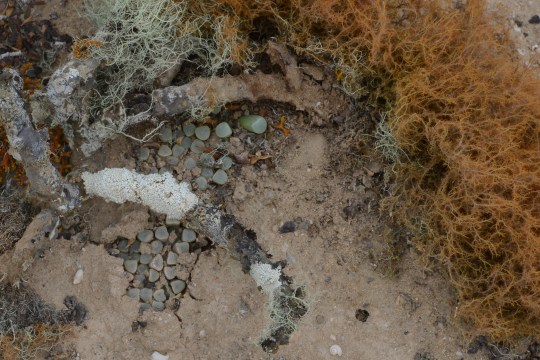
S2664 - Fenestraria rhopalophylla ssp. aurantiaca

S2664 – Fenestraria rhopalophylla ssp. aurantiaca

I chose this because it also shows some of the lichen, especially the large reddish one on the right, the Cape Hair Lichen – Teloschistes capensis.

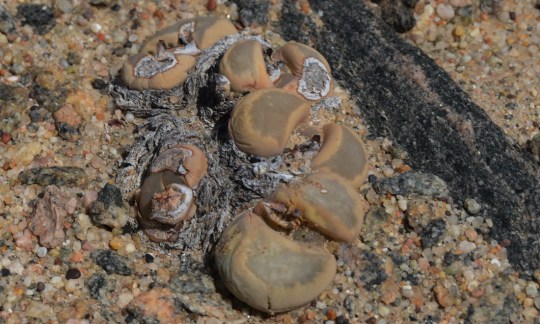
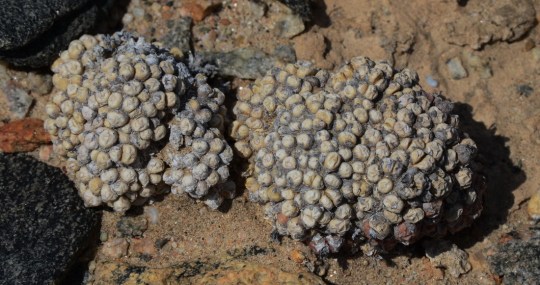
S2665 was a small hill just past Alexander Bay with views over the Oranje Rivier, now that the sky was clearing a bit. This image illustrates some of the difficulties of plant ID in the field
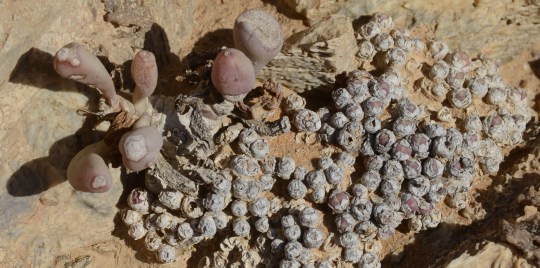
S2665 - Conophytum sp

S2665 – Conophytum sp

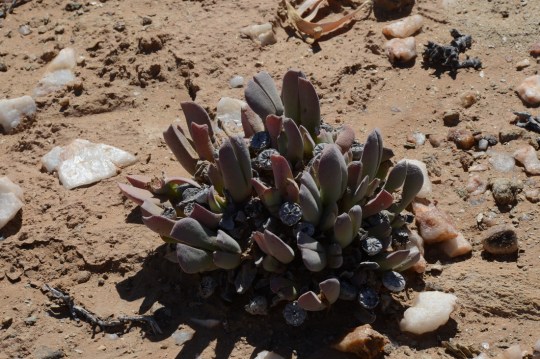
 The small globular things resembling rabbit or goat droppings are probably Conophytum at rest, covered in papery skins and the somewhat beaten up plant above them could be a Tylecodon sp. (or a Crassula or Mesemb for that matter). If you meet plants out of their growing season then often, certainly as a newbie, relying on finding a name by looking through books and the internet, you’re stuck. People publishing images to share with others tend to pick plants looking their best, in optimum growing conditions, not the way that you find them when you happen to see them in nature. I probably have a few hundred images of Conophytum looking like this ‘Conophytum shrivelled-ianus’ from a range of locations, almost certainly all different species or at least subspecies, but all (to me) looking the same.

Conrad next took us to Cornellskop, a low hill, famous for its stand of Aloe pillansii (S2666)
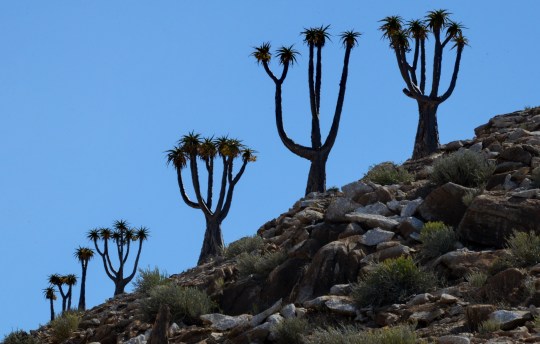
S2666 - Aloe pillansii

S2666 – Aloe pillansii

We had been looking for this two days ago, but had driven straight past it, mainly because the stand of Aloes grows on the other side of the hill, when seen from the road. How could we have missed it? Then we had just stopped (S2656) for  a single A. pillansii near the road and were side tracked by magnificent A. striata subsp. karasbergensis and so found ourselves rather pushed for time.

Much later (Christmas Eve 2012) whilst looking through succulent plant literature, I came across Bradleya #16 (1998) with a familiar looking Aloe on the cover, posing next to Sir David Attenborough! The picture was taken during the filming of ‘The Private Life of Plants’ (1993). Inside the cover is a very interesting article by Graham Williamson on the ecological status of Aloe pillansii (Aloaceae) in the Richtersveld with particular reference to Cornellskop. Ittranspires that this is the type locality of the species.  The article expresses concern about the future of Aloe pillansii and of the plants at this location in particular. A number of observations and suggestions are made to protect the plants, but the images taken during our visit do not show any evidence that any of these have been implemented. Keeping our fingers crossed for the future may not be enough.

On to S2657, where according to Google Earth we were at Halfmenspas. We saw our first Pachypodium namaquanum in habitat but I have chosen this picture of a Hoodia, as we’d be seeing better examples of the Halfmens at the next stop:

S2667 - Hoodia alstonii

S2667 – Hoodia alstonii

We had been calling it Hoodia flavum at the time, but Graham Williamson in the latest edition of his Richtersveld book calls it H. alstonii. Checking descriptions later, in front of the tellie back home, I agree with Graham.

As promised, we saw more Pachypodium namaquensis near by, at our next stop (S2668), still in Halfmenspas, the Afrikaner name for this plant is Halfmens – half human.
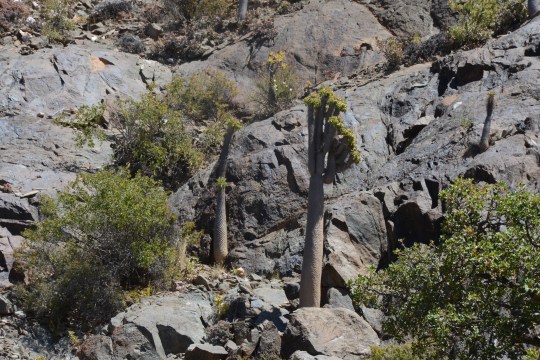
S2668 - Pachypodium namaquanum

S2668 – Pachypodium namaquanum

Unlike my observations earlier for Conophytum, we had timed it spot on for the Pachypodium, finding it in leaf and in flower everywhere we saw it.

And on to S2669, south of the Akkedispas. Although Afrikaans and Dutch are quite similar, it sometimes takes a bit of imagination to work out its origin. The pass here is the Lizard Pass. The Afrikaans Akkedis derives from the Dutch Hagedis. A lot can change over four centuries, including the modern Dutch that I’m comparing with the Afrikaans. The image I’ve selected here is of a Conophytum that has not yet shrivelled away. Any suggestions for a name?
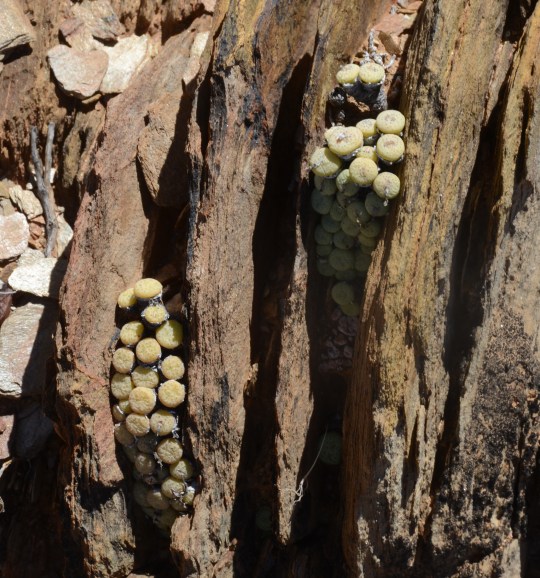
S2669 - Conophytum sp

S2669 – Conophytum sp

The next stop, S2670, was for lunch and as I’m trying to be economic with my limited free space allowance on this blog, I’ll skip lunch pictures and include two from S2671:

S2671 - Asclepiad sp

S2671 – Asclepiad sp

S2671 - Tylecodon paniculatus

S2671 – Tylecodon paniculatus

Unlike the Boterboom seen early on in the trip, where their magnificent stems were hidden by dense vegetation, due to generous rains before our arrival, here they were nicely exposed.

The hairy flowered Asclepiad contrasts nicely with the brightly coloured flower seen at the next stop S2672
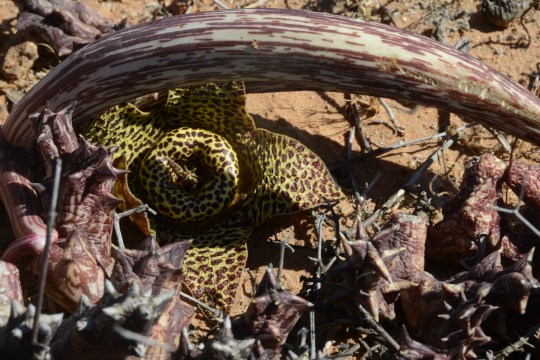
S2672 - Orbea carnosa

S2672 – Orbea carnosa

Notice the huge seed horn that almost obscures the bright flower. We were now in the Hellskloofpass, Hell’s Canyon Pass, and we were very glad to be in the 4×4 Toyota rather than in our Nissan XTrail. I wouldn’t have taken the Nissan over this track.

S2673 was for the amazing valley full of Aloe pearsonii – I believe that this is the only place where it occurs in nature.
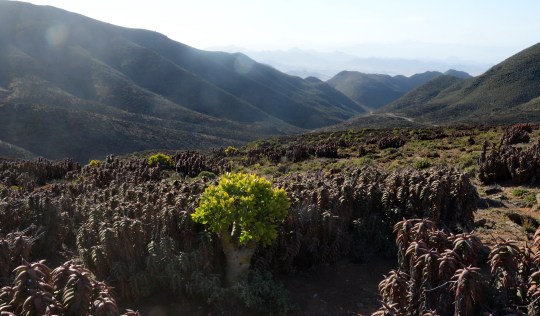
S2674 - Aloe pearsonii Tylecodon paniculatus

S2674 – A few Tylecodon paniculatus in a valley full of Aloe pearsonii

S2675 - Aloe garipensis

S2675 – Aloe garipensis

We arrived back at Port Nolloth in the dark. Thanks to Conrad and Flooris we saw many more interesting plants than we could have seen on our own and the 4×4 took us where our car would have struggled. Many thanks – we had a great day!
I felt that by crossing back into South Africa a phase of our trip had been completed. Time for some reflection. I have never before been on a plant focussed trip where I did not have names for so many of the plants photographed. As I’m now, after the event, learning about the plants we saw, it strikes me that we must have passed by so many that now, on paper, look quite interesting but that so far I have not been able to spot in my pictures and had never heard of before the trip. I guess that I’m unusual in the Cactus & Succulent hobby in that most people will have grown a group of plants for years in their greenhouses and on their windowsills before finally seeing their friends in nature – one of the ultimate rewards in the hobby. I’m a cactus freak and you’ll find very few of the other succulents in my collection, although there has been a small influx of Haworthia, Crassulas and Mesembs this year since plans for this trip were being hatched. Should I have done more preparation?

As I sit at home, a few days before Christmas with the rain bouncing off the windows and more reports of local flooding on the news, I think not. This is the ideal time to look through my images, relive the experiences and search through literature and the internet for IDs. Anyway, where would you start? In a way, I felt like one of the early explorers, just about everything I saw plant wise was new and unknown to me. Like the early plant explorers, often people with a variable background and knowledge in botany driven by a natural curiosity and interest in their environment, I have a need to put names to what I saw – I have already been booked for some 30 talks of What I Saw Last Winter to UK branches of the British Cactus & Succulent Society for 2013 and there is an expectation that the plants that you show have a name and that the presenter knows them. Fortunately I believe that I have sufficient nice pictures of plants for which I have names and iSpot provides invaluable help in suggesting names for plants in images that would further improve a presentation. And fortunately I travelled with people who knew more than I did and offered names, if only my memory could hold on to them.

Back to Africa and today’s outing, south of Port Nolloth. Over the next five days we would use Port Nolloth as a base to make day trips into northern Namaqualand and the Richtersveld. I see that I took 1,588 images during that time; the comparative photographic draught of plant images in Namibia was over!

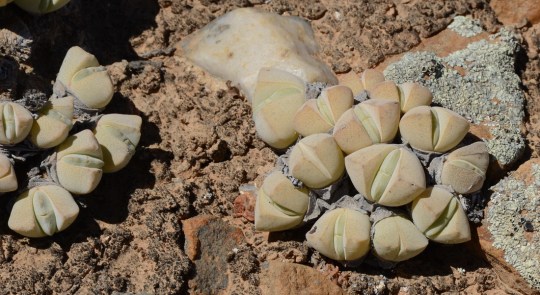
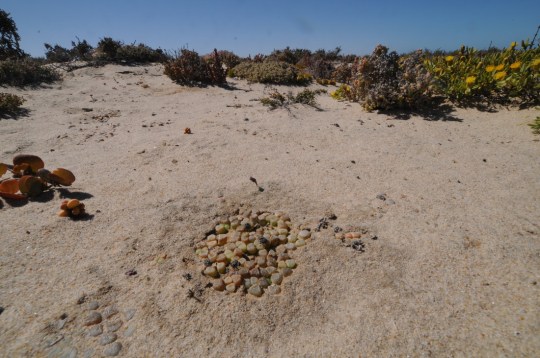
Our first stop of the day was at McDougall Bay, a few km south of Port Nolloth, where David had promised to show us a plant that at least I was familiar with – ‘Baby Toes’!

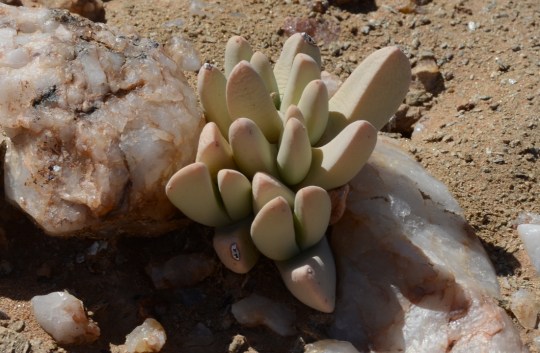
S2657 - Fenestraria rhopalophylla

S2657 – Fenestraria rhopalophylla ssp aurantiaca

There were some anxious minutes before we found the first plant. Were they still here? It had been seven years since David had last been here! We need not have worried. The center of the picture shows plant exposed after blowing away a layer of sand. Bottom left you can see some windows of plants covered in sand that illustrates the way we found the plant originally. Tip: carry a soft paint brush to clean up plants like this or make sure that the wind is blowing away from you as you get down on hands and knees to blow away the surface layer, unlike I did.

Fifteen minutes after posting this image on iSpot, Alan Horstmann added this comment: ‘Subsp aurantiaca prefers the littoral sands of the south and subsp rhopalophylla prefers the calciferous sands of the northern part of the distribution’. What a great site, thank you Alan!

We followed a track south, running some 10 km away from the coast towards Kleinsee. S2658 was prompted by Cliff rescuing a tortoise that was crossing the road. To be honest, it would have been fine if we had just driven around it, we saw less than one car per hour and tortoises can move remarkably fast once they’ve made up their mind where they are going. Cliff learned the hard way that tortoises empty their bladder as a form of defence when they are picked up. We used the opportunity to photograph the numerous ‘Cheiridopsis‘ (my broad concept) and ‘Mesemb shrub – purple flowers’.

S2658 - Drosanthemum luederitzii

S2658 – Drosanthemum luederitzii

A bit farther along the track, at S2659, we stopped again for nice clumps of another clumping Mesemb, provisionally identified as an Argyroderma sp., but with leaves that seem too angular for this genus.  Any ideas? [Identified on iSpot as Cheiridopsis glomerata, Thanks Derek!]

S2659 - Argyroderma sp

S2659 – Cheiridopsis glomerata

S2660 was just a quick stop to take a picture of a traffic sign – a red-edged warning triangle with a drawing of a tortoise! To celebrate this, my 101st stop since Kirstenbosch on 21 September, I also photographed this Mesemb shrub.

S2660 - Mesemb shrub

S2660 – Mesemb shrub

We reached Kleinsee and this diamond mining town, owned by De Beers, seemed to be the end of the road, with a guarded gate blocking the way. We explained that we had hoped to drive inland to Komaggas so had to register our passports to get a permit to drive on – quite easy really.

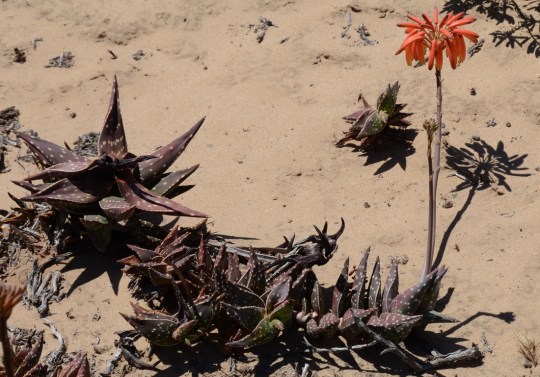
After racing some ostriches along the fence alongside the road, David spotted the bright red flowers of Aloes above the low shrubs (S2661). Not sure how often, if ever, security checks these tracks (we had not seen any cars) we decided to pop over the fence for some quick pictures, more weary of any ostriches than security!

S2661 - Aloe arenicola

S2661 – Aloe arenicola

S2661 - Aloe arenicola

S2661 – Aloe arenicola

Near Komaggas we found a nice hillside, no barbed wire and on this sunny and warm afternoon we spread out over the hill and enjoyed ourselves taking pictures – I left here with 146 images taken during 104 minutes; that’s just over 1.4 images per minute! Not bad with images like this one:
S2662 - Crassula deceptor

S2662 – Crassula deceptor and Haworthia arachnoidea plus friends

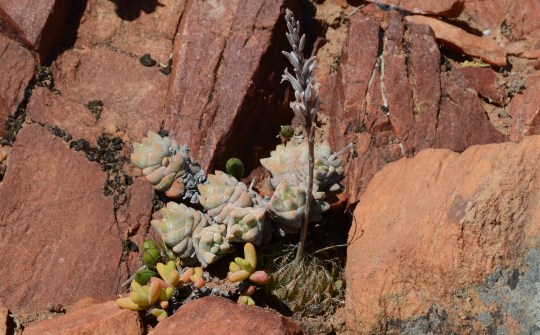
We found time for one more quick stop (2663), as the sun was going down quickly, throwing long shadows. It took a bit longer than planned after David discovered the plant of the day:

S2663 - Crassula alstonii

S2663 – Crassula alstonii

The tracks that we had been on all day were of a good quality, but now things started to deteriorate. Fading daylight did not help much either. We slid around on the soft sand, trying to keep going to avoid getting stuck in the sand. Fortunately Cliff again got us back safely to the hotel, well done Cliff!

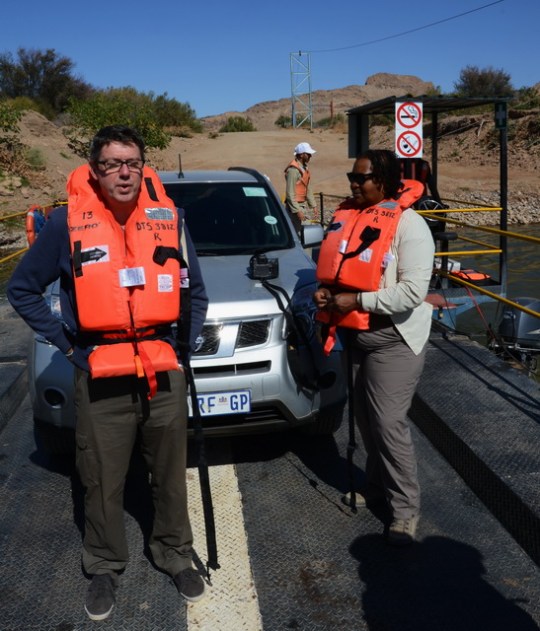
It’s only some 21 km from Rosh Pinah to the small 2 car at the time ferry across the Oranje Rivier at Sendelingsdrift and the border with South Africa. There was one car already being processed but there was only one officer on duty. We knew what to expect from numerous border crossings elsewhere but here it was all done calmly and in a friendly manner. I can recommend this experience, but check the opening hours and after heavy rainfalls (rare) the ferry may not be able to cross the river (S2652).

S2652 - Sendelingsdrift, ferry crossing from Namibia to South Africa

S2652 – Sendelingsdrift, ferry crossing from Namibia to South Africa

The same applied to the South African side of the border. All the buildings were fairly new – this border post and the ferry have only been open as a public crossing since 2007.

From the customs post a number of not too well sign-posted tracks lead off in various directions. Sat Nav seemed a little confused until a few km along the first choice track it became clear that we should have taken one of the alternatives.

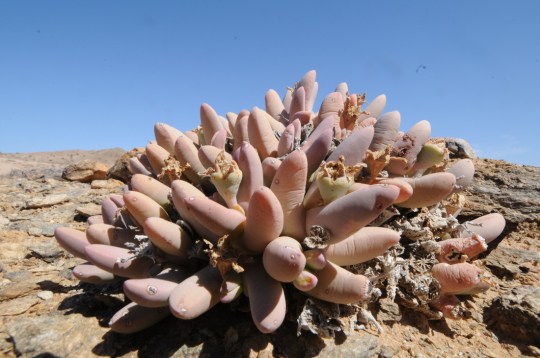
We stopped along our second choice track at a large flat area with numerous clump forming succulents. I’ve provisionally IDed them as members of the genus Cheiridopsis but there are several problems with that. First of all, just in this one location there were enough plants that looked different enough to convince a dedicated splitter that we were seeing at least half a dozen different species. However, things have become more complicated once I got back home to find that there are some 100 species of Cheiridopsis and that there are at least half a dozen more genera that look more like my Cheiridopsis than some of the members of that genus. So for now I’ll refer to all such plants as Cheiridopsis species until I’ve learned to tell what is what. Here are a few nice ones ….. or are they not Cheiridopsis?

S2653 - Cheiridopsis #2

S2653 – Cheiridopsis sp #1

S2653 - Cheiridopsis

S2653 – Cheiridopsis sp. #2

S2653 - Dracophilus dealbatus

S2653 – Dracophilus dealbatus

S2653 - Hartmanthus pergamentaceus

S2653 – Hartmanthus pergamentaceus

To complicate matters further, the foliage of these plants – and therefore the appearance of the whole plant as hardly any stem, if any, is visible – can dry up into a papery sheet in the dry season and then look quite different to specimens in groth that we were seeing.

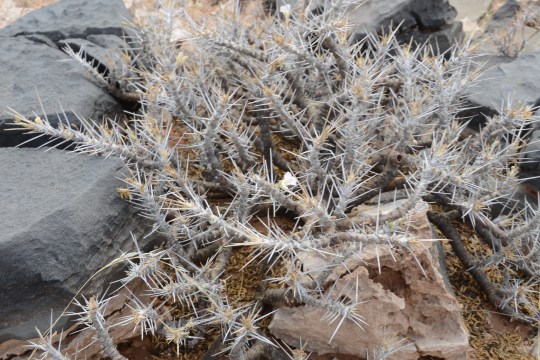
We were near a location suggested to Eunice for Crassula alstonii, one of the more interesting members of that genus (S2654). We searched spread out over a wide area on foot for over an hour but found none, but I still managed to take 61 images, including this one of a non-succulent but spiny shrub, in flower.

S2654 - Codon royenii

S2654 – Codon royenii

At S2655 we saw a lot more Crassula, all very nice plants, but again at time tricky to ID. I’m sure that I’ll be told which ones I got wrong in the following set;

S2655 - Crassula columnaris

S2655 – Crassula columnaris

S2655 - Crassula deceptor

S2655 – Crassula deceptor

S2655 Crassula macowaniana

S2655 Crassula macowaniana

and finally a couple of nice Aloes …..

S2656 - Aloe pillansii

S2656 – Aloe pillansii

S2656 - Aloe pillansii

S2656 – Aloe pillansii

S2656 - Aloe striata ssp karasbergensis

S2656 – Aloe striata ssp karasbergensis

S2656 - Aloe striata ssp karasbergensis

S2656 – Aloe striata ssp karasbergensis

and a peculiar plant that after searches on the internet has been provisionally identified as a Mesemb! all at S2656, still in the Richtersveld, before heading down for the 100 km plus drive to Port Nolloth.

S2656 - Prenia sladeniana

S2656 – Prenia sladeniana

S2656 - Prenia sladeniana

S2656 – Prenia sladeniana

As you’ll have noticed, we often use one day to travel from A to B, with stops along the way and then one or two more days to take a look in the area. And so a day around Rosh Pinah had been planned. But, as we woke up we realised that there’s not much scope for plant stops around Rosh Pinah. It is a mining town that had grown at quite a pace in recent years. In the main, the people staying in the accommodation where we were staying was more aimed at long-term stays for individuals or families, self catering with a bar and restaurant for those who preferred to eat out, aimed at contractors working in the middle of nowhere in the mining industry and related businesses.

We had come in from the north  and would leave tomorrow to the south, so the natural thing to do would be to explore to the east and / or the west – except that to the west is the Sperrgebiet, translated into English – the barred / blocked area. And the inadequate maps that we had with us did not suggest anything specifically to aim  for.

First of all we wanted to see Pachypodium namaquanum that is known to grow in the area and again on the other side of the Oranje Rivier in South Africa. It is said to grow on the highest mountains, facing to the north. Around Rosh Pinah, the mountains were mainly to the west and it was impossible to get clear views to their northern sides with binoculars to try to spot a few of them. Any tracks in that direction seemed to lead to gates to mines. No go.

Lithops karasmontana subs. eberlanzii, C149 to be precise, used to be known under the name Lithops erniana var. witputzensis and has its Type Locality in the area ‘110 km SSE of Aus’. Yesterday we had passed by a track off to the east with signage for the Witputs Farm aka Witputz – we found a whole range of alternative spellings of names of Dutch and in Namibia, German origin. Obviously the language is still evolving and is evidence of as much diversity as is found for different reasons in the flora. And so a plan evolved to see where that track would take us in that direction. The time/date stamps of the images taken tell part of the story. We hit the turning at 9:18 and headed east until some 20 minutes later we spotted some nice stands of Hoodia along the side of the road – time for a leg stretch and exercising the shutter fingers.

S2650 was a good stop – I took 150 images during the three hours that we hiked in the hills to the south of the track. We did find a small population of Lithops and due to the assumed proximity to C149, Lithops karasmontana subs. eberlanzii is the name I’ll be using until somebody who knows better tells me otherwise and helps me to understand why.

S2650 - Lithops karasmontana subsp eberlanzii

S2650 – Lithops karasmontana subsp eberlanzii

Many of the succulent plants we were seeing here were plants that we had seen before so I’ll avoid duplicates here, or list the 15 taxa I recorded here, many of them just ‘sp.’

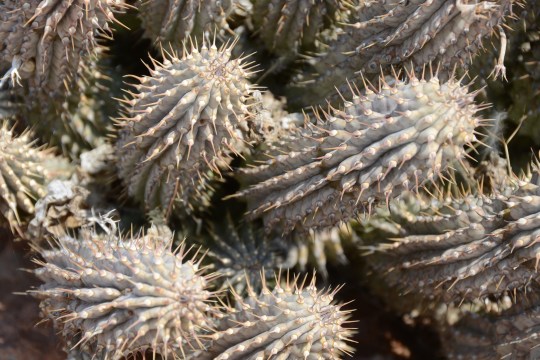
Another plant that we saw here and on many other locations is one given the quaint common name of ‘dog’s balls’, which we quickly translated to ‘dog’s bollocks’, thus neatly side-stepping the issue of which of the five species in the genus Larryleachia (formerly Trichocaulon and before that in Hoodia and originally the genus Stapelia) might be appropriate for the plant in front of our camera lenses. We tended to use the Latin name Larryleachia cactiformis that is so appropriate to any of these plants that superficially resemble globular or semi-columnar cacti. From a bit of reading on the internet and in Doreen Court’s The Succulent Flora of Southern Africa it seems that the five species differ mainly in flower detail, and as we saw none in flower ….. Some were larger than others, but that could just be a matter of age or environmental factors and some formed clumps while others were solitary, but it may well be that these are not reliable diagnostic features. Here is one photographed at S2650, showing the seedhorns that confirm that we missed its flowering.

S2650 - Larryleachia cactiformis

S2650 – Larryleachia cactiformis

As mentioned earlier, this stop was prompted by Hoodia’s seen at the side of the track. I’d better explain that again, we use this name out of ignorance for any smallish ceroid-like Stapeliad – again no flowers seen here. Here is what prompted the stop:

S2650 - Hoodia sp.

S2650 – Hoodia sp.

There are no images worth publishing from S2651, just blurred images of a family of deer (klip bokken?) crossing the road at speed) so I’ll finish today with another plant from S2650, again seen before and again in the future over quite a range:

S2650 - Cassula sericea

S2650 – Crassula sericea

The lovely velvety texture of the leaves ensured that it would get photographed again on many occasions.

Tomorrow we cross back into South Africa – lots more paper filling to look forward to?

Enthused by yesterday’s plants, particularly those seen at S2641, we set of to a spot suggested by friends in the UK, S2644, 2 km from Haalenberg, north of the B4 Luderitz to Aus road. Again, I’ll limit myself to showing you my favourite pics.

My scribbles from the day say that Juttadinteria simpsonii is reported from here, but did we see it? Would I recognise it? The first run through of the images had a unidentified plant here, small mesemb with knobbly leaves. Back in the UK I entered the Juttadinteria name into Google and the images that appeared suggest that we did indeed see it:

S2644 - Juttadinteria simpsonii

S2644 – Juttadinteria simpsonii

I’m now quite good at recognising Sarcocaulon patersonii, but what was the creamy white-flowered plant here? Back to the Bushman Candles and there it was: Monsonia crassicaulis from the Haalenberg area!

S2644 - Sarcocaulon crassicaulis

S2644 – Sarcocaulon crassicaulis

It’s always nice to see plants that you have grown in your green house in the UK growing here in nature. That was the case here with Lithops karasmontana ssp. eberlanzii at S2644, near the location where Desmond Cole found C398, C399 and C400. It looked very dehydrated and my instincts were to water it, but that is probably how I used to kill the Lithops at home: watering to encourage the new leaf pair to grow, before the old leaf pair had withered away.

S2644 - Lithops karasmontana ssp. eberlanzii

S2644 – Lithops karasmontana ssp. eberlanzii

We moved on to S2645, still along the C13 and quite near, south of Aus and after some searching found the plant that David had seen here on a previous visit: Crassula mesembryanthemopsis. The plants were almost completely covered in sand so after the initial ‘as we found them’ pictures, it was down on hands and knees to blow away some of the sand to expose the plants:

S2645 Crassula mesembryanthemopsis

S2645 – Crassula mesembryanthemopsis

Also at this location I photographed this plant:

S2645 - unidentified sp

S2645 – unidentified sp. [now identified as Ruschia divaricata]

The leaves of this small shrub suggest a Mesemb, but without flowering parts it’s difficult to confirm. The spines looked unusual until I learned in Mesembs of the World that there is a group, Group 13, of Ruschia-like Shrubby Mesembs, so that narrows it down a bit … to about 241 taxa!! Eberlanzia sedoides might be a candidate? This is a monotypic genus but 26 names have been used and are now called Ruschia and placed in  the subgenus Spinosae. I’ll have to load this image up to iSpot to see if anyone there can give a more positive ID. [PS: Most impressive! In less then an hour of posting this observation on iSpot, there was a confirmed ID! Ruschia divaricata]

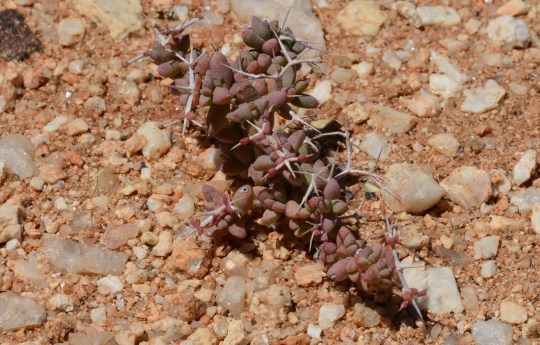
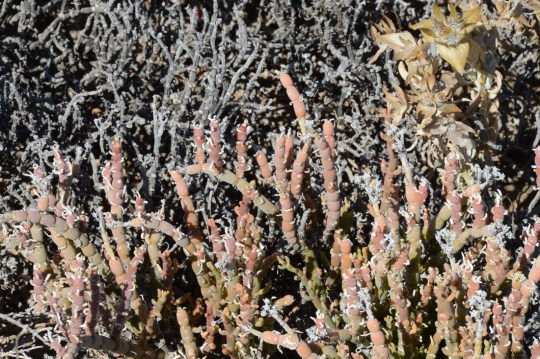
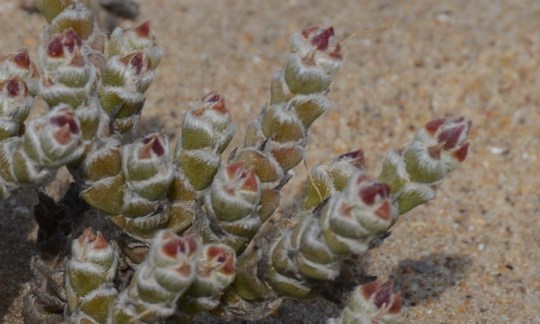
And while I’m at it I could post this image of another Mesemb photographed at S2648 that initially I had down as a Monilaria sp., until I learned that there is a whole group (group 8) of bead-leaved Mesembs, totalling 21 species in 5 genera! So which one is this?

S2648 - unidentified Mesemb

S2648 – unidentified Mesemb

PS – I know that some of you have subscribed to follow this blog and receive an email each time that a new posting is published BUT there are no notifications if I edit an existing page! So, do check back occasionally!

The plants today suggest that we are heading in the right direction. Reading various books, leaflets and information on websites I have learned that we have entered the West Coast Karoo, that stretches from Luderitz, south throgh Namibia and Southern Africa. This ecoregion has been subdivided into two zones, the Namaqualand-Namib domain that we had now entered and the Southern Karoo  domain that we would visit later before returning to Cape Town.

Not only did I have to become familiar with a huge number of taxa that were new to me, but also with eco-geographical names that are usually not mapped on the road maps that we carry. These domains are subdivided again into Regions and we found ourselves in the most northern one – the Sperrgebiet, most of which is taken over by diamond mining and is not accessible to the public. The number of succulent plant taxa that occur is mind boggling and seems to vary as a precise number depending on who you follow. One source states that ‘the region is host to, about half of the world’s 10’000 succulent species. About 67 genera and 1,940 species are endemic to this ecoregion’.  Despite the many images we took, we hardly scratched the surface, sticking perhaps to those plants that we are familiar with in Europe and in California. In Europe this tends to mean smaller plant that have to be grown indoors or in a greenhouse, where space is at a premium.

I have selected a few images of plants that I am familiar with or that intrigue me, even though I can’t name them, in some cases, not even the plant Family that they belong to. Enjoy, and do suggest names where you have a fairly firm idea of what they might be.

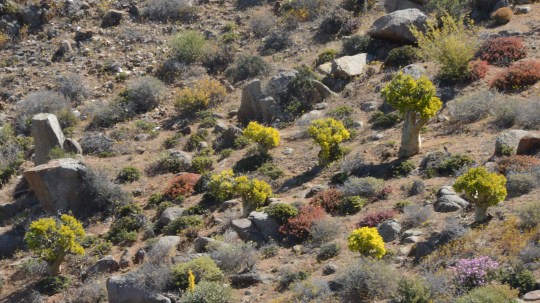
For the first stop of the day we became ‘normal’ tourists and visited Kolmanskop, a ghost town, frozen in time. In 1908 the first diamond in this area was found here and attracted many people to create the small town in typical style – this was a German colony at the time. After World War 1, the diamond supply became exhausted and in 1958 operations closed down, allowing the wind and sands to reclaim the village. The following two images show succulent plants that have benefitted from this desertification. I can’t even pin them down to a Plant Family. The website iSpot came to my help and suggested Brownanthus marlothii for one of them. A quick look in Mesembs of the World confirms that this is an excellent match. Thank you.

S2639 Genus sp

S2639 – Brownanthus marlothii

S2639 - Kolmanskop Ghost town

S2639 – Kolmanskop Ghost town

At the next stop, S2640, near by, things became a bit more fair in that the Sarcocaulons were in leaf and flower.

S2640 Sarcocaulon sp

S2640 – Sarcocaulon patersonii

I had a copy of the excellent Bushman Candles book by the late Charles Craib and John Lavranos and as a result I hazard a guess for the name: Sarcocaulon or Monsonia patersonii. These really are tough customers, as they were flowering in a very strong wind (we were wearing coats & jumpers again and running after hats that had been blown off) while being blasted by quite large sand particles. How do such delicate paper thin flower petals survive that?

S2641 was a revelation – we were back in plant land. Here are just a few.:

S2641 - Litops optica

S2641 – Lithops optica

S2641 Argyroderma sp

S2641 – Crassula elegans subsp. namibensis

[I had provisionally identified the plant above as an Argyroderma sp, but Derek Tribble has since suggested Crassula elegans subsp. namibensis which I’m happy to accept. If ever I need to give a talk about parralel evolution, this and an Argyroderma sp. will be a good example. Thanks Derek!]

S2641 - Conophytum sp

S2641 – Conophytum sp

I was really taken with the next plant, without any idea of an ID. Then while browsing through the Bushman Candles book, there it was, in the Photography in habitat chapter!

S2641 - Tylecodon shaefferianus

S2641 – Tylecodon shaeferianus

So that should be another tick on the list of identified plants – if I got it right!

No plants were photographed at S2642, at the Dias Point National Monument – a) there were none to be seen and b) I was afraid that my camera would be blown clean out of my hands!

So we had time for another stop on the way back to the hotel, and saw these nice plants in flower:

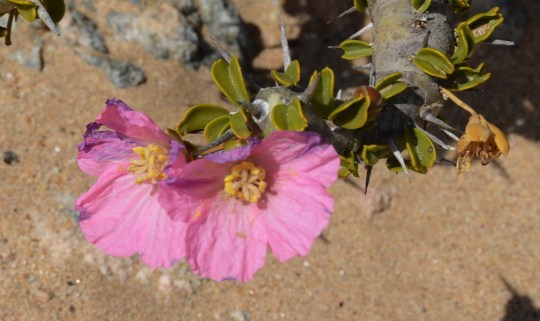
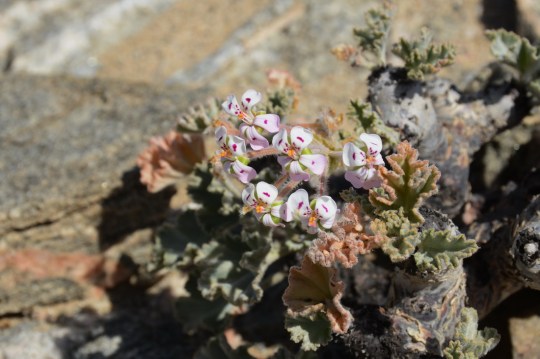
S2643 Geraniaceae sp

S2643 Geraniaceae sp

S2643 Mesemb shrub

S2643 Mesemb shrub

S2636 - Sarcocaulon sp

S2636 – Sarcocaulon sp

Today was yet another driving day, with four stops (S2635 to S2638). By now we had become used to seeing few plants, but we were heading back towards South Africa where on one day we had seen more different taxa than in all our time in Namibia. And when you do find a plant, like this Sarcocaulon, it has no leaves, flowers or fruits to try to decide what name to give it.  But, to put things into perspective, we would not have seen the plants that we have seen here if we had stayed south of the border.

S2637 - Aloe striata karasbergensis

S2637 – Aloe striata karasbergensis

S2637 - Hoodia sp

S2637 – Hoodia sp

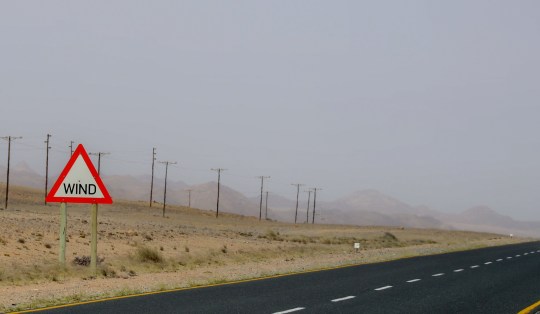
S2638 wind

S2638 wind

Yes, we were back nearing the coast!

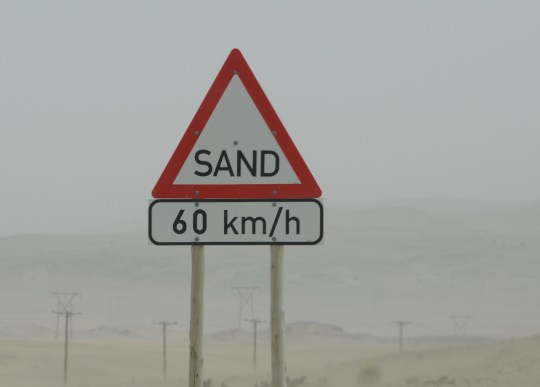
A bit farther along it seemed that the fog that we had experienced in Swakopmund was also back. As we heard the noise similar to hail stones hitting the car, another traffic sign explained the noise.

S2638 sand

S2638 sand

The sign was ambiguous; was this a maximum speed recommendation or the speed of the sand particles peppering the car? Probably both, as well as the distance over which we would experience this!

[written ‘live’, on the road]

Just a brief sign of life after today’s 500 km drive in the heat, 33C, back south. Nothing much to see plant wise – I took just 3 pictures, all three of the pickup truck in front of us, full of people in the back – must have been a taxi!

This is a rather barren area in terms of succulent plants, as we had already taken pictures of the Aloe dichatoma and other unknown Aloe sp (growing to over 2 m (6ft) tall, a few days ago as we headed north.

Even some of the hotels that claim to have internet facilities, don’t or charge too much. It’s still very much the same as Alain & Greet found it in 2010. Looking back through Alain’s Diary (in Dutch) we have seen much the same places, but also travelled some alternative routes and may be saw something different as a result.

Tomorrow we head west to Luderitz and after a few days, go south to Rosh Pinah and then cross at Sendelingdrif back into RSA.

We’re on our second car – nothing wrong with the first one, except that as we approached Windhoek, the service light came on. We were told that in Windhoek, it takes up to a week to get the service done. Instead they gave us a replacement – another Nissan XTrail. We checked back with them today as we noticed that this car has a service due in 2000 km time – before today’s 500 km stretch. The next Budget place is in Luderitz – could they ring ahead and book us in for a service there or get another replacement with enough km to the next service to get us to the end of the trip? This seemed to be an impossibility. They said that we would be OK for another 2,000 km before the next service is absolutely essential, so we’ll make it the problem for the Budget Dealer when we need to – in South Africa.

Today we are staying in the Canyon Hotel in Keetmanshoop, rather than the Quiver Tree. As you can see – it has wifi, which today is more important to me than stroking the Cheetahs again.

I promise to do catch ups of proper Diary reports when I get back to the UK.

[PS: from the UK, playing catch up; I’m getting there!]

This was another ‘driving day’ as, from the farthest point north of our trip, we headed back south.

All images, mainly taken from the car, all along the track are filed under S2634 and include this picture to show that I haven’t lost my sense of humour yet.

S2634

I did not know he had been to Africa!?

In Chile, it is not unusual to find some really old cars permanently parked along the road. We joke that this must have been Ritter’s car, as his reports from the field include a number of reports of his breakdowns. Here in South Africa broken down cars seem to be cleaned up / recycled quickly. Anyway, Toyotas don’t break down!

It’s only 108 km if you take the shortest road between the two towns. But if you want to see Fat Trees, it’s recommended to take a detour over the Grotebergpas, increasing today’s drive to 271 km.

We had a nice relaxed breakfast and took some pictures around our accommodation at the iGowati Country Hotel, Khorixas, the sort of place that when you see it on the internet, you find that it’s outside our budget, but when we arrived late yesterday afternoon, they were prepared to let us have beds at a fixed price per person, irrespective of the number of rooms we wanted – so we had one chalet each! and within budget, including breakfast!

We did not have to go back as far as last night’s poor light stop for more Welwitschia images, as these plants were now quite plentiful.  I had already read about the beetles that live in apparent symbiosis with the plant and after some stirring of the papery seed covers had soon stirred up some beetle activity:

S2626 - Welwitschia mirabilis

S2626 – Welwitschia mirabilis

Aloe flowers poking their heads out above the grasses had proven to be relatively easy to spot from a moving car, but here the large number that suddenly appeared seems unusual. It was next to a small village and I wonder if long ago these plants had been planted here and been cultivated for their medical properties.

S2627 Aloe hereroensis

S2627 – Aloe hereroensis

There are gaps in the stop numbers for these pictures, but that’s only because we had already seen better examples of the plants pictured elsewhere. There were a number of reports of ‘fat trees’ around the Grotebergpas’ (Large Mountain Pass) and we certainly saw a fair few – more guesses about their names. How did I do?

S2631 - Pachypodium lealii ssp lealii 3

S2631 – Pachypodium lealii ssp lealii

S2631 - Pachypodium lealii ssp lealii

S2631 – Pachypodium lealii ssp lealii

S2631 - Pachypodium lealii ssp lealii

S2631 – Pachypodium lealii ssp lealii

S2632 - Cyphostema juttae

S2632 – Cyphostema juttae

In addition to Fat Trees, the area is also known for some Fat Animals; Alain & Greet photographed elephants here in the area in 2010. We saw plenty of evidence of their regular visits. It seems that they use the road as their toilet! No luck in seeing the originators.

We did have one more nice surprise though as we spotted these from the car, again in fast fading light – very pleased with the camera’s light sensitivity!

S2633 - Giraffes

S2633 – Giraffes